by Tom Gurney
Tom Gurney BSc (Hons) is an art history expert with over 20 years experience
Published on June 19, 2020 / Updated on October 22, 2026
Email: tomgurney1@gmail.com / Phone: +44 7429 011000
Aretino in the Studio of Tintoretto
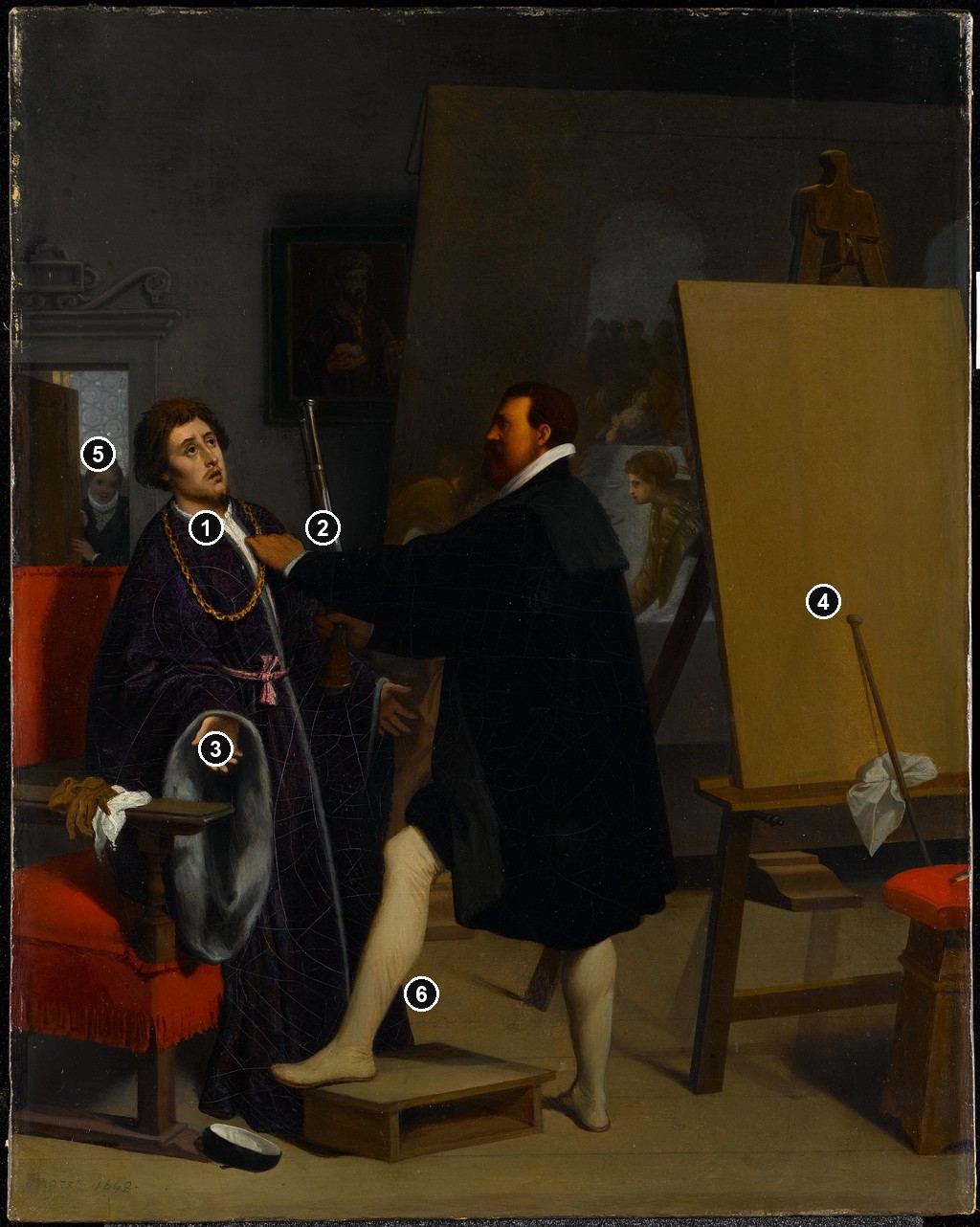
A portrait sitting has gone alarmingly wrong. Tintoretto holds a pistol upright and presses his other hand against his visitor’s chest. Pietro Aretino, wrapped in purple and fur, opens his hands and looks upward, while the empty canvas waits beside them. Ingres’s Aretino in the Studio of Tintoretto turns an encounter between painter and critic into a compact drama about fear, reputation and the power to control another person’s image. The Metropolitan Museum of Art’s painting dates from 1848, when Ingres returned to a subject he had first painted in 1815. [1]
At a Glance
- ArtistJean-Auguste-Dominique Ingres
- Date1848; second version of the subject
- Medium and sizeOil on canvas, 44.5 × 35.6 cm
- CollectionThe Metropolitan Museum of Art, New York, Robert Lehman Collection, 1975; accession 1975.1.185
- SubjectTintoretto frightens the writer Pietro Aretino during an invited portrait sitting; the story may be apocryphal. [1]
This work across Ingres’s career
Agamemnon’s Ambassadors
1801 (competition)Grande Odalisque
1814Louis XIII’s Vow
1824Monsieur Bertin
1832The Princesse de Broglie
1851–1853The Turkish Bath
1859–1862Contents
- The joke behind the pistol
- How Ingres makes the confrontation visible
- A studio assembled from pictures
- Returning to the subject in 1848
- The companion picture: Aretino before imperial power
- Exhibitions, criticism and the route to New York
- Annotated details
The joke behind the pistol
The weapon is part of a practical joke with an unusually sharp edge. In the story recorded in an artist’s note published by Henri Delaborde, Aretino has spoken badly of Tintoretto. The painter meets him, invites him home and offers to paint his portrait. Once his visitor is seated, Tintoretto suddenly produces a pistol from beneath his clothing. Aretino, convinced that the painter means to take revenge, cries out and asks what he intends. Tintoretto calmly explains that he wants to measure him. He proceeds from head to foot, announcing that Aretino is two and a half pistol-lengths tall. [2]
The disproportion is the joke: the painter has treated a deadly object as an ordinary studio implement, while the critic has had time to imagine the worst. According to the same account, Aretino recovers himself, rebukes Tintoretto for his outrageous behaviour and subsequently stops speaking ill of him. The episode ends in friendly relations. That ending matters. Ingres has chosen the instant before the frightened man understands what is happening, giving the viewer knowledge that the apparent victim lacks. [2]
Delaborde published the note in 1870, after Ingres’s death. It explains the narrative Ingres was working with; it does not establish that the encounter happened in Renaissance Venice. The museum likewise leaves the episode’s historical truth open. [1][2] The painting works as a pointed anecdote even if the event belongs to artists’ lore. Ridolfi’s seventeenth-century Tintoretto biography tells of a dagger; Paul Hayes Tucker presents the pistolese/pistolet translation story as a possible explanation for Ingres’s pistol. [3]
We should therefore resist turning the picture into evidence of a real attempted shooting. The pistol gives the threat an immediately recognisable shape, but its role in Ingres’s recorded story is theatrical. Its barrel rises between the two men, close enough to Aretino’s face to command attention, without being aimed at him. The painter’s steady hand on his chest is almost as unsettling: a gesture that could belong to arranging a sitter has become a means of holding him still.
How Ingres makes the confrontation visible
Two bodies, two kinds of control
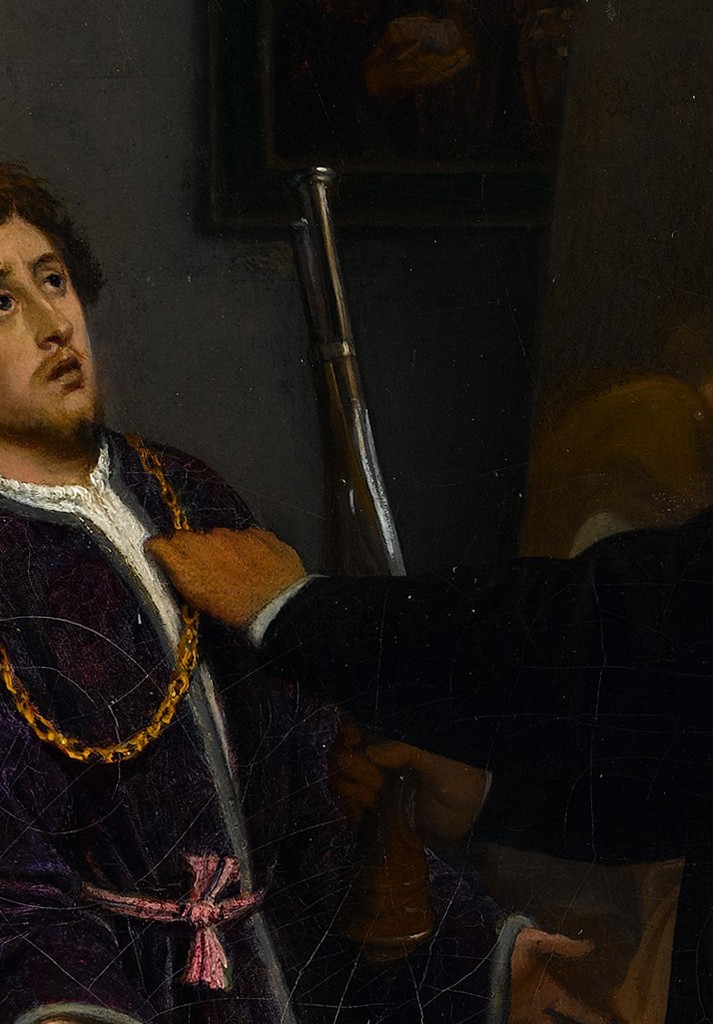
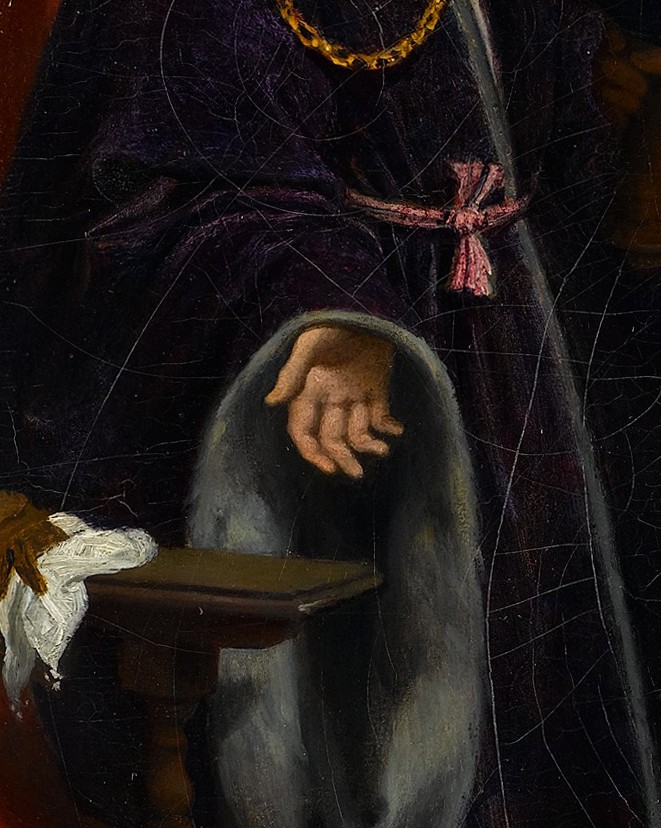
Aretino occupies the left side of the painting, hemmed in by a red chair and the figure standing before him. His palms turn outward and upward. His fingers remain spread, offering no defence and holding no object. The head inclines backwards, and his eyes look above the painter’s face. These small changes of direction make him seem to withdraw even though there is little room to move.
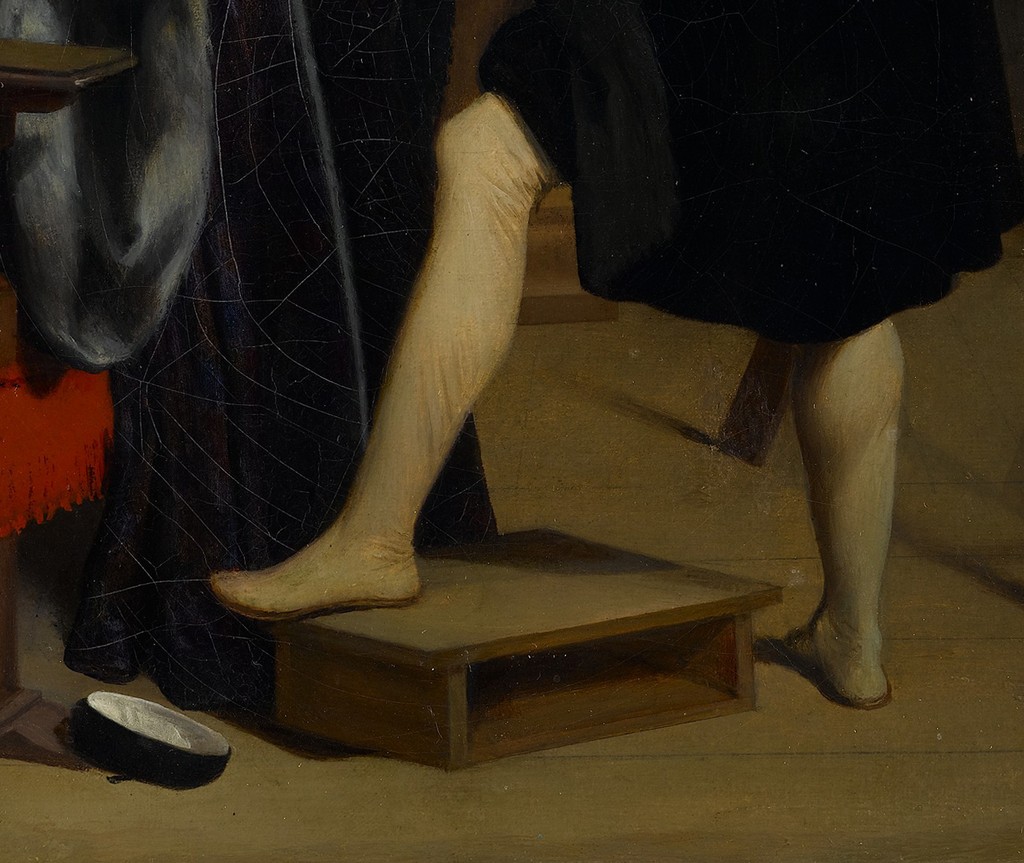
Tintoretto presents a broad, dark back to the viewer. One foot stands on a low wooden platform, the other on the floor; his raised knee creates a diagonal beneath the cloak. He has the more active stance, yet his upper body appears controlled. Against Aretino’s open hands, Tintoretto’s hands have definite jobs: one carries the pistol, the other makes contact. The encounter can be read through posture before its literary source is known.
The museum compares Aretino’s pose to Saint Francis receiving the stigmata, the miraculous wounds associated with Christ’s Crucifixion. [1] The upward glance and exposed palms give the fright an unexpectedly solemn register. Yet the purple robe, gold chain and sumptuous chair keep the figure firmly within a world of material comfort. The resulting mixture makes the scene hover between alarm and comedy. Aretino looks far more ceremonious than the humiliating situation warrants.
Colour carries the action
The darkest mass belongs to Tintoretto’s cloak. Its wide sweep brings his shoulder and extended arm together, setting off the small pale collar and the light stockings below. Aretino’s robe is also dark, but purple emerges within it, crossed by a pink tie and the gold curve of his chain. The grey fur lining catches the light beside his exposed palm. Ingres uses these differences within darkness to keep the two bodies legible.
Red upholstery spreads around Aretino at the left edge, while a smaller red cushion reappears at the lower right. Between them, the wooden floor and furniture form a restrained brown setting. The face and hands consequently hold attention without needing a bright background. Look especially at the chain: it drops in a heavy loop across Aretino’s chest, directly below the place where the painter touches him. The critic’s finery becomes part of the vulnerable body being inspected.
Objects that prolong the pause
The cap on the floor is easy to overlook. It lies near the front edge, its pale interior turned towards us. Gloves and a white cloth rest on the arm of the chair, while another white cloth hangs beside the waiting canvas. Accessories of formal appearance surround a visitor who seems to have lost control of the occasion.
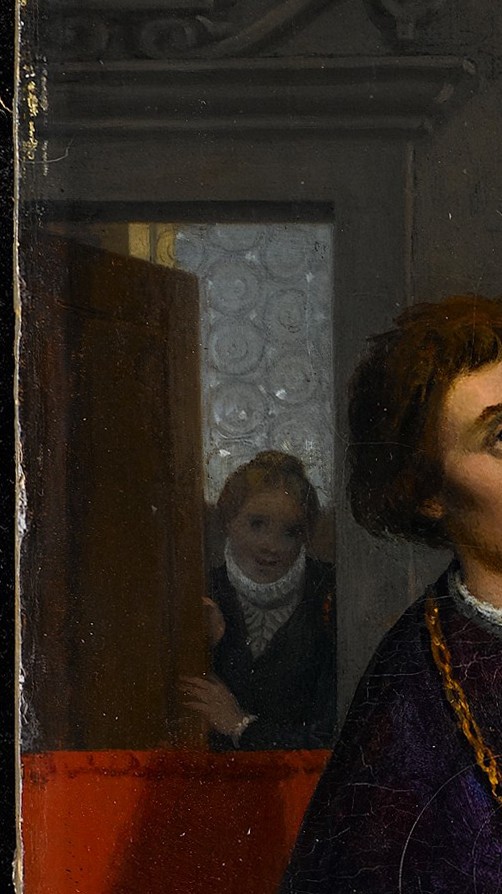
At the back, an onlooker peers through a partly opened door. We can see the face and a hand, but the small figure remains separate from the main action. The doorway introduces a second viewpoint within the room: someone else has caught sight of the extraordinary sitting. A framed portrait hangs higher on the wall, adding another face above the living ones. The painting encourages us to notice observers as well as protagonists.
Annotated Details from Aretino in the Studio of Tintoretto
The numbered points identify visible features discussed in this article. Return from each detail to the whole composition. Each caption identifies the work shown.
Aretino in the Studio of Tintoretto
Jean-Auguste-Dominique Ingres, Aretino in the Studio of Tintoretto, 1848. Oil on canvas, 44.5 × 35.6 cm. The Metropolitan Museum of Art, Robert Lehman Collection, 1975 (1975.1.185). Image source. CC0 / Public domain.
Aretino and the Envoy of Charles V
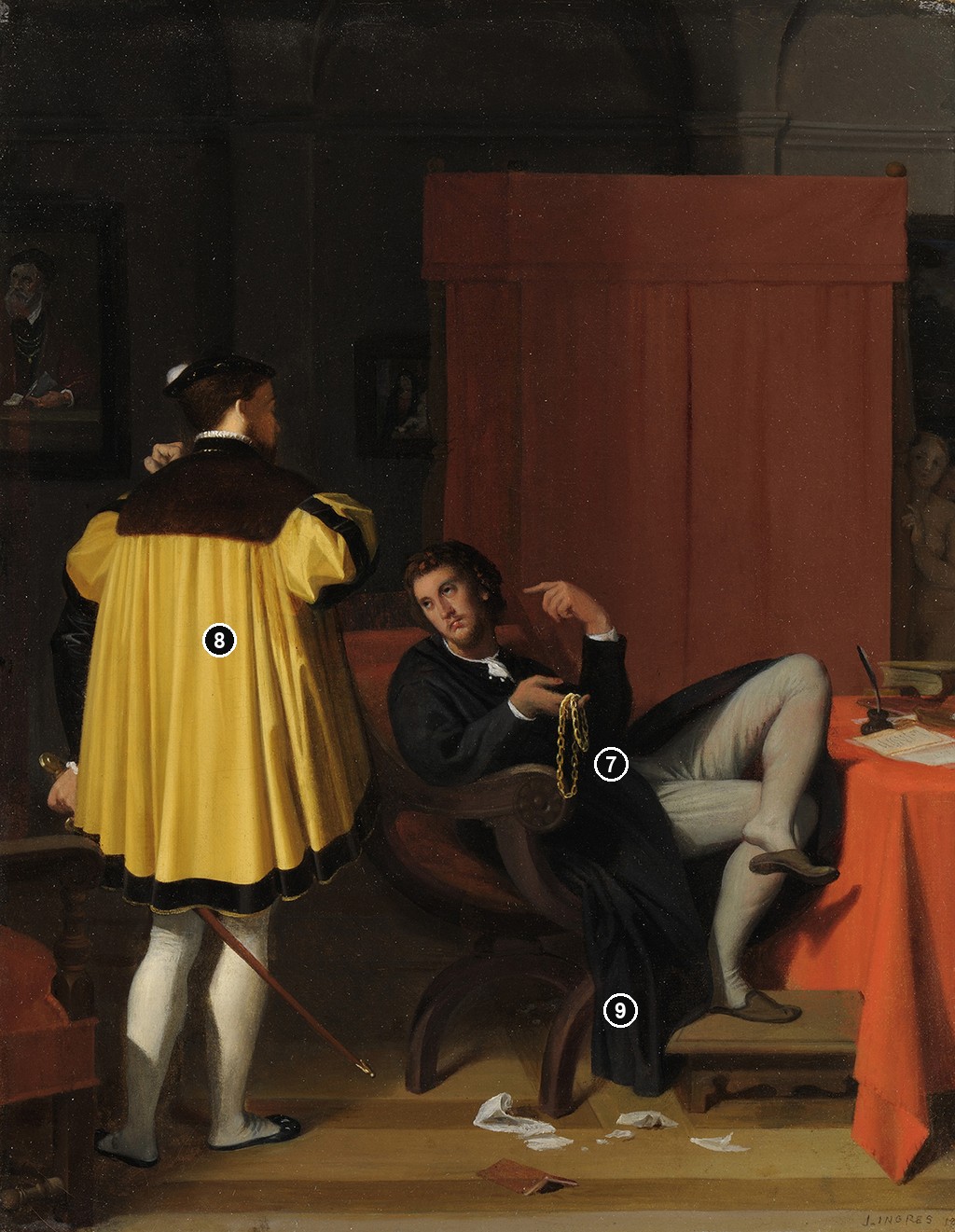
Ingres, Aretino and the Envoy of Charles V, 1848. Musée des Beaux-Arts de Lyon, 2013.1.1. The separate companion painting. Reproduction: Alain Basset; Wikimedia Commons. Image source. Public domain.
Details from ARETINO IN THE STUDIO OF TINTORETTO
Compare the confrontation in the studio with the differently arranged meeting in its separate 1848 companion painting.
Aretino in the Studio of Tintoretto
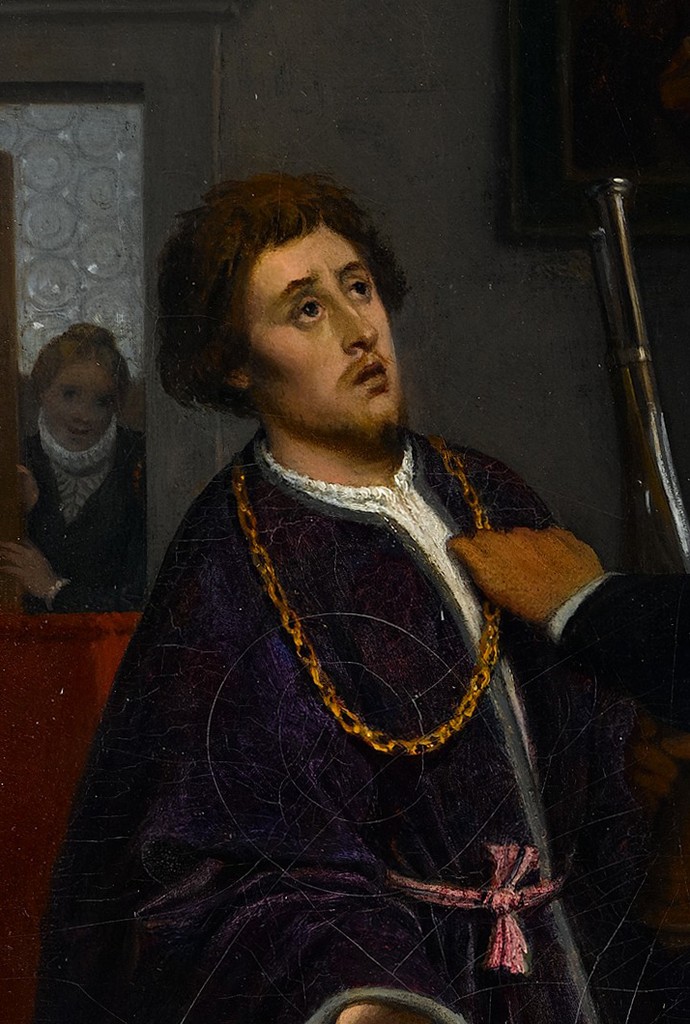
The raised face and gold chain
The seated figure lifts his face towards the standing painter. A gold chain makes a bright looping shape over the much darker garment below.
The hand at the collar and upright pistol
One hand grips the cloth near the collar while the pistol rises beside the seated head. These close, differently angled shapes concentrate the confrontation.
The open palm beside the chair
The seated figure’s open palm faces outwards above the chair arm. Its exposed fingers contrast with the standing figure’s firmer grip higher in the painting.
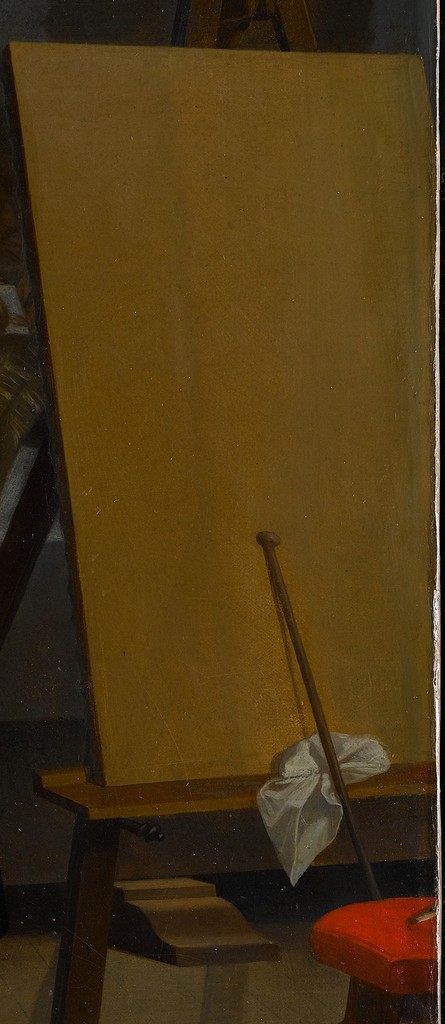
A bare canvas on the easel
The large blank canvas leans above a small table and books. Its broad pale rectangle occupies almost as much of the room as the two principal bodies.
The doorway behind the seated figure
A smaller face appears in the doorway behind the chair. The opening sets another observer at a distance from the encounter in the foreground.
Stockings, platform and fallen cap
The standing figure places one pale stockinged leg on the low platform. The other descends beside it, while a small dark cap lies near the lower edge.
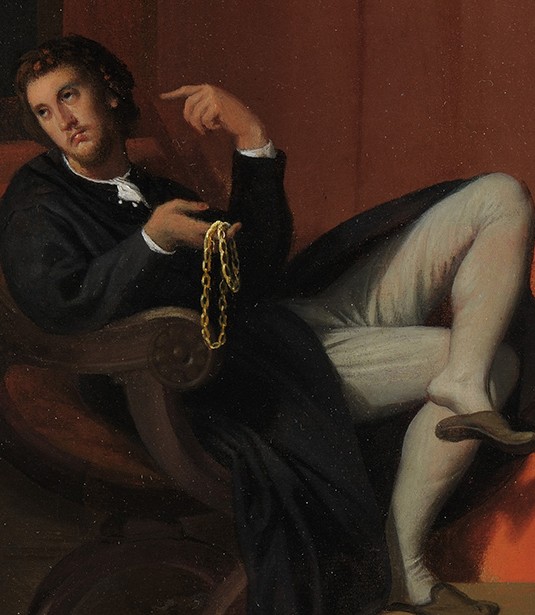
Aretino and the Envoy of Charles V
A seated figure holding a gold chain
The seated figure holds a hanging gold chain while raising the other hand beside his head. Compare these gestures with the open palm and lifted face in the studio painting.
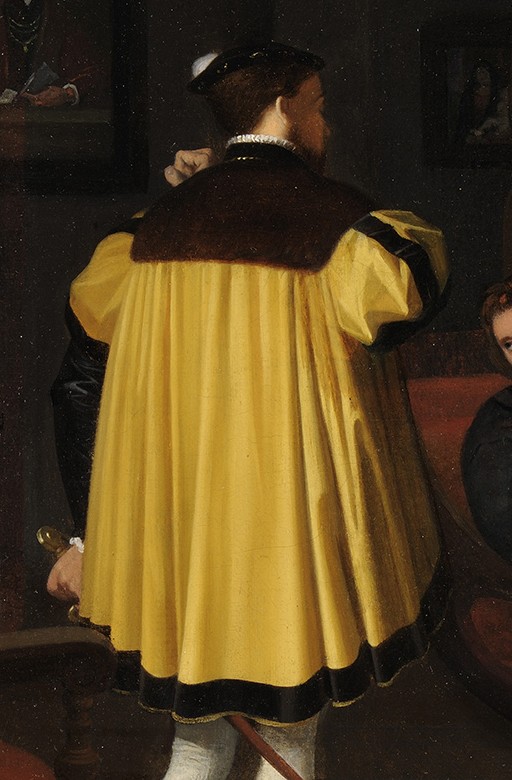
The envoy’s yellow cloak
The envoy stands with his back partly towards us in a broad yellow cloak. Its long folds create a single bright shape opposite the seated figure’s darker clothing.
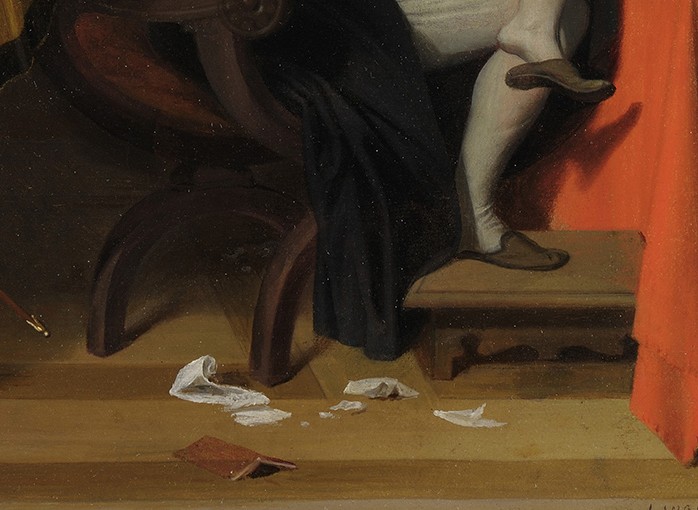
Papers beneath the chair and table
Pale scraps lie below the chair near the table and low footrest. These small irregular shapes interrupt the open floor beneath the larger figures.
A studio assembled from pictures
The large blank canvas takes up much of the right side. Its uninterrupted surface makes the encounter especially strange. There is no portrait yet for the critic to judge, and no painted likeness for the sitter to inspect. The two men have become the spectacle that the canvas was supposed to produce.
Behind them stands a larger picture containing a crowd and an interior. Tucker identifies it as Tintoretto’s altered Marriage at Cana, and sources the protagonists through Titian’s Portrait of a Gentleman, formerly called Aretino, and probably Tintoretto’s Louvre self-portrait. [3] The room is thus assembled from art. Aretino’s convincing presence should not be confused with a secure likeness of the writer.
The edges of the canvases help organise a room that might otherwise seem crowded. The tall, pale rectangle on the right balances the dark fall of Aretino’s robe on the left. Its sloping side cuts across the picture behind, letting us understand one surface as nearer than the other. Below, the easel’s splayed legs open a second space alongside the cramped encounter. The painter commands the centre while his equipment occupies almost an entire side of the image.
Ingres’s own remarks help explain the seriousness of this traffic with earlier art. In the notes gathered by Delaborde, he recommends keeping prints and sketches after the masters close at hand, to cultivate judgement and help one understand new things. [2] Such advice gives borrowing an active purpose. Here the inherited material has been arranged into an encounter whose awkwardness and comic timing remain immediately readable.
Returning to the subject in 1848
The Met identifies the later version as a commission for Marcotte Genlis. [1] Delaborde independently records an 1848 repetition with variants and names Marcotte Genlis as its owner when exhibited in 1855. He also distinguishes it from the earlier composition. [2] This is a fresh painted object with its own history, separated from the first treatment by more than three decades. Tucker contrasts the earlier wooden panel with this canvas, noting darker clothing, a cord replacing the belt and simplified furnishings. [3]
In the 1848 painting, those elements contribute to a very concentrated action. The pink cord draws the eye across Aretino’s middle before the robe drops towards the floor; the plain chair arm supports the abandoned gloves; the small lit doorway remains visible behind the sitter. Each object is easy to locate, while the darkness around the central figures keeps them close together. Tucker illustrates a Bayonne pencil-and-watercolour, a Montauban nude study dated about 1848 and a composition drawing possibly traced after the earlier painting. [3] The distinctions matter: a nude study and a possible tracing need not belong to the same stage. Ingres’s drawings offer a wider view of how an image could be studied, preserved and revisited.
Ingres addressed repetition directly in a statement dated 1859 and preserved by Delaborde. He acknowledged the complaint that he returned to old compositions too frequently. His answer was that affection for their subjects made them worth improving through repainting or retouching. He also admitted limits, considering it absurd to try remaking his Martyrdom of Saint Symphorian. [2] This later explanation should not be mistaken for a surviving brief for the Aretino commission, but it establishes the artistic value he could attach to revision.
The companion picture: Aretino before imperial power
Aretino in the Studio of Tintoretto was conceived with a companion, Aretino and the Envoy of Charles V. Delaborde pairs the earlier compositions and records 1848 repetitions of both. In the companion’s story, Charles V sends a gold chain after an unsuccessful expedition against Algiers, hoping to buy the writer’s silence. Aretino accepts the gift while expressing contempt for its smallness. [2]
The pairing changes the scale of the studio joke. A man who can embarrass an emperor is suddenly made helpless by a painter. Read together, the subjects offer two methods of managing criticism: a gift meant to purchase silence, and a frightening performance that makes the critic reconsider his conduct. Their humour depends on Aretino’s power over others as much as on his momentary loss of composure.
The 1848 Envoy is now in the Musée des Beaux-Arts de Lyon, which records it as oil on canvas, 43 × 34 cm, accession 2013.1.1. The museum acquired it in December 2012 with institutional support and a public subscription involving 1,536 donors. Charles V acts through his messenger; he is not physically represented. [4]
Delaborde describes a significant alteration in that companion: the earlier Aretino stood with one hand at his hip, weighing the chain in the other; the repetition seated him, leaning back in his chair. [2] Revision could thus change the writer’s whole performance. The companions were opportunities to rework a character and a relationship, beyond preserving an attractive arrangement.
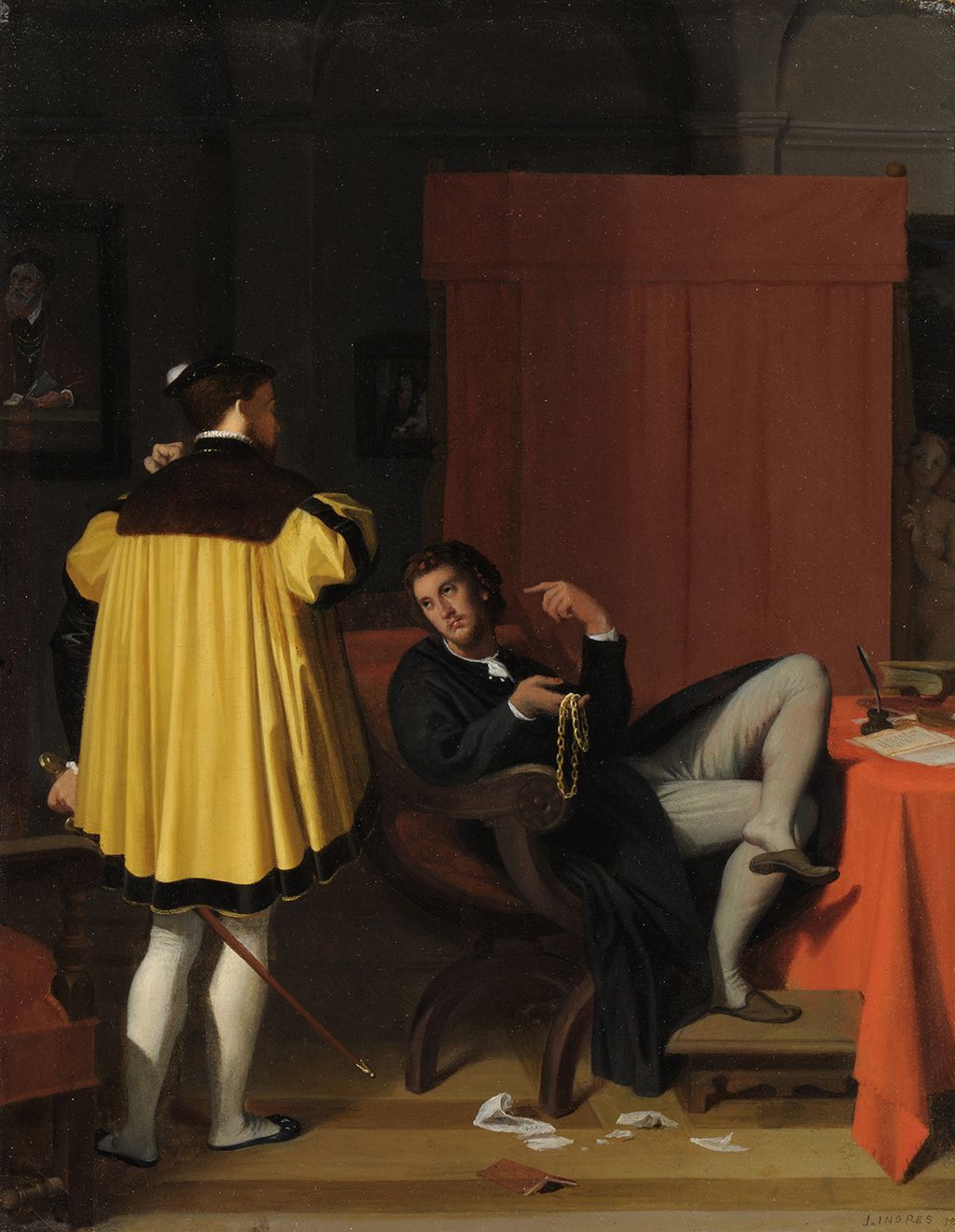
Ingres, Aretino and the Envoy of Charles V, 1848. Musée des Beaux-Arts de Lyon, 2013.1.1. The separate companion painting. [5]
Exhibitions, criticism and the route to New York
Delaborde places the earlier studio picture at the Cercle des Arts in Paris around 1839–40, then in the Collot collection and with Schroth following the 1852 sale. Those details concern the earlier work. For the 1848 repetition, he records the 1855 exhibition and its reproduction in outline in the volume associated with Magimel. [2] The same anecdote therefore circulated through separate paintings, public exhibition and a printed rendering. Its reception cannot be reduced to a single unveiling. Tucker reports Ary Scheffer’s 1848 objection to repeated subjects for a prospective purchase, and Théophile Silvestre’s 1855 attack on Ingres’s reuse of compositions and older art. [3] Such responses invite us to look closely at what a revised composition changes.
In the notes published by Delaborde, Ingres also allows criticism a constructive role. He recommends weighing friends’ observations in light of their taste and habits, and suggests that freely expressed opinions can be useful. [2] The pistol story should therefore not stand for his entire attitude towards judgement. Its vindictive pleasure coexists with a more practical recognition that another person may see a fault.
Later ownership passed through the Marcotte family and Bessonneau collection before Robert Lehman bought the painting in 1954. [3] It entered the Met with the Robert Lehman Collection in 1975. [1] Its small dimensions invite a close encounter today: the hand against the chest, the fallen cap and the waiting canvas can each redirect the story as we look.
Artworks directory
Explore 150 paintings, drawings and an original lithograph. This selection includes related versions and studies; dates distinguish completed works from later revisions.
| Name | Date | Medium |
|---|---|---|
| The Apotheosis of Homer | 1827 | Painting |
| Grande Odalisque | 1814 | Painting |
| The Turkish Bath | 1859–1862 | Painting |
| Madame Moitessier Seated | 1856 | Painting |
| Portrait of Monsieur Bertin | 1832 | Painting |
| Napoleon I on His Imperial Throne | 1806 | Painting |
| Odalisque with Slave | 1839 | Painting |
| The Ambassadors of Agamemnon in the Tent of Achilles | 1801 (competition) | Painting |
| The Valpinçon Bather | 1808 | Painting |
| The Source | 1856 | Painting |
| Oedipus Explaining the Enigma of the Sphinx | 1808; revised probably before 1827 | Painting |
| The Vow of Louis XIII | 1824 | Painting |
| Antiochus and Stratonice | 1840 | Painting |
| The Comtesse d’Haussonville | 1845 | Painting |
| The Princesse de Broglie | 1851–1853 | Painting |
| Jupiter and Thetis | 1811 | Painting |
| The Dream of Ossian | 1813 | Painting |
| The Martyrdom of Saint Symphorian | 1834 | Painting |
| Venus Anadyomene | 1808–1848 | Painting |
| Portrait of Madame de Senonnes | 1814 | Painting |
| Madame Rivière | 1805 | Painting |
| Mademoiselle Caroline Rivière | 1805 | Painting |
| Portrait of Philibert Rivière | 1805 | Painting |
| Bonaparte First Consul | 1804 | Painting |
| The Death of Leonardo da Vinci | 1818 | Painting |
| Joan of Arc at the Coronation of Charles VII | 1854 | Painting |
| Madame Duvaucey | 1807 | Painting |
| La Belle Zélie | 1806 | Painting |
| Madame Panckoucke | 1811 | Painting |
| Portrait of Charles Marcotte d’Argenteuil | 1810 | Painting |
| Joseph Antoine Moltedo | c.1810 | Painting |
| Madame Leblanc | 1823 | Painting |
| Delphine Ingres-Ramel (Portrait of Madame Ingres) | 1859 | Painting |
| Portrait of Amédée de Pastoret | 1823–1826 | Painting |
| Portrait of Baronne de Rothschild | 1848 | Painting |
| Madame Marcotte de Sainte Marie | 1826 | Painting |
| Madame Gonse | 1852 | Painting |
| Aretino in the Studio of Tintoretto | 1848 | Painting |
| Don Pedro of Toledo Kissing Henry IV’s Sword | 1831/1832 | Painting |
| Raphael and La Fornarina | 1814 | Painting |
| Roger Freeing Angelica | 1819 | Painting |
| Romulus’ Victory over Acron | 1812 | Painting |
| Self-Portrait at the Age of Twenty-Four | 1804; revised 1841–1851 | Painting |
| Male Torso | c.1800 | Painting |
| Odalisque in Grisaille (Ingres and workshop) | c.1824–1834 | Painting |
| The Small Bather | 1826 | Painting |
| The Little Bather Harem Interior | 1828 | Painting |
| Jesus Among the Doctors | 1862 | Painting |
| The Virgin Adoring the Host | 1852 | Painting |
| The Virgin of the Host | 1841 | Painting |
| Virgin of the Adoption | 1858 | Painting |
| Paolo and Francesca | 1814 | Painting |
| Homer Deified (revised composition, Louvre RF5273) | 1865 | Drawing |
| Odalisque with Slave (Louvre RF4622) | 1858 | Drawing |
| Odalisque (Walters Art Museum; Ingres and Paul Flandrin) | 1842 | Painting |
| Madame Moitessier Standing (National Gallery of Art) | 1851 | Painting |
| Jacques-Louis Leblanc (The Metropolitan Museum of Art) | 1823 | Painting |
| Ferdinand-Philippe, Duke of Orléans (Louvre RF2005-13) | 1842 | Painting |
| Ferdinand-Philippe, Duke of Orléans (Versailles MV5207; Ingres and workshop) | 1843 | Painting |
| Ferdinand-Philippe, Duke of Orléans (Versailles MV5209; Ingres and workshop) | 1844 | Painting |
| Antiochus and Stratonice (Musée Fabre; Ingres and Raymond Balze) | 1866 | Painting |
| Antiochus and Stratonice (Kunstmuseum Bern, Gurlitt bequest) | Undated (early dating proposed) | Drawing |
| Composition study for Antiochus and Stratonice (MIB867.2193) | 1806 | Drawing |
| Study for the Figure of Stratonice (Met63.66) | 1834–1840 | Graphite, black chalk and charcoal |
| Nude figure study for Stratonice (Boijmans F II 36 PK) | c.1834–1840 | Drawing |
| Paolo and Francesca (The Barber Institute,54.6) | c.1814–1820 | Painting |
| Paolo and Francesca (The Hyde Collection,1971.24) | c.1855–1860 | Painting |
| Paolo and Francesca (Amsterdam Museum TA10970) | 1820 | Drawing |
| Paolo and Francesca (dedicated to Artaud de Montor) | 1816 | Drawing |
| Study for the Bust of Francesca (MIB867.1398) | 1819 | Drawing |
| Study for the Bust of Francesca (MIB867.1396) | 1819 | Drawing |
| The Archangel Raphael, first idea (MIB867.2488) | 1842 | Drawing |
| The Archangel Raphael (MIB867.2500) | 1842 | Drawing |
| The Archangel Raphael Carrying Human Prayers to God (Chantilly DE513) | 1844 | Drawing |
| Louis-Philippe as Saint Philip, stained-glass study | 1844 | Drawing |
| Marie Frédéric Eugène de Reiset (Ford Collection RBF171-2) | 1844 | Drawing |
| Virgil Reading the Aeneid (Toulouse) | Begun 1811 | Painting |
| Tu Marcellus Eris (Brussels, inv. 1836) | c.1814 (museum dating) | Painting |
| Jean-François Gilibert | 1804 | Painting |
| François-Marius Granet | 1807 (museum dating) | Painting |
| Count Nikolai Dmitrievich Guryev | 1821 | Painting |
| Caroline Murat, Queen of Naples | 1814 | Painting |
| Count Mathieu Molé | 1834 | Painting |
| Cherubini and the Muse of Lyric Poetry (Louvre) | 1842 | Painting |
| Luigi Cherubini (Cincinnati) | 1841 | Painting |
| Comtesse de Rayneval (Louvre RF4505) | 1841 | Drawing |
| Venus on Paphos (Antonie Balaÿ) | c.1852 | Painting |
| Prince Napoléon | 1855 | Painting |
| Study for The Apotheosis of Napoleon I (Petit Palais) | Late 1853 | Painting |
| The Apotheosis of Napoleon I (destroyed ceiling) | 1853 | Painting |
| The Journalist (MIB867.2733) | 1834? | Drawing |
| Henry VIII, after Holbein | c.1815–1820 (?) | Drawing |
| Madame Récamier, after David (MIB867.3637) | Undated (early Paris period) | Drawing |
| Study for Comtesse d’Haussonville (MIB867.259; background possibly by another hand) | 1842–1845 | Drawing |
| La Source (reduced version reported by Delaborde) | Date unrecorded; reported 1870 | Painting |
| Odalisque (autograph lithograph,NGA1946.21.117) | 1825; published1826 | Lithograph |
| Portrait of a Seated Lady | 1814 | Graphite |
| The Kaunitz Sisters (Leopoldine, Caroline, and Ferdinandine) | 1818 | Graphite |
| Portrait of a Man | 1814 | Graphite |
| Study for the Portrait of Louis-François Bertin (1766–1841) | n.d. | Black chalk and graphite |
| Studies for the Cadaver of Acron | ca. 1810–12 | Graphite on wove paper |
| Study for the Drapery of Molière in "The Apotheosis of Homer" | n.d. | Black chalk with stumping |
| Madame Guillaume Guillon Lethière, née Marie-Joseph-Honorée Vanzenne, and her son Lucien Lethière | 1808 | Graphite |
| Niccolò Paganini (1782–1840) | ca. 1830 | Counterproof or tracing strengthened with graphite and gouache on translucent paper |
| Lady Mary Cavendish-Bentinck (?-1843) | 1816 | Graphite |
| Madame Alexandre Lethière and Her Daughter Letizia | ca. 1815 | Graphite |
| Merry Joseph Blondel (1781–1853) | 1809 | Graphite |
| Ursin-Jules Vatinelle (1798–1881) | 1820 | Graphite |
| Bust of a Gypsy Girl (ascribed to Ingres) | 1819 | Graphite on wove paper |
| Study of a Seated Nude Male | n.d. | Graphite |
| The Archangel Raphael (Study for a stained-glass window in the chapel of Notre-Dame de la Compassion-Saint-Ferdinand, Neuilly) | ca. 1842 | Graphite |
| Lancelot-Théodore, comte Turpin de Crissé | probably 1818 | Graphite |
| Study for the Figure of the Iliad in "The Apotheosis of Homer" | ca. 1827 | Graphite and black chalk heightened with white chalk on brown paper |
| Comtesse Turpin de Crissé | probably 1818 | Graphite |
| Nude Figures for L'Âge d'Or, Château de Dampierre | n.d. | Graphite on brownish paper |
| Study of Figures (attributed to Ingres) | n.d. | Graphite |
| Study of Figures (attributed to Ingres) | n.d. | Graphite; squared in graphite |
| Admiral Sir Fleetwood Broughton Reynolds Pellew | 1817 | Graphite on wove paper |
| Madame Jean-Auguste-Dominique Ingres, née Madeleine Chapelle | 1814 | Graphite on off-white wove paper |
| Virgil Reading the Aeneid to Augustus, Livia, and Octavia | 1809/1819 (?) | Pen and black ink, graphite, brush and gray wash, white gouache heightening, Conté crayon on blue paper |
| General Louis-Étienne Dulong de Rosnay | 1818 | Graphite (hard and soft pencils) |
| Madame Alexandre Lethière, née Rosa Meli, and Her Daughter, Letizia | 1815 | Graphite |
| The Lawyer Paul Grand | 1834 | Graphite |
| Jean-Joseph Fournier | 1815 | Graphite |
| Armand Bertin | 1842 | Graphite |
| Madame Armand Bertin, née Marie-Anne-Cécile Dollfuss | 1843 | Graphite |
| The Architect Charles-Victor Famin | 1836 | Graphite |
| Henri Lehmann | 1850 | Graphite |
| Portrait of a Lady | ca. 1815–17 | Graphite |
| Edmond Cavé (1794–1852) | 1844 | Oil on canvas |
| Head of Saint John the Evangelist | probably ca. 1818–20 | Oil on canvas, laid down on wood |
| Madame Edmond Cavé (Marie-Elisabeth Blavot, ca. 1806–1883) | ca. 1831–34 | Oil on canvas |
| Madame Félix Gallois | 1852 | Graphite with touches of gold in oil to highlight jewelry, on buff wove paper. |
| Dr. François Mêlier | 1849 | Graphite with graphite framing lines, corrected with white, on buff wove paper |
| Portrait of Madame Rhode (Rhoda?) | 1810–20 | Graphite on pale buff wove paper |
| Study for "Raphael and the Fornarina"(?) | ca. 1814(?) | Graphite on white wove paper |
| Portrait of Madame Paul Meurice, née Palmyre Granger | ca. 1845–50 | Graphite on wove paper |
| Alexander the Great presenting Campaspe to Apelles | 1810 | Graphite, brush and brown wash; squared in graphite |
| Study of Hands for "Christ Among the Doctors" | 1852–62 | Graphite on tracing paper |
| Study for The Turkish Bath (RF34502) | about 1850 | Pen and brown ink with graphite, partially squared |
| Study for The Turkish Bath (RF23354) | Undated | Pen and brown ink with graphite on joined sheets |
| Study for The Turkish Bath (RF54702) | about 1859 | Pen and brown ink |
| Studies of women for The Turkish Bath (RF12292) | Undated | Black chalk |
| Achilles Receiving the Envoys of Agamemnon (Nationalmuseum sketch, NM2161) | 1801 | Oil on wood |
| Half-Length Bather (Musée Bonnat-Helleu,89) | 1807 | Oil on canvas |
| Oedipus and the Sphinx (National Gallery,NG3290) | about1826 | Oil on canvas |
| Oedipus and the Sphinx (Walters,37.9) | 1864 | Oil on canvas |
| Oedipus and the Valpinçon Bather, after David (MI.867.2035) | Undated | Graphite on tracing paper, after David |
| Study of the Virgin for The Vow of Louis XIII (Dijon,1758) | about1822 | Black chalk, stump and white chalk on brown wove paper |
| First Thought for The Vow of Louis XIII (MI.885.11.21) | 1822 | Oil on canvas |
Frequently Asked Questions
The Metropolitan Museum of Art’s canvas is dated 1848. Ingres’s first version of the subject dates from 1815. Their histories should be kept separate. [1]
In the story preserved by Delaborde, he pretends to threaten him, then uses the pistol to take his measurements. Aretino’s fear precedes his understanding of the joke. The account is an anecdote, not secure evidence of an actual attack. [2]
Within the story, Aretino has come to sit for a portrait. [2] Visually, the unpainted surface holds the promised sitting in suspense while painter and critic enact a far more unruly encounter beside it.
Discussion
Look again at the images and ideas explored in Aretino in the Studio of Tintoretto. These editorial prompts invite your observations.
Reader Insights
Which detail most changes your reading of the encounter: Aretino’s open hands, Tintoretto’s steady touch, the onlooker in the doorway or the empty canvas? Does the scene become funnier or more unsettling once you know the story’s ending?
Compare the open hands with the rigid line of Tintoretto’s action. Where does the arrangement encourage amusement, and where does it suggest danger?
Which elements of the studio help tell the anecdote, and which make you conscious of a painter constructing a scene about painting?
Join the Conversation
Share a detail, comparison or question about Aretino in the Studio of Tintoretto below.
References
- The Metropolitan Museum of Art, Aretino in the Studio of Tintoretto. Collection record, accession 1975.1.185; object information and curatorial overview, consulted 17 October 2026. View source.
- Henri Delaborde, Ingres, sa vie, ses travaux, sa doctrine, d’après les notes manuscrites et les lettres du maître. Paris: Henri Plon, 1870. “Notes et pensées”, pp. 108, 121–122; catalogue nos. 58–61, pp. 227–229. Posthumously edited artist’s notes and historical catalogue; paraphrased here. (In French.) View source.
- Paul Hayes Tucker, “Aretino in the Studio of Tintoretto”, in The Robert Lehman Collection, III: Nineteenth- and Twentieth-Century Paintings, by Richard R. Brettell, Paul Hayes Tucker and Natalie H. Lee. New York: The Metropolitan Museum of Art; Princeton: Princeton University Press, 2009. Catalogue no. 1, pp. 2–10, including figures and notes. Scheffer and Silvestre are cited through Tucker’s account, p. 9. View source.
- Musée des Beaux-Arts de Lyon, L’Arétin et l’envoyé de Charles Quint. Collection record, accession 2013.1.1; object information, represented and cited persons, provenance and acquisition, consulted 17 October 2026. (In French.) View source.
- Supporting image. Ingres, Aretino and the Envoy of Charles V, 1848. Musée des Beaux-Arts de Lyon, 2013.1.1. The separate companion painting. Reproduction: Alain Basset; Wikimedia Commons. Image source. Public domain.
- Splash image. Jean-Auguste-Dominique Ingres, Aretino in the Studio of Tintoretto, 1848. Oil on canvas, 44.5 × 35.6 cm. The Metropolitan Museum of Art, Robert Lehman Collection, 1975 (1975.1.185). Image source. CC0 / Public domain.