by Tom Gurney
Tom Gurney BSc (Hons) is an art history expert with over 20 years experience
Published on June 19, 2020 / Updated on October 22, 2026
Email: tomgurney1@gmail.com / Phone: +44 7429 011000
Self Portrait Aged 24
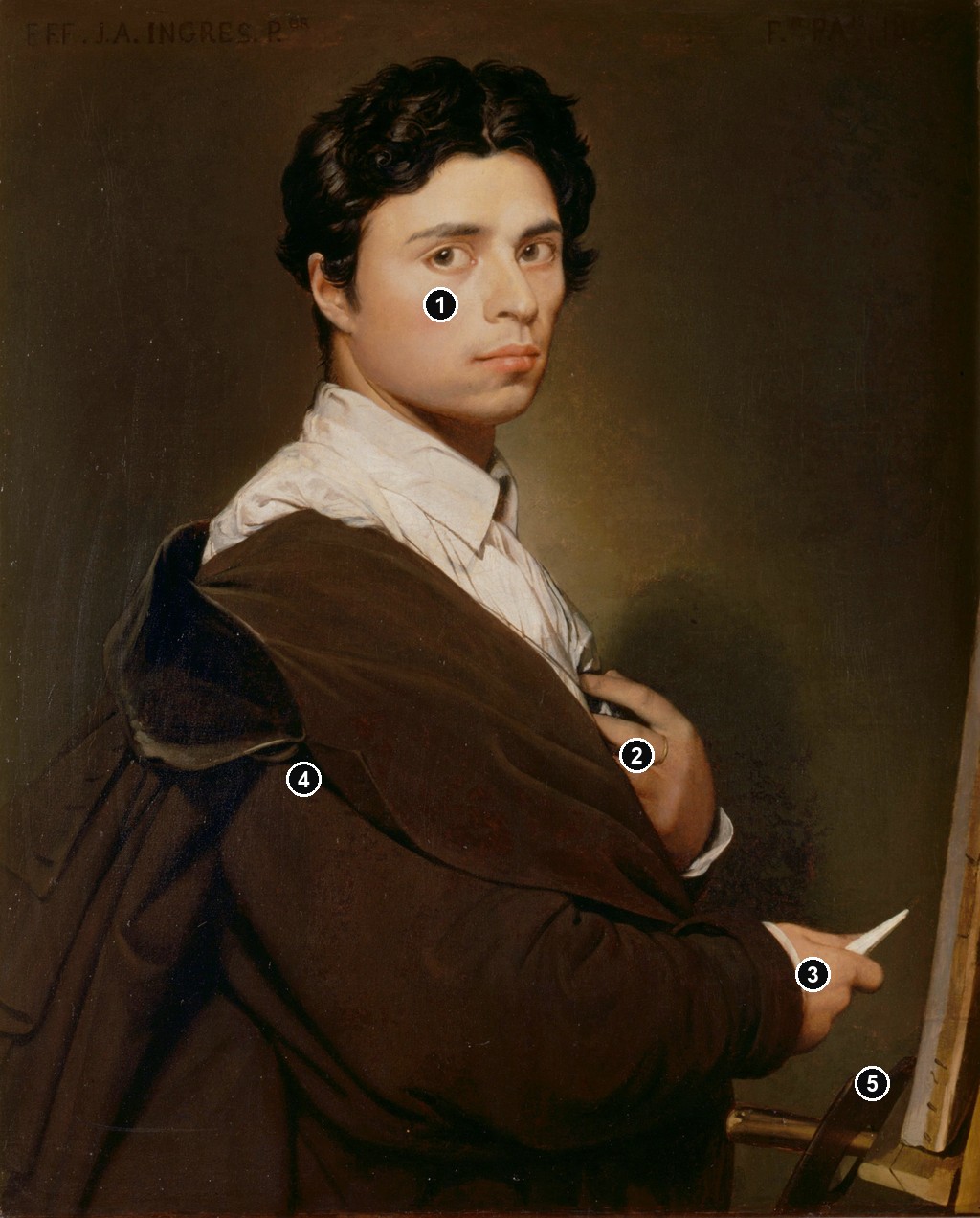
Ingres turns away from his easel to meet our eyes. His white collar rises sharply above a great brown coat; one hand holds chalk, while the other gathers the clothing against his chest. The face belongs to the young painter, but the picture surrounding it has a much longer history. Begun in 1804, the portrait was reworked in 1841–51. The original is in the Musée Condé at Chantilly. [1][2]
That long interval changes how we look. This is both a young artist’s likeness and an older artist’s reworking of his own appearance. Its apparent immediacy—the impression that we have interrupted him for a moment—survived a substantial reconstruction. An early copy by Julie Forestier allows us to recover something of the picture that first faced the public. [3]
At a Glance
- ArtistJean-Auguste-Dominique Ingres.
- Datebegun 1804; reworked 1841–51. [1][2]
- Mediumoil on canvas.
- CollectionMusée Condé, Chantilly; inventory PE 430. [1]
- First exhibitedSalon of 1806, in its earlier state. [1]
- Look forthe returning gaze, layered brown coat, gold ring and small white chalk.
This work across Ingres’s career
Agamemnon’s Ambassadors
1801 (competition)Self Portrait Aged 24 (current article)
1804; revised 1841–1851Grande Odalisque
1814Louis XIII’s Vow
1824Monsieur Bertin
1832The Princesse de Broglie
1851–1853The Turkish Bath
1859–1862Contents
- Looking at the painter at work
- The earlier portrait and Julie Forestier’s copy
- How examination confirmed the same canvas
- What the first audience saw
- The portrait Ingres found hard to surrender
- Copies, drawings and the life of an image
- A young likeness with a long history
- Annotated details
Looking at the painter at work
The body faces right, towards the canvas that enters along the edge of the picture. The head turns back towards us, bringing both eyes into view. This turning movement holds together two encounters: the painter’s work at the easel and his attention to someone outside the painted space. We occupy the direction of his gaze, although the picture gives us no surrounding studio from which to reconstruct a particular visit or sitting.
The turn is more complex than it first appears. The near shoulder is broad and rounded; the lower arm then leads across the bottom of the composition towards the chalk. Above it, the face looks back along a different direction. Follow the outline from the hair to the white collar and then down the coat, and the figure seems to spiral gently within the rectangular frame. Follow the eyes instead, and the movement stops. The painting invites a slow inspection of the clothing while making the face difficult to pass over.
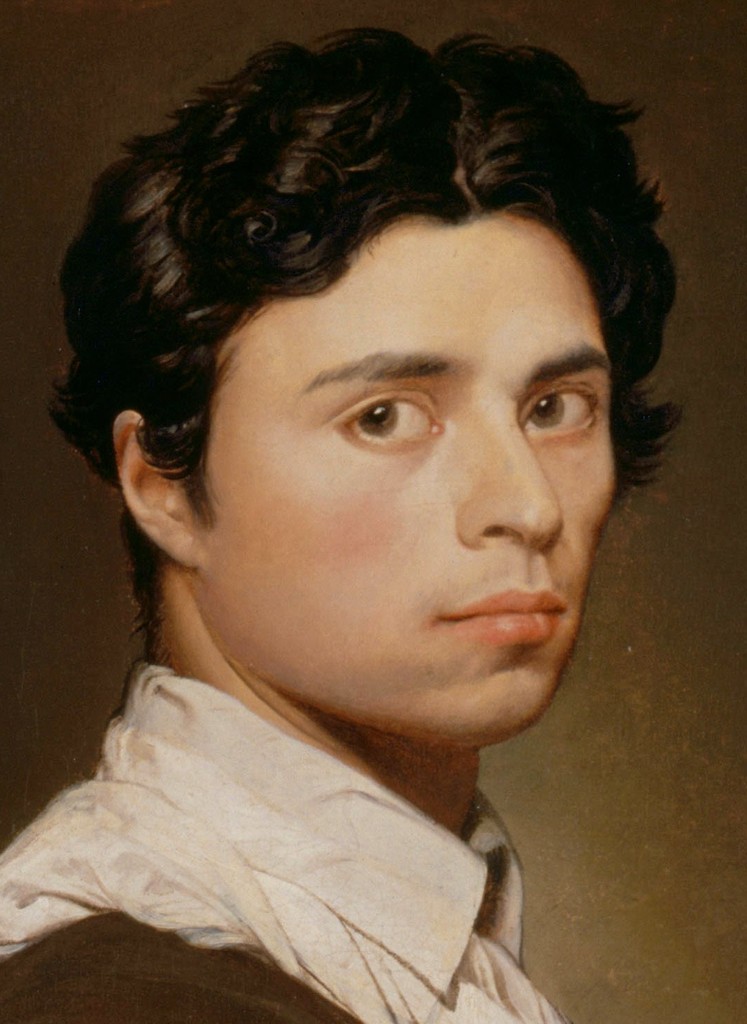
Dark curls create an irregular edge around the forehead. Below them, the transitions across the cheek are soft: pinkish warmth near the cheekbone, lighter flesh towards the nose, a shadow beneath the chin. The mouth is closed, its reddish colour distinct against the quieter skin tones. Small reflections in the eyes make them unusually present. None of these details establishes a particular emotion. The gaze can feel questioning, watchful or self-possessed depending on where our attention settles; those are responses to the image, rather than a record of Ingres’s thoughts.
White cloth and brown folds
The white shirt provides the picture’s most forceful contrast. Its stiff points frame the jaw, while the softer cloth below breaks into narrow creases. These small irregularities prevent the light area from becoming a simple white triangle. They also separate the face from the coat: without that pale interval, hair, shadow and clothing would meet in a much less distinct mass.
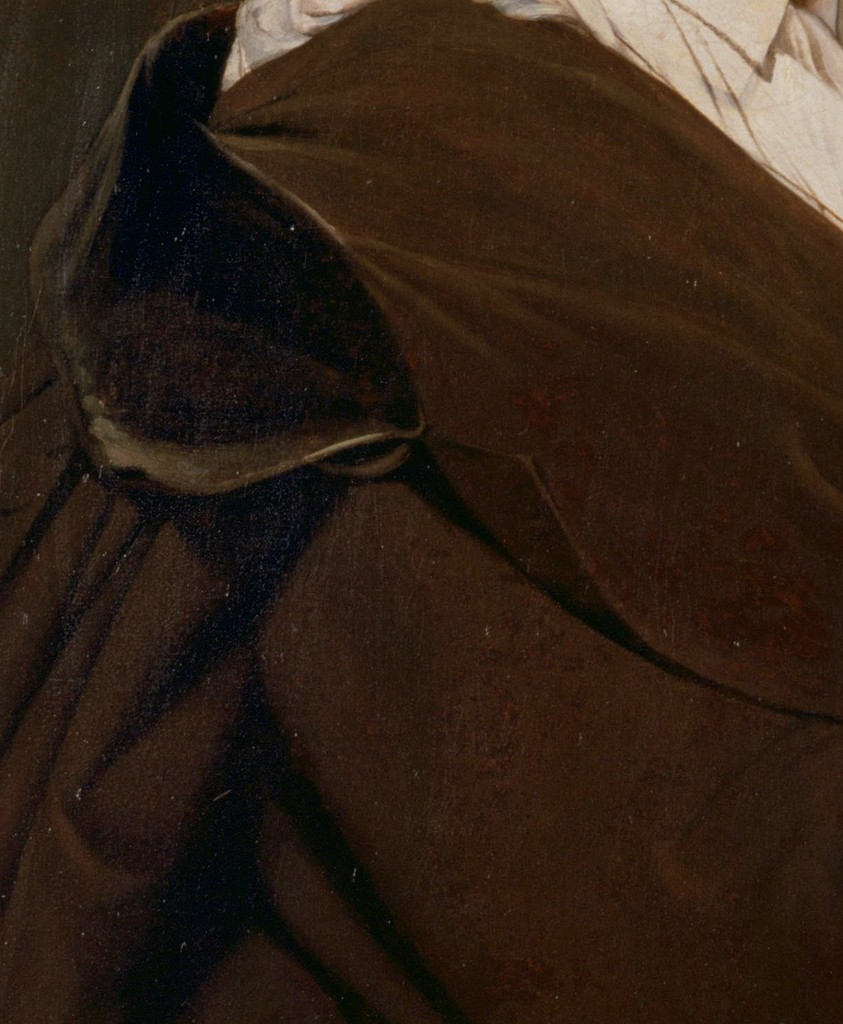
The coat offers another kind of rhythm. Broad overlapping capes fall across the back and shoulder, their edges making long curves. Deep folds beneath them return the eye towards the sleeve. Brown is far from uniform here. Some passages are almost black, others reddish or warmer and lighter; a thin illuminated edge can be enough to distinguish one layer from another. The background belongs to a similar range of colours, yet its comparatively quiet surface allows the more articulated clothing to advance.
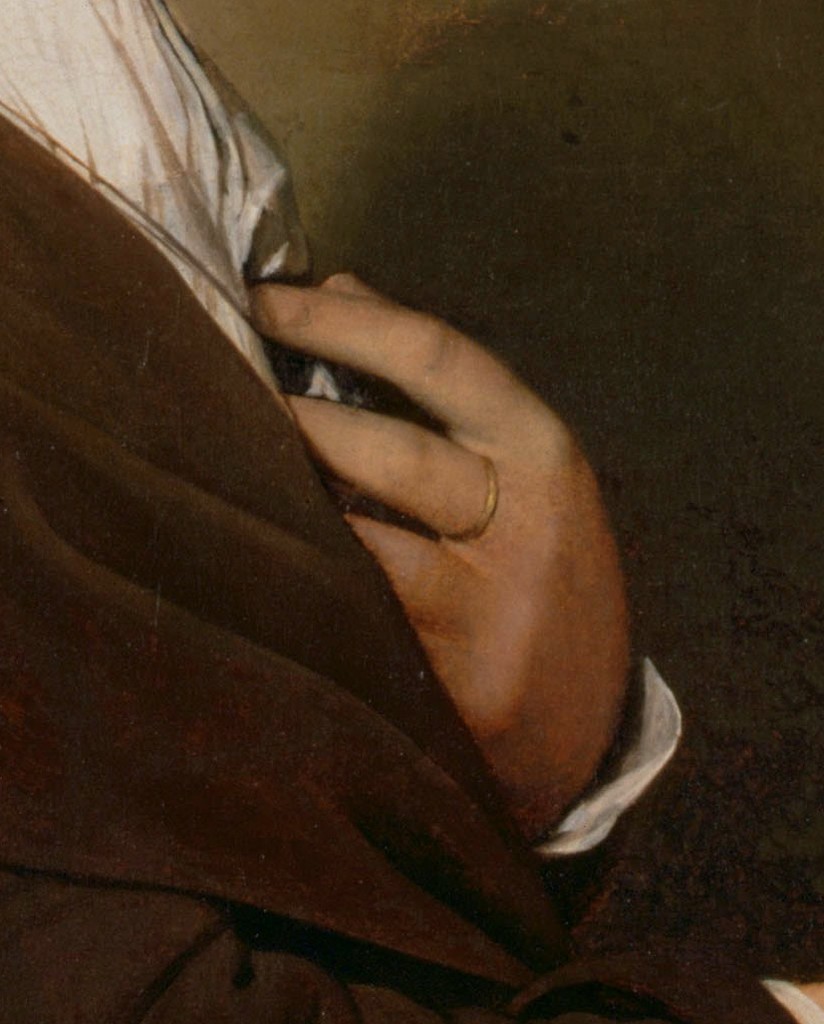
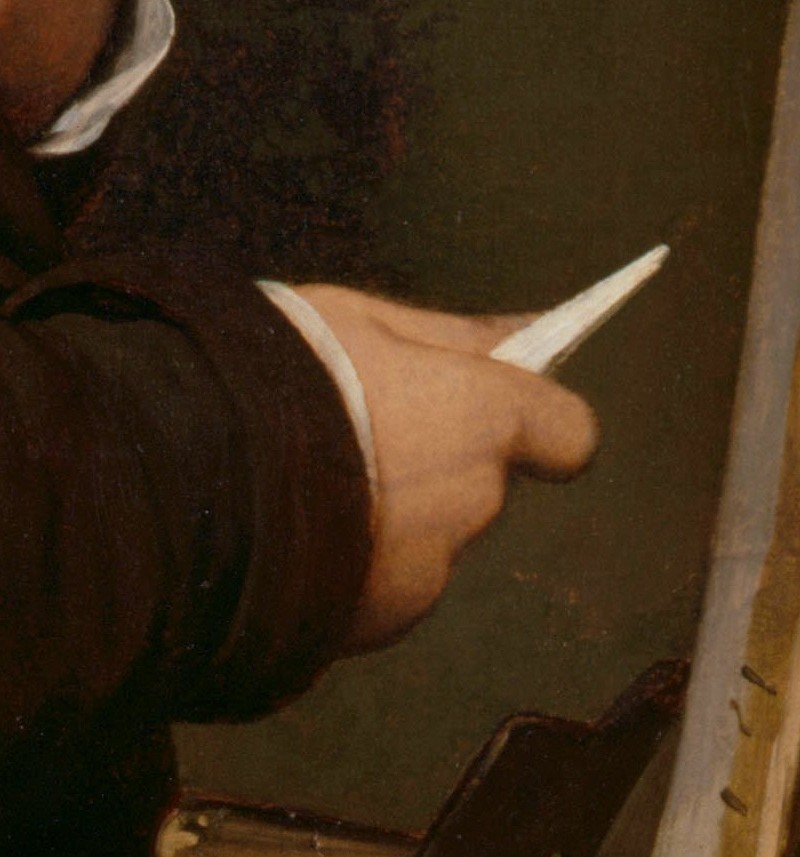
Look at how differently Ingres treats the two hands. The hand at the chest is partly enclosed by cloth, with a fine gold ring catching a little light. Its fingers gather towards the shirt. The working hand reaches towards the easel, enclosing the small, bright piece of chalk. Neither gesture is large, but the distance between them gives the lower half of the portrait a structure: one turns inward towards the body, the other out towards a surface on which the artist can make a mark.
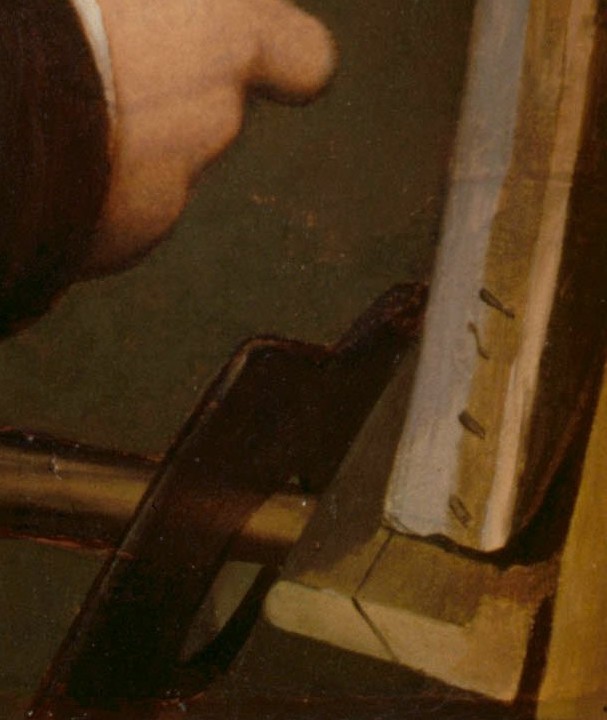
The easel occupies remarkably little space. A sloping wooden support and the narrow edge of a canvas suffice to explain the activity. There is no expansive view of tools, furniture or a studio interior. The equipment establishes the sitter as a working painter while leaving the largest share of our attention with his body and face. Along the top, the dark inscriptions can easily disappear into the brown ground; they repay a second look after the brighter collar has caught the eye.
Annotated Details from Self Portrait Aged 24
The numbered points identify visible features discussed in this article. Return from each detail to the whole composition. Each caption identifies the work shown.
Self Portrait Aged 24 — Chantilly
Jean-Auguste-Dominique Ingres, Self Portrait Aged 24, begun 1804, reworked 1841–51. Oil on canvas. Musée Condé, Chantilly, PE 430. Google Art Project via Wikimedia Commons. Image source. Public domain.
Forestier’s copy
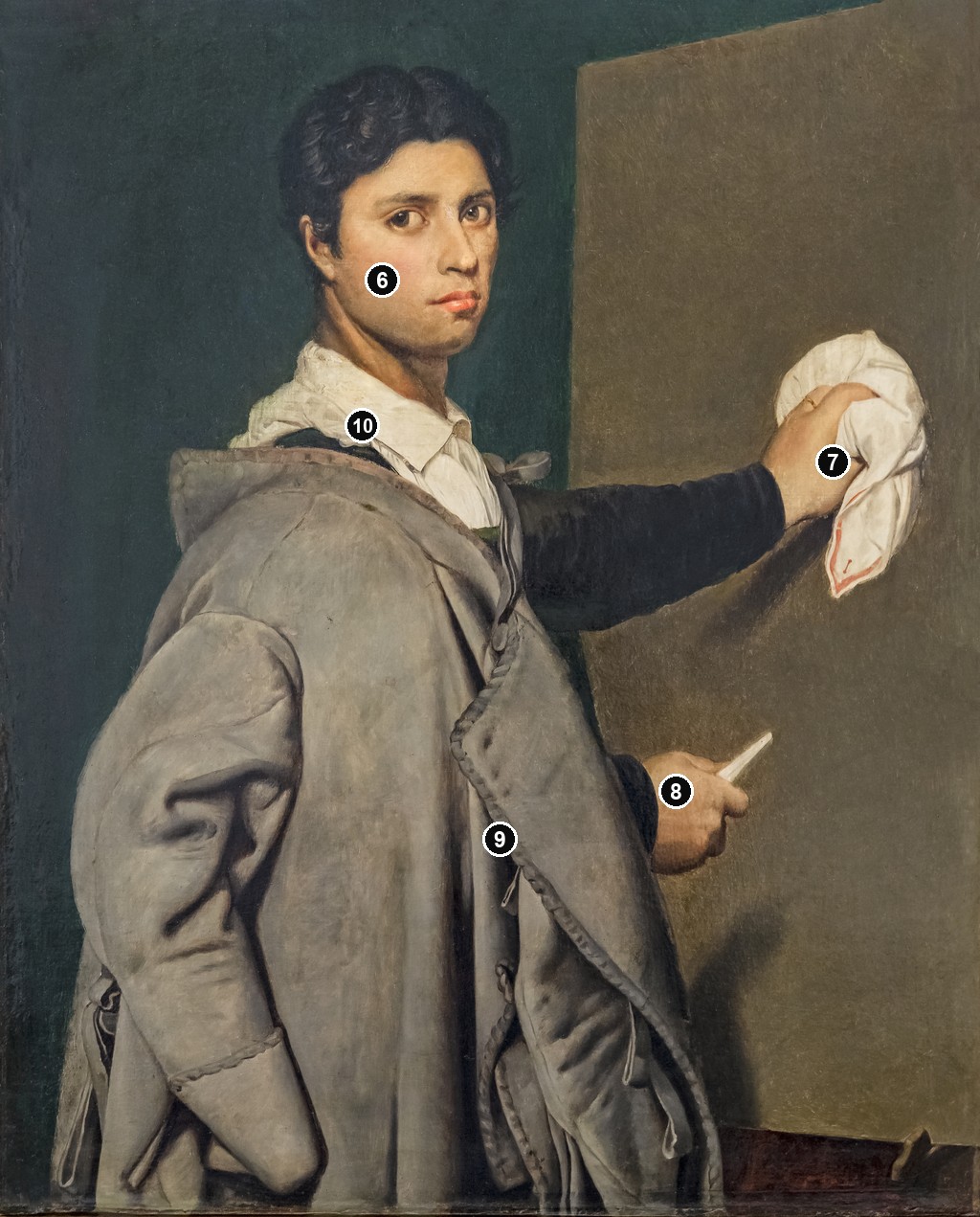
Julie Forestier after Ingres, copy of the earlier Self-Portrait composition, 1807. Musée Ingres Bourdelle, MI.2004.3.1. Photograph: Didier Descouens; Wikimedia Commons. Image source. CC BY-SA 4.0. Numbered overview: resized, with markers added. Detail images: cropped and JPEG-optimised. All these image derivatives are licensed CC BY-SA 4.0.
Flameng’s print
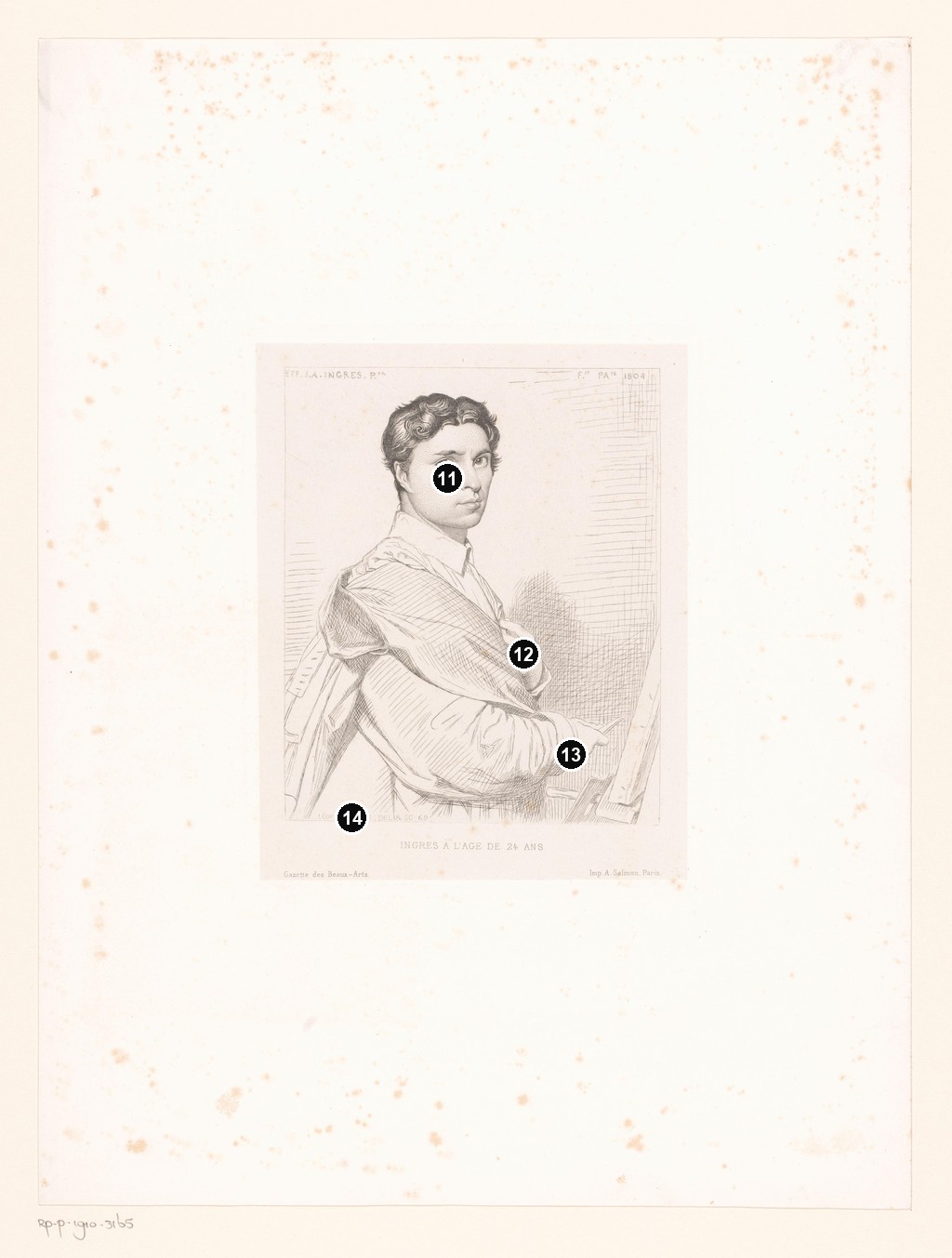
Léopold Flameng after Ingres, Portrait of Ingres Aged 24, 1869. Etching with chine collé; impression from the 1874 Album de la Gazette des Beaux-Arts. Rijksmuseum, Amsterdam, RP-P-1910-3165. Image source. Public domain.
Details from SELF PORTRAIT AGED 24
Compare the painted self-portrait with Julie Forestier’s separate painted copy and Léopold Flameng’s later print. The copies and print have their own makers, dates and visible differences.
Self Portrait Aged 24 — Chantilly
The face turning over the shoulder
The eyes turn towards the viewer above a high white collar. Dark curls frame the face while the shoulder leads away in another direction.
The ringed hand near the chest
A hand gathers the cloth near the chest, with a small ring marking one finger. Compare this compact gesture with the lower hand reaching towards the canvas.
The lower hand holding a pale implement
The lower hand holds a pale drawing implement beside the canvas edge. Its short pointed shape continues the direction of the extended forearm.
The broad folds across the shoulder
The brown garment falls in broad folds across the back and shoulder. These larger shapes lead towards the more tightly described white collar and hands.
The canvas edge and easel support
The canvas edge and wooden support meet near the lower corner. Their straight and diagonal lines make a firmer structure beside the softer sleeve and garment folds.
Forestier’s copy
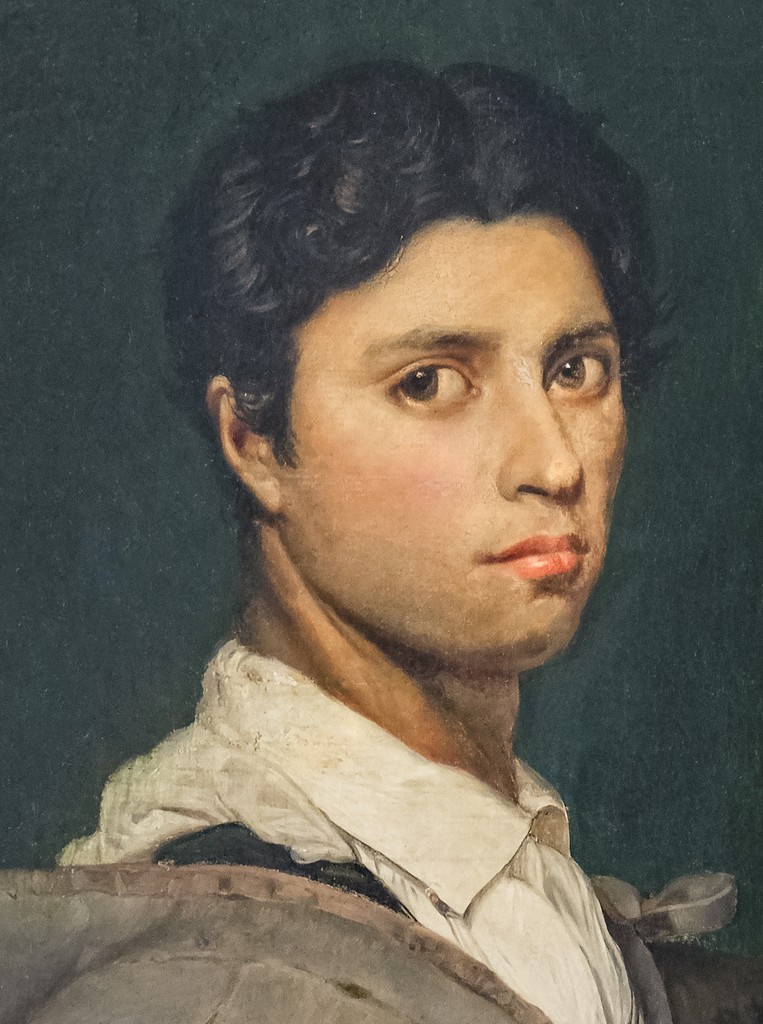
The turned face in Forestier’s copy
The young face turns towards the viewer above a pointed white collar. Compare its outline and surrounding curls with the altered portrait in Chantilly.
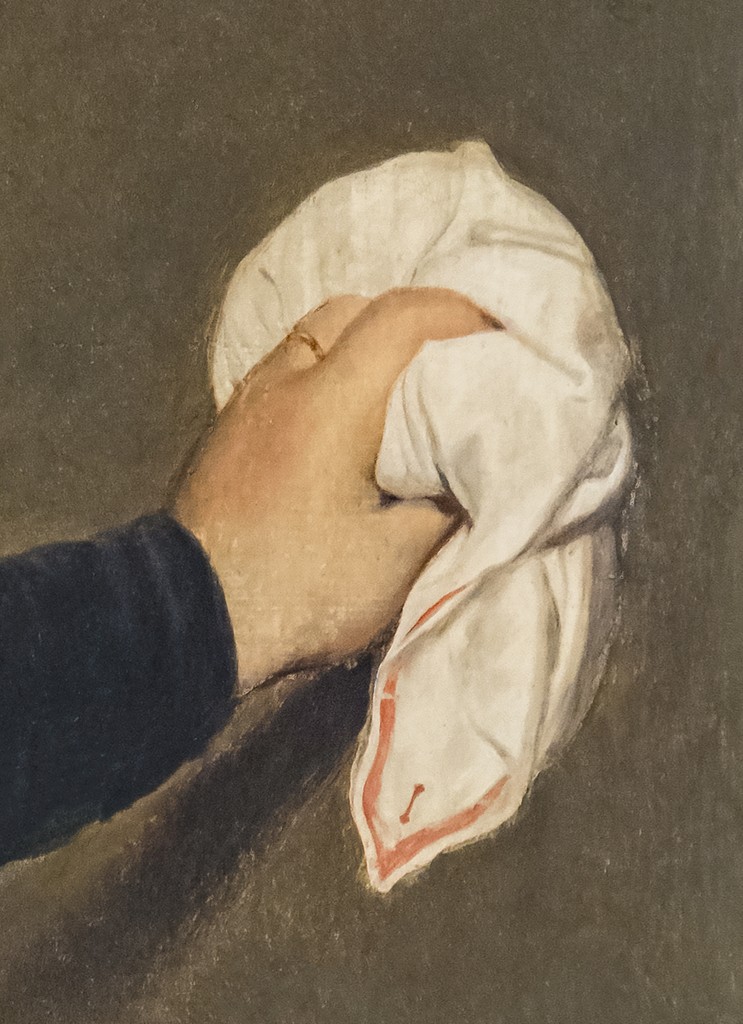
The raised hand holding white cloth
The raised hand presses pale cloth against the large canvas. Its high position gives the arm a different direction from the hand held near the chest in the Chantilly portrait.
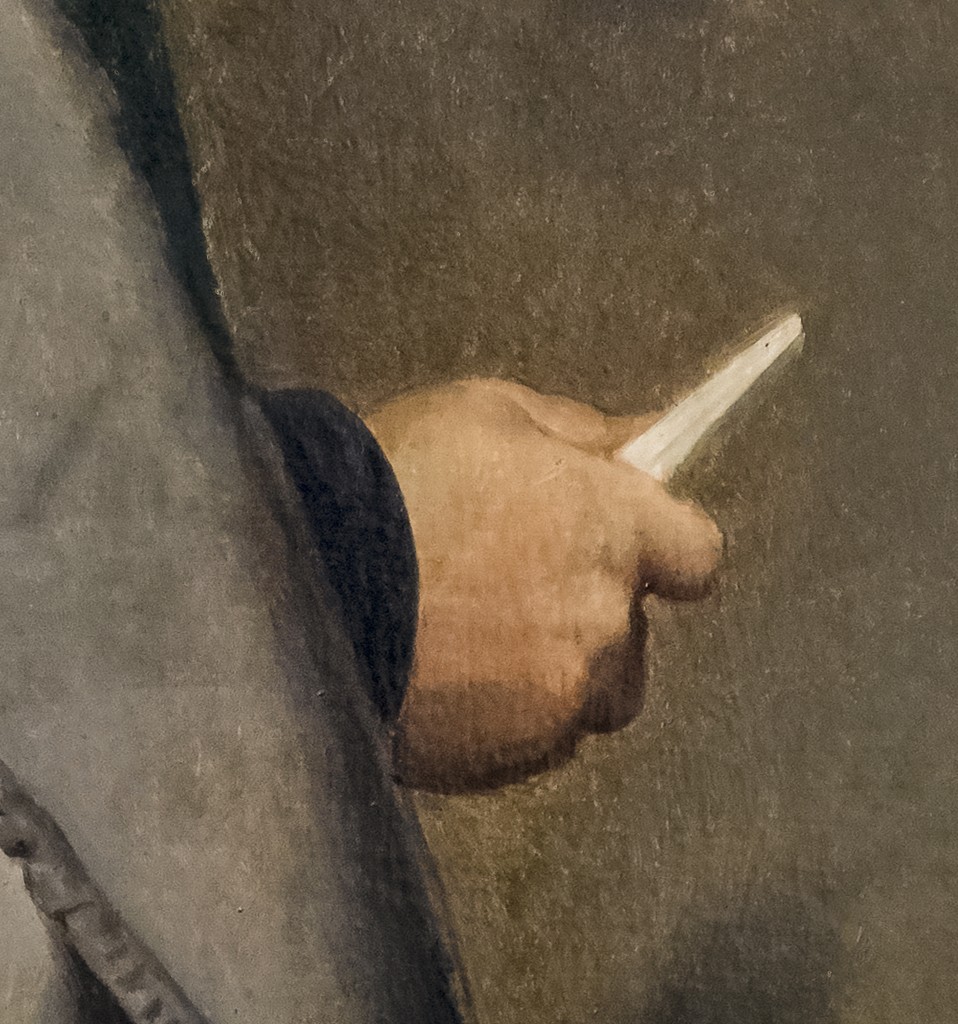
The lower hand and pale implement
The lower hand closes around a pale drawing implement. The dark cuff gives the small gesture a clear boundary against the lighter canvas behind it.
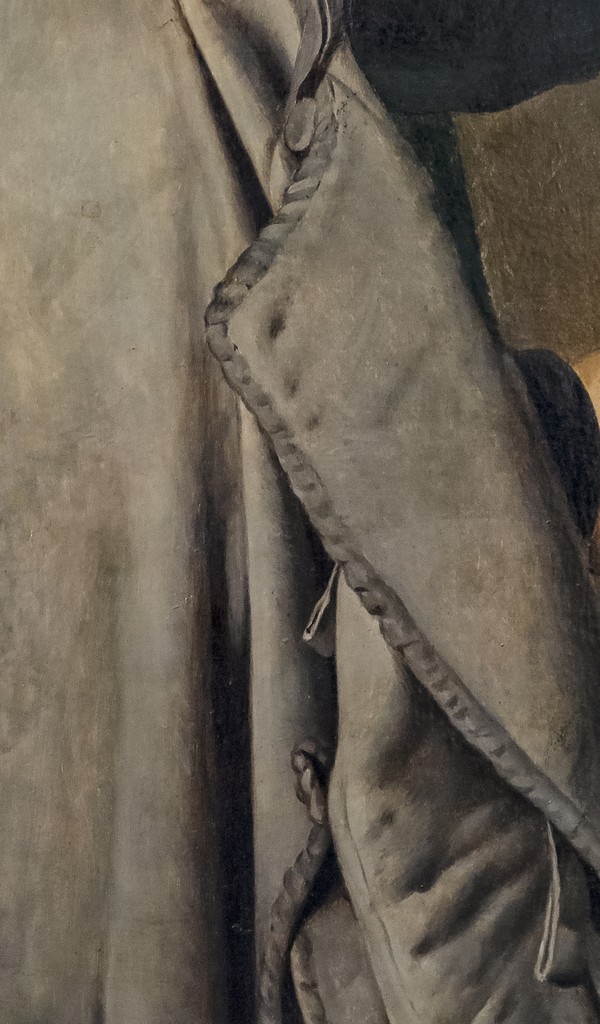
Buttons and loops down the coat
Buttons and loops descend through the grey coat beside a long diagonal fold. Their repeated small shapes divide a much larger area of fabric.
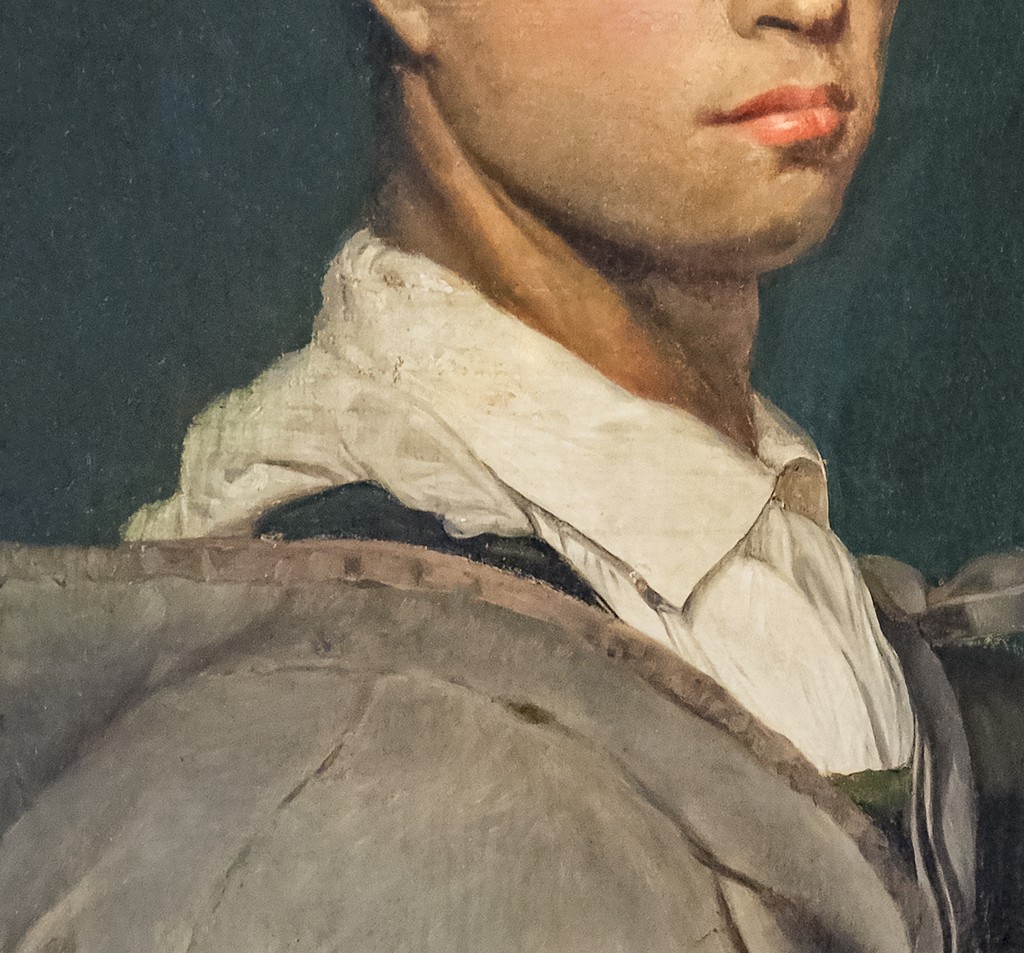
The pointed collar above the coat
The pointed white collar opens above the grey coat and dark inner clothing. Compare these angles with the broader white neckcloth in the later state of the portrait.
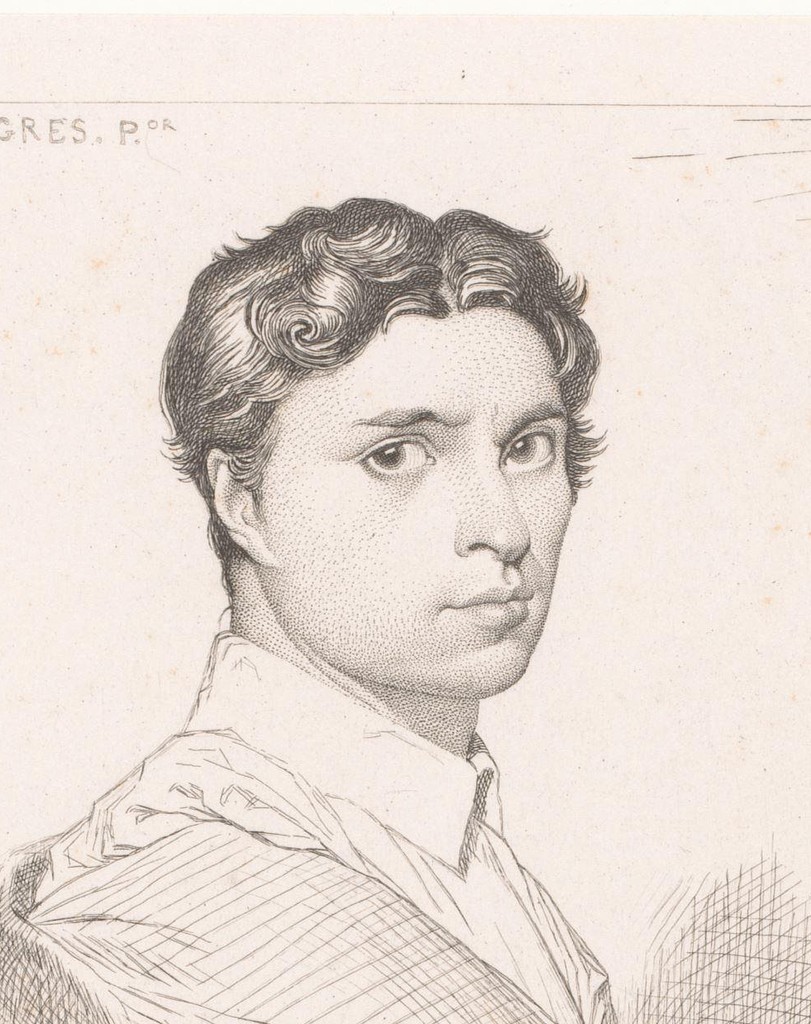
Flameng’s print
The turned face within the printed lines
Fine printed lines gather around the eyes, hair and turned cheek. The pale collar below the head separates the face from the more openly marked clothing.
The hand at the chest
A hand rests against the chest beside crossing lines of the coat. The curved fingers meet a more regular field of dark marks behind the figure.
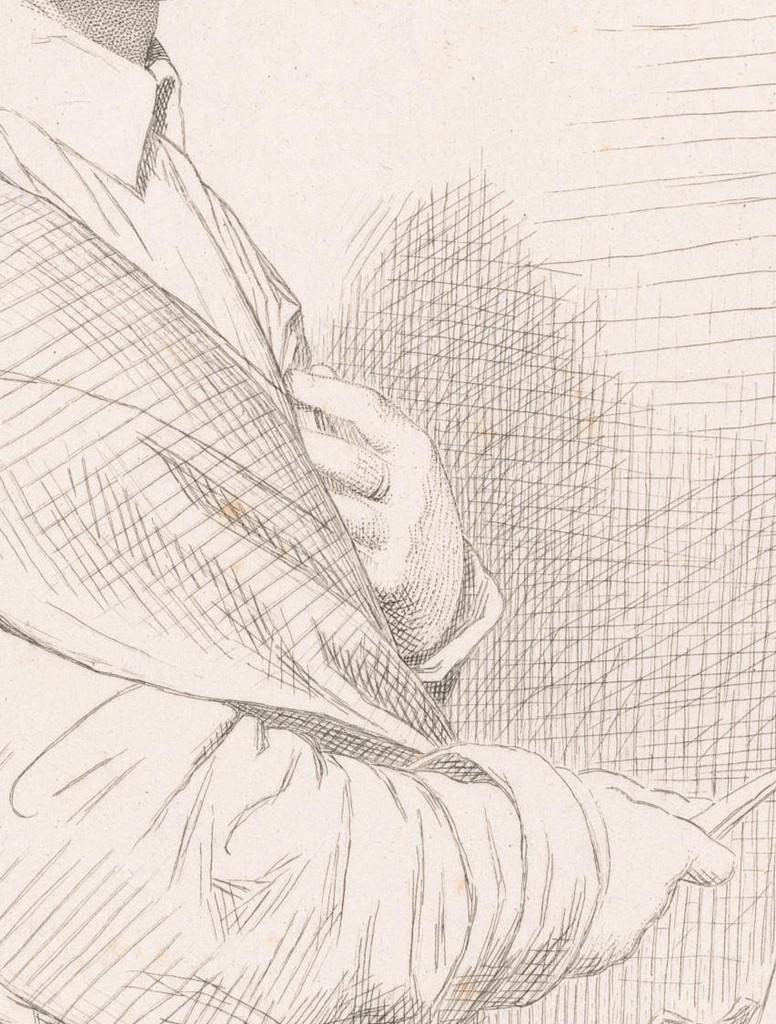
The drawing hand beside the sloping surface
The other hand reaches towards a sloping surface beside a slender drawing implement. Compare the straighter lines of that surface with the gathered sleeve around the wrist.
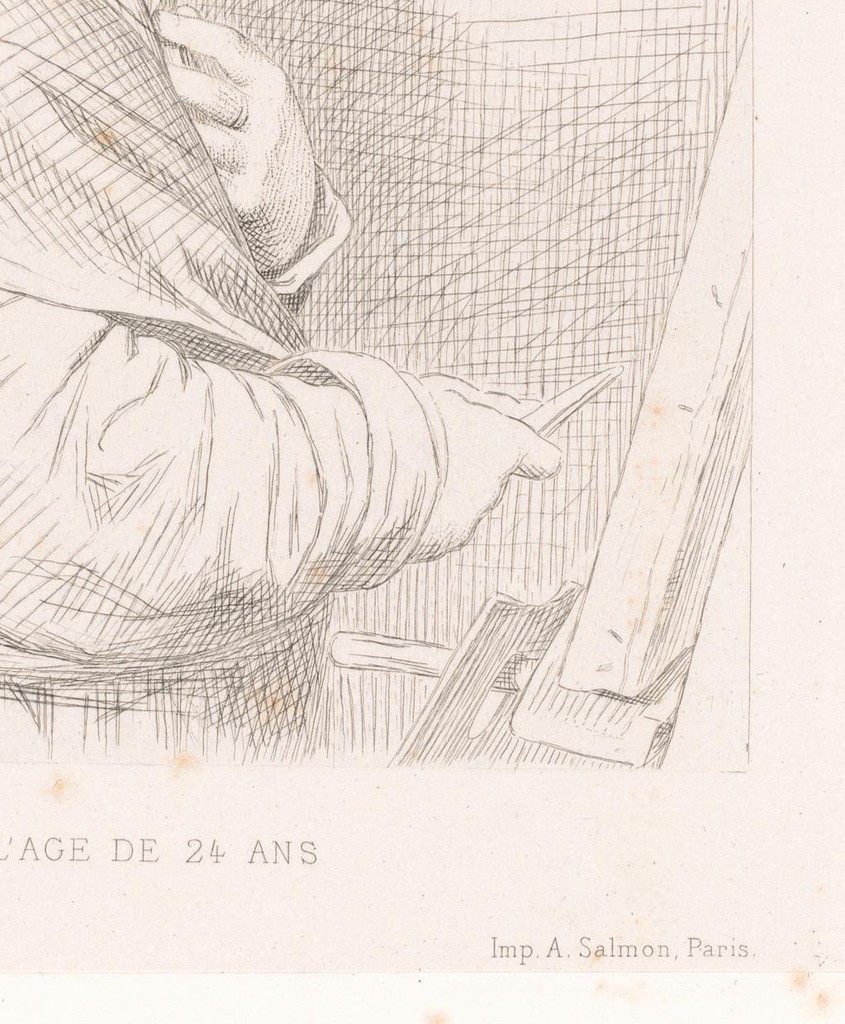
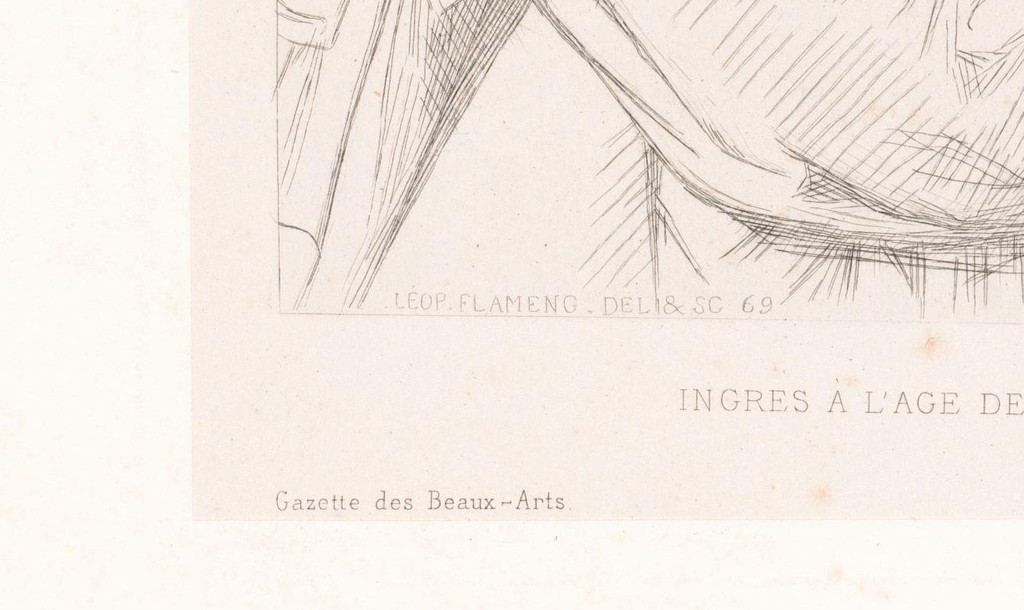
Flameng’s name below the figure
The small printed line below the figure names Flameng and includes the number 69. This belongs to the print’s own record, alongside the larger title beneath the portrait.
The earlier portrait and Julie Forestier’s copy
The young woman who preserved the first composition was an artist herself. Julie Forestier, then engaged to Ingres, made her copy in 1807. It is now in the Musée Ingres Bourdelle in Montauban, inventory MI.2004.3.1. The regional museum record connects its making with Ingres’s own request and records its dispatch to his father, Joseph Ingres, in July that year. [3]
Philip Conisbee’s catalogue entry identifies a letter of 12 January 1807 in which Ingres asked for a small painted or drawn copy, to be undertaken when Julie had time. Her picture preserves a light coat thrown over the shoulder, chalk in the right hand and an extended left arm holding a cloth towards the canvas. That canvas is blank in her version. [4]
These are consequential differences. The outstretched arm makes the early conception more explicitly about an action at the easel. The hand drawn back to the chest gives the present composition a more contained centre. A change in a sleeve or gesture can therefore alter the balance of a portrait without requiring a different face. Forestier’s work makes it possible to recognise that distinction, rather than treating every aspect of the familiar brown-coated figure as a single decision made in youth.
Her copy also had a life beyond its role as evidence. Edgar Degas acquired it on 3 February 1899; the published correction to the 1999 Ingres catalogue establishes that date. At the sale of Degas’s collection in 1918, it was acquired by M. de Chaffardon. [5] The route of a copy through another artist’s collection reminds us that reproduction could carry the presence of a painter whom a later generation wished to study and keep close. Its historical value and its value as a painting can coexist.
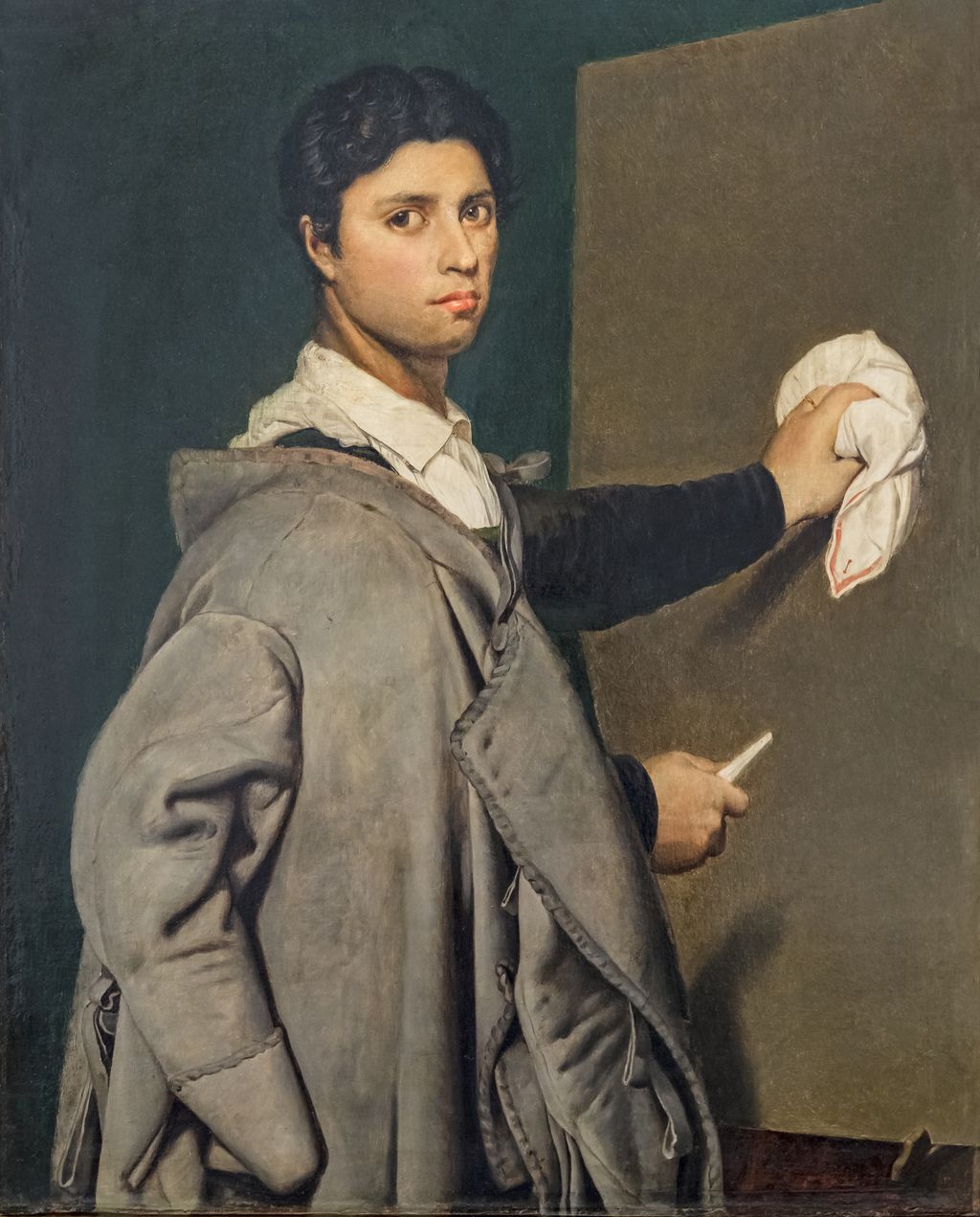
Julie Forestier after Ingres, copy of the earlier Self-Portrait composition, 1807. Musée Ingres Bourdelle, MI.2004.3.1. [6]
How examination confirmed the same canvas
Chantilly’s 2023 press kit reports a 2021 C2RMF examination. Infrared imaging found the earlier coat and extended arm beneath the paint, confirming the altered original. X-rays found a 12 × 16.5 cm canvas inset at lower right. [2] Solvents removed earlier clothing and background; opaque paint covered the abrasion. The easel, thumb, sleeve, collar and left hand changed; the face and left signature remained untouched. [2] The distinction matters when viewing the young face: preservation and revision occur together within one object.
What the first audience saw
The portrait appeared at the Salon of 1806 in its earlier form. [1] We should keep that state in mind when reading its reception. A spectator who saw the pale coat and extended arm encountered a different arrangement of large shapes and gestures from the one now at Chantilly.
Conisbee reproduces an anonymous 1806 critic’s mocking account: the cloth, the apparently empty canvas, the bulky drapery and the painter’s expression all became targets of ridicule. [4] The criticism is useful testimony about what attracted attention, but its language is a judgement made in a particular encounter. It does not supply a neutral description of the artist’s personality. A portrait that concentrates so strongly on a gaze also leaves considerable room for viewers to characterise that gaze differently.
The Musée Condé record also cites Théophile Gautier’s account of 1847, which dwells on the dark brows, abundant hair and forceful eyes. [1] That emphasis directs attention towards the head, the part of the composition that still arrests the viewer most immediately.
By 1855 the work was exhibited again, as Henri Delaborde’s historical catalogue records. [7] Its return to public view belonged to a later phase of its existence, after the major revisions. The dates identify two different encounters with the painting: the early Salon appearance and the later display of an image that Ingres had reshaped. They help explain why the title alone cannot tell us which state a writer or reproduction describes.
The portrait Ingres found hard to surrender
The portrait was difficult for Ingres to surrender. Delaborde’s 1870 catalogue prints a letter he wrote to Frédéric Reiset on 7 April 1860, when the self-portrait passed to Prince Napoléon in exchange for The Turkish Bath. Reiset had negotiated the arrangement. Ingres described the difficulty of parting with a cherished portrait and explained that the prince’s esteem, together with Reiset’s friendship, had made him honour the commitment. [7]
The letter offers something firmer than a guess based on the painted expression: direct, if posthumously published, testimony about the artist’s attachment to this particular object. By then, the portrait had accompanied him across much of his career. His reluctance gives its survival in the studio a personal dimension, but the document does not explain every earlier alteration. Attachment in 1860 and the decision to repaint decades earlier are separate matters.
Delaborde presents the letter within his own account of the exchange. His commentary heightens its emotional force; the artist’s words are the more secure basis for understanding the parting. Even in paraphrase, they complicate the straightforward idea of an artist selling an early work once it has become valuable. Here the exchange required mediation and a promise that Ingres felt bound to fulfil. [7]
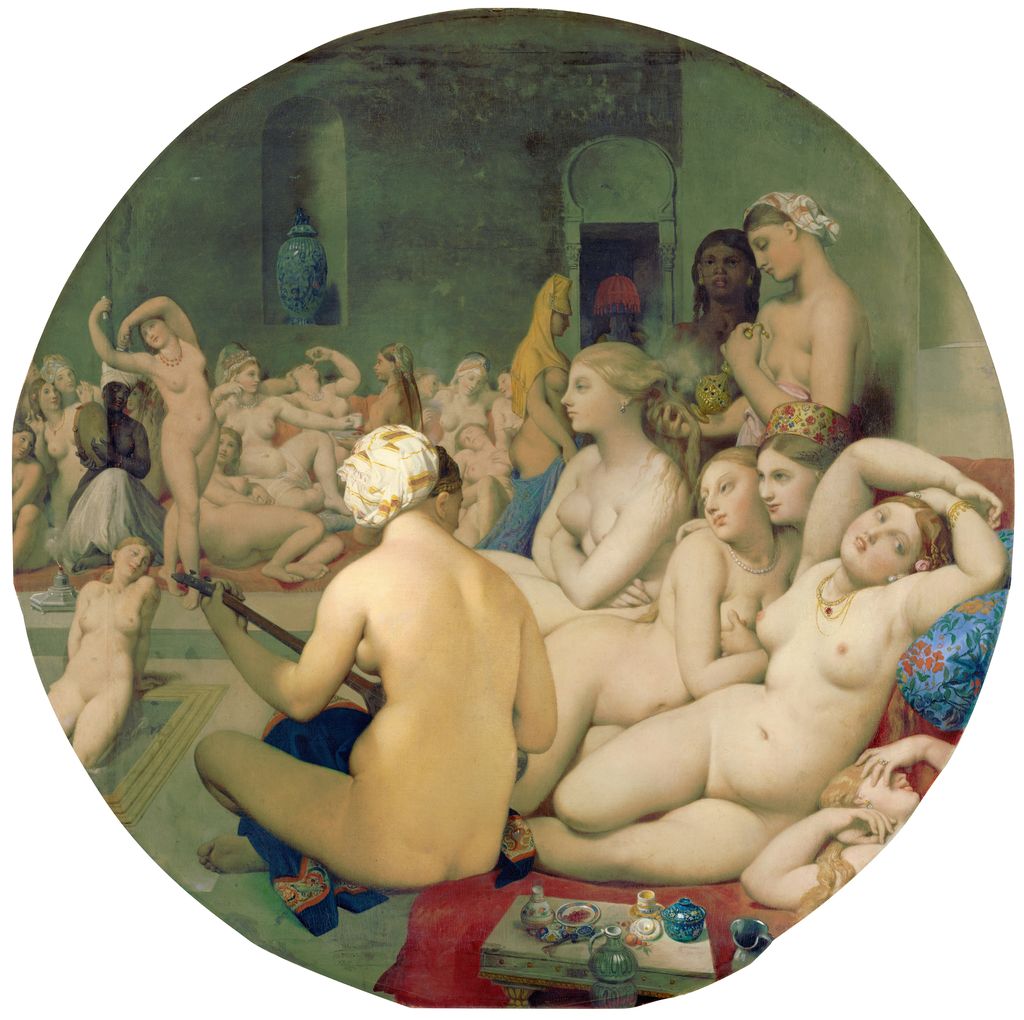
The two paintings make a particularly revealing pair within his career. The self-portrait presents one figure, clothed and close to the viewer, beside the tools of his profession. The Turkish Bath opens a very different imaginative world. Their connection in 1860 is an event in the history of ownership, not evidence that their subjects were intended to explain one another. The exchange brought together works with sharply different appearances because a patron, an intermediary and an artist negotiated over actual pictures. [7]
Reiset subsequently bought the portrait from the prince in 1868, a purchase already recorded by Delaborde. [7] It passed to the duc d’Aumale with the Reiset collection in 1879; the Musée Condé record documents its place in Aumale’s 1886 donation, made with a retained lifetime interest. [1] The journey from the artist’s possession to Chantilly thus involved several distinct collectors. Calling it simply a museum masterpiece can obscure the private negotiations through which it reached its present collection.
Copies, drawings and the life of an image
Forestier’s early copy must also be distinguished from the later version in New York. The Metropolitan Museum of Art identifies Ingres (1780–1867) as a Young Man, about 1850–60, as a painting by Laurence-Augustine Jubé Héquet, accession 43.85.1. It is a copy, rather than the Chantilly original. [8] Delaborde also recorded two pupil copies that Ingres had retouched and that belonged to his widow when he wrote in 1870. His general statement should not erase the individual maker’s name attached to a particular surviving picture. [7]
The portrait’s history in drawings is equally resistant to a simple sequence of preparation followed by finished painting. The Louvre’s tracing-paper self-portrait, RF 3507, has an uncertain date and a dedication to Ingres’s second wife, Delphine. [4] A related sleeve drawing in Montauban, MI.867.274, is associated with this composition, but its relationship to the early painted state does not by itself prove that it preceded the painting. [9] Repeating a figure on paper can preserve, reconsider or transmit an existing image as well as prepare a new one.
Prints extended the portrait’s reach. Léopold Flameng’s etching, dated 1869 in the Rijksmuseum record, is a reproduction after the image; the museum’s impression belongs to an Album de la Gazette des Beaux-Arts issued in 1874. [10] Delaborde mentions Flameng’s undertaking in his catalogue. [7] The names and dates on a print belong to that object’s history, which is distinct from the date inscribed on the painted self-portrait. The distinction is useful whenever the young Ingres appears in a book or online: the familiar likeness may have arrived through another artist’s work.
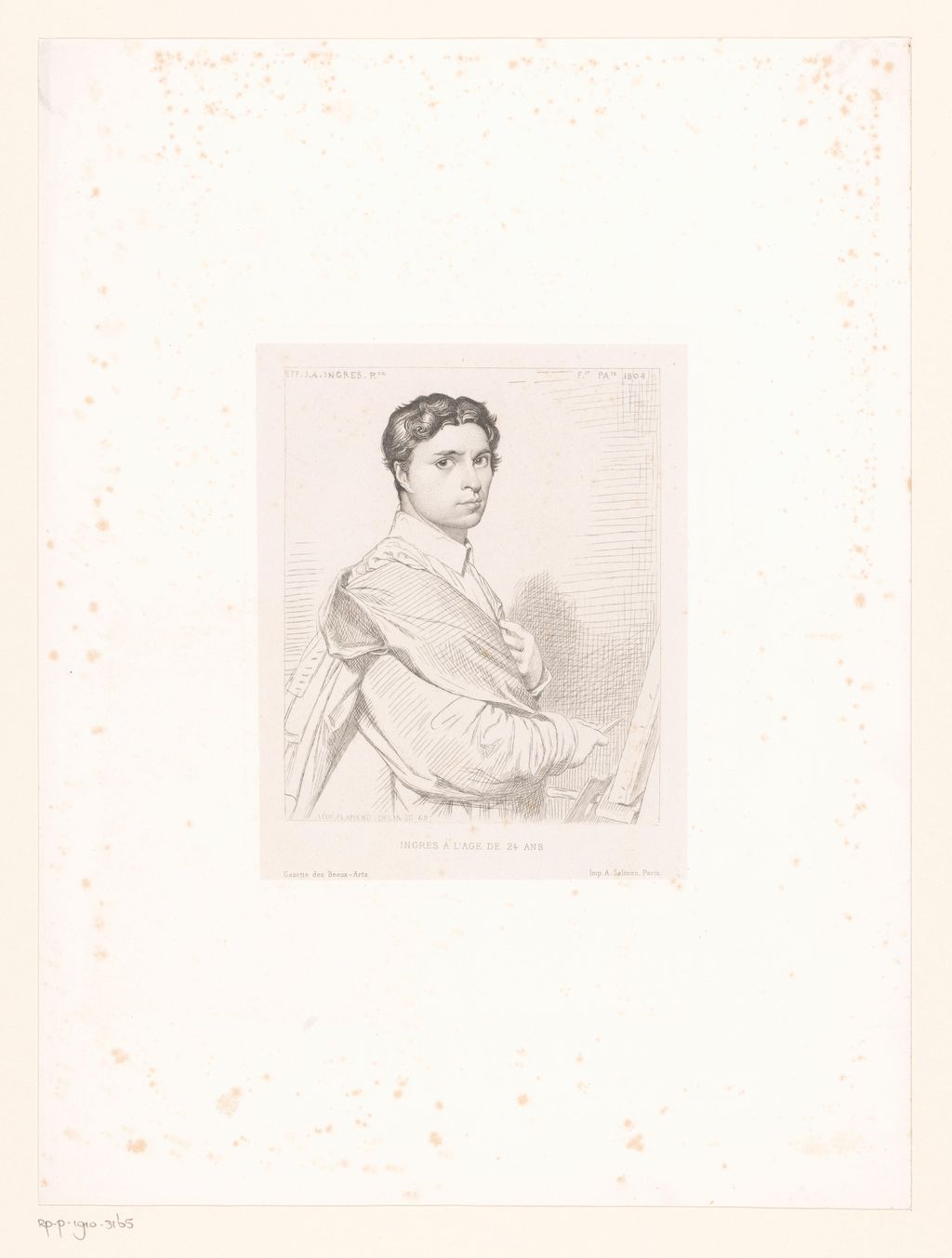
Léopold Flameng after Ingres, Portrait of Ingres Aged 24, 1869. Etching with chine collé; impression from the 1874 Album de la Gazette des Beaux-Arts. Rijksmuseum, Amsterdam, RP-P-1910-3165. [11]
A young likeness with a long history
Return to the small piece of chalk after considering those copies and reproductions. Within the painting it seems ready to make a first mark. Outside it, the likeness has already passed through painting, drawing and print, while the original canvas itself bears the history of substantial revision. That tension gives the image much of its interest: a suspended moment of work has proved capable of being worked upon again.
The pose is economical enough to make this history easy to miss. Face, collar, folded coat and hands read together without announcing their different stages of making. Look again at the narrow white point projecting from the working hand: it is one of the smallest details in the picture, yet it gives the whole figure something to do. The meeting of a carefully composed likeness with an unfinished action keeps the portrait from becoming merely an arrangement of elegant clothes.
Artworks directory
Explore 150 paintings, drawings and an original lithograph. This selection includes related versions and studies; dates distinguish completed works from later revisions.
| Name | Date | Medium |
|---|---|---|
| The Apotheosis of Homer | 1827 | Painting |
| Grande Odalisque | 1814 | Painting |
| The Turkish Bath | 1859–1862 | Painting |
| Madame Moitessier Seated | 1856 | Painting |
| Portrait of Monsieur Bertin | 1832 | Painting |
| Napoleon I on His Imperial Throne | 1806 | Painting |
| Odalisque with Slave | 1839 | Painting |
| The Ambassadors of Agamemnon in the Tent of Achilles | 1801 (competition) | Painting |
| The Valpinçon Bather | 1808 | Painting |
| The Source | 1856 | Painting |
| Oedipus Explaining the Enigma of the Sphinx | 1808; revised probably before 1827 | Painting |
| The Vow of Louis XIII | 1824 | Painting |
| Antiochus and Stratonice | 1840 | Painting |
| The Comtesse d’Haussonville | 1845 | Painting |
| The Princesse de Broglie | 1851–1853 | Painting |
| Jupiter and Thetis | 1811 | Painting |
| The Dream of Ossian | 1813 | Painting |
| The Martyrdom of Saint Symphorian | 1834 | Painting |
| Venus Anadyomene | 1808–1848 | Painting |
| Portrait of Madame de Senonnes | 1814 | Painting |
| Madame Rivière | 1805 | Painting |
| Mademoiselle Caroline Rivière | 1805 | Painting |
| Portrait of Philibert Rivière | 1805 | Painting |
| Bonaparte First Consul | 1804 | Painting |
| The Death of Leonardo da Vinci | 1818 | Painting |
| Joan of Arc at the Coronation of Charles VII | 1854 | Painting |
| Madame Duvaucey | 1807 | Painting |
| La Belle Zélie | 1806 | Painting |
| Madame Panckoucke | 1811 | Painting |
| Portrait of Charles Marcotte d’Argenteuil | 1810 | Painting |
| Joseph Antoine Moltedo | c.1810 | Painting |
| Madame Leblanc | 1823 | Painting |
| Delphine Ingres-Ramel (Portrait of Madame Ingres) | 1859 | Painting |
| Portrait of Amédée de Pastoret | 1823–1826 | Painting |
| Portrait of Baronne de Rothschild | 1848 | Painting |
| Madame Marcotte de Sainte Marie | 1826 | Painting |
| Madame Gonse | 1852 | Painting |
| Aretino in the Studio of Tintoretto | 1848 | Painting |
| Don Pedro of Toledo Kissing Henry IV’s Sword | 1831/1832 | Painting |
| Raphael and La Fornarina | 1814 | Painting |
| Roger Freeing Angelica | 1819 | Painting |
| Romulus’ Victory over Acron | 1812 | Painting |
| Self-Portrait at the Age of Twenty-Four | 1804; revised 1841–1851 | Painting |
| Male Torso | c.1800 | Painting |
| Odalisque in Grisaille (Ingres and workshop) | c.1824–1834 | Painting |
| The Small Bather | 1826 | Painting |
| The Little Bather Harem Interior | 1828 | Painting |
| Jesus Among the Doctors | 1862 | Painting |
| The Virgin Adoring the Host | 1852 | Painting |
| The Virgin of the Host | 1841 | Painting |
| Virgin of the Adoption | 1858 | Painting |
| Paolo and Francesca | 1814 | Painting |
| Homer Deified (revised composition, Louvre RF5273) | 1865 | Drawing |
| Odalisque with Slave (Louvre RF4622) | 1858 | Drawing |
| Odalisque (Walters Art Museum; Ingres and Paul Flandrin) | 1842 | Painting |
| Madame Moitessier Standing (National Gallery of Art) | 1851 | Painting |
| Jacques-Louis Leblanc (The Metropolitan Museum of Art) | 1823 | Painting |
| Ferdinand-Philippe, Duke of Orléans (Louvre RF2005-13) | 1842 | Painting |
| Ferdinand-Philippe, Duke of Orléans (Versailles MV5207; Ingres and workshop) | 1843 | Painting |
| Ferdinand-Philippe, Duke of Orléans (Versailles MV5209; Ingres and workshop) | 1844 | Painting |
| Antiochus and Stratonice (Musée Fabre; Ingres and Raymond Balze) | 1866 | Painting |
| Antiochus and Stratonice (Kunstmuseum Bern, Gurlitt bequest) | Undated (early dating proposed) | Drawing |
| Composition study for Antiochus and Stratonice (MIB867.2193) | 1806 | Drawing |
| Study for the Figure of Stratonice (Met63.66) | 1834–1840 | Graphite, black chalk and charcoal |
| Nude figure study for Stratonice (Boijmans F II 36 PK) | c.1834–1840 | Drawing |
| Paolo and Francesca (The Barber Institute,54.6) | c.1814–1820 | Painting |
| Paolo and Francesca (The Hyde Collection,1971.24) | c.1855–1860 | Painting |
| Paolo and Francesca (Amsterdam Museum TA10970) | 1820 | Drawing |
| Paolo and Francesca (dedicated to Artaud de Montor) | 1816 | Drawing |
| Study for the Bust of Francesca (MIB867.1398) | 1819 | Drawing |
| Study for the Bust of Francesca (MIB867.1396) | 1819 | Drawing |
| The Archangel Raphael, first idea (MIB867.2488) | 1842 | Drawing |
| The Archangel Raphael (MIB867.2500) | 1842 | Drawing |
| The Archangel Raphael Carrying Human Prayers to God (Chantilly DE513) | 1844 | Drawing |
| Louis-Philippe as Saint Philip, stained-glass study | 1844 | Drawing |
| Marie Frédéric Eugène de Reiset (Ford Collection RBF171-2) | 1844 | Drawing |
| Virgil Reading the Aeneid (Toulouse) | Begun 1811 | Painting |
| Tu Marcellus Eris (Brussels, inv. 1836) | c.1814 (museum dating) | Painting |
| Jean-François Gilibert | 1804 | Painting |
| François-Marius Granet | 1807 (museum dating) | Painting |
| Count Nikolai Dmitrievich Guryev | 1821 | Painting |
| Caroline Murat, Queen of Naples | 1814 | Painting |
| Count Mathieu Molé | 1834 | Painting |
| Cherubini and the Muse of Lyric Poetry (Louvre) | 1842 | Painting |
| Luigi Cherubini (Cincinnati) | 1841 | Painting |
| Comtesse de Rayneval (Louvre RF4505) | 1841 | Drawing |
| Venus on Paphos (Antonie Balaÿ) | c.1852 | Painting |
| Prince Napoléon | 1855 | Painting |
| Study for The Apotheosis of Napoleon I (Petit Palais) | Late 1853 | Painting |
| The Apotheosis of Napoleon I (destroyed ceiling) | 1853 | Painting |
| The Journalist (MIB867.2733) | 1834? | Drawing |
| Henry VIII, after Holbein | c.1815–1820 (?) | Drawing |
| Madame Récamier, after David (MIB867.3637) | Undated (early Paris period) | Drawing |
| Study for Comtesse d’Haussonville (MIB867.259; background possibly by another hand) | 1842–1845 | Drawing |
| La Source (reduced version reported by Delaborde) | Date unrecorded; reported 1870 | Painting |
| Odalisque (autograph lithograph,NGA1946.21.117) | 1825; published1826 | Lithograph |
| Portrait of a Seated Lady | 1814 | Graphite |
| The Kaunitz Sisters (Leopoldine, Caroline, and Ferdinandine) | 1818 | Graphite |
| Portrait of a Man | 1814 | Graphite |
| Study for the Portrait of Louis-François Bertin (1766–1841) | n.d. | Black chalk and graphite |
| Studies for the Cadaver of Acron | ca. 1810–12 | Graphite on wove paper |
| Study for the Drapery of Molière in "The Apotheosis of Homer" | n.d. | Black chalk with stumping |
| Madame Guillaume Guillon Lethière, née Marie-Joseph-Honorée Vanzenne, and her son Lucien Lethière | 1808 | Graphite |
| Niccolò Paganini (1782–1840) | ca. 1830 | Counterproof or tracing strengthened with graphite and gouache on translucent paper |
| Lady Mary Cavendish-Bentinck (?-1843) | 1816 | Graphite |
| Madame Alexandre Lethière and Her Daughter Letizia | ca. 1815 | Graphite |
| Merry Joseph Blondel (1781–1853) | 1809 | Graphite |
| Ursin-Jules Vatinelle (1798–1881) | 1820 | Graphite |
| Bust of a Gypsy Girl (ascribed to Ingres) | 1819 | Graphite on wove paper |
| Study of a Seated Nude Male | n.d. | Graphite |
| The Archangel Raphael (Study for a stained-glass window in the chapel of Notre-Dame de la Compassion-Saint-Ferdinand, Neuilly) | ca. 1842 | Graphite |
| Lancelot-Théodore, comte Turpin de Crissé | probably 1818 | Graphite |
| Study for the Figure of the Iliad in "The Apotheosis of Homer" | ca. 1827 | Graphite and black chalk heightened with white chalk on brown paper |
| Comtesse Turpin de Crissé | probably 1818 | Graphite |
| Nude Figures for L'Âge d'Or, Château de Dampierre | n.d. | Graphite on brownish paper |
| Study of Figures (attributed to Ingres) | n.d. | Graphite |
| Study of Figures (attributed to Ingres) | n.d. | Graphite; squared in graphite |
| Admiral Sir Fleetwood Broughton Reynolds Pellew | 1817 | Graphite on wove paper |
| Madame Jean-Auguste-Dominique Ingres, née Madeleine Chapelle | 1814 | Graphite on off-white wove paper |
| Virgil Reading the Aeneid to Augustus, Livia, and Octavia | 1809/1819 (?) | Pen and black ink, graphite, brush and gray wash, white gouache heightening, Conté crayon on blue paper |
| General Louis-Étienne Dulong de Rosnay | 1818 | Graphite (hard and soft pencils) |
| Madame Alexandre Lethière, née Rosa Meli, and Her Daughter, Letizia | 1815 | Graphite |
| The Lawyer Paul Grand | 1834 | Graphite |
| Jean-Joseph Fournier | 1815 | Graphite |
| Armand Bertin | 1842 | Graphite |
| Madame Armand Bertin, née Marie-Anne-Cécile Dollfuss | 1843 | Graphite |
| The Architect Charles-Victor Famin | 1836 | Graphite |
| Henri Lehmann | 1850 | Graphite |
| Portrait of a Lady | ca. 1815–17 | Graphite |
| Edmond Cavé (1794–1852) | 1844 | Oil on canvas |
| Head of Saint John the Evangelist | probably ca. 1818–20 | Oil on canvas, laid down on wood |
| Madame Edmond Cavé (Marie-Elisabeth Blavot, ca. 1806–1883) | ca. 1831–34 | Oil on canvas |
| Madame Félix Gallois | 1852 | Graphite with touches of gold in oil to highlight jewelry, on buff wove paper. |
| Dr. François Mêlier | 1849 | Graphite with graphite framing lines, corrected with white, on buff wove paper |
| Portrait of Madame Rhode (Rhoda?) | 1810–20 | Graphite on pale buff wove paper |
| Study for "Raphael and the Fornarina"(?) | ca. 1814(?) | Graphite on white wove paper |
| Portrait of Madame Paul Meurice, née Palmyre Granger | ca. 1845–50 | Graphite on wove paper |
| Alexander the Great presenting Campaspe to Apelles | 1810 | Graphite, brush and brown wash; squared in graphite |
| Study of Hands for "Christ Among the Doctors" | 1852–62 | Graphite on tracing paper |
| Study for The Turkish Bath (RF34502) | about 1850 | Pen and brown ink with graphite, partially squared |
| Study for The Turkish Bath (RF23354) | Undated | Pen and brown ink with graphite on joined sheets |
| Study for The Turkish Bath (RF54702) | about 1859 | Pen and brown ink |
| Studies of women for The Turkish Bath (RF12292) | Undated | Black chalk |
| Achilles Receiving the Envoys of Agamemnon (Nationalmuseum sketch, NM2161) | 1801 | Oil on wood |
| Half-Length Bather (Musée Bonnat-Helleu,89) | 1807 | Oil on canvas |
| Oedipus and the Sphinx (National Gallery,NG3290) | about1826 | Oil on canvas |
| Oedipus and the Sphinx (Walters,37.9) | 1864 | Oil on canvas |
| Oedipus and the Valpinçon Bather, after David (MI.867.2035) | Undated | Graphite on tracing paper, after David |
| Study of the Virgin for The Vow of Louis XIII (Dijon,1758) | about1822 | Black chalk, stump and white chalk on brown wove paper |
| First Thought for The Vow of Louis XIII (MI.885.11.21) | 1822 | Oil on canvas |
Frequently Asked Questions
The date 1804 identifies its beginning. Ingres substantially revised the same canvas in 1841–51. [2]
He holds white chalk in his right hand. His left hand rests against his chest; the earlier arrangement preserved by Forestier showed that arm extended towards the canvas with a cloth. [4]
Discussion
Look again at the images and ideas explored in Self Portrait Aged 24. These editorial prompts invite your observations.
Reader Insights
Follow the picture first from the eyes to the chalk, then from the coat’s broad folds to the hand at the chest. Which route makes the painter seem more absorbed in his work, and which makes you more conscious of being looked at?
Compare the present portrait with Julie Forestier’s copy of the earlier composition. Which change most alters the way the artist presents himself at work?
How does knowing that the same canvas contains decisions from widely separated years change your reading of its youthful face?
Join the Conversation
Share a detail, comparison or question about Self Portrait Aged 24 below.
References
- Musée Condé, Portrait d’Ingres par lui-même à l’âge de vingt-quatre ans. Collection record, PE 430; description, technique, inscriptions and provenance. (in French) View source.
- Musée Condé / Château de Chantilly, Ingres: The Artist and His Princes, exhibition press kit. May 2023, pp. 17–19 and 44–45; report of the 2021 C2RMF examination. This is the museum’s published summary of the technical research. View source.
- Musées Occitanie / Musée Ingres Bourdelle, Le Portrait de Jean-Auguste-Dominique Ingres. Julie Forestier, 1807, MI.2004.3.1; object record and account of the copy’s dispatch. (in French) View source.
- Philip Conisbee, Catalogue entries 11–12, in Gary Tinterow and Philip Conisbee, eds, Portraits by Ingres: Image of an Epoch. New York: Metropolitan Museum of Art, 1999, pp. 72–76, especially p. 74 and notes 1, 3, 5–6 on p. 75; anonymous Salon criticism quoted through this catalogue. View source.
- Gary Tinterow, Charlotte Hale and Eric Bertin, ‘Portraits by Ingres: Reflections, Technical Observations, Addenda, and Corrigenda’. Metropolitan Museum Journal 35 (2000), pp. 193–219; correction to catalogue entry 11, p. 210. View source.
- Supporting image. Julie Forestier after Ingres, copy of the earlier Self-Portrait composition, 1807. Musée Ingres Bourdelle, MI.2004.3.1. Photograph: Didier Descouens; Wikimedia Commons. Image source. CC BY-SA 4.0. Resized and JPEG-optimised; image derivative licensed CC BY-SA 4.0.
- Henri Delaborde, Ingres, sa vie, ses travaux, sa doctrine, d’après les notes manuscrites et les lettres du maître. Paris: Henri Plon, 1870, catalogue no. 129, pp. 251–252; includes Ingres’s letter to Reiset of 7 April 1860. Posthumous documentary compilation. (in French) View source.
- Metropolitan Museum of Art, Ingres (1780–1867) as a Young Man. Laurence-Augustine Jubé Héquet, about 1850–60, accession 43.85.1; current object information. View source.
- Musée Ingres Bourdelle, Manche du bras droit tendu. Graphite on paper, MI.867.274; relationship to the self-portrait. (in French) View source.
- Rijksmuseum, Portret van Jean-August-Dominique Ingres op 24-jarige leeftijd. Léopold Flameng, 1869, etching with chine collé, RP-P-1910-3165; record identifies the Album de la Gazette des Beaux-Arts, third series, Paris, 1874. (in Dutch) View source.
- Supporting image. Léopold Flameng after Ingres, Portrait of Ingres Aged 24, 1869. Etching with chine collé; impression from the 1874 Album de la Gazette des Beaux-Arts. Rijksmuseum, Amsterdam, RP-P-1910-3165. Image source. Public domain.
- Splash image. Jean-Auguste-Dominique Ingres, Self Portrait Aged 24, begun 1804, reworked 1841–51. Oil on canvas. Musée Condé, Chantilly, PE 430. Google Art Project via Wikimedia Commons. Image source. Public domain.