by Tom Gurney
Tom Gurney BSc (Hons) is an art history expert with over 20 years experience
Email: tomgurney1@gmail.com / Phone: +44 7429 011000
Style and Technique
The blue satin in The Princesse de Broglie commands attention. Its pale reflections spread across the skirt, while lace, pearls and bare arms interrupt the strong colour. The grey wall seems to offer a quiet background. Hale found deep blue beneath Broglie’s grey wall. [1]
Ingres’s paintings repeatedly invite this double way of looking. Their finished surfaces offer firm contours, convincing fabrics and faces that seem exceptionally composed. Looking from a complete picture to a detail, then back again, helps connect a single arm or fold with the arrangement of the whole.
At a Glance
- DrawingIngres’s definition included expression, internal form, planes and modelling, as well as outlines. [2]
- Preparationdistinguish the support, the ground and the later paint layers. [3]
- Transferan incised outline can preserve evidence of transfer between surfaces. [4]
- Colour and revisioncompare a visible effect with a documented change.
- Collaborationuse the work-specific museum credits below. [5][6][7]
Contents
- What Ingres meant by drawing
- Building a surface: support, ground and paint
- From a study to the canvas
- Colour within the construction
- Revision beneath an assured image
- What technical imaging can reveal
- Proportion, detail and constructed space
- A studio with several kinds of contribution
- Repetition, photography and further invention
- Annotated details
What Ingres meant by drawing
“Drawing does not simply mean reproducing contours.” In this statement, published in Henri Delaborde’s Ingres in 1870, the artist’s idea of drawing extends to expression, inner form, planes and modelling. The quotation is translated here from French. Delaborde assembled his book after Ingres’s death from notes and letters; it is an edited collection of his thinking, rather than a treatise he prepared for publication. [2]
That expansive definition changes how we look at the pictures. An outline separates an arm from the background, but modelling makes the arm appear rounded through transitions of light and shade. A plane is a surface facing in a particular direction: the cheek turning away from us, for example, or the broad front of a folded dress. Ingres grouped such decisions within drawing. His emphasis on it consequently included much of the work required to organise a painting in depth.
In Broglie’s portrait, follow the arm that crosses her waist. Its outer curve is easy to trace, yet its weight depends equally on the shadow between the forearms and the gradual movement from light into shade. Compare this with the lace sleeve, where tiny shapes expose fragments of flesh. Broad modelling and minute description coexist. The drawing principle operates at both scales.
Delaborde also records advice to keep drawing with the eyes when a pencil is unavailable. Looking itself becomes a form of practice: judging proportions, noticing the turn of a head, comparing the relative size of forms. His musical analogy develops a related idea. He suggests that painters would benefit from being musicians, then compares rightness of form with rightness of pitch, where a small excess or shortfall disturbs the harmony. These remarks describe a demanding sense of relationships, rather than a method confined to hard outlines. [2]
Elsewhere, Delaborde records Ingres explaining the purpose of studying antiquities and earlier painters: their works train the student to see nature. Copying a master is presented as an education of the eye, extending what can be recognised in the living model. [2] This helps connect his respect for inherited forms with his close attention to a particular arm or fold of fabric. A classical example and an observed detail could inform the same design.
These statements help explain the paintings without supplying a complete recipe for them. Ingres’s statements can sound absolute; his materials show choices made for particular circumstances. The fuller selection of his remarks on the Quotes page provides their broader context.
Building a surface: support, ground and paint
A painting begins before the recognisable image. Canvas and wood can serve as supports. A ground is a preparatory layer placed on that support to receive paint; it should be distinguished from both the support and the paint that follows. The National Gallery of Art’s technical glossary makes these stages explicit. [3] Glazing uses transparent paint to influence colours below; scumbling uses partly covering, more opaque paint. Neither term is another name for the ground. [3]
A portrait pair with different beginnings
Hale found different preparations in the Leblanc pair: the red-brown layer extends across his portrait, but only behind Madame Leblanc’s figure. [1] Placed beside each other, the pictures have obvious family resemblances. Black clothing surrounds pale flesh, gold chains sweep across the bodies, and richly patterned textiles bring colour into the foreground. Yet their dark passages do not all behave alike. Madame Leblanc’s sleeves and bodice allow fine distinctions between soft fabric, gathered folds and transparent lace. Monsieur Leblanc’s great expanse of coat establishes a broader, heavier mass. Their shared portrait language accommodates different material foundations. An imprimatura is a thin, translucent coloured layer applied over a ground. It can serve as a middle tone before further paint is applied. [8]
Smoothness does not measure time
In La Belle Zélie, the dark curls make a sharply patterned edge against the pale forehead and sky. Her shawl, necklace and rounded face have distinct surfaces, despite the quiet transitions within each. Look at those boundaries before deciding what the smooth appearance tells you about the making of the picture.

Ingres, La Belle Zélie, 1806. [9]

Ingres, Madame Leblanc, 1823. [10]
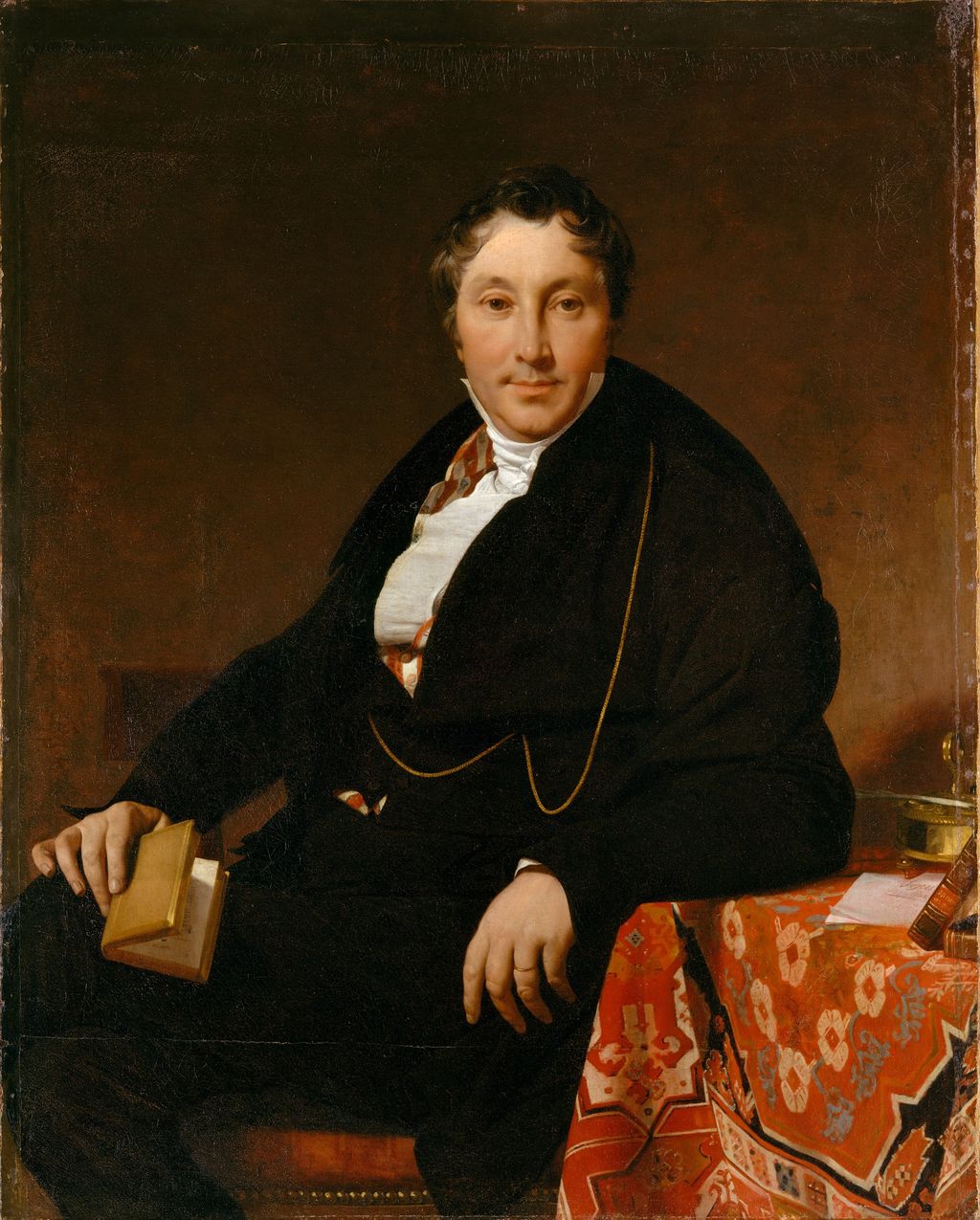
Ingres, Jacques-Louis Leblanc, 1823. The Metropolitan Museum of Art, 19.77.1. [11]
From a study to the canvas
The drawings shown here make preparation visible. Compare a complete sheet with its enlarged details before considering the painting to which it relates.
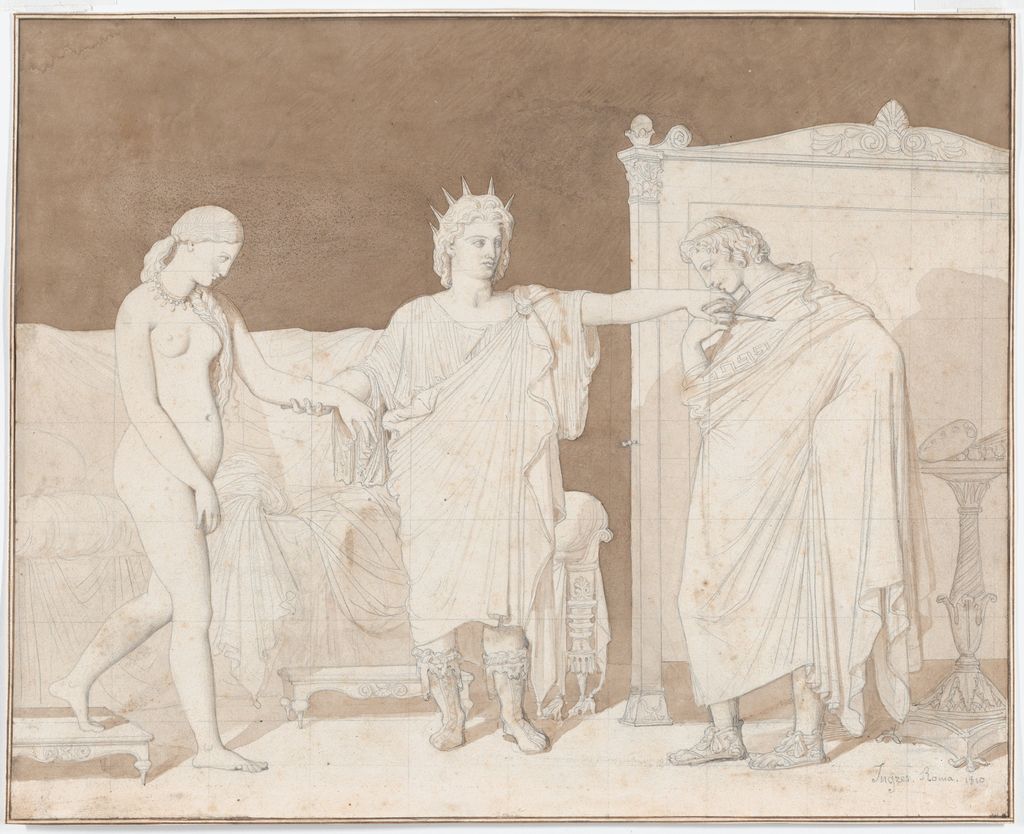
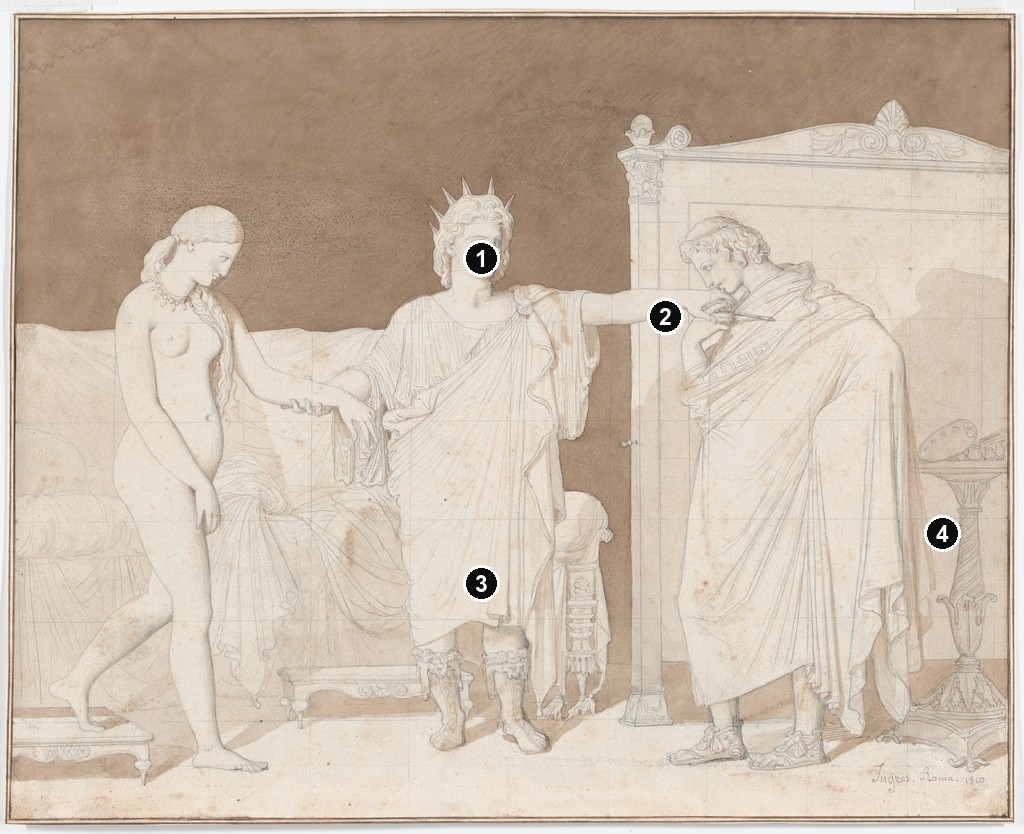
Ingres, Alexander the Great Presenting Campaspe to Apelles, 1810. Graphite and brown wash, squared in graphite. The Metropolitan Museum of Art, 2017.711.2. [12]
In the Alexander drawing, fine horizontal and vertical lines divide the field into rectangles. Follow one line past the heads, then another across the space between the bodies. The grid and the figures share the same page, allowing the placement of each form to be compared with those intersecting lines. Hale found a partial transfer grid in Madame de Senonnes, with lines 17 centimetres apart. [1] Senonnes’s shawl and cuff include ornament incised into wet paint. [1] Broglie’s nude and dressed studies share grids; a full-scale arm tracing aided transfer. [1]
In the finished Broglie portrait, one forearm crosses the blue skirt while the other descends along the chair. Follow each bare arm to see where pale skin meets lace, satin or yellow upholstery. Those boundaries make the body’s position legible within the mass of fabric.
A drawing made to travel between surfaces
The Metropolitan Museum’s Study for the Figure of Stratonice, dated 1834–40, makes the practical life of a sheet unusually clear. It combines graphite, black chalk and rubbed charcoal, and the museum records that some contours were incised for transfer. At 49.3 × 32 centimetres, it is a substantial study, capable of resolving the drapery in detail. Incision means that a pointed tool has pressed along selected lines, leaving physical evidence of the transfer process. [4]
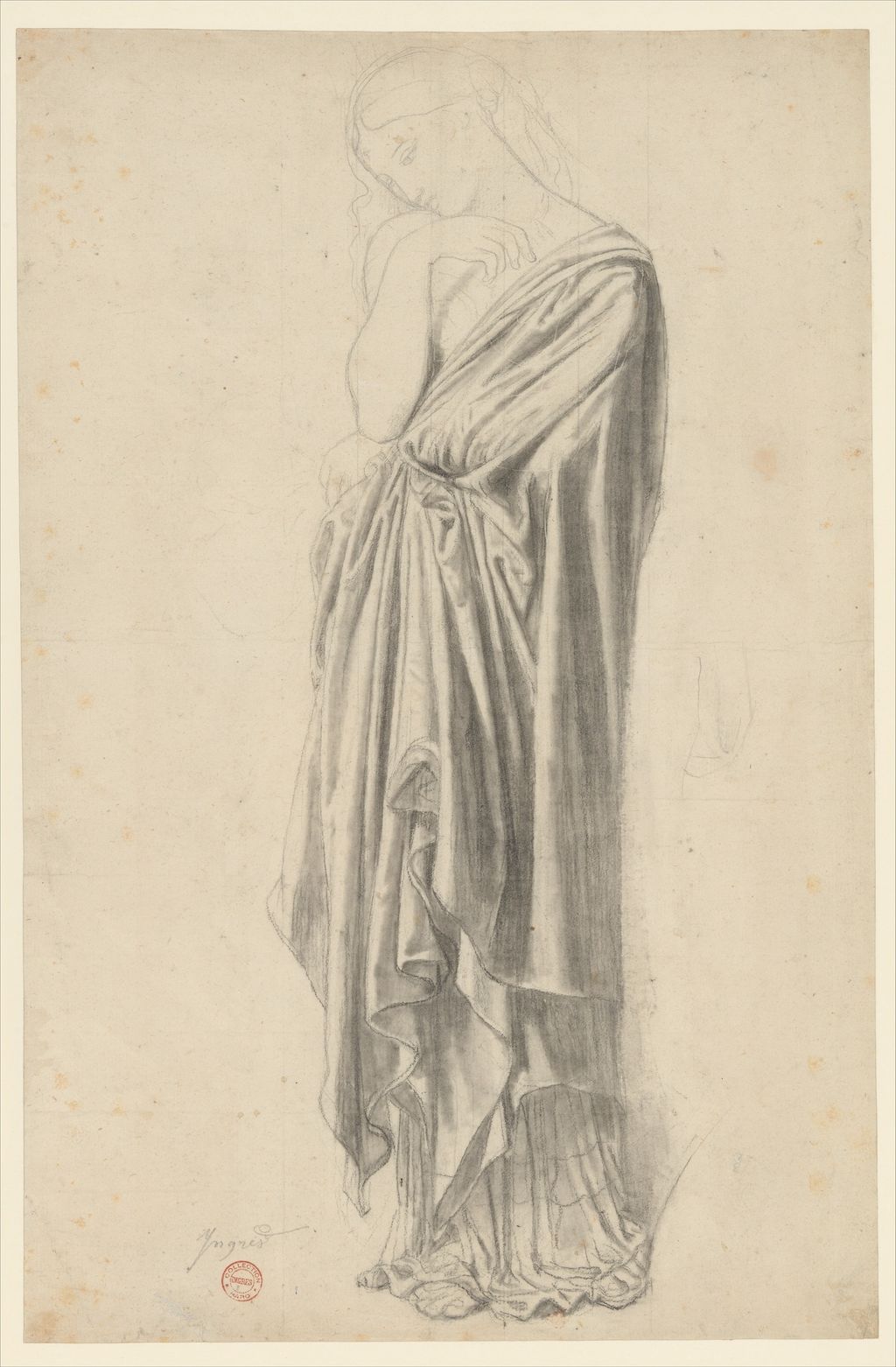
Ingres, Study for the Figure of Stratonice, 1834–40. The Metropolitan Museum of Art, 63.66. [13]
On the sheet, the face and raised hand remain lightly described while the hanging fabric receives deep shading. Long folds converge at the belt, spread across the upper body and descend towards the feet. The contrasting degrees of finish direct attention to the garment’s structure. Rubbed dark passages give it weight, while the pale paper supplies the lights. This is drawing as modelling as well as contour, and as a working object as well as an image.
Such evidence needs a little restraint. An incised outline on one sheet does not establish that every contour in every Ingres painting was mechanically copied. Likewise, the warning about reliance on compasses recorded by Delaborde concerns the insufficiency of measurement without seeing. It cannot reasonably be turned into a ban on all practical aids. [2][4]
Annotated Details from Line, tone and colour
The numbered points identify visible features discussed in this article. Return from each detail to the whole composition. Each caption identifies the work shown.
Alexander, Campaspe and Apelles
Ingres, Alexander the Great Presenting Campaspe to Apelles, 1810. Graphite and brown wash, squared in graphite. The Metropolitan Museum of Art, 2017.711.2. Bequest of Saretta Barnet, 2017. Image source. CC0 / Public domain.
Head of Saint John the Evangelist
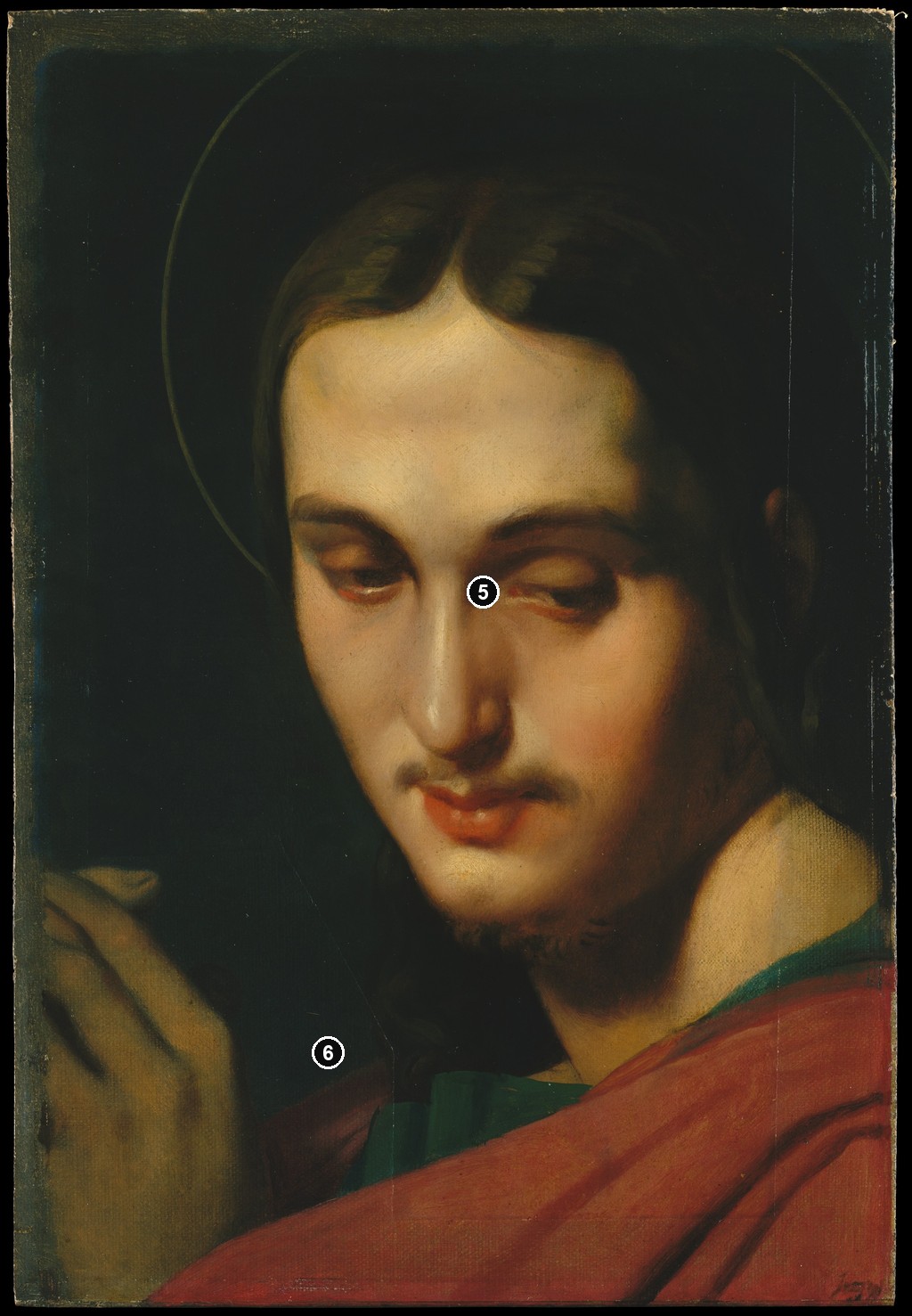
Ingres, Head of Saint John the Evangelist, probably c. 1818–20. The Metropolitan Museum of Art, 1985.118. Catharine Lorillard Wolfe Collection, Purchase, Bequest of Catharine Lorillard Wolfe, by exchange, and Wolfe Fund, 1985. Image source. CC0 / Public domain.
Details from LINE, TONE AND COLOUR
Compare the visible grid and contrasting pale figures in the Alexander drawing with the modelling and coloured cloth of the separate Saint John head. These details show visible features; they do not identify hidden layers or a complete sequence of work.
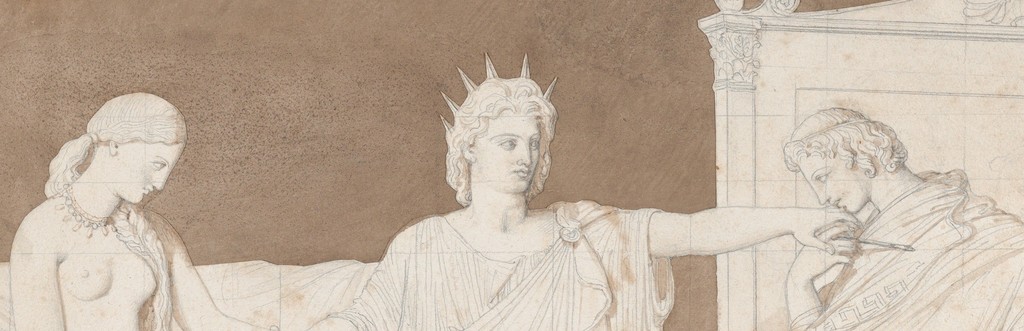
Alexander, Campaspe and Apelles
Three heads across the pale figures
The three heads occupy different heights across the pale figures. Fine horizontal and vertical lines continue through the surrounding design, while the brown field sets the figures apart.
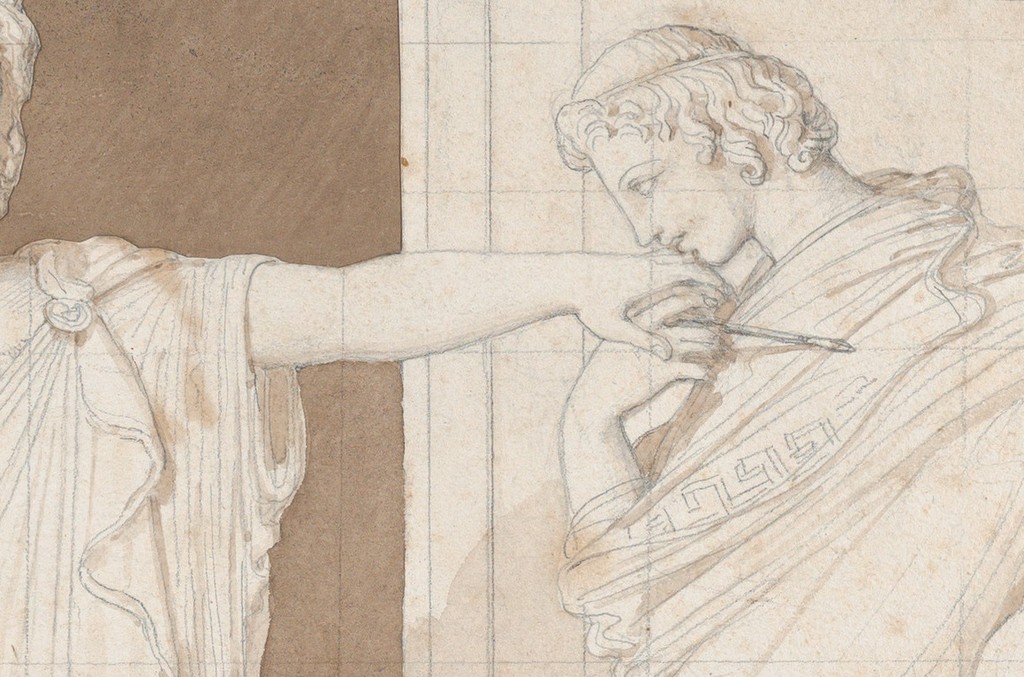
The extended arm meeting the painter’s hand
The central figure extends an arm towards the painter’s hand and slender implement. These small overlapping shapes bridge the space between the standing figures.
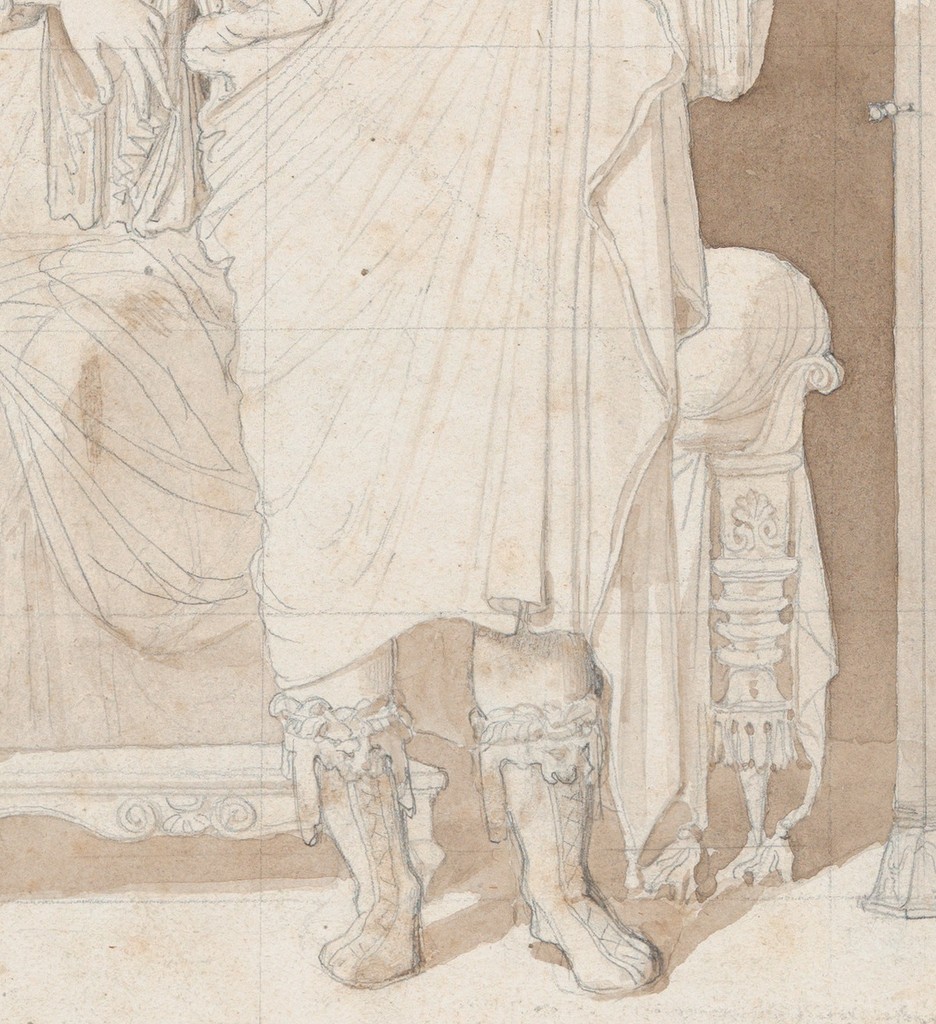
The hanging cloth and decorated boots
Long folds descend towards the central figure’s decorated boots. Curving hems and ornamental straps give the lower part of the figure a more crowded pattern.
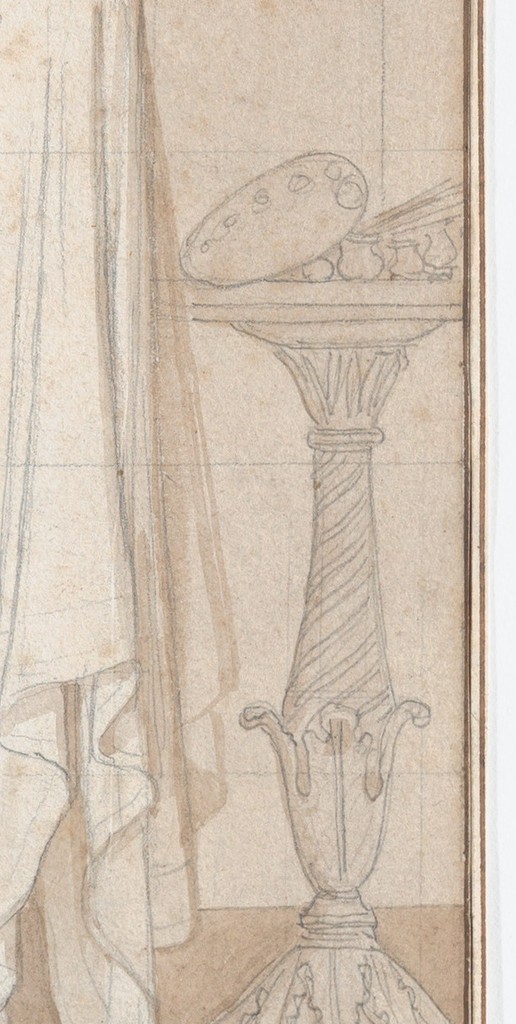
The palette beside the standing painter
An oval palette rests beside the standing painter and the tall support. Its rounded edge contrasts with the straight upright frame and the many curved folds of the garment.
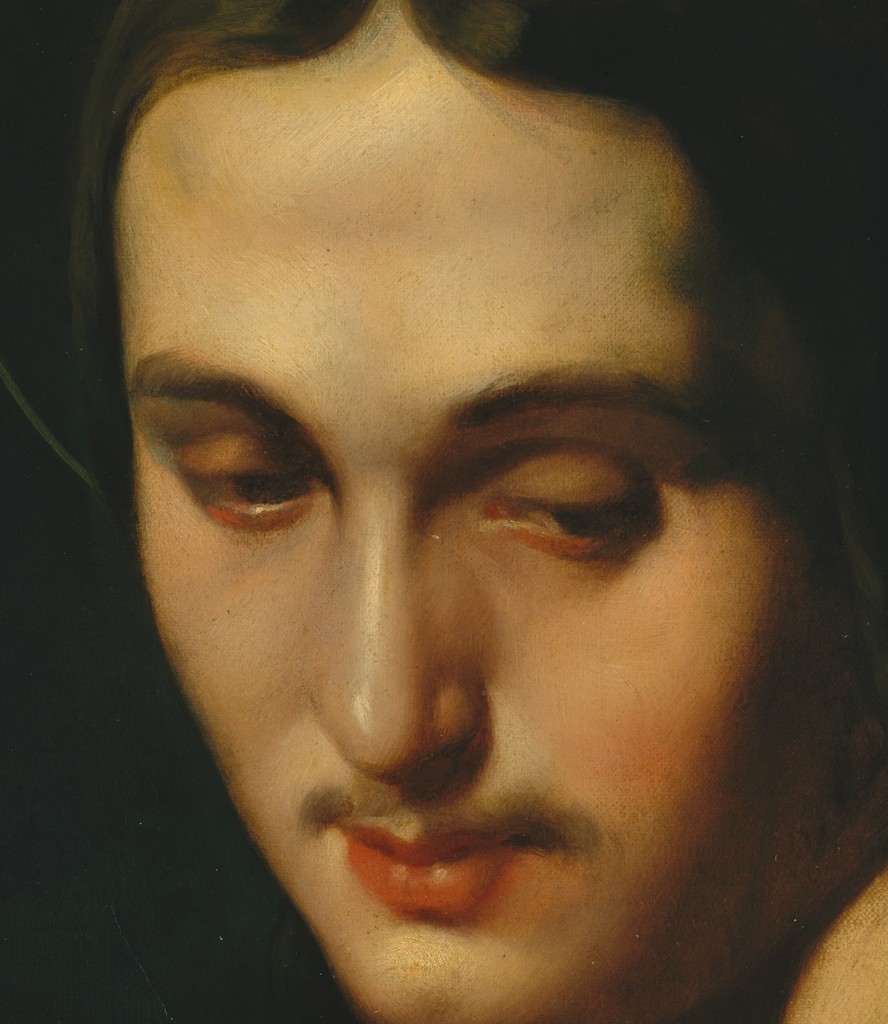
Head of Saint John the Evangelist
Lowered eyes within a dark surround
The lowered eyes sit within a pale face surrounded by dark hair and background. Follow the changes of light along the brow, nose and cheek rather than treating the face as an outline alone.
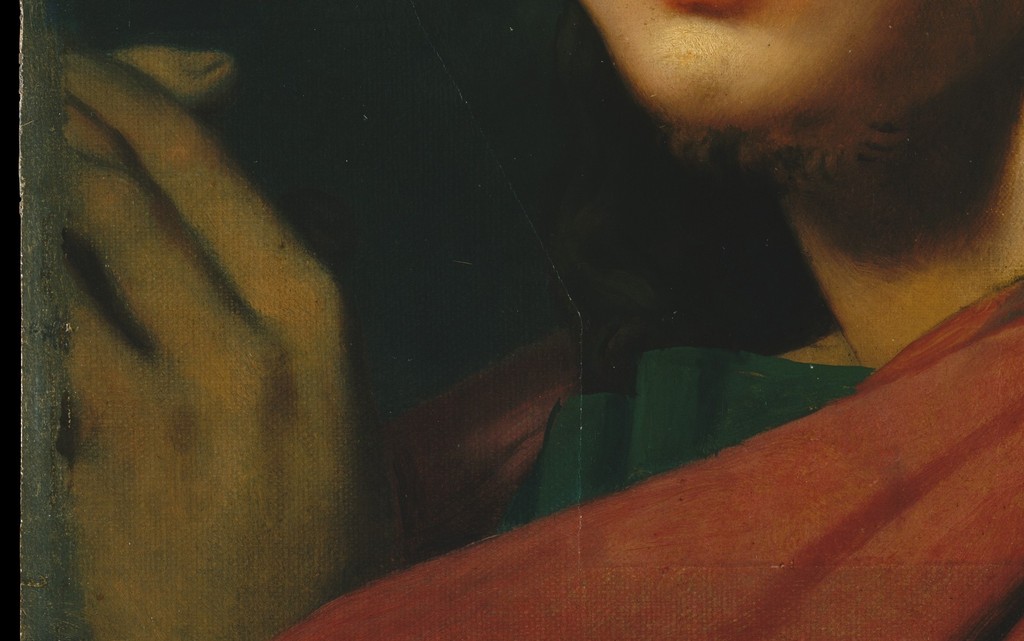
The hand beside red and green cloth
A hand rises beside the lower face, red cloth and a narrow green passage. These overlapping shapes bring warm and dark colours together near the lower edge.
Colour within the construction
Hale found green underpainting beneath Senonnes’s yellow furnishings. [1] In Broglie, the visible grey wall remains quieter than the broad blue skirt. Colour contrast can be studied in the reproduction; the physical sequence of layers requires a separate kind of evidence, such as examination with magnification or technical imaging. [14]
Colour helps organise the picture, establish light, separate materials and connect objects across a room. Consider Broglie’s yellow chair against her blue skirt. The chair’s warm curved surface supports the crossed arms and makes the pale skin easier to distinguish from the surrounding fabric. The white shawl provides another interval between the yellow upholstery, blue gown and black accessories. The colour relationships are also part of the composition’s rhythm.
Rothschild’s blue dress and pink painting
An 1846 letter requests Rothschild’s blue dress; the finished portrait’s blue touches lie over pink paint. [1]
Revision beneath an assured image
A pentimento is a change made during painting. Such alterations may become visible as upper paint grows more transparent, or be detected through technical imaging. [8] Hale found a higher collar beneath Moltedo’s final coat. [1] Caroline Murat’s portrait conceals an altered head and an inverted, unidentified male face. [1] These changes belong within a single painted object. They should be distinguished from a separate copy or version, whose surface and support have a history of their own.
A smooth finish can absorb extensive preparation, and prolonged attention need not leave a rough or hesitant surface. Equally, freely handled paint can be the result of a well-established design. The visible finish alone cannot tell us the duration of labour.
What technical imaging can reveal
Infrared can pass through some paint layers and make an underdrawing visible. Carbon black absorbs the radiation particularly strongly; the materials present affect what the image can show. The National Gallery distinguishes infrared photography from reflectography, which records a wider range of wavelengths. [8] X-radiography records differences in a material’s absorption or transmission of X-rays. The resulting pattern can reveal internal structure and variations in pigments, as the NGA’s glossary explains. It is a different kind of image from an infrared reflectogram. [3]
Visible examination remains essential. Getty conservator Kari Rayner describes close looking with low magnification and a microscope as ways to understand texture, application and paint layers. X-radiographs and infrared images add other evidence; they do not replace examination of the object. Read a technical image alongside the painting and the question being investigated. [14]
One self-portrait, substantially remade
Chantilly’s early self-portrait was reworked in 1841–51. [15]

Ingres, Self Portrait Aged 24, 1804; revised 1841–1851. [16]
Its earlier coat, revealed through imaging, matches Forestier’s copy. [15]
Venus and the changing canvas
Venus Anadyomene (1807–48) was enlarged above the arm and shortened below. [15] An earlier hand position remains tentative in Chantilly’s account. [15]
Proportion, detail and constructed space
The authority of Ingres’s detail can make the larger design seem equally literal. Pearls have weight, lace has holes, satin reflects light. Yet the arrangement of bodies and rooms often follows a more elastic order. Close description at one scale can coexist with transformation at another.
In Madame Rivière, dated 1805 in the Louvre’s record, the composition is oval. [17] That boundary finds echoes in the small oval of the face, the rounded chair and the sweeping fabric around the body. The sitter’s arms and shawl lead the eye through a series of curves, while the blue upholstery gives those pale forms a cool setting. The figure belongs to a carefully joined arrangement of shapes. Looking for that arrangement reveals more than treating each contour as an isolated anatomical report.
Grande Odalisque, the Louvre’s painting of 1814, offers a more conspicuous transformation. [18] Follow the back from the turned head towards the hips. The torso extends across the canvas in a long, almost uninterrupted passage, while the reaching arm carries the movement towards the fan and curtain. The sharply described jewellery and textiles make the scene feel materially specific, even as the body’s proportions resist an ordinary model of physical possibility.
Its effect also depends on colour and surrounding shapes. The pale back extends between blue fabric and warm bedding; the hanging curtain supplies a dark, vertically gathered counterweight. The long body is experienced within this arrangement of light, hue and directional movement. Its unusual proportions operate within that whole pictorial relationship.
Madame Moitessier brings a related tension into a portrait. Her hand seems extraordinarily supple where it supports the head, and the dress occupies an immense area below. Behind her, a mirror offers another view of the sitter while complicating the room. The National Gallery points out that the reflection does not consistently match her position, and that mirror, sofa and table occupy an implausibly compressed space. [19]
The compression is easy to feel before it is easy to explain. Objects accumulate close to the figure; floral silk, jewellery and upholstery crowd the foreground with description, while the reflected head occupies a much quieter area. Her reflected profile is recognisable, but it does not settle every spatial question. The room supplies a structure for looking at the sitter and her possessions, with connections between curves and colours that remain persuasive even where literal reconstruction becomes difficult.
These pictures need neither an anatomical diagnosis nor a claim that Ingres was unable to draw. His working material demonstrates sustained attention to bodies, drapery, placement and revision. The interesting question is how the credibility of individual parts supports a whole that has been shaped with considerable freedom.
A studio with several kinds of contribution
For each proposed collaboration, distinguish advice, transfer, accessory painting and replica production. These tasks leave different evidence. [20] Vigne combines documentary evidence with stylistic attribution; those are different kinds of argument. [20]
When technical evidence changes an attribution argument
Hale found no clear technical basis for separate landscape painters in Granet, Moltedo or Gouriev. [1]
Assistance with firmer documentary foundations
For The Apotheosis of Homer, Prosper Debia’s retrospective memoir recalls painting alongside Ingres during the work’s preparation for the Louvre. Vigne also identifies the archaeologist Désiré Raoul-Rochette’s assistance with Greek and Latin inscriptions. One contribution concerns the brush; the other concerns learned content. Debia’s account is retrospective testimony and does not map every passage he painted. [20] In Antiochus and Stratonice, Baltard designed the architecture. Balze recalled working on furniture and the lyre. [15][20]
Current museum credits offer further, work-specific distinctions. The Musée d’Orsay names Paul Balze and Alexandre Desgoffe as assisting with accessories and background in The Source. [5] The Walters Art Museum credits its 1842 Odalisque, often called Odalisque with Slave, to Ingres and Jean-Paul Flandrin, and describes Flandrin’s assistance. [6] The Metropolitan Museum attributes Odalisque in Grisaille to Ingres and workshop. [7] These formulations describe different objects and evidence; they should be carried with the pictures rather than collapsed into a general claim about everything produced in his studio.
A recognisable style could therefore emerge through several hands. Understanding that process requires attention to the artist’s design, the tasks delegated, the degree of intervention and the status of each version. It also requires acknowledging where the surviving evidence cannot make the division exact.
Repetition, photography and further invention
Photographs informed the reversed 1866 Stratonice by Ingres and Raymond Balze on tracing paper. [15] The late Homer Deified drawing supplies a longer example. The Louvre dates it to 1865 and explains that Ingres began it in 1840 in connection with an engraving by Luigi Calamatta. Over repeated revisions it moved substantially away from the 1827 painting, strengthening the architecture and changing the assembly of figures. The reproductive project became a prolonged rethinking of the subject. [21] The different makers and media of reproductions are explored further in Prints and Reproductions.
Looking with the process in mind
Begin with something the picture lets you judge directly: a contour, a fold, a change from warm to cool colour. In the Stratonice drawing, lightly indicated flesh and deeply shaded fabric give different parts of one figure different weight. Compare a detail with the whole sheet before drawing a conclusion about its purpose. [4]
Keep a revised canvas distinct from a separate version, and a visible effect distinct from a hidden layer. Such distinctions make Ingres’s classical authority more interesting: precise form was sustained through varied materials, repeated looking and an active willingness to reconsider.
Artworks directory
Explore 150 paintings, drawings and an original lithograph. This selection includes related versions and studies; dates distinguish completed works from later revisions.
| Name | Date | Medium |
|---|---|---|
| The Apotheosis of Homer | 1827 | Painting |
| Grande Odalisque | 1814 | Painting |
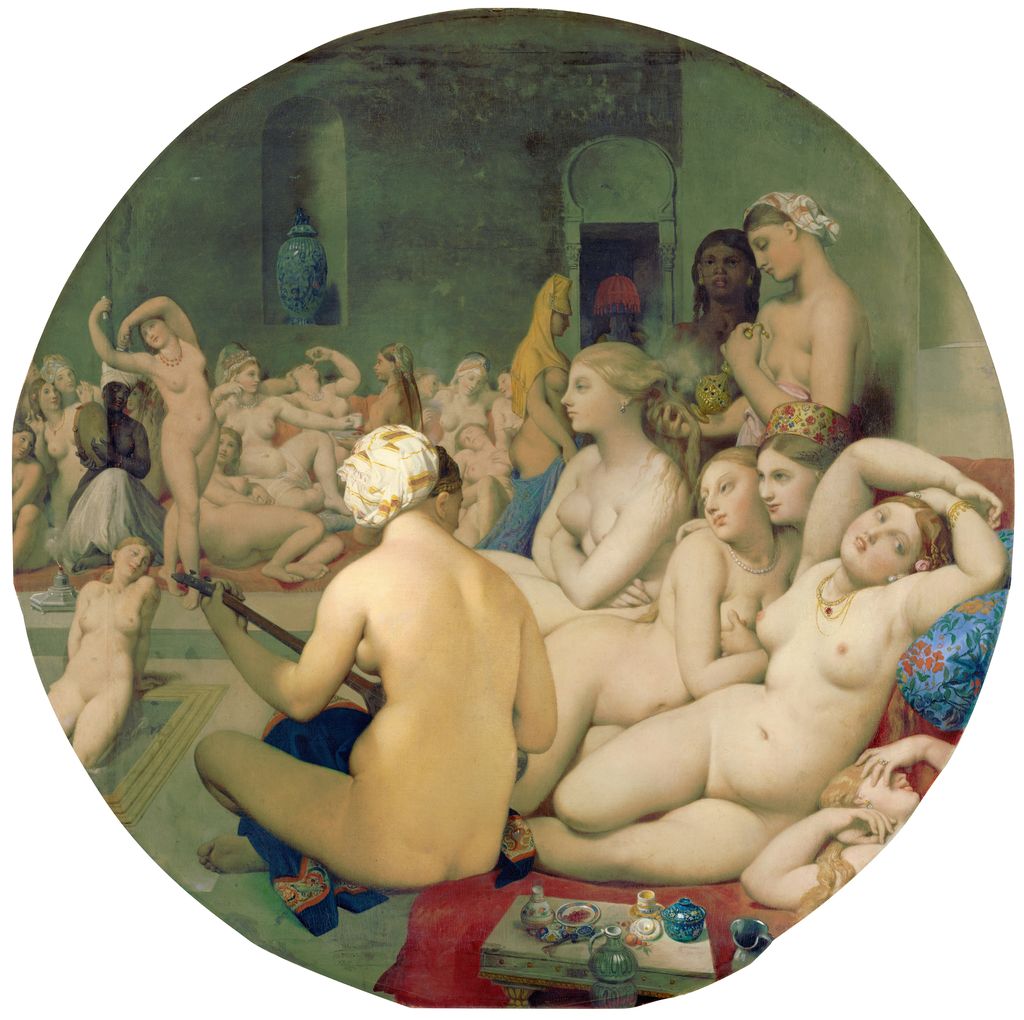
| The Turkish Bath | 1859–1862 | Painting |
| Madame Moitessier Seated | 1856 | Painting |
| Portrait of Monsieur Bertin | 1832 | Painting |
| Napoleon I on His Imperial Throne | 1806 | Painting |
| Odalisque with Slave | 1839 | Painting |
| The Ambassadors of Agamemnon in the Tent of Achilles | 1801 (competition) | Painting |
| The Valpinçon Bather | 1808 | Painting |
| The Source | 1856 | Painting |
| Oedipus Explaining the Enigma of the Sphinx | 1808; revised probably before 1827 | Painting |
| The Vow of Louis XIII | 1824 | Painting |
| Antiochus and Stratonice | 1840 | Painting |
| The Comtesse d’Haussonville | 1845 | Painting |
| The Princesse de Broglie | 1851–1853 | Painting |
| Jupiter and Thetis | 1811 | Painting |
| The Dream of Ossian | 1813 | Painting |
| The Martyrdom of Saint Symphorian | 1834 | Painting |
| Venus Anadyomene | 1808–1848 | Painting |
| Portrait of Madame de Senonnes | 1814 | Painting |
| Madame Rivière | 1805 | Painting |
| Mademoiselle Caroline Rivière | 1805 | Painting |
| Portrait of Philibert Rivière | 1805 | Painting |
| Bonaparte First Consul | 1804 | Painting |
| The Death of Leonardo da Vinci | 1818 | Painting |
| Joan of Arc at the Coronation of Charles VII | 1854 | Painting |
| Madame Duvaucey | 1807 | Painting |
| La Belle Zélie | 1806 | Painting |
| Madame Panckoucke | 1811 | Painting |
| Portrait of Charles Marcotte d’Argenteuil | 1810 | Painting |
| Joseph Antoine Moltedo | c.1810 | Painting |
| Madame Leblanc | 1823 | Painting |
| Delphine Ingres-Ramel (Portrait of Madame Ingres) | 1859 | Painting |
| Portrait of Amédée de Pastoret | 1823–1826 | Painting |
| Portrait of Baronne de Rothschild | 1848 | Painting |
| Madame Marcotte de Sainte Marie | 1826 | Painting |
| Madame Gonse | 1852 | Painting |
| Aretino in the Studio of Tintoretto | 1848 | Painting |
| Don Pedro of Toledo Kissing Henry IV’s Sword | 1831/1832 | Painting |
| Raphael and La Fornarina | 1814 | Painting |
| Roger Freeing Angelica | 1819 | Painting |
| Romulus’ Victory over Acron | 1812 | Painting |
| Self-Portrait at the Age of Twenty-Four | 1804; revised 1841–1851 | Painting |
| Male Torso | c.1800 | Painting |
| Odalisque in Grisaille (Ingres and workshop) | c.1824–1834 | Painting |
| The Small Bather | 1826 | Painting |
| The Little Bather Harem Interior | 1828 | Painting |
| Jesus Among the Doctors | 1862 | Painting |
| The Virgin Adoring the Host | 1852 | Painting |
| The Virgin of the Host | 1841 | Painting |
| Virgin of the Adoption | 1858 | Painting |
| Paolo and Francesca | 1814 | Painting |
| Homer Deified (revised composition, Louvre RF5273) | 1865 | Drawing |
| Odalisque with Slave (Louvre RF4622) | 1858 | Drawing |
| Odalisque (Walters Art Museum; Ingres and Paul Flandrin) | 1842 | Painting |
| Madame Moitessier Standing (National Gallery of Art) | 1851 | Painting |
| Jacques-Louis Leblanc (The Metropolitan Museum of Art) | 1823 | Painting |
| Ferdinand-Philippe, Duke of Orléans (Louvre RF2005-13) | 1842 | Painting |
| Ferdinand-Philippe, Duke of Orléans (Versailles MV5207; Ingres and workshop) | 1843 | Painting |
| Ferdinand-Philippe, Duke of Orléans (Versailles MV5209; Ingres and workshop) | 1844 | Painting |
| Antiochus and Stratonice (Musée Fabre; Ingres and Raymond Balze) | 1866 | Painting |
| Antiochus and Stratonice (Kunstmuseum Bern, Gurlitt bequest) | Undated (early dating proposed) | Drawing |
| Composition study for Antiochus and Stratonice (MIB867.2193) | 1806 | Drawing |
| Study for the Figure of Stratonice (Met63.66) | 1834–1840 | Graphite, black chalk and charcoal |
| Nude figure study for Stratonice (Boijmans F II 36 PK) | c.1834–1840 | Drawing |
| Paolo and Francesca (The Barber Institute,54.6) | c.1814–1820 | Painting |
| Paolo and Francesca (The Hyde Collection,1971.24) | c.1855–1860 | Painting |
| Paolo and Francesca (Amsterdam Museum TA10970) | 1820 | Drawing |
| Paolo and Francesca (dedicated to Artaud de Montor) | 1816 | Drawing |
| Study for the Bust of Francesca (MIB867.1398) | 1819 | Drawing |
| Study for the Bust of Francesca (MIB867.1396) | 1819 | Drawing |
| The Archangel Raphael, first idea (MIB867.2488) | 1842 | Drawing |
| The Archangel Raphael (MIB867.2500) | 1842 | Drawing |
| The Archangel Raphael Carrying Human Prayers to God (Chantilly DE513) | 1844 | Drawing |
| Louis-Philippe as Saint Philip, stained-glass study | 1844 | Drawing |
| Marie Frédéric Eugène de Reiset (Ford Collection RBF171-2) | 1844 | Drawing |
| Virgil Reading the Aeneid (Toulouse) | Begun 1811 | Painting |
| Tu Marcellus Eris (Brussels, inv. 1836) | c.1814 (museum dating) | Painting |
| Jean-François Gilibert | 1804 | Painting |
| François-Marius Granet | 1807 (museum dating) | Painting |
| Count Nikolai Dmitrievich Guryev | 1821 | Painting |
| Caroline Murat, Queen of Naples | 1814 | Painting |
| Count Mathieu Molé | 1834 | Painting |
| Cherubini and the Muse of Lyric Poetry (Louvre) | 1842 | Painting |
| Luigi Cherubini (Cincinnati) | 1841 | Painting |
| Comtesse de Rayneval (Louvre RF4505) | 1841 | Drawing |
| Venus on Paphos (Antonie Balaÿ) | c.1852 | Painting |
| Prince Napoléon | 1855 | Painting |
| Study for The Apotheosis of Napoleon I (Petit Palais) | Late 1853 | Painting |
| The Apotheosis of Napoleon I (destroyed ceiling) | 1853 | Painting |
| The Journalist (MIB867.2733) | 1834? | Drawing |
| Henry VIII, after Holbein | c.1815–1820 (?) | Drawing |
| Madame Récamier, after David (MIB867.3637) | Undated (early Paris period) | Drawing |
| Study for Comtesse d’Haussonville (MIB867.259; background possibly by another hand) | 1842–1845 | Drawing |
| La Source (reduced version reported by Delaborde) | Date unrecorded; reported 1870 | Painting |
| Odalisque (autograph lithograph,NGA1946.21.117) | 1825; published1826 | Lithograph |
| Portrait of a Seated Lady | 1814 | Graphite |
| The Kaunitz Sisters (Leopoldine, Caroline, and Ferdinandine) | 1818 | Graphite |
| Portrait of a Man | 1814 | Graphite |
| Study for the Portrait of Louis-François Bertin (1766–1841) | n.d. | Black chalk and graphite |
| Studies for the Cadaver of Acron | ca. 1810–12 | Graphite on wove paper |
| Study for the Drapery of Molière in "The Apotheosis of Homer" | n.d. | Black chalk with stumping |
| Madame Guillaume Guillon Lethière, née Marie-Joseph-Honorée Vanzenne, and her son Lucien Lethière | 1808 | Graphite |
| Niccolò Paganini (1782–1840) | ca. 1830 | Counterproof or tracing strengthened with graphite and gouache on translucent paper |
| Lady Mary Cavendish-Bentinck (?-1843) | 1816 | Graphite |
| Madame Alexandre Lethière and Her Daughter Letizia | ca. 1815 | Graphite |
| Merry Joseph Blondel (1781–1853) | 1809 | Graphite |
| Ursin-Jules Vatinelle (1798–1881) | 1820 | Graphite |
| Bust of a Gypsy Girl (ascribed to Ingres) | 1819 | Graphite on wove paper |
| Study of a Seated Nude Male | n.d. | Graphite |
| The Archangel Raphael (Study for a stained-glass window in the chapel of Notre-Dame de la Compassion-Saint-Ferdinand, Neuilly) | ca. 1842 | Graphite |
| Lancelot-Théodore, comte Turpin de Crissé | probably 1818 | Graphite |
| Study for the Figure of the Iliad in "The Apotheosis of Homer" | ca. 1827 | Graphite and black chalk heightened with white chalk on brown paper |
| Comtesse Turpin de Crissé | probably 1818 | Graphite |
| Nude Figures for L'Âge d'Or, Château de Dampierre | n.d. | Graphite on brownish paper |
| Study of Figures (attributed to Ingres) | n.d. | Graphite |
| Study of Figures (attributed to Ingres) | n.d. | Graphite; squared in graphite |
| Admiral Sir Fleetwood Broughton Reynolds Pellew | 1817 | Graphite on wove paper |
| Madame Jean-Auguste-Dominique Ingres, née Madeleine Chapelle | 1814 | Graphite on off-white wove paper |
| Virgil Reading the Aeneid to Augustus, Livia, and Octavia | 1809/1819 (?) | Pen and black ink, graphite, brush and gray wash, white gouache heightening, Conté crayon on blue paper |
| General Louis-Étienne Dulong de Rosnay | 1818 | Graphite (hard and soft pencils) |
| Madame Alexandre Lethière, née Rosa Meli, and Her Daughter, Letizia | 1815 | Graphite |
| The Lawyer Paul Grand | 1834 | Graphite |
| Jean-Joseph Fournier | 1815 | Graphite |
| Armand Bertin | 1842 | Graphite |
| Madame Armand Bertin, née Marie-Anne-Cécile Dollfuss | 1843 | Graphite |
| The Architect Charles-Victor Famin | 1836 | Graphite |
| Henri Lehmann | 1850 | Graphite |
| Portrait of a Lady | ca. 1815–17 | Graphite |
| Edmond Cavé (1794–1852) | 1844 | Oil on canvas |
| Head of Saint John the Evangelist | probably ca. 1818–20 | Oil on canvas, laid down on wood |
| Madame Edmond Cavé (Marie-Elisabeth Blavot, ca. 1806–1883) | ca. 1831–34 | Oil on canvas |
| Madame Félix Gallois | 1852 | Graphite with touches of gold in oil to highlight jewelry, on buff wove paper. |
| Dr. François Mêlier | 1849 | Graphite with graphite framing lines, corrected with white, on buff wove paper |
| Portrait of Madame Rhode (Rhoda?) | 1810–20 | Graphite on pale buff wove paper |
| Study for "Raphael and the Fornarina"(?) | ca. 1814(?) | Graphite on white wove paper |
| Portrait of Madame Paul Meurice, née Palmyre Granger | ca. 1845–50 | Graphite on wove paper |
| Alexander the Great presenting Campaspe to Apelles | 1810 | Graphite, brush and brown wash; squared in graphite |
| Study of Hands for "Christ Among the Doctors" | 1852–62 | Graphite on tracing paper |
| Study for The Turkish Bath (RF34502) | about 1850 | Pen and brown ink with graphite, partially squared |
| Study for The Turkish Bath (RF23354) | Undated | Pen and brown ink with graphite on joined sheets |
| Study for The Turkish Bath (RF54702) | about 1859 | Pen and brown ink |
| Studies of women for The Turkish Bath (RF12292) | Undated | Black chalk |
| Achilles Receiving the Envoys of Agamemnon (Nationalmuseum sketch, NM2161) | 1801 | Oil on wood |
| Half-Length Bather (Musée Bonnat-Helleu,89) | 1807 | Oil on canvas |
| Oedipus and the Sphinx (National Gallery,NG3290) | about1826 | Oil on canvas |
| Oedipus and the Sphinx (Walters,37.9) | 1864 | Oil on canvas |
| Oedipus and the Valpinçon Bather, after David (MI.867.2035) | Undated | Graphite on tracing paper, after David |
| Study of the Virgin for The Vow of Louis XIII (Dijon,1758) | about1822 | Black chalk, stump and white chalk on brown wove paper |
| First Thought for The Vow of Louis XIII (MI.885.11.21) | 1822 | Oil on canvas |
Frequently Asked Questions
No. Delaborde’s posthumous compilation includes expression, inner form, planes and modelling within Ingres’s definition. That breadth helps explain the rounded flesh and carefully organised light in his paintings. [2]
Colour can belong to a preparatory layer as well as the final surface. The distinction between a ground, an imprimatura and later paint is useful here. [3]
Both practices are documented. Follow the examples above to distinguish a transferred design from its later painted form. [1]
No. Technical images offer partial evidence and should be read alongside examination of the object. [14]
Yes; Chantilly’s self-portrait is a documented example. [15]
Discussion
Look again at the images and ideas explored in Style and Technique. These editorial prompts invite your observations.
Reader Insights
Compare Broglie’s grey wall and blue gown, or the dark clothing in the two Leblanc portraits. Which visible colour relationship holds your attention most strongly, and what could a technical examination add to your observation?
Compare the smooth appearance of a finished portrait with its preparatory drawings. Which decisions can you follow between the two?
Which question about making can an ordinary photograph answer, and which would require examination beneath the visible surface?
Join the Conversation
Share a detail, comparison or question about Style and Technique below.
References
- Gary Tinterow, Charlotte Hale and Eric Bertin, “Portraits by Ingres: Reflections, Technical Observations, Addenda, and Corrigenda”. Metropolitan Museum Journal 35, 2000, pp. 193–219. View source.
- Henri Delaborde, Ingres, sa vie, ses travaux, sa doctrine, d’après les notes manuscrites et les lettres du maître. Paris: Henri Plon, 1870, “Notes et pensées”, pp. 123–124: definition of drawing, looking, compasses and musical analogy; p. 139: study of nature, antiquities and masters. English quotation translated here from French. (in French) View source.
- National Gallery of Art, Technical Glossary, 2024. View source.
- The Metropolitan Museum of Art, Study for the Figure of Stratonice. Collection record, 1834–40, accession 63.66; medium, dimensions and incised contours for transfer. View source.
- Musée d’Orsay, La Source. Collection record, 1856, RF 219; artist credits and date field identifying Paul Balze and Alexandre Desgoffe’s assistance with accessories and background. English commentary; detailed object fields in French. View source.
- The Walters Art Museum, Odalisque. Collection record, 1842, accession 37.887; credits for Jean-Auguste-Dominique Ingres and Jean-Paul Flandrin, inscription and discussion of assistance. View source.
- The Metropolitan Museum of Art, Odalisque in Grisaille. Collection record, c. 1824–34, accession 38.65; attribution to Ingres and workshop. View source.
- National Gallery, London, Painting Glossary: Imprimatura, Pentimento, Infrared. View source 1. View source 2. View source 3.
- Supporting image. Ingres, La Belle Zélie, 1806. Musée des Beaux-Arts de Rouen; Photograph: Didier Descouens; Wikimedia Commons. Image source. CC BY-SA 4.0. Resized and JPEG-optimised; image derivative licensed CC BY-SA 4.0.
- Supporting image. Ingres, Madame Leblanc, 1823. The Metropolitan Museum of Art; Catharine Lorillard Wolfe Collection, Wolfe Fund, 1918. Image source. CC0 / Public domain.
- Supporting image. Ingres, Jacques-Louis Leblanc, 1823. The Metropolitan Museum of Art, 19.77.1. Catharine Lorillard Wolfe Collection, Wolfe Fund, 1918. Image source. CC0 / Public domain.
- Supporting image. Ingres, Alexander the Great Presenting Campaspe to Apelles, 1810. Graphite and brown wash, squared in graphite. The Metropolitan Museum of Art, 2017.711.2. Bequest of Saretta Barnet, 2017. Image source. CC0 / Public domain.
- Supporting image. Ingres, Study for the Figure of Stratonice, 1834–40. The Metropolitan Museum of Art, 63.66. Image source. CC0 / Public domain.
- Kari Rayner, “How We Use the Naked Eye and Other Tools to Understand a Painting”. Getty, 2021. View source.
- Château de Chantilly, Ingres: The Artist and His Princes, 2023, pp. 31, 44–47. View source.
- Supporting image. Ingres, Self Portrait Aged 24, 1804; revised 1841–1851. Musée Condé, Chantilly; Google Art Project via Wikimedia Commons. Image source. Public domain.
- Musée du Louvre, Madame Rivière. Collection record, 1805, MI 1446; description and oval composition. (in French) View source.
- Musée du Louvre, Une odalisque, dite La grande odalisque. Collection record, 1814, RF 1158. (in French) View source.
- National Gallery, London, Madame Moitessier. Collection record, 1856, NG4821; “In-depth”, discussion of the mirror and compressed space. View source.
- Georges Vigne, “Ingres and Co.”, in Portraits by Ingres: Image of an Epoch, 1999, pp. 529–532. Read with the corrections in reference 1. View source.
- Musée du Louvre, Département des Arts graphiques, Homère déifié. Collection record, 1865, RF 5273; technique and commentary on the project begun for Calamatta in 1840, citing Louis-Antoine Prat, Ingres, Paris: Louvre / 5 Continents, 2004, no. 55, p. 92. (in French) View source.
- Splash image. Jean-Auguste-Dominique Ingres, Madame Moitessier, 1856. Oil on canvas, 120 × 92.1 cm. National Gallery, London, NG4821. Image source. CC0 / Public domain.