by Tom Gurney
Tom Gurney BSc (Hons) is an art history expert with over 20 years experience
Published on June 19, 2020 / Updated on October 22, 2026
Email: tomgurney1@gmail.com / Phone: +44 7429 011000
Portrait of Baronne de Rothschild
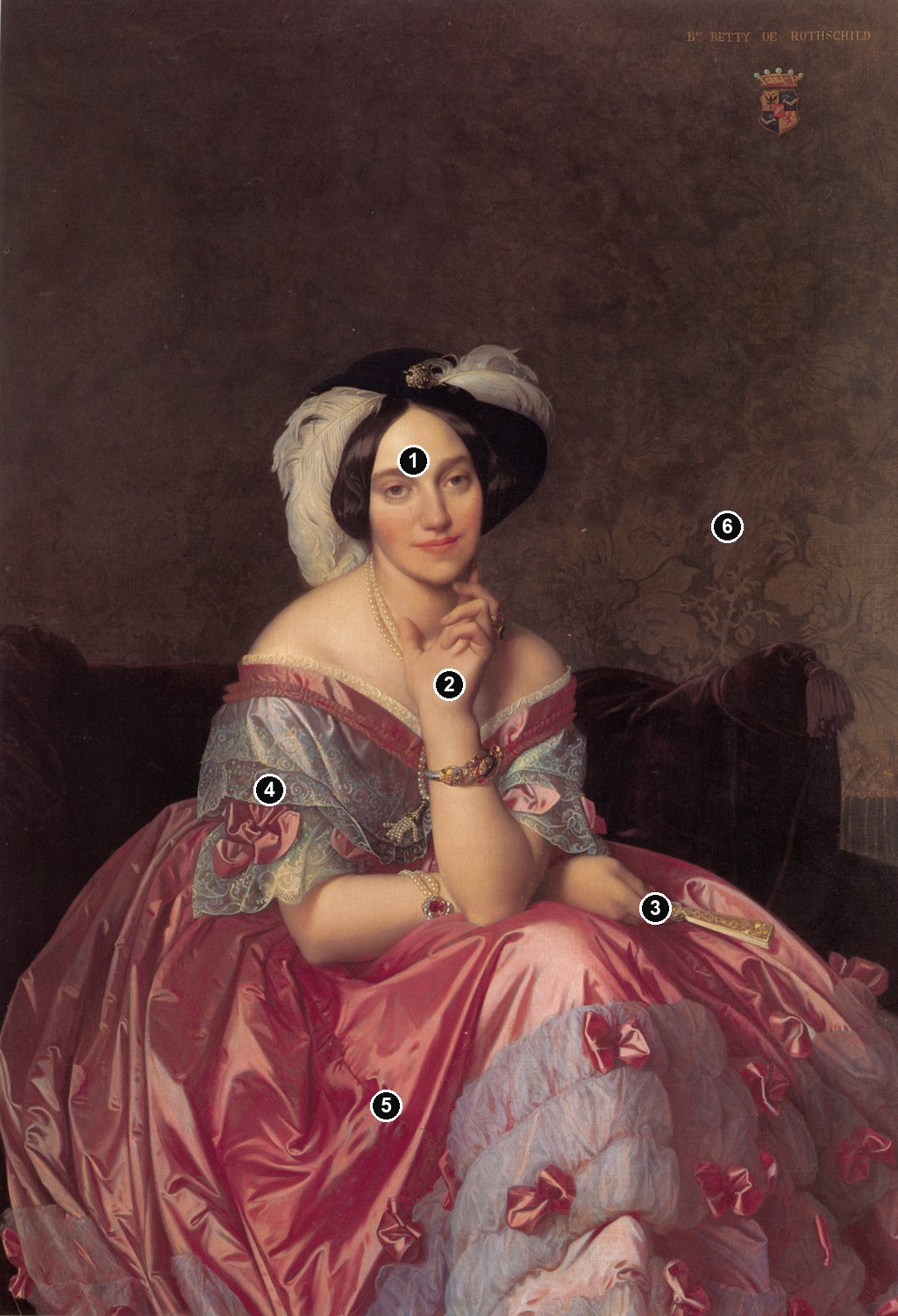
Betty de Rothschild looks towards us over a raised hand, surrounded by pink silk, pale lace and the dark red cushions of a sofa. The hand touches her chin so lightly that the gesture seems momentary. Below it, the enormous skirt fills the canvas with folds, ribbons and changing reflections. Above her, a broad expanse of patterned wall gives the small gold lettering of her name and coat of arms room to stand apart.
Ingres signed the portrait in 1848. [1] The finished picture combines an apparently easy social presence with an intricate arrangement of dress and body. Its recorded collection is private; the Institut national d’histoire de l’art documents it in its history of Rothschild collecting. [2]
At a Glance
- ArtistJean Auguste Dominique Ingres.
- SitterBetty, Baronne James de Rothschild (1805–1886). [3]
- DateSigned 1848. [1]
- MediumOil on canvas. [4]
- CollectionPrivate collection. [2]
- Look forThe raised hand, the closed fan, the changing pink of the skirt and the unusually spacious wall above the sitter.
This work across Ingres’s career
Agamemnon’s Ambassadors
1801 (competition)Grande Odalisque
1814Louis XIII’s Vow
1824Monsieur Bertin
1832The Princesse de Broglie
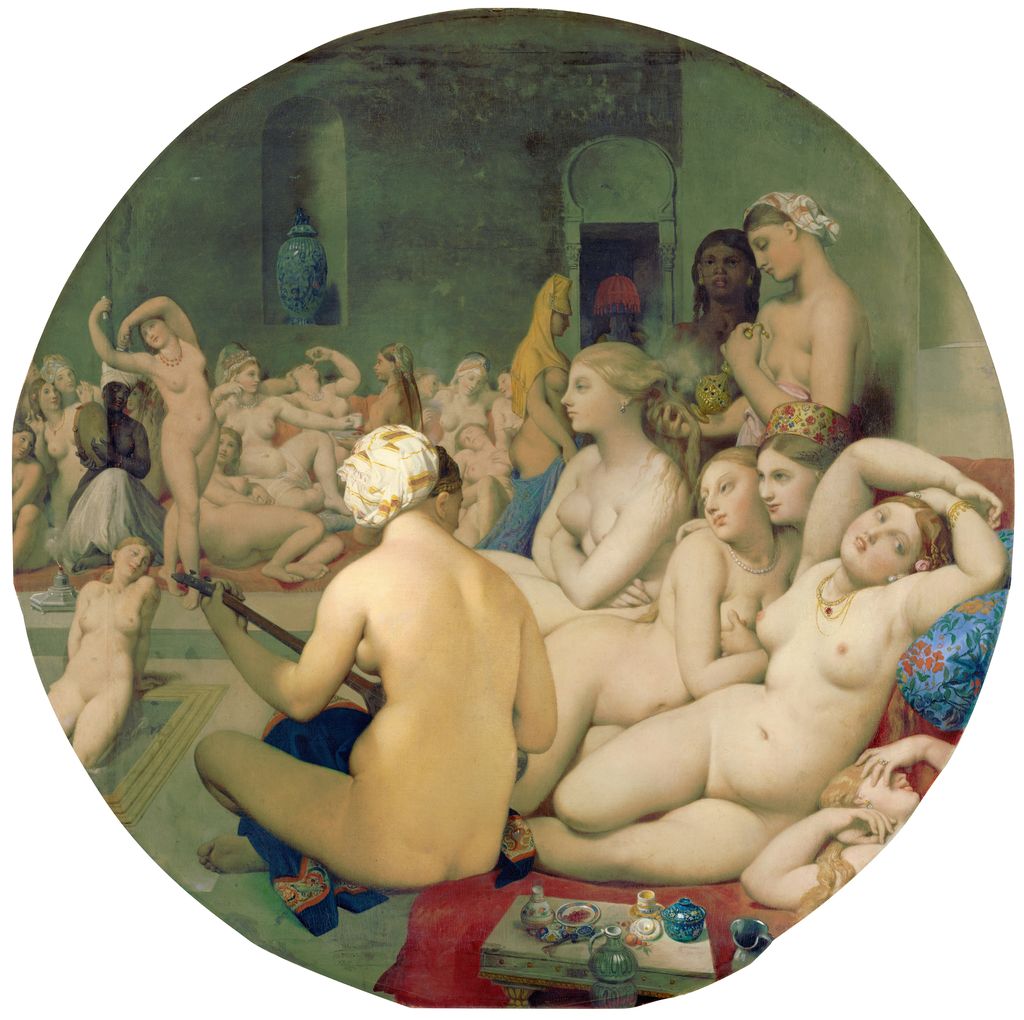
1851–1853The Turkish Bath
1859–1862Contents
- Betty de Rothschild and the art of receiving
- Looking at the portrait
- A commission repeatedly resumed
- Drawing the body and its covering
- Was the dress originally blue?
- What the first critics saw
- A family image: display, reproduction and recovery
- Annotated details
Betty de Rothschild and the art of receiving
Betty von Rothschild was educated in Vienna and married her uncle, the banker James Mayer de Rothschild, in 1824. In Paris she became a prominent hostess and patron of music, receiving artists, politicians, musicians and royalty. She and James had five children. Her connections with Chopin belonged to an active musical culture within the family. [3] These details give substance to the social world suggested by the portrait without requiring us to read her whole character from her face.
The painted inscription identifies her as Betty de Rothschild. The alternative title Baronne James de Rothschild identifies the same woman through her husband. [2] Here, however, the face and hands hold our attention well before we inspect the lettering. Name and heraldry occupy the upper right, while the human encounter takes place much lower down. The picture allows family identity and personal presence to register at different speeds.
Her surroundings suggest a room prepared for receiving company: upholstered furniture, a richly patterned wall covering and a dress intended to be seen. Yet no visitor is shown. Her gaze makes the space before the canvas feel occupied, inviting the viewer to supply the other half of an encounter. That effect is part of the portrait’s construction; it does not establish that Ingres recorded a particular conversation.
Looking at the portrait
The face, the hand and the fan
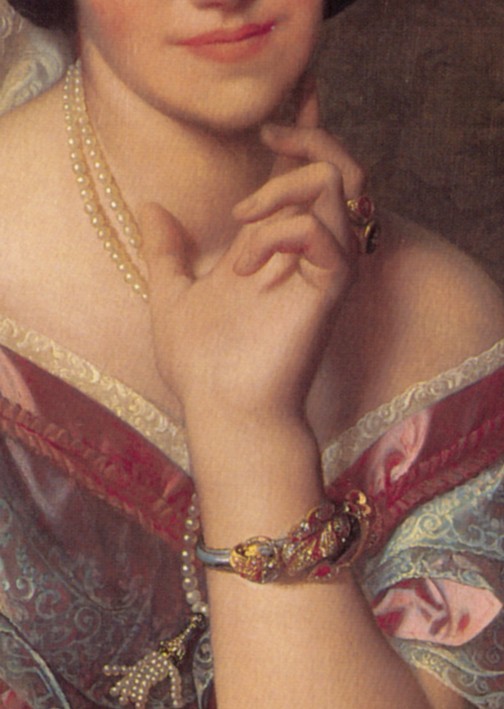
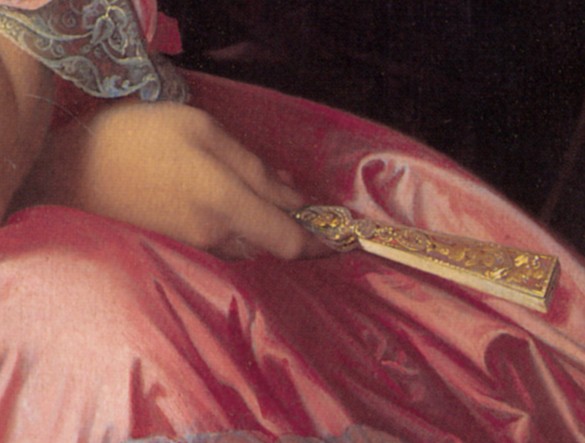
The left forearm rises almost vertically through the centre of the figure. At its top, the fingers curve beneath the chin, making a small irregular outline beside the much smoother oval of the face. The gold bracelet interrupts the length of the arm with a bright knot of detail. Below, the other forearm crosses the lap, ending in the hand that holds a closed, decorated fan. Together the arms give the abundant fabric a firm internal structure.
Follow the two hands and the pose becomes less simple than it first appears. One directs attention upwards, towards the eyes and mouth; the other sends it sideways, across the skirt. The fan extends that outward movement. Its straight, narrow form contrasts with the loose curves of the ribbons, offering the eye a brief, clear line amid the folded cloth.
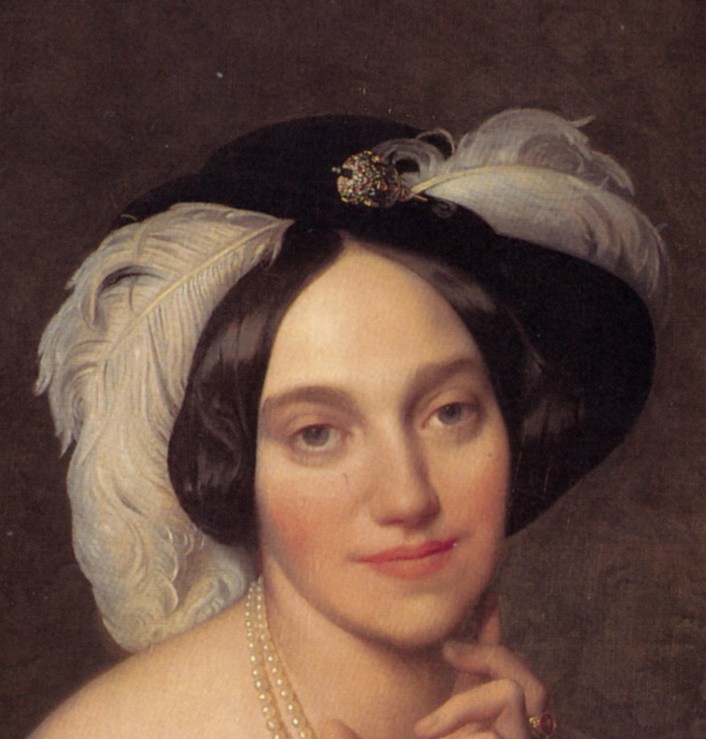
The head inclines slightly towards the raised hand. Dark hair and the black hat enclose the illuminated face, while white feathers loosen the silhouette on either side. The forehead is comparatively open and still; the eyes and gently curved mouth concentrate the smaller changes of expression. Ingres makes this distinction especially effective by placing so many sharp changes of texture nearby. We move from the soft modelling of skin to a bracelet, a ribbon or a feather, then return to the face.
How the skirt occupies the picture
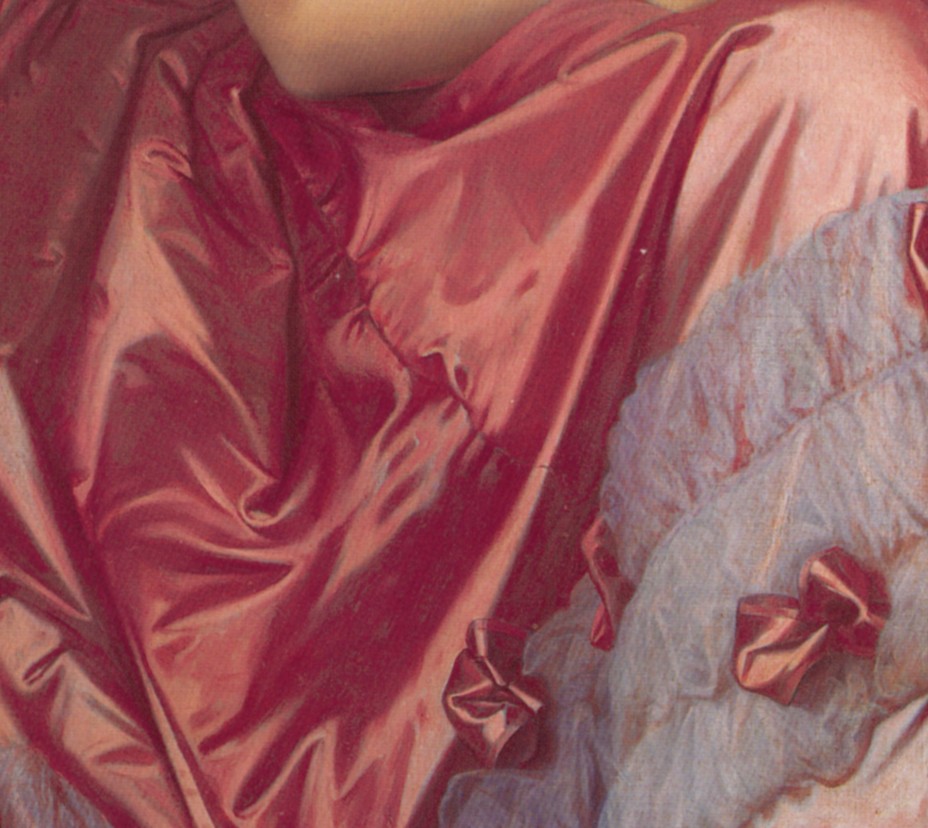
The dress spreads outwards until it reaches both lower edges. Across its surface, pink shifts from pale, almost silvery highlights to deep red shadows. Some folds make broad rounded ridges; others turn sharply, producing thin bright edges. The transitions allow us to imagine silk bending and gathering without losing sight of the larger sweep of the skirt.
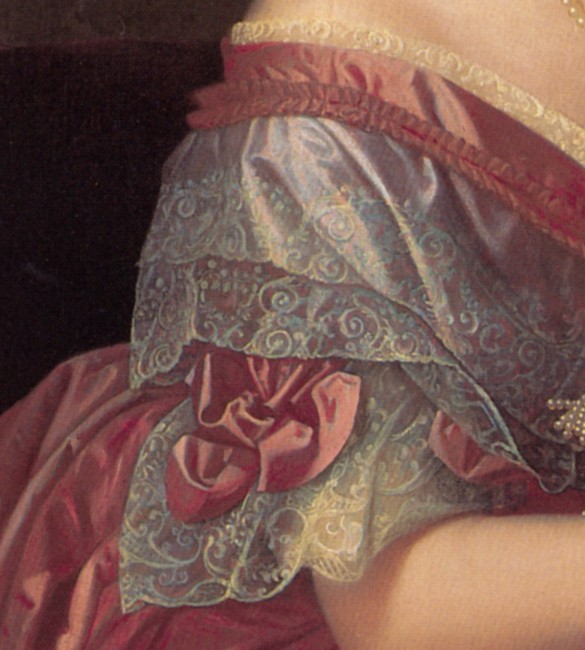
Pale translucent bands cross this field of pink. Their fine, clouded texture differs from the sharper shine of the silk, and small bows repeatedly interrupt their course. Near the sleeves, lace creates a more intricate pattern against the flesh and fabric beneath it. The dress therefore has several scales of activity: the overall volume around the seated body, the bands that divide that volume, and the tiny curls and folds within the ornament.
The raised knee is crucial. It supports the elbow and pushes the skirt forwards, giving the central foreground a rounded prominence. The body is largely concealed, but its pressure remains legible through the cloth. We understand the pose through differences in the direction and tension of the folds. The picture asks us to look at fabric as something shaped by a body, even when that body is hidden.
The quiet upper half
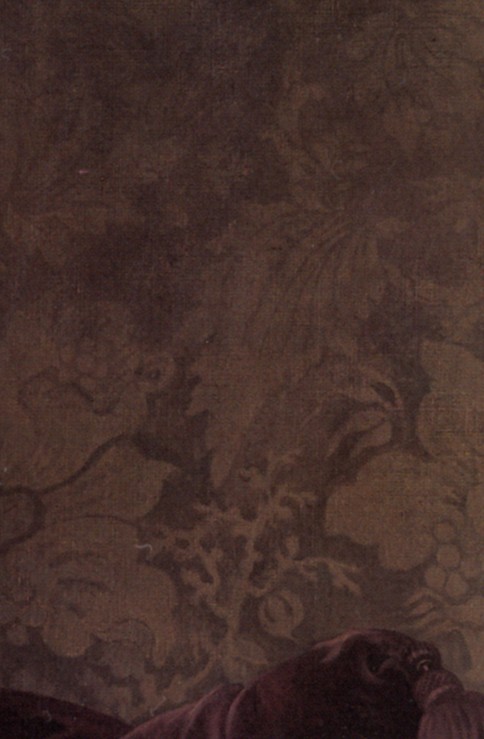
The contrast with the wall is striking. Above the hat, the painting opens into a large, subdued area whose pattern emerges slowly. The sofa forms a darker horizontal enclosure behind the shoulders. Its cushions and fringe establish a soft setting, but their muted colour keeps the exposed skin and dress distinct.
This spacious upper field changes the portrait’s pace. The foreground offers one thing after another to inspect; the wall lets the eye pause. It also gives the figure a setting larger than her immediate gesture. A closer crop would intensify the encounter with her face, while sacrificing the measured relationship between the woman, her furnishings and her inscribed identity.
Annotated Details from Portrait of Baronne de Rothschild
The numbered points identify visible features discussed in this article. Return from each detail to the whole composition. Jean-Auguste-Dominique Ingres, Portrait of Betty, Baronne James de Rothschild, 1848. Oil on canvas. Private collection. Wikimedia Commons. Image source. Public domain.
Details from PORTRAIT OF BARONNE DE ROTHSCHILD
Compare the raised and lowered hands, pale lace and broad folds around the sitter.
The face beneath feathers and dark hair
Pale feathers curve around the dark hair above the face. Their soft edges and lighter tone make a second frame beside the quieter background.
Fingers resting beside the chin
Bent fingers rise beside the chin and turn back towards the wrist. A bright bracelet interrupts the longer pale line of the forearm below.
A lowered hand and a closed fan
The lower hand rests against the skirt beside a narrow closed fan. The fan’s straighter edge offers a contrast to the hand’s rounded shapes.
Lace over a pink sleeve
Pale curls of lace spread over the brighter pink sleeve. The two fabrics remain distinct through their different edges, patterns and reflections.
Large folds across the skirt
Broad pink reflections travel across the skirt beside a pale panel and small bows. Follow the long folds before returning to these smaller decorations.
A patterned wall beside the sitter
A large floral pattern spreads across the wall beside the sitter’s head. Its darker shapes provide a quieter counterpart to the lace and folds in the foreground.
A commission repeatedly resumed
The commission dates from late 1841, according to the Musée Ingres Bourdelle’s account of the related dress study. [5] Ingres’s own correspondence shows how slowly it developed. On 26 June 1842 he told his friend Jean-François Gilibert that a sitting with Madame de Rothschild was fixed for the coming Tuesday, after a considerable exchange of letters. The same letter mentions the beginning of the Comtesse d’Haussonville’s portrait, a journey to Dampierre and work on Paolo and Francesca. [6]
These competing tasks matter. The Rothschild portrait was one undertaking among several that made demands on his time, and the letters repeatedly describe an overcrowded working life. In February 1843 the sitter’s head remained on his list of work to finish before returning to Dampierre. In July he anticipated another autumn of portraits and royal commissions. At the end of December, the two female portraits were still only sketched in. [6]
By 7 June 1844 the problem had become more fundamental: Ingres wrote that Madame de Rothschild’s portrait needed to be begun again. His complaint occurs beside references to Haussonville, stained-glass designs and the Dampierre decoration. In July 1845 he still counted Rothschild and Madame Moitessier among the portraits awaiting completion before he could devote himself to his larger projects. [6]
The correspondence gives us intervals of effort and dissatisfaction, rather than a continuous diary of the canvas. It cannot tell us how much paint survived each return to the work. Beginning again might involve extensive revision, but the phrase alone cannot establish a second surviving canvas or identify particular layers beneath the present surface.
On 24 June 1847 Ingres described the Rothschild portrait as barely finished after having been restarted to better effect. He immediately returned to the difficulty of portrait painting and its interference with other ambitions. [6] The finished object carries the date 1848. [1] The letter records his assessment of progress the previous year; the signature gives the date he attached to the painting.
His impatience also needs proportion. These are letters to a close friend, full of complaints about work, obligations and lost freedom. They show how demanding he found portraiture. They do not give us grounds to invent a personal quarrel with Betty or to imagine that such a polished result came easily.

Ingres, The Comtesse d’Haussonville, 1845. [7]
Drawing the body and its covering
The surviving studies include different dresses and changing arrangements of limbs. Tinterow distinguishes an early group around 1842 from later work around 1847. [8] The attribution and sitter of the earliest proposed study have been questioned. [4] A small suggestive sketch therefore offers a less certain starting point for reconstructing the composition than the signed painting.
A securely identified dress study belongs to the Musée Ingres Bourdelle in Montauban, inventory MI.867.375. The museum’s regional record lists black chalk and white chalk on paper, measuring 33.2 by 25.9 centimetres, and dates it 1848. [5] Working with both chalks allows a draughtsman to study illumination as well as outline: dark and light marks can distinguish the hollows and ridges that give folded cloth its volume. The catalogue dates this sheet approximately 1847, a little earlier than the regional record. It also reports an arm study reversed for use on the opposite side. [4]
The dress study was exhibited in 1861 and 1867 and photographed by Charles Marville. An early description identifies its paper as pink, subsequently faded. [4] Its separate exhibition history gives the preparatory work a life beyond the commission: folds studied for a portrait could become an object of attention in their own right.
Henri Delaborde’s posthumous catalogue of 1870 already records a black-chalk study heightened with white at Montauban. He explains its purpose as determining the lines and characteristic forms of the costume. [1] This is a useful corrective to looking only at the sitter’s face. The dress required decisions about shape, emphasis and the relation of one fold to another. Its apparent abundance rests on a highly organised pattern.
The drawings also help us understand the finished gesture without treating every study as a transparent record of a sitting. Preparatory work can isolate a limb or a piece of drapery, testing it separately from the whole figure. In the painting, all those separate problems disappear into a continuous surface. The ease we see is an effect reached through repeated choices.
Was the dress originally blue?
Louis Geofroy, reviewing the portrait in 1848, told a dramatic story. He claimed that Ingres had transformed a blue dress into a red one in two days, then resisted the sitter’s wish to reverse the change. Geofroy interpreted bluish passages as remnants of the earlier colour. [9] Tinterow questioned the story in the 1999 catalogue. [4]
Evidence published in 2000 makes the issue more interesting. Surface examination in London found blue highlights applied over pink paint. They therefore cannot simply be treated as exposed remains of a blue dress underneath. The same publication reports a letter in which Ingres asks Betty to send her blue dress so that he can finish painting its accessories. Its date, Monday 6 July, is assigned to 1846 through the calendar. [8]
The correspondence supports a blue-dress stage in the portrait’s development. The examined highlights, however, work within the final pink colour scheme. Neither finding establishes Geofroy’s two-day transformation or the dialogue he attributed to painter and patron. Tinterow also relates an 1847 fashion report describing a similar pink gown, while acknowledging that the identification is not exact. [8]
Look again at the cool pale bands against the warm silk. Their contrast makes the pink seem stronger, while the bluish reflections prevent the dress from becoming a single flat colour. A history of revision can help explain how the picture developed, but its final colour relationships remain worth seeing in their own right.
What the first critics saw
In his account of an 1848 studio visit, Théophile Gautier described the portrait in a room adjoining Venus Anadyomene. He admired the conjunction of modern fashion, social identity and the sitter’s apparent readiness to speak. For him, the pose suggested a conversation continuing from a ballroom or supper. He also singled out the strength of the colour, comparing its prospects with Titian’s painting. [10]
Gautier’s response helps us recognise the portrait’s animation, while revealing how readily a critic turns a pose into a scene. His imagined conversation is a persuasive reading of the image. It supplies no evidence for an actual remark, occasion or person standing outside the frame. The raised hand and direct gaze give that fiction somewhere to begin.
Geofroy likewise praised the colour and compared the portrait’s force with Monsieur Bertin. He admired the modelling of the arms and the handling of elaborate modern dress. Yet he also criticised the area around the mouth and the height of the background. [9] His review records an engaged, discriminating response, alongside the much less secure dress anecdote.
The two critics make colour central to their appreciation. Their testimony is particularly useful when approaching Ingres through a reputation dominated by drawing. In this portrait, contours guide us through hat, shoulders and arms, while shifts of pink, blue, white and dark red make those forms vivid. The visible painting sustains both kinds of attention at once.

Ingres, Portrait of Monsieur Bertin, 1832. [11]
A family image: display, reproduction and recovery
The portrait later hung in the great hall at Ferrières, within the Rothschild collections described by Laura de Fuccia for the INHA. [2] Nicholas Penny drew attention to a photograph of the hall around 1880, in which its frame is deep and richly ornamented. He contrasted that setting with the narrower Louis XIII-style frame accompanying the painting in 1999. [12] His observation concerns those historical presentations; it does not establish the frame used today.
Framing changes the encounter. A broad ornate surround can connect the painted silks and jewels with the decoration of a room. A narrow surround brings the eye more quickly to the painted boundary. The tall wall inside the picture remains the same, but the transition from the real room to Betty’s represented space takes on a different weight.
The image also circulated away from the original. Delaborde records an outline engraving in Magimel’s publication. [1] Disdéri photographed the painting in 1859, and the family commissioned painted copies. A separate photograph of a sitter adopting a similar pose has an uncertain identification. [4] These forms of reproduction have different claims: an engraving translates the composition, a photograph records the painting, and a posed photograph can echo it without becoming another version by Ingres.
The documented exhibition history includes his studio in 1848 and the posthumous exhibition of 1867. Its inclusion in the 1855 Exposition Universelle remains uncertain. It was lent to London in 1999. [4] Private ownership has therefore coexisted with episodes of public visibility.
During the German occupation of France, the painting was seized from the family as Jewish property. The catalogue provenance records its return in June 1946. [4] This rupture belongs to the history of the physical object, beyond the social world it depicts. A portrait made to preserve a family presence also became a work that had to be recovered and returned to that family.
Artworks directory
Explore 150 paintings, drawings and an original lithograph. This selection includes related versions and studies; dates distinguish completed works from later revisions.
| Name | Date | Medium |
|---|---|---|
| The Apotheosis of Homer | 1827 | Painting |
| Grande Odalisque | 1814 | Painting |
| The Turkish Bath | 1859–1862 | Painting |
| Madame Moitessier Seated | 1856 | Painting |
| Portrait of Monsieur Bertin | 1832 | Painting |
| Napoleon I on His Imperial Throne | 1806 | Painting |
| Odalisque with Slave | 1839 | Painting |
| The Ambassadors of Agamemnon in the Tent of Achilles | 1801 (competition) | Painting |
| The Valpinçon Bather | 1808 | Painting |
| The Source | 1856 | Painting |
| Oedipus Explaining the Enigma of the Sphinx | 1808; revised probably before 1827 | Painting |
| The Vow of Louis XIII | 1824 | Painting |
| Antiochus and Stratonice | 1840 | Painting |
| The Comtesse d’Haussonville | 1845 | Painting |
| The Princesse de Broglie | 1851–1853 | Painting |
| Jupiter and Thetis | 1811 | Painting |
| The Dream of Ossian | 1813 | Painting |
| The Martyrdom of Saint Symphorian | 1834 | Painting |
| Venus Anadyomene | 1808–1848 | Painting |
| Portrait of Madame de Senonnes | 1814 | Painting |
| Madame Rivière | 1805 | Painting |
| Mademoiselle Caroline Rivière | 1805 | Painting |
| Portrait of Philibert Rivière | 1805 | Painting |
| Bonaparte First Consul | 1804 | Painting |
| The Death of Leonardo da Vinci | 1818 | Painting |
| Joan of Arc at the Coronation of Charles VII | 1854 | Painting |
| Madame Duvaucey | 1807 | Painting |
| La Belle Zélie | 1806 | Painting |
| Madame Panckoucke | 1811 | Painting |
| Portrait of Charles Marcotte d’Argenteuil | 1810 | Painting |
| Joseph Antoine Moltedo | c.1810 | Painting |
| Madame Leblanc | 1823 | Painting |
| Delphine Ingres-Ramel (Portrait of Madame Ingres) | 1859 | Painting |
| Portrait of Amédée de Pastoret | 1823–1826 | Painting |
| Portrait of Baronne de Rothschild | 1848 | Painting |
| Madame Marcotte de Sainte Marie | 1826 | Painting |
| Madame Gonse | 1852 | Painting |
| Aretino in the Studio of Tintoretto | 1848 | Painting |
| Don Pedro of Toledo Kissing Henry IV’s Sword | 1831/1832 | Painting |
| Raphael and La Fornarina | 1814 | Painting |
| Roger Freeing Angelica | 1819 | Painting |
| Romulus’ Victory over Acron | 1812 | Painting |
| Self-Portrait at the Age of Twenty-Four | 1804; revised 1841–1851 | Painting |
| Male Torso | c.1800 | Painting |
| Odalisque in Grisaille (Ingres and workshop) | c.1824–1834 | Painting |
| The Small Bather | 1826 | Painting |
| The Little Bather Harem Interior | 1828 | Painting |
| Jesus Among the Doctors | 1862 | Painting |
| The Virgin Adoring the Host | 1852 | Painting |
| The Virgin of the Host | 1841 | Painting |
| Virgin of the Adoption | 1858 | Painting |
| Paolo and Francesca | 1814 | Painting |
| Homer Deified (revised composition, Louvre RF5273) | 1865 | Drawing |
| Odalisque with Slave (Louvre RF4622) | 1858 | Drawing |
| Odalisque (Walters Art Museum; Ingres and Paul Flandrin) | 1842 | Painting |
| Madame Moitessier Standing (National Gallery of Art) | 1851 | Painting |
| Jacques-Louis Leblanc (The Metropolitan Museum of Art) | 1823 | Painting |
| Ferdinand-Philippe, Duke of Orléans (Louvre RF2005-13) | 1842 | Painting |
| Ferdinand-Philippe, Duke of Orléans (Versailles MV5207; Ingres and workshop) | 1843 | Painting |
| Ferdinand-Philippe, Duke of Orléans (Versailles MV5209; Ingres and workshop) | 1844 | Painting |
| Antiochus and Stratonice (Musée Fabre; Ingres and Raymond Balze) | 1866 | Painting |
| Antiochus and Stratonice (Kunstmuseum Bern, Gurlitt bequest) | Undated (early dating proposed) | Drawing |
| Composition study for Antiochus and Stratonice (MIB867.2193) | 1806 | Drawing |
| Study for the Figure of Stratonice (Met63.66) | 1834–1840 | Graphite, black chalk and charcoal |
| Nude figure study for Stratonice (Boijmans F II 36 PK) | c.1834–1840 | Drawing |
| Paolo and Francesca (The Barber Institute,54.6) | c.1814–1820 | Painting |
| Paolo and Francesca (The Hyde Collection,1971.24) | c.1855–1860 | Painting |
| Paolo and Francesca (Amsterdam Museum TA10970) | 1820 | Drawing |
| Paolo and Francesca (dedicated to Artaud de Montor) | 1816 | Drawing |
| Study for the Bust of Francesca (MIB867.1398) | 1819 | Drawing |
| Study for the Bust of Francesca (MIB867.1396) | 1819 | Drawing |
| The Archangel Raphael, first idea (MIB867.2488) | 1842 | Drawing |
| The Archangel Raphael (MIB867.2500) | 1842 | Drawing |
| The Archangel Raphael Carrying Human Prayers to God (Chantilly DE513) | 1844 | Drawing |
| Louis-Philippe as Saint Philip, stained-glass study | 1844 | Drawing |
| Marie Frédéric Eugène de Reiset (Ford Collection RBF171-2) | 1844 | Drawing |
| Virgil Reading the Aeneid (Toulouse) | Begun 1811 | Painting |
| Tu Marcellus Eris (Brussels, inv. 1836) | c.1814 (museum dating) | Painting |
| Jean-François Gilibert | 1804 | Painting |
| François-Marius Granet | 1807 (museum dating) | Painting |
| Count Nikolai Dmitrievich Guryev | 1821 | Painting |
| Caroline Murat, Queen of Naples | 1814 | Painting |
| Count Mathieu Molé | 1834 | Painting |
| Cherubini and the Muse of Lyric Poetry (Louvre) | 1842 | Painting |
| Luigi Cherubini (Cincinnati) | 1841 | Painting |
| Comtesse de Rayneval (Louvre RF4505) | 1841 | Drawing |
| Venus on Paphos (Antonie Balaÿ) | c.1852 | Painting |
| Prince Napoléon | 1855 | Painting |
| Study for The Apotheosis of Napoleon I (Petit Palais) | Late 1853 | Painting |
| The Apotheosis of Napoleon I (destroyed ceiling) | 1853 | Painting |
| The Journalist (MIB867.2733) | 1834? | Drawing |
| Henry VIII, after Holbein | c.1815–1820 (?) | Drawing |
| Madame Récamier, after David (MIB867.3637) | Undated (early Paris period) | Drawing |
| Study for Comtesse d’Haussonville (MIB867.259; background possibly by another hand) | 1842–1845 | Drawing |
| La Source (reduced version reported by Delaborde) | Date unrecorded; reported 1870 | Painting |
| Odalisque (autograph lithograph,NGA1946.21.117) | 1825; published1826 | Lithograph |
| Portrait of a Seated Lady | 1814 | Graphite |
| The Kaunitz Sisters (Leopoldine, Caroline, and Ferdinandine) | 1818 | Graphite |
| Portrait of a Man | 1814 | Graphite |
| Study for the Portrait of Louis-François Bertin (1766–1841) | n.d. | Black chalk and graphite |
| Studies for the Cadaver of Acron | ca. 1810–12 | Graphite on wove paper |
| Study for the Drapery of Molière in "The Apotheosis of Homer" | n.d. | Black chalk with stumping |
| Madame Guillaume Guillon Lethière, née Marie-Joseph-Honorée Vanzenne, and her son Lucien Lethière | 1808 | Graphite |
| Niccolò Paganini (1782–1840) | ca. 1830 | Counterproof or tracing strengthened with graphite and gouache on translucent paper |
| Lady Mary Cavendish-Bentinck (?-1843) | 1816 | Graphite |
| Madame Alexandre Lethière and Her Daughter Letizia | ca. 1815 | Graphite |
| Merry Joseph Blondel (1781–1853) | 1809 | Graphite |
| Ursin-Jules Vatinelle (1798–1881) | 1820 | Graphite |
| Bust of a Gypsy Girl (ascribed to Ingres) | 1819 | Graphite on wove paper |
| Study of a Seated Nude Male | n.d. | Graphite |
| The Archangel Raphael (Study for a stained-glass window in the chapel of Notre-Dame de la Compassion-Saint-Ferdinand, Neuilly) | ca. 1842 | Graphite |
| Lancelot-Théodore, comte Turpin de Crissé | probably 1818 | Graphite |
| Study for the Figure of the Iliad in "The Apotheosis of Homer" | ca. 1827 | Graphite and black chalk heightened with white chalk on brown paper |
| Comtesse Turpin de Crissé | probably 1818 | Graphite |
| Nude Figures for L'Âge d'Or, Château de Dampierre | n.d. | Graphite on brownish paper |
| Study of Figures (attributed to Ingres) | n.d. | Graphite |
| Study of Figures (attributed to Ingres) | n.d. | Graphite; squared in graphite |
| Admiral Sir Fleetwood Broughton Reynolds Pellew | 1817 | Graphite on wove paper |
| Madame Jean-Auguste-Dominique Ingres, née Madeleine Chapelle | 1814 | Graphite on off-white wove paper |
| Virgil Reading the Aeneid to Augustus, Livia, and Octavia | 1809/1819 (?) | Pen and black ink, graphite, brush and gray wash, white gouache heightening, Conté crayon on blue paper |
| General Louis-Étienne Dulong de Rosnay | 1818 | Graphite (hard and soft pencils) |
| Madame Alexandre Lethière, née Rosa Meli, and Her Daughter, Letizia | 1815 | Graphite |
| The Lawyer Paul Grand | 1834 | Graphite |
| Jean-Joseph Fournier | 1815 | Graphite |
| Armand Bertin | 1842 | Graphite |
| Madame Armand Bertin, née Marie-Anne-Cécile Dollfuss | 1843 | Graphite |
| The Architect Charles-Victor Famin | 1836 | Graphite |
| Henri Lehmann | 1850 | Graphite |
| Portrait of a Lady | ca. 1815–17 | Graphite |
| Edmond Cavé (1794–1852) | 1844 | Oil on canvas |
| Head of Saint John the Evangelist | probably ca. 1818–20 | Oil on canvas, laid down on wood |
| Madame Edmond Cavé (Marie-Elisabeth Blavot, ca. 1806–1883) | ca. 1831–34 | Oil on canvas |
| Madame Félix Gallois | 1852 | Graphite with touches of gold in oil to highlight jewelry, on buff wove paper. |
| Dr. François Mêlier | 1849 | Graphite with graphite framing lines, corrected with white, on buff wove paper |
| Portrait of Madame Rhode (Rhoda?) | 1810–20 | Graphite on pale buff wove paper |
| Study for "Raphael and the Fornarina"(?) | ca. 1814(?) | Graphite on white wove paper |
| Portrait of Madame Paul Meurice, née Palmyre Granger | ca. 1845–50 | Graphite on wove paper |
| Alexander the Great presenting Campaspe to Apelles | 1810 | Graphite, brush and brown wash; squared in graphite |
| Study of Hands for "Christ Among the Doctors" | 1852–62 | Graphite on tracing paper |
| Study for The Turkish Bath (RF34502) | about 1850 | Pen and brown ink with graphite, partially squared |
| Study for The Turkish Bath (RF23354) | Undated | Pen and brown ink with graphite on joined sheets |
| Study for The Turkish Bath (RF54702) | about 1859 | Pen and brown ink |
| Studies of women for The Turkish Bath (RF12292) | Undated | Black chalk |
| Achilles Receiving the Envoys of Agamemnon (Nationalmuseum sketch, NM2161) | 1801 | Oil on wood |
| Half-Length Bather (Musée Bonnat-Helleu,89) | 1807 | Oil on canvas |
| Oedipus and the Sphinx (National Gallery,NG3290) | about1826 | Oil on canvas |
| Oedipus and the Sphinx (Walters,37.9) | 1864 | Oil on canvas |
| Oedipus and the Valpinçon Bather, after David (MI.867.2035) | Undated | Graphite on tracing paper, after David |
| Study of the Virgin for The Vow of Louis XIII (Dijon,1758) | about1822 | Black chalk, stump and white chalk on brown wove paper |
| First Thought for The Vow of Louis XIII (MI.885.11.21) | 1822 | Oil on canvas |
Frequently Asked Questions
She is Betty von Rothschild (1805–1886), wife of James Mayer de Rothschild and a Parisian hostess and patron of the arts. [3]
It is recorded as being in a private collection. The INHA’s page describes its historical place within Rothschild collecting. [2]
Discussion
Look again at the images and ideas explored in Portrait of Baronne de Rothschild. These editorial prompts invite your observations.
Reader Insights
Follow the line from the fan across the arms to the raised hand and face, then let your eye move down through the skirt. Which route gives you the stronger impression of Betty’s presence: the gestures or the fabric? How does the large area of wall change that impression?
Compare the expanse of pink fabric with the comparatively quiet wall. How does their unequal activity establish the sitter’s presence?
What can a letter about a dress add to looking, and what would still require physical evidence from the painted surface?
Join the Conversation
Share a detail, comparison or question about Portrait of Baronne de Rothschild below.
References
- Henri Delaborde, Ingres, sa vie, ses travaux, sa doctrine, d’après les notes manuscrites et les lettres du maître. Paris: Henri Plon, 1870, catalogue no. 153, p. 260: signature, Montauban dress study and outline reproduction. (In French.) View source.
- Laura de Fuccia, Institut national d’histoire de l’art, Alphonse de Rothschild. Updated 12 October 2021, section “Alphonse de Rothschild, une galerie européenne” and portrait caption. (In French.) View source.
- The Rothschild Archive, September 2018: The season in the south of France, The Graphic, 1892. “Archivist’s Choice”, September 2018, biographical paragraphs on Betty, Baroness James de Rothschild. View source.
- Gary Tinterow, Baronne James de Rothschild, née Betty von Rothschild. In Gary Tinterow, Philip Conisbee and Hans Naef, Portraits by Ingres: Image of an Epoch. New York: Metropolitan Museum of Art, 1999, catalogue no. 132, pp. 414–425; especially pp. 416–418, 421–425 and note 43. View source.
- Musées Occitanie / Musée Ingres Bourdelle, Étude pour Le Portrait de la baronne Betty de Rothschild (sa robe). Inventory MI.867.375, collection record and commentary. (In French.) View source.
- Ingres, letters to Jean-François Gilibert, in Boyer d’Agen, Ingres d’après une correspondance inédite. Paris: H. Daragon, 1909. Letters of 26 June 1842, pp. 349–351; 6 February 1843, pp. 359–362; 20 July 1843, pp. 362–363; 30 December 1843, pp. 369–370; 7 June 1844, pp. 370–371; 27 July 1845, pp. 378–380; and 24 June 1847, pp. 388–389. Published correspondence, paraphrased. (In French.) View source.
- Supporting image. Ingres, The Comtesse d’Haussonville, 1845. The Frick Collection; Google Art Project via Wikimedia Commons. Image source. Public domain.
- Gary Tinterow and Eric Bertin, “Portraits by Ingres: Image of an Epoch”: Reflections, Technical Observations, Addenda, and Corrigenda. Metropolitan Museum Journal 35 (2000), Tinterow, pp. 195–197, especially p. 196; Bertin, catalogue no. 132, p. 216. View source.
- Louis Geofroy, Vénus anadyomène — Portrait de Mme de Rothschild, par M. Ingres. Revue des Deux Mondes, 1848, tome 23, pp. 441–449; portrait discussion, pp. 447–449, available in the linked transcription and its two following pages. (In French.) View source.
- Théophile Gautier, L’atelier de M. Ingres en 1848. Article dated 2 August 1848, reprinted in Fusains et eaux-fortes. Paris: G. Charpentier, 1880, pp. 241–250, especially pp. 248–249. (In French.) View source.
- Supporting image. Ingres, Portrait of Monsieur Bertin, 1832. Musée du Louvre; Wikimedia Commons. Image source. Public domain.
- Nicholas Penny, Notes on frames in the exhibition, Portraits by Ingres. National Portrait Gallery, February 1999, paragraph on the Baronne James de Rothschild portrait and the Ferrières photograph. View source.
- Splash image. Jean-Auguste-Dominique Ingres, Portrait of Betty, Baronne James de Rothschild, 1848. Oil on canvas. Private collection. Wikimedia Commons. Image source. Public domain.