by Tom Gurney
Tom Gurney BSc (Hons) is an art history expert with over 20 years experience
Published on June 19, 2020 / Updated on October 22, 2026
Email: tomgurney1@gmail.com / Phone: +44 7429 011000
Venus Anadyomene
Venus stands above a small commotion. Winged children crowd her legs, lift a mirror and press their faces against her skin, while the goddess gathers her long hair with an arm curved over her head. Her body fills almost the entire height of the picture. Around her, everything seems to reach, turn or flutter; she remains composed, her gaze travelling past the attentions offered below.
Ingres began this painting in 1807 and completed it in 1848. [1] The large canvas belongs to the Musée Condé at Chantilly. [2] Its long history makes that apparent stillness especially striking. Letters describe the difficulty of bringing the work to completion. [1] Its calm surface invites a slower look. The finished Venus holds those different kinds of movement together: the animated scene we see and the slower transformations through which it emerged.
At a Glance
- ArtistJean-Auguste-Dominique Ingres.
- Dates1807–1848; the inscription includes “1808 ET 1848”.
- Medium and sizeOil on canvas, 163 × 92 cm.
- CollectionMusée Condé, Chantilly, PE 433.
- SubjectVenus emerging from the sea, attended by Amours. [2]
This work across Ingres’s career
Agamemnon’s Ambassadors
1801 (competition)Venus Anadyomene (current article)
1808–1848Grande Odalisque
1814Louis XIII’s Vow
1824Monsieur Bertin
1832The Princesse de Broglie
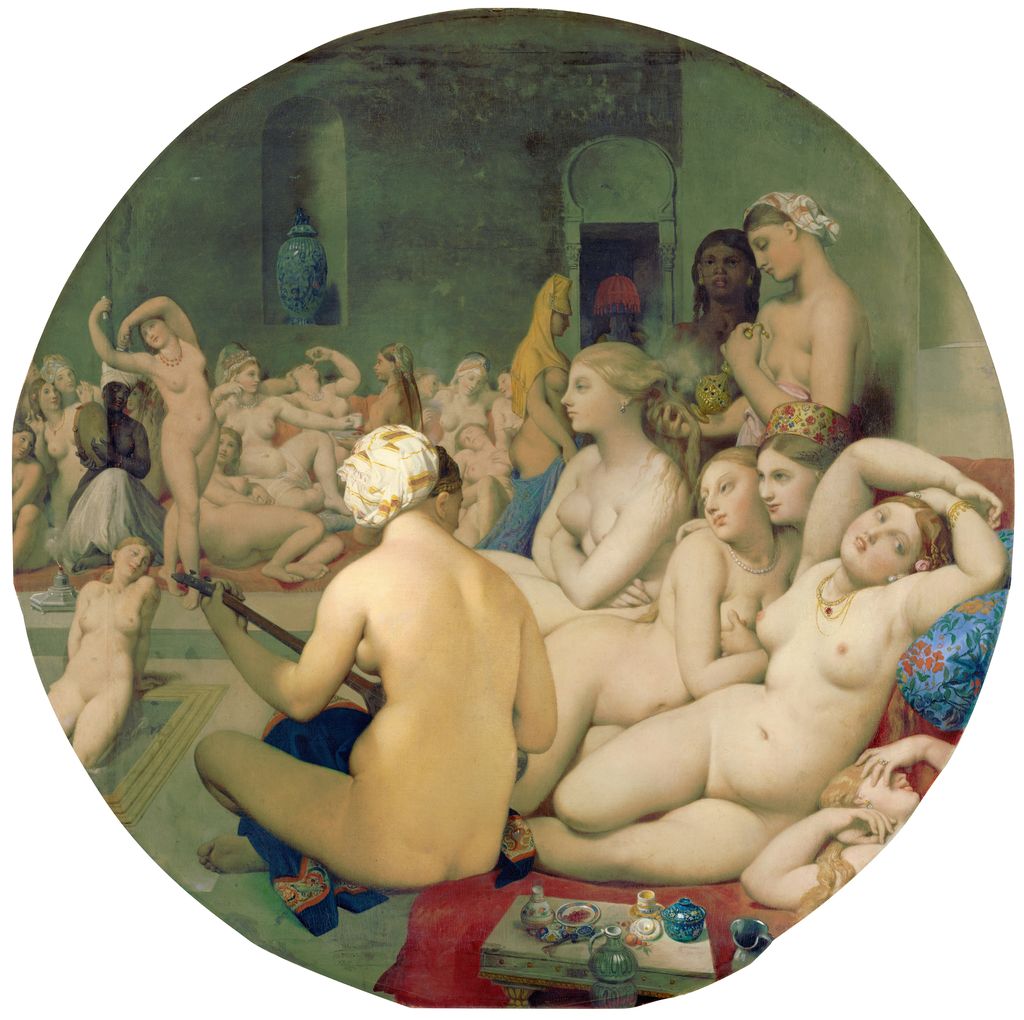
1851–1853The Turkish Bath
1859–1862Contents
- A goddess above the waves
- A painting returned to across forty years
- Beneath the smooth surface
- Antiquity, Renaissance art and living flesh
- Purchasers, criticism and Chantilly
- Venus and The Source
- Annotated details
A goddess above the waves
“Anadyomene” means rising from the sea. The title identifies Venus, the Roman goddess corresponding to the Greek Aphrodite, at her emergence from the water. Chantilly describes birth foam and winged Amours, figures of love. It names the distant female target of the archer as a naïad, a water spirit. [2]
The setting is easy to overlook because the figure is so dominant. A level horizon passes behind her waist. Above it lies a broad, clouded sky; below, the sea darkens around the children. This division gives the picture a simple underlying structure. The sea and sky spread horizontally, while Venus rises through them in a nearly uninterrupted column of light.
Her body is frontal enough to establish that commanding vertical, yet its parts continually turn. The head inclines, the waist narrows to one side, the hips swell towards the other and the knees shift the direction again. One arm crosses above the crown of her head; the other bends beside her shoulder. The pose sends the eye around a long circuit, from elbow to hand, along the hair and down the side of the body. It has the enclosure of a figure fitted into a niche, although there is no architecture around her.
The rounded painted boundary strengthens this effect. At the top, its curve answers the arch of the raised arm. At the bottom, it gathers the children and foam into a compact base. The dark water presses close to the pale limbs. There is little room for the eye to wander sideways without meeting another hand, wing or piece of the surrounding contour.
Venus is physically exposed but gives few clues to a particular action beyond arranging her hair. She neither strides out of the water nor appears startled by the children. The bend of her leg introduces movement without carrying her anywhere. Her expression is similarly suspended: the eyes turn to the side, the mouth is quiet and her face offers no emphatic response to the scene below. This reserve leaves the attendants to supply much of the painting’s narrative energy.
The mirror and the children
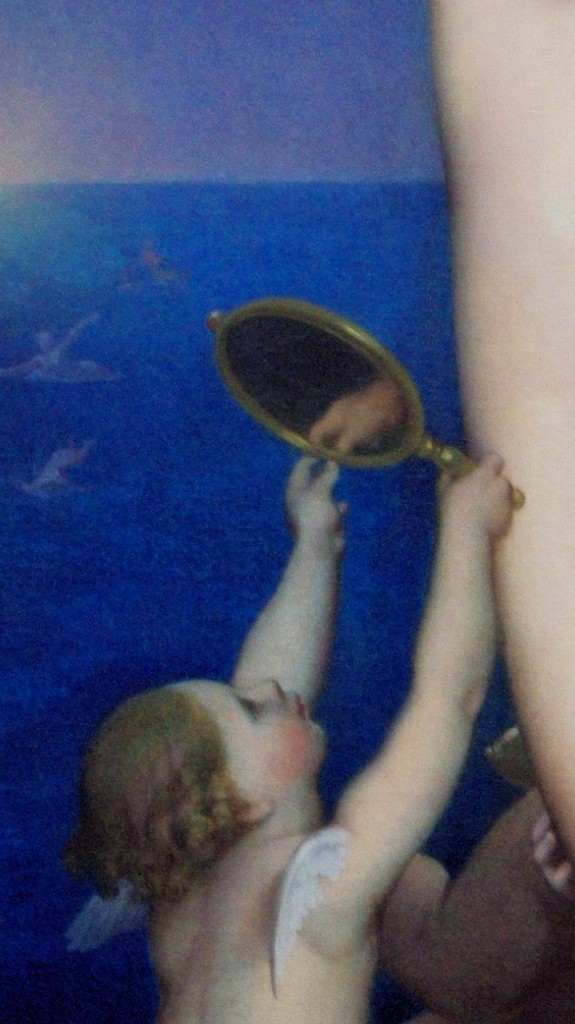
The mirror is angled upwards at the left, but Venus does not visibly consult it. Its dark oval is conspicuous against the lighter arm holding it. The object offers a smaller, tilted enclosure within the painting’s large upright one. The contrast is useful even without assigning the mirror a hidden meaning: it introduces the possibility of looking at Venus from another direction, while the goddess herself remains absorbed in the gesture above her head.
The children make contact with her in different ways. A face emerges close to her foot; another boy wraps himself around her leg and turns his mouth towards the knee. Their foreshortened bodies overlap at awkward angles. The visible effort of their poses makes Venus seem taller and steadier. Her broad, softly modelled torso is set against small shoulders, bent elbows, upturned faces and feathered wings.
On the right, the archer sends attention out towards the margin. His bow cuts a wiry curve across the darkness, a much thinner and more abrupt shape than the ample arcs of Venus’s arms. Beyond the central group, tiny distant figures extend the scene across the water. They belong to the same imagined world, yet their scale makes the foreground body feel almost architectural.
The children also prevent the nude from becoming an isolated outline. Their hands and faces interrupt the line of the legs. Foam conceals and reveals the feet. Looking down the figure therefore changes the experience of the picture: the open expanse of the chest and abdomen gives way to a crowded zone of touches, glances and broken contours.
Annotated Details from Venus Anadyomene
The numbered points identify visible features discussed in this article. Return from each detail to the whole composition. Venus. PE 433. Photograph: Ken and Nyetta (Ken Fairfax); Flickr via Wikimedia Commons. Image source. CC BY 2.0. Numbered overview: resized, with markers added. Detail images: cropped and JPEG-optimised. All these image derivatives are licensed CC BY 2.0.
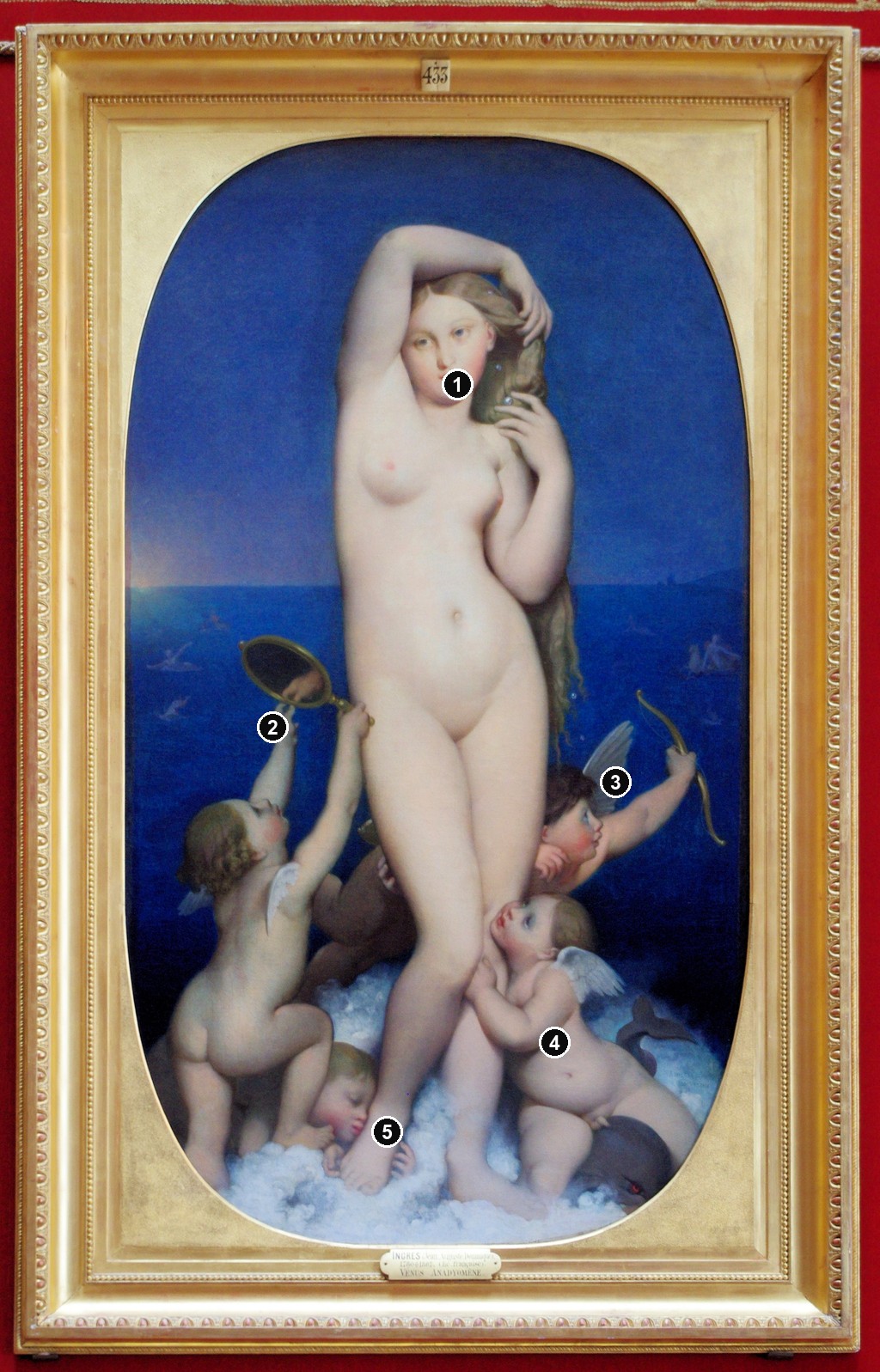
Details from VENUS ANADYOMENE
Follow the raised arm, mirror, bow and smaller figures within the shaped painted boundary.
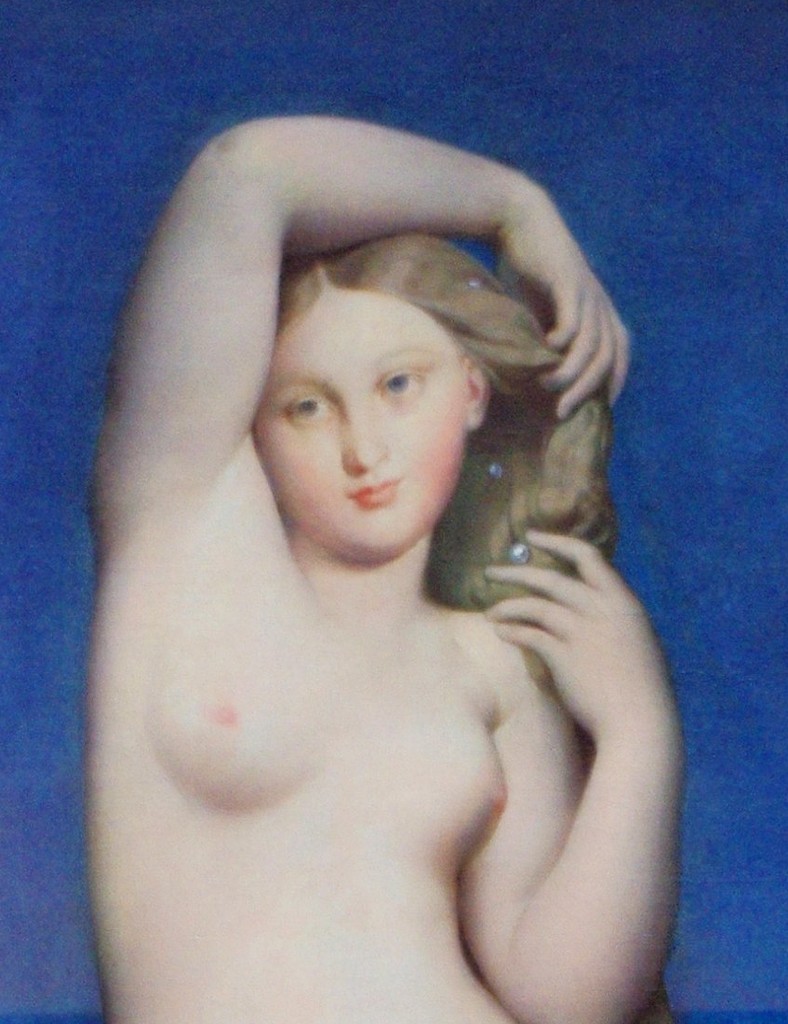
The raised arm and long hair
One arm curves over the head while the other hand gathers the long hair. Follow these different directions around the relatively quiet face.
The lifted mirror at the left
A small winged figure lifts a round mirror beside the standing body. The dark oval and two reaching arms make a compact group within the larger upright composition.
The bow beside the right-hand figure
The small figure at the right raises a curved bow against the blue background. Its thin outline runs beside the broader wing and bent arm.
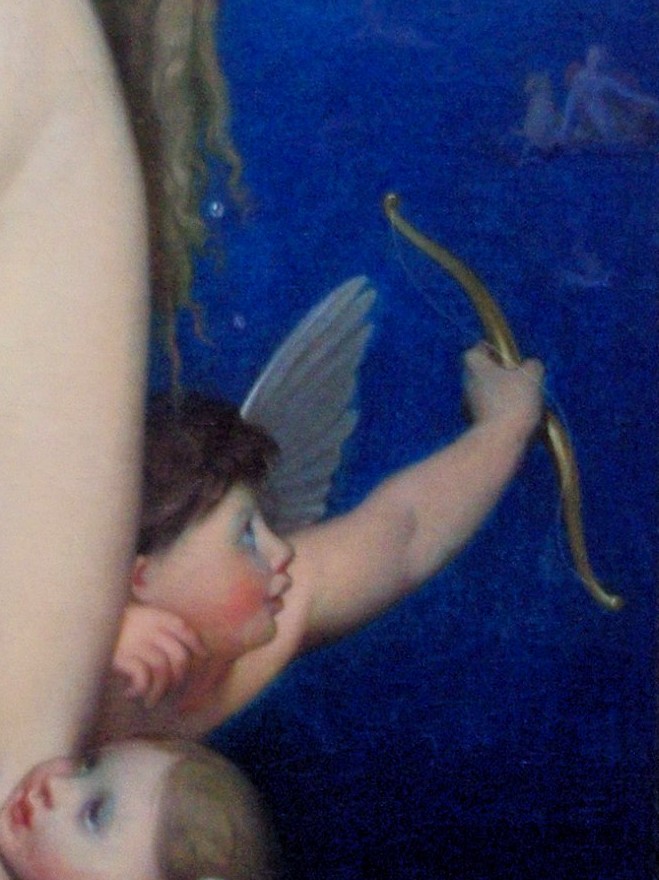
A child embracing the leg
A small winged child presses against one leg and turns its face upwards. Compare this close contact with the more extended gestures of the figures holding objects.
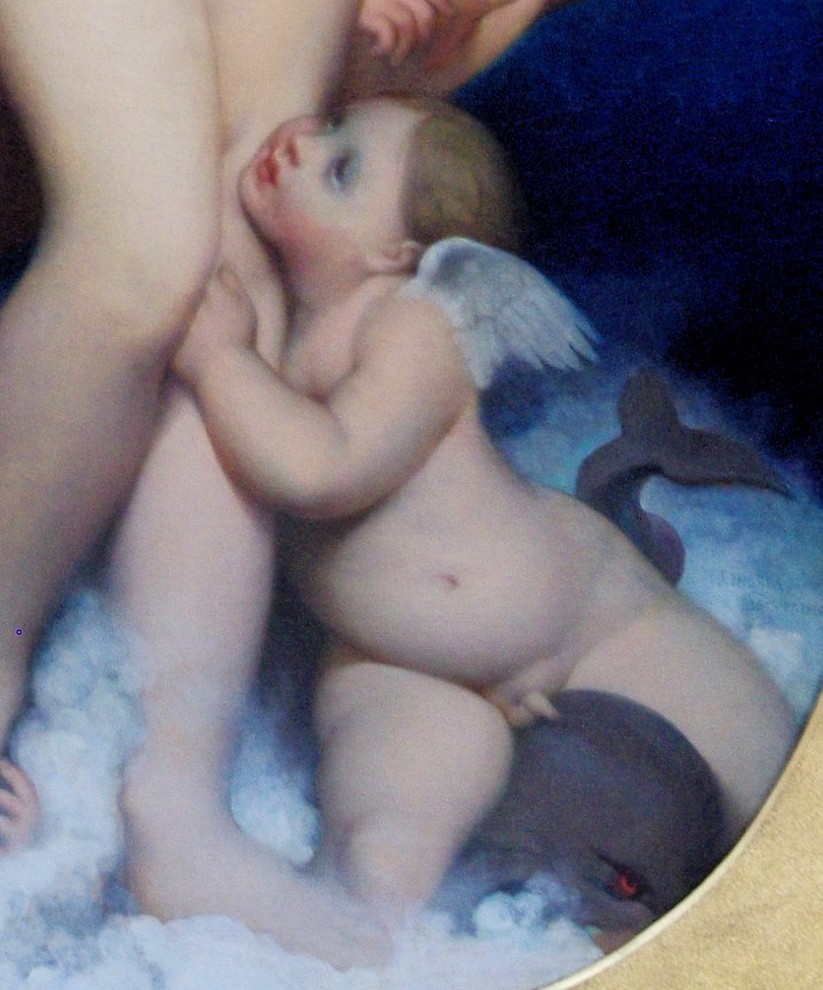
The foot above the foam
The standing foot appears among pale foam and the smaller figures below. Its long outline links the central upright body with the crowded lower edge.
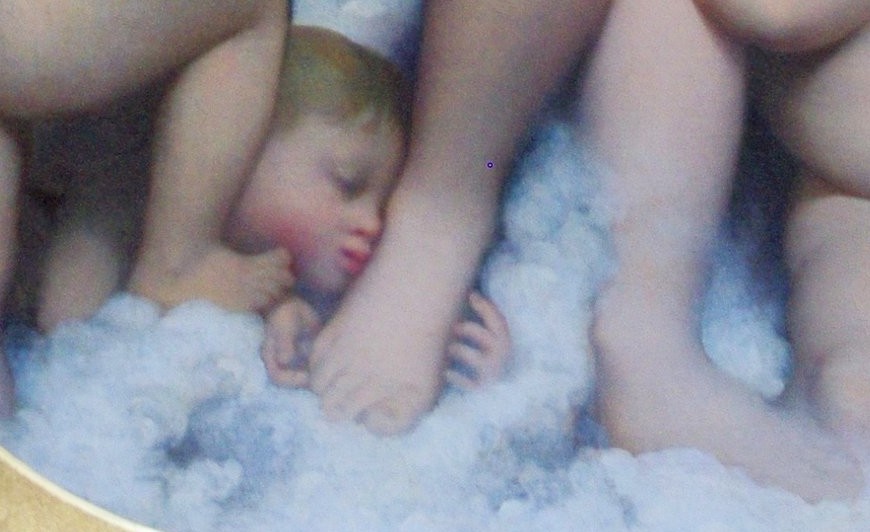
A painting returned to across forty years
The dates cover a long interval, with periods of activity and interruption. In Henri Delaborde’s posthumous account of Ingres’s work, the painting’s early history leads into a letter written from Florence to the artist’s friend Gilibert on 15 June 1821. Ingres described an advanced sketch that had attracted admiration without attracting someone willing to commission its completion. He contrasted this preferred undertaking with smaller, less welcome jobs that financial necessity required him to execute. [1]
The letter gives an unusually concrete reason why an ambitious painting could remain unfinished. Admiration was insufficient. To turn a studio project into a completed work, Ingres needed a patron prepared to support it. His complaint also reveals his own hierarchy of desire at that moment: the Venus represented an opportunity to pursue a large, elevated subject, while other work consumed the time needed to realise it. That hierarchy belongs to his account of his circumstances; it need not determine how we value the portraits and smaller pictures he made. [1]
At the end of the passage, he reported finding a French supporter. The excitement of this announcement makes the earlier frustration more immediate. An unfinished canvas could hold considerable promise for its maker while remaining an uncertain proposition for a purchaser. The letter records the moment when that uncertainty appeared to lift. [1] Chantilly’s 2023 research traces Leblanc’s Florentine patronage in 1822–24, the 1825 sea journey and reported seawater damage. Leblanc died in 1846; Delessert requested completion in 1847; journalists viewed the finished canvas in August 1848. [3]
Delaborde’s older narrative says Ingres could resume the work only forty years after its interruption in 1808. [1] The Florence revisions qualify that account. [3] “Forty years” describes an elapsed span. It would be misleading to imagine Ingres attending to the same passages every day throughout it.
Finishing Venus in June 1848
A second letter printed by Delaborde brings us close to the end. On 9 June 1848, Ingres wrote to Marcotte about the consolation of being able to work amid distressing events. He named his subject as Venus and the Amours and explained that he had reached material completion the previous day, after much labour. Yet he still expected the final finishing to occupy another eight or ten days. [1]
His distinction between reaching completion and giving the picture its last attention is particularly revealing. Finishing involved more than filling the remaining areas of canvas. The picture could exist as a whole while still requiring the adjustments that would settle relationships across its surface. The letter gives us his assessment of that threshold; it does not identify every stroke he subsequently changed. [1]
The calm of the image becomes more complex beside this document. The painting does not illustrate the political crisis of 1848. Ingres’s letter nevertheless places its final work within a troubled present, shortly before the violence of the June Days. Delaborde draws attention to that proximity when presenting the correspondence. [1] We can recognise the contrast without treating the goddess as a coded political allegory.
Nor does the letter make Venus a confession of the artist’s private feelings. It shows that work on an imagined, ordered scene could continue while events outside the studio remained disturbing. The connection between painting and circumstance is documented; the serene expression of the figure need not be made to explain the artist’s state of mind.
Beneath the smooth surface
C2RMF’s 2021 examination found added canvas, a cut lower edge, displaced figures and dolphin; radiography suggests an altered arm. Infrared imaging shows narrower hips. Faint lines may suggest a covering pose, consistent with the 1807 letter; it remains tentative. [3]
The distinction between the visible painting and these earlier traces is essential. An outline encountered beneath paint belongs to a stage in the making of the work. It cannot automatically be read as the artist’s first idea, a complete abandoned composition or an accurate record of a model. Different kinds of evidence answer different questions: the support records physical construction; an underlying drawn contour records preparation; a revised painted passage records another decision. Connecting them into a sequence requires judgement.
The tentative covering pose would interrupt the smooth outline we see today. A move from that arrangement to the visible hair gesture would substantially change the image. Hands held across the torso interrupt it; hands lifted towards the hair open it. The finished painting gives the chest and abdomen a wide, continuous area of illumination, while most of the busy gestures are pushed to the edges and below.
That comparison explains why the technical hypothesis is interesting even while it remains uncertain. It concerns the disposition of the whole body, not merely an adjusted fingertip. The faint marks alone cannot settle the reconstruction. They can help us understand the scale of the question being asked.
The altered boundary is equally consequential. In the finished image, the curve draws the lower group together and limits the space above Venus’s arm. The figure appears fitted to the enclosure, and the enclosure appears to answer her. That relationship can be appreciated on the surface even when the earlier construction is invisible. For more on how drawing, paint and revision interact across Ingres’s work, see Style and Technique.
Antiquity, Renaissance art and living flesh
Chantilly relates the picture to the antique Medici Venus, Botticelli’s Birth of Venus and Raphael’s Triumph of Galatea, particularly its marine attendants. Côme Fabre also proposes Jean Goujon’s nymph reliefs among its mannerist precedents. [2][3] These comparisons direct attention to different parts of the picture. The central nude invites comparison with a statue; the small surrounding figures invite a more expansive mythological scene. Ingres compresses those possibilities into a narrow field. Venus seems capable of standing alone, but the attendants make her the centre of an unfolding event.
Paint gives this statue-like presence a surface of a different kind. Warm flesh advances against cool blue-green water. Shallow shadows turn the abdomen and thighs without breaking them into strongly opposed patches. The raised arm casts a darker passage near the head, concentrating attention on the face. Small pale touches around the hair suggest drops of water, a fragile counterpoint to the broad, stable masses of the body.
Delaborde singled out Ingres’s treatment of form within light areas, comparing its delicacy with The Source. [1] The observation is useful when looking at the torso. Its volume emerges through restrained differences of tone across illuminated skin. Drawing and colour meet here: the silhouette establishes the figure’s limits, while gradual shifts inside it give the body its rounded presence.
Purchasers, criticism and Chantilly
Delaborde tells a pointed story about Benjamin Delessert’s withdrawal from purchasing the finished picture. A relative accompanying him to the studio criticised the drawing of a knee; Delessert then abandoned his intention, enabling Frédéric Reiset to acquire it. [1] This is Delaborde’s account of a particular encounter, rather than evidence that the painting’s anatomy met universal disapproval.
The knee is a revealing place for such an objection to settle. It is both a joint that must make bodily sense and a turning point in the arrangement of the legs. Around it, the child’s embrace draws attention to the limb’s shape. The passage invites scrutiny because the picture itself brings contact and contour together there. A purchaser concerned with correctness could approach it differently from someone absorbed in the figure’s flowing silhouette.
Delaborde’s own judgement was strongly favourable. He treated the Venus as an accomplished example of Ingres’s painting and recorded its exhibition in 1855, when it belonged to Reiset. He also noted Pollet’s undertaking of a burin engraving after it, a reproduction made by cutting lines into a metal plate. [1] The image thus acquired a life beyond the studio and the possession of a single collector.
Chantilly reports Gautier’s praise in 1848: he saw an evocation of ancient painting. [2] This was a contemporary way of seeing the work, not proof that it reconstructed a lost antique original. Its smooth surface could evoke an imagined classical past while its warm flesh remained palpably a painter’s creation.
The Duke of Aumale acquired Reiset’s group in 1879, including Venus. [3] Chantilly records his 1886 donation with usufruct: a lifetime right of use. [2] The canvas’s place at Chantilly therefore grew from a collecting history, after the interrupted patronage and negotiations that had accompanied its making.
Venus and The Source
The Source, completed in 1856 and now at the Musée d’Orsay, began around 1820. [4] It developed from a related standing-nude project. [3] The connection is immediately visible in the arm lifted over the head, the full-length frontal figure and the concentration of pale flesh within a narrow vertical space. Yet the two paintings organise that figure differently.
In Venus, the lifted hands attend to hair. In The Source, they support and tip a vessel, giving the arms an external object to hold. Water falls in a long stream beside the body. The sustained downward movement answers the figure’s upright stance, whereas Venus’s sea spreads behind her and breaks into foam at her feet.
The surroundings alter the encounter too. Flowers, rock and foliage frame the solitary figure of The Source. The Venus has a horizon, distant activity and children pressing into her immediate space. One painting places the nude beside a continuous flow of water; the other surrounds her with bodies responding to her arrival. Comparing them shows how much a raised arm can change when the same general pose receives a different task and setting.

Ingres, The Source, 1856. [5]
Artworks directory
Explore 150 paintings, drawings and an original lithograph. This selection includes related versions and studies; dates distinguish completed works from later revisions.
| Name | Date | Medium |
|---|---|---|
| The Apotheosis of Homer | 1827 | Painting |
| Grande Odalisque | 1814 | Painting |
| The Turkish Bath | 1859–1862 | Painting |
| Madame Moitessier Seated | 1856 | Painting |
| Portrait of Monsieur Bertin | 1832 | Painting |
| Napoleon I on His Imperial Throne | 1806 | Painting |
| Odalisque with Slave | 1839 | Painting |
| The Ambassadors of Agamemnon in the Tent of Achilles | 1801 (competition) | Painting |
| The Valpinçon Bather | 1808 | Painting |
| The Source | 1856 | Painting |
| Oedipus Explaining the Enigma of the Sphinx | 1808; revised probably before 1827 | Painting |
| The Vow of Louis XIII | 1824 | Painting |
| Antiochus and Stratonice | 1840 | Painting |
| The Comtesse d’Haussonville | 1845 | Painting |
| The Princesse de Broglie | 1851–1853 | Painting |
| Jupiter and Thetis | 1811 | Painting |
| The Dream of Ossian | 1813 | Painting |
| The Martyrdom of Saint Symphorian | 1834 | Painting |
| Venus Anadyomene | 1808–1848 | Painting |
| Portrait of Madame de Senonnes | 1814 | Painting |
| Madame Rivière | 1805 | Painting |
| Mademoiselle Caroline Rivière | 1805 | Painting |
| Portrait of Philibert Rivière | 1805 | Painting |
| Bonaparte First Consul | 1804 | Painting |
| The Death of Leonardo da Vinci | 1818 | Painting |
| Joan of Arc at the Coronation of Charles VII | 1854 | Painting |
| Madame Duvaucey | 1807 | Painting |
| La Belle Zélie | 1806 | Painting |
| Madame Panckoucke | 1811 | Painting |
| Portrait of Charles Marcotte d’Argenteuil | 1810 | Painting |
| Joseph Antoine Moltedo | c.1810 | Painting |
| Madame Leblanc | 1823 | Painting |
| Delphine Ingres-Ramel (Portrait of Madame Ingres) | 1859 | Painting |
| Portrait of Amédée de Pastoret | 1823–1826 | Painting |
| Portrait of Baronne de Rothschild | 1848 | Painting |
| Madame Marcotte de Sainte Marie | 1826 | Painting |
| Madame Gonse | 1852 | Painting |
| Aretino in the Studio of Tintoretto | 1848 | Painting |
| Don Pedro of Toledo Kissing Henry IV’s Sword | 1831/1832 | Painting |
| Raphael and La Fornarina | 1814 | Painting |
| Roger Freeing Angelica | 1819 | Painting |
| Romulus’ Victory over Acron | 1812 | Painting |
| Self-Portrait at the Age of Twenty-Four | 1804; revised 1841–1851 | Painting |
| Male Torso | c.1800 | Painting |
| Odalisque in Grisaille (Ingres and workshop) | c.1824–1834 | Painting |
| The Small Bather | 1826 | Painting |
| The Little Bather Harem Interior | 1828 | Painting |
| Jesus Among the Doctors | 1862 | Painting |
| The Virgin Adoring the Host | 1852 | Painting |
| The Virgin of the Host | 1841 | Painting |
| Virgin of the Adoption | 1858 | Painting |
| Paolo and Francesca | 1814 | Painting |
| Homer Deified (revised composition, Louvre RF5273) | 1865 | Drawing |
| Odalisque with Slave (Louvre RF4622) | 1858 | Drawing |
| Odalisque (Walters Art Museum; Ingres and Paul Flandrin) | 1842 | Painting |
| Madame Moitessier Standing (National Gallery of Art) | 1851 | Painting |
| Jacques-Louis Leblanc (The Metropolitan Museum of Art) | 1823 | Painting |
| Ferdinand-Philippe, Duke of Orléans (Louvre RF2005-13) | 1842 | Painting |
| Ferdinand-Philippe, Duke of Orléans (Versailles MV5207; Ingres and workshop) | 1843 | Painting |
| Ferdinand-Philippe, Duke of Orléans (Versailles MV5209; Ingres and workshop) | 1844 | Painting |
| Antiochus and Stratonice (Musée Fabre; Ingres and Raymond Balze) | 1866 | Painting |
| Antiochus and Stratonice (Kunstmuseum Bern, Gurlitt bequest) | Undated (early dating proposed) | Drawing |
| Composition study for Antiochus and Stratonice (MIB867.2193) | 1806 | Drawing |
| Study for the Figure of Stratonice (Met63.66) | 1834–1840 | Graphite, black chalk and charcoal |
| Nude figure study for Stratonice (Boijmans F II 36 PK) | c.1834–1840 | Drawing |
| Paolo and Francesca (The Barber Institute,54.6) | c.1814–1820 | Painting |
| Paolo and Francesca (The Hyde Collection,1971.24) | c.1855–1860 | Painting |
| Paolo and Francesca (Amsterdam Museum TA10970) | 1820 | Drawing |
| Paolo and Francesca (dedicated to Artaud de Montor) | 1816 | Drawing |
| Study for the Bust of Francesca (MIB867.1398) | 1819 | Drawing |
| Study for the Bust of Francesca (MIB867.1396) | 1819 | Drawing |
| The Archangel Raphael, first idea (MIB867.2488) | 1842 | Drawing |
| The Archangel Raphael (MIB867.2500) | 1842 | Drawing |
| The Archangel Raphael Carrying Human Prayers to God (Chantilly DE513) | 1844 | Drawing |
| Louis-Philippe as Saint Philip, stained-glass study | 1844 | Drawing |
| Marie Frédéric Eugène de Reiset (Ford Collection RBF171-2) | 1844 | Drawing |
| Virgil Reading the Aeneid (Toulouse) | Begun 1811 | Painting |
| Tu Marcellus Eris (Brussels, inv. 1836) | c.1814 (museum dating) | Painting |
| Jean-François Gilibert | 1804 | Painting |
| François-Marius Granet | 1807 (museum dating) | Painting |
| Count Nikolai Dmitrievich Guryev | 1821 | Painting |
| Caroline Murat, Queen of Naples | 1814 | Painting |
| Count Mathieu Molé | 1834 | Painting |
| Cherubini and the Muse of Lyric Poetry (Louvre) | 1842 | Painting |
| Luigi Cherubini (Cincinnati) | 1841 | Painting |
| Comtesse de Rayneval (Louvre RF4505) | 1841 | Drawing |
| Venus on Paphos (Antonie Balaÿ) | c.1852 | Painting |
| Prince Napoléon | 1855 | Painting |
| Study for The Apotheosis of Napoleon I (Petit Palais) | Late 1853 | Painting |
| The Apotheosis of Napoleon I (destroyed ceiling) | 1853 | Painting |
| The Journalist (MIB867.2733) | 1834? | Drawing |
| Henry VIII, after Holbein | c.1815–1820 (?) | Drawing |
| Madame Récamier, after David (MIB867.3637) | Undated (early Paris period) | Drawing |
| Study for Comtesse d’Haussonville (MIB867.259; background possibly by another hand) | 1842–1845 | Drawing |
| La Source (reduced version reported by Delaborde) | Date unrecorded; reported 1870 | Painting |
| Odalisque (autograph lithograph,NGA1946.21.117) | 1825; published1826 | Lithograph |
| Portrait of a Seated Lady | 1814 | Graphite |
| The Kaunitz Sisters (Leopoldine, Caroline, and Ferdinandine) | 1818 | Graphite |
| Portrait of a Man | 1814 | Graphite |
| Study for the Portrait of Louis-François Bertin (1766–1841) | n.d. | Black chalk and graphite |
| Studies for the Cadaver of Acron | ca. 1810–12 | Graphite on wove paper |
| Study for the Drapery of Molière in "The Apotheosis of Homer" | n.d. | Black chalk with stumping |
| Madame Guillaume Guillon Lethière, née Marie-Joseph-Honorée Vanzenne, and her son Lucien Lethière | 1808 | Graphite |
| Niccolò Paganini (1782–1840) | ca. 1830 | Counterproof or tracing strengthened with graphite and gouache on translucent paper |
| Lady Mary Cavendish-Bentinck (?-1843) | 1816 | Graphite |
| Madame Alexandre Lethière and Her Daughter Letizia | ca. 1815 | Graphite |
| Merry Joseph Blondel (1781–1853) | 1809 | Graphite |
| Ursin-Jules Vatinelle (1798–1881) | 1820 | Graphite |
| Bust of a Gypsy Girl (ascribed to Ingres) | 1819 | Graphite on wove paper |
| Study of a Seated Nude Male | n.d. | Graphite |
| The Archangel Raphael (Study for a stained-glass window in the chapel of Notre-Dame de la Compassion-Saint-Ferdinand, Neuilly) | ca. 1842 | Graphite |
| Lancelot-Théodore, comte Turpin de Crissé | probably 1818 | Graphite |
| Study for the Figure of the Iliad in "The Apotheosis of Homer" | ca. 1827 | Graphite and black chalk heightened with white chalk on brown paper |
| Comtesse Turpin de Crissé | probably 1818 | Graphite |
| Nude Figures for L'Âge d'Or, Château de Dampierre | n.d. | Graphite on brownish paper |
| Study of Figures (attributed to Ingres) | n.d. | Graphite |
| Study of Figures (attributed to Ingres) | n.d. | Graphite; squared in graphite |
| Admiral Sir Fleetwood Broughton Reynolds Pellew | 1817 | Graphite on wove paper |
| Madame Jean-Auguste-Dominique Ingres, née Madeleine Chapelle | 1814 | Graphite on off-white wove paper |
| Virgil Reading the Aeneid to Augustus, Livia, and Octavia | 1809/1819 (?) | Pen and black ink, graphite, brush and gray wash, white gouache heightening, Conté crayon on blue paper |
| General Louis-Étienne Dulong de Rosnay | 1818 | Graphite (hard and soft pencils) |
| Madame Alexandre Lethière, née Rosa Meli, and Her Daughter, Letizia | 1815 | Graphite |
| The Lawyer Paul Grand | 1834 | Graphite |
| Jean-Joseph Fournier | 1815 | Graphite |
| Armand Bertin | 1842 | Graphite |
| Madame Armand Bertin, née Marie-Anne-Cécile Dollfuss | 1843 | Graphite |
| The Architect Charles-Victor Famin | 1836 | Graphite |
| Henri Lehmann | 1850 | Graphite |
| Portrait of a Lady | ca. 1815–17 | Graphite |
| Edmond Cavé (1794–1852) | 1844 | Oil on canvas |
| Head of Saint John the Evangelist | probably ca. 1818–20 | Oil on canvas, laid down on wood |
| Madame Edmond Cavé (Marie-Elisabeth Blavot, ca. 1806–1883) | ca. 1831–34 | Oil on canvas |
| Madame Félix Gallois | 1852 | Graphite with touches of gold in oil to highlight jewelry, on buff wove paper. |
| Dr. François Mêlier | 1849 | Graphite with graphite framing lines, corrected with white, on buff wove paper |
| Portrait of Madame Rhode (Rhoda?) | 1810–20 | Graphite on pale buff wove paper |
| Study for "Raphael and the Fornarina"(?) | ca. 1814(?) | Graphite on white wove paper |
| Portrait of Madame Paul Meurice, née Palmyre Granger | ca. 1845–50 | Graphite on wove paper |
| Alexander the Great presenting Campaspe to Apelles | 1810 | Graphite, brush and brown wash; squared in graphite |
| Study of Hands for "Christ Among the Doctors" | 1852–62 | Graphite on tracing paper |
| Study for The Turkish Bath (RF34502) | about 1850 | Pen and brown ink with graphite, partially squared |
| Study for The Turkish Bath (RF23354) | Undated | Pen and brown ink with graphite on joined sheets |
| Study for The Turkish Bath (RF54702) | about 1859 | Pen and brown ink |
| Studies of women for The Turkish Bath (RF12292) | Undated | Black chalk |
| Achilles Receiving the Envoys of Agamemnon (Nationalmuseum sketch, NM2161) | 1801 | Oil on wood |
| Half-Length Bather (Musée Bonnat-Helleu,89) | 1807 | Oil on canvas |
| Oedipus and the Sphinx (National Gallery,NG3290) | about1826 | Oil on canvas |
| Oedipus and the Sphinx (Walters,37.9) | 1864 | Oil on canvas |
| Oedipus and the Valpinçon Bather, after David (MI.867.2035) | Undated | Graphite on tracing paper, after David |
| Study of the Virgin for The Vow of Louis XIII (Dijon,1758) | about1822 | Black chalk, stump and white chalk on brown wove paper |
| First Thought for The Vow of Louis XIII (MI.885.11.21) | 1822 | Oil on canvas |
Frequently Asked Questions
It means Venus rising from the sea. The white foam gives that title a visible form. [2]
No. His 1821 letter describes a long-unfinished sketch awaiting a purchaser; his 1848 letter describes the last finishing. [1]
They are separate paintings. Compare the jar and falling water in The Source with the hair gesture, sea and winged children in Venus.
Discussion
Look again at the images and ideas explored in Venus Anadyomene. These editorial prompts invite your observations.
Reader Insights
Does Venus seem more still because the children around her are so active? Compare the raised arm with the gestures around her legs, and consider where the picture makes you pause or keeps your eye moving.
Compare Venus’s raised arm with the upright figure in The Source. How does the activity around Venus change your experience of a similar stillness?
What changes in your interpretation when you think of the painting as an object returned to over decades?
Join the Conversation
Share a detail, comparison or question about Venus Anadyomene below.
References
- Henri Delaborde, Ingres, sa vie, ses travaux, sa doctrine, d’après les notes manuscrites et les lettres du maître. Paris: Henri Plon, 1870, catalogue no. 23, pp. 190–192; letters to Gilibert, 15 June 1821, and Marcotte, 9 June 1848. Posthumous documentary compilation. (in French) View source.
- Musée Condé, Vénus. View source.
- Chantilly, Ingres, press kit, 2023, pp. 39–40, 42, 46–47. View source.
- Musée d’Orsay, La Source, RF 219. Collection record, object details and commentary: Florence beginnings around 1820; completion in 1856; Musée d’Orsay location. View source.
- Supporting image. Ingres, The Source, 1856. Image source. CC0 / Public domain.
- Ministère de la Culture, Collections des musées de France, Joconde, Venus Anadyomene, Louvre MI 726, record 000PE001558. Updated 28 March 2025. Attribution to Ingres or his workshop; reduced repetition on cardboard. (in French) View source.
- Splash image. Venus. PE 433. Wikimedia Commons. Image source. Public domain.