by Tom Gurney
Tom Gurney BSc (Hons) is an art history expert with over 20 years experience
Published on June 19, 2020 / Updated on October 22, 2026
Email: tomgurney1@gmail.com / Phone: +44 7429 011000
Portrait of Amédée de Pastoret
The black coat takes time to reveal itself. At first it gives Amédée de Pastoret a compact, dark silhouette against the green room. Then its embroidered leaves begin to catch the light, spreading across his chest and climbing the high collar. His face, white shirt and widely spread fingers emerge from this restrained setting with unusual clarity. A red ribbon and elaborate gold sword hilt provide small, brilliant interruptions.
Painted in 1823–26, the portrait belongs to the Art Institute of Chicago. [1] Ingres establishes the sitter’s presence through the disposition of a body: the head held above the collar, one elbow thrust outward, the hands occupying different parts of the coat. Following those details brings us closer to how the portrait works, before its sitter’s history supplies another way of reading it.
At a Glance
- ArtistJean-Auguste-Dominique Ingres.
- Date1823–26; signed and dated 1826.
- Medium and sizeOil on canvas, 103 × 83.5 cm.
- SitterAmédée-David de Pastoret, then comte de Pastoret.
- CollectionArt Institute of Chicago, accession 1971.452. [1][2]
This work across Ingres’s career
Agamemnon’s Ambassadors
1801 (competition)Grande Odalisque
1814Amédée de Pastoret (current article)
1823–1826Louis XIII’s Vow
1824Monsieur Bertin
1832The Princesse de Broglie
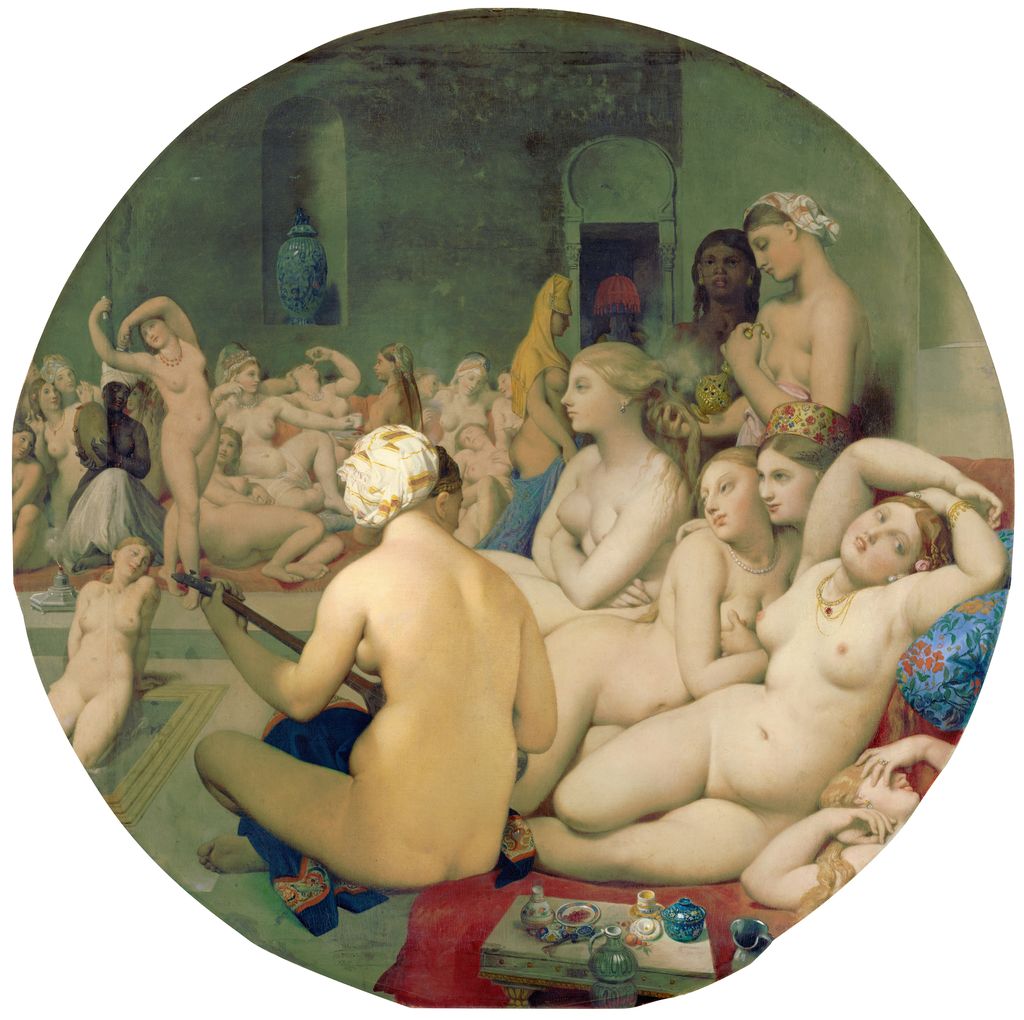
1851–1853The Turkish Bath
1859–1862Contents
- Black embroidery against a green room
- The man wearing the uniform
- A patron who helped Ingres obtain work
- Why the date runs from 1823 to 1826
- A public portrait with an anonymous Salon title
- From the family collection to Degas and Chicago
- A useful comparison: Marcotte d’Argenteuil
- Annotated details
Black embroidery against a green room
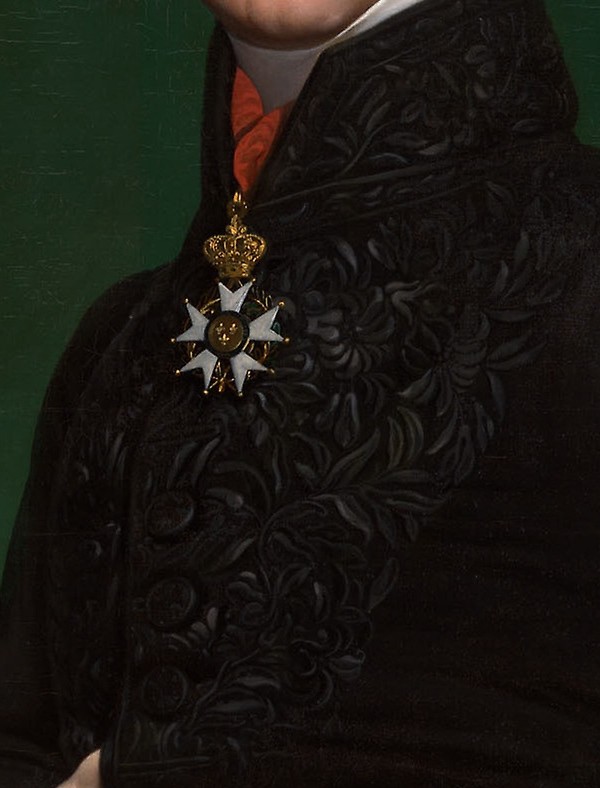
The coat occupies most of the lower picture, but Ingres gives its different surfaces distinct characters. The sleeve on our right is relatively plain. Light follows its upper edge, crosses a fold at the elbow and fades into the dark forearm. Across the chest, by contrast, the embroidery produces an intricate network of curling shapes. The pattern remains close in colour to the cloth beneath it; its visibility depends on tiny changes of light and shade.
This makes black an active part of the painting. It can appear smooth, recessed, patterned or almost lustrous within a very narrow range. The costume’s decoration becomes clearer as we continue looking. Its complexity rewards attention without breaking the large shape of the torso.
The Art Institute identifies the clothing as the embroidered black uniform associated with Pastoret’s service as an auditor in the Council of State, and the decoration at his neck as the Legion of Honour. [1] The white points of the cross and the red ribbon sit immediately below his face. Their position encourages the eye to travel upward along the centre of the body, from the embroidery to the collar and then to the head.
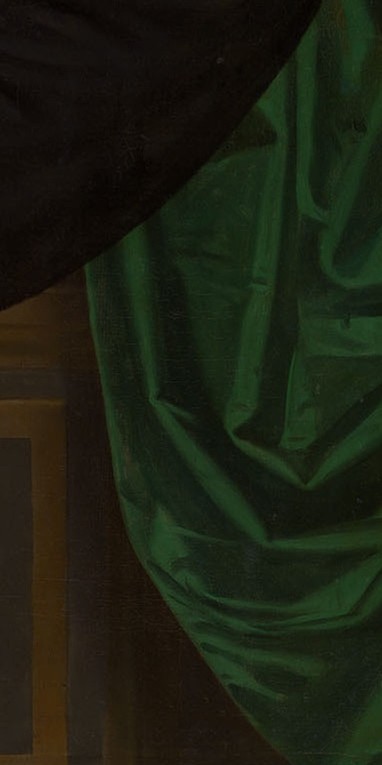
The green background helps hold this arrangement together. Broad vertical bands on the wall rise behind the figure; on the right, gathered drapery turns a similar colour into a sequence of folds. The wall appears comparatively still, while the curtain dips and gathers towards the lower corner. Between them, Pastoret’s bent arm produces a firm angular contour.
At waist level, horizontal strips of gold and grey panelling steady the room. These lines are partly interrupted by the body and the objects beside it. They give us enough architecture to recognise an interior without inviting us to wander through it. Our attention stays on the figure close to the picture’s surface.
Two hands, two kinds of movement
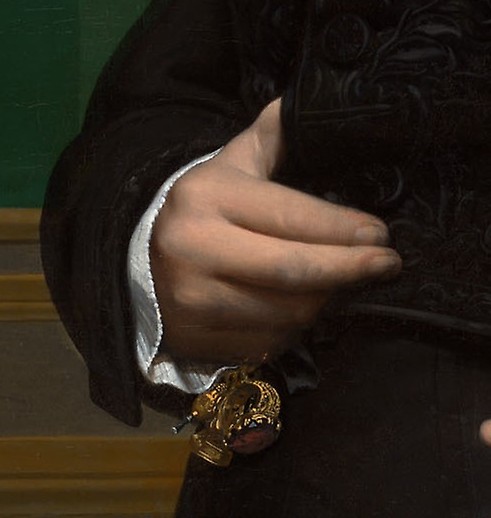
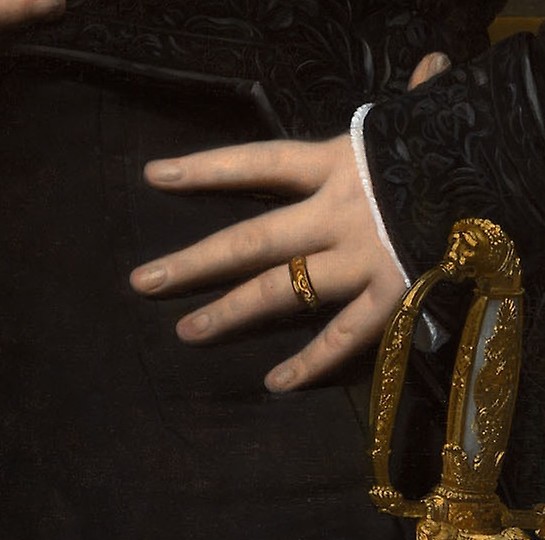
Pastoret’s right hand, on our left, gathers the front of his coat, with the thumb disappearing into it. The fingers make a small, contained shape. On the opposite side, the left hand spreads across his hip. The fingers separate into pale, tapering forms, and a gold ring catches the eye near the middle of their fan.
The two gestures create different rhythms. The tucked hand leads inward towards the embroidered centre of the coat. The open hand carries our attention across a plain dark area and towards the sword. Above it, the elbow makes the figure wider, claiming a substantial portion of the canvas. The apparent ease of the stance depends on this very precise distribution of shapes.
The hands also complicate the uniform. Official dress can make a sitter seem enclosed within a role, yet these gestures give the clothes the flexibility of something being worn. Fabric pulls around the grasping hand and bends with the forearm. The coat’s large dark areas connect the body, while the small white edges of the cuffs locate the wrists within it.
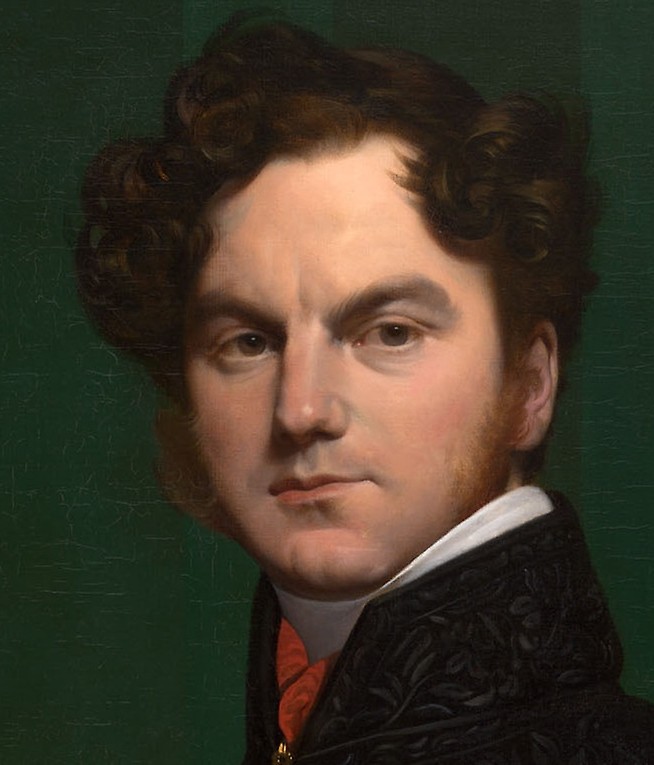
The face is quieter. The mouth is closed, the gaze directed towards us, and the brows remain sharply legible beneath the loose curls. We can describe the effect as reserved or self-possessed. Turning that impression into a verdict on Pastoret’s character would require a different kind of evidence.
Annotated Details from Portrait of Amédée de Pastoret
The numbered points identify visible features discussed in this article. Return from each detail to the whole composition. Ingres, Pastoret. Art Institute of Chicago, 1971.452. Image source. CC0 / Public domain.
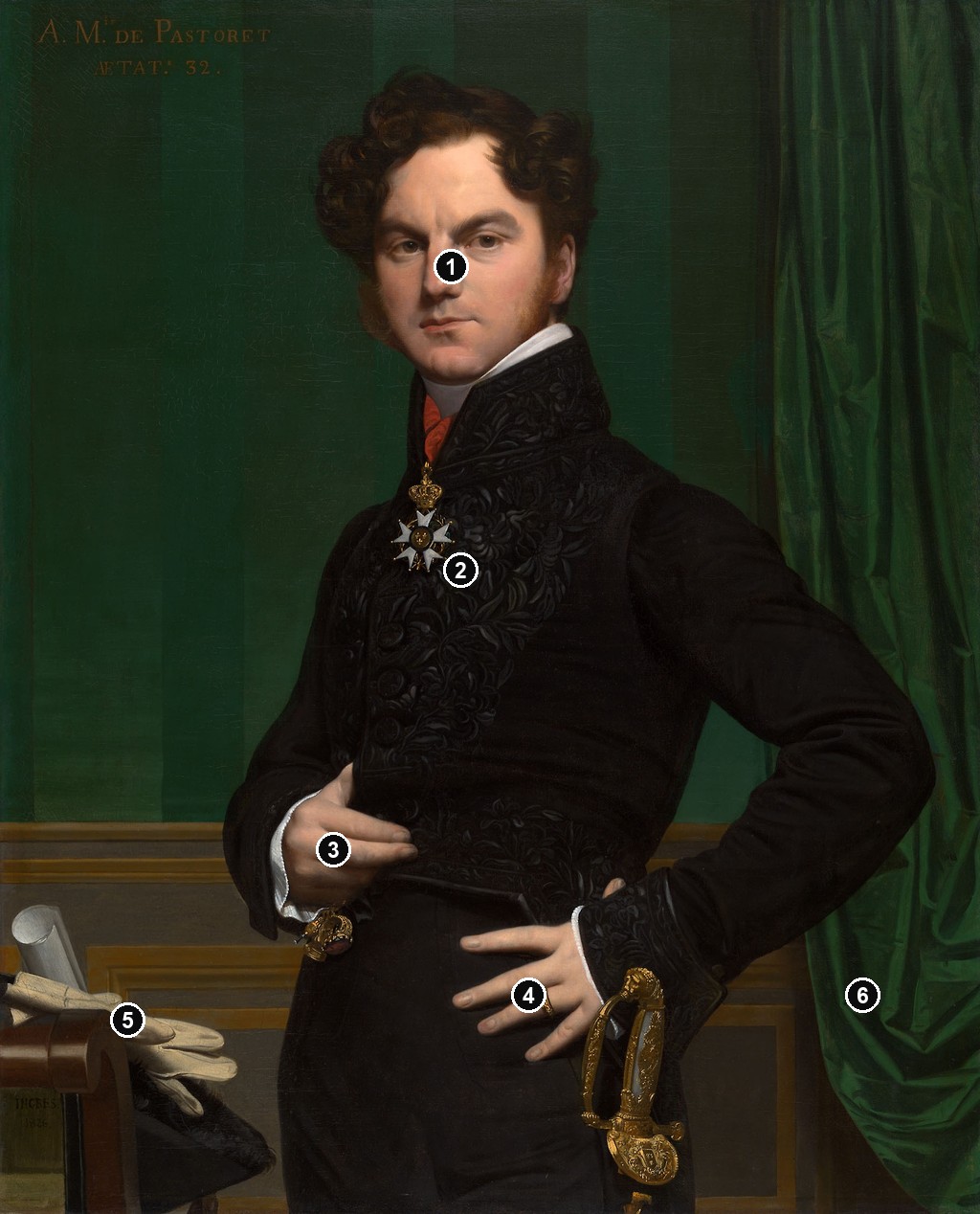
Details from PORTRAIT OF AMÉDÉE DE PASTORET
Trace the hands and embroidered uniform, then look towards the small objects and green curtain around the figure.
The face above the high collar
The head turns slightly within a mass of dark hair. The small white collar and red neckcloth separate the face from the black uniform below.
Black embroidery around the decoration
Leaf-like embroidery spreads down the high collar and chest around a bright suspended decoration. Look for differences between the shiny raised pattern and the darker cloth.
A hand meeting the coat front
One hand reaches across the front of the coat with two fingers close together. The pale cuff and dark embroidery emphasise the turn at the wrist.
The spread hand beside the sword
The other hand opens across the lower coat beside the sword. A narrow ring and white cuff make smaller accents within its broad spreading shape.
Gloves and rolled papers on the chair
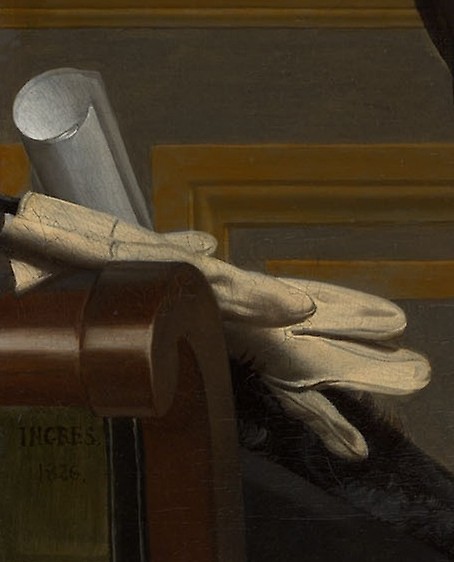
Pale gloves lie near rolled papers at the lower left. Their soft, irregular shapes contrast with the straighter edge and rounded corner of the chair.
The hanging green curtain
Long vertical folds descend through the green curtain before gathering near the bottom. Their broad rhythm contrasts with the small repeated embroidery of the uniform.
The man wearing the uniform
Amédée-David de Pastoret lived from 1791 to 1857. He entered the Council of State as an auditor in 1809, served the Bourbon monarchy after Napoleon’s fall, and became a councillor of state in 1825. He was also a member of the Académie des Beaux-Arts from 1823. [3] These appointments give the uniform a particular setting: the portrait belongs to the years of the restored Bourbon monarchy, when Pastoret combined public office with a place in artistic institutions. Pastoret was a count when painted; he became marquis in 1840. [2]
His subsequent career crossed further political changes. After the revolution of 1830 he refused the oath to Louis-Philippe and supported the Bourbon claimants in exile. In 1852 Napoleon III appointed him a senator. He also wrote poems and historical fiction. [3] The composed figure in the painting therefore belongs to one moment within a career that moved through several regimes. Neither the sword nor the direct gaze can tell that whole story on its own.
A patron who helped Ingres obtain work
Pastoret’s relationship with Ingres extended beyond this commission. In his posthumous account of the artist, Henri Delaborde credits Pastoret with commissioning the small Entry of Charles V into Paris in 1820 and with helping secure the government commission for The Vow of Louis XIII. Delaborde places this assistance among the friendships and encouragements that sustained Ingres during his stay in Florence. [4]
That account gives the portrait an added intimacy. The man presented in official costume had used his influence to bring the painter work. The relationship involved both the possession of pictures and access to the institutions that commissioned them. The Art Institute also considers it likely that Pastoret helped Ingres gain admission to the Académie des Beaux-Arts. [1] “Likely” leaves room for the difference between a patron’s support and proof of the precise part he played in an election. Their first meeting is uncertain; surviving correspondence begins around 1818. Pastoret eventually owned seven Ingres works, including an 1822 portrait drawing of his wife. [2]

Ingres, The Vow of Louis XIII, 1824. [5]
Why the date runs from 1823 to 1826
The 1826 signature and inscription giving Pastoret’s age as thirty-two prompted the hypothesis of an 1823 start. [2] The Art Institute dates the painting 1823–26. [1] The inscriptions occupy very different positions. The sitter’s name and age appear high on the open wall, where they can be read without entering the crowded lower part of the composition. Ingres’s signature is tucked beside the chair near the bottom edge. One identifies the person shown; the other names the painter and supplies a date. Their separation makes each serve a distinct purpose within the picture.
Two studies catalogued in Montauban concern the torso and arm (867.363) and left hand (867.364). Letters reported in the 1999 catalogue confirm a 1,000-franc price in December 1824 and request Pastoret’s gloves. These do not establish three years of continuous work. [2]
These details direct attention back to the making of the portrait. The pose has to work at the scale of the whole body, but it also depends on small, specific things: the turn of a wrist, the projection of an elbow, the form of an accessory. The gloves resting on the chair belong to that second scale of attention. Their pale, folded shapes make a little counterweight to the luminous hands.
The chair also holds a roll of paper and a dark hat. The paper’s round end faces towards us, while its length rises diagonally behind the gloves. The polished brown chair arm curves forward beneath them. This small gathering of objects breaks up the lower-left corner without competing with the sitter’s head. Across the picture, the ornate sword hilt supplies a brighter and more vertical accent. The composition balances these two groups around the dark mass of the coat.
A public portrait with an anonymous Salon title
The painting appeared at the Salon of 1827 as number 575, Portrait d’homme—Portrait of a Man. Eric Bertin’s corrections to the 1999 exhibition catalogue establish that the Salon title did not reveal the sitter’s name. [6] That anonymous wording differs from the individual identity preserved within the painting itself. As Andrew Carrington Shelton reports, Jal and La Pandore recognised Pastoret and mocked his political and literary pretensions. [2]
The distinction is useful when looking at the pose. A hand on the hip, a projecting elbow and an elevated head can be read as confidence, formality or self-importance. The visible arrangement remains the same while the viewer’s knowledge and sympathies alter its effect. A portrait can supply the occasion for political judgement without making every judgement an explanation of the painter’s intentions.
Delaborde records a second exhibition in 1855. He also lists an outline engraving in the volume published by Magimel and lithographic reproductions by Belliard and Aubert. [4] These are reproductions after the painting, rather than evidence that Ingres made all the prints himself.
An outline version would necessarily change our experience of this particular portrait. The silhouette, bent elbow and spread hand could remain forceful, while the almost concealed embroidery would lose much of its dependence on subtle differences within black. Reproduction makes the arrangement portable, but the painted colour relationships remain essential to the original encounter.
From the family collection to Degas and Chicago
The portrait stayed in the family until Pastoret’s daughter died in 1890. Edgar Degas acquired it in 1897 and kept it until his death in 1917. [1] Durand-Ruel bought it for Degas; David David-Weill acquired it in 1918, before its passage through Wildenstein. [2] The Art Institute acquired the painting in 1971. [1]
The movement from a sitter’s family to another artist’s collection changes the portrait’s setting. A likeness made within a relationship of patronage becomes an object selected by a later painter. We cannot recover Degas’s experience simply by looking at it, but the work offers abundant reasons for a painter to linger: the management of black, the unequal hands, the economy with which a few objects establish a room.
Its frame has a history of its own. In 1999 Nicholas Penny identified the frame then surrounding Pastoret as an unaltered Parisian neoclassical example from the 1780s. His essay also cautioned that even a portrait’s first frame need not have been designed or selected by Ingres. [7] This older frame should therefore not be treated as a securely documented choice made by the artist for the completed painting in 1826.
That distinction encourages us to look at a framed portrait as an object assembled across time. The painted gold of the room belongs inside Ingres’s composition. The surrounding carved and gilded structure belongs to the picture’s material presentation, and needs evidence of its own.
A useful comparison: Marcotte d’Argenteuil
Ingres’s Portrait of Charles Marcotte d’Argenteuil, painted in 1810 and now in the National Gallery of Art, Washington, offers a revealing comparison. [8] Both men turn their faces towards us above high collars; in each picture, a pale hand stands out against dark clothing.
Marcotte’s hand hangs loosely over an orange-red support. His outer garment spreads around the shoulders in broad blue folds, and a yellow waistcoat brightens the area below his chin. Pastoret’s uniform gives the body a closer, more continuous enclosure. His left hand presses visually against the hip, and the elbow sets a clear angle against the curtain.
The comparison brings out how much a portrait’s manner depends on clothing and support. Marcotte’s draped garment and resting hand let the forms settle. Pastoret’s fitted coat, outward elbow and spread fingers keep the figure taut. These differences can be experienced directly in the paintings without assigning either man a fixed personality. They also make a useful entry into the variety of Ingres’s portraits: a repeated interest in hands, faces and fabric can produce very different encounters.

Ingres, Portrait of Charles Marcotte d’Argenteuil, 1810. [9]
Artworks directory
Explore 150 paintings, drawings and an original lithograph. This selection includes related versions and studies; dates distinguish completed works from later revisions.
| Name | Date | Medium |
|---|---|---|
| The Apotheosis of Homer | 1827 | Painting |
| Grande Odalisque | 1814 | Painting |
| The Turkish Bath | 1859–1862 | Painting |
| Madame Moitessier Seated | 1856 | Painting |
| Portrait of Monsieur Bertin | 1832 | Painting |
| Napoleon I on His Imperial Throne | 1806 | Painting |
| Odalisque with Slave | 1839 | Painting |
| The Ambassadors of Agamemnon in the Tent of Achilles | 1801 (competition) | Painting |
| The Valpinçon Bather | 1808 | Painting |
| The Source | 1856 | Painting |
| Oedipus Explaining the Enigma of the Sphinx | 1808; revised probably before 1827 | Painting |
| The Vow of Louis XIII | 1824 | Painting |
| Antiochus and Stratonice | 1840 | Painting |
| The Comtesse d’Haussonville | 1845 | Painting |
| The Princesse de Broglie | 1851–1853 | Painting |
| Jupiter and Thetis | 1811 | Painting |
| The Dream of Ossian | 1813 | Painting |
| The Martyrdom of Saint Symphorian | 1834 | Painting |
| Venus Anadyomene | 1808–1848 | Painting |
| Portrait of Madame de Senonnes | 1814 | Painting |
| Madame Rivière | 1805 | Painting |
| Mademoiselle Caroline Rivière | 1805 | Painting |
| Portrait of Philibert Rivière | 1805 | Painting |
| Bonaparte First Consul | 1804 | Painting |
| The Death of Leonardo da Vinci | 1818 | Painting |
| Joan of Arc at the Coronation of Charles VII | 1854 | Painting |
| Madame Duvaucey | 1807 | Painting |
| La Belle Zélie | 1806 | Painting |
| Madame Panckoucke | 1811 | Painting |
| Portrait of Charles Marcotte d’Argenteuil | 1810 | Painting |
| Joseph Antoine Moltedo | c.1810 | Painting |
| Madame Leblanc | 1823 | Painting |
| Delphine Ingres-Ramel (Portrait of Madame Ingres) | 1859 | Painting |
| Portrait of Amédée de Pastoret | 1823–1826 | Painting |
| Portrait of Baronne de Rothschild | 1848 | Painting |
| Madame Marcotte de Sainte Marie | 1826 | Painting |
| Madame Gonse | 1852 | Painting |
| Aretino in the Studio of Tintoretto | 1848 | Painting |
| Don Pedro of Toledo Kissing Henry IV’s Sword | 1831/1832 | Painting |
| Raphael and La Fornarina | 1814 | Painting |
| Roger Freeing Angelica | 1819 | Painting |
| Romulus’ Victory over Acron | 1812 | Painting |
| Self-Portrait at the Age of Twenty-Four | 1804; revised 1841–1851 | Painting |
| Male Torso | c.1800 | Painting |
| Odalisque in Grisaille (Ingres and workshop) | c.1824–1834 | Painting |
| The Small Bather | 1826 | Painting |
| The Little Bather Harem Interior | 1828 | Painting |
| Jesus Among the Doctors | 1862 | Painting |
| The Virgin Adoring the Host | 1852 | Painting |
| The Virgin of the Host | 1841 | Painting |
| Virgin of the Adoption | 1858 | Painting |
| Paolo and Francesca | 1814 | Painting |
| Homer Deified (revised composition, Louvre RF5273) | 1865 | Drawing |
| Odalisque with Slave (Louvre RF4622) | 1858 | Drawing |
| Odalisque (Walters Art Museum; Ingres and Paul Flandrin) | 1842 | Painting |
| Madame Moitessier Standing (National Gallery of Art) | 1851 | Painting |
| Jacques-Louis Leblanc (The Metropolitan Museum of Art) | 1823 | Painting |
| Ferdinand-Philippe, Duke of Orléans (Louvre RF2005-13) | 1842 | Painting |
| Ferdinand-Philippe, Duke of Orléans (Versailles MV5207; Ingres and workshop) | 1843 | Painting |
| Ferdinand-Philippe, Duke of Orléans (Versailles MV5209; Ingres and workshop) | 1844 | Painting |
| Antiochus and Stratonice (Musée Fabre; Ingres and Raymond Balze) | 1866 | Painting |
| Antiochus and Stratonice (Kunstmuseum Bern, Gurlitt bequest) | Undated (early dating proposed) | Drawing |
| Composition study for Antiochus and Stratonice (MIB867.2193) | 1806 | Drawing |
| Study for the Figure of Stratonice (Met63.66) | 1834–1840 | Graphite, black chalk and charcoal |
| Nude figure study for Stratonice (Boijmans F II 36 PK) | c.1834–1840 | Drawing |
| Paolo and Francesca (The Barber Institute,54.6) | c.1814–1820 | Painting |
| Paolo and Francesca (The Hyde Collection,1971.24) | c.1855–1860 | Painting |
| Paolo and Francesca (Amsterdam Museum TA10970) | 1820 | Drawing |
| Paolo and Francesca (dedicated to Artaud de Montor) | 1816 | Drawing |
| Study for the Bust of Francesca (MIB867.1398) | 1819 | Drawing |
| Study for the Bust of Francesca (MIB867.1396) | 1819 | Drawing |
| The Archangel Raphael, first idea (MIB867.2488) | 1842 | Drawing |
| The Archangel Raphael (MIB867.2500) | 1842 | Drawing |
| The Archangel Raphael Carrying Human Prayers to God (Chantilly DE513) | 1844 | Drawing |
| Louis-Philippe as Saint Philip, stained-glass study | 1844 | Drawing |
| Marie Frédéric Eugène de Reiset (Ford Collection RBF171-2) | 1844 | Drawing |
| Virgil Reading the Aeneid (Toulouse) | Begun 1811 | Painting |
| Tu Marcellus Eris (Brussels, inv. 1836) | c.1814 (museum dating) | Painting |
| Jean-François Gilibert | 1804 | Painting |
| François-Marius Granet | 1807 (museum dating) | Painting |
| Count Nikolai Dmitrievich Guryev | 1821 | Painting |
| Caroline Murat, Queen of Naples | 1814 | Painting |
| Count Mathieu Molé | 1834 | Painting |
| Cherubini and the Muse of Lyric Poetry (Louvre) | 1842 | Painting |
| Luigi Cherubini (Cincinnati) | 1841 | Painting |
| Comtesse de Rayneval (Louvre RF4505) | 1841 | Drawing |
| Venus on Paphos (Antonie Balaÿ) | c.1852 | Painting |
| Prince Napoléon | 1855 | Painting |
| Study for The Apotheosis of Napoleon I (Petit Palais) | Late 1853 | Painting |
| The Apotheosis of Napoleon I (destroyed ceiling) | 1853 | Painting |
| The Journalist (MIB867.2733) | 1834? | Drawing |
| Henry VIII, after Holbein | c.1815–1820 (?) | Drawing |
| Madame Récamier, after David (MIB867.3637) | Undated (early Paris period) | Drawing |
| Study for Comtesse d’Haussonville (MIB867.259; background possibly by another hand) | 1842–1845 | Drawing |
| La Source (reduced version reported by Delaborde) | Date unrecorded; reported 1870 | Painting |
| Odalisque (autograph lithograph,NGA1946.21.117) | 1825; published1826 | Lithograph |
| Portrait of a Seated Lady | 1814 | Graphite |
| The Kaunitz Sisters (Leopoldine, Caroline, and Ferdinandine) | 1818 | Graphite |
| Portrait of a Man | 1814 | Graphite |
| Study for the Portrait of Louis-François Bertin (1766–1841) | n.d. | Black chalk and graphite |
| Studies for the Cadaver of Acron | ca. 1810–12 | Graphite on wove paper |
| Study for the Drapery of Molière in "The Apotheosis of Homer" | n.d. | Black chalk with stumping |
| Madame Guillaume Guillon Lethière, née Marie-Joseph-Honorée Vanzenne, and her son Lucien Lethière | 1808 | Graphite |
| Niccolò Paganini (1782–1840) | ca. 1830 | Counterproof or tracing strengthened with graphite and gouache on translucent paper |
| Lady Mary Cavendish-Bentinck (?-1843) | 1816 | Graphite |
| Madame Alexandre Lethière and Her Daughter Letizia | ca. 1815 | Graphite |
| Merry Joseph Blondel (1781–1853) | 1809 | Graphite |
| Ursin-Jules Vatinelle (1798–1881) | 1820 | Graphite |
| Bust of a Gypsy Girl (ascribed to Ingres) | 1819 | Graphite on wove paper |
| Study of a Seated Nude Male | n.d. | Graphite |
| The Archangel Raphael (Study for a stained-glass window in the chapel of Notre-Dame de la Compassion-Saint-Ferdinand, Neuilly) | ca. 1842 | Graphite |
| Lancelot-Théodore, comte Turpin de Crissé | probably 1818 | Graphite |
| Study for the Figure of the Iliad in "The Apotheosis of Homer" | ca. 1827 | Graphite and black chalk heightened with white chalk on brown paper |
| Comtesse Turpin de Crissé | probably 1818 | Graphite |
| Nude Figures for L'Âge d'Or, Château de Dampierre | n.d. | Graphite on brownish paper |
| Study of Figures (attributed to Ingres) | n.d. | Graphite |
| Study of Figures (attributed to Ingres) | n.d. | Graphite; squared in graphite |
| Admiral Sir Fleetwood Broughton Reynolds Pellew | 1817 | Graphite on wove paper |
| Madame Jean-Auguste-Dominique Ingres, née Madeleine Chapelle | 1814 | Graphite on off-white wove paper |
| Virgil Reading the Aeneid to Augustus, Livia, and Octavia | 1809/1819 (?) | Pen and black ink, graphite, brush and gray wash, white gouache heightening, Conté crayon on blue paper |
| General Louis-Étienne Dulong de Rosnay | 1818 | Graphite (hard and soft pencils) |
| Madame Alexandre Lethière, née Rosa Meli, and Her Daughter, Letizia | 1815 | Graphite |
| The Lawyer Paul Grand | 1834 | Graphite |
| Jean-Joseph Fournier | 1815 | Graphite |
| Armand Bertin | 1842 | Graphite |
| Madame Armand Bertin, née Marie-Anne-Cécile Dollfuss | 1843 | Graphite |
| The Architect Charles-Victor Famin | 1836 | Graphite |
| Henri Lehmann | 1850 | Graphite |
| Portrait of a Lady | ca. 1815–17 | Graphite |
| Edmond Cavé (1794–1852) | 1844 | Oil on canvas |
| Head of Saint John the Evangelist | probably ca. 1818–20 | Oil on canvas, laid down on wood |
| Madame Edmond Cavé (Marie-Elisabeth Blavot, ca. 1806–1883) | ca. 1831–34 | Oil on canvas |
| Madame Félix Gallois | 1852 | Graphite with touches of gold in oil to highlight jewelry, on buff wove paper. |
| Dr. François Mêlier | 1849 | Graphite with graphite framing lines, corrected with white, on buff wove paper |
| Portrait of Madame Rhode (Rhoda?) | 1810–20 | Graphite on pale buff wove paper |
| Study for "Raphael and the Fornarina"(?) | ca. 1814(?) | Graphite on white wove paper |
| Portrait of Madame Paul Meurice, née Palmyre Granger | ca. 1845–50 | Graphite on wove paper |
| Alexander the Great presenting Campaspe to Apelles | 1810 | Graphite, brush and brown wash; squared in graphite |
| Study of Hands for "Christ Among the Doctors" | 1852–62 | Graphite on tracing paper |
| Study for The Turkish Bath (RF34502) | about 1850 | Pen and brown ink with graphite, partially squared |
| Study for The Turkish Bath (RF23354) | Undated | Pen and brown ink with graphite on joined sheets |
| Study for The Turkish Bath (RF54702) | about 1859 | Pen and brown ink |
| Studies of women for The Turkish Bath (RF12292) | Undated | Black chalk |
| Achilles Receiving the Envoys of Agamemnon (Nationalmuseum sketch, NM2161) | 1801 | Oil on wood |
| Half-Length Bather (Musée Bonnat-Helleu,89) | 1807 | Oil on canvas |
| Oedipus and the Sphinx (National Gallery,NG3290) | about1826 | Oil on canvas |
| Oedipus and the Sphinx (Walters,37.9) | 1864 | Oil on canvas |
| Oedipus and the Valpinçon Bather, after David (MI.867.2035) | Undated | Graphite on tracing paper, after David |
| Study of the Virgin for The Vow of Louis XIII (Dijon,1758) | about1822 | Black chalk, stump and white chalk on brown wove paper |
| First Thought for The Vow of Louis XIII (MI.885.11.21) | 1822 | Oil on canvas |
Frequently Asked Questions
His Council of State uniform is accompanied by the Legion of Honour. [1] The sword forms part of this formal presentation; its presence does not establish a military episode.
It belongs to the Art Institute of Chicago, accession 1971.452. [1]
Discussion
Look again at the images and ideas explored in Portrait of Amédée de Pastoret. These editorial prompts invite your observations.
Reader Insights
Which gives Pastoret the stronger presence: the two contrasting hand gestures, or the carefully placed objects around him? Follow the lines from the gloves and paper to the hands and sword, then consider how your reading changes when you return to his face.
Compare the embroidered uniform with Marcotte’s blue coat. How does each garment affect the balance between public role and individual presence?
What becomes more noticeable when you follow the hands and objects before returning to Pastoret’s face?
Join the Conversation
Share a detail, comparison or question about Portrait of Amédée de Pastoret below.
References
- Art Institute of Chicago, Amédée-David, the Comte de Pastoret. Current collection record and description, accession 1971.452; full object data, consulted 17 October 2026. View source 1. View source 2.
- Andrew Carrington Shelton, “Amédée-David, Comte de Pastoret”, catalogue 98, in Gary Tinterow and Philip Conisbee, eds., Portraits by Ingres: Image of an Epoch. New York: The Metropolitan Museum of Art, 1999, pp. 295–300, especially pp. 296, 298–300 and notes 1, 12–14, 19–22. Letters known here through the catalogue’s account of Pierre Angrand and Hans Naef’s 1970 publications. View source.
- Sénat, France, “Amédée-David, marquis de Pastoret”. Historical biographical dossier, consulted 17 October 2026. (in French) View source.
- Henri Delaborde, Ingres, sa vie, ses travaux, sa doctrine, d’après les notes manuscrites et les lettres du maître. Paris: Henri Plon, 1870, p. 40, note 1; p. 259, catalogue 150. Posthumous account; paraphrased from the digitised text. (in French) View source.
- Supporting image. Ingres, The Vow of Louis XIII, 1824. Montauban Cathedral; Wikimedia Commons. Image source. Public domain.
- Eric Bertin, “Addenda and Corrigenda”, in Gary Tinterow, Charlotte Hale and Eric Bertin, “‘Portraits by Ingres: Image of an Epoch’: Reflections, Technical Observations, Addenda, and Corrigenda”. Metropolitan Museum Journal 35, 2000, p. 213, catalogue 98. View source.
- Nicholas Penny, “Notes on frames in the exhibition, Portraits by Ingres”. National Portrait Gallery, February 1999, opening qualification and paragraph discussing the Comte de Pastoret’s frame. View source.
- National Gallery of Art, Washington, Marcotte d’Argenteuil. Collection record, 1810, accession 1952.2.24, consulted 17 October 2026. View source.
- Supporting image. Ingres, Portrait of Charles Marcotte d’Argenteuil, 1810. National Gallery of Art, Washington, Samuel H. Kress Collection. Image source. Public domain.
- Splash image. Ingres, Pastoret. Art Institute of Chicago, 1971.452. Image source. CC0 / Public domain.