by Tom Gurney
Tom Gurney BSc (Hons) is an art history expert with over 20 years experience
Published on June 19, 2020 / Updated on October 22, 2026
Email: tomgurney1@gmail.com / Phone: +44 7429 011000
The Small Bather
A woman’s illuminated back fills most of The Small Bather. Around her, other bodies emerge slowly from the darkness: a child standing in water, a companion leaning towards her, a reclining figure on a distant bank. The painting invites two kinds of attention. Its broad, pale central shape registers immediately; the small incidents around its edges require us to look again.
This is the woodland version of the subject, dated 1826 and held by the Phillips Collection in Washington, DC. [1] Its combination of an imposing figure with an intimate landscape gives it a distinct character within Ingres’s bather paintings. The familiar seated pose has entered a different world, where the ground beneath the body and the people around it change how we see it.
At a Glance
- ArtistJean-Auguste-Dominique Ingres (Phillips attribution; contested in the Musée Ingres Bourdelle’s study record). [1][2]
- Date1826.
- MediumOil on canvas.
- SizeApproximately 32.7 × 25.1 cm, excluding the frame.
- CollectionThe Phillips Collection, Washington, DC, object 0927; acquired 1948. [1]
This work across Ingres’s career
Agamemnon’s Ambassadors
1801 (competition)Grande Odalisque
1814Louis XIII’s Vow
1824Monsieur Bertin
1832The Princesse de Broglie
1851–1853The Turkish Bath
1859–1862Contents
- Looking into the woodland scene
- A familiar pose on unfamiliar ground
- The other small bather
- Drawing, repetition and attribution
- A painting in collectors’ hands
- Annotated details
Looking into the woodland scene
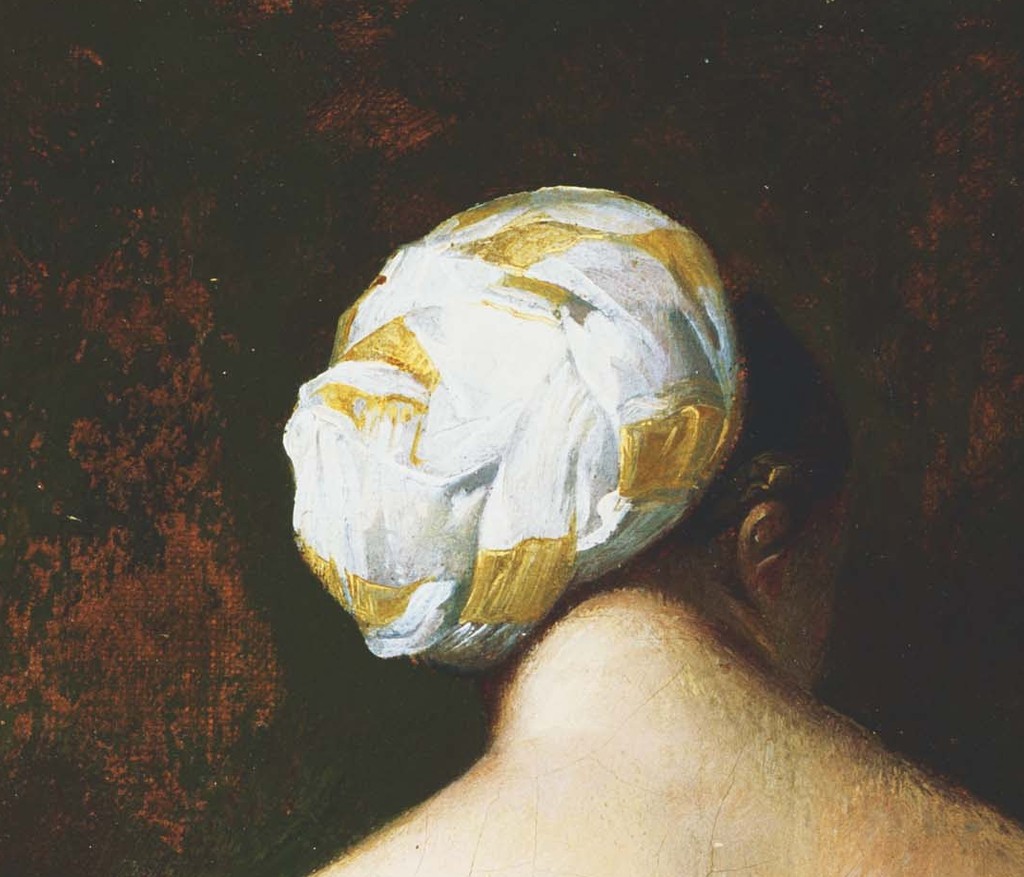
Begin with the head covering. White folds alternate with ochre-gold bands, gathering into a rounded mass above the neck. Against the almost black background, these pale pieces of fabric are unusually conspicuous. The head itself is turned away. A sliver of cheek and ear gives just enough information to establish its direction, while withholding the exchange of looks that might turn this into a portrait.
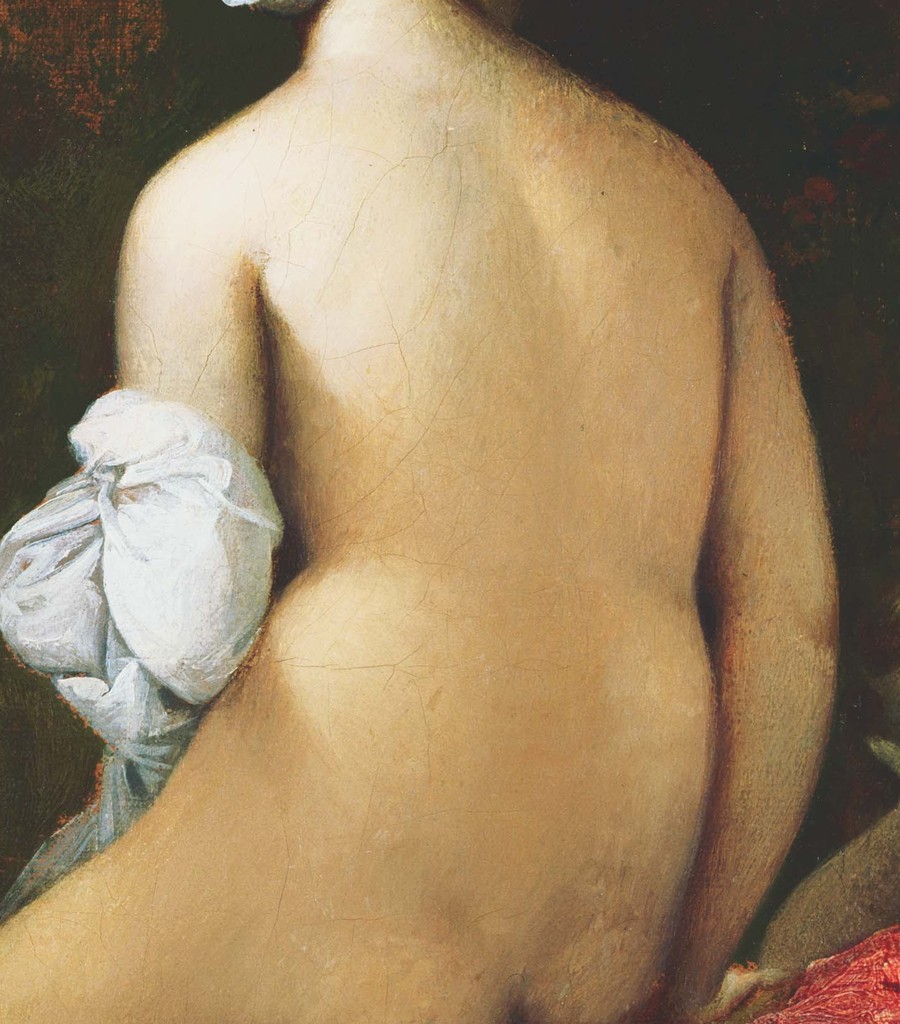
Below it, the shoulders form a gently sloping arch. Light spreads across the upper back and continues down towards the hip, interrupted by delicate changes of tone. The spine is suggested with restraint. There is little emphasis on individual muscles, and the broad surface holds together across the small variations in illumination. The figure’s far arm descends beside the body, adding a narrow darker edge on the right. On the left, a white sleeve gathered around the elbow breaks the continuous outline of flesh.
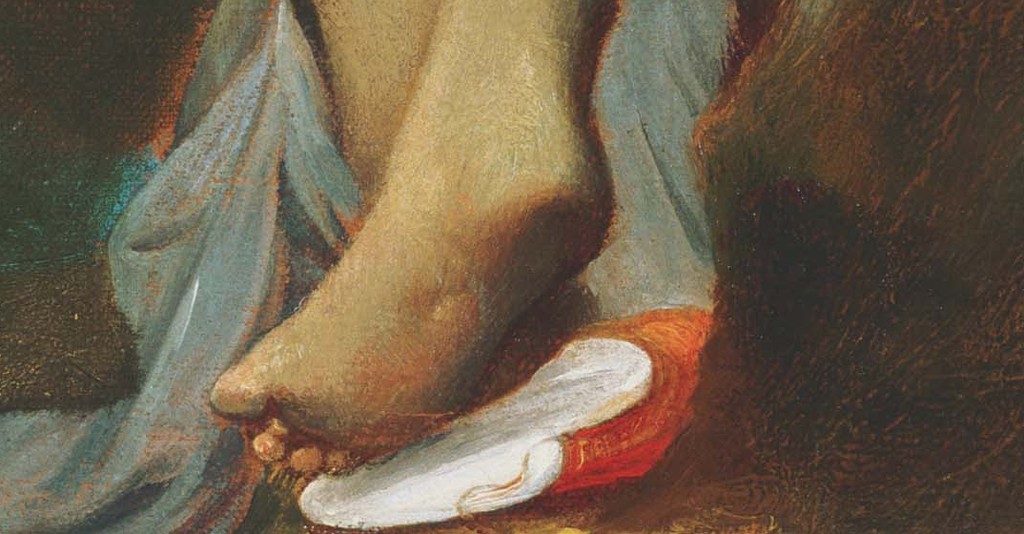
Follow that sleeve downwards and the arrangement becomes more intricate. The woman’s thigh extends towards the left before the lower leg turns back towards the bottom of the picture. The overlapping legs create a long, tapering passage between the large upper body and the small exposed foot. Close to the toes lies a red-and-white slipper; blue-grey cloth spreads beside it. These objects provide changes of colour, texture and scale at the foot of an otherwise dominant figure.
The bank supporting her has its own weight. A strip of grass runs beneath the hip, and the earth below drops steeply into shadow. Its irregular surface contrasts with the sustained curves of the body. The lower right corner is particularly dark and solid, so that the bright slipper and pale foot seem poised beside a substantial mass of ground. The woman occupies a perch above the water, close enough to belong to the bathing scene but sufficiently elevated to stand apart from its activity.
The smaller figures
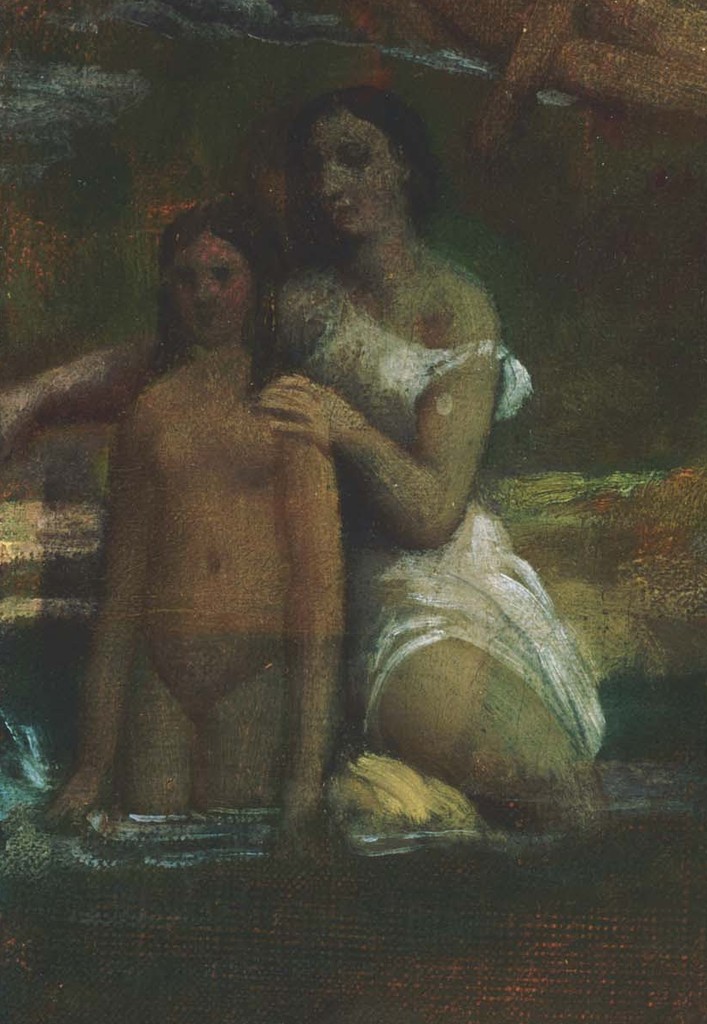
At the lower left, a child stands in the water while a seated or crouching woman reaches towards her. Their heads, arms and the bright cloth around the adult form a compact group. Ripples gather around the child’s lower body. Seen after the central figure, the pair feels surprisingly small; their practical activity introduces movement into the painting without disturbing the larger silhouette.
Further back, another pale body stretches across a dark bank. Its turn towards a companion makes a shallow diagonal across the scene. There is no need to invent a conversation between them: the inclination of the bodies is enough to suggest that they share a space and attend to one another. The distance between this pair and the child is conveyed largely through diminished scale, darkness and intervening water.
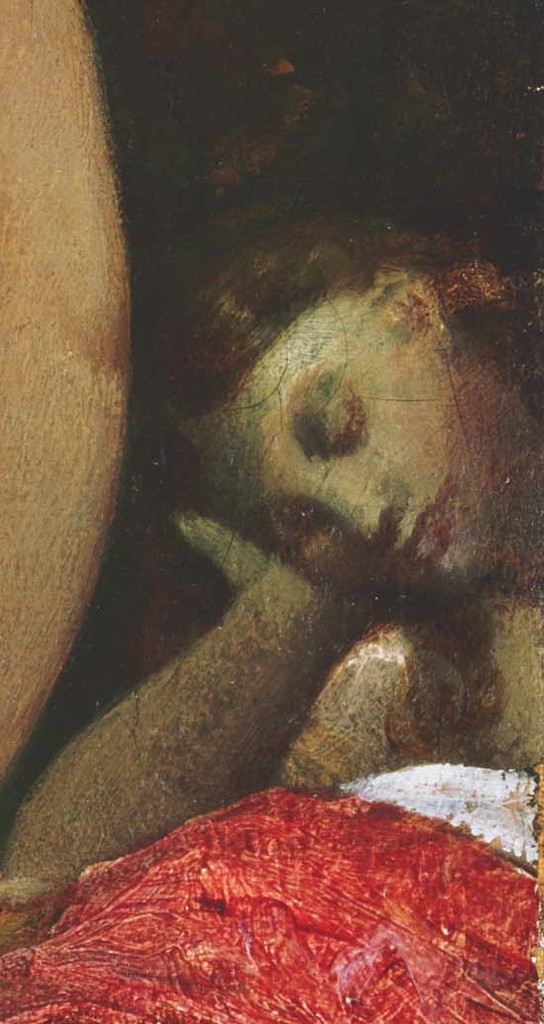
On the opposite side, a head rests against a hand just behind the main bather. The closed eyes and inclined face give this figure a different rhythm from the active group by the water. The arm and head occupy a narrow interval at the right edge, easy to overlook beside the vivid heap of red fabric below them. Once noticed, they make the foreground feel more crowded and intimate. The picture distributes several states of the body—sitting, reclining, resting and bathing—around one large, still form. Looking from group to group brings the subdued background into focus, then returns the eye to the back that first caught it.
Annotated Details from The Small Bather
The numbered points identify visible features discussed in this article. Return from each detail to the whole composition. The Small Bather, 1826. Phillips Collection. Google Art Project via Wikimedia Commons. Image source. Public domain.
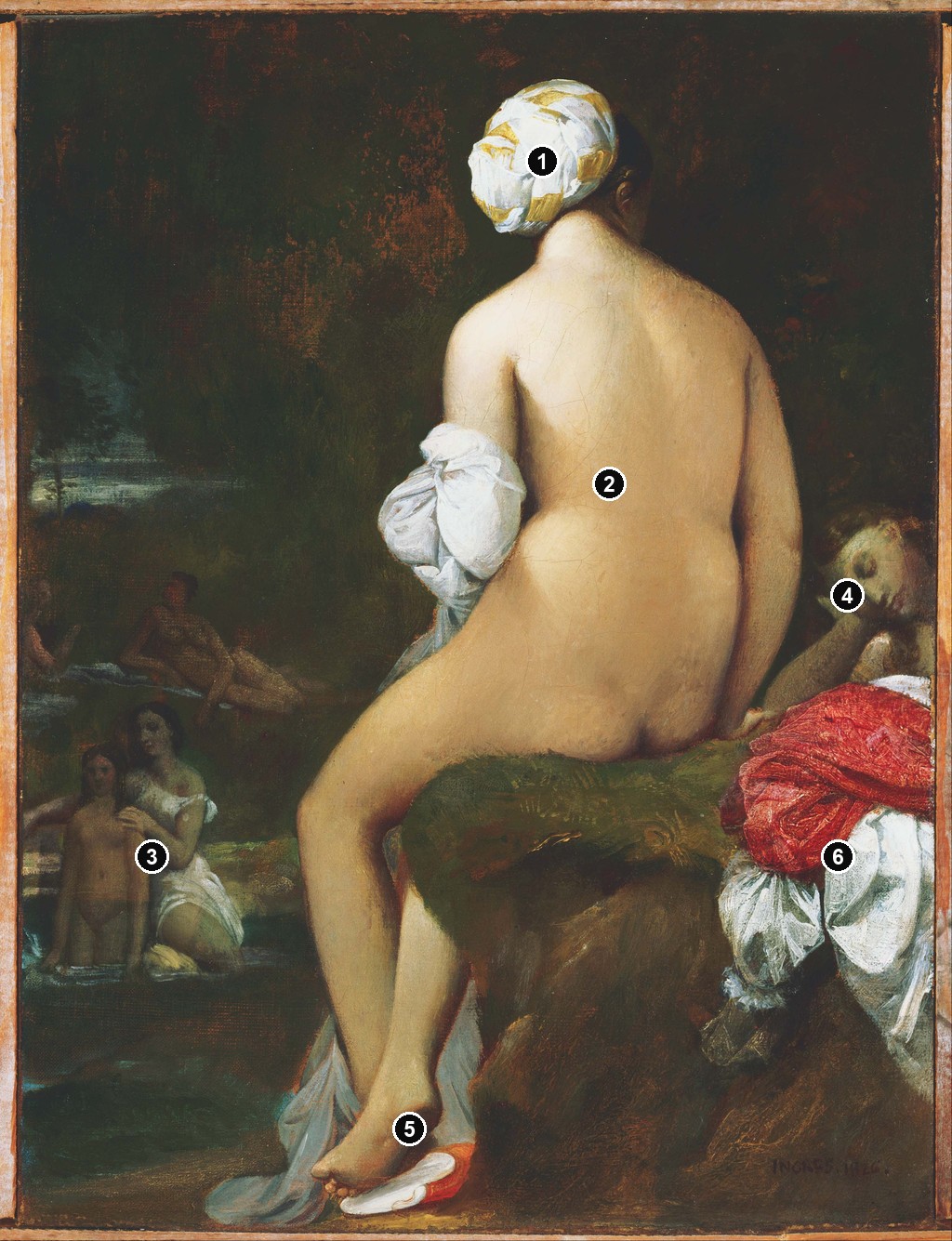
Details from THE SMALL BATHER
Look from the large back and wrapped head towards the much smaller figures, fabrics and slipper around the woodland scene.
The striped head covering
White folds alternate with gold-coloured bands around the turned head. The small visible portion of cheek and ear gives a direction to the figure without showing her face.
Light across the back
The broad illuminated back narrows towards the waist and opens again at the hip. A darker arm and a slim shadow along the right side keep its outline distinct from the background.
The small bathing pair
A small standing child and an adult gather beside the water at the left. Their faces, arms and pale cloth form a compact group far below the large foreground shoulder.
A resting head and hand
A smaller head inclines towards a supporting hand at the right edge. Its lowered eyelids and tilted position introduce a quieter pose beside the upright back.
The lowered foot and slipper
The pale foot ends beside a red-and-white slipper and blue-grey cloth. These smaller changes of shape and colour bring the long leg down towards the lower edge.
Red and white fabric on the bank
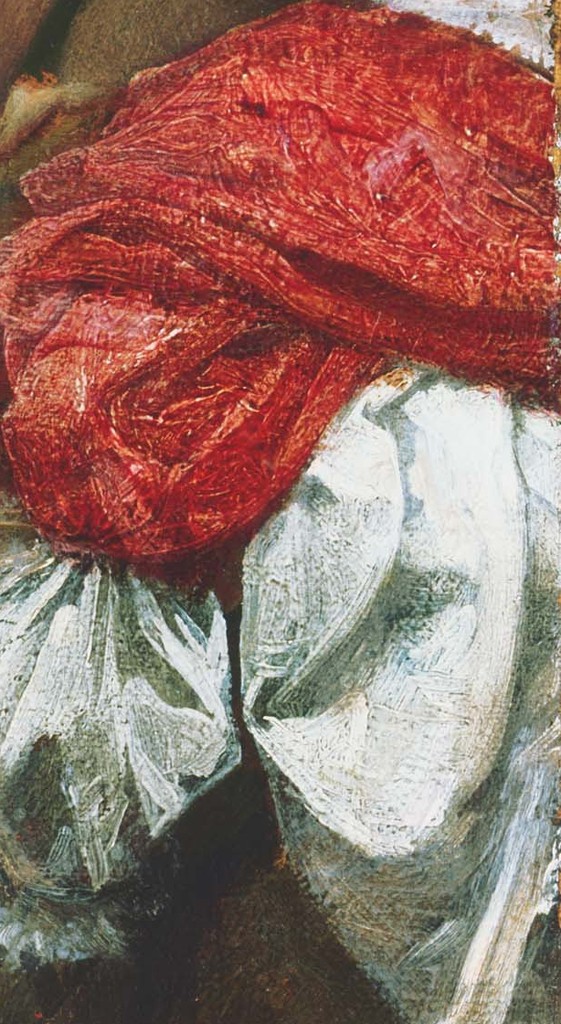
The red cloth gathers above a broad white frill. Their broken folds and vivid contrast make a separate point of attention beside the darker earth.
A familiar pose on unfamiliar ground
The central figure recalls The Valpinçon Bather, the Louvre painting dated 1808. That canvas measures 146 × 97.5 cm, making the change in physical scale considerable. [3] A reproduction can make the two women appear similar in size; the actual objects offer very different encounters. The Phillips painting can be taken in at close range, with its small surrounding figures compressed into a few centimetres.
Compare the outlines. In both works the head turns away, a gathered white sleeve surrounds the left elbow, and the long leg descends towards a slipper. These repeated elements make the relationship recognisable even before the settings are considered. The difference lies in the framework around the body. In the earlier painting, the white bedding continues the light of the skin across the lower right, while the tall dark curtain gives the left edge a strong vertical structure.
In the woodland picture, the light body meets a much darker support. Grass and earth interrupt the spread of white that surrounds the seated woman in the earlier composition. The blue-grey fabric below the feet is a small, low accent, without the enclosing presence of the tall curtain. Openings towards water and distant figures take the place of the earlier room’s broad, relatively quiet surfaces.
This changes the figure’s apparent relationship to her surroundings. The earlier bed offers an ample, soft place to sit. Here the ground feels narrower and more uneven. The main bather also shares her setting with people engaged in actions that she does not visibly join. Her turned head leaves the direction of her attention partly concealed. We can follow her placement among the others without assigning her a thought or a narrative role.
The repeated pose therefore rewards comparison beyond the simple recognition of a favourite motif. The support beneath a figure, the balance of light around it and the scale of neighbouring bodies can alter a composition even when its most prominent outline remains familiar.

Ingres, The Valpinçon Bather, 1808. [4]
The other small bather
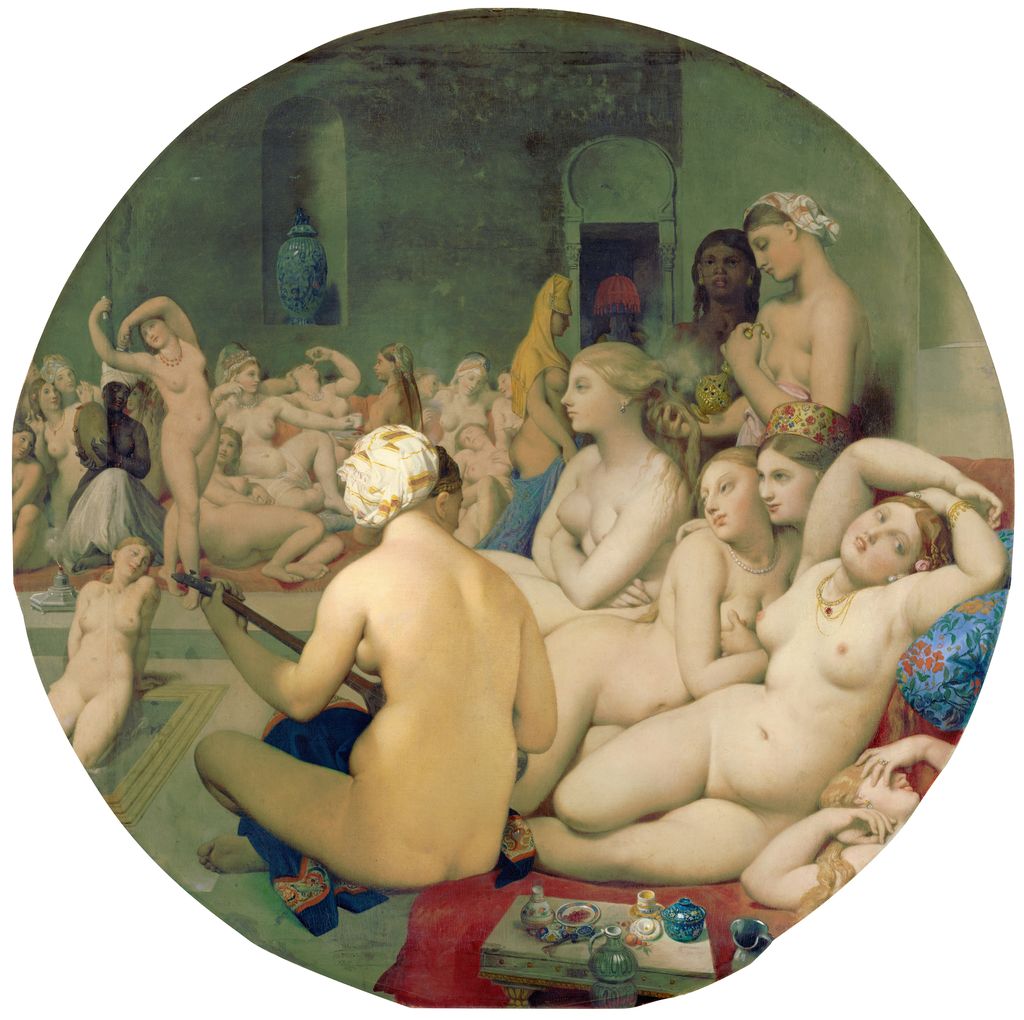
The similarly titled Little Bather: Interior of a Harem is a separate painting, dated 1828, in the Louvre. It measures 35 × 27 cm. The Louvre records it as a reduced and modified repetition of the earlier Valpinçon Bather, painted for the collector L. J. A. Coutan. [5]
There the seated woman is again supported by white bedding. A built pool occupies the lower left; architecture, curtains and an ewer help define an interior. The surrounding figures are rearranged, with a woman partly immersed in the pool and others gathered beyond. Setting the two small pictures alongside one another makes the woodland bank of the Phillips painting especially distinctive. The red fabric and brightly wrapped head remain strong accents, but they belong to different arrangements of space.
Nineteenth-century cataloguing already recognised more than one small version. In his posthumous book on Ingres, published in 1870, Henri Delaborde described an 1828 reduced bather with women bathing in the background, then in the Hauguet collection. He followed it with a separate small variant signed and dated 1826, belonging to Madame Blanc. [6] His entry helps establish the historical distinction between the dated variants. It does not, by itself, supply a secure link between Madame Blanc and the canvas now in Washington.
 Jean-Auguste-Dominique Ingres.jpg)
Ingres, The Little Bather Harem Interior, 1828. [7]
Drawing, repetition and attribution
A sheet in the Musée Ingres Bourdelle, Femme sortant du bain, adds another part of the story. The museum dates this graphite drawing to Paris in 1826 and associates it with both small bather compositions. Its commentary explains that overlapping motifs led Georges Vigne to group related studies together. A drawing’s connection to this family of images therefore need not mean that every element was prepared exclusively for one painting. [2]
That distinction matters when thinking about repetition. A figure or gesture can be considered in relation to several arrangements. Drawings help us follow such connections, but the existence of a related study does not settle every question about the authorship or execution of a finished canvas.
There is a specific attribution caution here. The Phillips Collection currently presents The Small Bather as an Ingres. The Montauban drawing record explicitly describes the Washington picture’s attribution as contested. [1][2] These institutional positions should both be acknowledged. The disagreement cannot be resolved merely by noticing the familiar pose or the similarities between the two small paintings. Those comparisons explain relationships between images; they do not identify each hand that may have worked on a particular surface. The visual discussion here concerns the painting as it can be seen. Its smooth passages, outlines and colour relationships offer much to examine, without turning their appearance into laboratory evidence about pigments, underlying drawing or workshop participation.
A painting in collectors’ hands
An undated typed dossier preserved in the Phillips Collection’s archives records an earlier ownership history for a Baigneuse dated 1826. It gives a signature at the lower right and dimensions close to those of the present painting. According to that document, Ingres sold it to Haro senior; Haro sold it to Baron Moure senior in Paris in 1830; it subsequently passed to Moure’s son. The dossier then lists Paul Rosenberg and Baron François de Hatvany, both under 1911. [8]
This is useful historical testimony, although it is a summary rather than a sequence of surviving sale receipts. The two names entered under the same year should not be expanded into a more precise transaction story than the document supplies. Nor does that list explain how the Madame Blanc mentioned by Delaborde would fit into the chain. The records preserve pieces of the painting’s history whose relationship remains incompletely established. [6][8]
The same dossier lists two exhibitions: the Ingres exhibition at Galerie Georges Petit in 1911, number 32, and Paul Rosenberg’s Great Masters of French 19th Century in Paris in May–June 1931, number 47. [8] These entries show how the painting was recorded in exhibition and dealer contexts before its arrival in an American museum. They do not tell us how contemporary viewers responded; an exhibition listing is different evidence from a review.
Duncan Phillips’s comparison
Phillips acquired a foil to Delacroix. [1] Looking at it closely complicates any easy division between drawing and colour. The central silhouette is exceptionally insistent, but red fabric, a cool blue-grey fold and the warm bands of the head covering help organise the whole scene. At the right edge, bright red and white almost compete with the illuminated back. Across the rest of the picture, dark greens and browns allow the smallest pale bodies to become legible. Colour determines where the eye pauses and how far it can penetrate into the background. Her rounded form recalls Canova, the museum suggests. [1]
Artworks directory
Explore 150 paintings, drawings and an original lithograph. This selection includes related versions and studies; dates distinguish completed works from later revisions.
| Name | Date | Medium |
|---|---|---|
| The Apotheosis of Homer | 1827 | Painting |
| Grande Odalisque | 1814 | Painting |
| The Turkish Bath | 1859–1862 | Painting |
| Madame Moitessier Seated | 1856 | Painting |
| Portrait of Monsieur Bertin | 1832 | Painting |
| Napoleon I on His Imperial Throne | 1806 | Painting |
| Odalisque with Slave | 1839 | Painting |
| The Ambassadors of Agamemnon in the Tent of Achilles | 1801 (competition) | Painting |
| The Valpinçon Bather | 1808 | Painting |
| The Source | 1856 | Painting |
| Oedipus Explaining the Enigma of the Sphinx | 1808; revised probably before 1827 | Painting |
| The Vow of Louis XIII | 1824 | Painting |
| Antiochus and Stratonice | 1840 | Painting |
| The Comtesse d’Haussonville | 1845 | Painting |
| The Princesse de Broglie | 1851–1853 | Painting |
| Jupiter and Thetis | 1811 | Painting |
| The Dream of Ossian | 1813 | Painting |
| The Martyrdom of Saint Symphorian | 1834 | Painting |
| Venus Anadyomene | 1808–1848 | Painting |
| Portrait of Madame de Senonnes | 1814 | Painting |
| Madame Rivière | 1805 | Painting |
| Mademoiselle Caroline Rivière | 1805 | Painting |
| Portrait of Philibert Rivière | 1805 | Painting |
| Bonaparte First Consul | 1804 | Painting |
| The Death of Leonardo da Vinci | 1818 | Painting |
| Joan of Arc at the Coronation of Charles VII | 1854 | Painting |
| Madame Duvaucey | 1807 | Painting |
| La Belle Zélie | 1806 | Painting |
| Madame Panckoucke | 1811 | Painting |
| Portrait of Charles Marcotte d’Argenteuil | 1810 | Painting |
| Joseph Antoine Moltedo | c.1810 | Painting |
| Madame Leblanc | 1823 | Painting |
| Delphine Ingres-Ramel (Portrait of Madame Ingres) | 1859 | Painting |
| Portrait of Amédée de Pastoret | 1823–1826 | Painting |
| Portrait of Baronne de Rothschild | 1848 | Painting |
| Madame Marcotte de Sainte Marie | 1826 | Painting |
| Madame Gonse | 1852 | Painting |
| Aretino in the Studio of Tintoretto | 1848 | Painting |
| Don Pedro of Toledo Kissing Henry IV’s Sword | 1831/1832 | Painting |
| Raphael and La Fornarina | 1814 | Painting |
| Roger Freeing Angelica | 1819 | Painting |
| Romulus’ Victory over Acron | 1812 | Painting |
| Self-Portrait at the Age of Twenty-Four | 1804; revised 1841–1851 | Painting |
| Male Torso | c.1800 | Painting |
| Odalisque in Grisaille (Ingres and workshop) | c.1824–1834 | Painting |
| The Small Bather | 1826 | Painting |
| The Little Bather Harem Interior | 1828 | Painting |
| Jesus Among the Doctors | 1862 | Painting |
| The Virgin Adoring the Host | 1852 | Painting |
| The Virgin of the Host | 1841 | Painting |
| Virgin of the Adoption | 1858 | Painting |
| Paolo and Francesca | 1814 | Painting |
| Homer Deified (revised composition, Louvre RF5273) | 1865 | Drawing |
| Odalisque with Slave (Louvre RF4622) | 1858 | Drawing |
| Odalisque (Walters Art Museum; Ingres and Paul Flandrin) | 1842 | Painting |
| Madame Moitessier Standing (National Gallery of Art) | 1851 | Painting |
| Jacques-Louis Leblanc (The Metropolitan Museum of Art) | 1823 | Painting |
| Ferdinand-Philippe, Duke of Orléans (Louvre RF2005-13) | 1842 | Painting |
| Ferdinand-Philippe, Duke of Orléans (Versailles MV5207; Ingres and workshop) | 1843 | Painting |
| Ferdinand-Philippe, Duke of Orléans (Versailles MV5209; Ingres and workshop) | 1844 | Painting |
| Antiochus and Stratonice (Musée Fabre; Ingres and Raymond Balze) | 1866 | Painting |
| Antiochus and Stratonice (Kunstmuseum Bern, Gurlitt bequest) | Undated (early dating proposed) | Drawing |
| Composition study for Antiochus and Stratonice (MIB867.2193) | 1806 | Drawing |
| Study for the Figure of Stratonice (Met63.66) | 1834–1840 | Graphite, black chalk and charcoal |
| Nude figure study for Stratonice (Boijmans F II 36 PK) | c.1834–1840 | Drawing |
| Paolo and Francesca (The Barber Institute,54.6) | c.1814–1820 | Painting |
| Paolo and Francesca (The Hyde Collection,1971.24) | c.1855–1860 | Painting |
| Paolo and Francesca (Amsterdam Museum TA10970) | 1820 | Drawing |
| Paolo and Francesca (dedicated to Artaud de Montor) | 1816 | Drawing |
| Study for the Bust of Francesca (MIB867.1398) | 1819 | Drawing |
| Study for the Bust of Francesca (MIB867.1396) | 1819 | Drawing |
| The Archangel Raphael, first idea (MIB867.2488) | 1842 | Drawing |
| The Archangel Raphael (MIB867.2500) | 1842 | Drawing |
| The Archangel Raphael Carrying Human Prayers to God (Chantilly DE513) | 1844 | Drawing |
| Louis-Philippe as Saint Philip, stained-glass study | 1844 | Drawing |
| Marie Frédéric Eugène de Reiset (Ford Collection RBF171-2) | 1844 | Drawing |
| Virgil Reading the Aeneid (Toulouse) | Begun 1811 | Painting |
| Tu Marcellus Eris (Brussels, inv. 1836) | c.1814 (museum dating) | Painting |
| Jean-François Gilibert | 1804 | Painting |
| François-Marius Granet | 1807 (museum dating) | Painting |
| Count Nikolai Dmitrievich Guryev | 1821 | Painting |
| Caroline Murat, Queen of Naples | 1814 | Painting |
| Count Mathieu Molé | 1834 | Painting |
| Cherubini and the Muse of Lyric Poetry (Louvre) | 1842 | Painting |
| Luigi Cherubini (Cincinnati) | 1841 | Painting |
| Comtesse de Rayneval (Louvre RF4505) | 1841 | Drawing |
| Venus on Paphos (Antonie Balaÿ) | c.1852 | Painting |
| Prince Napoléon | 1855 | Painting |
| Study for The Apotheosis of Napoleon I (Petit Palais) | Late 1853 | Painting |
| The Apotheosis of Napoleon I (destroyed ceiling) | 1853 | Painting |
| The Journalist (MIB867.2733) | 1834? | Drawing |
| Henry VIII, after Holbein | c.1815–1820 (?) | Drawing |
| Madame Récamier, after David (MIB867.3637) | Undated (early Paris period) | Drawing |
| Study for Comtesse d’Haussonville (MIB867.259; background possibly by another hand) | 1842–1845 | Drawing |
| La Source (reduced version reported by Delaborde) | Date unrecorded; reported 1870 | Painting |
| Odalisque (autograph lithograph,NGA1946.21.117) | 1825; published1826 | Lithograph |
| Portrait of a Seated Lady | 1814 | Graphite |
| The Kaunitz Sisters (Leopoldine, Caroline, and Ferdinandine) | 1818 | Graphite |
| Portrait of a Man | 1814 | Graphite |
| Study for the Portrait of Louis-François Bertin (1766–1841) | n.d. | Black chalk and graphite |
| Studies for the Cadaver of Acron | ca. 1810–12 | Graphite on wove paper |
| Study for the Drapery of Molière in "The Apotheosis of Homer" | n.d. | Black chalk with stumping |
| Madame Guillaume Guillon Lethière, née Marie-Joseph-Honorée Vanzenne, and her son Lucien Lethière | 1808 | Graphite |
| Niccolò Paganini (1782–1840) | ca. 1830 | Counterproof or tracing strengthened with graphite and gouache on translucent paper |
| Lady Mary Cavendish-Bentinck (?-1843) | 1816 | Graphite |
| Madame Alexandre Lethière and Her Daughter Letizia | ca. 1815 | Graphite |
| Merry Joseph Blondel (1781–1853) | 1809 | Graphite |
| Ursin-Jules Vatinelle (1798–1881) | 1820 | Graphite |
| Bust of a Gypsy Girl (ascribed to Ingres) | 1819 | Graphite on wove paper |
| Study of a Seated Nude Male | n.d. | Graphite |
| The Archangel Raphael (Study for a stained-glass window in the chapel of Notre-Dame de la Compassion-Saint-Ferdinand, Neuilly) | ca. 1842 | Graphite |
| Lancelot-Théodore, comte Turpin de Crissé | probably 1818 | Graphite |
| Study for the Figure of the Iliad in "The Apotheosis of Homer" | ca. 1827 | Graphite and black chalk heightened with white chalk on brown paper |
| Comtesse Turpin de Crissé | probably 1818 | Graphite |
| Nude Figures for L'Âge d'Or, Château de Dampierre | n.d. | Graphite on brownish paper |
| Study of Figures (attributed to Ingres) | n.d. | Graphite |
| Study of Figures (attributed to Ingres) | n.d. | Graphite; squared in graphite |
| Admiral Sir Fleetwood Broughton Reynolds Pellew | 1817 | Graphite on wove paper |
| Madame Jean-Auguste-Dominique Ingres, née Madeleine Chapelle | 1814 | Graphite on off-white wove paper |
| Virgil Reading the Aeneid to Augustus, Livia, and Octavia | 1809/1819 (?) | Pen and black ink, graphite, brush and gray wash, white gouache heightening, Conté crayon on blue paper |
| General Louis-Étienne Dulong de Rosnay | 1818 | Graphite (hard and soft pencils) |
| Madame Alexandre Lethière, née Rosa Meli, and Her Daughter, Letizia | 1815 | Graphite |
| The Lawyer Paul Grand | 1834 | Graphite |
| Jean-Joseph Fournier | 1815 | Graphite |
| Armand Bertin | 1842 | Graphite |
| Madame Armand Bertin, née Marie-Anne-Cécile Dollfuss | 1843 | Graphite |
| The Architect Charles-Victor Famin | 1836 | Graphite |
| Henri Lehmann | 1850 | Graphite |
| Portrait of a Lady | ca. 1815–17 | Graphite |
| Edmond Cavé (1794–1852) | 1844 | Oil on canvas |
| Head of Saint John the Evangelist | probably ca. 1818–20 | Oil on canvas, laid down on wood |
| Madame Edmond Cavé (Marie-Elisabeth Blavot, ca. 1806–1883) | ca. 1831–34 | Oil on canvas |
| Madame Félix Gallois | 1852 | Graphite with touches of gold in oil to highlight jewelry, on buff wove paper. |
| Dr. François Mêlier | 1849 | Graphite with graphite framing lines, corrected with white, on buff wove paper |
| Portrait of Madame Rhode (Rhoda?) | 1810–20 | Graphite on pale buff wove paper |
| Study for "Raphael and the Fornarina"(?) | ca. 1814(?) | Graphite on white wove paper |
| Portrait of Madame Paul Meurice, née Palmyre Granger | ca. 1845–50 | Graphite on wove paper |
| Alexander the Great presenting Campaspe to Apelles | 1810 | Graphite, brush and brown wash; squared in graphite |
| Study of Hands for "Christ Among the Doctors" | 1852–62 | Graphite on tracing paper |
| Study for The Turkish Bath (RF34502) | about 1850 | Pen and brown ink with graphite, partially squared |
| Study for The Turkish Bath (RF23354) | Undated | Pen and brown ink with graphite on joined sheets |
| Study for The Turkish Bath (RF54702) | about 1859 | Pen and brown ink |
| Studies of women for The Turkish Bath (RF12292) | Undated | Black chalk |
| Achilles Receiving the Envoys of Agamemnon (Nationalmuseum sketch, NM2161) | 1801 | Oil on wood |
| Half-Length Bather (Musée Bonnat-Helleu,89) | 1807 | Oil on canvas |
| Oedipus and the Sphinx (National Gallery,NG3290) | about1826 | Oil on canvas |
| Oedipus and the Sphinx (Walters,37.9) | 1864 | Oil on canvas |
| Oedipus and the Valpinçon Bather, after David (MI.867.2035) | Undated | Graphite on tracing paper, after David |
| Study of the Virgin for The Vow of Louis XIII (Dijon,1758) | about1822 | Black chalk, stump and white chalk on brown wove paper |
| First Thought for The Vow of Louis XIII (MI.885.11.21) | 1822 | Oil on canvas |
Frequently Asked Questions
Look just behind the central bather at the right edge. A second woman rests her head against her hand, partly overshadowed by the red and white fabric below her.
Discussion
Look again at the images and ideas explored in The Small Bather. These editorial prompts invite your observations.
Reader Insights
Compare the grass bank here with the white bed in The Valpinçon Bather. How does the surface beneath the seated woman change your impression of her pose?
Compare the woodland around this bather with the interior around the small Louvre bather. What does each setting make newly visible in the repeated pose?
How does the change from cloth to grass alter the visual relationship between the body and its support?
Join the Conversation
Share a detail, comparison or question about The Small Bather below.
References
- The Phillips Collection, The Small Bather, object 0927. Object information and collection commentary, accessed 17 October 2026. View source.
- Musée Ingres Bourdelle, Femme sortant du bain, MI.867.1184. “Fonctionnement et contexte”, creation and material fields; updated 4 April 2025. (in French) View source.
- Musée du Louvre, La baigneuse, dite Baigneuse de Valpinçon, RF 259. Date and dimensions. (in French) View source.
- Supporting image. Ingres, The Valpinçon Bather, 1808. Image source. CC0 / Public domain.
- Musée du Louvre, La petite baigneuse. Intérieur de harem, RF 1728. Date, dimensions and historical information. (in French) View source.
- Henri Delaborde, Ingres, sa vie, ses travaux, sa doctrine, d’après les notes manuscrites et les lettres du maître. Paris: Henri Plon, 1870, catalogue no. 73, p. 235. (in French) View source.
- Supporting image. Ingres, The Little Bather Harem Interior, 1828. Musée du Louvre; Photograph: JackyM59; Wikimedia Commons. Image source. CC BY-SA 4.0. Resized and JPEG-optimised; image derivative licensed CC BY-SA 4.0.
- The Phillips Collection Archives, Institute of Modern Art correspondence file, 1941–1948, PDF p. 159: undated typed “Ingres: Baigneuse” dossier, collections and exhibitions sections. View source.
- Splash image. The Small Bather, 1826. Phillips Collection. Google Art Project via Wikimedia Commons. Image source. Public domain.