by Tom Gurney
Tom Gurney BSc (Hons) is an art history expert with over 20 years experience
Published on June 19, 2020 / Updated on October 22, 2026
Email: tomgurney1@gmail.com / Phone: +44 7429 011000
Odalisque in Grisaille
The pale body stretches across a nearly black background, framed by curtains whose folds catch narrow streaks of light. At first the scene seems almost emptied of colour. Look longer and differences emerge: a faint warmth in the cushions, cooler grey cloth, the softly modelled face and the broad, comparatively bare foreground. The eye moves between a convincing human presence and the means used to construct it. Odalisque in Grisaille makes that movement especially absorbing because its passages of delicate finish sit alongside areas that remain visibly abbreviated.
At a Glance
- AttributionJean-Auguste-Dominique Ingres and workshop.
- Datec.1824–1834.
- CollectionMetropolitan Museum of Art, New York; 38.65. [1]
This work across Ingres’s career
Agamemnon’s Ambassadors
1801 (competition)Grande Odalisque
1814Louis XIII’s Vow
1824Odalisque in Grisaille (current article)
c.1824–1834Monsieur Bertin
1832The Princesse de Broglie
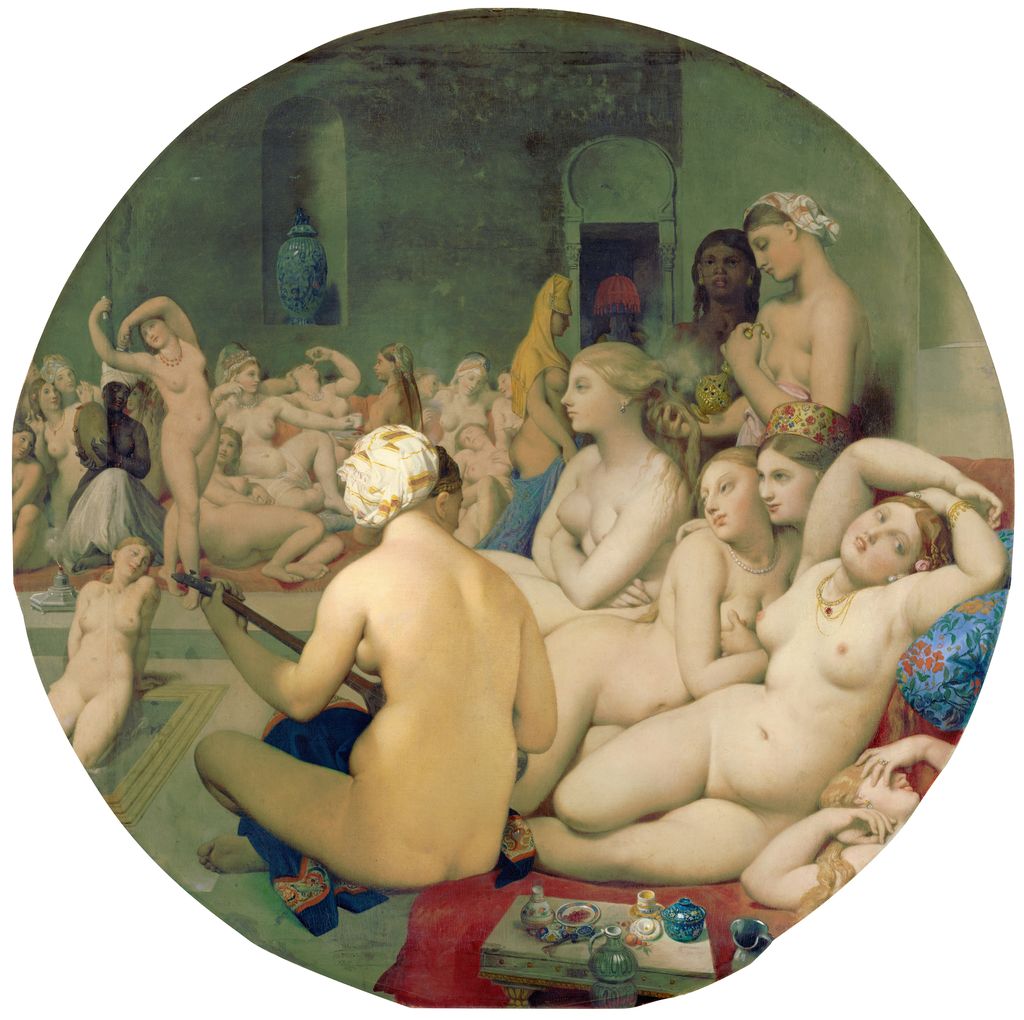
1851–1853The Turkish Bath
1859–1862Contents
- The familiar pose in a changed setting
- How the grey painting works
- A surface with different degrees of finish
- What was the grisaille for?
- Repeating an image
- The odalisque on paper
- Attribution and ownership
- Kerry James Marshall’s response
- Annotated details
The familiar pose in a changed setting
This unfinished reduction reworks Grande Odalisque. [1] The Louvre painting is dated 1814 and measures 91 × 162 cm. It was painted for Caroline Murat, Queen of Naples, and appeared at the Salon of 1819. [2] Comparing the two reveals changes beyond the suppression of brilliant colour. The scene imagines a concubine in a harem. [1] The textiles suggest luxury, but the sparse setting in the grisaille gives little sense of a place beyond the figure’s immediate surroundings.
In the Louvre version, the reclining woman occupies a long, shallow field filled with richly differentiated things. Blue upholstery, white linen, reddish gold fabric and the peacock-feather fan supply separate centres of interest. The curtain on the right bears a repeating coloured pattern; accessories collect near the lower corners. Her body belongs to this elaborate arrangement of surfaces even as its pale expanse stands apart from them.
The grisaille draws the setting closer around her. The format feels more upright, the curtains taller, and the empty dark area above the body more commanding. The fan and the conspicuous cluster of objects at the right have disappeared. The extended hand meets the gathered curtain directly. Where the coloured version invites the eye to wander among ornaments, this one makes the relationship between skin, drapery and darkness harder to escape.
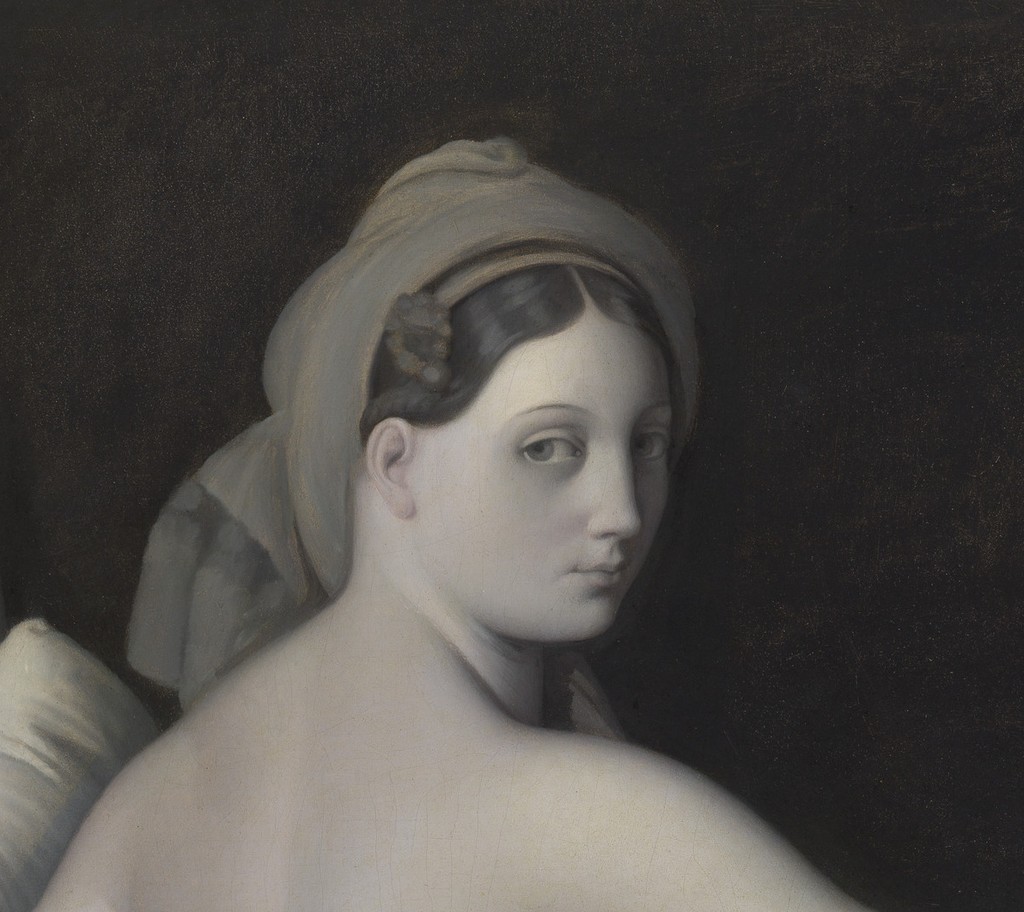
The change is especially clear at the head. Dark hair, a pale wrapping and the quiet oval of the face form a compact group at the left. The eyes turn out towards the viewer while the shoulder and back carry the body away. Around this small, carefully articulated face, the background offers almost nothing to measure or identify. Its darkness isolates the turn of the head without supplying a convincing room behind it.
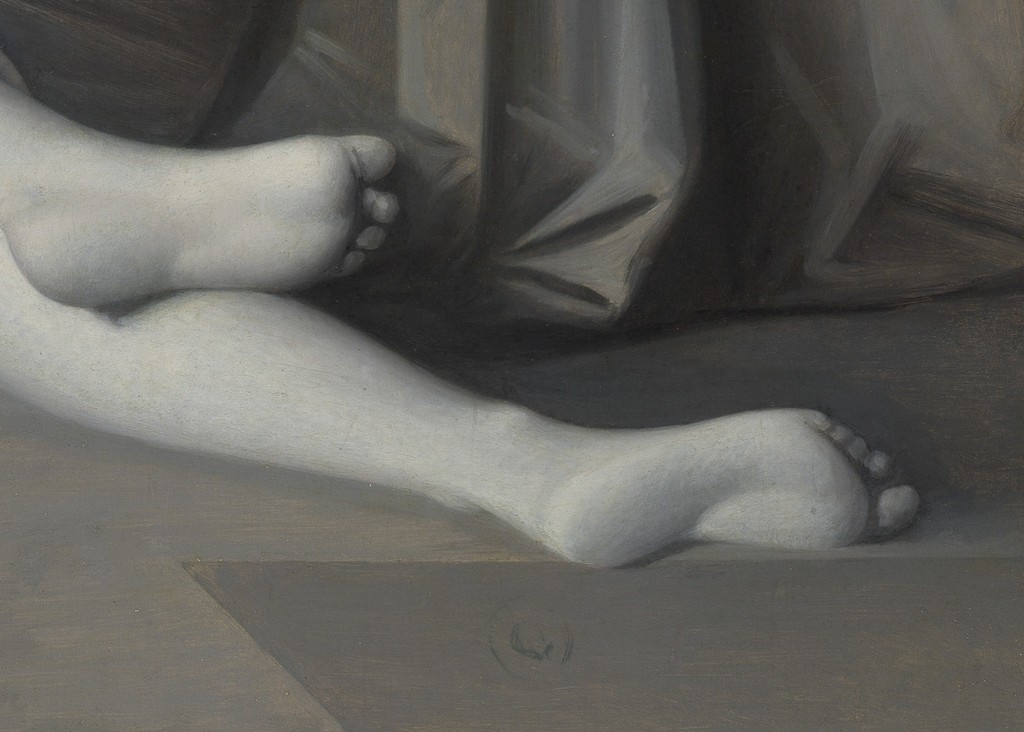
Below, the long back runs into the broad curve of the hip. The near leg then travels diagonally towards the lower right. Above it, the other foot interrupts the hanging cloth. Follow these forms slowly and the figure becomes a sequence of turns, overlaps and changes of direction. Recognising a reclining woman is immediate; resolving every part of the pose takes longer.
The comparison also changes the meaning of “reduced”. The smaller canvas does not merely preserve the larger painting’s contents at a different scale. Its omissions and altered balance give the body a different visual environment. It is worth looking at this object on its own before treating it as a convenient illustration of the more famous composition.

Ingres, Grande Odalisque, 1814. [3]
Annotated Details from Odalisque in Grisaille
The numbered points identify visible features discussed in this article. Return from each detail to the whole composition. Jean-Auguste-Dominique Ingres and workshop, Odalisque in Grisaille, c. 1824–1834. Met, 38.65; Catharine Lorillard Wolfe Collection, Wolfe Fund, 1938. Image source. CC0 / Public domain.
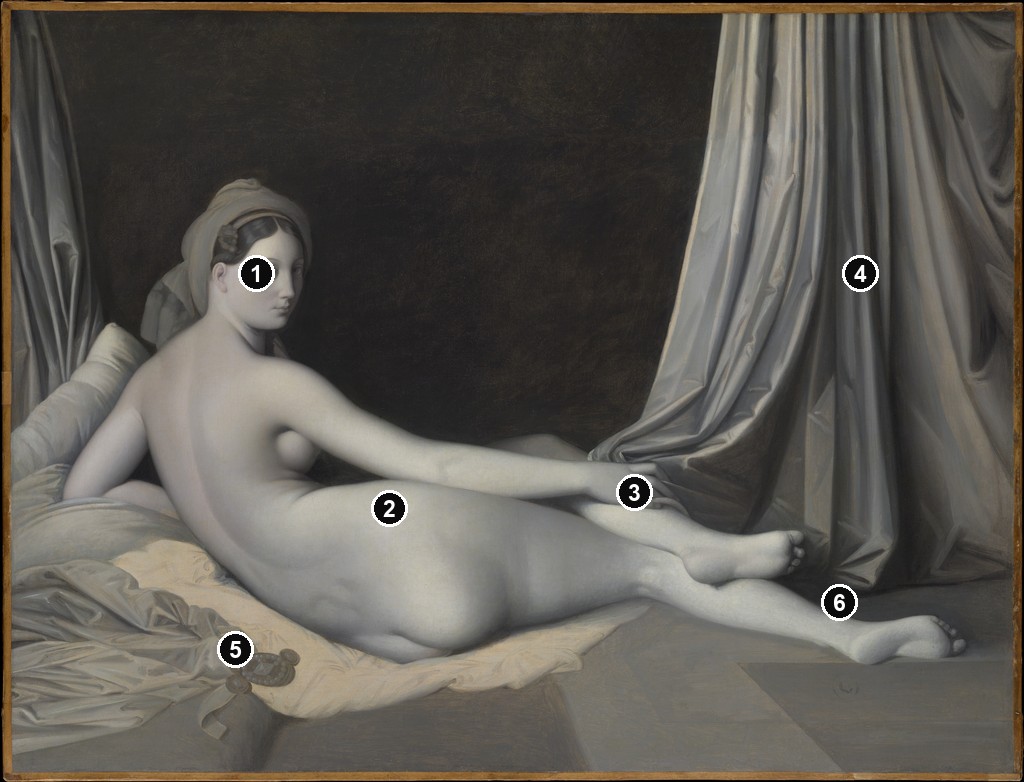
Details from ODALISQUE IN GRISAILLE
Compare the softly shaded body with the sharper folds, extended hand and differently finished foreground passages.
The face and pale wrapping
The small face turns out from the dark background. The pale wrapping, dark hair and softly shaded cheek form a compact arrangement above the much broader shoulder.
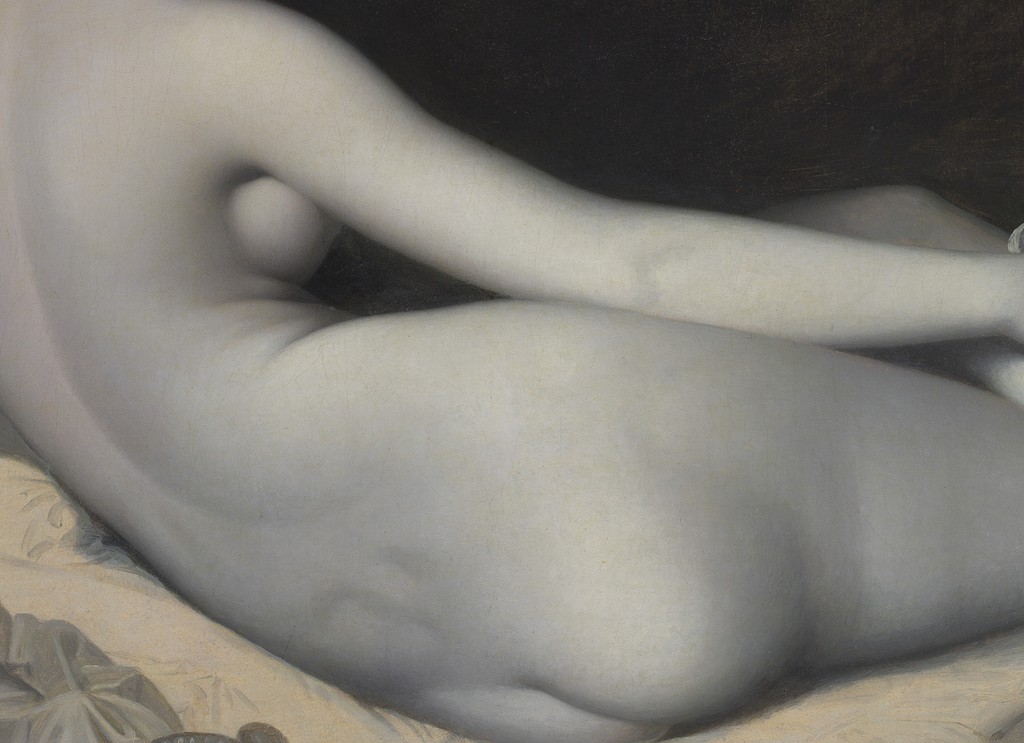
The broad curve of the back
Light spreads across the back and hip in a broad continuous passage. Compare this smooth transition with the broken folds of fabric beneath the body.
The hand meeting the curtain
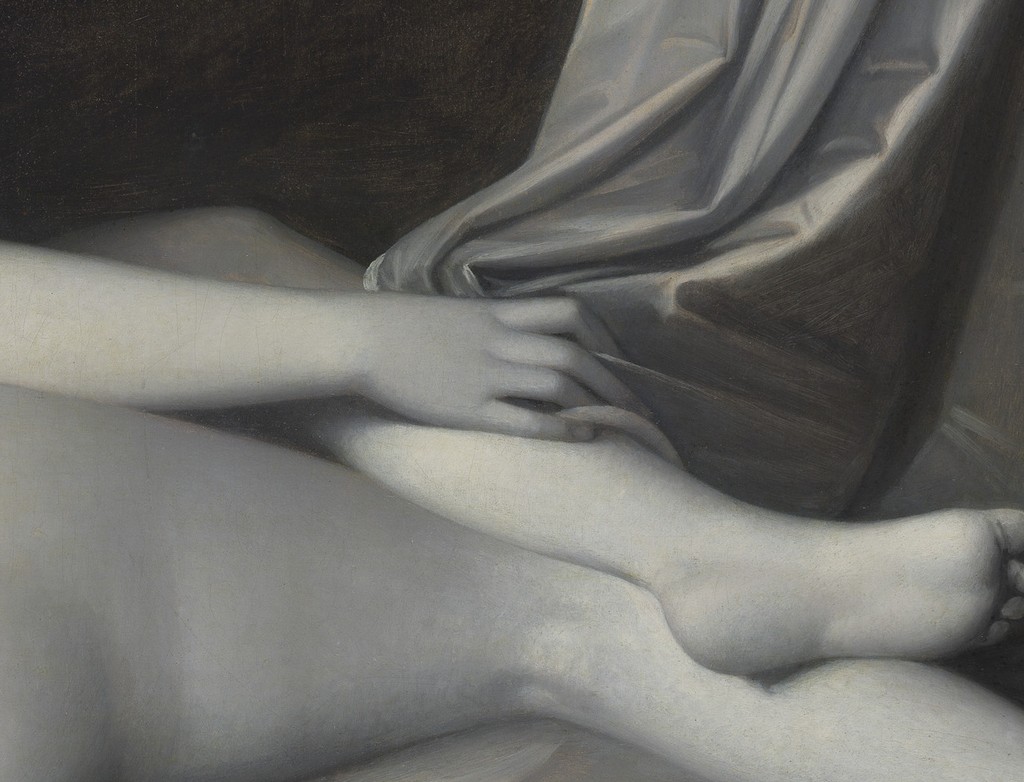
The extended fingers meet a compressed group of folds. Pale skin and grey cloth remain distinct even where their contours become closely entangled.
Long folds in the hanging cloth
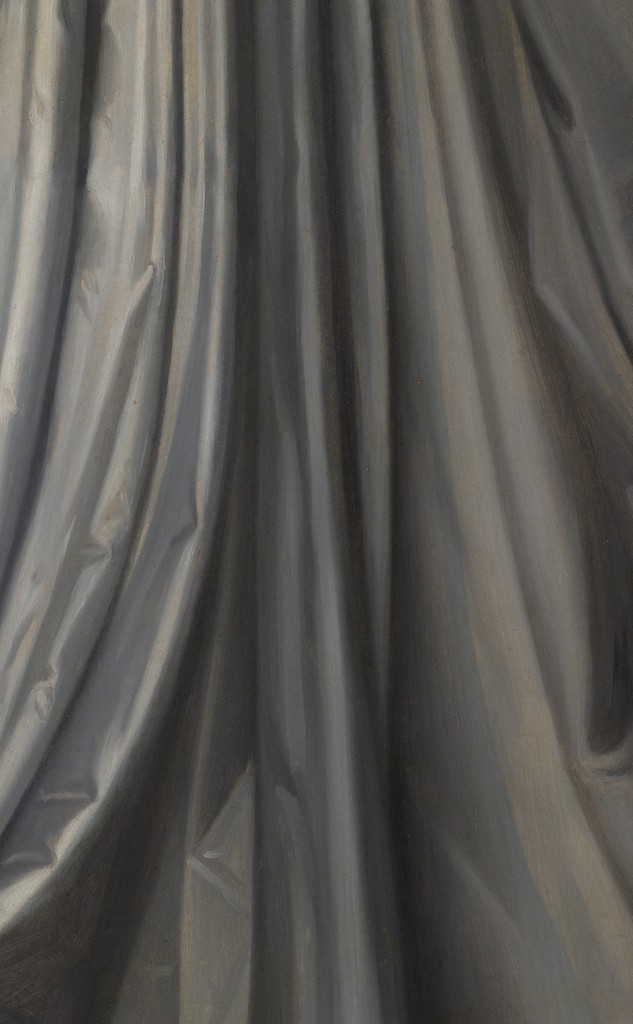
Tall bands of light and shadow descend through the curtain. Their sharp changes contrast with the gentler modelling of the body below.
Folded fabric in the foreground
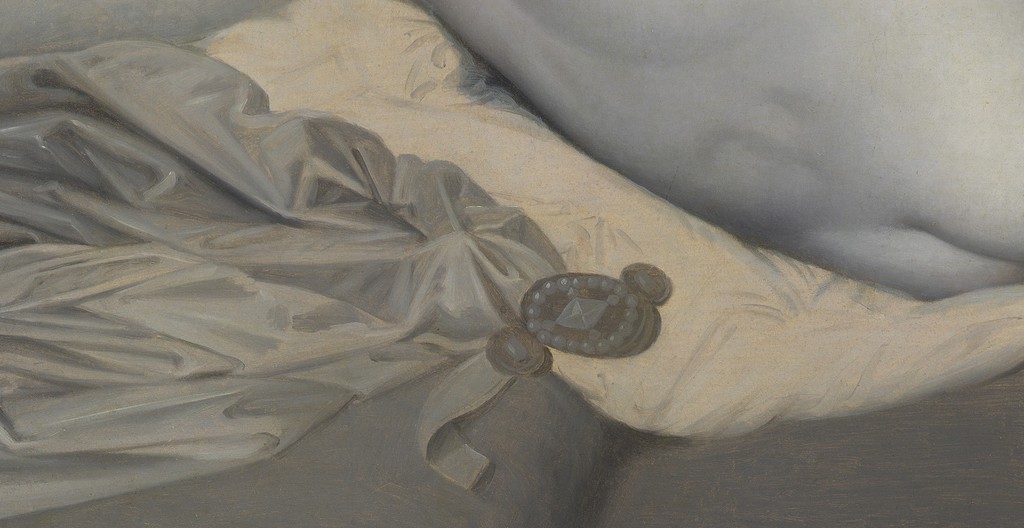
Closely gathered folds give way to broader, less fully described passages. Follow the changing edges across the pale fabric without assuming a sequence in which they were painted.
Two feet against the grey cloth
The feet end in different directions beside the hanging cloth. Their rounded heels and small toes introduce another set of turns within the longer diagonals of the legs.
How the grey painting works
Grisaille describes painting predominantly in shades of grey. Here the word directs attention to tonal relationships: how light or dark one passage appears beside another. It does not require us to imagine that every visible area is an identical neutral grey.
The face and upper body have gentle transitions. Shadow gathers beneath the chin and along the turning shoulder without breaking the continuity of the skin. The hip is more expansive, with a much broader passage from light to shade. Against it, the folds of cloth create sharper changes. A narrow light edge can sit beside a deep groove, making fabric seem crumpled where flesh seems smooth.
The curtain at the right brings these two kinds of handling together. Its large hanging folds echo the length of the body, but their repeated angular breaks oppose her rounded contours. Near the hand, compressed folds create a small tangle of dark and light. Higher up, they open into tall vertical strips. This change of scale helps the curtain connect the intimate action of the fingers with the full height of the picture.
The blackened field above the back does something different. It has little internal description and creates a broad interval between the two sides of the composition. Look from the busy cloth at the lower left into that dark area: the eye loses the small cues that describe texture and distance. The body becomes unusually legible as an arrangement across the surface.
There are quieter differences within the pale passages too. The cushions at the left have a muted creamy warmth; the surrounding material appears cooler. The torso does not look like white paper laid over a dark ground. Even within this restricted range, adjacent tones give its light areas varying weight. These are observations of the visible painting, rather than evidence for a particular pigment mixture.
That distinction matters when relating the work to Ingres’s statements about colour. Henri Delaborde’s posthumous collection of his notes gives drawing a very broad meaning. Ingres includes expression, inner form, planes and modelling within it, well beyond the tracing of an outline. [4] This painting offers an accessible way to understand that expanded definition: the shaded turn of a shoulder is as consequential as its outer edge.
In the same compilation, Ingres argues that colour depends on distinctions particular to individual objects, including warm and cool tones; he recalls the effect of white drapery beside warm flesh in his Oedipus. He also recommends erring towards grey rather than excessive intensity when an exact tone cannot be found. [4] These are general remarks, assembled after his death, rather than instructions for this canvas. They nevertheless complicate the idea that a grey painting must express indifference to colour. The restricted range still demands choices about the relationships between things.
A surface with different degrees of finish
The face offers the most concentrated impression of completion. Hair separates neatly from skin; the eye and mouth receive small, decisive accents. Along the extended arm, modelling is comparatively continuous. At the hand, the fingers look more schematically stated, while the broad foreground includes flat passages where the brush has not supplied an equally persuasive account of fabric or depth.
These differences make looking unusually active. A finished face can encourage the expectation that the rest of a painting will describe the world with similar precision. Here that expectation breaks down as the eye travels towards the bottom edge. The pale leg still has volume, but the surface beneath it becomes more plainly a painted area. The surrounding scene moves between an inhabitable space and a set of shapes.
It would be easy to arrange these passages into a story of execution: face first, foreground last, an interruption at a particular moment. The visible surface does not establish that sequence. Nor can uneven finish identify an assistant’s contribution by itself. It gives us evidence of different effects within the picture, without supplying a map of the hands or working sessions that produced them. The lower foreground gives the crowded folds at the left somewhere to subside. The eye notices both the descriptive work already accomplished and the openness that remains around it.
What was the grisaille for?
Miller suggests printmaking or teaching, without a confirmed purpose or linked reproduction. [1] Each possibility draws attention to a different practical strength of the image. A printmaker concerned with translating a coloured painting into black and white must decide how its separate forms will remain distinct. Looking here, one can see how much can be carried by a pale body against dark space, and by the difference between the broad shading of flesh and the broken shading of cloth. A viewer can understand that problem without assuming this particular painting solved it for a particular printmaker.
For teaching, the same composition offers a concentrated exercise in relationships: a long curve against vertical folds, a small detailed head against an unbroken dark field, an extended arm above an extended leg. Those relationships are available to anyone studying the picture. Their usefulness does not establish that Ingres commissioned a classroom demonstration or assigned it to a named pupil.
The uncertainty leaves the object open to more than one kind of attention. We can ask how its tonal design might function in a workshop while still enjoying the singular balance of its visible surface. Purpose and visual effect are connected questions, but an answer to one cannot automatically supply the other.
Repeating an image
Delaborde provides a useful early documentary foothold. At the end of his catalogue entry for Grande Odalisque, published in 1870, he records a grisaille repetition belonging to Madame Ingres. His next entry concerns a separate small sketch associated with the Gilibert family. [4] Keeping those notices distinct prevents the grey canvas from becoming confused with every small version of the reclining figure.
The placement of the notice is revealing in a modest, concrete way. Delaborde treats the grisaille within the larger painting’s history, while acknowledging its existence as another object. That is still a productive way to approach it: the repeated pose creates a relationship, but the individual painting has its own format, surface and subsequent life.
Ingres addressed criticism of his repeated compositions in a statement dated 1859 in Delaborde’s collection. He explained that he loved the subjects and believed repetition or retouching could make the works better. He invoked Poussin as a precedent while recognising that repetition had limits. [4] The statement is much later than the grisaille and does not explain its immediate circumstances. It does show that returning to an existing image could be, for him, an act of continued revision.
Viewed in that context, the familiar figure need not make the painting a passive duplicate. The removal of accessories, the quieter surroundings and the greater prominence of the dark field all affect where attention settles. A composition can remain recognisable while its emphases change. The body’s relationship to the frame becomes particularly noticeable here, because fewer competing objects interrupt it. For a broader view of how Ingres revisited figures across different media, his prints provide a useful comparison. They show that repeating an image also meant reconsidering how it could be described.
The odalisque on paper
Ingres’s lithograph Odalisque, dated 1825 and published in 1826, survives in the National Gallery of Art’s Rosenwald Collection. Its image measures only 13.1 × 20.9 cm. [5] Jean-Pierre Sudré’s much larger lithograph Odalisque Reclining, dated 1826, is explicitly catalogued as a print after Ingres. [6]
Both prints reverse the figure’s direction compared with the paintings discussed here: the head appears at the right, with the legs extending to the left. This immediately changes the experience of following the pose. The small Ingres print uses lightly stated outlines and a fine grain of shading. Pale paper remains conspicuous across much of the body. The curtains, ornaments and patterned furnishings retain an intricate presence despite the modest image size.
Sudré’s print produces a denser and more sustained tonal effect. The dark background presses against the illuminated shoulder; folds and cushions become substantial masses. At the lower edge, small objects and the patterned animal skin create a crowded strip beneath the body. Viewed beside the grisaille, it shows how differently a restricted tonal range can be organised. The painting clears away much of this descriptive activity, while the print preserves a richly furnished setting.
Delaborde credited Sudré’s lithograph with helping to popularise Grande Odalisque. His account is a nineteenth-century assessment of the image’s reception, rather than a record of this grey canvas being handed to the printmaker. [4] The surviving prints make the possibility of reproductive use understandable. Their differences also warn against treating a general resemblance in grey tones as proof of a direct working relationship.
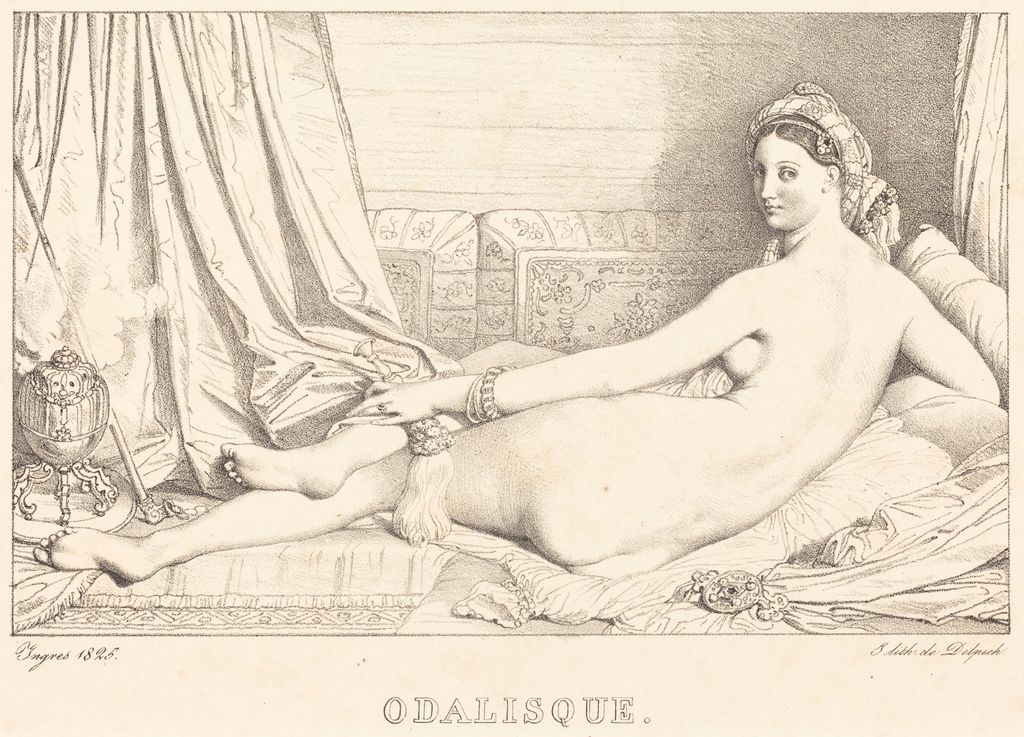
Ingres, Odalisque, made in 1825 and published in 1826. Lithograph. National Gallery of Art, Rosenwald Collection, 1946.21.117. [7]
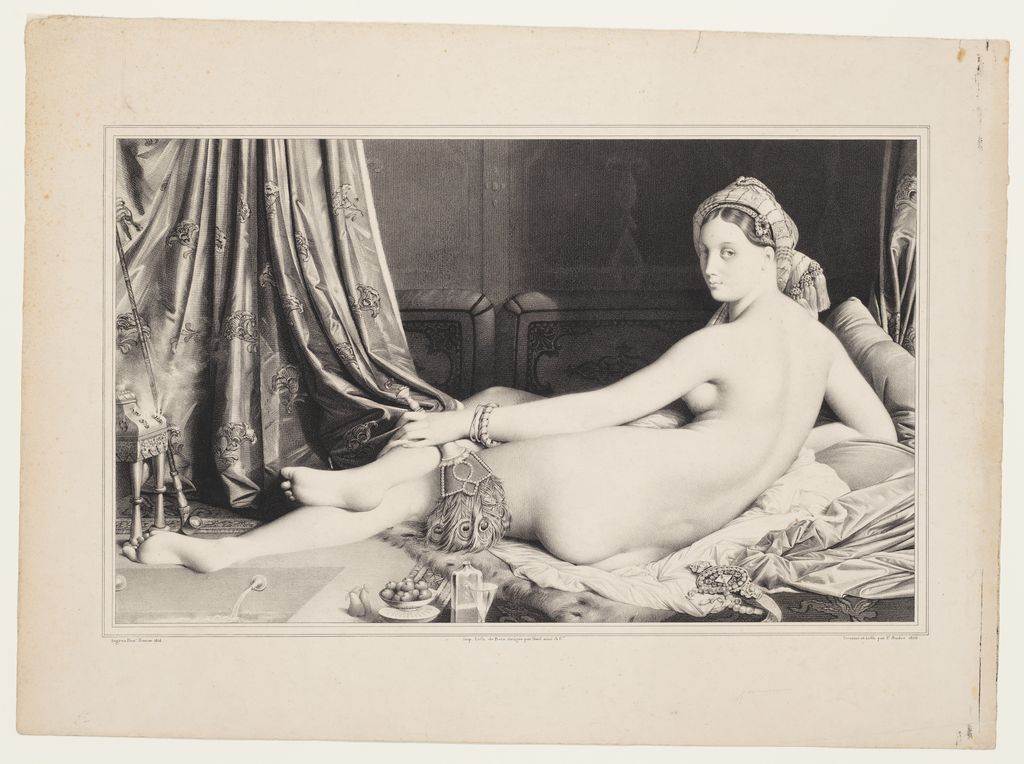
Jean-Pierre Sudré after Ingres, Odalisque Reclining, 1826. Lithograph. The Metropolitan Museum of Art, 27.43. [8]
Attribution and ownership
The Met records a workshop attribution in 1973 and sole-authorship support from 1983, adopted by Miller in 2015. Its current attribution includes workshop participation. [1] These positions concern the physical production of this canvas. Recognising Ingres’s composition cannot, on its own, determine who painted every passage. Equally, a broadly worked area does not identify a different painter without further evidence. The museum’s changing accounts allow readers to see why a familiar design can have a more complicated attribution history.
Delaborde’s notice places the grisaille with Ingres’s widow shortly after his death. [4] The 1867 studio inventory called it a grisaille sketch. Later owners included the Ramel and Riant families and the dealer Jacques Seligmann. [1] This history separates its early private existence from the later public life in which different scholars assessed it.
An early record of ownership answers a different question from an attribution. It helps establish that the object existed within the artist’s immediate circle; it does not document the division of work on its surface. Holding those questions apart makes the historical evidence more useful, without asking it to resolve everything.
Kerry James Marshall’s response
In his 2015 contribution to the Met’s Artist Project, Kerry James Marshall calls the painting “ultra-modern”. Grey keeps it, for him, firmly within the realm of an invented image. He understands precision as the making of choices, including choices between detailed and flat passages. Following the body towards the lower foot, he argues that its unexpectedly small scale sustains the composition’s rhythm and decorative flatness. This is a painter’s interpretation of the image, not technical proof of Ingres’s intentions or the canvas’s authorship. [9]
Marshall’s response provides a useful change of viewing pace. After studying the small transitions that make skin appear rounded, step back and attend to the disposition of the whole figure. The body’s light mass occupies the lower field while the darkness above remains broad and relatively empty. The curtain at the right connects those zones. Rounded flesh and an emphatic surface design can be experienced together; the painting does not require the eye to settle permanently on one.
Artworks directory
Explore 150 paintings, drawings and an original lithograph. This selection includes related versions and studies; dates distinguish completed works from later revisions.
| Name | Date | Medium |
|---|---|---|
| The Apotheosis of Homer | 1827 | Painting |
| Grande Odalisque | 1814 | Painting |
| The Turkish Bath | 1859–1862 | Painting |
| Madame Moitessier Seated | 1856 | Painting |
| Portrait of Monsieur Bertin | 1832 | Painting |
| Napoleon I on His Imperial Throne | 1806 | Painting |
| Odalisque with Slave | 1839 | Painting |
| The Ambassadors of Agamemnon in the Tent of Achilles | 1801 (competition) | Painting |
| The Valpinçon Bather | 1808 | Painting |
| The Source | 1856 | Painting |
| Oedipus Explaining the Enigma of the Sphinx | 1808; revised probably before 1827 | Painting |
| The Vow of Louis XIII | 1824 | Painting |
| Antiochus and Stratonice | 1840 | Painting |
| The Comtesse d’Haussonville | 1845 | Painting |
| The Princesse de Broglie | 1851–1853 | Painting |
| Jupiter and Thetis | 1811 | Painting |
| The Dream of Ossian | 1813 | Painting |
| The Martyrdom of Saint Symphorian | 1834 | Painting |
| Venus Anadyomene | 1808–1848 | Painting |
| Portrait of Madame de Senonnes | 1814 | Painting |
| Madame Rivière | 1805 | Painting |
| Mademoiselle Caroline Rivière | 1805 | Painting |
| Portrait of Philibert Rivière | 1805 | Painting |
| Bonaparte First Consul | 1804 | Painting |
| The Death of Leonardo da Vinci | 1818 | Painting |
| Joan of Arc at the Coronation of Charles VII | 1854 | Painting |
| Madame Duvaucey | 1807 | Painting |
| La Belle Zélie | 1806 | Painting |
| Madame Panckoucke | 1811 | Painting |
| Portrait of Charles Marcotte d’Argenteuil | 1810 | Painting |
| Joseph Antoine Moltedo | c.1810 | Painting |
| Madame Leblanc | 1823 | Painting |
| Delphine Ingres-Ramel (Portrait of Madame Ingres) | 1859 | Painting |
| Portrait of Amédée de Pastoret | 1823–1826 | Painting |
| Portrait of Baronne de Rothschild | 1848 | Painting |
| Madame Marcotte de Sainte Marie | 1826 | Painting |
| Madame Gonse | 1852 | Painting |
| Aretino in the Studio of Tintoretto | 1848 | Painting |
| Don Pedro of Toledo Kissing Henry IV’s Sword | 1831/1832 | Painting |
| Raphael and La Fornarina | 1814 | Painting |
| Roger Freeing Angelica | 1819 | Painting |
| Romulus’ Victory over Acron | 1812 | Painting |
| Self-Portrait at the Age of Twenty-Four | 1804; revised 1841–1851 | Painting |
| Male Torso | c.1800 | Painting |
| Odalisque in Grisaille (Ingres and workshop) | c.1824–1834 | Painting |
| The Small Bather | 1826 | Painting |
| The Little Bather Harem Interior | 1828 | Painting |
| Jesus Among the Doctors | 1862 | Painting |
| The Virgin Adoring the Host | 1852 | Painting |
| The Virgin of the Host | 1841 | Painting |
| Virgin of the Adoption | 1858 | Painting |
| Paolo and Francesca | 1814 | Painting |
| Homer Deified (revised composition, Louvre RF5273) | 1865 | Drawing |
| Odalisque with Slave (Louvre RF4622) | 1858 | Drawing |
| Odalisque (Walters Art Museum; Ingres and Paul Flandrin) | 1842 | Painting |
| Madame Moitessier Standing (National Gallery of Art) | 1851 | Painting |
| Jacques-Louis Leblanc (The Metropolitan Museum of Art) | 1823 | Painting |
| Ferdinand-Philippe, Duke of Orléans (Louvre RF2005-13) | 1842 | Painting |
| Ferdinand-Philippe, Duke of Orléans (Versailles MV5207; Ingres and workshop) | 1843 | Painting |
| Ferdinand-Philippe, Duke of Orléans (Versailles MV5209; Ingres and workshop) | 1844 | Painting |
| Antiochus and Stratonice (Musée Fabre; Ingres and Raymond Balze) | 1866 | Painting |
| Antiochus and Stratonice (Kunstmuseum Bern, Gurlitt bequest) | Undated (early dating proposed) | Drawing |
| Composition study for Antiochus and Stratonice (MIB867.2193) | 1806 | Drawing |
| Study for the Figure of Stratonice (Met63.66) | 1834–1840 | Graphite, black chalk and charcoal |
| Nude figure study for Stratonice (Boijmans F II 36 PK) | c.1834–1840 | Drawing |
| Paolo and Francesca (The Barber Institute,54.6) | c.1814–1820 | Painting |
| Paolo and Francesca (The Hyde Collection,1971.24) | c.1855–1860 | Painting |
| Paolo and Francesca (Amsterdam Museum TA10970) | 1820 | Drawing |
| Paolo and Francesca (dedicated to Artaud de Montor) | 1816 | Drawing |
| Study for the Bust of Francesca (MIB867.1398) | 1819 | Drawing |
| Study for the Bust of Francesca (MIB867.1396) | 1819 | Drawing |
| The Archangel Raphael, first idea (MIB867.2488) | 1842 | Drawing |
| The Archangel Raphael (MIB867.2500) | 1842 | Drawing |
| The Archangel Raphael Carrying Human Prayers to God (Chantilly DE513) | 1844 | Drawing |
| Louis-Philippe as Saint Philip, stained-glass study | 1844 | Drawing |
| Marie Frédéric Eugène de Reiset (Ford Collection RBF171-2) | 1844 | Drawing |
| Virgil Reading the Aeneid (Toulouse) | Begun 1811 | Painting |
| Tu Marcellus Eris (Brussels, inv. 1836) | c.1814 (museum dating) | Painting |
| Jean-François Gilibert | 1804 | Painting |
| François-Marius Granet | 1807 (museum dating) | Painting |
| Count Nikolai Dmitrievich Guryev | 1821 | Painting |
| Caroline Murat, Queen of Naples | 1814 | Painting |
| Count Mathieu Molé | 1834 | Painting |
| Cherubini and the Muse of Lyric Poetry (Louvre) | 1842 | Painting |
| Luigi Cherubini (Cincinnati) | 1841 | Painting |
| Comtesse de Rayneval (Louvre RF4505) | 1841 | Drawing |
| Venus on Paphos (Antonie Balaÿ) | c.1852 | Painting |
| Prince Napoléon | 1855 | Painting |
| Study for The Apotheosis of Napoleon I (Petit Palais) | Late 1853 | Painting |
| The Apotheosis of Napoleon I (destroyed ceiling) | 1853 | Painting |
| The Journalist (MIB867.2733) | 1834? | Drawing |
| Henry VIII, after Holbein | c.1815–1820 (?) | Drawing |
| Madame Récamier, after David (MIB867.3637) | Undated (early Paris period) | Drawing |
| Study for Comtesse d’Haussonville (MIB867.259; background possibly by another hand) | 1842–1845 | Drawing |
| La Source (reduced version reported by Delaborde) | Date unrecorded; reported 1870 | Painting |
| Odalisque (autograph lithograph,NGA1946.21.117) | 1825; published1826 | Lithograph |
| Portrait of a Seated Lady | 1814 | Graphite |
| The Kaunitz Sisters (Leopoldine, Caroline, and Ferdinandine) | 1818 | Graphite |
| Portrait of a Man | 1814 | Graphite |
| Study for the Portrait of Louis-François Bertin (1766–1841) | n.d. | Black chalk and graphite |
| Studies for the Cadaver of Acron | ca. 1810–12 | Graphite on wove paper |
| Study for the Drapery of Molière in "The Apotheosis of Homer" | n.d. | Black chalk with stumping |
| Madame Guillaume Guillon Lethière, née Marie-Joseph-Honorée Vanzenne, and her son Lucien Lethière | 1808 | Graphite |
| Niccolò Paganini (1782–1840) | ca. 1830 | Counterproof or tracing strengthened with graphite and gouache on translucent paper |
| Lady Mary Cavendish-Bentinck (?-1843) | 1816 | Graphite |
| Madame Alexandre Lethière and Her Daughter Letizia | ca. 1815 | Graphite |
| Merry Joseph Blondel (1781–1853) | 1809 | Graphite |
| Ursin-Jules Vatinelle (1798–1881) | 1820 | Graphite |
| Bust of a Gypsy Girl (ascribed to Ingres) | 1819 | Graphite on wove paper |
| Study of a Seated Nude Male | n.d. | Graphite |
| The Archangel Raphael (Study for a stained-glass window in the chapel of Notre-Dame de la Compassion-Saint-Ferdinand, Neuilly) | ca. 1842 | Graphite |
| Lancelot-Théodore, comte Turpin de Crissé | probably 1818 | Graphite |
| Study for the Figure of the Iliad in "The Apotheosis of Homer" | ca. 1827 | Graphite and black chalk heightened with white chalk on brown paper |
| Comtesse Turpin de Crissé | probably 1818 | Graphite |
| Nude Figures for L'Âge d'Or, Château de Dampierre | n.d. | Graphite on brownish paper |
| Study of Figures (attributed to Ingres) | n.d. | Graphite |
| Study of Figures (attributed to Ingres) | n.d. | Graphite; squared in graphite |
| Admiral Sir Fleetwood Broughton Reynolds Pellew | 1817 | Graphite on wove paper |
| Madame Jean-Auguste-Dominique Ingres, née Madeleine Chapelle | 1814 | Graphite on off-white wove paper |
| Virgil Reading the Aeneid to Augustus, Livia, and Octavia | 1809/1819 (?) | Pen and black ink, graphite, brush and gray wash, white gouache heightening, Conté crayon on blue paper |
| General Louis-Étienne Dulong de Rosnay | 1818 | Graphite (hard and soft pencils) |
| Madame Alexandre Lethière, née Rosa Meli, and Her Daughter, Letizia | 1815 | Graphite |
| The Lawyer Paul Grand | 1834 | Graphite |
| Jean-Joseph Fournier | 1815 | Graphite |
| Armand Bertin | 1842 | Graphite |
| Madame Armand Bertin, née Marie-Anne-Cécile Dollfuss | 1843 | Graphite |
| The Architect Charles-Victor Famin | 1836 | Graphite |
| Henri Lehmann | 1850 | Graphite |
| Portrait of a Lady | ca. 1815–17 | Graphite |
| Edmond Cavé (1794–1852) | 1844 | Oil on canvas |
| Head of Saint John the Evangelist | probably ca. 1818–20 | Oil on canvas, laid down on wood |
| Madame Edmond Cavé (Marie-Elisabeth Blavot, ca. 1806–1883) | ca. 1831–34 | Oil on canvas |
| Madame Félix Gallois | 1852 | Graphite with touches of gold in oil to highlight jewelry, on buff wove paper. |
| Dr. François Mêlier | 1849 | Graphite with graphite framing lines, corrected with white, on buff wove paper |
| Portrait of Madame Rhode (Rhoda?) | 1810–20 | Graphite on pale buff wove paper |
| Study for "Raphael and the Fornarina"(?) | ca. 1814(?) | Graphite on white wove paper |
| Portrait of Madame Paul Meurice, née Palmyre Granger | ca. 1845–50 | Graphite on wove paper |
| Alexander the Great presenting Campaspe to Apelles | 1810 | Graphite, brush and brown wash; squared in graphite |
| Study of Hands for "Christ Among the Doctors" | 1852–62 | Graphite on tracing paper |
| Study for The Turkish Bath (RF34502) | about 1850 | Pen and brown ink with graphite, partially squared |
| Study for The Turkish Bath (RF23354) | Undated | Pen and brown ink with graphite on joined sheets |
| Study for The Turkish Bath (RF54702) | about 1859 | Pen and brown ink |
| Studies of women for The Turkish Bath (RF12292) | Undated | Black chalk |
| Achilles Receiving the Envoys of Agamemnon (Nationalmuseum sketch, NM2161) | 1801 | Oil on wood |
| Half-Length Bather (Musée Bonnat-Helleu,89) | 1807 | Oil on canvas |
| Oedipus and the Sphinx (National Gallery,NG3290) | about1826 | Oil on canvas |
| Oedipus and the Sphinx (Walters,37.9) | 1864 | Oil on canvas |
| Oedipus and the Valpinçon Bather, after David (MI.867.2035) | Undated | Graphite on tracing paper, after David |
| Study of the Virgin for The Vow of Louis XIII (Dijon,1758) | about1822 | Black chalk, stump and white chalk on brown wove paper |
| First Thought for The Vow of Louis XIII (MI.885.11.21) | 1822 | Oil on canvas |
Frequently Asked Questions
The visible cushions and flesh contain subtle warm notes beside cooler cloth. The title describes the dominant impression; close looking reveals distinctions within it.
Uneven finish alone cannot assign passages to individual hands. Differences in description are visible; identifying their makers requires further evidence.
Discussion
Look again at the images and ideas explored in Odalisque in Grisaille. These editorial prompts invite your observations.
Reader Insights
Which changes your experience more: the removal of the colourful accessories, or the larger, darker space around the figure? Compare the paintings, then follow the reclining pose through the two lithographs.
Compare the areas of smooth modelling with the less resolved surroundings. Where does the difference in finish most affect your movement through the image?
How does the museum’s attribution to Ingres and workshop change the questions you ask about this particular repetition?
Join the Conversation
Share a detail, comparison or question about Odalisque in Grisaille below.
References
- Metropolitan Museum of Art, Odalisque in Grisaille, 38.65. Object Information, Provenance, References; Asher Ethan Miller, Catalogue Entry (2015). View source.
- Musée du Louvre, Une odalisque, dite La grande odalisque, RF 1158. Description, dimensions, date and history. (in French) View source.
- Supporting image. Ingres, Grande Odalisque, 1814. Image source. CC0 / Public domain.
- Henri Delaborde, Ingres, sa vie, ses travaux, sa doctrine, d’après les notes manuscrites et les lettres du maître. Paris: Henri Plon, 1870. “Notes et pensées”, p.108 (statement dated 1859), p.123 (drawing), pp.132–134 (colour); catalogue nos.75–76, pp.235–236 (odalisques and reproductive prints). Posthumous compilation. (in French) View source.
- National Gallery of Art, Odalisque, Jean-Auguste-Dominique Ingres, 1825, published 1826. Rosenwald Collection, 1946.21.117. Object details and inscriptions. View source.
- The Metropolitan Museum of Art, Odalisque Reclining, Jean-Pierre Sudré after Ingres, 1826. Object 27.43. Object Information. View source.
- Supporting image. Ingres, Odalisque, made in 1825 and published in 1826. Lithograph. National Gallery of Art, Rosenwald Collection, 1946.21.117. Image source. CC0 / Public domain.
- Supporting image. Jean-Pierre Sudré after Ingres, Odalisque Reclining, 1826. Lithograph. The Metropolitan Museum of Art, 27.43. Image source. CC0 / Public domain.
- Kerry James Marshall, Kerry James Marshall on Odalisque in Grisaille. The Artist Project, Metropolitan Museum of Art, 22 June 2015. Published transcript. View source.
- Splash image. Jean-Auguste-Dominique Ingres and workshop, Odalisque in Grisaille, c. 1824–1834. Met, 38.65; Catharine Lorillard Wolfe Collection, Wolfe Fund, 1938. Image source. CC0 / Public domain.