by Tom Gurney
Tom Gurney BSc (Hons) is an art history expert with over 20 years experience
Published on June 19, 2020 / Updated on October 22, 2026
Email: tomgurney1@gmail.com / Phone: +44 7429 011000
Portrait of Madame de Senonnes
Red velvet fills the lower half of Ingres’s Portrait of Madame de Senonnes. Above it, a face emerges against a mirror so dark that its reflection is almost lost. The sitter seems close enough to address us, yet the longer we look, the less straightforward the encounter becomes. One arm travels in an extraordinarily long curve; the mirror offers another view of her without opening up the room; the bright folds and jewels continually draw attention away from her eyes.
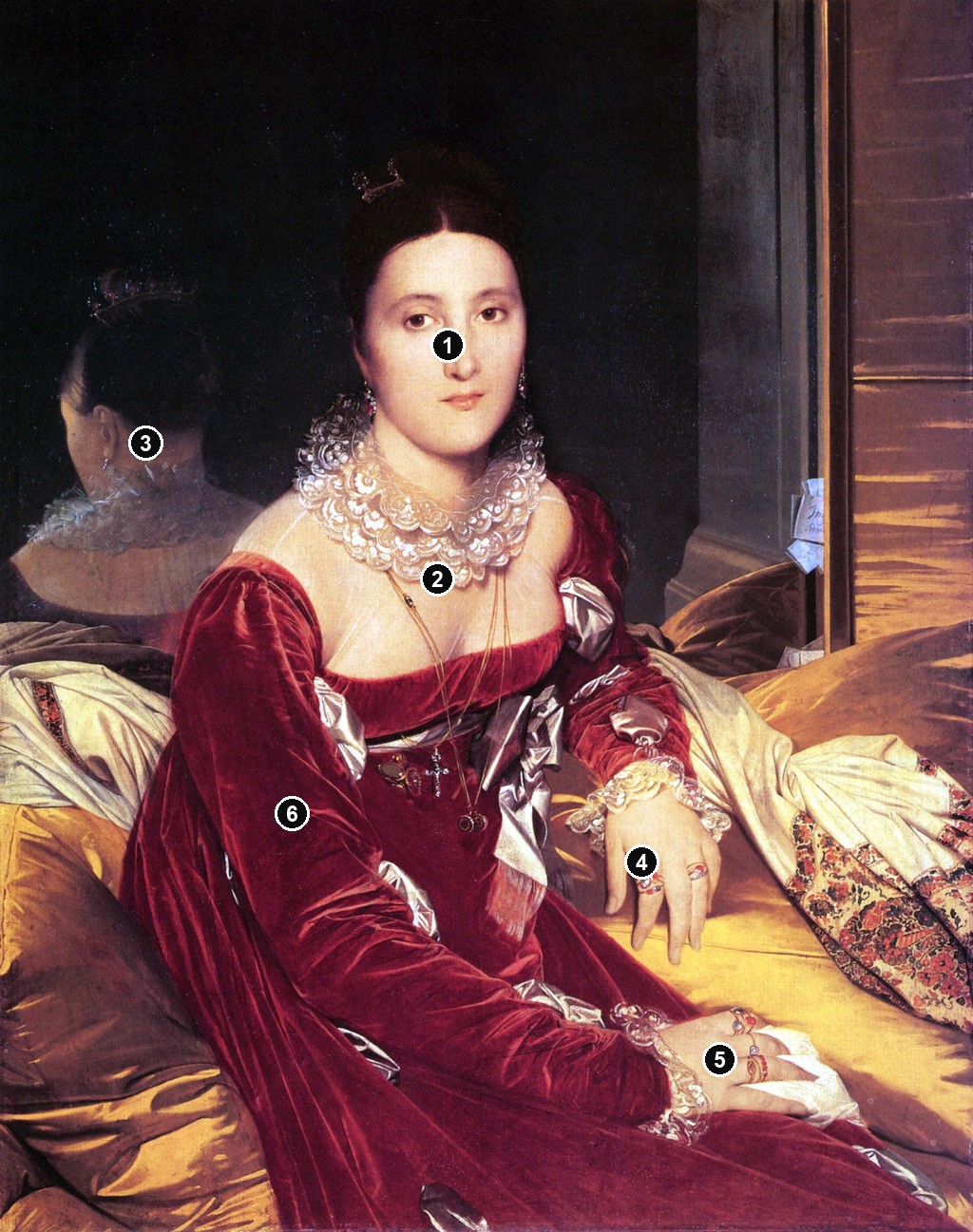
Painted in 1814 and now in the Musée d’arts de Nantes, this is a portrait in which recognisable things become the material of an elaborate design. [1] Its pleasures lie in following that design: from skin to lace, from a hanging hand to a painted visiting card, and from the woman before us to the quieter figure behind her.
At a Glance
- ArtistJean-Auguste-Dominique Ingres.
- Date1814.
- MediumOil on canvas.
- Dimensions106 × 84 cm.
- CollectionMusée d’arts de Nantes, inventory 1028; purchased in 1853. [1]
- SitterMarie-Geneviève-Marguerite Marcoz, later Vicomtesse de Senonnes. [1][2]
- Look forThe dark reflected neck, silver sleeve openings, dangling hand and small signed paper in the mirror frame.
This work across Ingres’s career
Agamemnon’s Ambassadors
1801 (competition)Grande Odalisque
1814Louis XIII’s Vow
1824Monsieur Bertin
1832The Princesse de Broglie
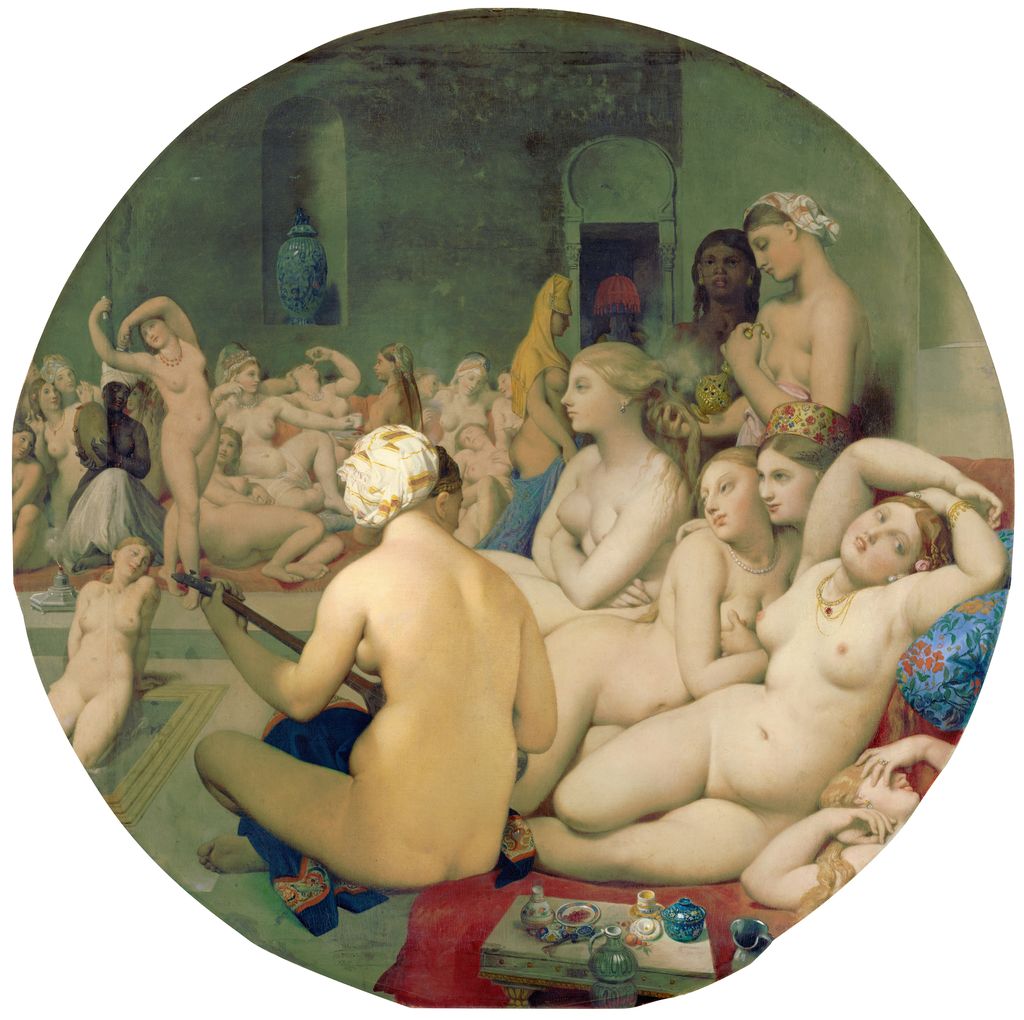
1851–1853The Turkish Bath
1859–1862Contents
- Marie Marcoz before the title
- Velvet, silver and the movement of light
- Two hands and one long curve
- A mirror that gives little away
- How the painted surface was prepared
- Drawings and the search for a pose
- The date and the exhibition that did not happen
- From a family portrait to Nantes
- Looking beside other paintings by Ingres
- Annotated details
Marie Marcoz before the title
The familiar title looks forward to a marriage. When Ingres painted her in 1814, Marie Marcoz had yet to become Madame de Senonnes. Born into a family of Lyonnais cloth merchants, she had married Jean Talansier, divorced in 1809 and formed a relationship in Rome with Alexandre de Senonnes, an aristocrat and art enthusiast who commissioned the portrait. Their marriage followed in Paris in 1815, against his family’s wishes. [2]
The clothes, furnishings and jewellery give her a carefully presented appearance. The title places her within a named family and a social rank acquired after the picture was painted. Yet her particular presence depends on smaller decisions: the set of the eyes, the slight separation of the lips, the placement of the wrists. We can attend to those choices while leaving open how Marie herself felt about the social opposition to her marriage.
Velvet, silver and the movement of light
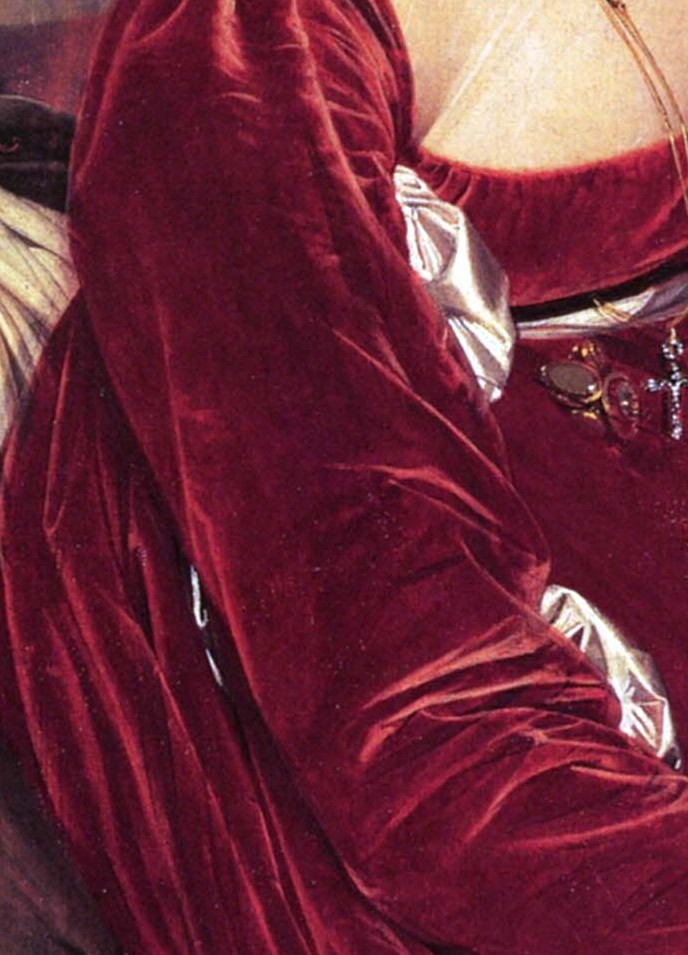
The dress provides the painting’s largest continuous shape. Its deep reds swell through the skirt and sleeves, darken almost to brown in the folds, then catch thin, vivid highlights. Follow the sleeve on the left of the image from the shoulder to the wrist. Its outer contour makes one long sweep, while its interior is broken into many short creases. The whole arm reads as an elegant curve before the folds register as individual pieces of observed cloth.
Kastner-Tardy’s analysis for Panorama de l’art identifies the high-waisted red velvet gown, silver satin at the belt and sleeve openings, transparent tulle and a collar of fine blonde lace. The dress combines the fashionable Empire silhouette with decorative slashed sleeves. [2] The white and silver passages do more than describe trimmings. They punctuate the red, allowing the eye to move across a surface that might otherwise become a heavy, undifferentiated mass.
The distinction between velvet and satin is especially clear where the sleeve openings sit alongside the dark fabric. The red admits broad stretches of shadow. The silver changes abruptly from a near-white ridge to a cool grey hollow. Both appear soft, but they handle light differently. Ingres makes the viewer recognise that difference through the disposition of painted marks, without requiring a separate explanation of either material.
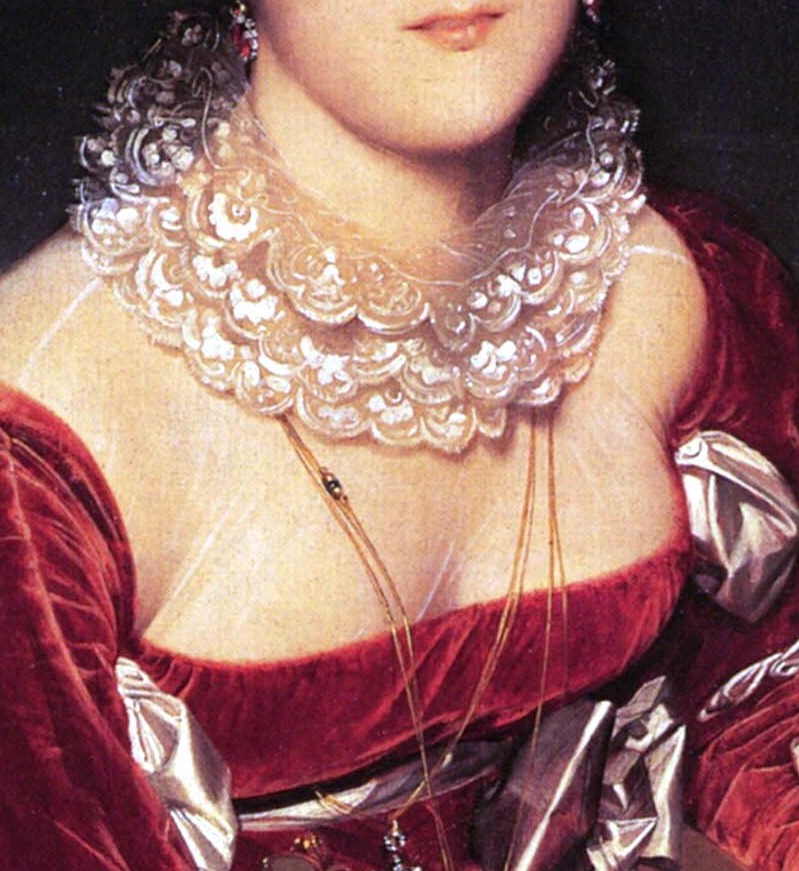
The collar introduces another scale of looking. From farther away, it is a pale, almost circular frame around the lower face. Closer attention breaks it into loops, scallops and small intervals of darkness. The fine material over the chest is more elusive: its visibility depends upon the edges and faint changes across the skin beneath it. The brightest white is reserved for particular threads and folds, so transparency and opacity can sit close together.
Gold chains descend across the chest, sometimes separating, sometimes crossing. Their slender lines connect the light upper body to the densely coloured dress. The pendants interrupt those lines with small, concentrated shapes, including a cross. Lower down, rings bring similar flashes of colour to the hands. Jewellery links areas that are widely separated on the canvas, giving the eye another route between the chest and the fingers.
The cream shawl changes the picture’s rhythm again. Its pale body gathers across the cushions, while the patterned border at the right introduces tiny forms and several colours within a narrow strip. Against that intricacy, the smooth fingers look especially simple. The painting repeatedly invites close inspection and then releases us into a broad area of colour or flesh.
Two hands and one long curve
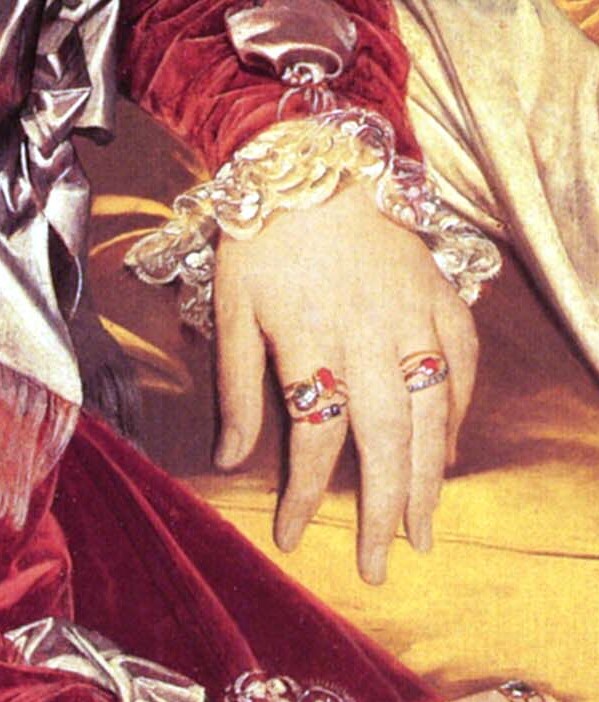
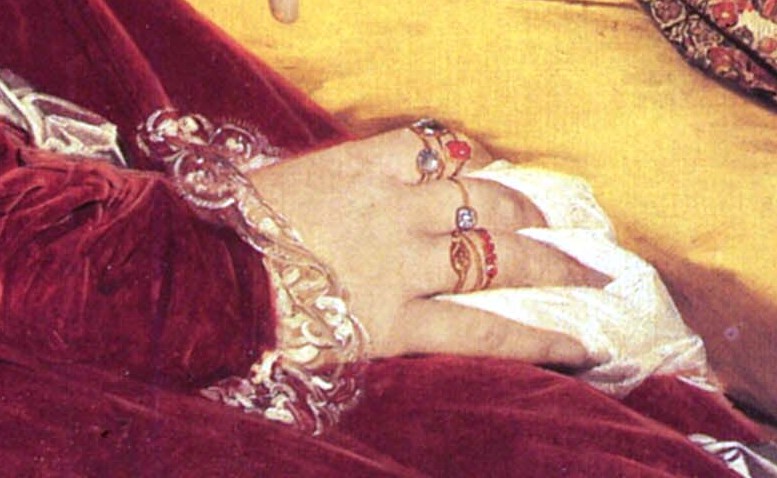
The hands occupy very different positions. At the right of the image, one drops from the raised forearm over the yellow cushion. The fingers separate gently, their tips describing an uneven descending line. Lower down, the other rests across the dress and a small piece of white cloth. Its fingers turn sideways into the composition. These are quiet gestures, but their difference stops the pose becoming mechanically symmetrical.
The upper hand is particularly effective as a meeting point of materials. Flesh lies beside lace, rings, cream fabric and yellow upholstery. Small highlights flash from the stones while the fingers remain softly modelled. The cushion seems to support the arm and make the gesture effortless. At the same time, its yellow surface gives the hand a clear field against which its shape can be read.
The sleeve at the left carries the opposite arm over an unusually long distance. Try following it without stopping at the jewellery or silver openings. The shoulder, elbow and wrist become parts of a continuous, turning path. The figure seems both settled into the seat and drawn out across the canvas. The folds persuade us of fabric, while the larger arrangement asks us to accept a body governed by the picture’s rhythm.
This coexistence is central to the portrait. Looking closely at a ring or a sleeve fold encourages trust in the precision of the representation. Stepping back reveals how strongly Ingres has organised the whole figure. Minute description does not guarantee that every proportion behaves like a measurement taken from a body. Here, convincing texture and an extended silhouette reinforce one another: the tactile richness makes the sinuous design feel inhabited.
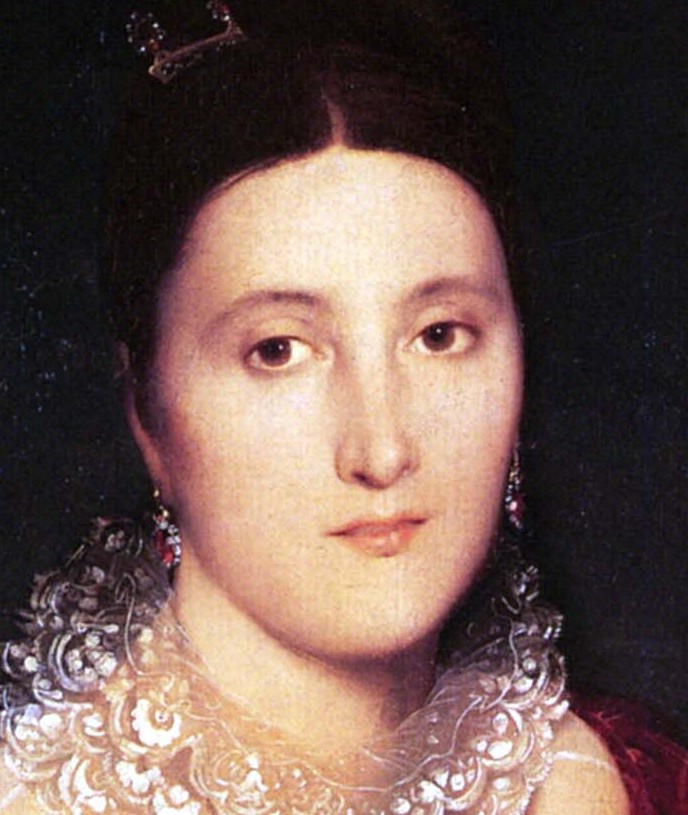
The face has a comparable balance of regularity and difference. Its outline is a clear oval, framed by dark hair divided at the centre. Within that orderly shape, the eyes have slightly different openings and angles; the mouth is small and gently parted. Those differences keep the head from becoming an ornamental form equivalent to the collar beneath it. They give the viewer something to attend to without settling upon one lasting expression.
A mirror that gives little away
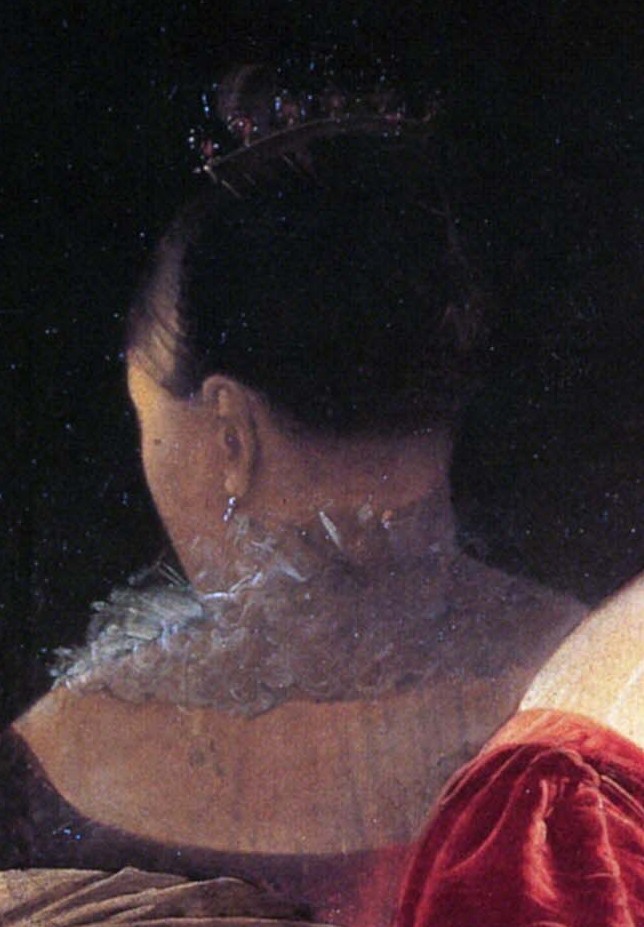
The mirror occupies much of the upper background, although at first it can read as a nearly blank dark wall. The reflected head at the left clarifies its function. We see the hair gathered behind, the decorated comb, the back of the neck and part of the upper body. Light catches the reflected skin, but with much less force than it reaches the face turned towards us.
That second view gives the figure another side. It also changes the balance of the picture. Without the reflection, the pale face would stand almost alone against the dark upper field. The lower, dimmer head at the left draws our attention sideways and then back again. The sitter’s presence is distributed between two unequal images, one immediately legible and the other requiring a moment’s adjustment.
The mirror gives little information about the rest of the room. There is no expansive reflected interior through which to reconstruct the sitter’s surroundings. The dark area behind her head leaves the bright fabric below unusually prominent. We know there is space behind her because we can see another side of her body, yet that space remains difficult to enter imaginatively.
The contrast between face and reflection also affects the intimacy of the encounter. The front-facing head meets the viewer; the reflected head turns away. These are simultaneous views of the same person, held within very different degrees of clarity. The painting allows proximity while preserving a part of the figure that is inaccessible to direct exchange.
The signed paper
At the right-hand edge of the mirror, a small slip of paper interrupts the vertical frame. It bears the abbreviated signature and place-name “Ing. Roma”. Delaborde’s posthumous account of 1870 specifically describes the signature on a visiting card tucked into the mirror frame. [3] This is a represented paper within the scene, rather than lettering on the painting’s external frame.
The device rewards a change of attention. Having followed the face and its shadowy counterpart, we notice a tiny, sharply angled object at the margin. Its pale surface stands against the dark surround; its folded or overlapping edges give it a modest physical presence. Ingres’s name enters the room in the form of an object that could belong there. The signature participates in the illusion it identifies.
Annotated Details from Portrait of Madame de Senonnes
The numbered points identify visible features discussed in this article. Return from each detail to the whole composition. Each caption identifies the work shown.
Madame de Senonnes
Jean-Auguste-Dominique Ingres, Portrait of Madame de Senonnes, 1814. Oil on canvas, 106 × 84 cm. Musée d’arts de Nantes, inventory 1028, purchased 1853. The mirror returns a subdued view of the sitter’s gathered hair and neck. Wikimedia Commons. Image source. Public domain.
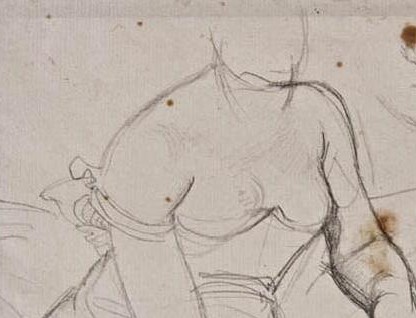
Madame de Senonnes — Bust Study
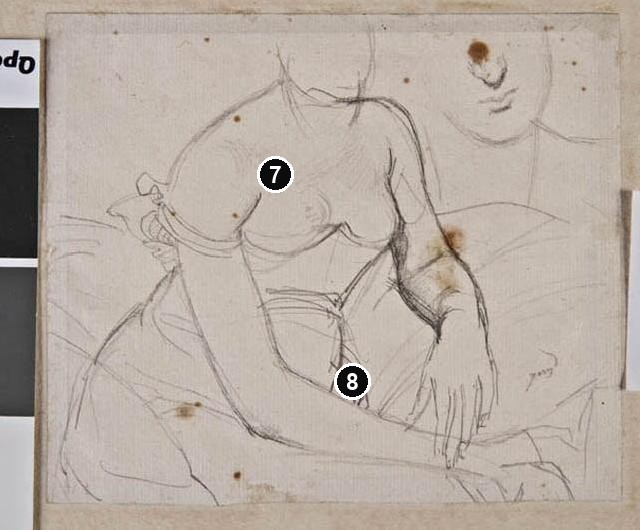
Ingres, Study for Madame de Senonnes, MI.867.383. Graphite on paper, 13 × 15.3 cm. Musée Ingres Bourdelle; dated 1814–1816 in its current record. The separate upper-body and arm study. Wikimedia Commons. Image source. Public domain.
Details from PORTRAIT OF MADAME DE SENONNES
Compare the painted velvet, jewellery, hands and mirror with the separate graphite study of the sitter’s upper body and arms. Keep the study’s provisional lines distinct from the finished painting.
Madame de Senonnes
A face above the lace collar
The pale face is framed by dark hair and an almost black background. The small crown-like hair ornament appears above the central parting.
The openwork collar and hanging chains
Loops of pale lace surround the neck while several chains descend over the red dress. The compact collar and long vertical ornaments lead the eye in different directions.
The reflected head and shoulders
The mirror repeats the back of the head, neck and collar. Its darker image adds another view of the sitter while withholding her reflected face.
The hand resting against yellow upholstery
The lowered fingers rest against yellow fabric below a pale cuff. Rings and small highlights interrupt the broad shape of the hand.
The nearer hand and white cloth
The foreground hand holds a fold of white cloth. Its nearly horizontal fingers meet the long red sleeve and the small bright loops around the wrist.
Red velvet beside silver folds
Deep red folds turn towards brighter ridges along the sleeve. Narrow flashes of silver-coloured fabric sharpen the boundary between the arm and the body.
Madame de Senonnes — Bust Study
The neckline and shoulder curves
The sheet follows the curved neckline and sloping shoulders with a few darker contours. The neck is left open at the top; this supplied study does not include a finished head.
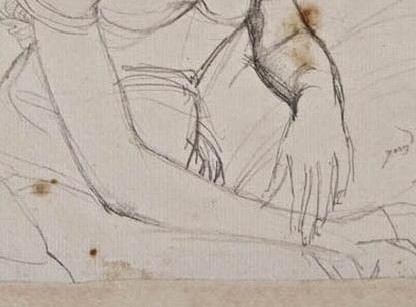
The forearms and lowered fingers
One forearm crosses the lower body while the other hand descends beside it. Repeated lines around the wrist and long fingers keep the arrangement visibly provisional.
How the painted surface was prepared
Technical examination gives the portrait a history beneath its smooth appearance. Charlotte Hale reported that infrared reflectography revealed parts of a transfer grid over a white ground in the lower painting, with squares spaced at 17 cm. She noted eight related sketches in Montauban but no surviving squared drawing then identified; erasure was her probable explanation for the grid’s partial visibility. [4]
Hale also distinguished delicate drawn preparation for the face, features and necklace from vigorous drawing and brushwork in the textiles. She found vivid green underpainting beneath the yellow furnishings and details incised into wet paint in the shawl and lace of the right cuff. [4]
A grid helps an artist carry relationships between parts across a larger surface. Its presence here gives a practical dimension to the flowing design. The incision findings are equally suggestive: some apparent threads and patterns involved a pointed tool moving through paint. These are published examination results; the finished image alone cannot reveal all of those operations.
Drawings and the search for a pose
A preparatory drawing need not look like a reduced version of a finished picture. It can isolate a problem: how one arm crosses the torso, where a shoulder turns or how much space remains between a hand and the edge. Thinking of studies in this way helps explain why a portrait with such a continuous surface could develop through separate trials.
The Musée Ingres Bourdelle preserves a graphite Study for Madame de Senonnes, inventory MI.867.383, measuring 13 × 15.3 cm. Its regional collection record gives the date range 1814–1816. [5] That is a catalogue range for an individual sheet, rather than a reason to replace the painting’s established date. Keeping drawing and painting distinct avoids making every associated object fit an artificially exact sequence.
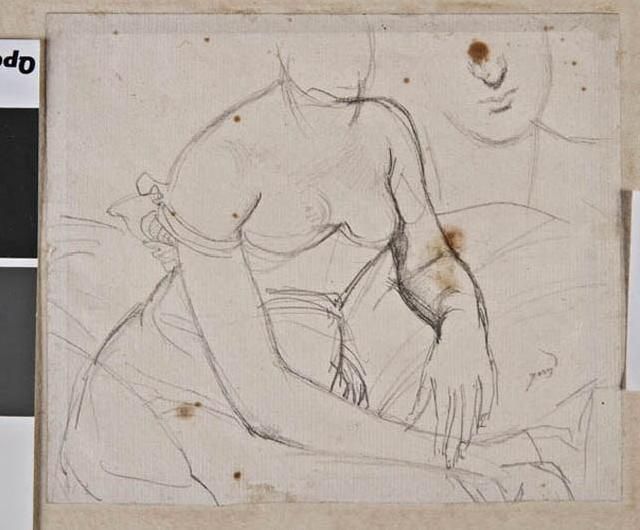
Ingres, Study for Madame de Senonnes, MI.867.383. Graphite on paper, 13 × 15.3 cm. Musée Ingres Bourdelle; dated 1814–1816 in its current record. The separate upper-body and arm study. [6]
Philip Conisbee’s catalogue entry describes other compositional possibilities, including a reclining pose related to David’s Madame Récamier and a sketch of the sitter lying on her front. [7] These alternatives make the final upright encounter more consequential. A reclined body would have organised the canvas through its horizontal extension. Here, the head rises above a broad spread of fabric, and the arms carry the movement down and across the picture.
The finished portrait preserves an impression of physical ease while making the face readily available to the viewer. We do not have to reconstruct a specific succession of sittings to appreciate the choice. The difference between possible poses is already a difference in the relationship a portrait offers: the distance from which we seem to look, how directly the sitter addresses us and where the body leads our attention.
The date and the exhibition that did not happen
A letter can change the history of a painting when its date is read correctly. As Conisbee explains, Ingres’s letter to Marcotte d’Argenteuil of 7 July 1814, once misread as 1816, mentions the portrait nearing completion. The work also appears in a letter of 26 May 1814. Conisbee reports that Ingres hoped to exhibit it at the Salon, but it was not shown there. [7]
The distinction between intention and appearance matters. The painting’s concentrated finish belongs to a work that could have faced a much wider audience than its original owners. Yet the hoped-for exhibition cannot be treated as an actual public debut. Its early history includes an unrealised opportunity for viewers to encounter it.
The correspondence also makes the conventional date more useful than a simple label. It anchors the portrait within a particular period of work, while the picture itself gives us Rome in the signature. Neither fact establishes every stage of its execution, but together they offer firmer ground than speculation drawn from the sitter’s later marriage.
From a family portrait to Nantes
Marie died in 1828. The painting remained within the Senonnes family before its sale to an Angers dealer in 1852 and purchase by Nantes in 1853. [1] Delaborde’s account supplies an early outline of its passage: Alexandre gave the portrait to his brother, the marquis, and an heir subsequently sold it to the dealer, who passed it to the museum. [3]
The Musée Ingres Bourdelle’s collection commentary connects the family’s disposal of the portrait with its hostility to the marriage. [5] The explanation concerns the picture’s treatment as a family possession. In the portrait itself, social tensions remain outside the frame: we see one woman, surrounded by the things chosen to present her.
For Nantes, the acquisition was part of an active engagement with contemporary art. The museum’s account of its nineteenth-century collections places the 1853 purchase within a policy of buying works by living artists, pursued after its opening to the public in 1830. [8] The portrait entered a civic collection during Ingres’s lifetime. A likeness originally bound to particular people and their household could now be studied by visitors with no connection to the family.
That change of setting alters how the details work for an audience. The rings no longer need to be recognised as possessions familiar to the sitter’s circle. The dress can be examined as an arrangement of colour and texture, and the mirror can be compared with other paintings. The woman retains her name, while the portrait acquires a public life through looking. Its appeal to other painters took a practical form too: Eric Bertin’s addenda record copies by James Tissot and Charles Perron. [4]
Looking beside other paintings by Ingres
The nearest comparison in date is Grande Odalisque, also painted in 1814. [9] Set the two images beside each other and follow their longest curves. In the nude, the back and the extended arm carry the eye along the horizontal canvas. In the portrait, the sleeve covers the arm, but a similarly sustained movement passes from shoulder towards the lower hand. Dress changes what can be seen without removing the importance of the body’s larger outline.
The comparison also makes the different encounters clear. The odalisque turns her head towards us while presenting her back. Marie’s torso is available from the front, with the back returned to us in the mirror. In one painting, a turn joins two orientations within the body; in the other, reflection allows contrasting views to occupy the same field.
The later seated portrait of Madame Moitessier, completed in 1856, offers another combination of rich dress and reflected head. [10] Its floral fabric spreads across a broad skirt, while the reflection presents a much more pronounced profile. Against that example, the shadowed back of Marie’s head seems especially reticent. The resemblance between the devices helps us see their different effects; a mirror does not give every Ingres portrait the same atmosphere.
Return, finally, to Marie’s face after looking at the silver folds and yellow cushions. It may now seem quieter than it did at first. The surrounding objects are extraordinarily articulate about their surfaces; the face continues to resist a single description. That is part of the experience the portrait sustains: a wealth of visible information held around a person whose inner life remains her own.

Ingres, Grande Odalisque, 1814. [11]

Ingres, Madame Moitessier Seated, 1856. [12]
Artworks directory
Explore 150 paintings, drawings and an original lithograph. This selection includes related versions and studies; dates distinguish completed works from later revisions.
| Name | Date | Medium |
|---|---|---|
| The Apotheosis of Homer | 1827 | Painting |
| Grande Odalisque | 1814 | Painting |
| The Turkish Bath | 1859–1862 | Painting |
| Madame Moitessier Seated | 1856 | Painting |
| Portrait of Monsieur Bertin | 1832 | Painting |
| Napoleon I on His Imperial Throne | 1806 | Painting |
| Odalisque with Slave | 1839 | Painting |
| The Ambassadors of Agamemnon in the Tent of Achilles | 1801 (competition) | Painting |
| The Valpinçon Bather | 1808 | Painting |
| The Source | 1856 | Painting |
| Oedipus Explaining the Enigma of the Sphinx | 1808; revised probably before 1827 | Painting |
| The Vow of Louis XIII | 1824 | Painting |
| Antiochus and Stratonice | 1840 | Painting |
| The Comtesse d’Haussonville | 1845 | Painting |
| The Princesse de Broglie | 1851–1853 | Painting |
| Jupiter and Thetis | 1811 | Painting |
| The Dream of Ossian | 1813 | Painting |
| The Martyrdom of Saint Symphorian | 1834 | Painting |
| Venus Anadyomene | 1808–1848 | Painting |
| Portrait of Madame de Senonnes | 1814 | Painting |
| Madame Rivière | 1805 | Painting |
| Mademoiselle Caroline Rivière | 1805 | Painting |
| Portrait of Philibert Rivière | 1805 | Painting |
| Bonaparte First Consul | 1804 | Painting |
| The Death of Leonardo da Vinci | 1818 | Painting |
| Joan of Arc at the Coronation of Charles VII | 1854 | Painting |
| Madame Duvaucey | 1807 | Painting |
| La Belle Zélie | 1806 | Painting |
| Madame Panckoucke | 1811 | Painting |
| Portrait of Charles Marcotte d’Argenteuil | 1810 | Painting |
| Joseph Antoine Moltedo | c.1810 | Painting |
| Madame Leblanc | 1823 | Painting |
| Delphine Ingres-Ramel (Portrait of Madame Ingres) | 1859 | Painting |
| Portrait of Amédée de Pastoret | 1823–1826 | Painting |
| Portrait of Baronne de Rothschild | 1848 | Painting |
| Madame Marcotte de Sainte Marie | 1826 | Painting |
| Madame Gonse | 1852 | Painting |
| Aretino in the Studio of Tintoretto | 1848 | Painting |
| Don Pedro of Toledo Kissing Henry IV’s Sword | 1831/1832 | Painting |
| Raphael and La Fornarina | 1814 | Painting |
| Roger Freeing Angelica | 1819 | Painting |
| Romulus’ Victory over Acron | 1812 | Painting |
| Self-Portrait at the Age of Twenty-Four | 1804; revised 1841–1851 | Painting |
| Male Torso | c.1800 | Painting |
| Odalisque in Grisaille (Ingres and workshop) | c.1824–1834 | Painting |
| The Small Bather | 1826 | Painting |
| The Little Bather Harem Interior | 1828 | Painting |
| Jesus Among the Doctors | 1862 | Painting |
| The Virgin Adoring the Host | 1852 | Painting |
| The Virgin of the Host | 1841 | Painting |
| Virgin of the Adoption | 1858 | Painting |
| Paolo and Francesca | 1814 | Painting |
| Homer Deified (revised composition, Louvre RF5273) | 1865 | Drawing |
| Odalisque with Slave (Louvre RF4622) | 1858 | Drawing |
| Odalisque (Walters Art Museum; Ingres and Paul Flandrin) | 1842 | Painting |
| Madame Moitessier Standing (National Gallery of Art) | 1851 | Painting |
| Jacques-Louis Leblanc (The Metropolitan Museum of Art) | 1823 | Painting |
| Ferdinand-Philippe, Duke of Orléans (Louvre RF2005-13) | 1842 | Painting |
| Ferdinand-Philippe, Duke of Orléans (Versailles MV5207; Ingres and workshop) | 1843 | Painting |
| Ferdinand-Philippe, Duke of Orléans (Versailles MV5209; Ingres and workshop) | 1844 | Painting |
| Antiochus and Stratonice (Musée Fabre; Ingres and Raymond Balze) | 1866 | Painting |
| Antiochus and Stratonice (Kunstmuseum Bern, Gurlitt bequest) | Undated (early dating proposed) | Drawing |
| Composition study for Antiochus and Stratonice (MIB867.2193) | 1806 | Drawing |
| Study for the Figure of Stratonice (Met63.66) | 1834–1840 | Graphite, black chalk and charcoal |
| Nude figure study for Stratonice (Boijmans F II 36 PK) | c.1834–1840 | Drawing |
| Paolo and Francesca (The Barber Institute,54.6) | c.1814–1820 | Painting |
| Paolo and Francesca (The Hyde Collection,1971.24) | c.1855–1860 | Painting |
| Paolo and Francesca (Amsterdam Museum TA10970) | 1820 | Drawing |
| Paolo and Francesca (dedicated to Artaud de Montor) | 1816 | Drawing |
| Study for the Bust of Francesca (MIB867.1398) | 1819 | Drawing |
| Study for the Bust of Francesca (MIB867.1396) | 1819 | Drawing |
| The Archangel Raphael, first idea (MIB867.2488) | 1842 | Drawing |
| The Archangel Raphael (MIB867.2500) | 1842 | Drawing |
| The Archangel Raphael Carrying Human Prayers to God (Chantilly DE513) | 1844 | Drawing |
| Louis-Philippe as Saint Philip, stained-glass study | 1844 | Drawing |
| Marie Frédéric Eugène de Reiset (Ford Collection RBF171-2) | 1844 | Drawing |
| Virgil Reading the Aeneid (Toulouse) | Begun 1811 | Painting |
| Tu Marcellus Eris (Brussels, inv. 1836) | c.1814 (museum dating) | Painting |
| Jean-François Gilibert | 1804 | Painting |
| François-Marius Granet | 1807 (museum dating) | Painting |
| Count Nikolai Dmitrievich Guryev | 1821 | Painting |
| Caroline Murat, Queen of Naples | 1814 | Painting |
| Count Mathieu Molé | 1834 | Painting |
| Cherubini and the Muse of Lyric Poetry (Louvre) | 1842 | Painting |
| Luigi Cherubini (Cincinnati) | 1841 | Painting |
| Comtesse de Rayneval (Louvre RF4505) | 1841 | Drawing |
| Venus on Paphos (Antonie Balaÿ) | c.1852 | Painting |
| Prince Napoléon | 1855 | Painting |
| Study for The Apotheosis of Napoleon I (Petit Palais) | Late 1853 | Painting |
| The Apotheosis of Napoleon I (destroyed ceiling) | 1853 | Painting |
| The Journalist (MIB867.2733) | 1834? | Drawing |
| Henry VIII, after Holbein | c.1815–1820 (?) | Drawing |
| Madame Récamier, after David (MIB867.3637) | Undated (early Paris period) | Drawing |
| Study for Comtesse d’Haussonville (MIB867.259; background possibly by another hand) | 1842–1845 | Drawing |
| La Source (reduced version reported by Delaborde) | Date unrecorded; reported 1870 | Painting |
| Odalisque (autograph lithograph,NGA1946.21.117) | 1825; published1826 | Lithograph |
| Portrait of a Seated Lady | 1814 | Graphite |
| The Kaunitz Sisters (Leopoldine, Caroline, and Ferdinandine) | 1818 | Graphite |
| Portrait of a Man | 1814 | Graphite |
| Study for the Portrait of Louis-François Bertin (1766–1841) | n.d. | Black chalk and graphite |
| Studies for the Cadaver of Acron | ca. 1810–12 | Graphite on wove paper |
| Study for the Drapery of Molière in "The Apotheosis of Homer" | n.d. | Black chalk with stumping |
| Madame Guillaume Guillon Lethière, née Marie-Joseph-Honorée Vanzenne, and her son Lucien Lethière | 1808 | Graphite |
| Niccolò Paganini (1782–1840) | ca. 1830 | Counterproof or tracing strengthened with graphite and gouache on translucent paper |
| Lady Mary Cavendish-Bentinck (?-1843) | 1816 | Graphite |
| Madame Alexandre Lethière and Her Daughter Letizia | ca. 1815 | Graphite |
| Merry Joseph Blondel (1781–1853) | 1809 | Graphite |
| Ursin-Jules Vatinelle (1798–1881) | 1820 | Graphite |
| Bust of a Gypsy Girl (ascribed to Ingres) | 1819 | Graphite on wove paper |
| Study of a Seated Nude Male | n.d. | Graphite |
| The Archangel Raphael (Study for a stained-glass window in the chapel of Notre-Dame de la Compassion-Saint-Ferdinand, Neuilly) | ca. 1842 | Graphite |
| Lancelot-Théodore, comte Turpin de Crissé | probably 1818 | Graphite |
| Study for the Figure of the Iliad in "The Apotheosis of Homer" | ca. 1827 | Graphite and black chalk heightened with white chalk on brown paper |
| Comtesse Turpin de Crissé | probably 1818 | Graphite |
| Nude Figures for L'Âge d'Or, Château de Dampierre | n.d. | Graphite on brownish paper |
| Study of Figures (attributed to Ingres) | n.d. | Graphite |
| Study of Figures (attributed to Ingres) | n.d. | Graphite; squared in graphite |
| Admiral Sir Fleetwood Broughton Reynolds Pellew | 1817 | Graphite on wove paper |
| Madame Jean-Auguste-Dominique Ingres, née Madeleine Chapelle | 1814 | Graphite on off-white wove paper |
| Virgil Reading the Aeneid to Augustus, Livia, and Octavia | 1809/1819 (?) | Pen and black ink, graphite, brush and gray wash, white gouache heightening, Conté crayon on blue paper |
| General Louis-Étienne Dulong de Rosnay | 1818 | Graphite (hard and soft pencils) |
| Madame Alexandre Lethière, née Rosa Meli, and Her Daughter, Letizia | 1815 | Graphite |
| The Lawyer Paul Grand | 1834 | Graphite |
| Jean-Joseph Fournier | 1815 | Graphite |
| Armand Bertin | 1842 | Graphite |
| Madame Armand Bertin, née Marie-Anne-Cécile Dollfuss | 1843 | Graphite |
| The Architect Charles-Victor Famin | 1836 | Graphite |
| Henri Lehmann | 1850 | Graphite |
| Portrait of a Lady | ca. 1815–17 | Graphite |
| Edmond Cavé (1794–1852) | 1844 | Oil on canvas |
| Head of Saint John the Evangelist | probably ca. 1818–20 | Oil on canvas, laid down on wood |
| Madame Edmond Cavé (Marie-Elisabeth Blavot, ca. 1806–1883) | ca. 1831–34 | Oil on canvas |
| Madame Félix Gallois | 1852 | Graphite with touches of gold in oil to highlight jewelry, on buff wove paper. |
| Dr. François Mêlier | 1849 | Graphite with graphite framing lines, corrected with white, on buff wove paper |
| Portrait of Madame Rhode (Rhoda?) | 1810–20 | Graphite on pale buff wove paper |
| Study for "Raphael and the Fornarina"(?) | ca. 1814(?) | Graphite on white wove paper |
| Portrait of Madame Paul Meurice, née Palmyre Granger | ca. 1845–50 | Graphite on wove paper |
| Alexander the Great presenting Campaspe to Apelles | 1810 | Graphite, brush and brown wash; squared in graphite |
| Study of Hands for "Christ Among the Doctors" | 1852–62 | Graphite on tracing paper |
| Study for The Turkish Bath (RF34502) | about 1850 | Pen and brown ink with graphite, partially squared |
| Study for The Turkish Bath (RF23354) | Undated | Pen and brown ink with graphite on joined sheets |
| Study for The Turkish Bath (RF54702) | about 1859 | Pen and brown ink |
| Studies of women for The Turkish Bath (RF12292) | Undated | Black chalk |
| Achilles Receiving the Envoys of Agamemnon (Nationalmuseum sketch, NM2161) | 1801 | Oil on wood |
| Half-Length Bather (Musée Bonnat-Helleu,89) | 1807 | Oil on canvas |
| Oedipus and the Sphinx (National Gallery,NG3290) | about1826 | Oil on canvas |
| Oedipus and the Sphinx (Walters,37.9) | 1864 | Oil on canvas |
| Oedipus and the Valpinçon Bather, after David (MI.867.2035) | Undated | Graphite on tracing paper, after David |
| Study of the Virgin for The Vow of Louis XIII (Dijon,1758) | about1822 | Black chalk, stump and white chalk on brown wove paper |
| First Thought for The Vow of Louis XIII (MI.885.11.21) | 1822 | Oil on canvas |
Frequently Asked Questions
The title uses her later married name. She married Alexandre de Senonnes in 1815, after the painting’s date of 1814. [2]
It shows part of the sitter from behind, including her gathered hair, neck and upper body. Most of its surface is dark, so it gives little sense of a wider room.
“Ing. Roma” appears on a small painted paper tucked into the mirror frame at the right of the composition. Delaborde described this device in 1870. [3]
Discussion
Look again at the images and ideas explored in Portrait of Madame de Senonnes. These editorial prompts invite your observations.
Reader Insights
Look first at the dress, then return to the face. Which detail most changes the encounter for you: the silver sleeve openings, the hanging hand, the shadowed reflection or the small signed paper?
Compare Marie’s partial reflection with the fuller second view in the Haussonville portrait. How much does each mirror reveal?
Which passage most draws your attention to the painter’s choices: the dress’s bright openings, the long arm or the paper bearing the signature?
Join the Conversation
Share a detail, comparison or question about Portrait of Madame de Senonnes below.
References
- Nantes, Le Portrait, p. 14 (label 1814; narrative 1814–1816); collection page. View source 1. View source 2.
- Kastner-Tardy, “Portrait de madame de Senonnes”. Panorama de l’art, 2014. View source.
- Henri Delaborde, Ingres, sa vie, ses travaux, sa doctrine, d’après les notes manuscrites et les lettres du maître. Paris: Henri Plon, 1870, catalogue no. 154, p. 260, signature and ownership account. Its proposed 1806–1810 date has been superseded. (In French.) View source.
- Charlotte Hale, technical observations, in Gary Tinterow, Charlotte Hale and Eric Bertin. “‘Portraits by Ingres: Image of an Epoch’: Reflections, Technical Observations, Addenda, and Corrigenda”. Metropolitan Museum Journal 35 (2000), pp. 193–219, especially Hale, p. 203 and fig. 14; Eric Bertin’s addenda, pp. 211–212, on copies. View source.
- Musées Occitanie, Senonnes study. MI.867.383. View source.
- Supporting image. Ingres, Study for Madame de Senonnes, MI.867.383. Graphite on paper, 13 × 15.3 cm. Musée Ingres Bourdelle; dated 1814–1816 in its current record. The separate upper-body and arm study. Wikimedia Commons. Image source. Public domain.
- Philip Conisbee, Entry on Madame de Senonnes, in Gary Tinterow and Philip Conisbee, eds., Portraits by Ingres: Image of an Epoch. New York: The Metropolitan Museum of Art, 1999, catalogue no. 35, pp. 148–151, especially pp. 150–151 and notes 2–4. Letters of 26 May and 7 July 1814 are discussed through this entry. View source.
- Musée d’arts de Nantes, “Art du 19ᵉ siècle”, “La collection”, on acquisitions of contemporary art and the 1853 purchase. (In French.) View source.
- Musée du Louvre, “Une odalisque, dite La grande odalisque”, inventory RF 1158, date and object record. (In French.) View source.
- The National Gallery, London, “Jean-Auguste-Dominique Ingres, Madame Moitessier”, NG4821, 1856, object record. View source.
- Supporting image. Ingres, Grande Odalisque, 1814. Image source. CC0 / Public domain.
- Supporting image. Ingres, Madame Moitessier Seated, 1856. Image source. CC0 / Public domain.
- Splash image. Jean-Auguste-Dominique Ingres, Portrait of Madame de Senonnes, 1814. Oil on canvas, 106 × 84 cm. Musée d’arts de Nantes, inventory 1028, purchased 1853. The mirror returns a subdued view of the sitter’s gathered hair and neck. Wikimedia Commons. Image source. Public domain.