Jean-Auguste-Dominique Ingres.jpg)
 by Tom Gurney
Tom Gurney BSc (Hons) is an art history expert with over 20 years experience
Published on June 19, 2020 / Updated on October 22, 2026
Email: tomgurney1@gmail.com / Phone: +44 7429 011000
The Little Bather Harem Interior
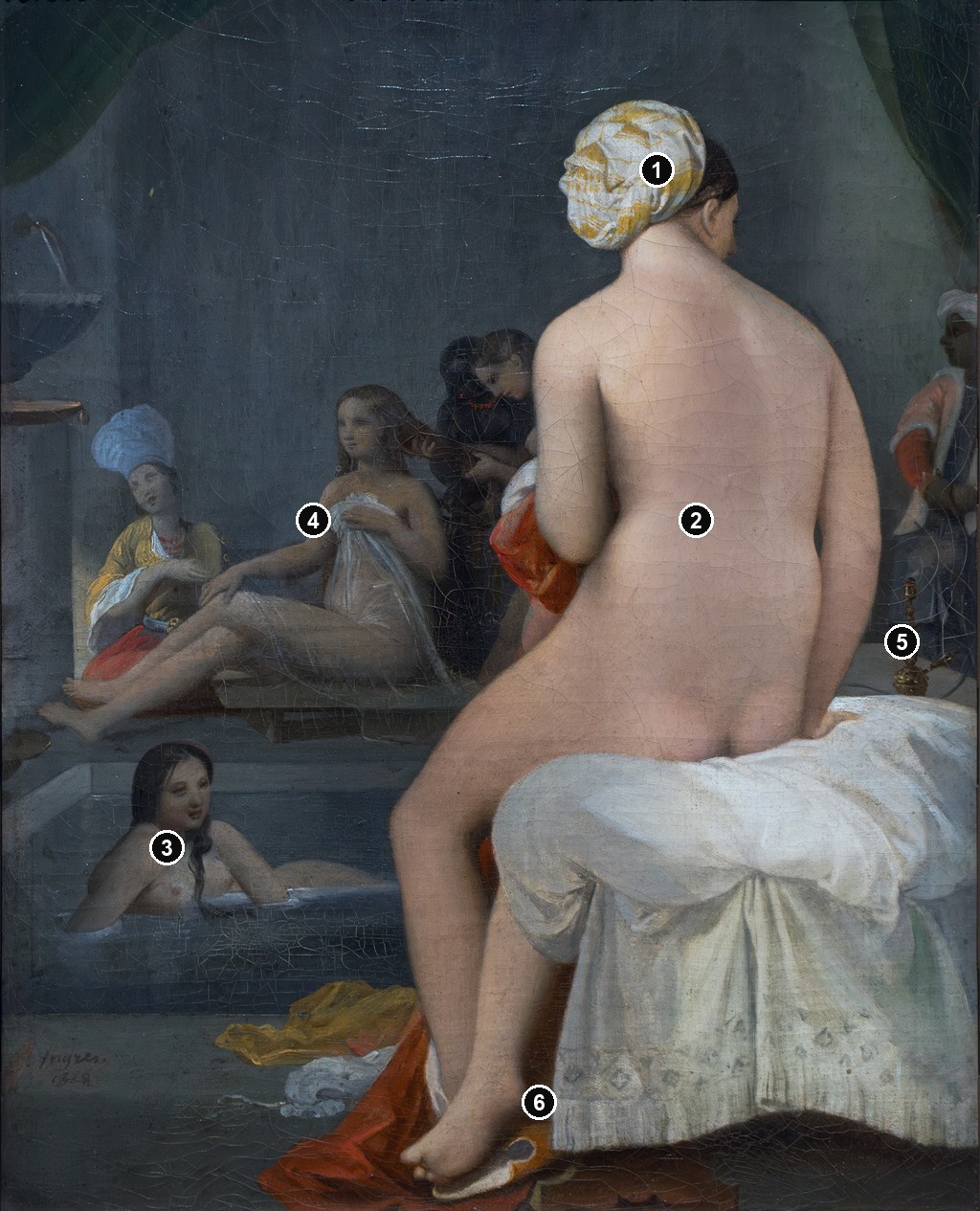
A seated woman turns her back towards us while a whole bathing room opens beyond her shoulder. Her pale body and white bed linen fill the foreground; across the water, smaller figures recline, gather and receive attention. The first impression is stillness, but following the figures into the shadows reveals a room organised around different kinds of activity and display.
Ingres painted this harem interior for L. J. A. Coutan in 1828. [1] Its familiar seated figure comes from The Valpinçon Bather, painted twenty years earlier. [2] Here, the surrounding company changes the experience of looking at her: a once solitary figure becomes the largest presence in a shared, imagined interior.
At a Glance
- ArtistJean-Auguste-Dominique Ingres.
- Date1828.
- Medium and sizeOil on canvas, 35 × 27 cm.
- CollectionMusée du Louvre, Paris, RF 1728. [1]
This work across Ingres’s career
Agamemnon’s Ambassadors
1801 (competition)Grande Odalisque
1814Louis XIII’s Vow
1824Monsieur Bertin
1832The Princesse de Broglie
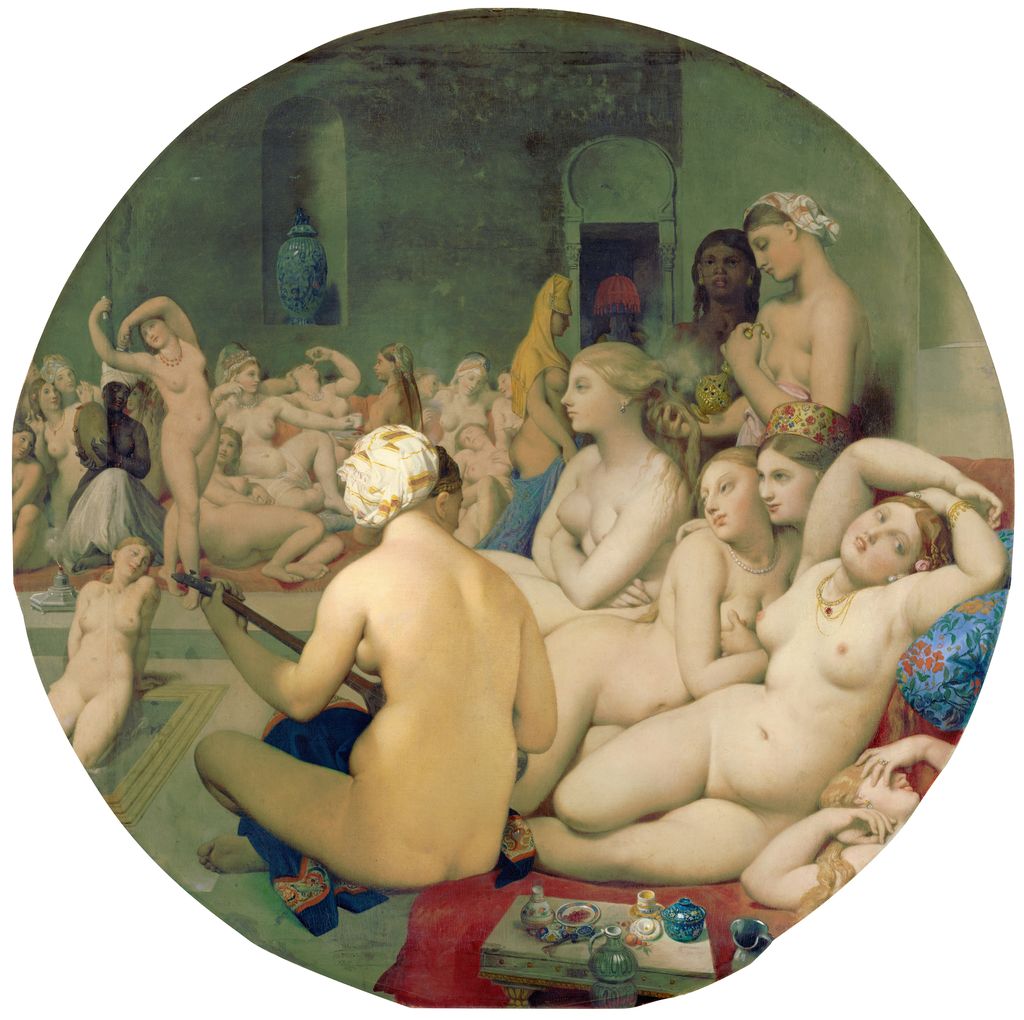
1851–1853The Turkish Bath
1859–1862Contents
- A room revealed around a back
- Familiar form, changed surroundings
- Drawings shared between pictures
- An imagined harem and its unequal visibility
- From a collector's painting to the Louvre
- Annotated details
A room revealed around a back
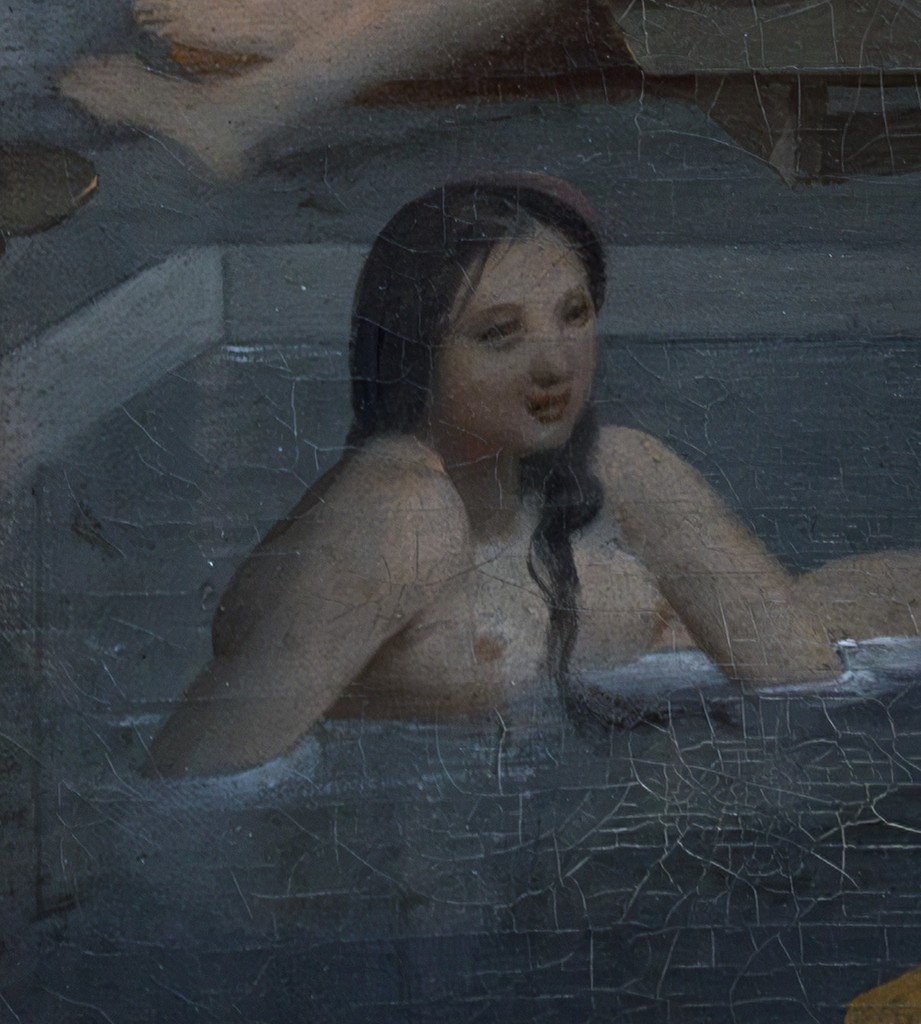
The foreground woman occupies the right side of the painting, leaving a narrow but remarkably busy opening on the left. She sits above a rectangular pool, whose dark rim cuts across the lower part of the scene. A woman rises from the water, with wet-looking dark hair falling beside her face. Her head is much smaller than the seated figure's turban. That difference in scale makes the bath extend backwards even though very little floor space is available to explain its depth.
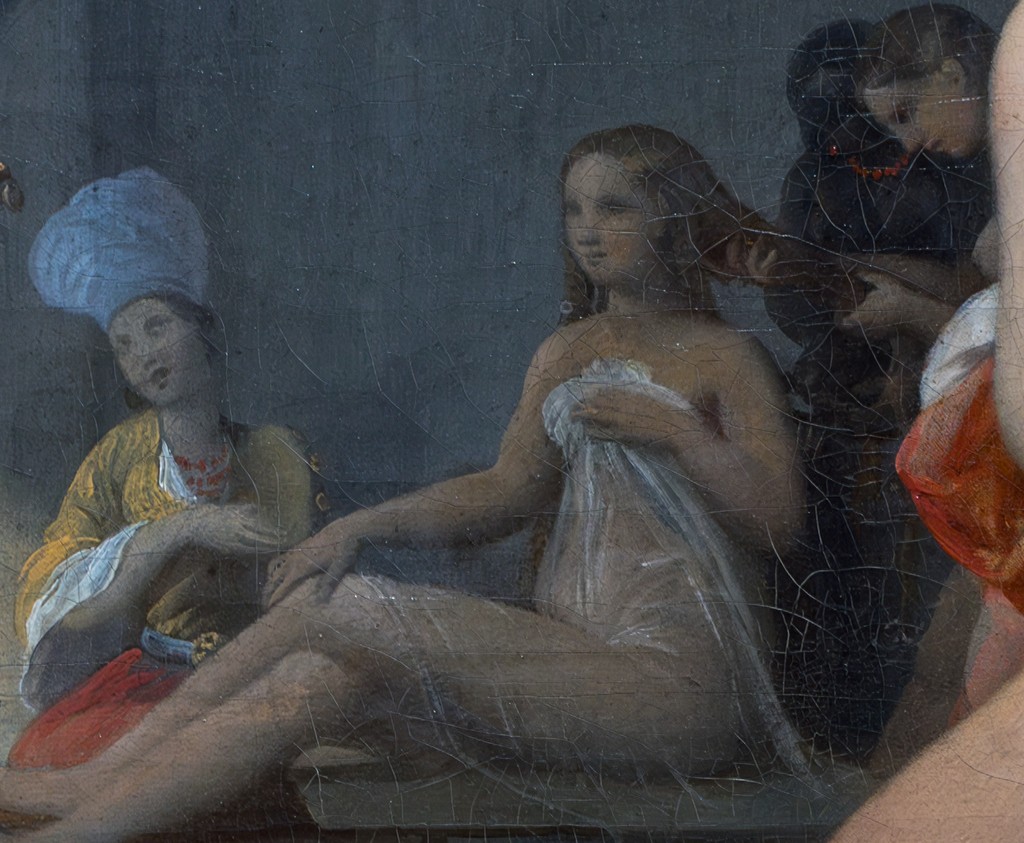
Further away, a woman reclines with her legs stretched towards the left. She holds translucent white fabric across her chest and lap. A companion in a blue turban and yellow garment sits near her feet, while a dark-clothed attendant bends behind her head. Their hands and inclinations of head create a cluster of small movements. Beside this group, the foreground woman's large, unbroken back appears exceptionally quiet. Two small figures stand in shadow behind the bathers: one wears a red necklace, the other a white headwrap and red sleeve. The Louvre identifies Black servants here. [1] Their activity helps define the interior.
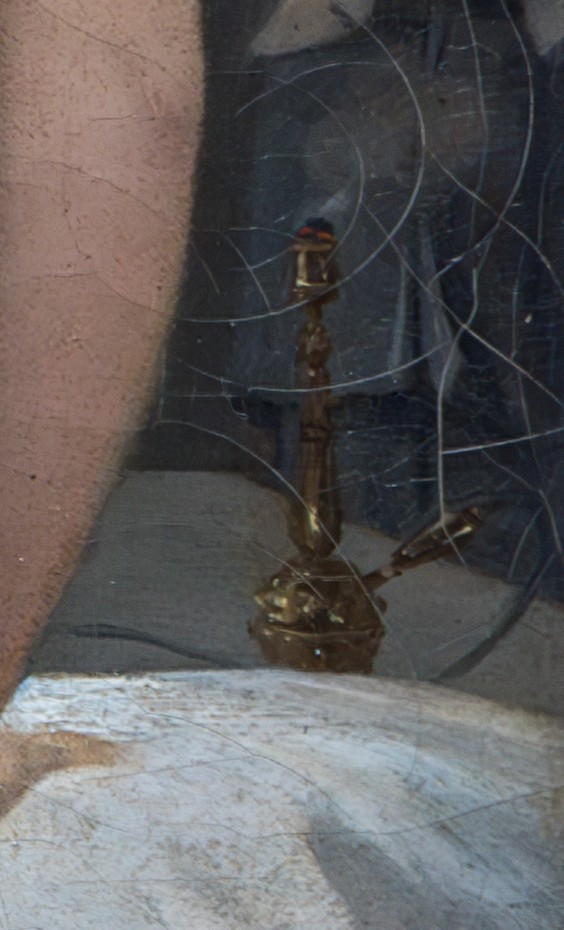
At the edges, objects continue the bathing theme. A wall fitting projects from the upper left; on the right, a slender metal vessel catches small highlights. Cloth lies scattered below the bed in red, yellow and pale blue. The room's blue-grey surfaces bind the different figures together, while the warmer colours gather around skin, dress and fabric. The eye can move from the yellow pattern of the main turban to the distant yellow sleeve, then return through a patch of red towards the slipper at the woman's foot.
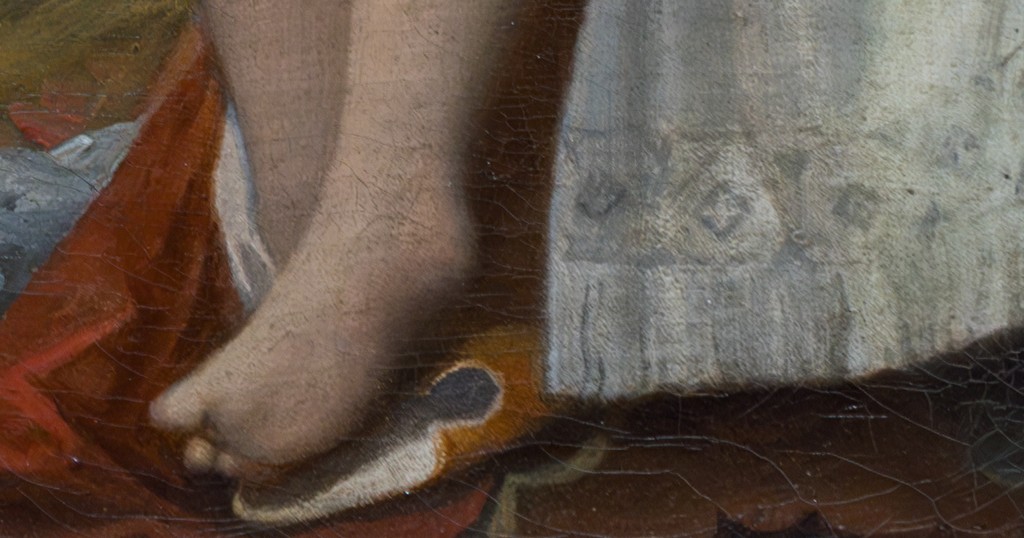
The bed presents a particularly strong contrast with the water. Its white cover has a thick rolled edge, gathered folds and a hanging fringe. The pool lies flat and dark; the linen bulges towards us. Between these two surfaces, the bather's leg descends to the floor. The picture gains much of its depth from these overlapping things, each of which offers a different visual sensation: cool water, soft cloth, smooth skin and hard metal.
Annotated Details from The Little Bather Harem Interior
The numbered points identify visible features discussed in this article. Return from each detail to the whole composition. Ingres, The Little Bather: Interior of a Harem, 1828. Musée du Louvre, RF 1728. Photograph: JackyM59; Wikimedia Commons. Image source. CC BY-SA 4.0. Numbered overview: resized, with markers added. Detail images: cropped and JPEG-optimised. All these image derivatives are licensed CC BY-SA 4.0.
Details from THE LITTLE BATHER HAREM INTERIOR
Follow the main figure into the pool, surrounding group, small vessel and folds of cloth around the interior.
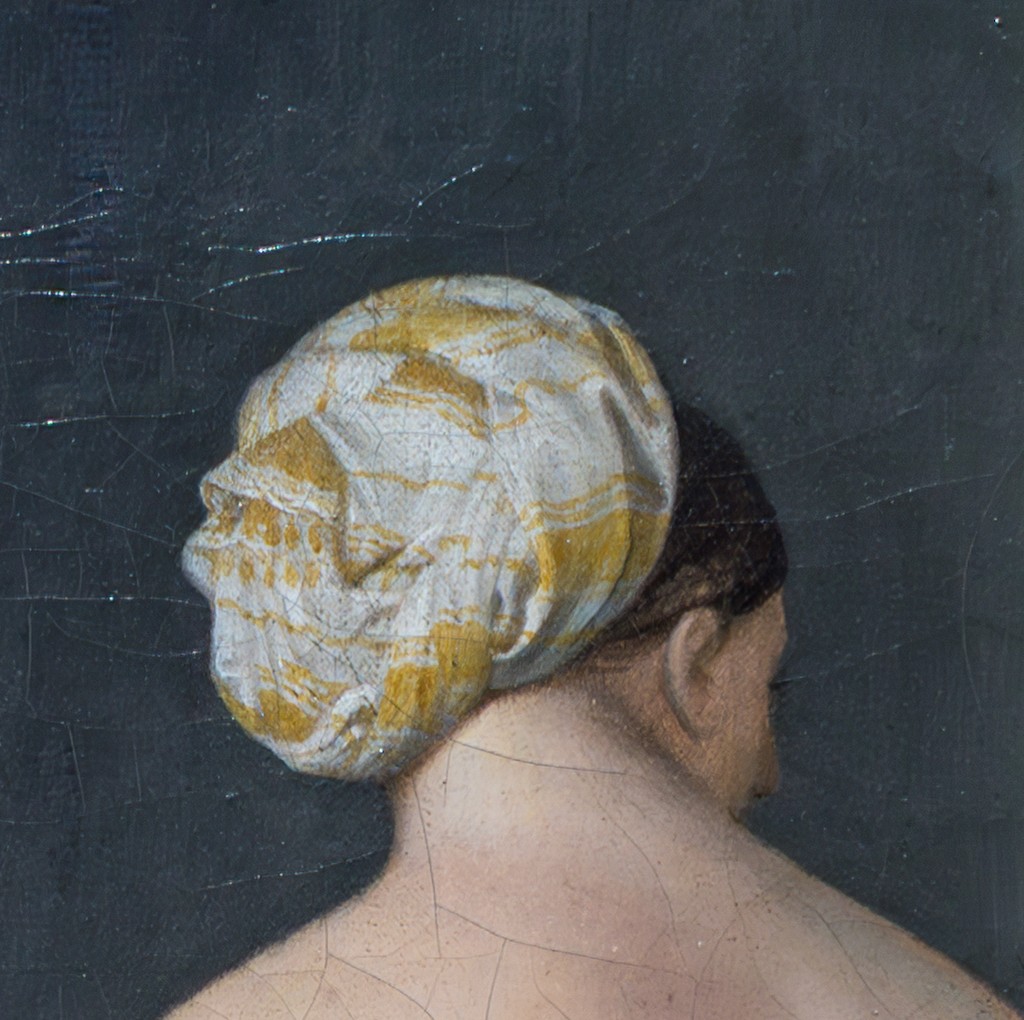
The wrapped head and turned profile
White and gold-coloured bands gather around the turned head. Compare the irregular folds with the smooth curve of the neck below.
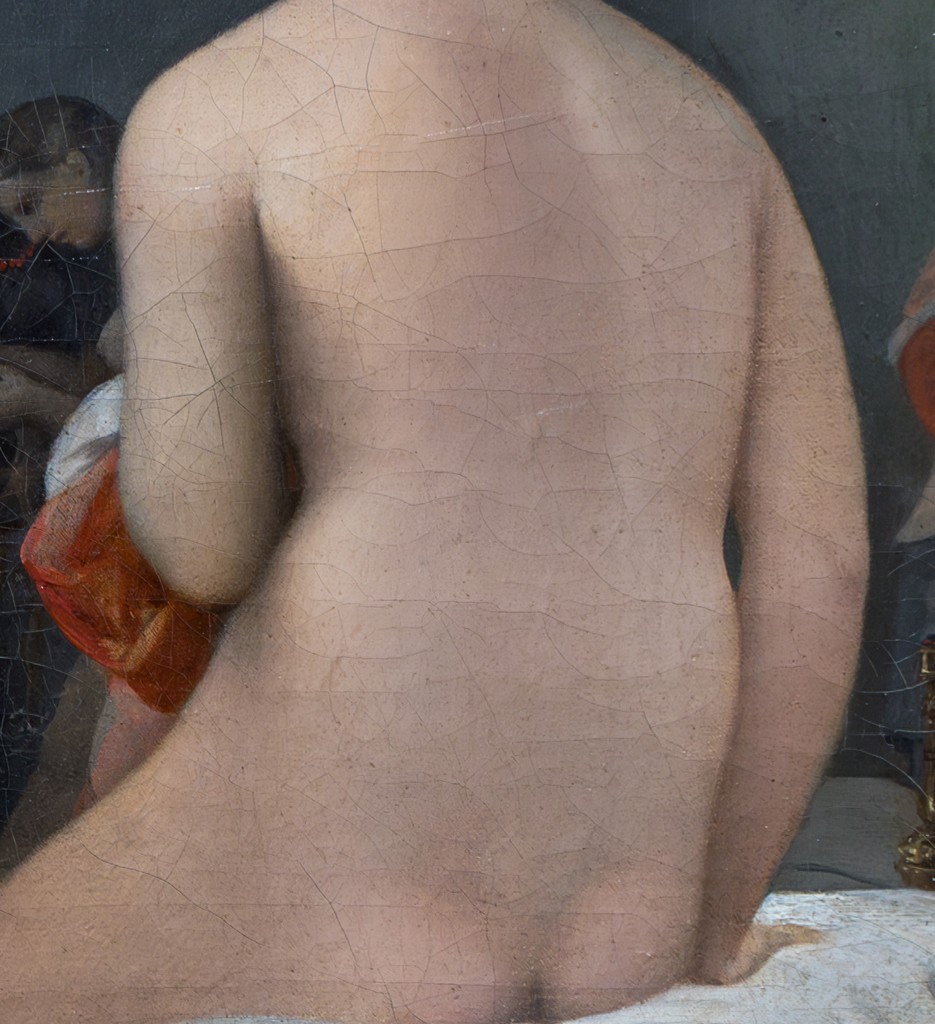
The back against the interior
The large pale back stands out against the cooler room and smaller figures. Follow the outer contour from the shoulder down towards the seated hip.
The woman in the pool
A smaller woman appears in the pool below the seated figure. Her bent arms and lifted face carry a different movement through the dark water.
The group beyond the foreground figure
Seated figures, head coverings and extended hands gather behind the large body. Their overlapping positions make the room feel more crowded than the main silhouette first suggests.
The ewer at the right
A small vessel stands between the large pale body and the darker figure beyond. Its upright neck and curved outline add another compact shape at the edge of the scene.
The foot, slipper and falling linen
The lowered foot meets a slipper beside red fabric and hanging linen. The small curves around the toes contrast with the long, straighter folds descending from the seat.
Familiar form, changed surroundings
The original Valpinçon Bather dates from 1808 and measures 146 × 97.5 cm. It was sent to Paris as part of Ingres's work as a pensioner at the French Academy in Rome. [3] The later painting brings the figure into a much smaller object while enlarging the company around her.
Seen together, the two compositions show how much can change while a pose remains recognisable. Both women wear a wrapped headcloth, sit on white bedding and turn their faces away. In the earlier picture, a curtain and wall hanging close off the space around the body. In the harem interior, that enclosed background gives way to people and water. The main figure still screens part of the scene, but the opening beside her now invites a second, more searching kind of attention.
Her headcloth also changes its colour relationship. The earlier red and white stripes become a pale fabric patterned with yellow. In the harem picture, that small area answers the distant yellow garment across the room. The elbow drapery becomes warmer and redder, while the large white bed cover remains the principal light area beneath the body. Repetition here involves adjustments across the whole colour arrangement.
The modelling of the body also helps it hold the foreground. Across the back, faint changes from light to shadow describe a broad, rounded surface; a narrow darker passage follows the spine towards the seat. Stronger shadow gathers beside the arm and where the body meets the bedding. These transitions differ from the sharp little accents of the fringe and metal vessel. The figure's continuity depends on keeping much of the surface quiet, while nearby objects can be broken into folds, edges and points of light. Looking between them makes the painted body seem both substantial and unusually simplified.
The woman's face stays largely beyond view. A little cheek, ear and dark hair establish her turn towards the room. Because we cannot meet her eyes, we have no direct exchange with her. Her position nevertheless makes her a possible intermediary between our viewpoint and the other bathers: we look past her into a space she also faces. This is a reading of the arrangement, rather than evidence of a particular thought or feeling assigned to the woman.
Ingres's other small treatment of the motif, The Small Bather, is dated 1826 and belongs to the Phillips Collection in Washington. [4] Its grassy seat, wooded darkness and sleeping head beside the main figure make it easy to distinguish from the Louvre's bed and architectural interior. Comparing them reveals two different ways to extend the same figure into a surrounding world. The woodland version makes her pale back emerge from vegetation; the harem painting places it among linen, masonry and other bodies.

The Small Bather, 1826. [5]

Ingres, The Valpinçon Bather, 1808. [6]
Drawings shared between pictures
A surviving sheet at the Musée Ingres Bourdelle helps connect the versions. Femme sortant du bain, MI.867.1184, is a graphite drawing dated 1826. The museum links it with both small bathers and explains that Georges Vigne grouped related studies because their motifs overlap. [7]
The drawing evidence thus crosses the boundaries of the individual paintings. Assigning every associated sheet exclusively to the 1828 canvas would obscure that relationship. A repeated figure could acquire a different setting, and studies could remain useful across related compositions. [7] The same record describes the Phillips painting's attribution as contested; the Phillips Collection presents it as a work by Ingres. [4][7] That disagreement concerns the Washington object and should not be transferred to the Louvre painting. The sheet also carries a lengthy inscription about bathing in French and Latin. [7] Its presence brings writing alongside drawing, although the record supplies no transcription from which to trace particular painted details.
An imagined harem and its unequal visibility
The title encourages us to read the interior as a harem. Turbans, patterned cloth, bathing and attendance help construct that setting. Yet the painting gives us no secure route from its blue-grey room to a specific building, household or observed event. Its most prominent body has already travelled between pictures. The room is assembled around an established artistic motif, and its figures are arranged for our view.
That distinction matters because the painting's abundance of detail can feel persuasive. The hanging fringe, narrow pool rim and little metallic highlights give separate objects a strong presence. Their precision does not make the whole scene a document of everyday life. The picture allows close scrutiny of bodies and furnishings while supplying little information about the lives of the people represented.
Look at the intervals around the smaller figures. A bent head fits behind the reclining woman, while a red sleeve appears between the seated body and the right edge. Their narrow spaces contrast with the broad, brightly lit back in front. The painting does not tell us these people’s biographies or legal status.
The viewer's access is unequal too. We are placed very close to one woman's exposed back, but can also look into the distance at people who do not return our gaze. The arrangement makes intimacy available as a spectacle. At the same time, the foreground figure obstructs the right side of the room, leaving much unseen. The painting's invitation to look depends on this combination of proximity, partial concealment and smaller scenes beyond.
From a collector's painting to the Louvre
The Louvre purchased the painting at public sale in 1908. [1] Henri Delaborde's posthumous 1870 catalogue offers an early account of the version family. Under number 73, he lists a reduced, altered bather signed and dated 1828, with several women bathing in the background, and associates it with the Hauguet collection. He then distinguishes another small variant dated 1826, belonging to Madame Blanc. [2] His entry is an important historical witness to the existence of separate versions. The Louvre also cites Delaborde. [1]
Delaborde's wording also directs attention to the feature that makes the harem interior distinct: the women beyond the main figure. Even in a brief catalogue entry, the altered background is part of the work's identity. His account helps resist the temptation to see every small bather as an interchangeable reduction of the famous back. Exhibitions include Musée Marmottan Monet (2019) and Louvre-Lens (2026). [1]
Ingres would return to a crowded bathing interior in The Turkish Bath, begun in rectangular form in 1859 and completed as a circular composition in 1862. [8] The little harem has its own balance, however: one large foreground figure, a low pool and a separate group beyond. It deserves time on those terms, as a concentrated exploration of how a familiar body changes when its surroundings become populated.
Artworks directory
Explore 150 paintings, drawings and an original lithograph. This selection includes related versions and studies; dates distinguish completed works from later revisions.
| Name | Date | Medium |
|---|---|---|
| The Apotheosis of Homer | 1827 | Painting |
| Grande Odalisque | 1814 | Painting |
| The Turkish Bath | 1859–1862 | Painting |
| Madame Moitessier Seated | 1856 | Painting |
| Portrait of Monsieur Bertin | 1832 | Painting |
| Napoleon I on His Imperial Throne | 1806 | Painting |
| Odalisque with Slave | 1839 | Painting |
| The Ambassadors of Agamemnon in the Tent of Achilles | 1801 (competition) | Painting |
| The Valpinçon Bather | 1808 | Painting |
| The Source | 1856 | Painting |
| Oedipus Explaining the Enigma of the Sphinx | 1808; revised probably before 1827 | Painting |
| The Vow of Louis XIII | 1824 | Painting |
| Antiochus and Stratonice | 1840 | Painting |
| The Comtesse d’Haussonville | 1845 | Painting |
| The Princesse de Broglie | 1851–1853 | Painting |
| Jupiter and Thetis | 1811 | Painting |
| The Dream of Ossian | 1813 | Painting |
| The Martyrdom of Saint Symphorian | 1834 | Painting |
| Venus Anadyomene | 1808–1848 | Painting |
| Portrait of Madame de Senonnes | 1814 | Painting |
| Madame Rivière | 1805 | Painting |
| Mademoiselle Caroline Rivière | 1805 | Painting |
| Portrait of Philibert Rivière | 1805 | Painting |
| Bonaparte First Consul | 1804 | Painting |
| The Death of Leonardo da Vinci | 1818 | Painting |
| Joan of Arc at the Coronation of Charles VII | 1854 | Painting |
| Madame Duvaucey | 1807 | Painting |
| La Belle Zélie | 1806 | Painting |
| Madame Panckoucke | 1811 | Painting |
| Portrait of Charles Marcotte d’Argenteuil | 1810 | Painting |
| Joseph Antoine Moltedo | c.1810 | Painting |
| Madame Leblanc | 1823 | Painting |
| Delphine Ingres-Ramel (Portrait of Madame Ingres) | 1859 | Painting |
| Portrait of Amédée de Pastoret | 1823–1826 | Painting |
| Portrait of Baronne de Rothschild | 1848 | Painting |
| Madame Marcotte de Sainte Marie | 1826 | Painting |
| Madame Gonse | 1852 | Painting |
| Aretino in the Studio of Tintoretto | 1848 | Painting |
| Don Pedro of Toledo Kissing Henry IV’s Sword | 1831/1832 | Painting |
| Raphael and La Fornarina | 1814 | Painting |
| Roger Freeing Angelica | 1819 | Painting |
| Romulus’ Victory over Acron | 1812 | Painting |
| Self-Portrait at the Age of Twenty-Four | 1804; revised 1841–1851 | Painting |
| Male Torso | c.1800 | Painting |
| Odalisque in Grisaille (Ingres and workshop) | c.1824–1834 | Painting |
| The Small Bather | 1826 | Painting |
| The Little Bather Harem Interior | 1828 | Painting |
| Jesus Among the Doctors | 1862 | Painting |
| The Virgin Adoring the Host | 1852 | Painting |
| The Virgin of the Host | 1841 | Painting |
| Virgin of the Adoption | 1858 | Painting |
| Paolo and Francesca | 1814 | Painting |
| Homer Deified (revised composition, Louvre RF5273) | 1865 | Drawing |
| Odalisque with Slave (Louvre RF4622) | 1858 | Drawing |
| Odalisque (Walters Art Museum; Ingres and Paul Flandrin) | 1842 | Painting |
| Madame Moitessier Standing (National Gallery of Art) | 1851 | Painting |
| Jacques-Louis Leblanc (The Metropolitan Museum of Art) | 1823 | Painting |
| Ferdinand-Philippe, Duke of Orléans (Louvre RF2005-13) | 1842 | Painting |
| Ferdinand-Philippe, Duke of Orléans (Versailles MV5207; Ingres and workshop) | 1843 | Painting |
| Ferdinand-Philippe, Duke of Orléans (Versailles MV5209; Ingres and workshop) | 1844 | Painting |
| Antiochus and Stratonice (Musée Fabre; Ingres and Raymond Balze) | 1866 | Painting |
| Antiochus and Stratonice (Kunstmuseum Bern, Gurlitt bequest) | Undated (early dating proposed) | Drawing |
| Composition study for Antiochus and Stratonice (MIB867.2193) | 1806 | Drawing |
| Study for the Figure of Stratonice (Met63.66) | 1834–1840 | Graphite, black chalk and charcoal |
| Nude figure study for Stratonice (Boijmans F II 36 PK) | c.1834–1840 | Drawing |
| Paolo and Francesca (The Barber Institute,54.6) | c.1814–1820 | Painting |
| Paolo and Francesca (The Hyde Collection,1971.24) | c.1855–1860 | Painting |
| Paolo and Francesca (Amsterdam Museum TA10970) | 1820 | Drawing |
| Paolo and Francesca (dedicated to Artaud de Montor) | 1816 | Drawing |
| Study for the Bust of Francesca (MIB867.1398) | 1819 | Drawing |
| Study for the Bust of Francesca (MIB867.1396) | 1819 | Drawing |
| The Archangel Raphael, first idea (MIB867.2488) | 1842 | Drawing |
| The Archangel Raphael (MIB867.2500) | 1842 | Drawing |
| The Archangel Raphael Carrying Human Prayers to God (Chantilly DE513) | 1844 | Drawing |
| Louis-Philippe as Saint Philip, stained-glass study | 1844 | Drawing |
| Marie Frédéric Eugène de Reiset (Ford Collection RBF171-2) | 1844 | Drawing |
| Virgil Reading the Aeneid (Toulouse) | Begun 1811 | Painting |
| Tu Marcellus Eris (Brussels, inv. 1836) | c.1814 (museum dating) | Painting |
| Jean-François Gilibert | 1804 | Painting |
| François-Marius Granet | 1807 (museum dating) | Painting |
| Count Nikolai Dmitrievich Guryev | 1821 | Painting |
| Caroline Murat, Queen of Naples | 1814 | Painting |
| Count Mathieu Molé | 1834 | Painting |
| Cherubini and the Muse of Lyric Poetry (Louvre) | 1842 | Painting |
| Luigi Cherubini (Cincinnati) | 1841 | Painting |
| Comtesse de Rayneval (Louvre RF4505) | 1841 | Drawing |
| Venus on Paphos (Antonie Balaÿ) | c.1852 | Painting |
| Prince Napoléon | 1855 | Painting |
| Study for The Apotheosis of Napoleon I (Petit Palais) | Late 1853 | Painting |
| The Apotheosis of Napoleon I (destroyed ceiling) | 1853 | Painting |
| The Journalist (MIB867.2733) | 1834? | Drawing |
| Henry VIII, after Holbein | c.1815–1820 (?) | Drawing |
| Madame Récamier, after David (MIB867.3637) | Undated (early Paris period) | Drawing |
| Study for Comtesse d’Haussonville (MIB867.259; background possibly by another hand) | 1842–1845 | Drawing |
| La Source (reduced version reported by Delaborde) | Date unrecorded; reported 1870 | Painting |
| Odalisque (autograph lithograph,NGA1946.21.117) | 1825; published1826 | Lithograph |
| Portrait of a Seated Lady | 1814 | Graphite |
| The Kaunitz Sisters (Leopoldine, Caroline, and Ferdinandine) | 1818 | Graphite |
| Portrait of a Man | 1814 | Graphite |
| Study for the Portrait of Louis-François Bertin (1766–1841) | n.d. | Black chalk and graphite |
| Studies for the Cadaver of Acron | ca. 1810–12 | Graphite on wove paper |
| Study for the Drapery of Molière in "The Apotheosis of Homer" | n.d. | Black chalk with stumping |
| Madame Guillaume Guillon Lethière, née Marie-Joseph-Honorée Vanzenne, and her son Lucien Lethière | 1808 | Graphite |
| Niccolò Paganini (1782–1840) | ca. 1830 | Counterproof or tracing strengthened with graphite and gouache on translucent paper |
| Lady Mary Cavendish-Bentinck (?-1843) | 1816 | Graphite |
| Madame Alexandre Lethière and Her Daughter Letizia | ca. 1815 | Graphite |
| Merry Joseph Blondel (1781–1853) | 1809 | Graphite |
| Ursin-Jules Vatinelle (1798–1881) | 1820 | Graphite |
| Bust of a Gypsy Girl (ascribed to Ingres) | 1819 | Graphite on wove paper |
| Study of a Seated Nude Male | n.d. | Graphite |
| The Archangel Raphael (Study for a stained-glass window in the chapel of Notre-Dame de la Compassion-Saint-Ferdinand, Neuilly) | ca. 1842 | Graphite |
| Lancelot-Théodore, comte Turpin de Crissé | probably 1818 | Graphite |
| Study for the Figure of the Iliad in "The Apotheosis of Homer" | ca. 1827 | Graphite and black chalk heightened with white chalk on brown paper |
| Comtesse Turpin de Crissé | probably 1818 | Graphite |
| Nude Figures for L'Âge d'Or, Château de Dampierre | n.d. | Graphite on brownish paper |
| Study of Figures (attributed to Ingres) | n.d. | Graphite |
| Study of Figures (attributed to Ingres) | n.d. | Graphite; squared in graphite |
| Admiral Sir Fleetwood Broughton Reynolds Pellew | 1817 | Graphite on wove paper |
| Madame Jean-Auguste-Dominique Ingres, née Madeleine Chapelle | 1814 | Graphite on off-white wove paper |
| Virgil Reading the Aeneid to Augustus, Livia, and Octavia | 1809/1819 (?) | Pen and black ink, graphite, brush and gray wash, white gouache heightening, Conté crayon on blue paper |
| General Louis-Étienne Dulong de Rosnay | 1818 | Graphite (hard and soft pencils) |
| Madame Alexandre Lethière, née Rosa Meli, and Her Daughter, Letizia | 1815 | Graphite |
| The Lawyer Paul Grand | 1834 | Graphite |
| Jean-Joseph Fournier | 1815 | Graphite |
| Armand Bertin | 1842 | Graphite |
| Madame Armand Bertin, née Marie-Anne-Cécile Dollfuss | 1843 | Graphite |
| The Architect Charles-Victor Famin | 1836 | Graphite |
| Henri Lehmann | 1850 | Graphite |
| Portrait of a Lady | ca. 1815–17 | Graphite |
| Edmond Cavé (1794–1852) | 1844 | Oil on canvas |
| Head of Saint John the Evangelist | probably ca. 1818–20 | Oil on canvas, laid down on wood |
| Madame Edmond Cavé (Marie-Elisabeth Blavot, ca. 1806–1883) | ca. 1831–34 | Oil on canvas |
| Madame Félix Gallois | 1852 | Graphite with touches of gold in oil to highlight jewelry, on buff wove paper. |
| Dr. François Mêlier | 1849 | Graphite with graphite framing lines, corrected with white, on buff wove paper |
| Portrait of Madame Rhode (Rhoda?) | 1810–20 | Graphite on pale buff wove paper |
| Study for "Raphael and the Fornarina"(?) | ca. 1814(?) | Graphite on white wove paper |
| Portrait of Madame Paul Meurice, née Palmyre Granger | ca. 1845–50 | Graphite on wove paper |
| Alexander the Great presenting Campaspe to Apelles | 1810 | Graphite, brush and brown wash; squared in graphite |
| Study of Hands for "Christ Among the Doctors" | 1852–62 | Graphite on tracing paper |
| Study for The Turkish Bath (RF34502) | about 1850 | Pen and brown ink with graphite, partially squared |
| Study for The Turkish Bath (RF23354) | Undated | Pen and brown ink with graphite on joined sheets |
| Study for The Turkish Bath (RF54702) | about 1859 | Pen and brown ink |
| Studies of women for The Turkish Bath (RF12292) | Undated | Black chalk |
| Achilles Receiving the Envoys of Agamemnon (Nationalmuseum sketch, NM2161) | 1801 | Oil on wood |
| Half-Length Bather (Musée Bonnat-Helleu,89) | 1807 | Oil on canvas |
| Oedipus and the Sphinx (National Gallery,NG3290) | about1826 | Oil on canvas |
| Oedipus and the Sphinx (Walters,37.9) | 1864 | Oil on canvas |
| Oedipus and the Valpinçon Bather, after David (MI.867.2035) | Undated | Graphite on tracing paper, after David |
| Study of the Virgin for The Vow of Louis XIII (Dijon,1758) | about1822 | Black chalk, stump and white chalk on brown wove paper |
| First Thought for The Vow of Louis XIII (MI.885.11.21) | 1822 | Oil on canvas |
Frequently Asked Questions
It reworks the much larger Valpinçon Bather on a small canvas. Delaborde already described the 1828 work as a reduced and modified repetition. [2]
The figures beyond the seated woman carry movement through the pool and across the far bed. Watch the different angles of their arms and heads.
Discussion
Look again at the images and ideas explored in The Little Bather Harem Interior. These editorial prompts invite your observations.
Reader Insights
How does your experience of the seated woman change when you follow her view towards the bathers and attendants across the pool?
Compare the foreground back with the much smaller figures across the water. How do scale and distance distribute your attention?
What does the room add to a pose that can also stand almost alone in The Valpinçon Bather?
Join the Conversation
Share a detail, comparison or question about The Little Bather Harem Interior below.
References
- Musée du Louvre, La petite baigneuse. Intérieur de harem, RF 1728. Updated 6 August 2026. View source.
- Henri Delaborde, Ingres, sa vie, ses travaux, sa doctrine, d'après les notes manuscrites et les lettres du maître. Paris: Henri Plon, 1870, catalogue nos. 72–73, p. 235. Posthumous catalogue; historical ownership statements refer to its period. (in French) View source.
- Musée du Louvre, La baigneuse, dite Baigneuse de Valpinçon, RF 259. Collection record; date, dimensions and history of the 1808 academy submission. (in French) View source.
- The Phillips Collection, The Small Bather, object 0927. Collection record and commentary; 1826 painting and woodland setting. View source.
- Supporting image. The Small Bather, 1826. The Phillips Collection; Google Art Project via Wikimedia Commons. Image source. Public domain.
- Supporting image. Ingres, The Valpinçon Bather, 1808. Image source. CC0 / Public domain.
- Musée Ingres Bourdelle, Femme sortant du bain, MI.867.1184. Collection record, updated 4 April 2025; context, technique and inscriptions. (in French) View source.
- Musée du Louvre, Le bain turc, RF 1934. Collection record; rectangular state of 1859 and circular completion in 1862. (in French) View source.
- Splash image. Ingres, The Little Bather: Interior of a Harem, 1828. Musée du Louvre, RF 1728. Photograph: JackyM59 / Wikimedia Commons. Image source. CC BY-SA 4.0. Resized and JPEG-optimised; image derivative licensed CC BY-SA 4.0.