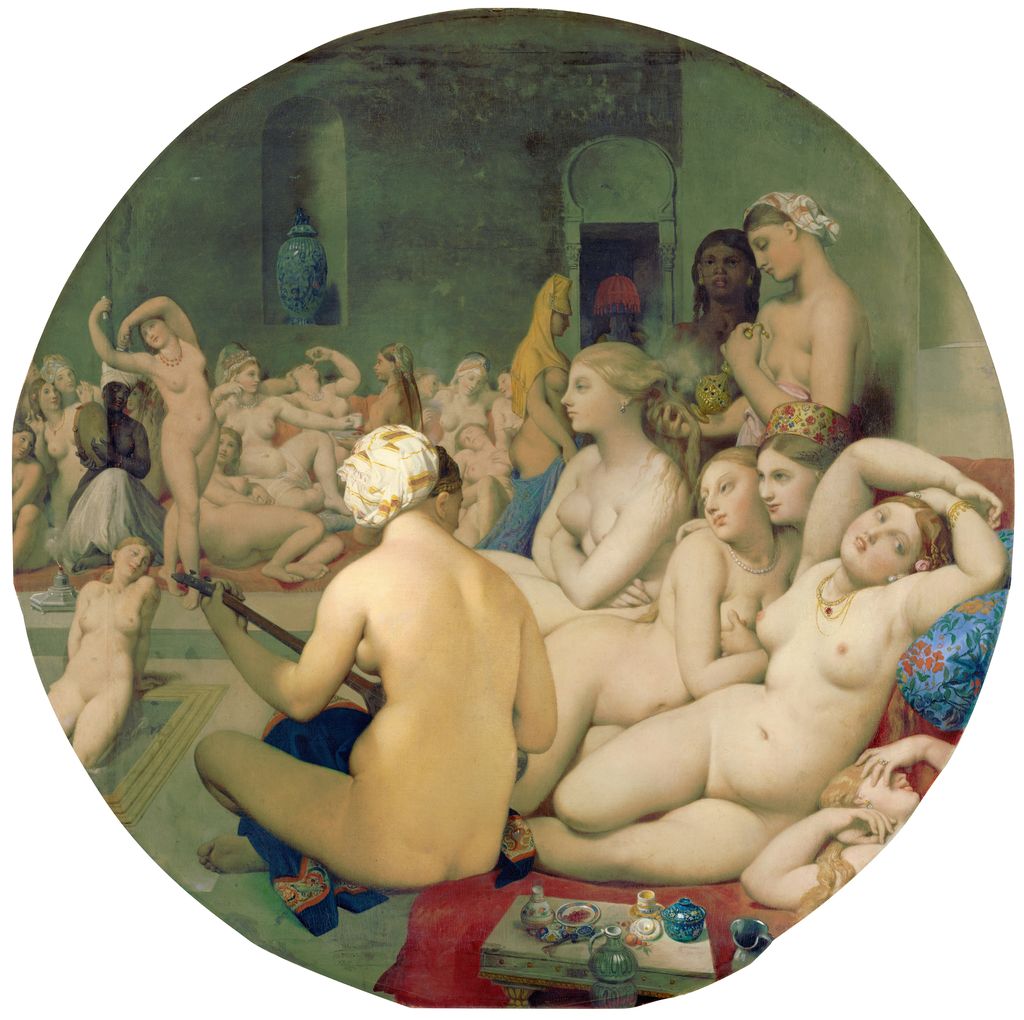
by Tom Gurney
Tom Gurney BSc (Hons) is an art history expert with over 20 years experience
Published on June 19, 2020 / Updated on October 22, 2026
Email: tomgurney1@gmail.com / Phone: +44 7429 011000
The Virgin Adoring the Host
The white disc above the chalice is one of the smallest things in this painting, yet everything seems to gather around it. Mary lowers her eyes; the saints press close on either side; two candle flames mark the limits of the altar. Ingres painted this version of The Virgin Adoring the Host in 1852 for Louise Marcotte. [1] Its restrained gestures reward a near view. Follow the gold edging of the blue mantle towards the chalice, then look back at the joined hands: the picture connects a richly clothed human figure with an almost featureless circle of white.
At a Glance
- ArtistJean Auguste Dominique Ingres.
- Date1852.
- MediumOil on canvas.
- Size40.3 × 32.7 cm.
- CollectionThe Metropolitan Museum of Art, New York; 2005.186.
- AcquisitionGift of Lila and Herman Shickman, 2005. [1]
This work across Ingres’s career
Agamemnon’s Ambassadors
1801 (competition)Grande Odalisque
1814Louis XIII’s Vow
1824Monsieur Bertin
1832The Princesse de Broglie
1851–1853The Turkish Bath
1859–1862Contents
- A gift with a name on it
- Mary before the Eucharist
- Saints Helena and Louis
- Blue cloth, pale skin and gold
- An older tradition at an intimate scale
- A familiar composition reconsidered
- From a family gift to a museum
- Annotated details
A gift with a name on it
The dedication names Louise Marcotte and dates the gift to 1852. The acquisition essay identifies it as the first variant of the Russian original. [2] Through Louise, Ingres met his second wife, Delphine Ramel; they married in 1852. [1]
Its proportions suit that encounter. The altar cuts across the foreground at the bottom of the image, close enough to seem almost continuous with the viewer’s space. Above it the figures are cropped, their bodies filling the narrow rectangle. There is little room for wandering through a setting. Our attention moves among faces, hands and objects brought together at close quarters.
Mary before the Eucharist
The title identifies the white disc as the Host. Ingres explained the religious conception of the earlier version in a letter dated 5 September 1840, reproduced after his death by Henri Delaborde. Mary, already received into heaven, descends in an apparition to the faithful. With her hands joined before an altar, she adores her Son’s divinity in the Host and chalice, which Ingres describes as symbols of humanity’s redemption. This explanation concerns the original composition, developed before the Marcotte gift. [3]
It helps us understand a striking feature of the image: Christ is present without appearing as a child in Mary’s arms. The Host, the consecrated bread of the Eucharist, occupies the place towards which devotion is directed. Ingres’s letter makes Mary herself a worshipper. Her maternal identity remains central, but the action is adoration, and its focus stands before her on the altar. [3]
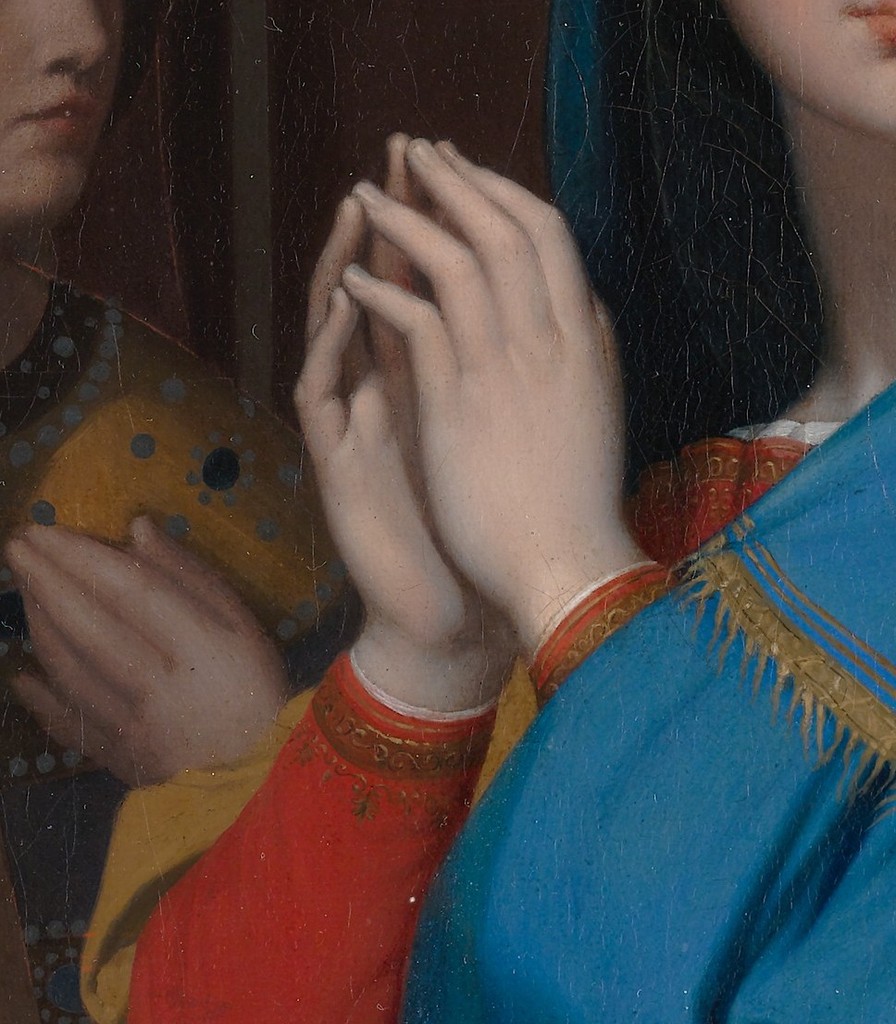
This distinction changes the way the viewer reads the joined hands. They are not reaching to support an infant. Their raised fingertips form a small, closed silhouette beside the face, suspended above the red sleeve. The gap between hands and chalice allows the eye to travel downwards. Mary’s lowered eyelids continue that movement without a pronounced bow of the head.
The frontal arrangement also suits the apparition described in the letter. We see no path by which the figures have entered, and no ordinary activity explains their assembly. The curtain seals off the background. Against it, the thin gold halo describes a complete form around Mary’s head even where the dark ground nearly absorbs it. These visible choices allow the encounter to feel self-contained: something presented before the viewer, with no need for a sequence of surrounding events.
The child in the abandoned conception
Delaborde records an earlier idea in which Mary adored the sleeping infant Jesus lying before her. According to his account, Ingres had covered that painting in white, and Raymond Balze later removed the covering. Delaborde also mentions a painted study of the child. These are records of separate objects and an earlier conception, rather than an account of damage or treatment to the Marcotte canvas. [3]
The change of subject is substantial even though the posture of adoration could survive it. A sleeping child gives the gaze a visible body to rest upon. The Host reduces that bodily presence to a small, clearly bounded form. Read beside Ingres’s letter, the earlier idea helps explain why the finished arrangement can recall a Madonna and Child while giving the familiar relationship a different devotional focus. [3] The central space below Mary’s hands becomes unusually important.
Annotated Details from The Virgin Adoring the Host
The numbered points identify visible features discussed in this article. Return from each detail to the whole composition. Ingres, The Virgin Adoring the Host, 1852. The Metropolitan Museum of Art, Gift of Lila and Herman Shickman, 2005. Image source. CC0 / Public domain.
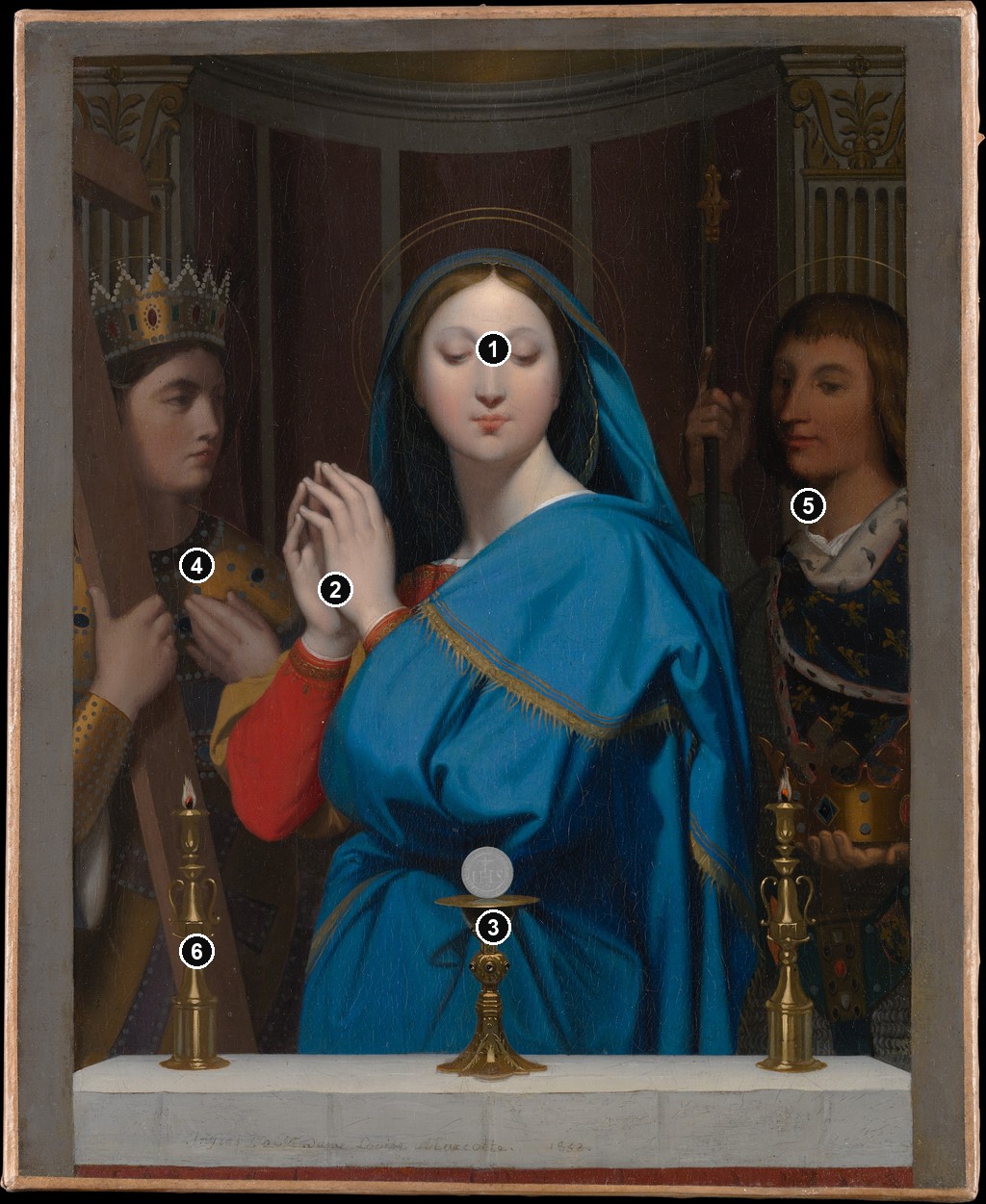
Details from THE VIRGIN ADORING THE HOST
Follow the lowered face, joined hands, saintly attributes and candles around the central Host.
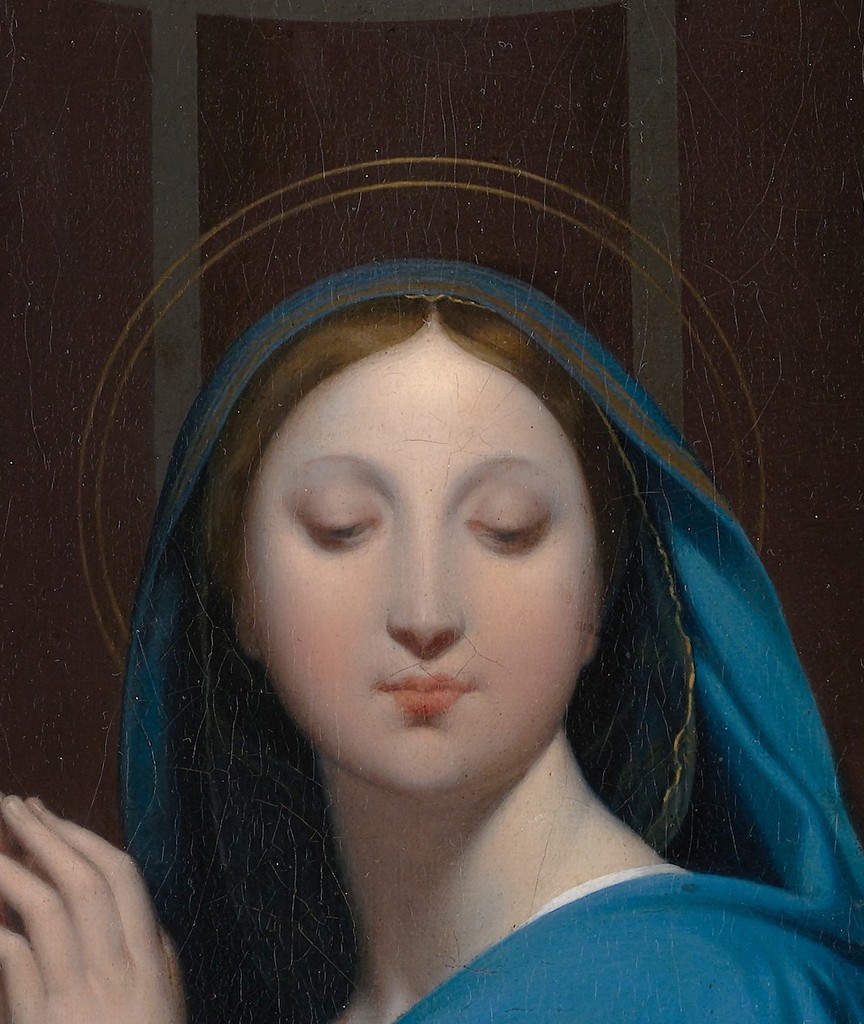
The lowered face inside the halo
The face inclines beneath the blue covering inside a fine circular halo. The downward eyes and small mouth occupy a quiet area within the surrounding dark and bright shapes.
The joined hands and decorated cuffs
The fingers meet beside the face above red and gold cuffs. Follow the changing spaces between them before comparing their outline with the larger blue mantle.
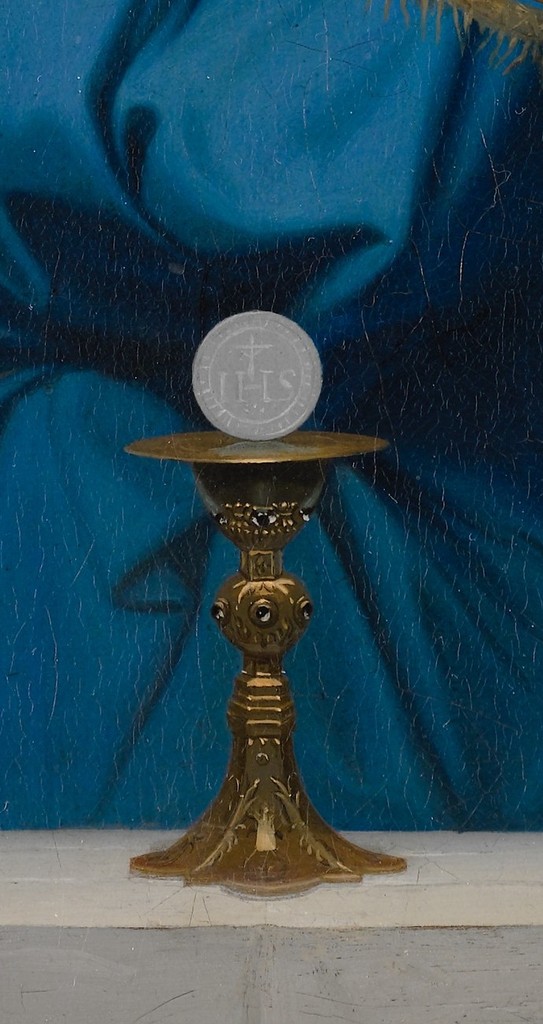
The Host above the golden vessel
The pale circular Host stands above the golden vessel on the altar. Its simple round shape contrasts with the many small curves and ornaments beneath it.
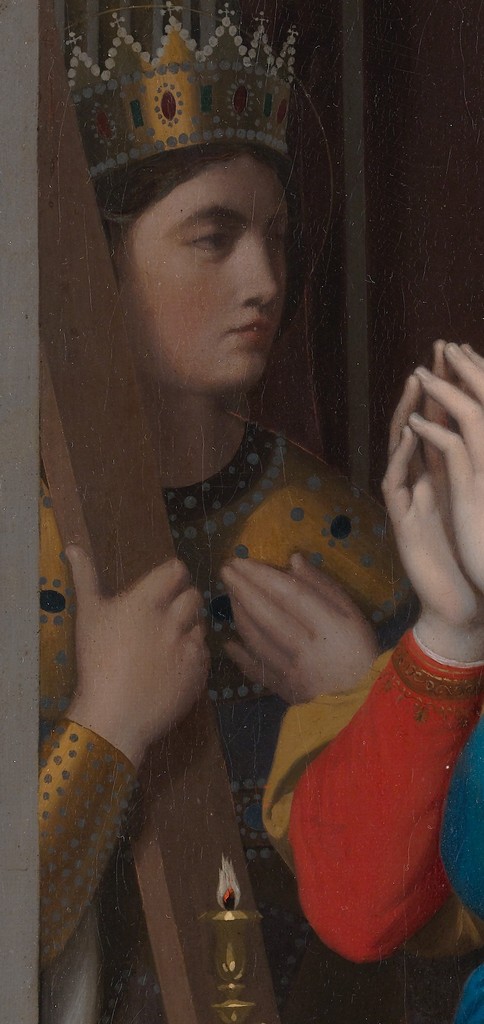
Saint Helena’s crown and cross
A jewelled crown rises above the saint’s lowered face while the large cross runs down beside her. These objects identify a second upright arrangement at the side of Mary.
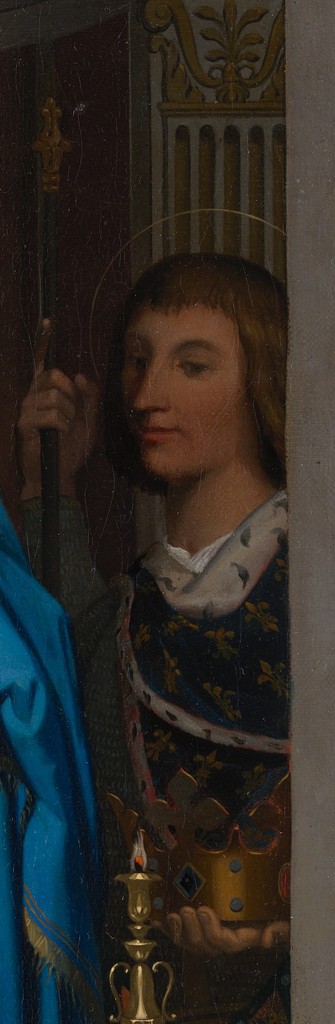
Saint Louis holding the sceptre
The saint at the other side holds a long sceptre beside his face. Pale cloth and the gold lilies across his dark clothing add several small patterns beside Mary’s broad blue mantle.
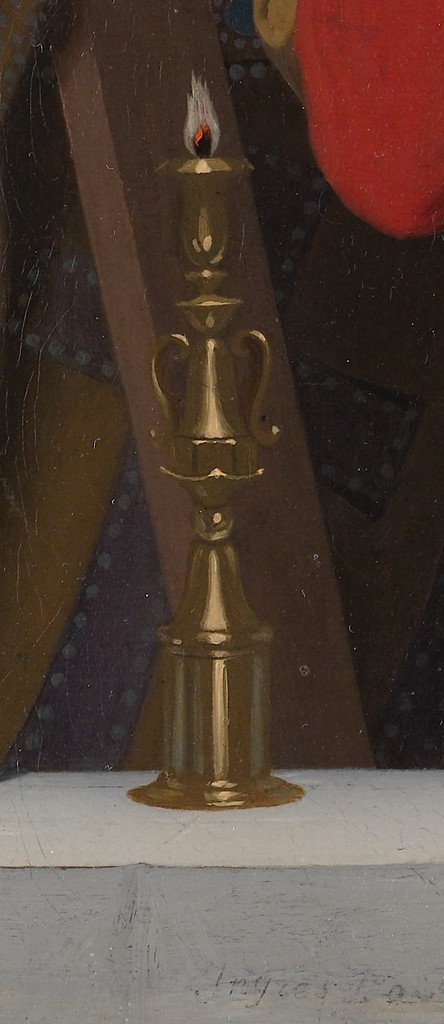
The left candle beside the altar
A burning candle stands on a narrow golden stem beside the central vessel. Compare its long upright shape with the broader white edge of the altar below.
Saints Helena and Louis
Helena and Louis replace the Russian saints Nicholas and Alexander Nevsky. Their significance for Louise remains unspecified. [2] At the left, Helena’s large cross rises beside her face and continues down towards the altar. Her crown glitters with tiny pale highlights. On the right, Louis wears a dark robe patterned with gold fleurs-de-lis and edged with white fur. One hand holds an upright sceptre; the other supports a crown near the lower edge. The two figures bring different shapes into the composition: the broad diagonal of the cross on one side, the narrow vertical of the sceptre on the other.
Their presence is more active than an initial glance might suggest. Both turn inwards, yet neither simply mirrors the other. Helena’s face is seen further in profile, while Louis’s turns towards the centre with his eyes lowered. Their hands and attributes occupy the outer portions of the rectangle. Mary’s hands remain free of an object, and the centre below them stays open for the chalice.
The crowns are particularly effective in this small space. Helena wears hers high in the painting, while Louis holds his low, close to the level of the candle. The unequal placement prevents the surrounding splendour from becoming a rigid ornamental frame. Gold runs through the picture in many forms—jewels, embroidery, halo, vessels—but it keeps returning our attention to the unadorned white Host.
Blue cloth, pale skin and gold
Mary’s mantle supplies the largest continuous area of colour. Its bright blue wraps around her head, spreads across the chest and descends in heavy folds to the altar. The gold fringe follows a long curve over the shoulder, then breaks into minute hanging strokes. That mixture of broad colour and fine detail makes the drapery readable at different distances: a strong enclosing shape first, an intricately worked surface on closer inspection.
The red sleeve is almost entirely confined to the area beneath the hands. Its warmth gives the pale fingers a firm setting, while the blue on the opposite side opens into a much larger field. The composition has a stable centre without exact bilateral symmetry. Mary’s face sits near the middle; her hands move left; the great sweep of the mantle balances them on the right.
Look also at the different kinds of light. Mary’s forehead, nose and cheeks are gently modelled, with few sharp changes. The metalwork, by contrast, catches pinpoint accents. The chalice has a long, elaborately articulated stem and spreading foot; the candlesticks answer it with smaller shafts on either side. Their hard glints sharpen our perception of the softer flesh and cloth.
The candles are visibly alight, but the broad illumination of the face cannot be explained simply by those tiny flames. The painting asks us to accept a presentation in which objects are made legible according to their role. The central face is clear, the attendants more subdued, the background almost closed. We need not identify a single natural light source to follow that hierarchy.
The white altar cloth has a different function from all these sumptuous surfaces. Its long horizontal edge checks the movement of the folds and the upright figures. The Host rises above it, carried by the chalice, with a small cross and letters barely disturbing its circular shape. After the profusion of gold detail, the contrast between the white cloth and disc rewards patience.
An older tradition at an intimate scale
The Metropolitan Museum places the picture within the tradition of small devotional paintings and singles out Raphael’s early sixteenth-century work. [1] Here, the curtain overhead creates a shallow canopy. Its low sweep loosely answers the halo, while the narrow strips of architectural ornament at the sides contain the gathering. These elements give the three figures a setting, but they leave little depth behind them. The painting’s greatest expanses are bodily and material: face, hands, blue mantle, white cloth.
Small scale does not make the image casual. Each figure is held within a closely balanced arrangement, and the chalice stands almost ceremonially on the central axis. Yet the close grouping allows the viewer to inspect details that would be lost across a church: the contacts between the fingertips, the fine gold borders and the contrast between the saints’ patterned clothing and Mary’s broad blue folds. Formal solemnity and close attention work together.
A familiar composition reconsidered
The original commission came from the future Alexander II; the painting was exhibited in Paris in 1842. [2] Its completion belongs to 1841: Eric Bertin’s documentary corrections reproduce a letter of 21 March that year in which Victor Schnetz reports that Ingres had finished a Madonna with two saints the previous day, and sketches the composition. [4]
Compare the earlier Virgin of the Host with the Marcotte painting: the central head, raised hands, curved mantle edge and altar grouping remain recognisable. The attendants change. [2] The left cross rises beside the blue covering; on the right, gold patterns fill the dark robe.
Ingres continued to return to the subject. Delaborde distinguishes a version dated 1854 in which angels replace the saints, shown at the Universal Exhibition of 1855. [3] That substitution provides a useful measure of the Marcotte picture’s particular character. Human attendants here carry conspicuous attributes of rank and identity; the centre binds their separate presences into a shared act of devotion.
A further comparison with the Virgin of the Adoption is useful for the hands alone. Delaborde records that separate painting as dated 1858. [3] There, Mary’s fingers touch a translucent veil at her chest. Here, her hands join beside the face, their upward outline more sharply isolated. Similar blue mantles and lowered eyes can accommodate different gestures and different relationships with the viewer. Repetition offers an opportunity to notice such choices.

Ingres, The Virgin of the Host, 1841. [5]

Ingres, Virgin of the Adoption, 1858. [6]
From a family gift to a museum
The acquisition account lists Mme Joseph Marcotte, Mme Marcel Pougin de la Maisonneuve, a London collection (1954–at least 1968), then the Shickmans. [2] That private dedication survives in a public museum collection. [1]
Artworks directory
Explore 150 paintings, drawings and an original lithograph. This selection includes related versions and studies; dates distinguish completed works from later revisions.
| Name | Date | Medium |
|---|---|---|
| The Apotheosis of Homer | 1827 | Painting |
| Grande Odalisque | 1814 | Painting |
| The Turkish Bath | 1859–1862 | Painting |
| Madame Moitessier Seated | 1856 | Painting |
| Portrait of Monsieur Bertin | 1832 | Painting |
| Napoleon I on His Imperial Throne | 1806 | Painting |
| Odalisque with Slave | 1839 | Painting |
| The Ambassadors of Agamemnon in the Tent of Achilles | 1801 (competition) | Painting |
| The Valpinçon Bather | 1808 | Painting |
| The Source | 1856 | Painting |
| Oedipus Explaining the Enigma of the Sphinx | 1808; revised probably before 1827 | Painting |
| The Vow of Louis XIII | 1824 | Painting |
| Antiochus and Stratonice | 1840 | Painting |
| The Comtesse d’Haussonville | 1845 | Painting |
| The Princesse de Broglie | 1851–1853 | Painting |
| Jupiter and Thetis | 1811 | Painting |
| The Dream of Ossian | 1813 | Painting |
| The Martyrdom of Saint Symphorian | 1834 | Painting |
| Venus Anadyomene | 1808–1848 | Painting |
| Portrait of Madame de Senonnes | 1814 | Painting |
| Madame Rivière | 1805 | Painting |
| Mademoiselle Caroline Rivière | 1805 | Painting |
| Portrait of Philibert Rivière | 1805 | Painting |
| Bonaparte First Consul | 1804 | Painting |
| The Death of Leonardo da Vinci | 1818 | Painting |
| Joan of Arc at the Coronation of Charles VII | 1854 | Painting |
| Madame Duvaucey | 1807 | Painting |
| La Belle Zélie | 1806 | Painting |
| Madame Panckoucke | 1811 | Painting |
| Portrait of Charles Marcotte d’Argenteuil | 1810 | Painting |
| Joseph Antoine Moltedo | c.1810 | Painting |
| Madame Leblanc | 1823 | Painting |
| Delphine Ingres-Ramel (Portrait of Madame Ingres) | 1859 | Painting |
| Portrait of Amédée de Pastoret | 1823–1826 | Painting |
| Portrait of Baronne de Rothschild | 1848 | Painting |
| Madame Marcotte de Sainte Marie | 1826 | Painting |
| Madame Gonse | 1852 | Painting |
| Aretino in the Studio of Tintoretto | 1848 | Painting |
| Don Pedro of Toledo Kissing Henry IV’s Sword | 1831/1832 | Painting |
| Raphael and La Fornarina | 1814 | Painting |
| Roger Freeing Angelica | 1819 | Painting |
| Romulus’ Victory over Acron | 1812 | Painting |
| Self-Portrait at the Age of Twenty-Four | 1804; revised 1841–1851 | Painting |
| Male Torso | c.1800 | Painting |
| Odalisque in Grisaille (Ingres and workshop) | c.1824–1834 | Painting |
| The Small Bather | 1826 | Painting |
| The Little Bather Harem Interior | 1828 | Painting |
| Jesus Among the Doctors | 1862 | Painting |
| The Virgin Adoring the Host | 1852 | Painting |
| The Virgin of the Host | 1841 | Painting |
| Virgin of the Adoption | 1858 | Painting |
| Paolo and Francesca | 1814 | Painting |
| Homer Deified (revised composition, Louvre RF5273) | 1865 | Drawing |
| Odalisque with Slave (Louvre RF4622) | 1858 | Drawing |
| Odalisque (Walters Art Museum; Ingres and Paul Flandrin) | 1842 | Painting |
| Madame Moitessier Standing (National Gallery of Art) | 1851 | Painting |
| Jacques-Louis Leblanc (The Metropolitan Museum of Art) | 1823 | Painting |
| Ferdinand-Philippe, Duke of Orléans (Louvre RF2005-13) | 1842 | Painting |
| Ferdinand-Philippe, Duke of Orléans (Versailles MV5207; Ingres and workshop) | 1843 | Painting |
| Ferdinand-Philippe, Duke of Orléans (Versailles MV5209; Ingres and workshop) | 1844 | Painting |
| Antiochus and Stratonice (Musée Fabre; Ingres and Raymond Balze) | 1866 | Painting |
| Antiochus and Stratonice (Kunstmuseum Bern, Gurlitt bequest) | Undated (early dating proposed) | Drawing |
| Composition study for Antiochus and Stratonice (MIB867.2193) | 1806 | Drawing |
| Study for the Figure of Stratonice (Met63.66) | 1834–1840 | Graphite, black chalk and charcoal |
| Nude figure study for Stratonice (Boijmans F II 36 PK) | c.1834–1840 | Drawing |
| Paolo and Francesca (The Barber Institute,54.6) | c.1814–1820 | Painting |
| Paolo and Francesca (The Hyde Collection,1971.24) | c.1855–1860 | Painting |
| Paolo and Francesca (Amsterdam Museum TA10970) | 1820 | Drawing |
| Paolo and Francesca (dedicated to Artaud de Montor) | 1816 | Drawing |
| Study for the Bust of Francesca (MIB867.1398) | 1819 | Drawing |
| Study for the Bust of Francesca (MIB867.1396) | 1819 | Drawing |
| The Archangel Raphael, first idea (MIB867.2488) | 1842 | Drawing |
| The Archangel Raphael (MIB867.2500) | 1842 | Drawing |
| The Archangel Raphael Carrying Human Prayers to God (Chantilly DE513) | 1844 | Drawing |
| Louis-Philippe as Saint Philip, stained-glass study | 1844 | Drawing |
| Marie Frédéric Eugène de Reiset (Ford Collection RBF171-2) | 1844 | Drawing |
| Virgil Reading the Aeneid (Toulouse) | Begun 1811 | Painting |
| Tu Marcellus Eris (Brussels, inv. 1836) | c.1814 (museum dating) | Painting |
| Jean-François Gilibert | 1804 | Painting |
| François-Marius Granet | 1807 (museum dating) | Painting |
| Count Nikolai Dmitrievich Guryev | 1821 | Painting |
| Caroline Murat, Queen of Naples | 1814 | Painting |
| Count Mathieu Molé | 1834 | Painting |
| Cherubini and the Muse of Lyric Poetry (Louvre) | 1842 | Painting |
| Luigi Cherubini (Cincinnati) | 1841 | Painting |
| Comtesse de Rayneval (Louvre RF4505) | 1841 | Drawing |
| Venus on Paphos (Antonie Balaÿ) | c.1852 | Painting |
| Prince Napoléon | 1855 | Painting |
| Study for The Apotheosis of Napoleon I (Petit Palais) | Late 1853 | Painting |
| The Apotheosis of Napoleon I (destroyed ceiling) | 1853 | Painting |
| The Journalist (MIB867.2733) | 1834? | Drawing |
| Henry VIII, after Holbein | c.1815–1820 (?) | Drawing |
| Madame Récamier, after David (MIB867.3637) | Undated (early Paris period) | Drawing |
| Study for Comtesse d’Haussonville (MIB867.259; background possibly by another hand) | 1842–1845 | Drawing |
| La Source (reduced version reported by Delaborde) | Date unrecorded; reported 1870 | Painting |
| Odalisque (autograph lithograph,NGA1946.21.117) | 1825; published1826 | Lithograph |
| Portrait of a Seated Lady | 1814 | Graphite |
| The Kaunitz Sisters (Leopoldine, Caroline, and Ferdinandine) | 1818 | Graphite |
| Portrait of a Man | 1814 | Graphite |
| Study for the Portrait of Louis-François Bertin (1766–1841) | n.d. | Black chalk and graphite |
| Studies for the Cadaver of Acron | ca. 1810–12 | Graphite on wove paper |
| Study for the Drapery of Molière in "The Apotheosis of Homer" | n.d. | Black chalk with stumping |
| Madame Guillaume Guillon Lethière, née Marie-Joseph-Honorée Vanzenne, and her son Lucien Lethière | 1808 | Graphite |
| Niccolò Paganini (1782–1840) | ca. 1830 | Counterproof or tracing strengthened with graphite and gouache on translucent paper |
| Lady Mary Cavendish-Bentinck (?-1843) | 1816 | Graphite |
| Madame Alexandre Lethière and Her Daughter Letizia | ca. 1815 | Graphite |
| Merry Joseph Blondel (1781–1853) | 1809 | Graphite |
| Ursin-Jules Vatinelle (1798–1881) | 1820 | Graphite |
| Bust of a Gypsy Girl (ascribed to Ingres) | 1819 | Graphite on wove paper |
| Study of a Seated Nude Male | n.d. | Graphite |
| The Archangel Raphael (Study for a stained-glass window in the chapel of Notre-Dame de la Compassion-Saint-Ferdinand, Neuilly) | ca. 1842 | Graphite |
| Lancelot-Théodore, comte Turpin de Crissé | probably 1818 | Graphite |
| Study for the Figure of the Iliad in "The Apotheosis of Homer" | ca. 1827 | Graphite and black chalk heightened with white chalk on brown paper |
| Comtesse Turpin de Crissé | probably 1818 | Graphite |
| Nude Figures for L'Âge d'Or, Château de Dampierre | n.d. | Graphite on brownish paper |
| Study of Figures (attributed to Ingres) | n.d. | Graphite |
| Study of Figures (attributed to Ingres) | n.d. | Graphite; squared in graphite |
| Admiral Sir Fleetwood Broughton Reynolds Pellew | 1817 | Graphite on wove paper |
| Madame Jean-Auguste-Dominique Ingres, née Madeleine Chapelle | 1814 | Graphite on off-white wove paper |
| Virgil Reading the Aeneid to Augustus, Livia, and Octavia | 1809/1819 (?) | Pen and black ink, graphite, brush and gray wash, white gouache heightening, Conté crayon on blue paper |
| General Louis-Étienne Dulong de Rosnay | 1818 | Graphite (hard and soft pencils) |
| Madame Alexandre Lethière, née Rosa Meli, and Her Daughter, Letizia | 1815 | Graphite |
| The Lawyer Paul Grand | 1834 | Graphite |
| Jean-Joseph Fournier | 1815 | Graphite |
| Armand Bertin | 1842 | Graphite |
| Madame Armand Bertin, née Marie-Anne-Cécile Dollfuss | 1843 | Graphite |
| The Architect Charles-Victor Famin | 1836 | Graphite |
| Henri Lehmann | 1850 | Graphite |
| Portrait of a Lady | ca. 1815–17 | Graphite |
| Edmond Cavé (1794–1852) | 1844 | Oil on canvas |
| Head of Saint John the Evangelist | probably ca. 1818–20 | Oil on canvas, laid down on wood |
| Madame Edmond Cavé (Marie-Elisabeth Blavot, ca. 1806–1883) | ca. 1831–34 | Oil on canvas |
| Madame Félix Gallois | 1852 | Graphite with touches of gold in oil to highlight jewelry, on buff wove paper. |
| Dr. François Mêlier | 1849 | Graphite with graphite framing lines, corrected with white, on buff wove paper |
| Portrait of Madame Rhode (Rhoda?) | 1810–20 | Graphite on pale buff wove paper |
| Study for "Raphael and the Fornarina"(?) | ca. 1814(?) | Graphite on white wove paper |
| Portrait of Madame Paul Meurice, née Palmyre Granger | ca. 1845–50 | Graphite on wove paper |
| Alexander the Great presenting Campaspe to Apelles | 1810 | Graphite, brush and brown wash; squared in graphite |
| Study of Hands for "Christ Among the Doctors" | 1852–62 | Graphite on tracing paper |
| Study for The Turkish Bath (RF34502) | about 1850 | Pen and brown ink with graphite, partially squared |
| Study for The Turkish Bath (RF23354) | Undated | Pen and brown ink with graphite on joined sheets |
| Study for The Turkish Bath (RF54702) | about 1859 | Pen and brown ink |
| Studies of women for The Turkish Bath (RF12292) | Undated | Black chalk |
| Achilles Receiving the Envoys of Agamemnon (Nationalmuseum sketch, NM2161) | 1801 | Oil on wood |
| Half-Length Bather (Musée Bonnat-Helleu,89) | 1807 | Oil on canvas |
| Oedipus and the Sphinx (National Gallery,NG3290) | about1826 | Oil on canvas |
| Oedipus and the Sphinx (Walters,37.9) | 1864 | Oil on canvas |
| Oedipus and the Valpinçon Bather, after David (MI.867.2035) | Undated | Graphite on tracing paper, after David |
| Study of the Virgin for The Vow of Louis XIII (Dijon,1758) | about1822 | Black chalk, stump and white chalk on brown wove paper |
| First Thought for The Vow of Louis XIII (MI.885.11.21) | 1822 | Oil on canvas |
Frequently Asked Questions
Helena and Louis accompany her in this version. The earlier Russian composition has Nicholas and Alexander Nevsky. [2]
Ingres’s explanation of the original conception places Christ’s divinity in the Host and chalice. Mary adores that presence with joined hands. [3]
The Metropolitan Museum of Art in New York owns the canvas, accession number 2005.186. [1]
Discussion
Look again at the images and ideas explored in The Virgin Adoring the Host. These editorial prompts invite your observations.
Reader Insights
Where does your eye settle first: on Mary’s face, her joined hands or the white Host? Follow the lines between them, then consider how the saints and candle flames affect that movement.
Compare the saints’ positions with the central alignment of Mary and the Host. Do they frame an intimate act or widen it into a shared gathering?
How does the presence of named patron saints affect your understanding of a devotional painting made as a gift?
Join the Conversation
Share a detail, comparison or question about The Virgin Adoring the Host below.
References
- The Metropolitan Museum of Art, The Virgin Adoring the Host. Collection record, 2005.186; description and artwork details. View source.
- The Metropolitan Museum of Art, Recent Acquisitions: A Selection, 2005–2006. Bulletin 64, no. 2 (Fall 2006), p. 48. View source.
- Henri Delaborde, Ingres, sa vie, ses travaux, sa doctrine, d’après les notes manuscrites et les lettres du maître. Paris: Henri Plon, 1870, pp. 180–182, catalogue nos. 8 and 10–14; letter of 5 September 1840 quoted at p. 181. (in French) View source.
- Eric Bertin, “Addenda and Corrigenda”, in Gary Tinterow, Charlotte Hale and Eric Bertin, “‘Portraits by Ingres: Image of an Epoch’: Reflections, Technical Observations, Addenda, and Corrigenda”. Metropolitan Museum Journal 35 (2000), pp. 214–215 and fig. 23. View source.
- Supporting image. Ingres, The Virgin of the Host, 1841. Pushkin Museum of Fine Arts; Wikimedia Commons. Image source. Public domain.
- Supporting image. Ingres, Virgin of the Adoption, 1858. National Gallery of Victoria; Google Art Project via Wikimedia Commons. Image source. Public domain.
- Splash image. Ingres, The Virgin Adoring the Host, 1852. The Metropolitan Museum of Art, Gift of Lila and Herman Shickman, 2005. Image source. CC0 / Public domain.