by Tom Gurney
Tom Gurney BSc (Hons) is an art history expert with over 20 years experience
Published on June 19, 2020 / Updated on October 22, 2026
Email: tomgurney1@gmail.com / Phone: +44 7429 011000
Madame Leblanc
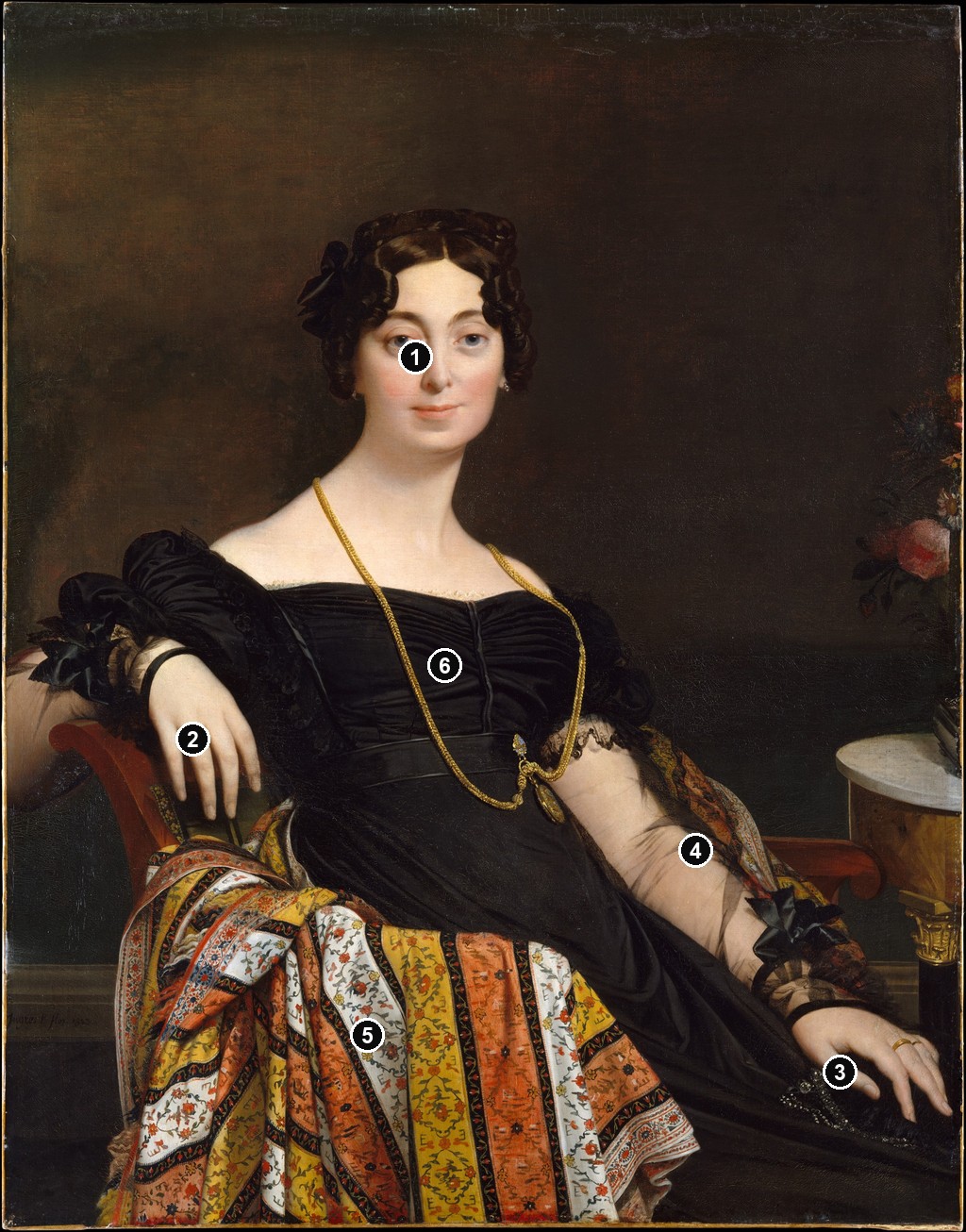
A gold chain makes a long loop across Madame Leblanc’s black dress; beneath it, a brilliant striped shawl spills towards the edge of the picture. Her face holds our attention above this display of colour and texture. Ingres painted Françoise Poncelle, known by her married name Madame Jacques-Louis Leblanc, in 1823. [1] The portrait invites a double encounter: with a woman looking steadily towards us, and with a carefully arranged world of surfaces, gestures and possessions.
At a Glance
- ArtistJean-Auguste-Dominique Ingres.
- Date and medium1823; oil on canvas.
- Size119.4 × 92.7 cm.
- SitterFrançoise Poncelle (1788–1839), wife of Jacques-Louis Leblanc.
- CollectionMetropolitan Museum of Art, New York; 19.77.2.
- Companionthe painted portrait of her husband. [1]
This work across Ingres’s career
Agamemnon’s Ambassadors
1801 (competition)Grande Odalisque
1814Louis XIII’s Vow
1824Monsieur Bertin
1832The Princesse de Broglie
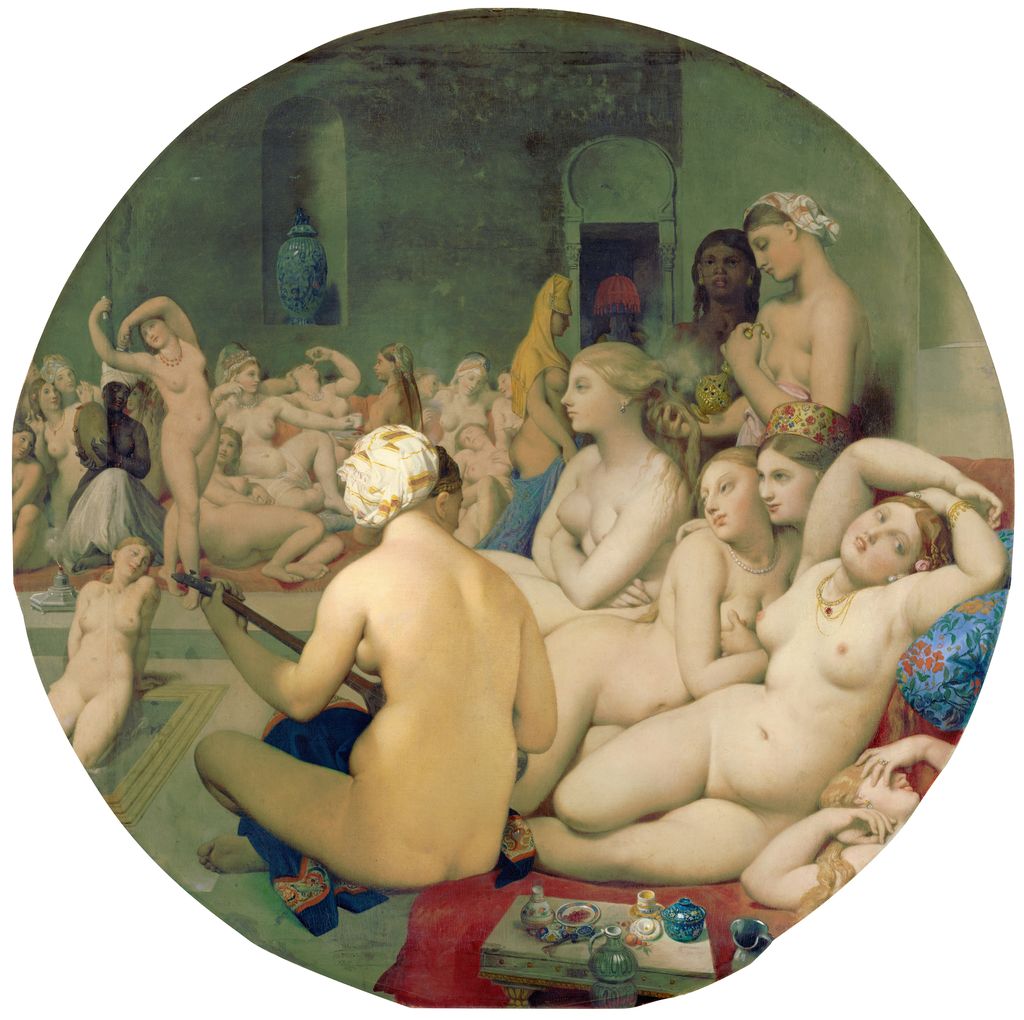
1851–1853The Turkish Bath
1859–1862Contents
- A face above a field of black
- Françoise Poncelle and the Florentine circle
- Gauze, gold and the two hands
- A companion across the room
- From drawings to a revised canvas
- A portrait seen alone, then collected as a pair
- Annotated details
A face above a field of black
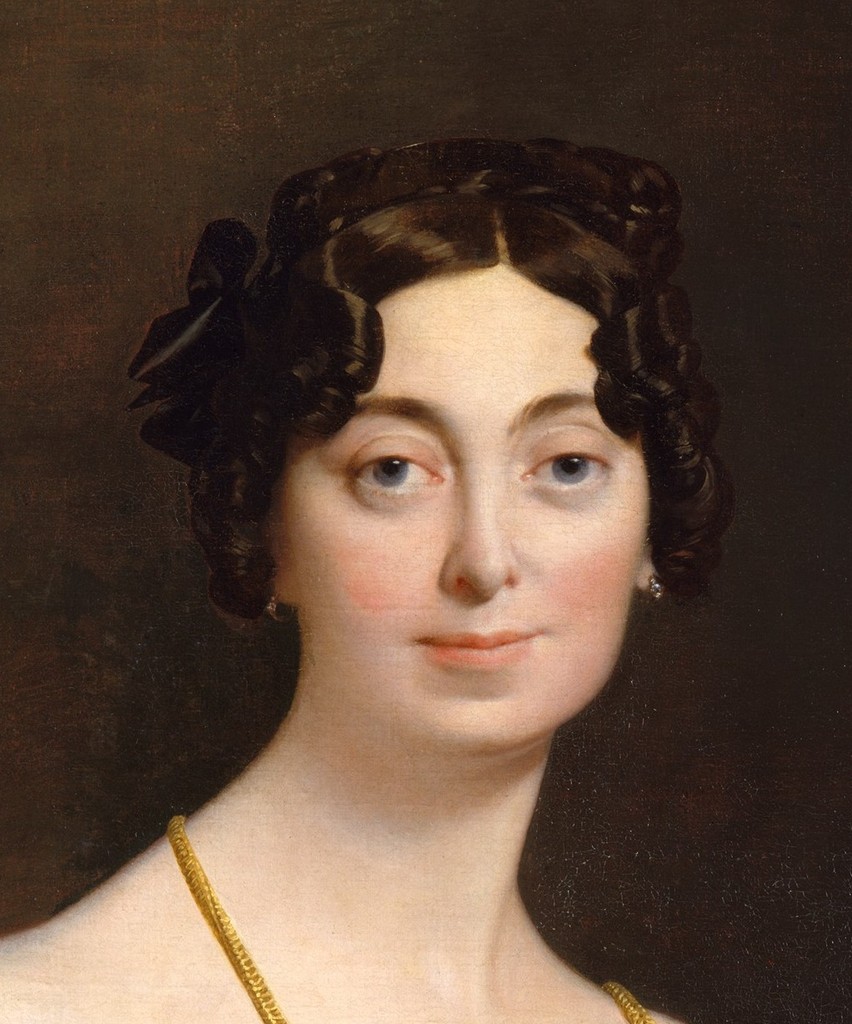
The upper part of the painting is remarkably spare. A broad stretch of brown surrounds the sitter’s head. No window, distant landscape or architectural opening explains the room. Its emptiness gives the small distinctions in her expression unusual weight: the slight lift at the corners of her mouth, the reddish edges of her eyelids, the soft shadow beside the nose. Her eyes meet ours without the head being rigidly upright. There is a gentle inclination towards the right of the image, answered by the descending slope of her shoulders.
The arrangement of her hair is much more emphatic. A central parting divides the dark mass above her forehead, and glossy curls turn down beside her cheeks. The black bow on the left interrupts the rounded silhouette. Against this elaborate surround, the face seems relatively unadorned. Its colour is concentrated in the cheeks and lips, while the forehead, neck and upper chest form a broad pale passage.
Look at how that passage ends. The dress cuts across the shoulders, then rises and falls in shallow curves above the gathered bodice. Fine pale edging keeps the neckline from becoming an abrupt border between skin and cloth. Below, closely packed folds catch narrow slivers of light. The dress is black, but it is full of internal differences: smooth bands, ridges, small recesses and the sharper accents of ribbons. Ingres makes the eye work slowly through a colour that might initially seem almost featureless.
Her expression can suggest ease or composure. Those are responses to the painted face, however, rather than evidence of her private temperament. The same slight smile may seem welcoming when we attend to the eyes and more reserved when we notice how completely she occupies her own space. The painting permits both readings without supplying an anecdote to settle them.
Françoise Poncelle and the Florentine circle
The couple belonged to the former court of Élisa Baciocchi, Napoleon’s sister and Grand Duchess of Tuscany: Françoise had been her lady-in-waiting, Jacques-Louis her secretary. The Met describes the generosity with which they received Ingres in Florence. [2] They had married in 1811; Jacques-Louis subsequently worked as a banker. The Louvre’s account connects his financial position with his support for the painter. [3]
Christopher Riopelle’s catalogue entry places their introduction through Jean-Pierre Gonin in 1820. Leblanc commissioned the unfinished Venus Anadyomene before the painted portraits of 1823. [4] These works belong to a relationship that embraced different kinds of painting, rather than a single isolated sitting. The separate story of Venus Anadyomene follows that much longer project.
The visible setting makes the couple’s comfort tangible. Madame Leblanc sits in a wooden chair with curved arms. At the right edge, a pale tabletop and a gilded support introduce other kinds of reflective surface. Above them, flowers are partly cut off by the picture’s boundary. The objects never become a complete inventory of the room. They appear in fragments around the sitter, giving enough information to suggest furnished space while preserving the broad darkness behind her. Riopelle identifies the cashmere shawl’s embroidered E with Grand Duchess Élisa. [4]
This selective furnishing affects how we read her place within the scene. The chair supports her body and receives the shawl, while the table stands apart. Nothing obliges her to handle an object or perform a task. Her hands can remain relaxed; her gaze supplies the encounter. The richness of the surroundings is available to our inspection without becoming an activity she must demonstrate.
Gauze, gold and the two hands
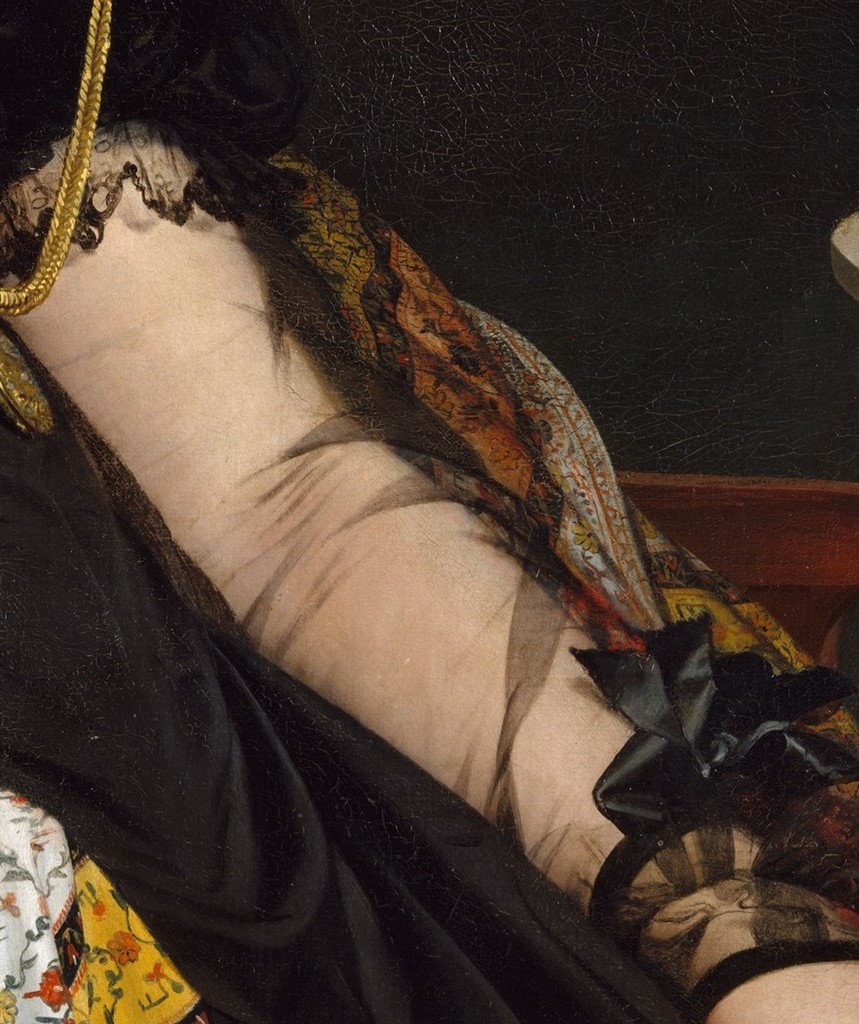
The sleeves are among the best places to slow down. At the shoulder, dark fabric gathers into generous puffs. Lower down, the skin remains visible through thin black gauze. Across the long forearm on the right, diagonal folds make darker streaks over the pale flesh beneath. At the wrist, a dark bow and gathered cuff bring that transparency to a firm stop.
Several different boundaries overlap here: the outline of the arm, the outline of the sleeve, the edges of its folds, and the black dress beyond. They do not all coincide. That is what makes the sleeve convincing as something laid over a body. The gauze has its own loose shape even where we can follow the limb through it.
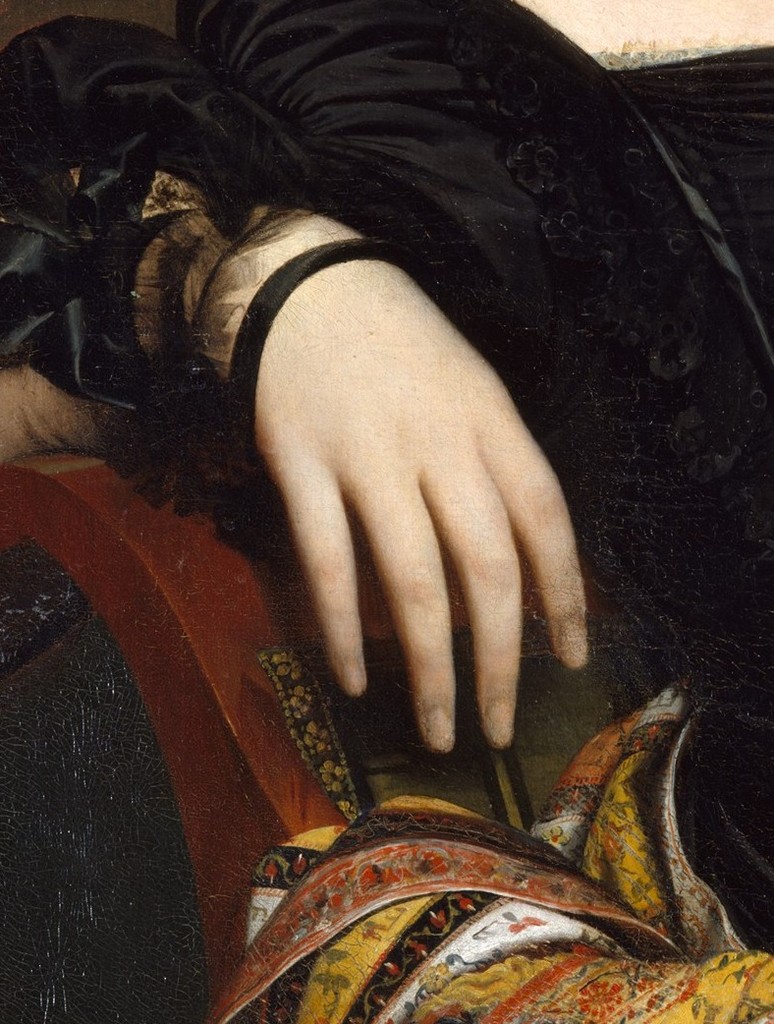
On the opposite side, the right hand hangs over the chair arm. The upper arm is sharply shortened by its angle towards us, while the fingers are presented at length. The curved wooden support is easier to trace than the course of the limb above it. This gives the gesture an appealing peculiarity: the hand seems close and legible, but its connection back to the shoulder takes a second look.
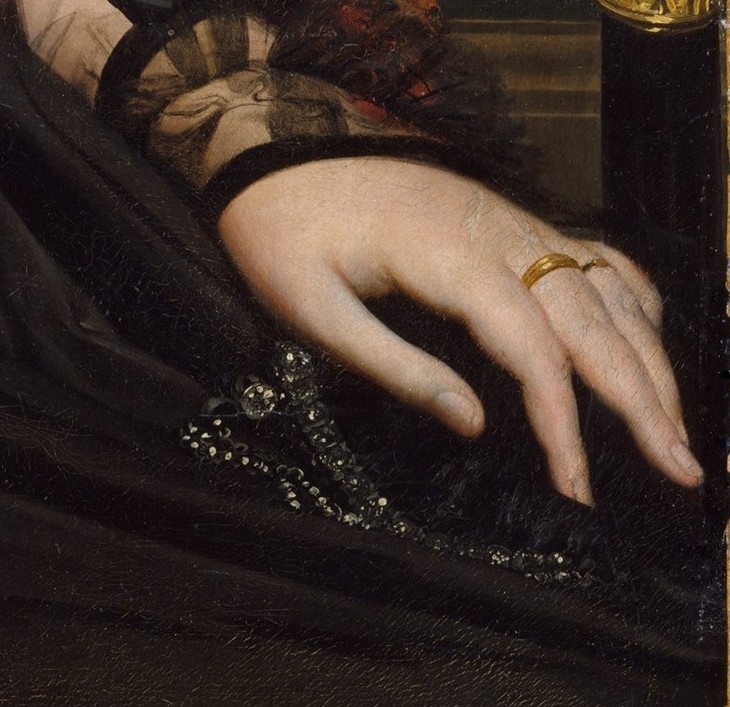
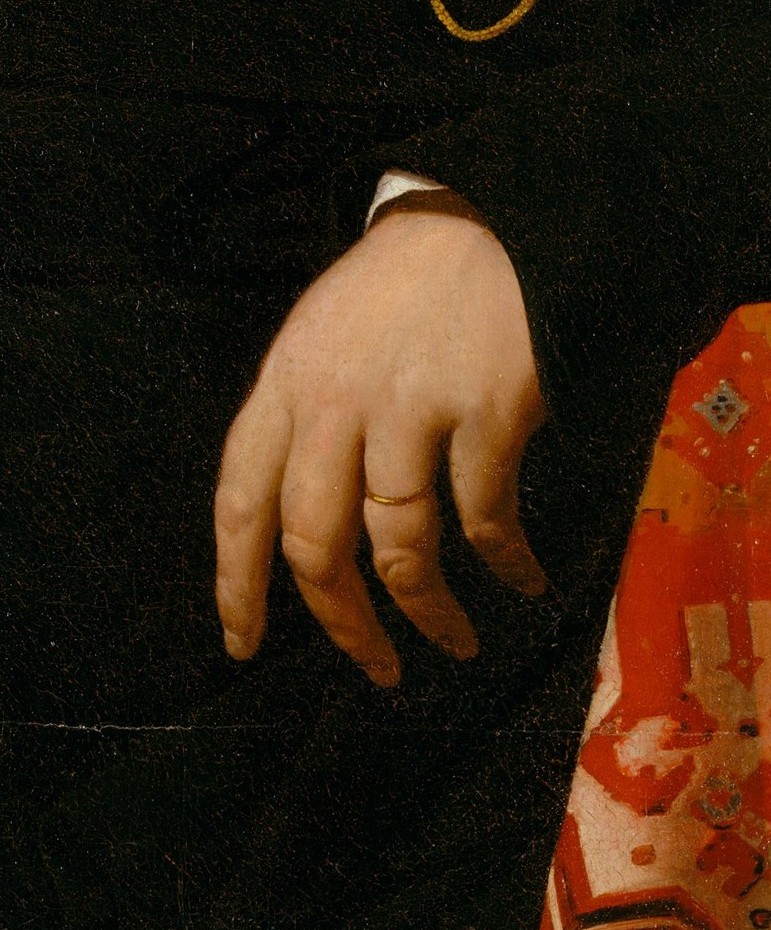
The left hand, near the lower right corner, extends the longer diagonal of the other arm. A gold ring picks out one finger. There is no corresponding flourish in the hanging hand; its separate fingers drop at different lengths against the dark chair. The two hands bring the figure into the foreground in different ways, one suspended and one resting.
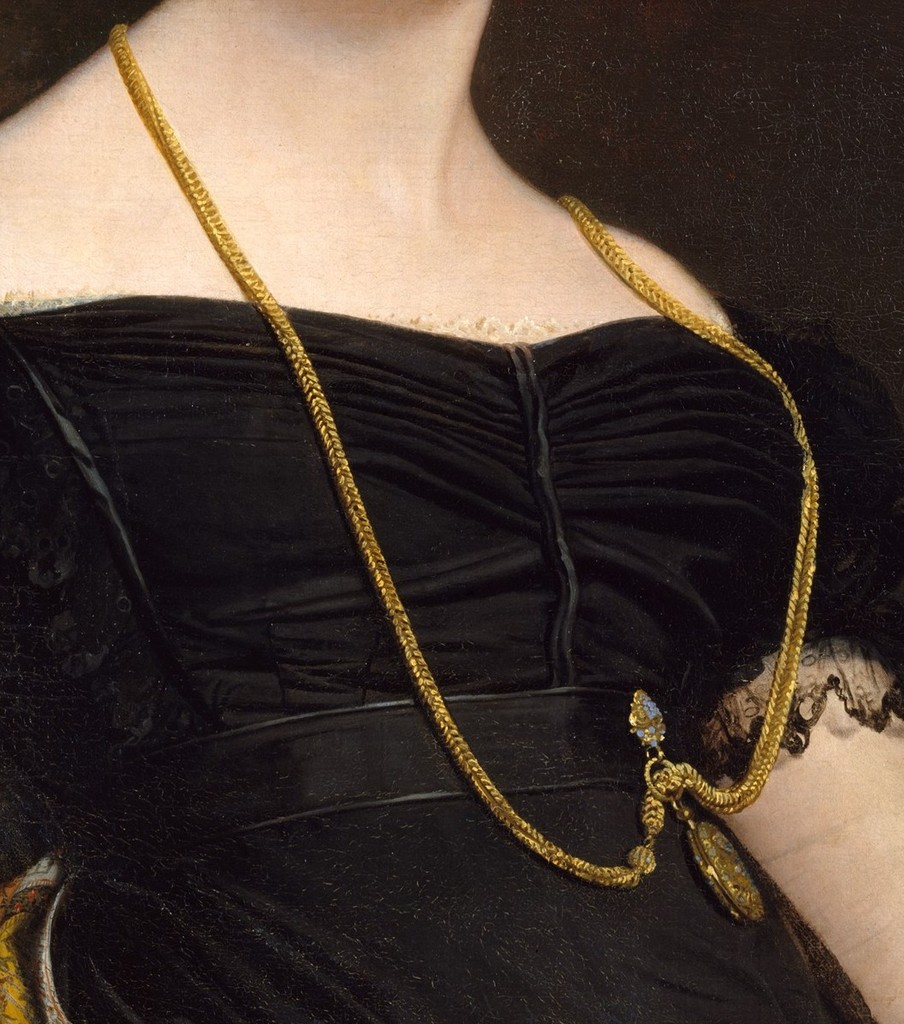
The chain provides another route through the composition. It runs from the exposed neck over the opaque bodice and ends in an ornament low on the chest. Its tiny bright links make a continuous line across several kinds of darkness. Beside the free curves of sleeve and chair, it offers a more regular, gravity-bound curve. The eye can follow it without having to untangle the fabric.
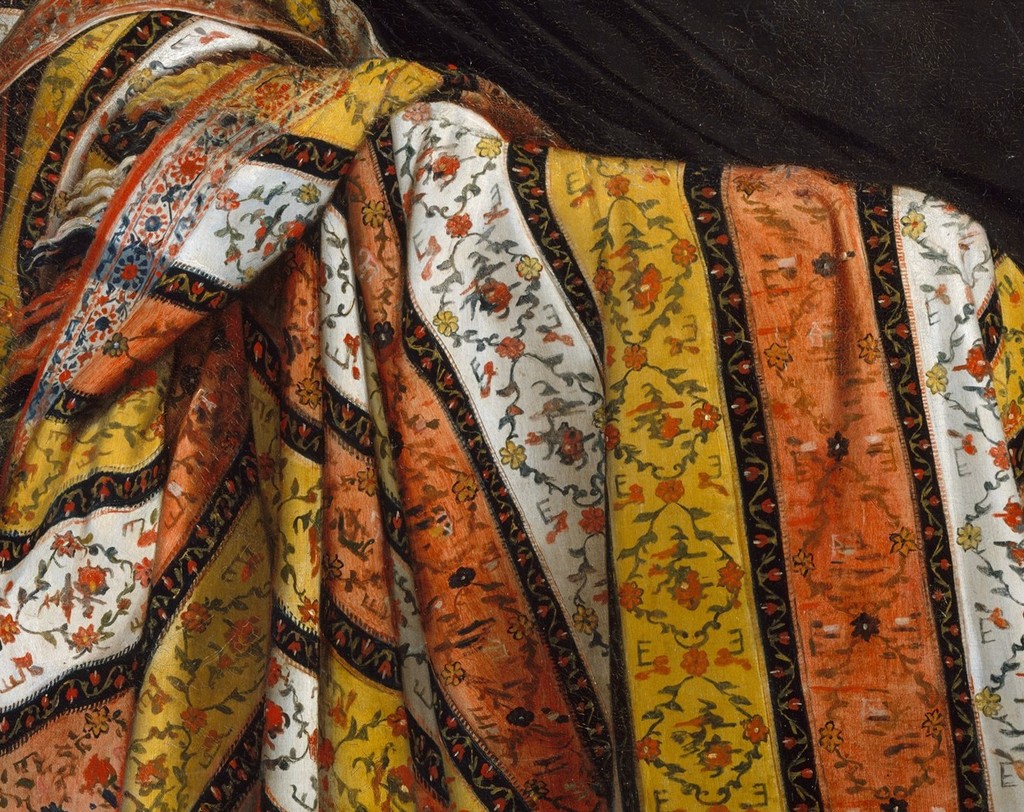
Below, the shawl spreads out into orange, yellow, white and dark patterned stripes. Some bands descend almost vertically; others turn over folds or disappear into bunches. The repetition allows us to judge those changes. A straight stripe becomes a bent stripe when the cloth changes direction. Small floral forms continue across the bands, supplying a second, finer scale of detail. The shawl gives the lower part of the portrait both its strongest colour and its most visibly complicated surface.
Annotated Details from Madame Leblanc
The numbered points identify visible features discussed in this article. Return from each detail to the whole composition. Each caption identifies the work shown.
Madame Leblanc
Madame Leblanc. The Metropolitan Museum of Art, 19.77.2; Catharine Lorillard Wolfe Collection, Wolfe Fund, 1918. Image source. CC0 / Public domain.
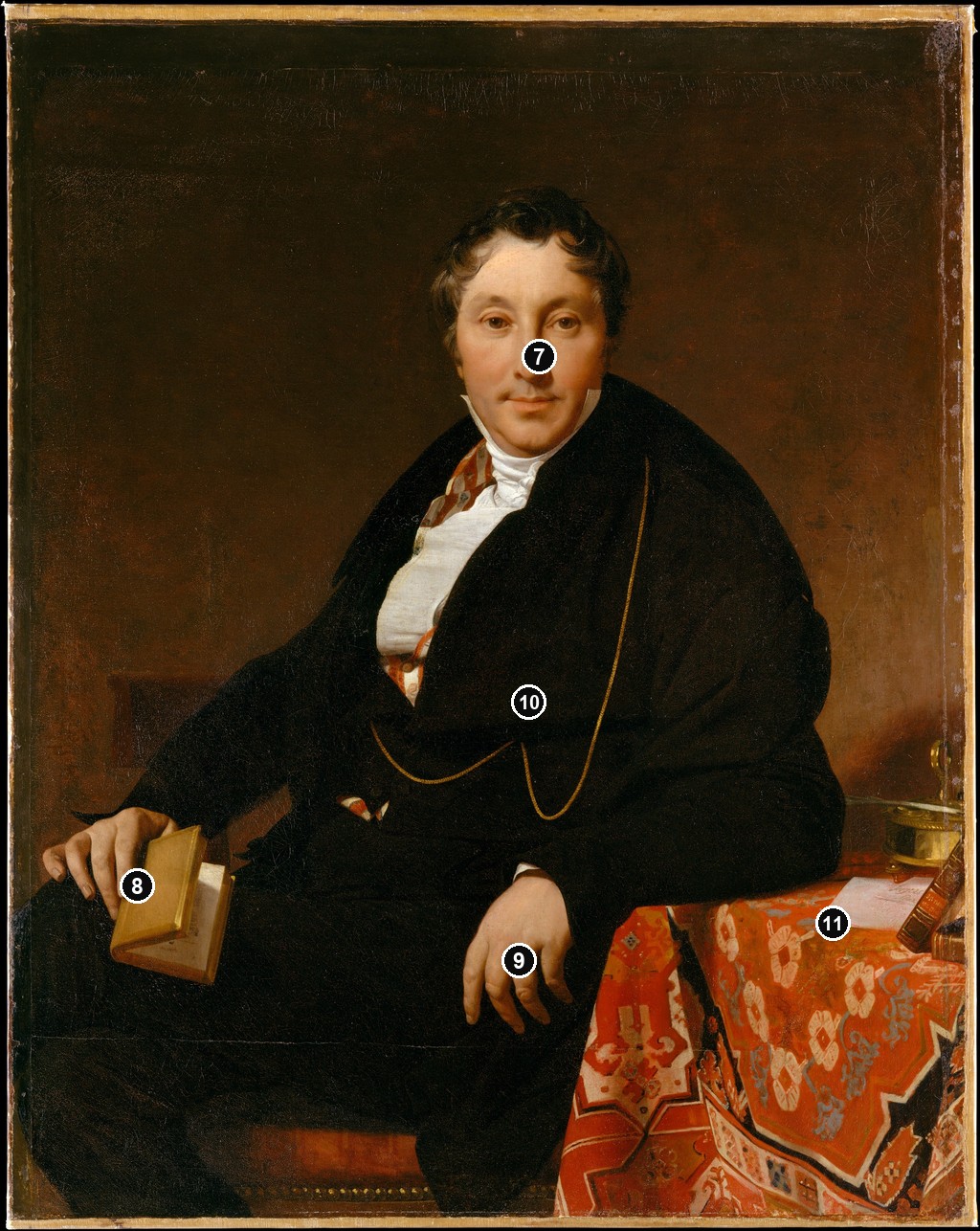
Jacques-Louis Leblanc
Ingres, Jacques-Louis Leblanc, 1823. The Metropolitan Museum of Art, 19.77.1. Catharine Lorillard Wolfe Collection, Wolfe Fund, 1918. Image source. CC0 / Public domain.
Details from MADAME LEBLANC
Compare Françoise’s portrait with the separate canvas of her husband Jacques-Louis, especially their faces, hands, black clothing and patterned furnishings.
Madame Leblanc
The face between curls and a bow
Short dark curls surround the face, with a black bow extending to the side. Their changing edges sharpen the distinction between the head and the quieter background.
The hand over the chair back
The fingers descend separately over the chair back. Pale skin, a narrow dark band and the red wood make a small sequence of contrasting shapes.
A second hand against the black dress
The other hand reaches down over the dress near the lower corner. A gold-coloured ring and the small dark accessory beneath it concentrate detail at this edge.
A forearm seen through gauze
Dark gauze crosses the pale forearm in thin, overlapping bands. Its diagonal edges interrupt the smoother modelling of the arm beneath.
The patterned shawl across the lap
Bright yellow, orange and pale bands break into many small motifs as the shawl folds. Its busy surface occupies a different register from the large black dress.
The long gold-coloured chain
The chain descends from the neck, loops across the black bodice and gathers near the waist. Small changes of light keep it distinct against the dark fabric.
Jacques-Louis Leblanc
The face above a high white collar
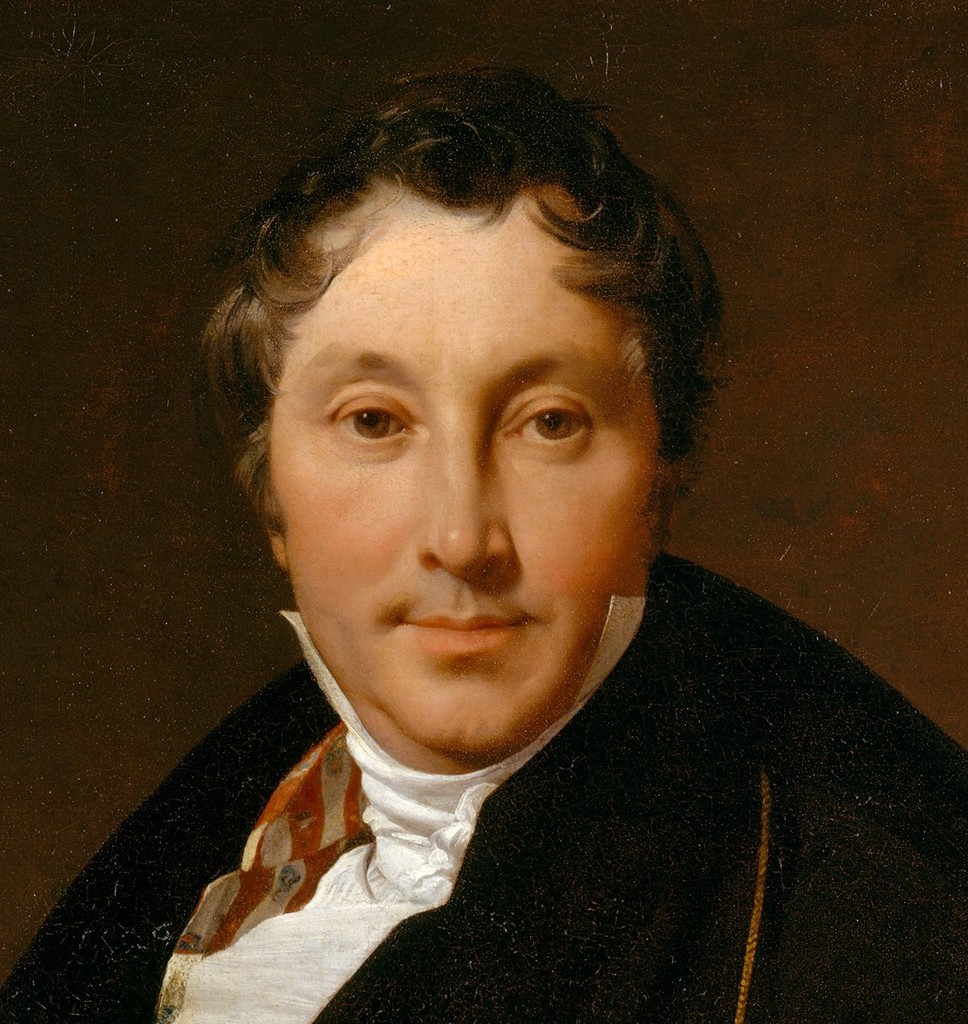
The face turns towards the viewer above a high white collar. Dark curls and coat edges frame this smaller area of pale colour.
The hand holding a small open book
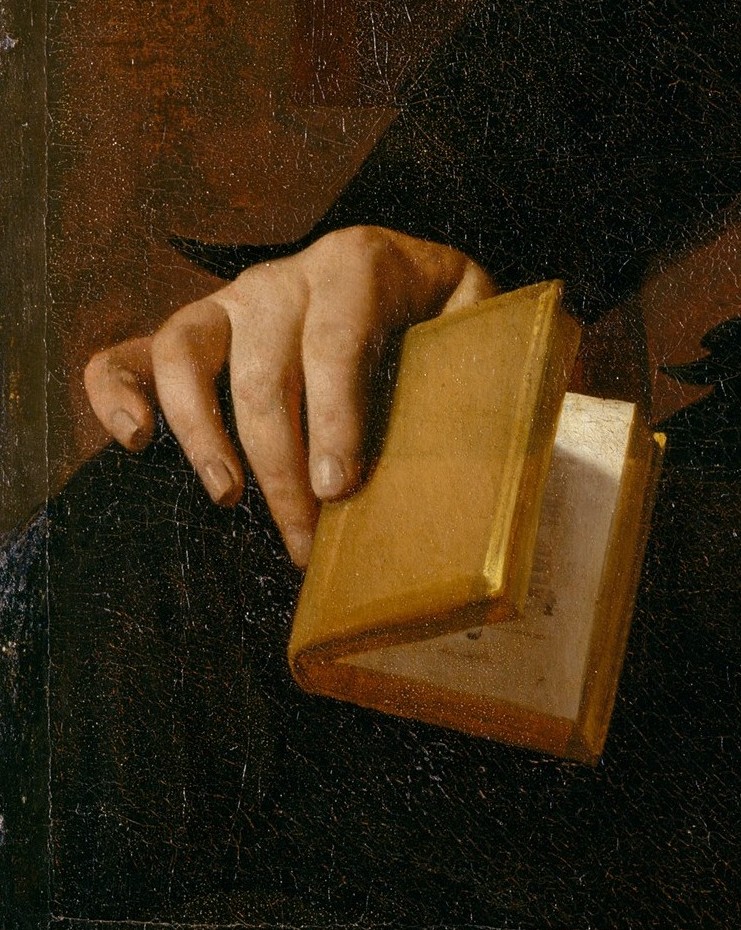
A hand rests over a small open book beside the seated body. Fingers, pale pages and the darker cover form several overlapping shapes near the chair arm.
The lowered hand and gold ring
The other hand hangs lower beside the patterned table, with a thin gold ring around one finger. Compare this loose gesture with the hand holding the book across the portrait.
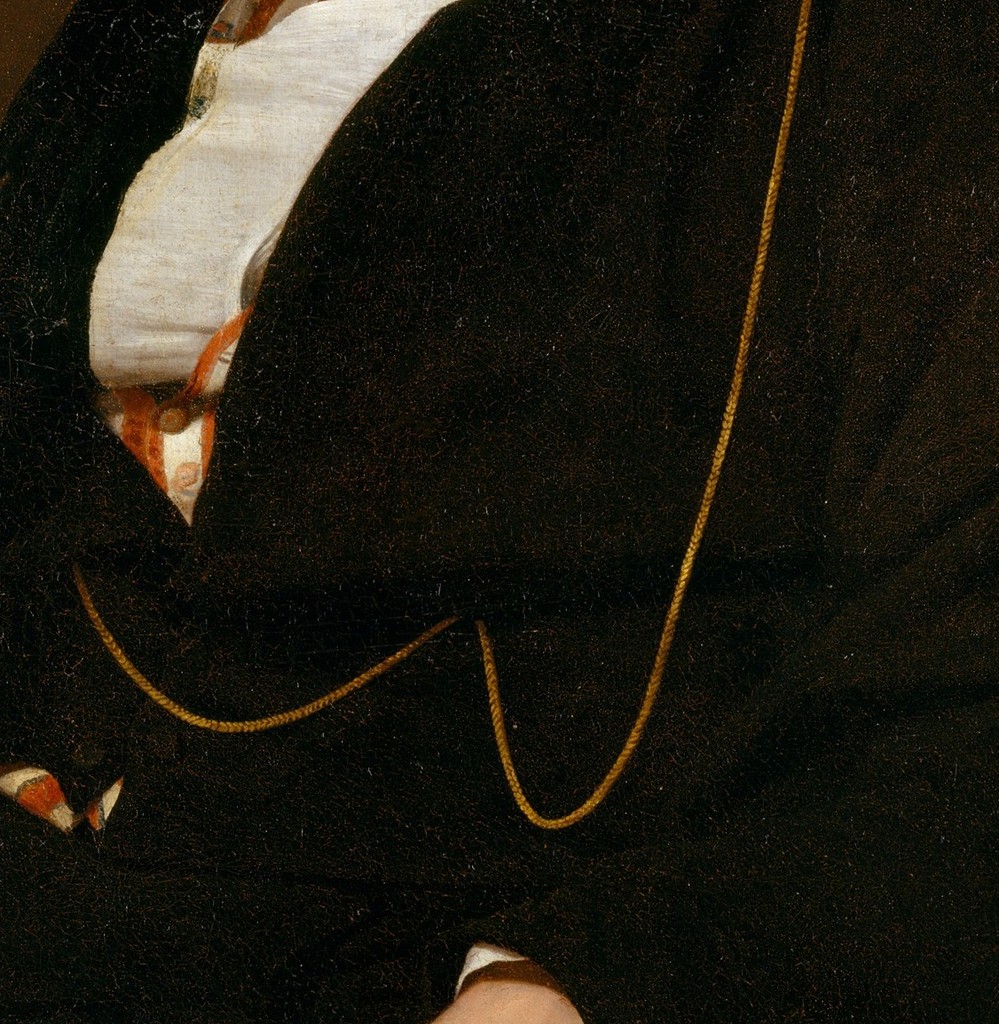
The hanging chain across the black coat
A thin gold chain hangs in several curves across the black coat. Its bright line divides a much larger dark shape without breaking the seated figure’s broad outline.
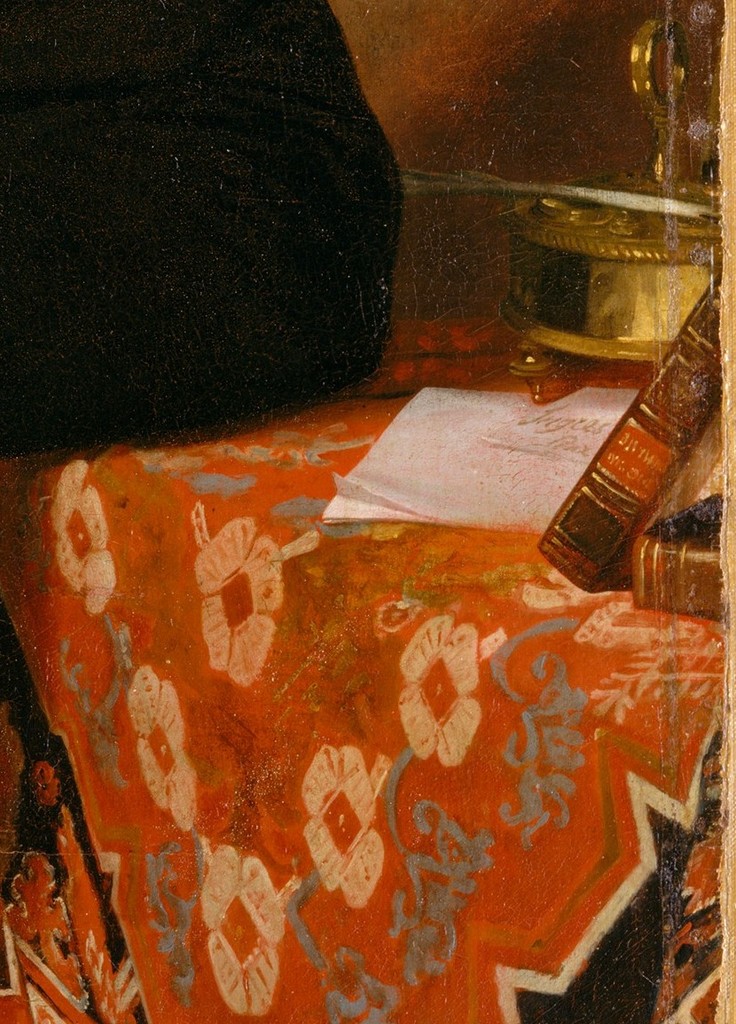
Small objects on the patterned table
A pale note and small rounded objects lie on the red patterned table covering. Their straighter and circular edges contrast with the many changing motifs across the cloth.
A companion across the room
Jacques-Louis Leblanc’s portrait is also dated 1823 and belongs to the Met, where it is numbered 19.77.1. [2] Seen together, the two paintings offer particularly useful comparisons. His open book balances the objects around her chair; his white shirt makes a compact bright patch where her exposed shoulders create a much wider one. His red table covering is gathered at the lower right, while her multicoloured shawl occupies much of the lower left.
Both sitters look out towards the viewer. Their bodies are angled, and their hanging hands introduce a similar looseness into otherwise substantial seated figures. Yet the shapes are far from interchangeable. His dark coat forms a broad, almost continuous mass. Her puffed sleeves, narrow waist and long diagonal forearm break the black clothing into a more articulated structure. Comparison reveals how many decisions lie within the shared idea of a seated portrait.
The Met proposes that the paintings probably faced one another, because their lighting differs. This remains a suggested arrangement. It does not establish a fixed left-and-right position on a single wall. [1] Thinking of them across a room is useful: the separate gazes could each address someone in the space between them.
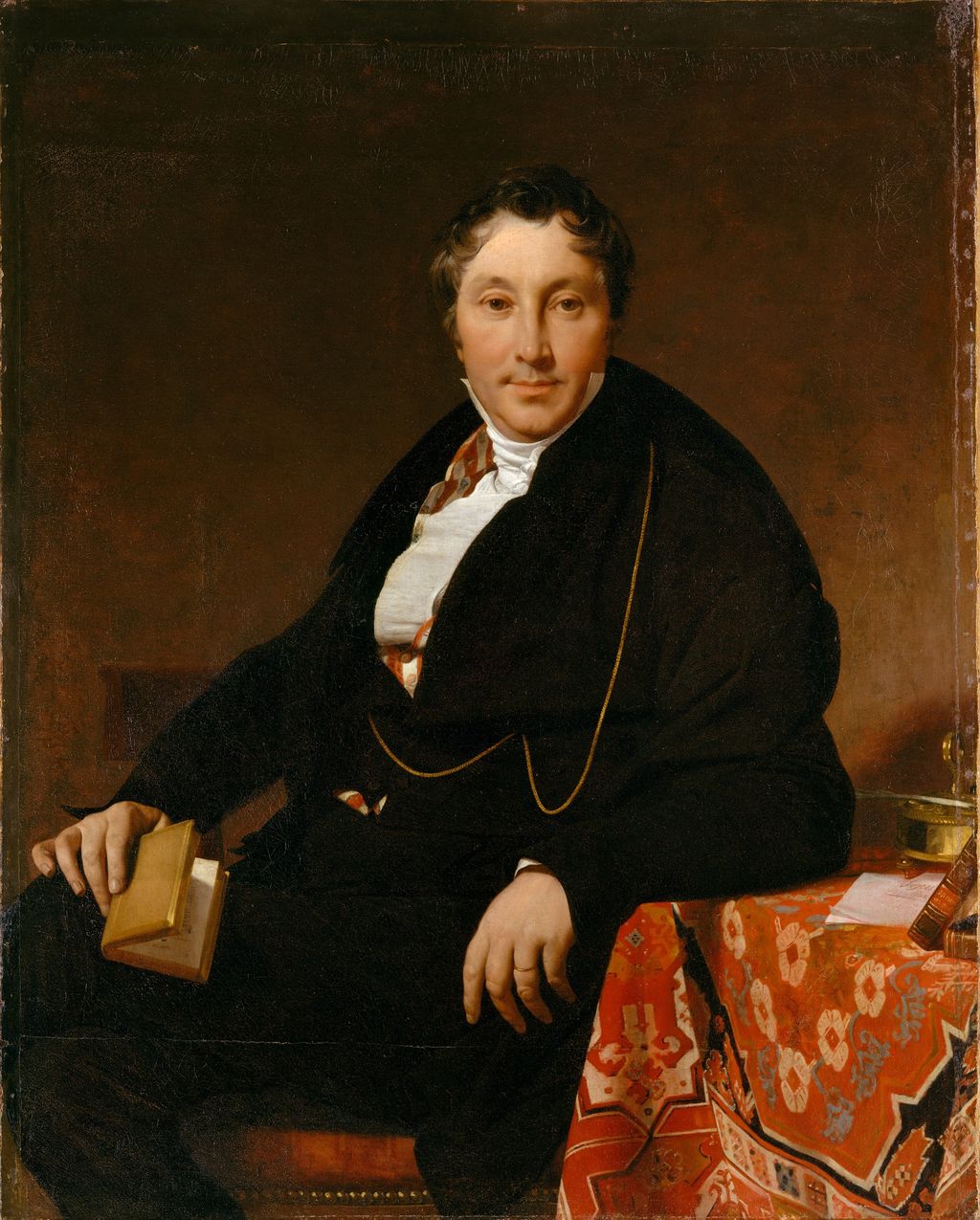
Ingres, Jacques-Louis Leblanc, 1823. The Metropolitan Museum of Art, 19.77.1. [5]
From drawings to a revised canvas
Two kinds of drawing must be distinguished. The Louvre’s independent portrait of Françoise is inscribed to her husband and dated Florence, 1822; his drawn portrait is dated 1823. [3] [6] Riopelle describes her standing, arms folded. Preparatory sheets for the oil painting explore the seated arrangement; an early proposal included their daughter Isaure. Her separate painted portrait dates from 1823, although its dedication records a gift in 1832. [4]
One securely identified sheet at Montauban, MI.867.299, is catalogued as a study for Madame Leblanc and dated 1822–23. [7] The current Met account reports more than two dozen drawings investigating poses. [1] These records give a sense of sustained preparation without requiring every surviving sheet to perform the same function. The distinction between an independent likeness and a working study is explored further in Ingres’s drawings.
Using infrared imaging to investigate beneath the paint, conservator Charlotte Hale found further revisions. The chair arm began as a slender scroll, passed through a wider version, and reached its present form; Madame’s right arm was initially steeper. Underdrawing places an eyelid lower and includes an unpainted curl. Neck and shoulder contours were filled out, and the tabletop was first indicated higher. [8]
These findings make the foreground especially rewarding to revisit. The apparent relaxation of the hanging hand depends on the arm’s angle and the support beneath it. Altering those relationships changes how easily we can imagine the body occupying the chair. The final arrangement preserves a little ambiguity while giving the separate hand a clear outline.
Hale also explains a material difference between the companions. Madame’s figure uses the luminosity of a white ground, the preparatory layer beneath the paint; a red-brown layer occurs beneath her background. Her husband’s red-brown preparation extends across his picture, over a more granular ground. Her canvas has trimmed sides and a roughly 2.5 cm fill at the top. His has additions and a folded edge. Hale’s proposed sequence—husband first, frames selected, wife painted, husband adjusted—is plausible, rather than proven. [8]
A portrait seen alone, then collected as a pair
The family returned to Paris in 1832. Madame’s portrait arrived too late for the 1833 Salon and appeared in 1834, without her husband’s. Riopelle reports contemporary criticism of its distorted figure. [4] What may now seem an assured arrangement had once given viewers cause to object.
Henri Delaborde’s posthumous book on Ingres, published in 1870, records both the 1834 Salon appearance and the portrait’s return at the Universal Exhibition of 1855. It also notes an outline reproduction in Magimel’s publication. [9] Such a reproduction would offer a particularly different encounter with this image: outline can carry the long arm, chair scroll and looped chain, while the distinction between sheer and opaque black depends heavily on tone.
Degas acquired the pair in 1896. The Met’s account says he had first seen them in 1854 and regarded their purchase as an exceptional event in his collecting. [2] Riopelle identifies Durand-Ruel as the intermediary at the sale of Isaure’s collection; Degas retained the portraits until his death in 1917. [4] The Metropolitan bought them at his estate sale in 1918, using the Wolfe Fund. [2]
Their history brings two ways of encountering Madame Leblanc into focus. Alone, she can hold an exhibition viewer through the directness of her gaze and the strangeness of the foreshortened arm. Alongside her husband, the same details become part of a larger exchange of shapes and colours. Neither view exhausts the painting. Returning to the single canvas after seeing its companion makes the individual arrangement more distinct.
Artworks directory
Explore 150 paintings, drawings and an original lithograph. This selection includes related versions and studies; dates distinguish completed works from later revisions.
| Name | Date | Medium |
|---|---|---|
| The Apotheosis of Homer | 1827 | Painting |
| Grande Odalisque | 1814 | Painting |
| The Turkish Bath | 1859–1862 | Painting |
| Madame Moitessier Seated | 1856 | Painting |
| Portrait of Monsieur Bertin | 1832 | Painting |
| Napoleon I on His Imperial Throne | 1806 | Painting |
| Odalisque with Slave | 1839 | Painting |
| The Ambassadors of Agamemnon in the Tent of Achilles | 1801 (competition) | Painting |
| The Valpinçon Bather | 1808 | Painting |
| The Source | 1856 | Painting |
| Oedipus Explaining the Enigma of the Sphinx | 1808; revised probably before 1827 | Painting |
| The Vow of Louis XIII | 1824 | Painting |
| Antiochus and Stratonice | 1840 | Painting |
| The Comtesse d’Haussonville | 1845 | Painting |
| The Princesse de Broglie | 1851–1853 | Painting |
| Jupiter and Thetis | 1811 | Painting |
| The Dream of Ossian | 1813 | Painting |
| The Martyrdom of Saint Symphorian | 1834 | Painting |
| Venus Anadyomene | 1808–1848 | Painting |
| Portrait of Madame de Senonnes | 1814 | Painting |
| Madame Rivière | 1805 | Painting |
| Mademoiselle Caroline Rivière | 1805 | Painting |
| Portrait of Philibert Rivière | 1805 | Painting |
| Bonaparte First Consul | 1804 | Painting |
| The Death of Leonardo da Vinci | 1818 | Painting |
| Joan of Arc at the Coronation of Charles VII | 1854 | Painting |
| Madame Duvaucey | 1807 | Painting |
| La Belle Zélie | 1806 | Painting |
| Madame Panckoucke | 1811 | Painting |
| Portrait of Charles Marcotte d’Argenteuil | 1810 | Painting |
| Joseph Antoine Moltedo | c.1810 | Painting |
| Madame Leblanc | 1823 | Painting |
| Delphine Ingres-Ramel (Portrait of Madame Ingres) | 1859 | Painting |
| Portrait of Amédée de Pastoret | 1823–1826 | Painting |
| Portrait of Baronne de Rothschild | 1848 | Painting |
| Madame Marcotte de Sainte Marie | 1826 | Painting |
| Madame Gonse | 1852 | Painting |
| Aretino in the Studio of Tintoretto | 1848 | Painting |
| Don Pedro of Toledo Kissing Henry IV’s Sword | 1831/1832 | Painting |
| Raphael and La Fornarina | 1814 | Painting |
| Roger Freeing Angelica | 1819 | Painting |
| Romulus’ Victory over Acron | 1812 | Painting |
| Self-Portrait at the Age of Twenty-Four | 1804; revised 1841–1851 | Painting |
| Male Torso | c.1800 | Painting |
| Odalisque in Grisaille (Ingres and workshop) | c.1824–1834 | Painting |
| The Small Bather | 1826 | Painting |
| The Little Bather Harem Interior | 1828 | Painting |
| Jesus Among the Doctors | 1862 | Painting |
| The Virgin Adoring the Host | 1852 | Painting |
| The Virgin of the Host | 1841 | Painting |
| Virgin of the Adoption | 1858 | Painting |
| Paolo and Francesca | 1814 | Painting |
| Homer Deified (revised composition, Louvre RF5273) | 1865 | Drawing |
| Odalisque with Slave (Louvre RF4622) | 1858 | Drawing |
| Odalisque (Walters Art Museum; Ingres and Paul Flandrin) | 1842 | Painting |
| Madame Moitessier Standing (National Gallery of Art) | 1851 | Painting |
| Jacques-Louis Leblanc (The Metropolitan Museum of Art) | 1823 | Painting |
| Ferdinand-Philippe, Duke of Orléans (Louvre RF2005-13) | 1842 | Painting |
| Ferdinand-Philippe, Duke of Orléans (Versailles MV5207; Ingres and workshop) | 1843 | Painting |
| Ferdinand-Philippe, Duke of Orléans (Versailles MV5209; Ingres and workshop) | 1844 | Painting |
| Antiochus and Stratonice (Musée Fabre; Ingres and Raymond Balze) | 1866 | Painting |
| Antiochus and Stratonice (Kunstmuseum Bern, Gurlitt bequest) | Undated (early dating proposed) | Drawing |
| Composition study for Antiochus and Stratonice (MIB867.2193) | 1806 | Drawing |
| Study for the Figure of Stratonice (Met63.66) | 1834–1840 | Graphite, black chalk and charcoal |
| Nude figure study for Stratonice (Boijmans F II 36 PK) | c.1834–1840 | Drawing |
| Paolo and Francesca (The Barber Institute,54.6) | c.1814–1820 | Painting |
| Paolo and Francesca (The Hyde Collection,1971.24) | c.1855–1860 | Painting |
| Paolo and Francesca (Amsterdam Museum TA10970) | 1820 | Drawing |
| Paolo and Francesca (dedicated to Artaud de Montor) | 1816 | Drawing |
| Study for the Bust of Francesca (MIB867.1398) | 1819 | Drawing |
| Study for the Bust of Francesca (MIB867.1396) | 1819 | Drawing |
| The Archangel Raphael, first idea (MIB867.2488) | 1842 | Drawing |
| The Archangel Raphael (MIB867.2500) | 1842 | Drawing |
| The Archangel Raphael Carrying Human Prayers to God (Chantilly DE513) | 1844 | Drawing |
| Louis-Philippe as Saint Philip, stained-glass study | 1844 | Drawing |
| Marie Frédéric Eugène de Reiset (Ford Collection RBF171-2) | 1844 | Drawing |
| Virgil Reading the Aeneid (Toulouse) | Begun 1811 | Painting |
| Tu Marcellus Eris (Brussels, inv. 1836) | c.1814 (museum dating) | Painting |
| Jean-François Gilibert | 1804 | Painting |
| François-Marius Granet | 1807 (museum dating) | Painting |
| Count Nikolai Dmitrievich Guryev | 1821 | Painting |
| Caroline Murat, Queen of Naples | 1814 | Painting |
| Count Mathieu Molé | 1834 | Painting |
| Cherubini and the Muse of Lyric Poetry (Louvre) | 1842 | Painting |
| Luigi Cherubini (Cincinnati) | 1841 | Painting |
| Comtesse de Rayneval (Louvre RF4505) | 1841 | Drawing |
| Venus on Paphos (Antonie Balaÿ) | c.1852 | Painting |
| Prince Napoléon | 1855 | Painting |
| Study for The Apotheosis of Napoleon I (Petit Palais) | Late 1853 | Painting |
| The Apotheosis of Napoleon I (destroyed ceiling) | 1853 | Painting |
| The Journalist (MIB867.2733) | 1834? | Drawing |
| Henry VIII, after Holbein | c.1815–1820 (?) | Drawing |
| Madame Récamier, after David (MIB867.3637) | Undated (early Paris period) | Drawing |
| Study for Comtesse d’Haussonville (MIB867.259; background possibly by another hand) | 1842–1845 | Drawing |
| La Source (reduced version reported by Delaborde) | Date unrecorded; reported 1870 | Painting |
| Odalisque (autograph lithograph,NGA1946.21.117) | 1825; published1826 | Lithograph |
| Portrait of a Seated Lady | 1814 | Graphite |
| The Kaunitz Sisters (Leopoldine, Caroline, and Ferdinandine) | 1818 | Graphite |
| Portrait of a Man | 1814 | Graphite |
| Study for the Portrait of Louis-François Bertin (1766–1841) | n.d. | Black chalk and graphite |
| Studies for the Cadaver of Acron | ca. 1810–12 | Graphite on wove paper |
| Study for the Drapery of Molière in "The Apotheosis of Homer" | n.d. | Black chalk with stumping |
| Madame Guillaume Guillon Lethière, née Marie-Joseph-Honorée Vanzenne, and her son Lucien Lethière | 1808 | Graphite |
| Niccolò Paganini (1782–1840) | ca. 1830 | Counterproof or tracing strengthened with graphite and gouache on translucent paper |
| Lady Mary Cavendish-Bentinck (?-1843) | 1816 | Graphite |
| Madame Alexandre Lethière and Her Daughter Letizia | ca. 1815 | Graphite |
| Merry Joseph Blondel (1781–1853) | 1809 | Graphite |
| Ursin-Jules Vatinelle (1798–1881) | 1820 | Graphite |
| Bust of a Gypsy Girl (ascribed to Ingres) | 1819 | Graphite on wove paper |
| Study of a Seated Nude Male | n.d. | Graphite |
| The Archangel Raphael (Study for a stained-glass window in the chapel of Notre-Dame de la Compassion-Saint-Ferdinand, Neuilly) | ca. 1842 | Graphite |
| Lancelot-Théodore, comte Turpin de Crissé | probably 1818 | Graphite |
| Study for the Figure of the Iliad in "The Apotheosis of Homer" | ca. 1827 | Graphite and black chalk heightened with white chalk on brown paper |
| Comtesse Turpin de Crissé | probably 1818 | Graphite |
| Nude Figures for L'Âge d'Or, Château de Dampierre | n.d. | Graphite on brownish paper |
| Study of Figures (attributed to Ingres) | n.d. | Graphite |
| Study of Figures (attributed to Ingres) | n.d. | Graphite; squared in graphite |
| Admiral Sir Fleetwood Broughton Reynolds Pellew | 1817 | Graphite on wove paper |
| Madame Jean-Auguste-Dominique Ingres, née Madeleine Chapelle | 1814 | Graphite on off-white wove paper |
| Virgil Reading the Aeneid to Augustus, Livia, and Octavia | 1809/1819 (?) | Pen and black ink, graphite, brush and gray wash, white gouache heightening, Conté crayon on blue paper |
| General Louis-Étienne Dulong de Rosnay | 1818 | Graphite (hard and soft pencils) |
| Madame Alexandre Lethière, née Rosa Meli, and Her Daughter, Letizia | 1815 | Graphite |
| The Lawyer Paul Grand | 1834 | Graphite |
| Jean-Joseph Fournier | 1815 | Graphite |
| Armand Bertin | 1842 | Graphite |
| Madame Armand Bertin, née Marie-Anne-Cécile Dollfuss | 1843 | Graphite |
| The Architect Charles-Victor Famin | 1836 | Graphite |
| Henri Lehmann | 1850 | Graphite |
| Portrait of a Lady | ca. 1815–17 | Graphite |
| Edmond Cavé (1794–1852) | 1844 | Oil on canvas |
| Head of Saint John the Evangelist | probably ca. 1818–20 | Oil on canvas, laid down on wood |
| Madame Edmond Cavé (Marie-Elisabeth Blavot, ca. 1806–1883) | ca. 1831–34 | Oil on canvas |
| Madame Félix Gallois | 1852 | Graphite with touches of gold in oil to highlight jewelry, on buff wove paper. |
| Dr. François Mêlier | 1849 | Graphite with graphite framing lines, corrected with white, on buff wove paper |
| Portrait of Madame Rhode (Rhoda?) | 1810–20 | Graphite on pale buff wove paper |
| Study for "Raphael and the Fornarina"(?) | ca. 1814(?) | Graphite on white wove paper |
| Portrait of Madame Paul Meurice, née Palmyre Granger | ca. 1845–50 | Graphite on wove paper |
| Alexander the Great presenting Campaspe to Apelles | 1810 | Graphite, brush and brown wash; squared in graphite |
| Study of Hands for "Christ Among the Doctors" | 1852–62 | Graphite on tracing paper |
| Study for The Turkish Bath (RF34502) | about 1850 | Pen and brown ink with graphite, partially squared |
| Study for The Turkish Bath (RF23354) | Undated | Pen and brown ink with graphite on joined sheets |
| Study for The Turkish Bath (RF54702) | about 1859 | Pen and brown ink |
| Studies of women for The Turkish Bath (RF12292) | Undated | Black chalk |
| Achilles Receiving the Envoys of Agamemnon (Nationalmuseum sketch, NM2161) | 1801 | Oil on wood |
| Half-Length Bather (Musée Bonnat-Helleu,89) | 1807 | Oil on canvas |
| Oedipus and the Sphinx (National Gallery,NG3290) | about1826 | Oil on canvas |
| Oedipus and the Sphinx (Walters,37.9) | 1864 | Oil on canvas |
| Oedipus and the Valpinçon Bather, after David (MI.867.2035) | Undated | Graphite on tracing paper, after David |
| Study of the Virgin for The Vow of Louis XIII (Dijon,1758) | about1822 | Black chalk, stump and white chalk on brown wove paper |
| First Thought for The Vow of Louis XIII (MI.885.11.21) | 1822 | Oil on canvas |
Frequently Asked Questions
She was Françoise Poncelle, formerly a lady-in-waiting to Élisa Baciocchi and the wife of Jacques-Louis Leblanc, an important supporter of Ingres in Florence. [2]
Her right arm projects towards the viewer and is strongly foreshortened. The hand hanging over the chair makes the change of direction especially noticeable. It is useful to trace the sleeve and chair separately before following the limb.
No. Although conceived as companions, Madame’s portrait appeared alone at the Salon of 1834. [1]
It belongs to the Metropolitan Museum of Art in New York. [1]
Discussion
Look again at the images and ideas explored in Madame Leblanc. These editorial prompts invite your observations.
Reader Insights
Follow the portrait from the face down to each hand, then back up along the gold chain. Which route gives you the strongest sense of a person sitting in space, and where does the arrangement begin to feel deliberately unusual?
Compare Françoise’s portrait with that of Jacques-Louis Leblanc. Which visual links make them feel like a pair without making them identical?
How does the long gold chain guide attention through an otherwise broad field of black clothing?
Join the Conversation
Share a detail, comparison or question about Madame Leblanc below.
References
- The Metropolitan Museum of Art, Madame Jacques-Louis Leblanc (Françoise Poncelle, 1788–1839). Collection record, 19.77.2; object details and curatorial overview. Consulted 17 October 2026. View source.
- The Metropolitan Museum of Art, Jacques-Louis Leblanc (1774–1846). Collection record, 19.77.1; object details and curatorial overview. Consulted 17 October 2026. View source.
- Musée du Louvre, Portrait de Françoise Leblanc. RF 5643, recto; inscription, technique and commentary quoting Louis-Antoine Prat, Ingres, 2004, no. 18, pp. 81–82. (In French.) View source.
- Christopher Riopelle, Catalogue entries 88–89, in Gary Tinterow and Philip Conisbee, eds., Portraits by Ingres: Image of an Epoch. New York: Metropolitan Museum of Art, 1999, pp. 256–261, especially pp. 256–257, 260–261 and note 3. View source.
- Supporting image. Ingres, Jacques-Louis Leblanc, 1823. The Metropolitan Museum of Art, 19.77.1. Catharine Lorillard Wolfe Collection, Wolfe Fund, 1918. Image source. CC0 / Public domain.
- Musée du Louvre, Portrait de Jacques-Louis Leblanc. RF 5642, recto; date and object identification. (In French.) View source.
- Musées Occitanie / Musée Ingres Bourdelle, Étude pour le Portrait de Madame Leblanc. MI.867.299; object date and identification. (In French.) View source.
- Charlotte Hale, technical observations in Gary Tinterow, Charlotte Hale and Eric Bertin, “‘Portraits by Ingres: Image of an Epoch’: Reflections, Technical Observations, Addenda, and Corrigenda”. Metropolitan Museum Journal 35 (2000), pp. 193–219, here p. 205. View source.
- Henri Delaborde, Ingres, sa vie, ses travaux, sa doctrine, d’après les notes manuscrites et les lettres du maître. Paris: Henri Plon, 1870, catalogue nos. 134–135, pp. 253–254. (In French.) View source.
- Splash image. Madame Leblanc. The Metropolitan Museum of Art, 19.77.2; Catharine Lorillard Wolfe Collection, Wolfe Fund, 1918. Image source. CC0 / Public domain.