 by Tom Gurney
Tom Gurney BSc (Hons) is an art history expert with over 20 years experience
Published on June 19, 2020 / Updated on October 22, 2026
Email: tomgurney1@gmail.com / Phone: +44 7429 011000
Male Torso
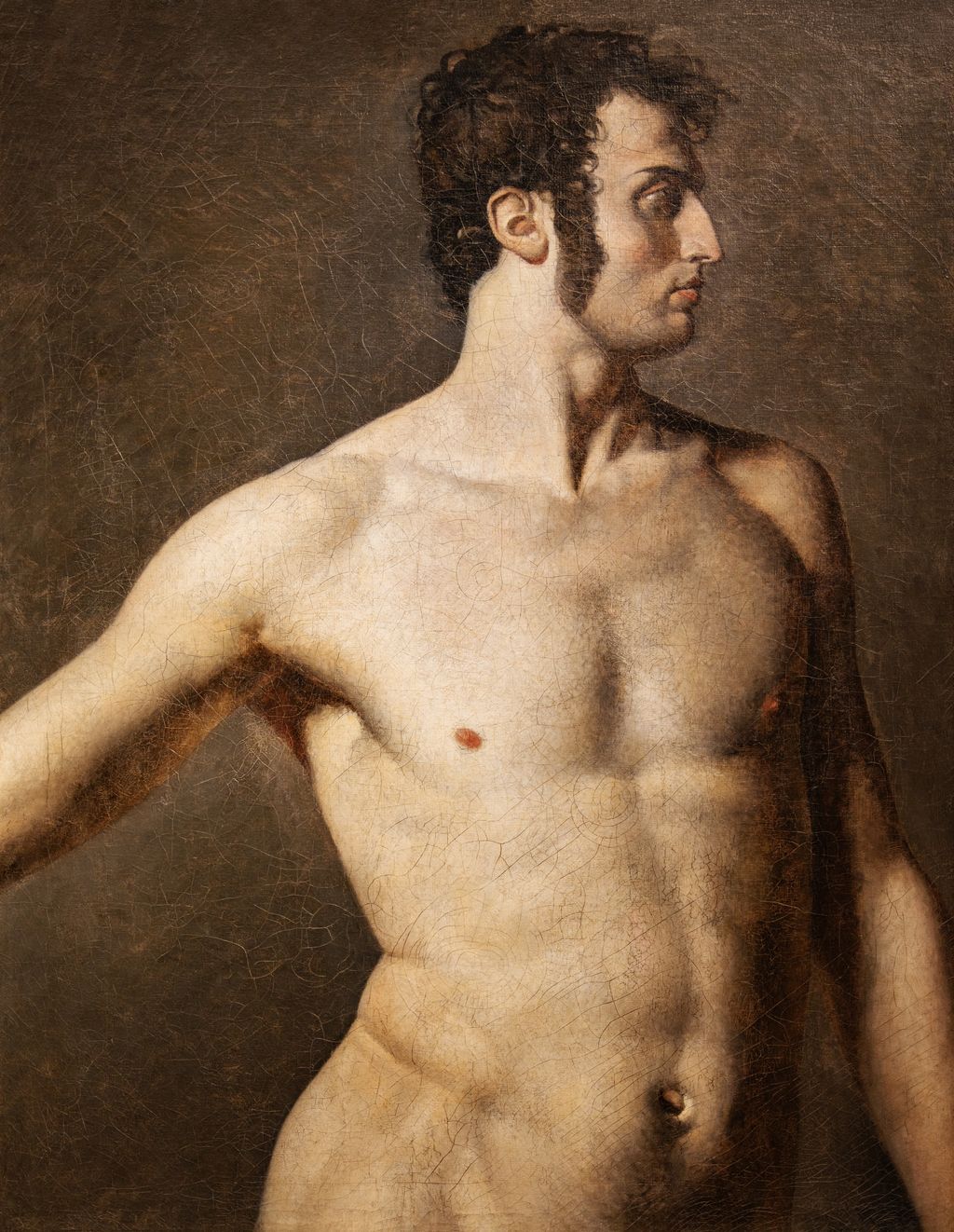
A young man turns his head sharply to the right while his chest remains open towards us. Light spreads across one shoulder, catches the throat and falls away into the deeper shadows of the opposite breast. Ingres's Male Torso, painted around 1800 in Jacques-Louis David's studio and now in the Musée Ingres Bourdelle, makes this simple opposition between head and body absorbing. [1] The title directs attention to an anatomical fragment; the face keeps drawing us back to a particular living person.
At a Glance
- ArtistJean-Auguste-Dominique Ingres
- French titleTorse d'homme
- DateAround 1800
- MediumOil on canvas
- Dimensions99 × 80 cm
- CollectionMusée Ingres Bourdelle, Montauban, MID.851.1. [1]
- Look forThe change of direction between the face, shoulders and abdomen, and the unequal light across the chest.
This work across Ingres’s career
Agamemnon’s Ambassadors
1801 (competition)Grande Odalisque
1814Louis XIII’s Vow
1824Monsieur Bertin
1832The Princesse de Broglie
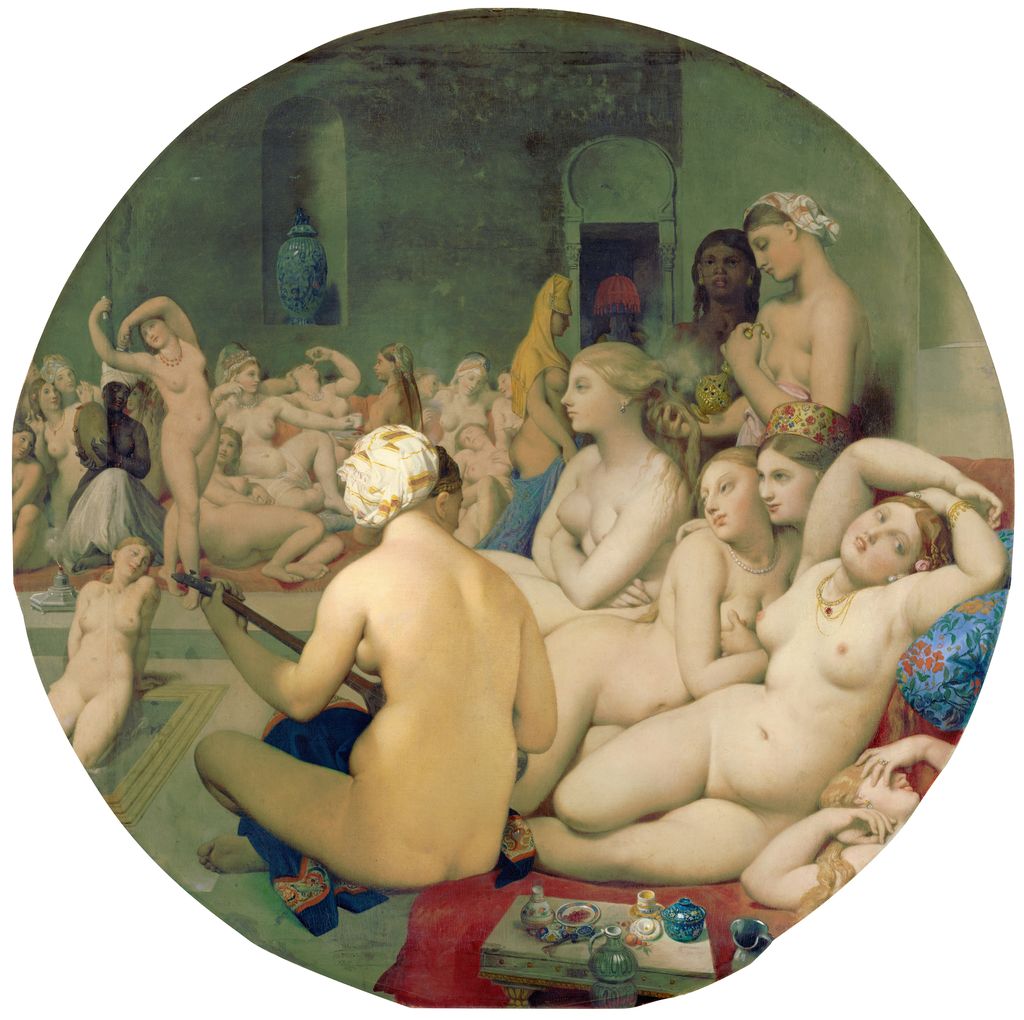
1851–1853The Turkish Bath
1859–1862Contents
- A study from David's studio
- Following the turn of the body
- A model with a face
- Form, anatomy and Ingres's later teaching
- An early painting in Montauban
- Annotated details
A study from David's studio
Musées Occitanie suggests that the painting could have been practice for the demi-figure peinte, a competition in painting a half-length figure. Its format suited the exercise, but it lacks the required hands and drapery. A connection with competition training is therefore possible; identification as a submitted or prize-winning entry is insecure. [2]
Both arms continue beyond the frame. We can follow their direction, but cannot see what either hand might be doing. Without a gesture, clothing or an object to explain the pose, attention settles on the way the shoulder rises and the chest turns. The exercise has a restricted field and considerable complexity within it: the painter has to make an arrangement of illuminated surfaces read as a continuous body.
Another early Ingres torso belongs to the Beaux-Arts de Paris. Catalogued as Torse ou demi-figure peinte, it measures 102 × 80 cm and is associated with the school's 1800 competition. It is a separate painting, inventory Torse 15, rather than another title for the Montauban canvas. [3] Similar titles can obscure the distinction between individual works produced during a period of concentrated study. Looking closely at the body reveals a sequence of demanding problems: joining the head to the neck, making an arm project out of the chest, and giving a broad light area enough variation to remain rounded.
Following the turn of the body
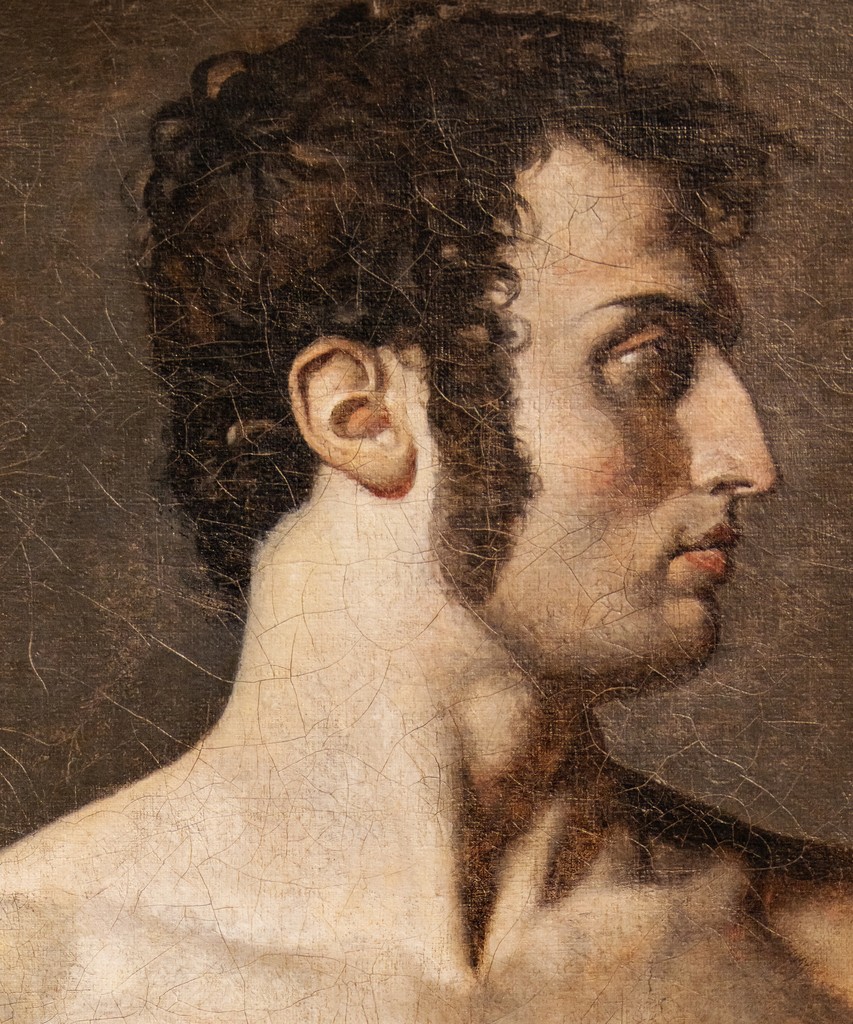
Begin with the ear, a small, clearly articulated shape between the dark curls and the illuminated neck. From it, the jaw travels towards the right. The nose extends the movement, producing a strong profile against the brown background. Below, the shoulders establish a much broader, more frontal shape. Head and torso consequently offer different views of the same person at once.
The neck carries the transition. Its pale left side opens into the slope of the shoulder, while a narrow dark passage descends beneath the jaw towards the centre of the chest. That shadow is a hinge in the composition: it makes the turn intelligible without enclosing the neck in a hard outline. Trace the two sides separately and their asymmetry becomes particularly clear. One flows outward into light; the other contracts inward into darkness.
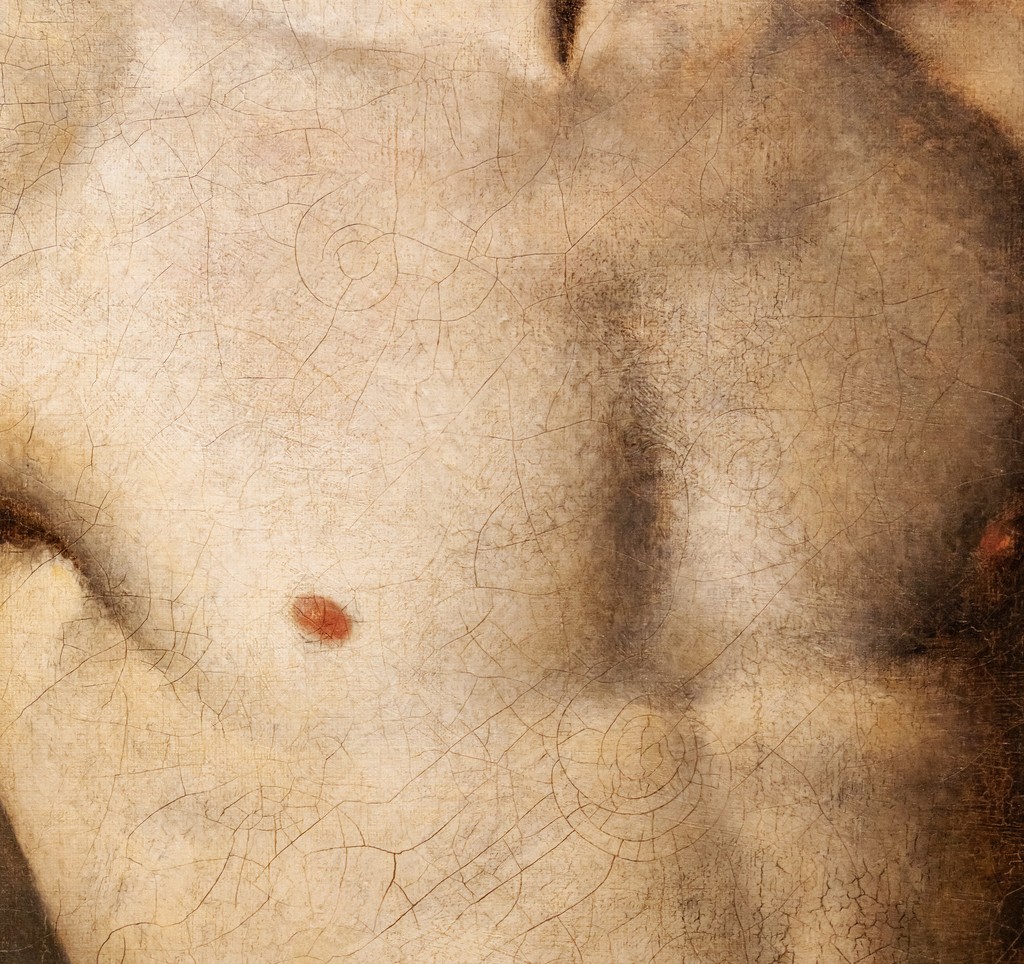
Across the chest, the two pectoral muscles receive markedly different treatment. On the left of the image, the breast is broad and luminous, with a reddish nipple standing out against the pale flesh. The opposite breast turns into shadow and seems to withdraw. Ingres makes the difference legible through the transition of tones, rather than through an equally emphatic outline around each muscle. The body gains depth as one side advances and the other recedes.
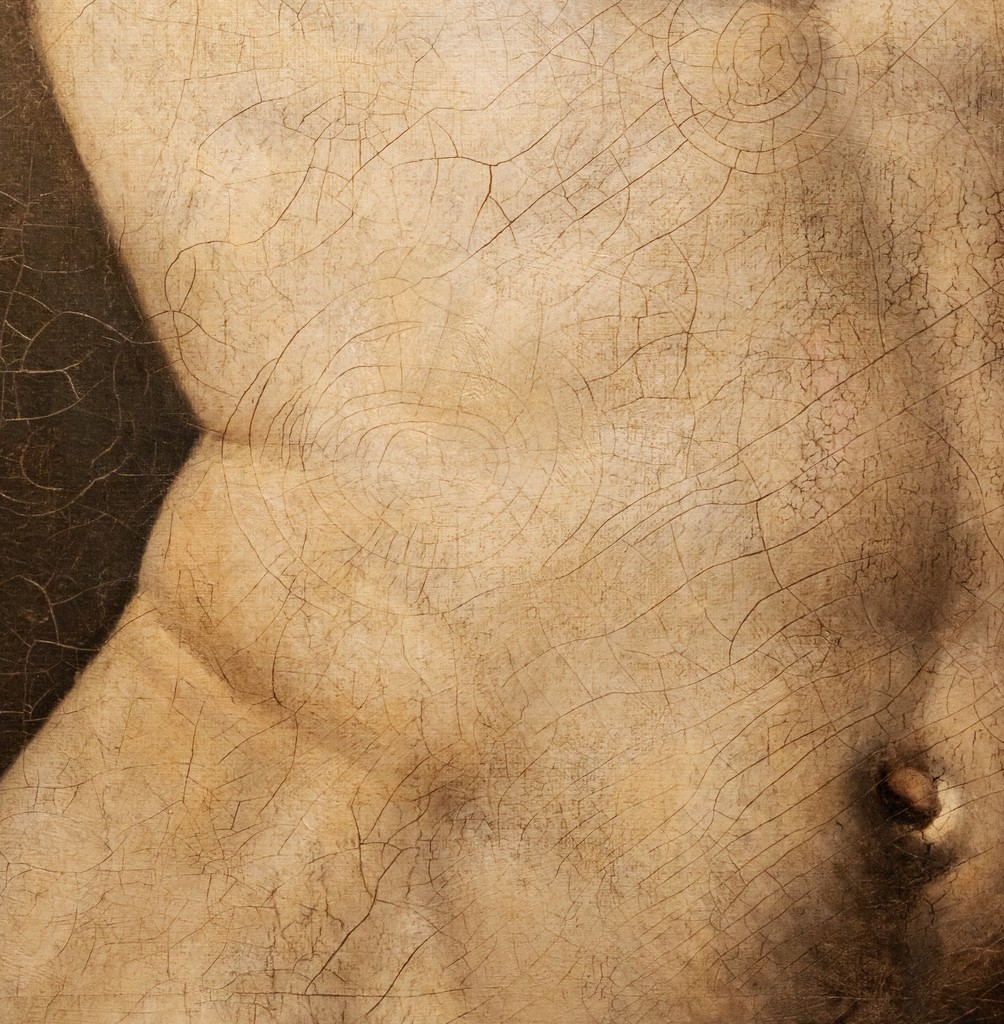
The abdomen introduces a further adjustment. Its central shadow and the navel sit to the right of the large bright area above. The waist sweeps in on the left, while the right flank is compressed between darkness and the descending arm. These shifting alignments keep the figure from becoming a stack of symmetrical parts. It is worth moving the eye slowly from face to chest to navel: the apparent stillness contains several changes of direction.
The frame and the absent hands
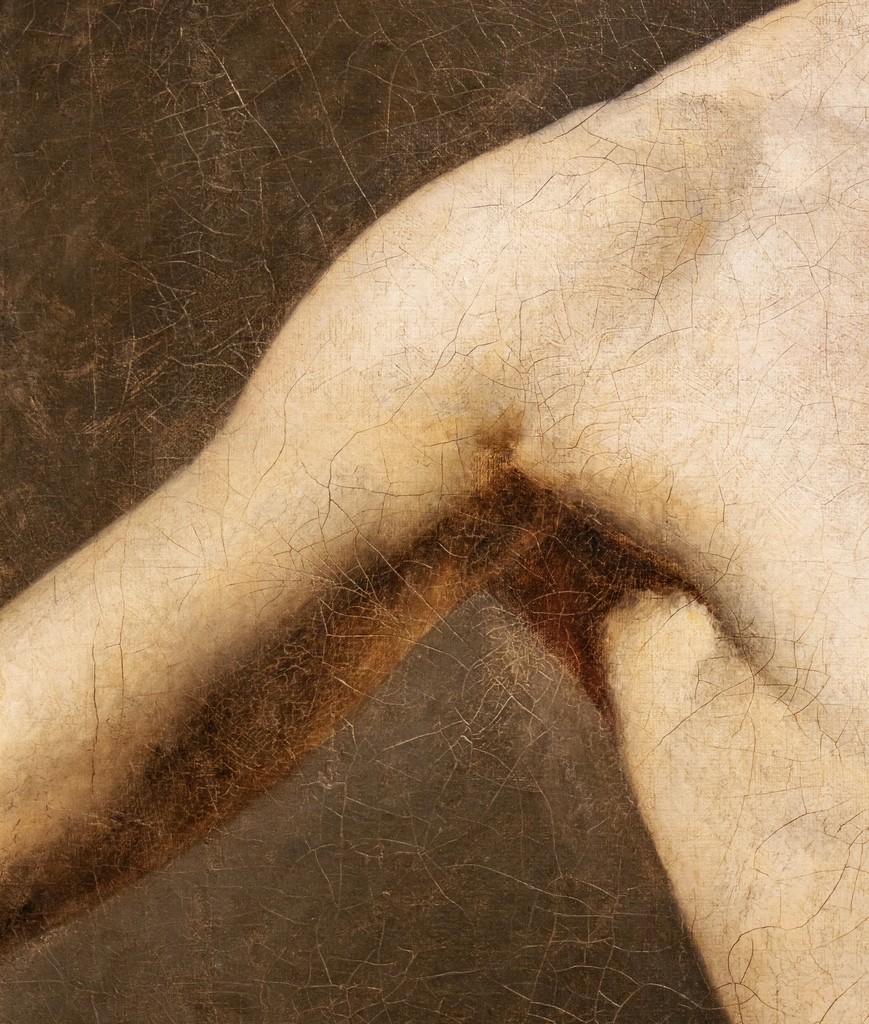
The arm on the left moves diagonally out of the picture, opening a wedge of background beneath it. The other arm descends close to the right edge. Together they give the torso width and a sense of continuation beyond the canvas, yet neither provides a completed gesture. The lower edge cuts the body below the navel, leaving the balance of the hips and legs unresolved.
This framing brings us close enough to inspect the body while withholding the full pose. Try mentally extending the arms and supplying hands: several actions become possible, and none is compelled by the image. The painting's visual energy comes from the movements that remain within view. An invented activity would narrow a study whose central interest is the body itself.
The plain background reinforces that concentration. It has no horizon, furnishing or identifiable location to establish scale or occupation. The head has breathing room on the right, where the profile faces into the surrounding darkness. Below, the chest fills the frame much more forcefully. The resulting balance between a relatively isolated face and an expansive body helps explain why the picture can feel both intimate and monumental.
Annotated Details from Male Torso
The numbered points identify visible features discussed in this article. Return from each detail to the whole composition. Jean-Auguste-Dominique Ingres, Male Torso, around 1800. Oil on canvas, 99 × 80 cm. Musée Ingres Bourdelle, Montauban, MID.851.1. Photograph: Didier Descouens (Archaeodontosaurus); Wikimedia Commons. Image source. Public domain.
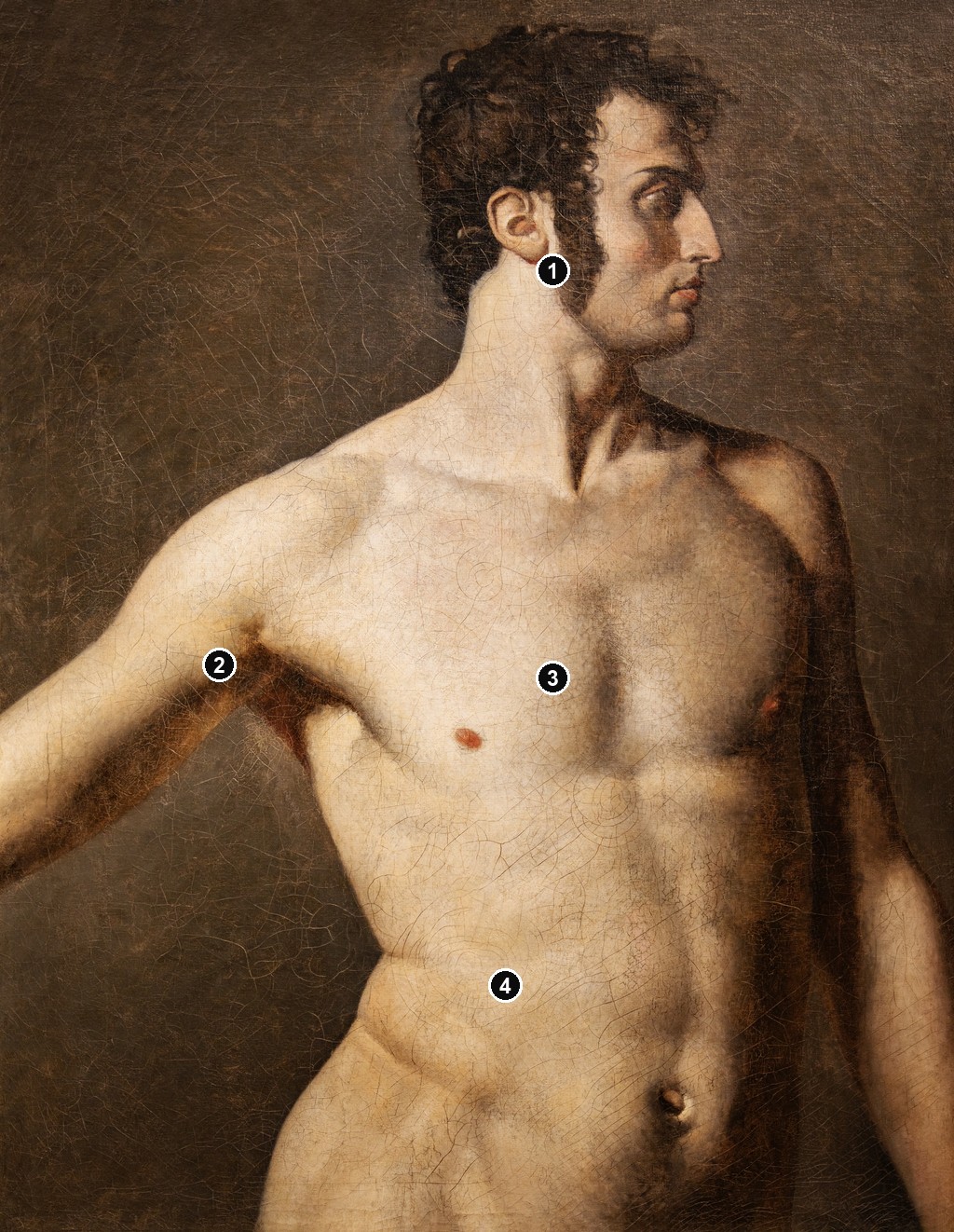
Details from MALE TORSO
Follow the profile, shoulder and narrowing waist through the turn of the figure.
The profile above the turned neck
The head turns sharply towards the edge, showing the nose and lips in profile. The visible ear and changing shadows beneath the jaw connect that turn to the neck.
The extended arm and shoulder
One arm extends beyond the edge from the broad shoulder. Follow its sloping outline back into the chest, where the direction of the body begins to change.
Light across the chest
A broad passage of light crosses the chest beside deeper shadow under the opposite arm. Compare the outer contour with the smaller changes of tone within it.
The narrowing waist below the ribs
The body narrows beneath the ribs before widening again near the lower edge. Light and shadow continue through this change in the outer contour.
A model with a face
Dark curls, pronounced sideburns, a long nose and slightly parted lips give the model a recognisable appearance. The eye is directed away from us. Those details invite the kind of attention we give to a portrait, although the bare chest and restricted setting offer little social information about the person represented. Musées Occitanie compares his features with two other academic studies and his attitude with Ingres's Scipio. These comparisons of appearance and pose supply no personal name for the model. [2]
A face can be carefully observed without giving us access to its sitter's thoughts. Here the turned eye and closed encounter with the viewer may suggest absorbed attention, but we cannot establish what the man was looking at or feeling. The distinction is useful because the head does so much pictorial work. Its sharply defined profile establishes direction; its curls punctuate the silhouette; its warmer cheek and lips bring small accents of colour into the much larger expanse of flesh.
The interplay between individual likeness and bodily study makes the painting especially rewarding beside Ingres's portraits. A portrait ordinarily gives us further clues to a person's identity through dress, possessions or an inscription. Here the face remains specific while those other forms of identification fall away. The anonymity belongs to our knowledge of the picture; it does not make the painted person visually generic.
Form, anatomy and Ingres's later teaching
A later perspective on the painting comes from the thoughts and teaching remarks published by Henri Delaborde in 1870, after Ingres's death. These undated passages are an editorial compilation, not a record of the instructions given in David's studio around 1800. They nevertheless help clarify questions about form that this early study makes visible. [4]
Ingres's advice gives priority to a dominant large form that takes hold of the eye. He favours rounded modelling, with internal details kept subordinate to the whole. [4] In this torso, the great illuminated sweep from shoulder through chest provides just such a starting point for looking. The smaller articulations become apparent after we have grasped that broad volume. If we begin instead by naming each muscle, we risk overlooking the relationship that makes the individual parts cohere.
The remarks on anatomy are similarly practical. Ingres values knowledge of the skeleton because bones establish the body's framework and supply reference points for drawing. He places less emphasis on anatomical learning about individual muscles, while still insisting that their order and relative arrangement must be understood to avoid structural errors. [4] This is a distinction between kinds of useful knowledge, not permission to ignore construction. In the painting, the collarbones, sternum and transitions at the shoulders help the soft masses of flesh remain intelligible as a body.
Another passage cautions against giving a thin-necked model a thick neck simply to match a preferred type of beauty. Elsewhere, the head and neck are described as forming discontinuous lines. [4] These observations encourage attention to the particular connections before us. Here, following one uninterrupted contour would miss the interruptions around the jaw, throat and shoulder that make the turn convincing.
The teaching offers a vocabulary for looking at an earlier painted body. It cannot establish what instructions David gave Ingres, how many sessions the model posed, or whether this canvas developed through a particular sequence of preparatory drawings. Those details of its making remain unknown.
Flesh colour and the shape of light
Delaborde's compilation also preserves Ingres's distinction between the broad arrangement of light and dark and the particular colour of individual things. The neighbouring discussion considers warm flesh, cooler colours and the effect of bright white drapery beside skin. [4] Colour and tonal modelling are related questions, but they are not interchangeable.
Look again at the chest with that distinction in mind. The illuminated flesh ranges from cream to subdued gold; the cheek and lips introduce warmer notes; the shadows move towards brown. The painting's restrained palette contains many differences within what we might initially call a single flesh colour. The dark curls provide another kind of contrast, sharper and more compact than the soft change across the breast.
These visible effects can be discussed without reconstructing a paint recipe. Oil on canvas is the documented medium. [1] The photograph alone cannot establish the pigments, ground, underdrawing or sequence of layers. What it does let us follow is the distribution of colour and light across the surface: the broad shoulder's brightness, the small warmth of the lips, and the dark passage that binds the face to the torso.
An early painting in Montauban
Musées Occitanie proposes that the canvas was probably sent to Ingres's father with his first Prix de Rome picture and soon displayed at the local drawing school. This account of its early visibility in his home town remains a qualified reconstruction. [2]
Lapauze’s 1911 monograph reproduced the Montauban canvas under the heading Torse. The photograph’s right-facing profile, extended arm and cropped waist identify the same painting. Its caption associates it with an 1800 competition prize. [4] The separately catalogued Paris torso remains important here: a historical caption does not resolve which canvas was entered and judged. [3] The museum’s exhibition record includes Montauban in 1862, Paris in 1911, 1921 and 1934, and Ingres avant Ingres at Orléans in 2021–22. [1]
This canvas rewards that approach. Its academic setting explains the concentration on a bare male figure. Its particular arrangement of light, profile and cropped limbs gives us a reason to stay. The evidence of a young painter's attention lies in the difficult passage from one part of a living body to another.
Artworks directory
Explore 150 paintings, drawings and an original lithograph. This selection includes related versions and studies; dates distinguish completed works from later revisions.
| Name | Date | Medium |
|---|---|---|
| The Apotheosis of Homer | 1827 | Painting |
| Grande Odalisque | 1814 | Painting |
| The Turkish Bath | 1859–1862 | Painting |
| Madame Moitessier Seated | 1856 | Painting |
| Portrait of Monsieur Bertin | 1832 | Painting |
| Napoleon I on His Imperial Throne | 1806 | Painting |
| Odalisque with Slave | 1839 | Painting |
| The Ambassadors of Agamemnon in the Tent of Achilles | 1801 (competition) | Painting |
| The Valpinçon Bather | 1808 | Painting |
| The Source | 1856 | Painting |
| Oedipus Explaining the Enigma of the Sphinx | 1808; revised probably before 1827 | Painting |
| The Vow of Louis XIII | 1824 | Painting |
| Antiochus and Stratonice | 1840 | Painting |
| The Comtesse d’Haussonville | 1845 | Painting |
| The Princesse de Broglie | 1851–1853 | Painting |
| Jupiter and Thetis | 1811 | Painting |
| The Dream of Ossian | 1813 | Painting |
| The Martyrdom of Saint Symphorian | 1834 | Painting |
| Venus Anadyomene | 1808–1848 | Painting |
| Portrait of Madame de Senonnes | 1814 | Painting |
| Madame Rivière | 1805 | Painting |
| Mademoiselle Caroline Rivière | 1805 | Painting |
| Portrait of Philibert Rivière | 1805 | Painting |
| Bonaparte First Consul | 1804 | Painting |
| The Death of Leonardo da Vinci | 1818 | Painting |
| Joan of Arc at the Coronation of Charles VII | 1854 | Painting |
| Madame Duvaucey | 1807 | Painting |
| La Belle Zélie | 1806 | Painting |
| Madame Panckoucke | 1811 | Painting |
| Portrait of Charles Marcotte d’Argenteuil | 1810 | Painting |
| Joseph Antoine Moltedo | c.1810 | Painting |
| Madame Leblanc | 1823 | Painting |
| Delphine Ingres-Ramel (Portrait of Madame Ingres) | 1859 | Painting |
| Portrait of Amédée de Pastoret | 1823–1826 | Painting |
| Portrait of Baronne de Rothschild | 1848 | Painting |
| Madame Marcotte de Sainte Marie | 1826 | Painting |
| Madame Gonse | 1852 | Painting |
| Aretino in the Studio of Tintoretto | 1848 | Painting |
| Don Pedro of Toledo Kissing Henry IV’s Sword | 1831/1832 | Painting |
| Raphael and La Fornarina | 1814 | Painting |
| Roger Freeing Angelica | 1819 | Painting |
| Romulus’ Victory over Acron | 1812 | Painting |
| Self-Portrait at the Age of Twenty-Four | 1804; revised 1841–1851 | Painting |
| Male Torso | c.1800 | Painting |
| Odalisque in Grisaille (Ingres and workshop) | c.1824–1834 | Painting |
| The Small Bather | 1826 | Painting |
| The Little Bather Harem Interior | 1828 | Painting |
| Jesus Among the Doctors | 1862 | Painting |
| The Virgin Adoring the Host | 1852 | Painting |
| The Virgin of the Host | 1841 | Painting |
| Virgin of the Adoption | 1858 | Painting |
| Paolo and Francesca | 1814 | Painting |
| Homer Deified (revised composition, Louvre RF5273) | 1865 | Drawing |
| Odalisque with Slave (Louvre RF4622) | 1858 | Drawing |
| Odalisque (Walters Art Museum; Ingres and Paul Flandrin) | 1842 | Painting |
| Madame Moitessier Standing (National Gallery of Art) | 1851 | Painting |
| Jacques-Louis Leblanc (The Metropolitan Museum of Art) | 1823 | Painting |
| Ferdinand-Philippe, Duke of Orléans (Louvre RF2005-13) | 1842 | Painting |
| Ferdinand-Philippe, Duke of Orléans (Versailles MV5207; Ingres and workshop) | 1843 | Painting |
| Ferdinand-Philippe, Duke of Orléans (Versailles MV5209; Ingres and workshop) | 1844 | Painting |
| Antiochus and Stratonice (Musée Fabre; Ingres and Raymond Balze) | 1866 | Painting |
| Antiochus and Stratonice (Kunstmuseum Bern, Gurlitt bequest) | Undated (early dating proposed) | Drawing |
| Composition study for Antiochus and Stratonice (MIB867.2193) | 1806 | Drawing |
| Study for the Figure of Stratonice (Met63.66) | 1834–1840 | Graphite, black chalk and charcoal |
| Nude figure study for Stratonice (Boijmans F II 36 PK) | c.1834–1840 | Drawing |
| Paolo and Francesca (The Barber Institute,54.6) | c.1814–1820 | Painting |
| Paolo and Francesca (The Hyde Collection,1971.24) | c.1855–1860 | Painting |
| Paolo and Francesca (Amsterdam Museum TA10970) | 1820 | Drawing |
| Paolo and Francesca (dedicated to Artaud de Montor) | 1816 | Drawing |
| Study for the Bust of Francesca (MIB867.1398) | 1819 | Drawing |
| Study for the Bust of Francesca (MIB867.1396) | 1819 | Drawing |
| The Archangel Raphael, first idea (MIB867.2488) | 1842 | Drawing |
| The Archangel Raphael (MIB867.2500) | 1842 | Drawing |
| The Archangel Raphael Carrying Human Prayers to God (Chantilly DE513) | 1844 | Drawing |
| Louis-Philippe as Saint Philip, stained-glass study | 1844 | Drawing |
| Marie Frédéric Eugène de Reiset (Ford Collection RBF171-2) | 1844 | Drawing |
| Virgil Reading the Aeneid (Toulouse) | Begun 1811 | Painting |
| Tu Marcellus Eris (Brussels, inv. 1836) | c.1814 (museum dating) | Painting |
| Jean-François Gilibert | 1804 | Painting |
| François-Marius Granet | 1807 (museum dating) | Painting |
| Count Nikolai Dmitrievich Guryev | 1821 | Painting |
| Caroline Murat, Queen of Naples | 1814 | Painting |
| Count Mathieu Molé | 1834 | Painting |
| Cherubini and the Muse of Lyric Poetry (Louvre) | 1842 | Painting |
| Luigi Cherubini (Cincinnati) | 1841 | Painting |
| Comtesse de Rayneval (Louvre RF4505) | 1841 | Drawing |
| Venus on Paphos (Antonie Balaÿ) | c.1852 | Painting |
| Prince Napoléon | 1855 | Painting |
| Study for The Apotheosis of Napoleon I (Petit Palais) | Late 1853 | Painting |
| The Apotheosis of Napoleon I (destroyed ceiling) | 1853 | Painting |
| The Journalist (MIB867.2733) | 1834? | Drawing |
| Henry VIII, after Holbein | c.1815–1820 (?) | Drawing |
| Madame Récamier, after David (MIB867.3637) | Undated (early Paris period) | Drawing |
| Study for Comtesse d’Haussonville (MIB867.259; background possibly by another hand) | 1842–1845 | Drawing |
| La Source (reduced version reported by Delaborde) | Date unrecorded; reported 1870 | Painting |
| Odalisque (autograph lithograph,NGA1946.21.117) | 1825; published1826 | Lithograph |
| Portrait of a Seated Lady | 1814 | Graphite |
| The Kaunitz Sisters (Leopoldine, Caroline, and Ferdinandine) | 1818 | Graphite |
| Portrait of a Man | 1814 | Graphite |
| Study for the Portrait of Louis-François Bertin (1766–1841) | n.d. | Black chalk and graphite |
| Studies for the Cadaver of Acron | ca. 1810–12 | Graphite on wove paper |
| Study for the Drapery of Molière in "The Apotheosis of Homer" | n.d. | Black chalk with stumping |
| Madame Guillaume Guillon Lethière, née Marie-Joseph-Honorée Vanzenne, and her son Lucien Lethière | 1808 | Graphite |
| Niccolò Paganini (1782–1840) | ca. 1830 | Counterproof or tracing strengthened with graphite and gouache on translucent paper |
| Lady Mary Cavendish-Bentinck (?-1843) | 1816 | Graphite |
| Madame Alexandre Lethière and Her Daughter Letizia | ca. 1815 | Graphite |
| Merry Joseph Blondel (1781–1853) | 1809 | Graphite |
| Ursin-Jules Vatinelle (1798–1881) | 1820 | Graphite |
| Bust of a Gypsy Girl (ascribed to Ingres) | 1819 | Graphite on wove paper |
| Study of a Seated Nude Male | n.d. | Graphite |
| The Archangel Raphael (Study for a stained-glass window in the chapel of Notre-Dame de la Compassion-Saint-Ferdinand, Neuilly) | ca. 1842 | Graphite |
| Lancelot-Théodore, comte Turpin de Crissé | probably 1818 | Graphite |
| Study for the Figure of the Iliad in "The Apotheosis of Homer" | ca. 1827 | Graphite and black chalk heightened with white chalk on brown paper |
| Comtesse Turpin de Crissé | probably 1818 | Graphite |
| Nude Figures for L'Âge d'Or, Château de Dampierre | n.d. | Graphite on brownish paper |
| Study of Figures (attributed to Ingres) | n.d. | Graphite |
| Study of Figures (attributed to Ingres) | n.d. | Graphite; squared in graphite |
| Admiral Sir Fleetwood Broughton Reynolds Pellew | 1817 | Graphite on wove paper |
| Madame Jean-Auguste-Dominique Ingres, née Madeleine Chapelle | 1814 | Graphite on off-white wove paper |
| Virgil Reading the Aeneid to Augustus, Livia, and Octavia | 1809/1819 (?) | Pen and black ink, graphite, brush and gray wash, white gouache heightening, Conté crayon on blue paper |
| General Louis-Étienne Dulong de Rosnay | 1818 | Graphite (hard and soft pencils) |
| Madame Alexandre Lethière, née Rosa Meli, and Her Daughter, Letizia | 1815 | Graphite |
| The Lawyer Paul Grand | 1834 | Graphite |
| Jean-Joseph Fournier | 1815 | Graphite |
| Armand Bertin | 1842 | Graphite |
| Madame Armand Bertin, née Marie-Anne-Cécile Dollfuss | 1843 | Graphite |
| The Architect Charles-Victor Famin | 1836 | Graphite |
| Henri Lehmann | 1850 | Graphite |
| Portrait of a Lady | ca. 1815–17 | Graphite |
| Edmond Cavé (1794–1852) | 1844 | Oil on canvas |
| Head of Saint John the Evangelist | probably ca. 1818–20 | Oil on canvas, laid down on wood |
| Madame Edmond Cavé (Marie-Elisabeth Blavot, ca. 1806–1883) | ca. 1831–34 | Oil on canvas |
| Madame Félix Gallois | 1852 | Graphite with touches of gold in oil to highlight jewelry, on buff wove paper. |
| Dr. François Mêlier | 1849 | Graphite with graphite framing lines, corrected with white, on buff wove paper |
| Portrait of Madame Rhode (Rhoda?) | 1810–20 | Graphite on pale buff wove paper |
| Study for "Raphael and the Fornarina"(?) | ca. 1814(?) | Graphite on white wove paper |
| Portrait of Madame Paul Meurice, née Palmyre Granger | ca. 1845–50 | Graphite on wove paper |
| Alexander the Great presenting Campaspe to Apelles | 1810 | Graphite, brush and brown wash; squared in graphite |
| Study of Hands for "Christ Among the Doctors" | 1852–62 | Graphite on tracing paper |
| Study for The Turkish Bath (RF34502) | about 1850 | Pen and brown ink with graphite, partially squared |
| Study for The Turkish Bath (RF23354) | Undated | Pen and brown ink with graphite on joined sheets |
| Study for The Turkish Bath (RF54702) | about 1859 | Pen and brown ink |
| Studies of women for The Turkish Bath (RF12292) | Undated | Black chalk |
| Achilles Receiving the Envoys of Agamemnon (Nationalmuseum sketch, NM2161) | 1801 | Oil on wood |
| Half-Length Bather (Musée Bonnat-Helleu,89) | 1807 | Oil on canvas |
| Oedipus and the Sphinx (National Gallery,NG3290) | about1826 | Oil on canvas |
| Oedipus and the Sphinx (Walters,37.9) | 1864 | Oil on canvas |
| Oedipus and the Valpinçon Bather, after David (MI.867.2035) | Undated | Graphite on tracing paper, after David |
| Study of the Virgin for The Vow of Louis XIII (Dijon,1758) | about1822 | Black chalk, stump and white chalk on brown wove paper |
| First Thought for The Vow of Louis XIII (MI.885.11.21) | 1822 | Oil on canvas |
Frequently Asked Questions
The title identifies the principal area of study rather than listing everything represented. The head is essential to the composition: its turn sets up the opposition with the chest, and its profile gives direction to the whole figure.
No entry or prize is securely established for this Montauban painting. Its missing hands and drapery prevent a confident competition identification. [2]
We can describe the sideways gaze, parted lips and turned head, and consider their effect. A definite emotion or a story about the sitting would require evidence beyond those visible features.
Discussion
Look again at the images and ideas explored in Male Torso. These editorial prompts invite your observations.
Reader Insights
Follow the painting once from the face down to the navel, then again from the bright shoulder across the chest. Which route gives you the stronger sense of the body's turn, and where does light do more work than outline?
Compare the modelling of the chest with the more sharply defined boundary at the shoulder. How do shading and contour divide the work of describing the body?
Does the face make this study feel like an individual encounter, or does your attention remain on the body’s turn?
Join the Conversation
Share a detail, comparison or question about Male Torso below.
References
- Musée Ingres Bourdelle, Torse d'homme, MID.851.1. Collection record, updated 9 October 2025; creation, context, medium, measurements and exhibition fields. (in French) View source.
- Musées Occitanie, Torse d'homme, MID 851.1. Collection commentary, “En savoir plus”: proposed competition practice, model comparisons and early Montauban history. (in French) View source.
- Beaux-Arts de Paris, Cat'zArts, Torse ou demi-figure peinte, Torse 15. Collection record: medium, measurements, inventory and 1800 competition fields. (in French) View source.
- Henri Delaborde, Ingres, sa vie, ses travaux, sa doctrine, d'après les notes manuscrites et les lettres du maître. Paris: Henri Plon, 1870. “Notes et pensées”, pp. 129–133: form, anatomy, the model, head and neck, colour and effect. (in French) Also Henry Lapauze, Ingres, sa vie et son œuvre (1780–1867), d’après des documents inédits, Paris: Imprimerie Georges Petit, 1911, p. 32: photograph headed “Torse”, its museum identification and historical prize caption. The reproduced painting is identified visually; the caption does not settle the competition question. (in French) View source 1. View source 2.
- Splash image. Jean-Auguste-Dominique Ingres, Male Torso, around 1800. Oil on canvas, 99 × 80 cm. Musée Ingres Bourdelle, Montauban, MID.851.1. Photograph: Didier Descouens (Archaeodontosaurus) / Wikimedia Commons. Image source. Public domain.