by Tom Gurney
Tom Gurney BSc (Hons) is an art history expert with over 20 years experience
Email: tomgurney1@gmail.com / Phone: +44 7429 011000
Portraits
A hand spread across a knee, a sleeve transparent enough to reveal the arm beneath it, a face hovering above a blue satin dress: Ingres builds a person's presence out of details that invite prolonged looking. His portraits can feel exceptionally immediate. They can also make a familiar body seem strange, held in a pose whose curves and angles matter as much as the resemblance. The encounter moves between recognition and arrangement. We meet a particular person through an image that has been carefully made.
That tension runs through his painted and drawn portraits, from families and friends to rulers and celebrated society sitters. Contemporary clothes coexist with remembered Renaissance paintings; private likenesses become public statements; a light pencil contour can carry as much descriptive force as a meticulously painted jewel. Rosenblum connects portraiture with Ingres’s history painting. [1]
At a Glance
- What to look forthe relationship between face, hands, clothing and the space around the sitter.
- Rangepainted and drawn likenesses of family members, friends, travellers, patrons and public figures. [1][2]
- Useful comparisonsthe Rivière family, the Leblanc pair, Bertin and Pastoret, and the contrasting settings of the Princesse de Broglie and Madame Moitessier.
- A central questionhow much of the presence we feel comes from observed detail, and how much from the organisation of the picture?
Contents
- A likeness with the ambitions of painting
- Families, pairs and the space between people
- How authority occupies a portrait
- Dress and rooms as parts of the likeness
- Recognising a person without inventing a personality
- Drawn portraits: a complete encounter on paper
- Whose hand, and how much can the surface tell us?
- What the public saw
- A legacy of collecting, comparison and revision
- Annotated details
A likeness with the ambitions of painting
Ingres valued history painting above portraiture, whose demands he sometimes resented. [3] The practical starting point is to look at the whole person. Ingres's heads attract us, but hands regulate the encounter: they grip, support, touch, rest or extend into the foreground. Clothing gives the body an outline and a public identity. A plain background can concentrate attention as powerfully as a room full of possessions. These elements deserve to be read together before a facial expression is translated into a verdict about character. His recorded statements on drawing offer a related point of entry into the relationship between outline, modelling and expression. Tinterow notes the variety of finish among the portraits. [2]
Explore Ingres portraits


Ingres, Portrait of Philibert Rivière, 1805. Musée du Louvre; Photograph: Didier Descouens; Wikimedia Commons. Image source. CC BY-SA 4.0. Resized and JPEG-optimised; image derivative licensed CC BY-SA 4.0.
Families, pairs and the space between people
The Rivière family: three different kinds of presence
The Louvre dates the portraits of Philibert Rivière, his wife and their daughter Caroline to 1805. The 1806 Salon, at which the two female portraits appeared, belongs to their exhibition history. Keeping those dates separate also helps us see the group as a set of individual solutions, rather than three examples of a single formula. [4][5][6]
In Philibert Rivière, the sitter turns towards us from beside his desk. His dark coat and white clothing create broad divisions; the books and papers offer more particular information. The book spines, loose papers and small pictured face divide the desk into narrow bands and rectangles. [4]
Madame Rivière inhabits an oval composition. Pale dress, veil and shawl surround her, while the blue upholstery gives the figure a firmer coloured support. The Louvre's description carefully distinguishes these overlapping textiles: the shawl passes across the shoulders and covers the right arm, rather than merely lying as an accessory on the lap. [5] Reading that arrangement slowly matters. The viewer has to follow a body through fabric, and the enveloping curves make the act of tracing its position part of the portrait's effect.
Caroline is placed before a landscape, her body angled and her face turned forward. Brown gloves and the fur surrounding her arms give a different weight and texture to the white dress. Her originally curved painted upper edge distinguishes her format again. [6] The three pictures share the intimacy of a family commission while distributing its members across a desk, an upholstered interior and an outdoor prospect. We can compare their ways of appearing without inventing a domestic drama to explain the differences.
The Leblancs: companionship across two canvases
The portraits of Jacques-Louis Leblanc and Françoise Poncelle, Madame Leblanc, were painted in Florence in 1823. Both had served Elisa Baciocchi, Grand Duchess of Tuscany, and they welcomed Ingres and his wife into their circle. The Metropolitan Museum suggests that the paintings were intended to face one another, since their lighting differs. Their exact original arrangement remains a proposal, but their connection is visible in the hands, chains and patterned fabrics. [7][8]

Ingres, Madame Leblanc, 1823. [9]
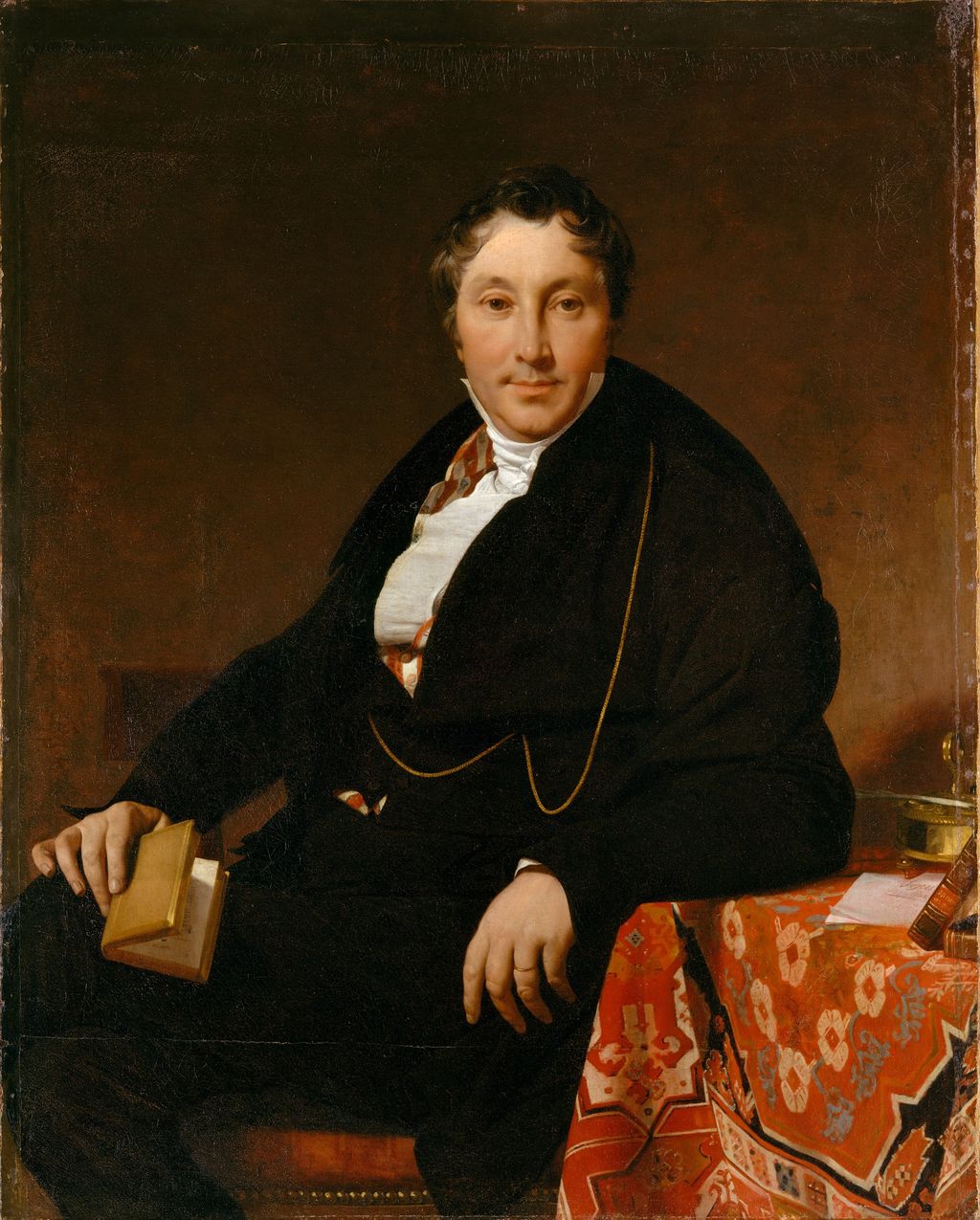
Ingres, Jacques-Louis Leblanc, 1823. The Metropolitan Museum of Art, 19.77.1. [10]
Look from one picture to the other. Both sitters wear black, but the clothes do different work. His coat gathers into a broad, enclosing mass; her dress has tightly gathered folds and transparent sleeves. Her gold chain drops in a long loop and returns towards the waist, while his travels across the chest. Each sitter's hands occupy different levels. A book helps anchor his lower body; her hand rests over the chair arm while the other reaches towards the opposite edge. The bright shawl spread across her lap answers the carpet over his table. These correspondences connect the canvases without making the sitters interchangeable. Hale found a red-brown layer across Monsieur Leblanc, but only behind Madame Leblanc. [11] Monsieur Leblanc’s canvas was enlarged; Hale tentatively connects the alterations with paired frames. [11]
Madame Leblanc’s armrest and arms were revised. [11] Her apparently settled ease emerged from alternatives. The portrait was eventually exhibited alone at the Salon of 1834. [7] An image designed in relation to another person could acquire a very different public life when removed from its companion.
How authority occupies a portrait
The hands in Louis-François Bertin's portrait spread over his knees. His arms enclose the torso, and the broadly planted body presses towards the viewer. A pale wall supplies almost no competing incident. The sitter's name appears above him, but his professional equipment is absent: the portrait does without a desk, newspaper or pen. The Louvre dates the painting to 1832 and records its appearance at the Salon of 1833. [12]
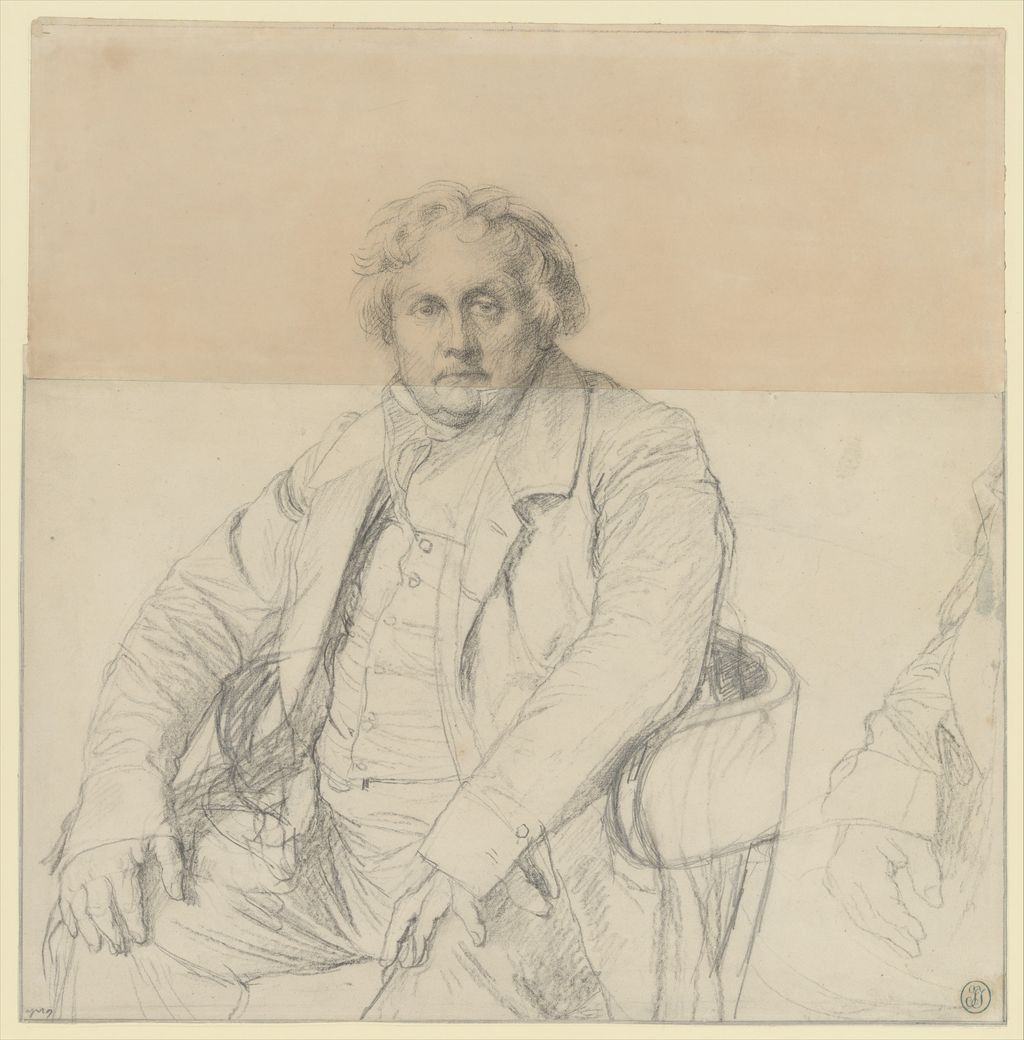
Ingres, Study for the Portrait of Louis-François Bertin, undated. The Metropolitan Museum of Art, 43.85.4. [13]
The visual argument begins with the body. The spreading fingers and strongly projected knees give ordinary sitting an emphatic physical structure. Small details of white collar, rumpled hair and reflected light keep the overall mass from becoming anonymous. Beside it, Amédée-David de Pastoret, painted in 1823–26, offers a different demonstration of status. His embroidered black uniform identifies his office as an auditor for the Council of State; the Legion of Honour and sword supply explicit marks of distinction. [14] His left hand opens against the hip, its long fingers set beside the decorated hilt, while the other hand reaches into the coat. The elbow projects decisively sideways. Green drapery and wall covering support a slimmer, more upright silhouette than Bertin's.
The contrast is useful because both men wear dark clothes and return our gaze. Authority nevertheless has a different construction in each painting. Pastoret's is articulated through office, costume and a controlled standing pose; Bertin's seems to emerge from the weight and pressure of a seated body. The force of the encounter survives that difference in public roles and outward presentation.
Napoleon I on His Imperial Throne, painted in 1806, pushes the problem to a ceremonial extreme. [15] The throne's great circular back surrounds the emperor's head. White fur, red fabric, gold ornament and the long staffs of the regalia spread across almost the whole canvas. The hands participate in an apparatus of rule: they hold, support and connect its objects. Compared with Bertin's exposed fingers, they have become relatively small components of a much larger image.
Its effect differs sharply from a sovereign casually inhabiting a room. Napoleon appears fixed at the centre of a dense arrangement whose symmetry and surface detail give ceremony a lasting physical form. Bertin's plain setting and Napoleon's accumulated splendour show how far Ingres could vary the environment while retaining a commanding confrontation with the viewer.
Even the most apparently immediate of these encounters was prepared. A black-chalk and graphite study for Bertin in the Metropolitan Museum establishes the seated body and the widely placed hands. The coat is built from searching lines, and a further hand study appears at the side of the sheet. [16] Drawing makes the pose look worked upon, rather than simply caught. Later accounts conflict about the discovery of Bertin’s pose. [17]
Dress and rooms as parts of the likeness
The Comtesse d'Haussonville: turning within a room
The blue-grey dress in the Comtesse d'Haussonville's portrait runs downwards in long folds, while her hands turn the eye back towards the head. One rests beneath her chin; the other reaches across her waist. Behind her, the mirror shows the back of the coiffure and the red ribbon. Flowers and small objects crowd the mantelpiece. The reflected view opens another aspect of the person while keeping her enclosed in the room's decorative surfaces.
Louise de Broglie met Ingres in Rome in 1840; her portrait followed in 1842–45. [18] This social setting helps explain the opportunity to paint her. It is less useful as a shortcut to interpreting the precise angle of her head or the meaning of an expression. Her identity and family associations are documented; the resulting impression of poise is something we encounter in the picture.
The portrait also shows how an interior extends a likeness. We recognise the silhouette instantly, but its individuality is distributed across the arrangement: the pale dress against the darker reflected background, the turn of the upper body and the suspended hand at the chin. Remove the mantelpiece or the mirror and the figure's relation to the surrounding space changes. Accessories have compositional work to do as well as social associations.
The Princesse de Broglie: blue satin and measured preparation
In the Princesse de Broglie, painted in 1851–53, the background is comparatively restrained. Pauline de Broglie's pale arms cross against an expanse of brilliant blue satin; white lace gathers at the neckline and sleeves, and a patterned shawl lies over the chair. The Metropolitan Museum records the commission from her husband, Albert de Broglie. [19]
The dress continually changes character as the eye travels across it. Along the left side of the skirt, highlights cut into deep folds; around the bodice, small gathered edges and bows make a denser pattern. The lace both covers and exposes the arms. Jewellery introduces tiny hard accents against these softer surfaces. Meanwhile, the head remains relatively quiet. Its scale and placement give it a different pace from the broad, restless field of fabric below. Broglie’s nude and dressed studies share grids; a full-scale arm tracing aided transfer. [11] Broglie’s grey background covers deep blue; the hat was added over the chair and shawl. [11]
Madame Moitessier: a second view in the mirror
The seated Madame Moitessier, completed in 1856, expands the interior again. Her flowered dress occupies a large part of the lower canvas. One forefinger rises towards the temple, while the other hand rests with a fan near the opposite side. In the mirror, the head appears in profile and the red ribbons become more conspicuous. [20]
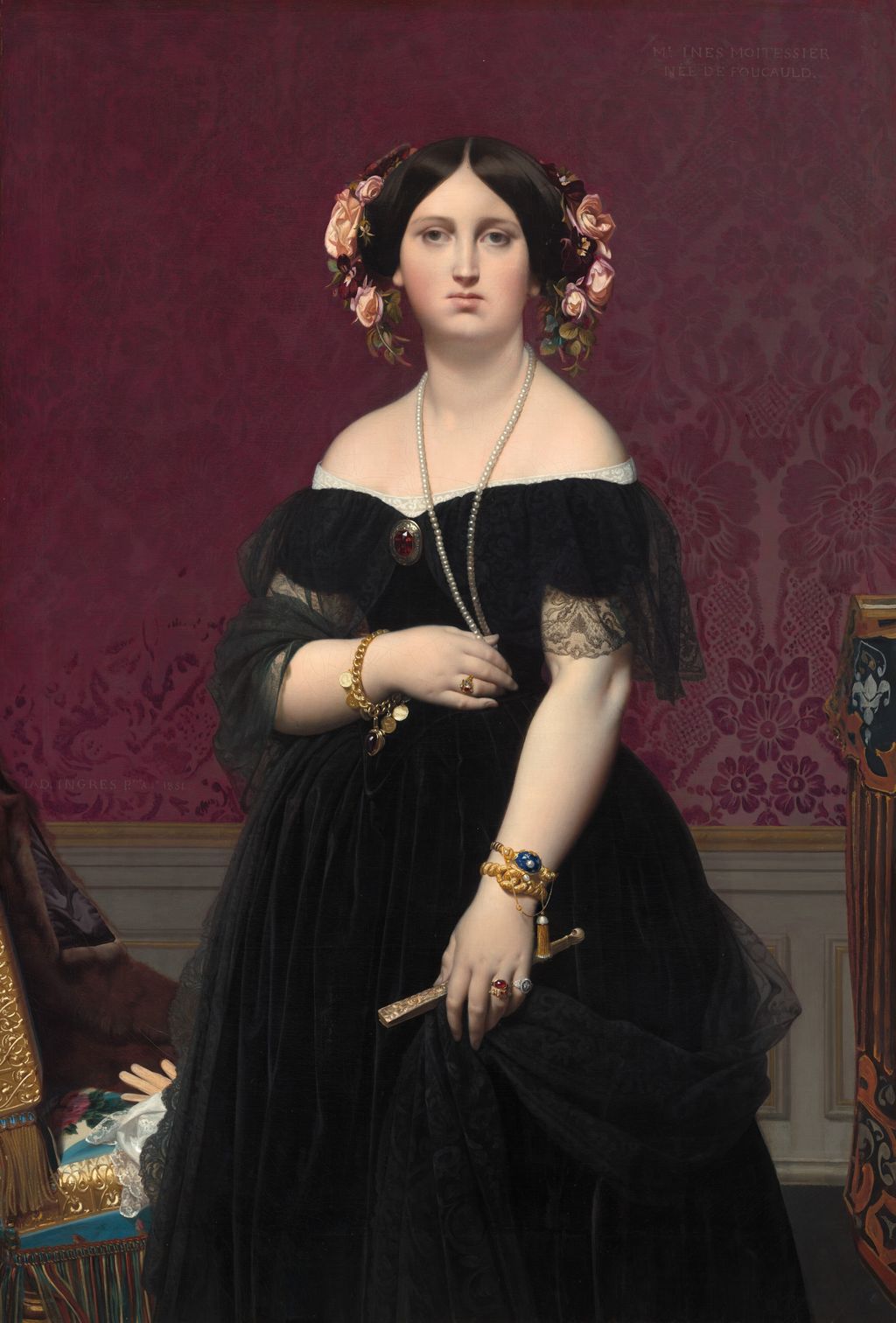
Ingres, Madame Moitessier, standing portrait, 1851. National Gallery of Art, Washington, 1946.7.18. [21]
The National Gallery notes that the mirror reflection does not match Madame Moitessier’s position. It also connects her raised-hand pose to a Roman mural from Herculaneum. [20] The long making of the portrait also involved the sitter. The National Gallery records her active collaboration in revisions during the years following the 1844 commission. A daughter was removed from the composition and the dress changed as the painting developed. [20] This is valuable evidence of participation. It gives the portrait a history of negotiation and revision without requiring us to invent particular conversations or attribute every decision to one person. Ingres requested Rothschild’s blue dress in an 1846 letter; blue touches on the finished portrait lie above pink paint. [2][22]
Recognising a person without inventing a personality
A portrait's name feels like a secure point of entry. Sometimes the name itself needs scrutiny. Rouen's museum identifies the sitter of La Belle Zélie, dated 1806, as a woman formerly identified erroneously as Madame Aymon. The familiar title does not recover her documented individual identity. [23] It is possible to recognise the particularity of a painted face without knowing whose face it is.
The distinction matters for portraits whose subjects have frequently been described through suggestive labels. Words such as seductive, reserved, coquettish or mysterious may record a viewer's response to an expression and pose. They do not establish the sitter's disposition. Ingres's portraits make that gap especially apparent: facial particularity is presented through a strongly organised image.
A more defensible starting point is to ask what is known, then return to the painting. With Madame Moitessier, there is documentary support for participation in changes. With the Leblancs, there is a social relationship with the artist and a designed relationship between the canvases. Duvaucey offers a particularly revealing case. Chantilly credits Hans Naef’s 1968 research with identifying Anna Antonia de Nittis, married Duvaucey. [18]
Drawn portraits: a complete encounter on paper
Painted portraits can make clothing and furniture seem almost touchable. Ingres's portrait drawings achieve a different balance between what is specified and what is left open. The concentration of detail in the head, set against lighter contours elsewhere, asks the eye to complete a body without needing every surface to be filled. Rabinow records portrait work for diplomats and foreign tourists in 1815. [24] Such sheets offered portable likenesses, but their visual economy should not lead us to treat them as merely reduced substitutes for paintings.
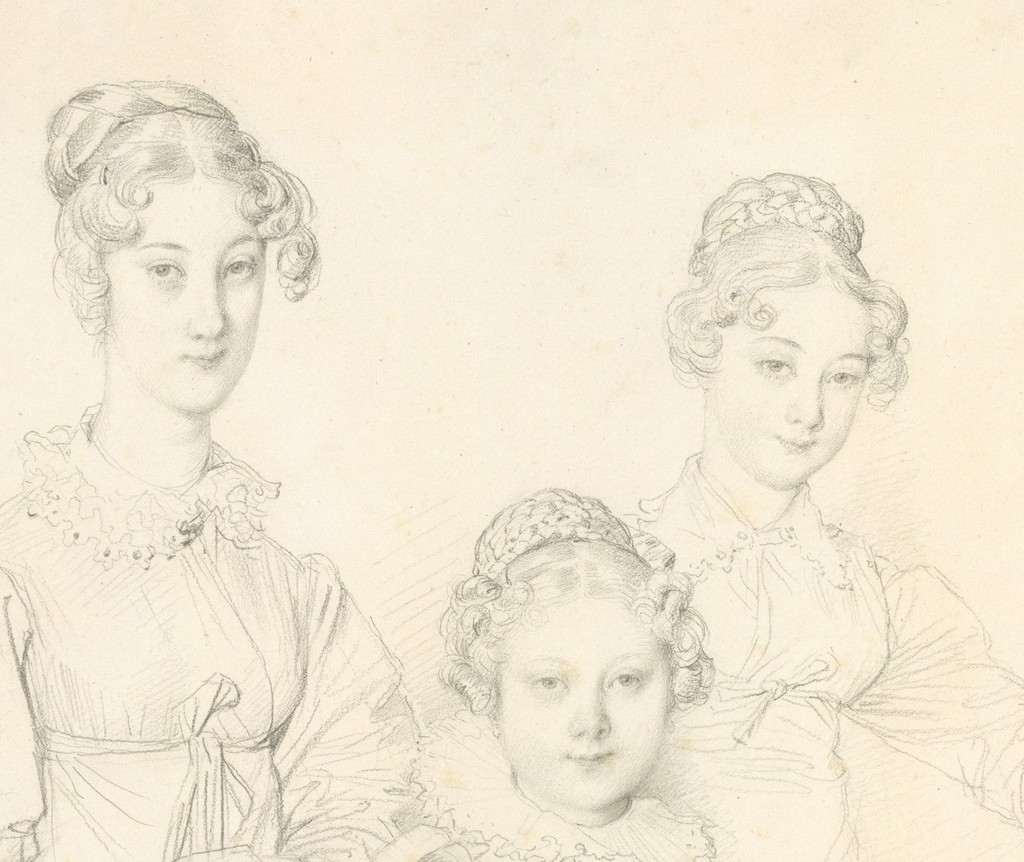
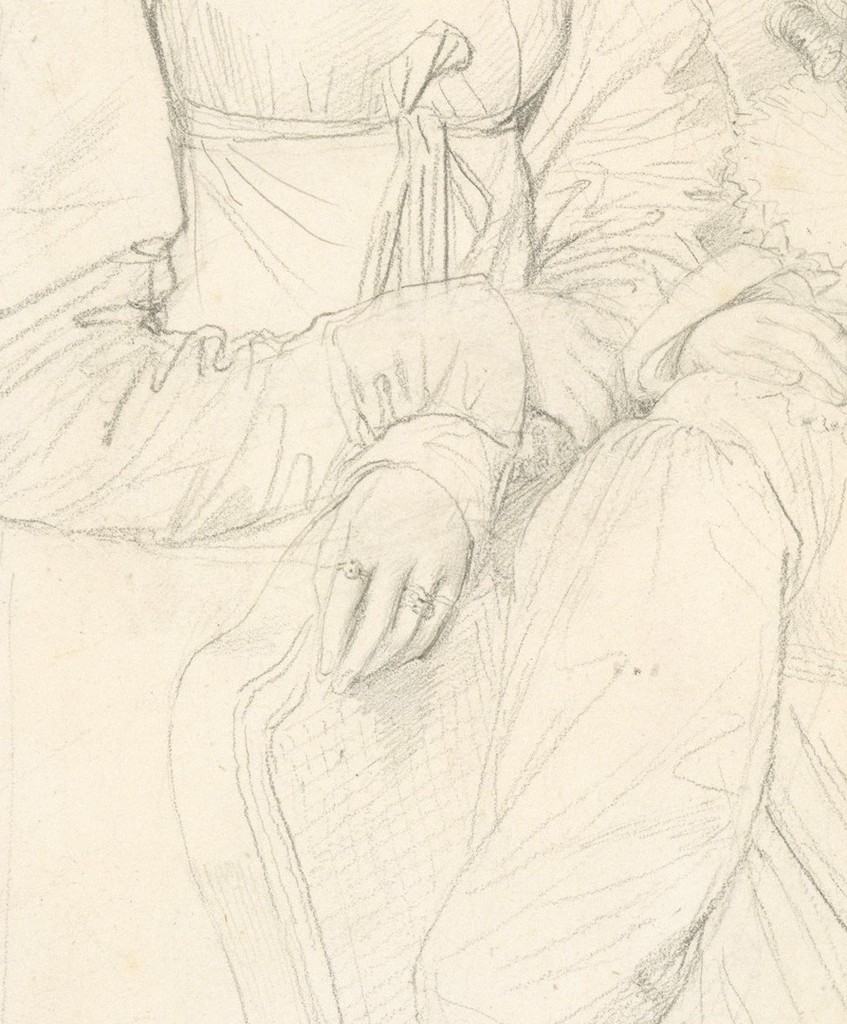
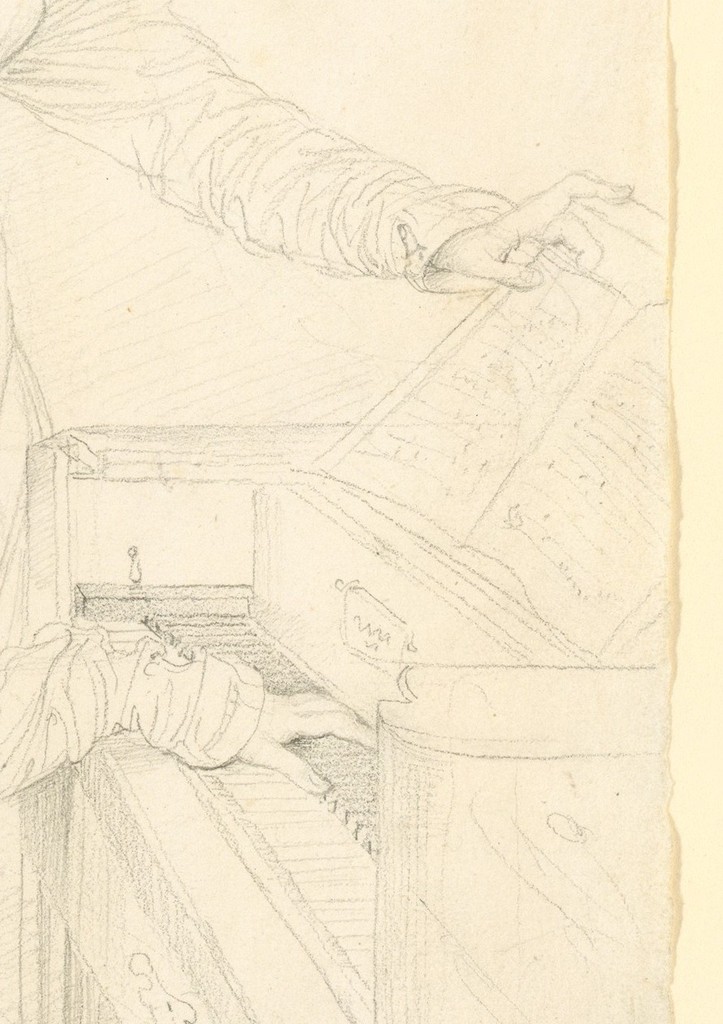
The Met’s 1818 graphite drawing presents the three Kaunitz sisters, daughters of Austria’s ambassador to Rome. It suggests the piano setting may be the family’s concert room. [25] Three heads form a loose triangle. The figures overlap, yet their gazes bring each face separately towards us. A hand on a chair and hands near the keyboard connect the group to a lightly indicated interior.
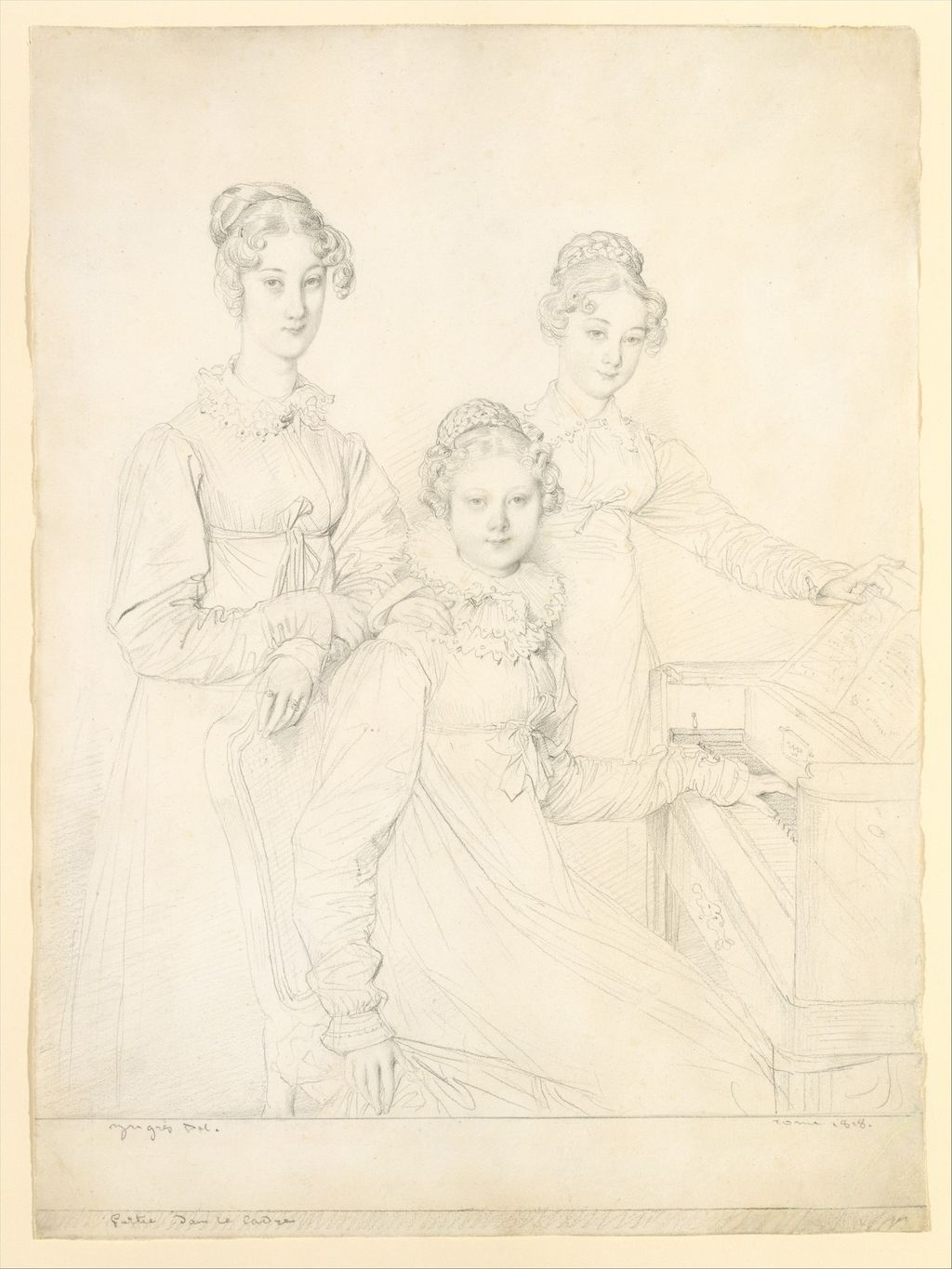
Ingres, The Kaunitz Sisters: Leopoldine, Caroline and Ferdinandine, 1818. Graphite. The Metropolitan Museum of Art, 1998.21. [26]
The faces receive the softest modelling. Dresses and furniture depend more heavily on contour, folds and fine hatching. The difference creates a clear order of attention: the sisters appear first as people, then as figures arranged around shared music. Empty paper remains active around the bodies. It gives breathing space to the ensemble while allowing the piano's curved edge to be stated with very little shading.
An intimate single portrait can be more compressed still. In the Metropolitan's graphite likeness of Ingres's first wife, Madeleine Chapelle, dated 1814, the head turns back towards us above a dress whose structure is largely given by lines. [27] The face has weight and softness; the sleeve's pattern and collar have a quick descriptive energy. The contrast makes the encounter legible without giving every part the same degree of finish.
The later painted Madame Ingres depicts Delphine Ingres-Ramel in 1859 and belongs to the Oskar Reinhart collection in Winterthur. [28] The hand raised beside her face, blue dress and lace create a more elaborate surface than the graphite portrait. A shared marital title conceals two distinct people and two very different objects; using their first names keeps that difference visible.
A finished drawing and a preparatory study also make different demands. The Kaunitz sheet presents an arranged group. The Bertin study retains alternatives and searching marks because it was helping to establish another image. Calling both simply 'sketches' conceals that difference. The drawings study follows these functions and materials in greater depth.
Annotated Details from Portraits on paper and canvas
The numbered points identify visible features discussed in this article. Return from each detail to the whole composition. Each caption identifies the work shown.
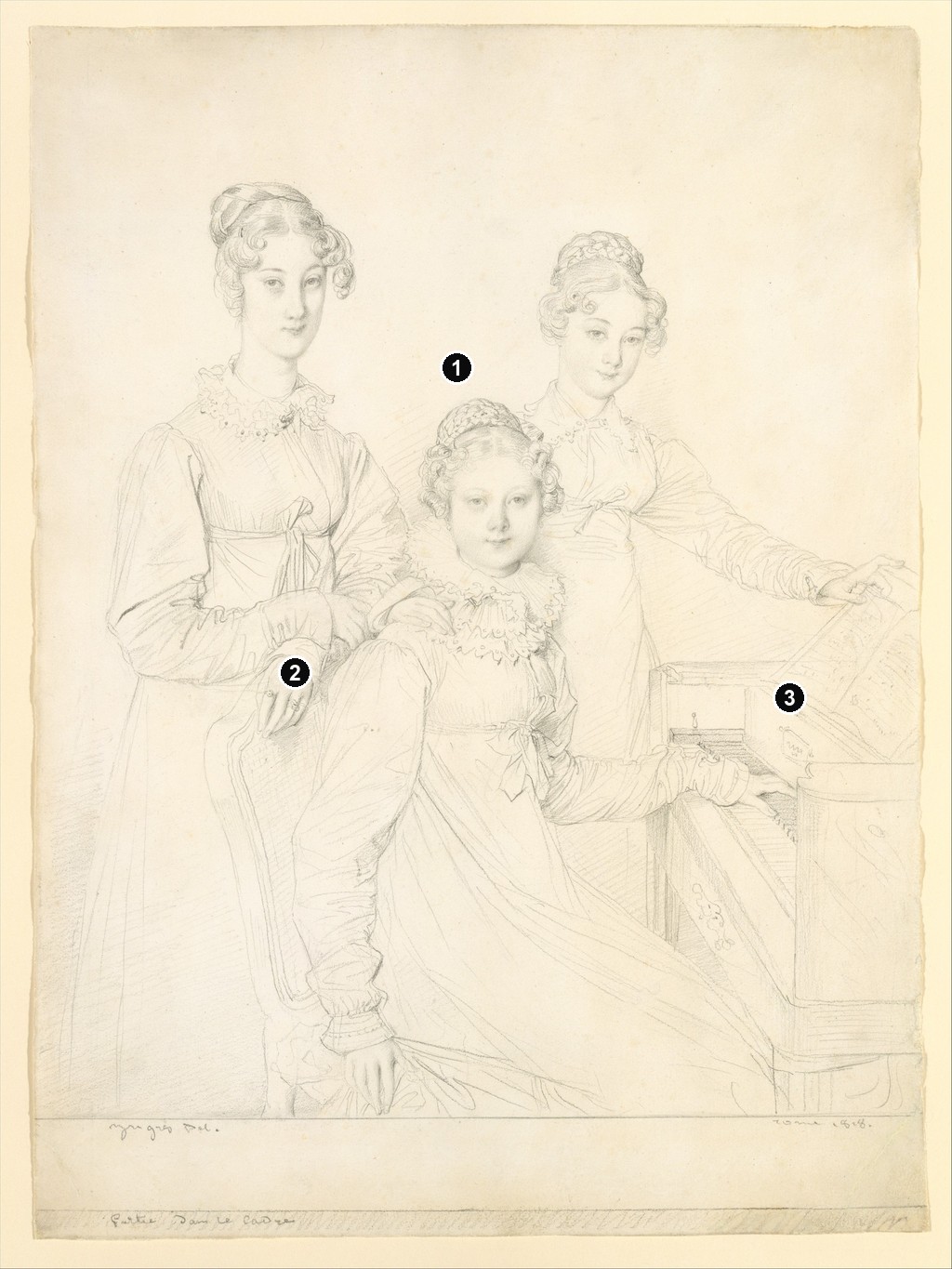
The Kaunitz Sisters
Ingres, The Kaunitz Sisters (Met 1998.21). Gift of Mrs. Charles Wrightsman, in honor of Philippe de Montebello, 1998. Image source. CC0 / Public domain.
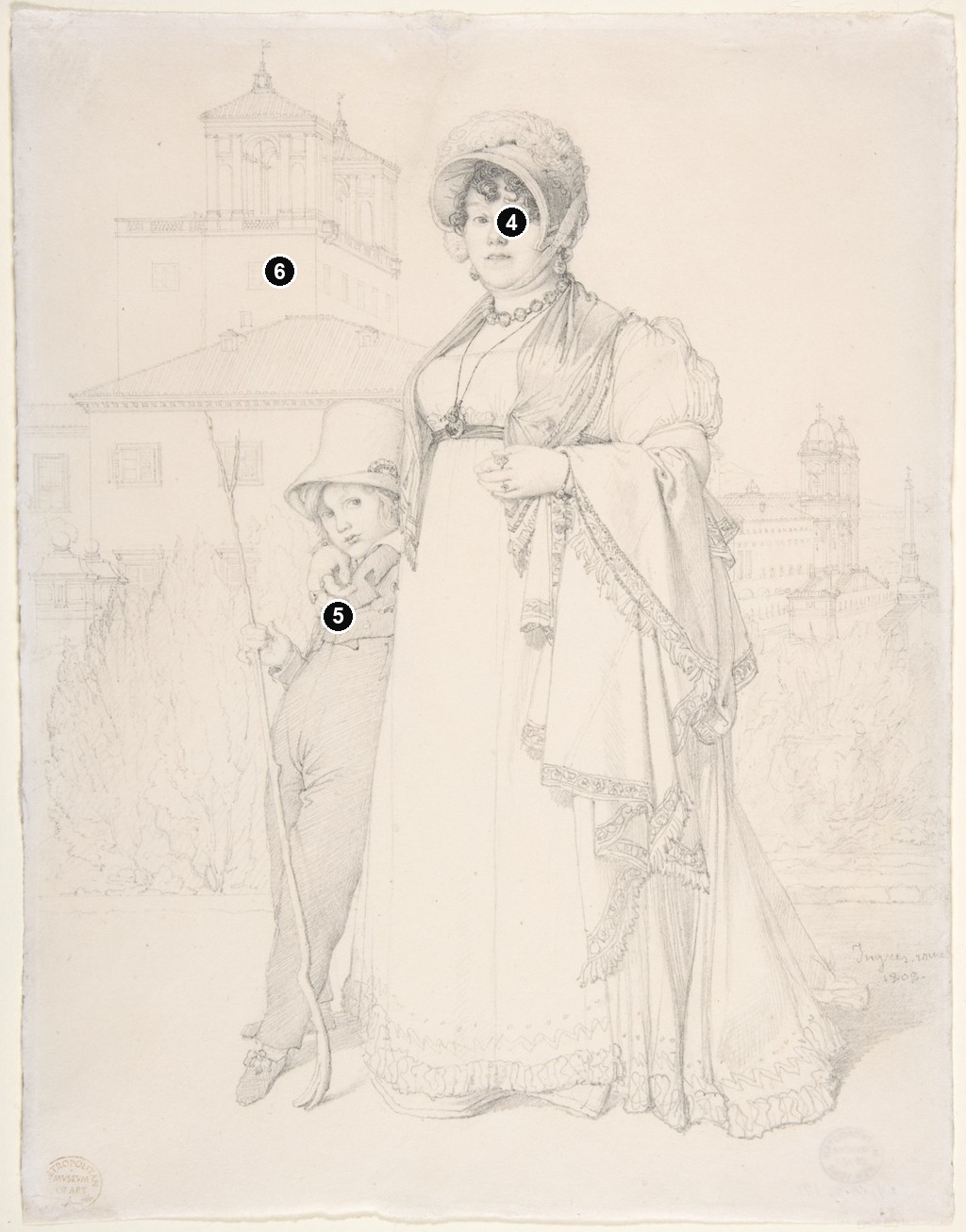
Madame Guillaume Guillon Lethière and Lucien
Ingres, Madame Guillaume Guillon Lethière and her son Lucien, 1808. Graphite. The Metropolitan Museum of Art, 29.100.191. H. O. Havemeyer Collection, Bequest of Mrs. H. O. Havemeyer, 1929. Image source. CC0 / Public domain.
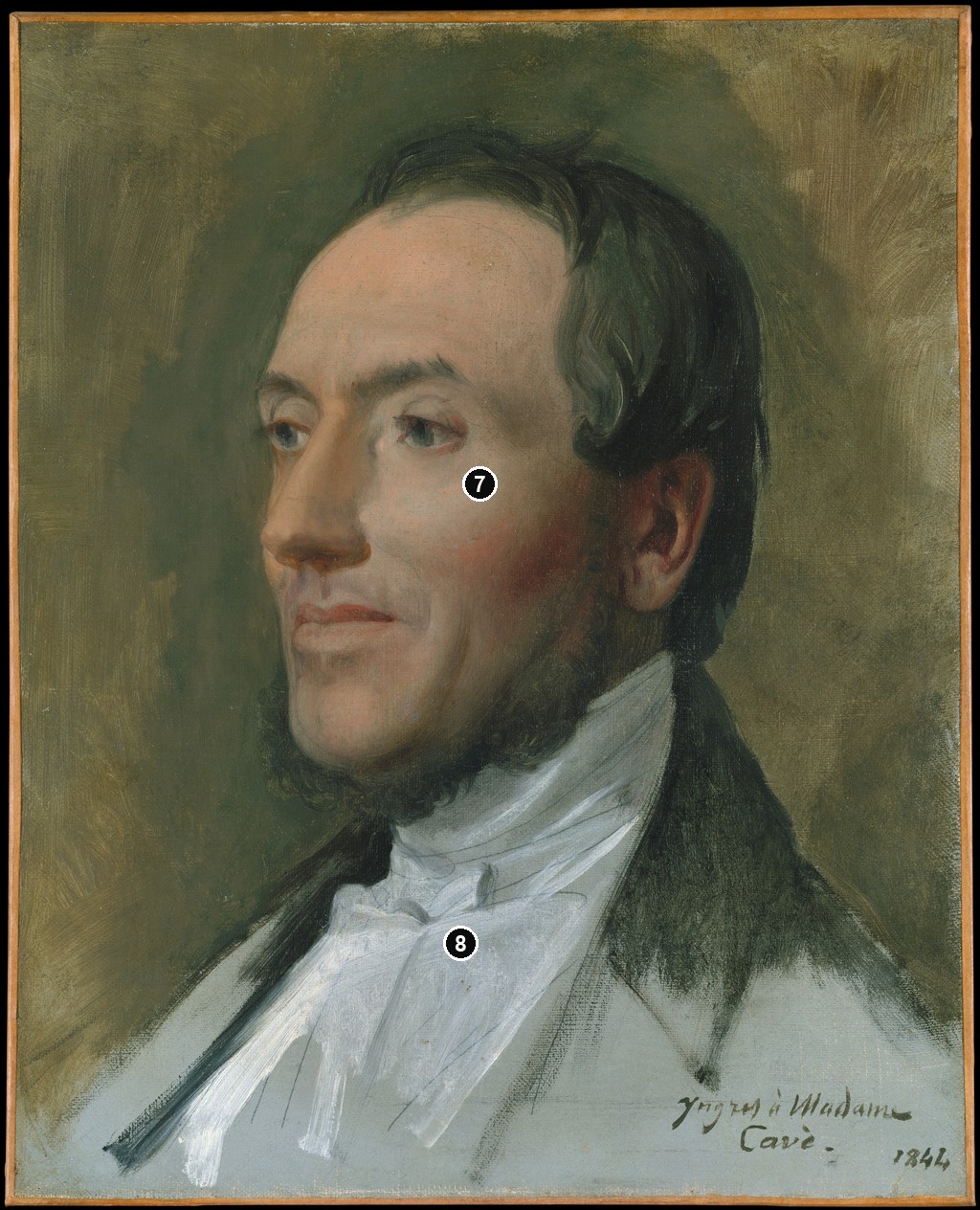
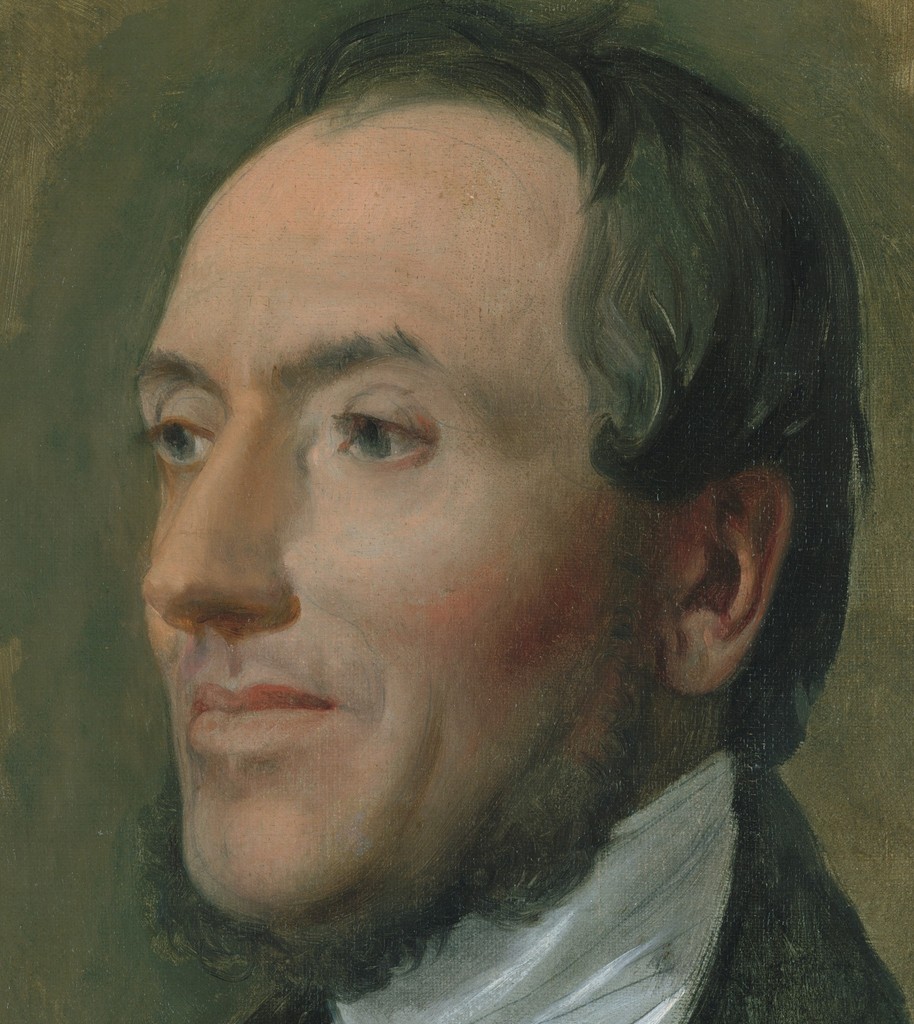
Edmond Cavé
Ingres, Edmond Cavé, 1844. The Metropolitan Museum of Art, 43.85.2. Bequest of Grace Rainey Rogers, 1943. Image source. CC0 / Public domain.
Madame Edmond Cavé
Ingres, Madame Edmond Cavé, c. 1831–34. The Metropolitan Museum of Art, 43.85.3. Bequest of Grace Rainey Rogers, 1943. Image source. CC0 / Public domain.
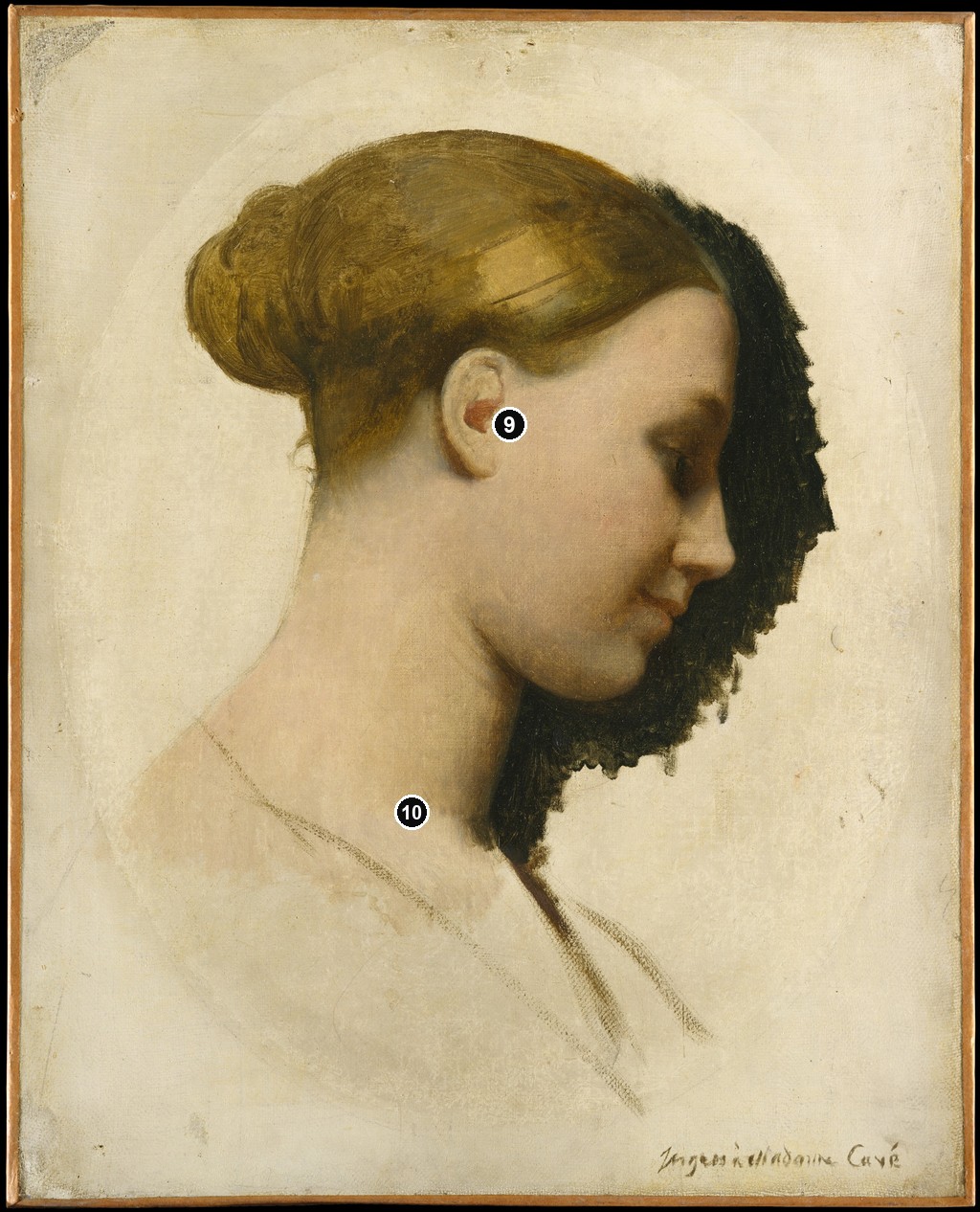
Details from PORTRAITS ON PAPER AND CANVAS
Compare the Kaunitz sisters and the separate 1808 drawing of Madame Guillaume Guillon Lethière with Lucien, then the two different portraits of Edmond Cavé and Madame Edmond Cavé. The sitters and dates are identified in each caption.
The Kaunitz Sisters
Three faces arranged at different heights
Three faces occupy different heights above the overlapping bodies. The dark eyes and carefully drawn curls give each head a separate presence within the group.
Hands beside the chair back
Two hands lie beside the curving chair back on the left. Their shorter lines join the standing figure to the seated figure without closing all the surrounding outlines.
The keyboard and the open music
A hand extends towards the keyboard beneath the open music. Straighter lines describe these furnishings beside the looser curves of the sleeves and dress.
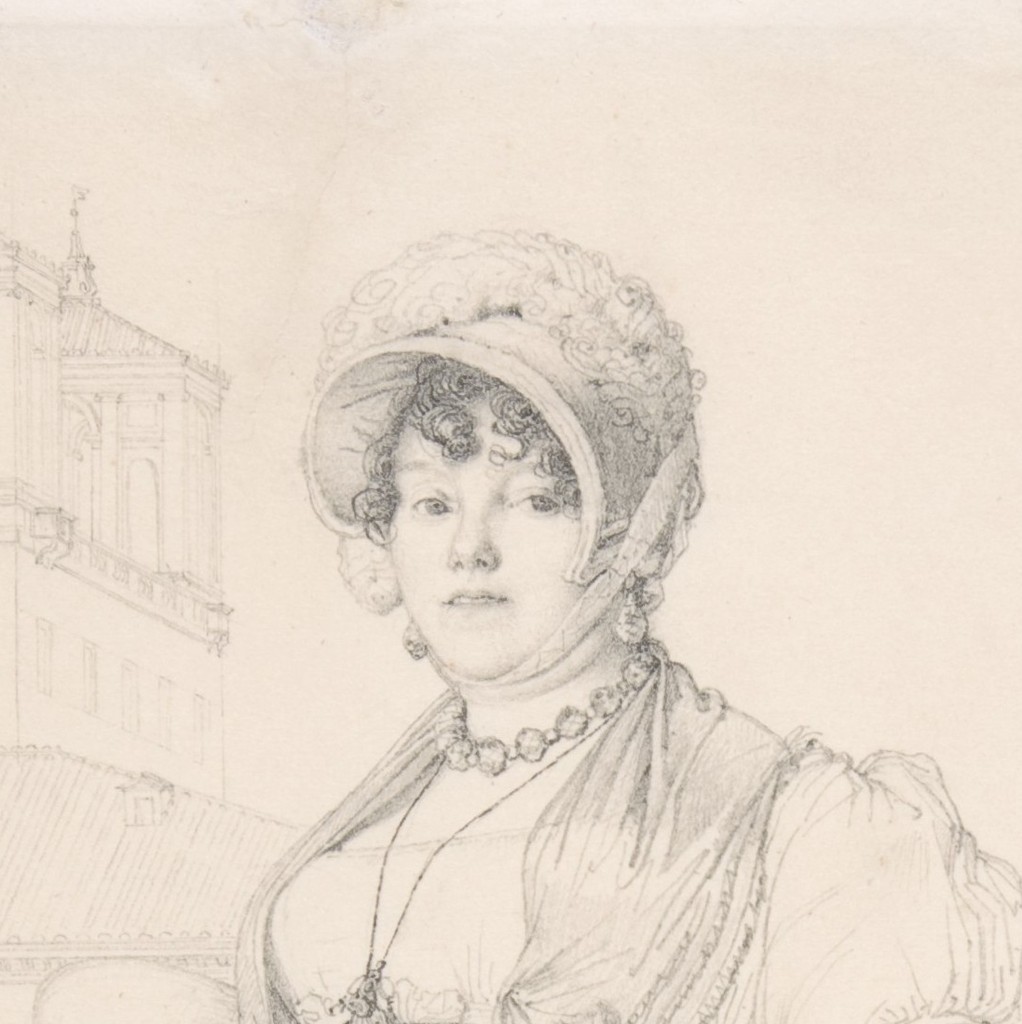
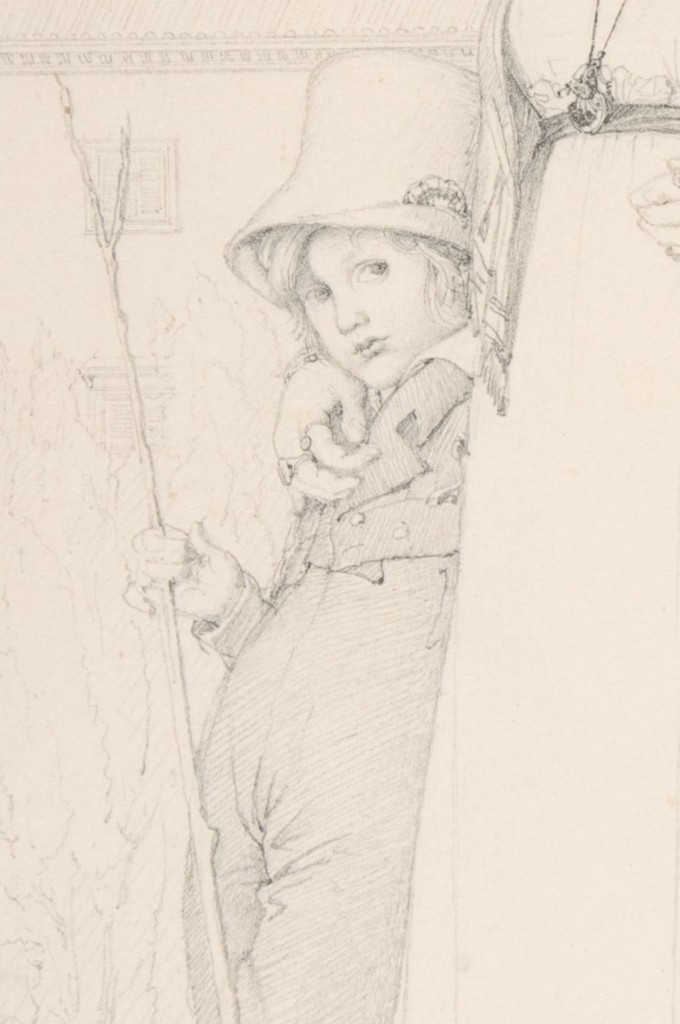
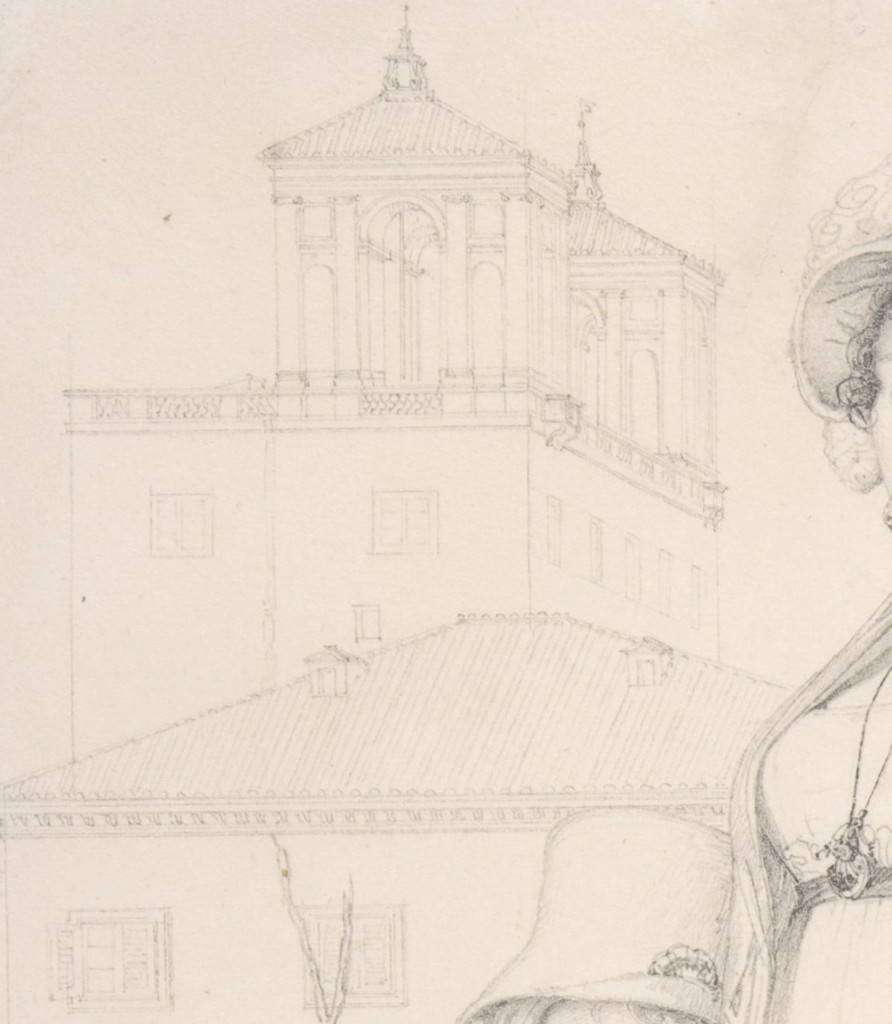
Madame Guillaume Guillon Lethière and Lucien
The face beneath an elaborate bonnet
The face sits beneath a bonnet filled with curls, loops and small repeated forms. A necklace and the crossing edges of the garment continue the pattern below the head.
The boy beside the lowered hand
The boy leans beside the adult’s lowered hand and hanging cloth. His tilted head, small hat and bent arm make a compact figure within the larger standing group.
Architecture behind the two sitters
A tall building rises behind the two figures, with lightly drawn roofs, windows and an upper façade. These smaller lines keep the setting distinct from the darker faces.
Edmond Cavé
The turned face and dark hair
The face turns away from the viewer, framed by dark hair and side whiskers. Small shifts of light around the eye, cheek and mouth describe its rounded form.
White cloth beside the abbreviated coat
Bright strokes cross the white neckcloth beside broader dark marks of the coat. The lower edges remain more loosely described than the face above.
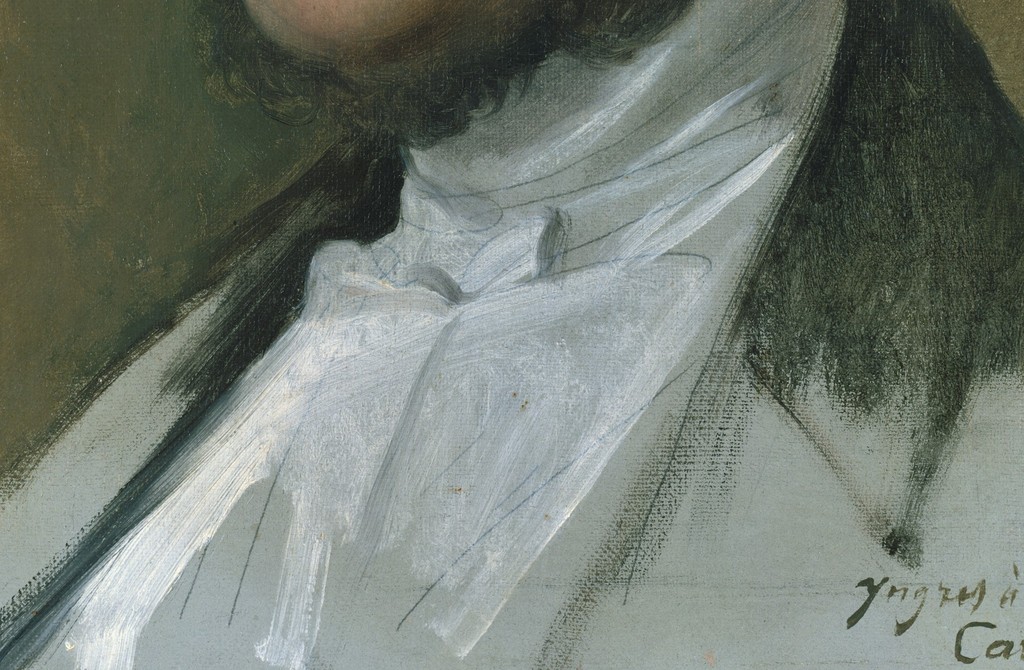
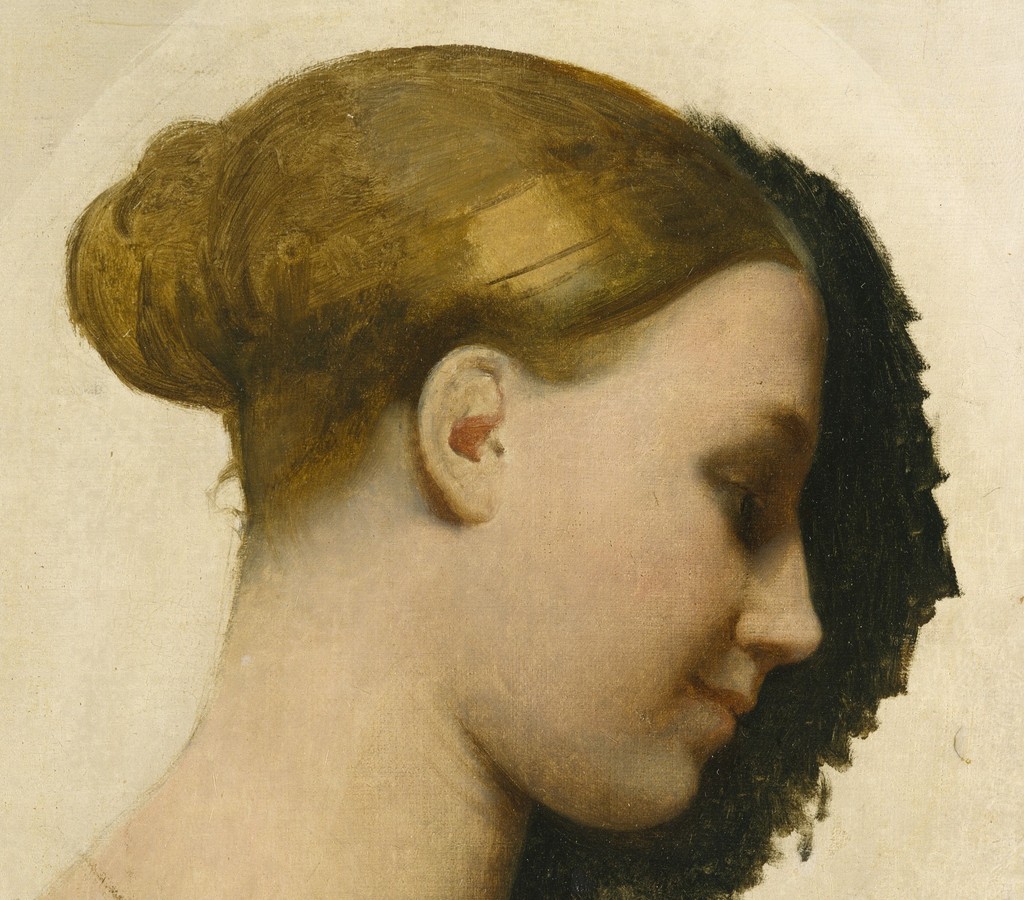
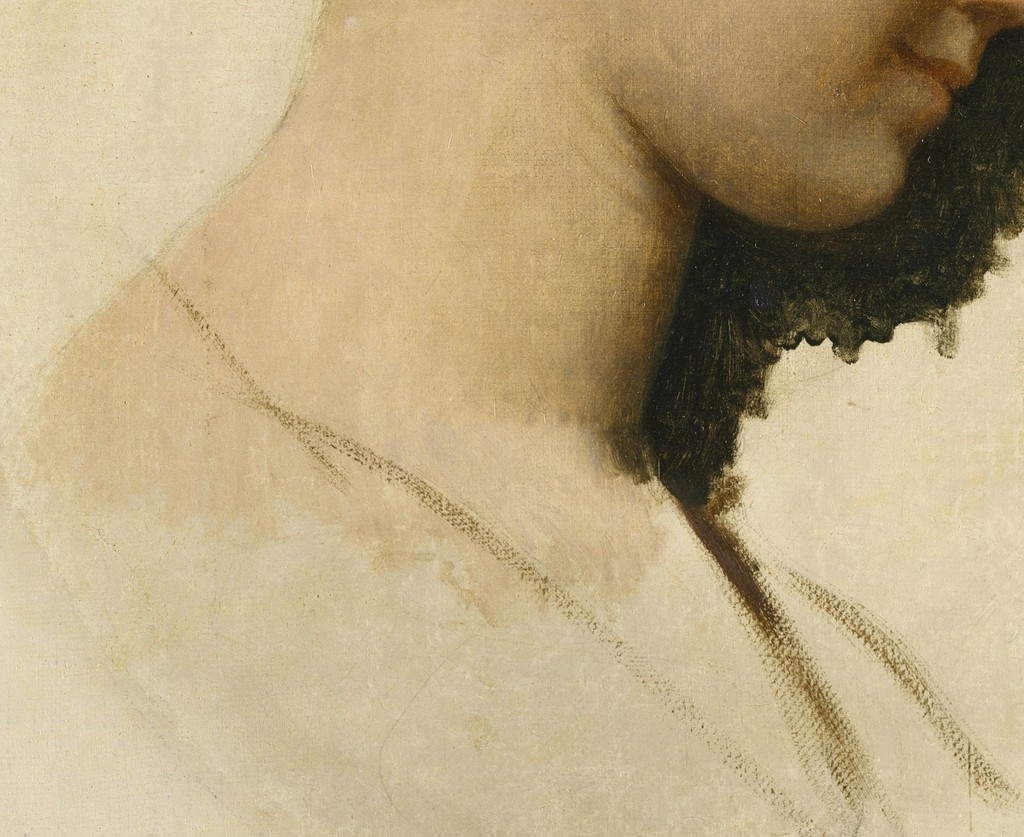
Madame Edmond Cavé
The inclined face and gathered hair
The head inclines towards the right beneath hair gathered into a rounded bun. The dark area behind the face makes the pale profile especially clear.
The neck beside pale surrounding cloth
The neck descends into a broad pale area of clothing. More definite dark strokes meet lighter, more open passages around the shoulder and lower outline.
Whose hand, and how much can the surface tell us?
The involvement of other artists is a legitimate question in Ingres's portraits. It requires evidence for particular works. A finely finished passage cannot be assigned to an assistant merely because it depicts furniture, nor can a landscape automatically be detached from the painted figure before it. Hale found no technical evidence requiring separate landscape painters for Granet, Moltedo or Gouriev. [11] Senonnes combines a transfer grid with green underpainting beneath yellow furnishings. [11] Technical investigation makes visible a kind of labour that the finished picture suppresses. It does not by itself identify every participant. Chantilly distinguishes the original Orléans portrait from later versions involving Ingres’s workshop. [18] The style and technique study develops the material evidence further.
What the public saw
Shelton traces disagreement over likeness, status and artistic ambition. [3] Napoleon’s 1806 portrait attracted hostile criticism. [3] Bertin won public success in 1833. [3] The 1846 Bonne-Nouvelle exhibition gathered eleven Ingres paintings. [3] D’Haussonville’s proportions divided critics. [3] The 1855 retrospective placed portraits beside history paintings. [1][3]
A legacy of collecting, comparison and revision
Edgar Degas's admiration took the concrete form of ownership. He acquired the Leblanc portraits in 1896 and Pastoret in 1897, keeping them until his death in 1917. The Metropolitan Museum bought the pair at the sale of his collection in 1918. [8][14] These choices bring an early family pair and a Restoration portrait into the working world of a later artist. They offer more precise evidence of sustained interest than a general list of modern painters said to have admired Ingres.
Ingres announced his Montauban gift in 1851; his bequest was accepted in 1867. [24] The museum archive allows a composed final image to be compared with a sequence of possibilities. A lowered eyelid, revised arm or transferred contour brings the sitter's apparent stillness back into the movement of making. Chantilly’s 1806-exhibited self-portrait was substantially altered in 1841–51, as technical research confirms. [18] A portrait can preserve a face while its format, costume and gesture acquire a later history.
For a rewarding comparison, choose two portraits and begin below the face. Follow the hands, then the clothing, then the places where the figure meets its surroundings. Return to the eyes only after that circuit. Ingres's people often become more particular as we notice how thoroughly their presence depends upon the rest of the picture.
Artworks directory
Explore 150 paintings, drawings and an original lithograph. This selection includes related versions and studies; dates distinguish completed works from later revisions.
| Name | Date | Medium |
|---|---|---|
| The Apotheosis of Homer | 1827 | Painting |
| Grande Odalisque | 1814 | Painting |
| The Turkish Bath | 1859–1862 | Painting |
| Madame Moitessier Seated | 1856 | Painting |
| Portrait of Monsieur Bertin | 1832 | Painting |
| Napoleon I on His Imperial Throne | 1806 | Painting |
| Odalisque with Slave | 1839 | Painting |
| The Ambassadors of Agamemnon in the Tent of Achilles | 1801 (competition) | Painting |
| The Valpinçon Bather | 1808 | Painting |
| The Source | 1856 | Painting |
| Oedipus Explaining the Enigma of the Sphinx | 1808; revised probably before 1827 | Painting |
| The Vow of Louis XIII | 1824 | Painting |
| Antiochus and Stratonice | 1840 | Painting |
| The Comtesse d’Haussonville | 1845 | Painting |
| The Princesse de Broglie | 1851–1853 | Painting |
| Jupiter and Thetis | 1811 | Painting |
| The Dream of Ossian | 1813 | Painting |
| The Martyrdom of Saint Symphorian | 1834 | Painting |
| Venus Anadyomene | 1808–1848 | Painting |
| Portrait of Madame de Senonnes | 1814 | Painting |
| Madame Rivière | 1805 | Painting |
| Mademoiselle Caroline Rivière | 1805 | Painting |
| Portrait of Philibert Rivière | 1805 | Painting |
| Bonaparte First Consul | 1804 | Painting |
| The Death of Leonardo da Vinci | 1818 | Painting |
| Joan of Arc at the Coronation of Charles VII | 1854 | Painting |
| Madame Duvaucey | 1807 | Painting |
| La Belle Zélie | 1806 | Painting |
| Madame Panckoucke | 1811 | Painting |
| Portrait of Charles Marcotte d’Argenteuil | 1810 | Painting |
| Joseph Antoine Moltedo | c.1810 | Painting |
| Madame Leblanc | 1823 | Painting |
| Delphine Ingres-Ramel (Portrait of Madame Ingres) | 1859 | Painting |
| Portrait of Amédée de Pastoret | 1823–1826 | Painting |
| Portrait of Baronne de Rothschild | 1848 | Painting |
| Madame Marcotte de Sainte Marie | 1826 | Painting |
| Madame Gonse | 1852 | Painting |
| Aretino in the Studio of Tintoretto | 1848 | Painting |
| Don Pedro of Toledo Kissing Henry IV’s Sword | 1831/1832 | Painting |
| Raphael and La Fornarina | 1814 | Painting |
| Roger Freeing Angelica | 1819 | Painting |
| Romulus’ Victory over Acron | 1812 | Painting |
| Self-Portrait at the Age of Twenty-Four | 1804; revised 1841–1851 | Painting |
| Male Torso | c.1800 | Painting |
| Odalisque in Grisaille (Ingres and workshop) | c.1824–1834 | Painting |
| The Small Bather | 1826 | Painting |
| The Little Bather Harem Interior | 1828 | Painting |
| Jesus Among the Doctors | 1862 | Painting |
| The Virgin Adoring the Host | 1852 | Painting |
| The Virgin of the Host | 1841 | Painting |
| Virgin of the Adoption | 1858 | Painting |
| Paolo and Francesca | 1814 | Painting |
| Homer Deified (revised composition, Louvre RF5273) | 1865 | Drawing |
| Odalisque with Slave (Louvre RF4622) | 1858 | Drawing |
| Odalisque (Walters Art Museum; Ingres and Paul Flandrin) | 1842 | Painting |
| Madame Moitessier Standing (National Gallery of Art) | 1851 | Painting |
| Jacques-Louis Leblanc (The Metropolitan Museum of Art) | 1823 | Painting |
| Ferdinand-Philippe, Duke of Orléans (Louvre RF2005-13) | 1842 | Painting |
| Ferdinand-Philippe, Duke of Orléans (Versailles MV5207; Ingres and workshop) | 1843 | Painting |
| Ferdinand-Philippe, Duke of Orléans (Versailles MV5209; Ingres and workshop) | 1844 | Painting |
| Antiochus and Stratonice (Musée Fabre; Ingres and Raymond Balze) | 1866 | Painting |
| Antiochus and Stratonice (Kunstmuseum Bern, Gurlitt bequest) | Undated (early dating proposed) | Drawing |
| Composition study for Antiochus and Stratonice (MIB867.2193) | 1806 | Drawing |
| Study for the Figure of Stratonice (Met63.66) | 1834–1840 | Graphite, black chalk and charcoal |
| Nude figure study for Stratonice (Boijmans F II 36 PK) | c.1834–1840 | Drawing |
| Paolo and Francesca (The Barber Institute,54.6) | c.1814–1820 | Painting |
| Paolo and Francesca (The Hyde Collection,1971.24) | c.1855–1860 | Painting |
| Paolo and Francesca (Amsterdam Museum TA10970) | 1820 | Drawing |
| Paolo and Francesca (dedicated to Artaud de Montor) | 1816 | Drawing |
| Study for the Bust of Francesca (MIB867.1398) | 1819 | Drawing |
| Study for the Bust of Francesca (MIB867.1396) | 1819 | Drawing |
| The Archangel Raphael, first idea (MIB867.2488) | 1842 | Drawing |
| The Archangel Raphael (MIB867.2500) | 1842 | Drawing |
| The Archangel Raphael Carrying Human Prayers to God (Chantilly DE513) | 1844 | Drawing |
| Louis-Philippe as Saint Philip, stained-glass study | 1844 | Drawing |
| Marie Frédéric Eugène de Reiset (Ford Collection RBF171-2) | 1844 | Drawing |
| Virgil Reading the Aeneid (Toulouse) | Begun 1811 | Painting |
| Tu Marcellus Eris (Brussels, inv. 1836) | c.1814 (museum dating) | Painting |
| Jean-François Gilibert | 1804 | Painting |
| François-Marius Granet | 1807 (museum dating) | Painting |
| Count Nikolai Dmitrievich Guryev | 1821 | Painting |
| Caroline Murat, Queen of Naples | 1814 | Painting |
| Count Mathieu Molé | 1834 | Painting |
| Cherubini and the Muse of Lyric Poetry (Louvre) | 1842 | Painting |
| Luigi Cherubini (Cincinnati) | 1841 | Painting |
| Comtesse de Rayneval (Louvre RF4505) | 1841 | Drawing |
| Venus on Paphos (Antonie Balaÿ) | c.1852 | Painting |
| Prince Napoléon | 1855 | Painting |
| Study for The Apotheosis of Napoleon I (Petit Palais) | Late 1853 | Painting |
| The Apotheosis of Napoleon I (destroyed ceiling) | 1853 | Painting |
| The Journalist (MIB867.2733) | 1834? | Drawing |
| Henry VIII, after Holbein | c.1815–1820 (?) | Drawing |
| Madame Récamier, after David (MIB867.3637) | Undated (early Paris period) | Drawing |
| Study for Comtesse d’Haussonville (MIB867.259; background possibly by another hand) | 1842–1845 | Drawing |
| La Source (reduced version reported by Delaborde) | Date unrecorded; reported 1870 | Painting |
| Odalisque (autograph lithograph,NGA1946.21.117) | 1825; published1826 | Lithograph |
| Portrait of a Seated Lady | 1814 | Graphite |
| The Kaunitz Sisters (Leopoldine, Caroline, and Ferdinandine) | 1818 | Graphite |
| Portrait of a Man | 1814 | Graphite |
| Study for the Portrait of Louis-François Bertin (1766–1841) | n.d. | Black chalk and graphite |
| Studies for the Cadaver of Acron | ca. 1810–12 | Graphite on wove paper |
| Study for the Drapery of Molière in "The Apotheosis of Homer" | n.d. | Black chalk with stumping |
| Madame Guillaume Guillon Lethière, née Marie-Joseph-Honorée Vanzenne, and her son Lucien Lethière | 1808 | Graphite |
| Niccolò Paganini (1782–1840) | ca. 1830 | Counterproof or tracing strengthened with graphite and gouache on translucent paper |
| Lady Mary Cavendish-Bentinck (?-1843) | 1816 | Graphite |
| Madame Alexandre Lethière and Her Daughter Letizia | ca. 1815 | Graphite |
| Merry Joseph Blondel (1781–1853) | 1809 | Graphite |
| Ursin-Jules Vatinelle (1798–1881) | 1820 | Graphite |
| Bust of a Gypsy Girl (ascribed to Ingres) | 1819 | Graphite on wove paper |
| Study of a Seated Nude Male | n.d. | Graphite |
| The Archangel Raphael (Study for a stained-glass window in the chapel of Notre-Dame de la Compassion-Saint-Ferdinand, Neuilly) | ca. 1842 | Graphite |
| Lancelot-Théodore, comte Turpin de Crissé | probably 1818 | Graphite |
| Study for the Figure of the Iliad in "The Apotheosis of Homer" | ca. 1827 | Graphite and black chalk heightened with white chalk on brown paper |
| Comtesse Turpin de Crissé | probably 1818 | Graphite |
| Nude Figures for L'Âge d'Or, Château de Dampierre | n.d. | Graphite on brownish paper |
| Study of Figures (attributed to Ingres) | n.d. | Graphite |
| Study of Figures (attributed to Ingres) | n.d. | Graphite; squared in graphite |
| Admiral Sir Fleetwood Broughton Reynolds Pellew | 1817 | Graphite on wove paper |
| Madame Jean-Auguste-Dominique Ingres, née Madeleine Chapelle | 1814 | Graphite on off-white wove paper |
| Virgil Reading the Aeneid to Augustus, Livia, and Octavia | 1809/1819 (?) | Pen and black ink, graphite, brush and gray wash, white gouache heightening, Conté crayon on blue paper |
| General Louis-Étienne Dulong de Rosnay | 1818 | Graphite (hard and soft pencils) |
| Madame Alexandre Lethière, née Rosa Meli, and Her Daughter, Letizia | 1815 | Graphite |
| The Lawyer Paul Grand | 1834 | Graphite |
| Jean-Joseph Fournier | 1815 | Graphite |
| Armand Bertin | 1842 | Graphite |
| Madame Armand Bertin, née Marie-Anne-Cécile Dollfuss | 1843 | Graphite |
| The Architect Charles-Victor Famin | 1836 | Graphite |
| Henri Lehmann | 1850 | Graphite |
| Portrait of a Lady | ca. 1815–17 | Graphite |
| Edmond Cavé (1794–1852) | 1844 | Oil on canvas |
| Head of Saint John the Evangelist | probably ca. 1818–20 | Oil on canvas, laid down on wood |
| Madame Edmond Cavé (Marie-Elisabeth Blavot, ca. 1806–1883) | ca. 1831–34 | Oil on canvas |
| Madame Félix Gallois | 1852 | Graphite with touches of gold in oil to highlight jewelry, on buff wove paper. |
| Dr. François Mêlier | 1849 | Graphite with graphite framing lines, corrected with white, on buff wove paper |
| Portrait of Madame Rhode (Rhoda?) | 1810–20 | Graphite on pale buff wove paper |
| Study for "Raphael and the Fornarina"(?) | ca. 1814(?) | Graphite on white wove paper |
| Portrait of Madame Paul Meurice, née Palmyre Granger | ca. 1845–50 | Graphite on wove paper |
| Alexander the Great presenting Campaspe to Apelles | 1810 | Graphite, brush and brown wash; squared in graphite |
| Study of Hands for "Christ Among the Doctors" | 1852–62 | Graphite on tracing paper |
| Study for The Turkish Bath (RF34502) | about 1850 | Pen and brown ink with graphite, partially squared |
| Study for The Turkish Bath (RF23354) | Undated | Pen and brown ink with graphite on joined sheets |
| Study for The Turkish Bath (RF54702) | about 1859 | Pen and brown ink |
| Studies of women for The Turkish Bath (RF12292) | Undated | Black chalk |
| Achilles Receiving the Envoys of Agamemnon (Nationalmuseum sketch, NM2161) | 1801 | Oil on wood |
| Half-Length Bather (Musée Bonnat-Helleu,89) | 1807 | Oil on canvas |
| Oedipus and the Sphinx (National Gallery,NG3290) | about1826 | Oil on canvas |
| Oedipus and the Sphinx (Walters,37.9) | 1864 | Oil on canvas |
| Oedipus and the Valpinçon Bather, after David (MI.867.2035) | Undated | Graphite on tracing paper, after David |
| Study of the Virgin for The Vow of Louis XIII (Dijon,1758) | about1822 | Black chalk, stump and white chalk on brown wove paper |
| First Thought for The Vow of Louis XIII (MI.885.11.21) | 1822 | Oil on canvas |
Frequently Asked Questions
Ingres organised figures through strong contours, selected poses and carefully adjusted settings. In particular paintings, such as Madame Moitessier, the relationship between a figure and its reflection resists a straightforward reconstruction of the room. Each case deserves close looking; an unusual effect alone cannot establish precisely why he chose it. [20]
Compare the two Leblancs to see how separate pictures establish a relationship. Then look at Bertin beside Pastoret for different constructions of authority, and at Broglie beside Moitessier for the relationship between dress, body and setting. Each pairing makes a particular aspect of Ingres's practice easier to see.
Discussion
Look again at the images and ideas explored in Portraits. These editorial prompts invite your observations.
Reader Insights
Choose two of Ingres's portraits. Which change most alters your sense of the sitter: the arrangement of the hands, the clothing, the setting or the direction of the gaze? Point to one visible detail that supports your response.
Compare Bertin’s outward elbows with Pauline de Broglie’s gathered hands. What different kinds of space do the figures occupy?
Which features can you describe confidently in a portrait, and where would a claim about the sitter’s personality require further evidence?
Join the Conversation
Share a detail, comparison or question about Portraits below.
References
- Robert Rosenblum, “Ingres’s Portraits and Their Muses”, in Portraits by Ingres: Image of an Epoch, 1999, pp. 3–13. View source.
- Gary Tinterow, “Reflections”, in Metropolitan Museum Journal 35, 2000, pp. 193–197. View source.
- Andrew Carrington Shelton, “Critical Reception”, in Portraits by Ingres, 1999, pp. 497–515. View source.
- Musée du Louvre, Philibert Rivière (1766–1816). Collection record, MI 1445; date, description and inscription. (in French) View source.
- Musée du Louvre, Madame Rivière. Collection record, MI 1446; date, oval composition, clothing and Salon history. (in French) View source.
- Musée du Louvre, Mademoiselle Caroline Rivière. Collection record, MI 1447; date, original curved painted surface, clothing and Salon history. (in French) View source.
- The Metropolitan Museum of Art, Madame Jacques-Louis Leblanc (Françoise Poncelle, 1788–1839). Collection record, 19.77.2; 1823, proposed facing arrangement, relationship to pendant and Salon of 1834. View source.
- The Metropolitan Museum of Art, Jacques-Louis Leblanc (1774–1846). Collection record, 19.77.1; 1823, Florentine patronage, Degas's acquisition in 1896 and museum acquisition in 1918. View source.
- Supporting image. Ingres, Madame Leblanc, 1823. The Metropolitan Museum of Art; Catharine Lorillard Wolfe Collection, Wolfe Fund, 1918. Image source. CC0 / Public domain.
- Supporting image. Ingres, Jacques-Louis Leblanc, 1823. The Metropolitan Museum of Art, 19.77.1. Catharine Lorillard Wolfe Collection, Wolfe Fund, 1918. Image source. CC0 / Public domain.
- Charlotte Hale, “Technical Observations”, in Metropolitan Museum Journal 35, 2000, pp. 198–207. View source.
- Musée du Louvre, Louis-François Bertin, dit Bertin l'Aîné (1766–1841). Collection record, RF 1071; 1832, inscription, description and Salon of 1833. (in French) View source.
- Supporting image. Ingres, Study for the Portrait of Louis-François Bertin, undated. The Metropolitan Museum of Art, 43.85.4. Image source. CC0 / Public domain.
- Art Institute of Chicago, Amédée-David, the Comte de Pastoret. Collection record, 1971.452; 1823–26, Council of State uniform, insignia and Degas ownership, 1897–1917; also consulted through the museum's object API. View source.
- Musée de l'Armée, Napoléon Ier sur le trône impérial. Collection record, Inv. 4 Ea 89/1; 1806. (in French) View source.
- The Metropolitan Museum of Art, Study for the Portrait of Louis-François Bertin (1766–1841). Collection record, 43.85.4; black chalk and graphite, undated in the current record. View source.
- Shelton, Bertin entry, Portraits by Ingres, 1999, pp. 302–303. View source.
- Château de Chantilly, Ingres: The Artist and His Princes, 2023, pp. 20–22, 32–34, 43–45. View source.
- The Metropolitan Museum of Art, Joséphine-Éléonore-Marie-Pauline de Galard de Brassac de Béarn (1825–1860), Princesse de Broglie. Collection record, 1975.1.186; 1851–53 and commission. View source.
- National Gallery, London, Madame Moitessier. Collection record, NG4821; “Overview” and “In-depth”, on the 1844 commission, 1856 completion, sitter's collaboration, antique pose and mirror. View source.
- Supporting image. Ingres, Madame Moitessier, standing portrait, 1851. National Gallery of Art, Washington, 1946.7.18. Samuel H. Kress Collection. Image source. Public domain.
- Eric Bertin, Rothschild addendum, Metropolitan Museum Journal 35, 2000, pp. 216–217. View source.
- Musée des Beaux-Arts de Rouen, La Belle Zélie. Collection record, 870.1.1; 1806 and rejection of the former Madame Aymon identification. (in French) View source.
- Rebecca Rabinow, “Chronology”, Portraits by Ingres, 1999, pp. 547, 553, 556. View source.
- The Metropolitan Museum of Art, The Kaunitz Sisters. 1998.21; 1818. View source.
- Supporting image. Ingres, The Kaunitz Sisters (Met 1998.21). Gift of Mrs. Charles Wrightsman, in honor of Philippe de Montebello, 1998. Image source. CC0 / Public domain.
- The Metropolitan Museum of Art, Madame Jean-Auguste-Dominique Ingres, née Madeleine Chapelle. Collection record, 2004.475.2; 1814, graphite on off-white wove paper. View source.
- Sammlung Oskar Reinhart “Am Römerholz”, “Britain and France, 19th century: Neoclassicism, Romanticism and Realism”. Collection presentation, illustrated entry for Jean-Auguste-Dominique Ingres, Portrait of Delphine Ingres-Ramel, 1859. View source.
- Splash image. Jean-Auguste-Dominique Ingres, The Princesse de Broglie, 1851–53. Oil on canvas, 121.3 × 90.8 cm. The Metropolitan Museum of Art, Robert Lehman Collection, 1975 (1975.1.186). Image source. CC0 / Public domain.