 by Tom Gurney
Tom Gurney BSc (Hons) is an art history expert with over 20 years experience
Email: tomgurney1@gmail.com / Phone: +44 7429 011000
Paolo and Francesca
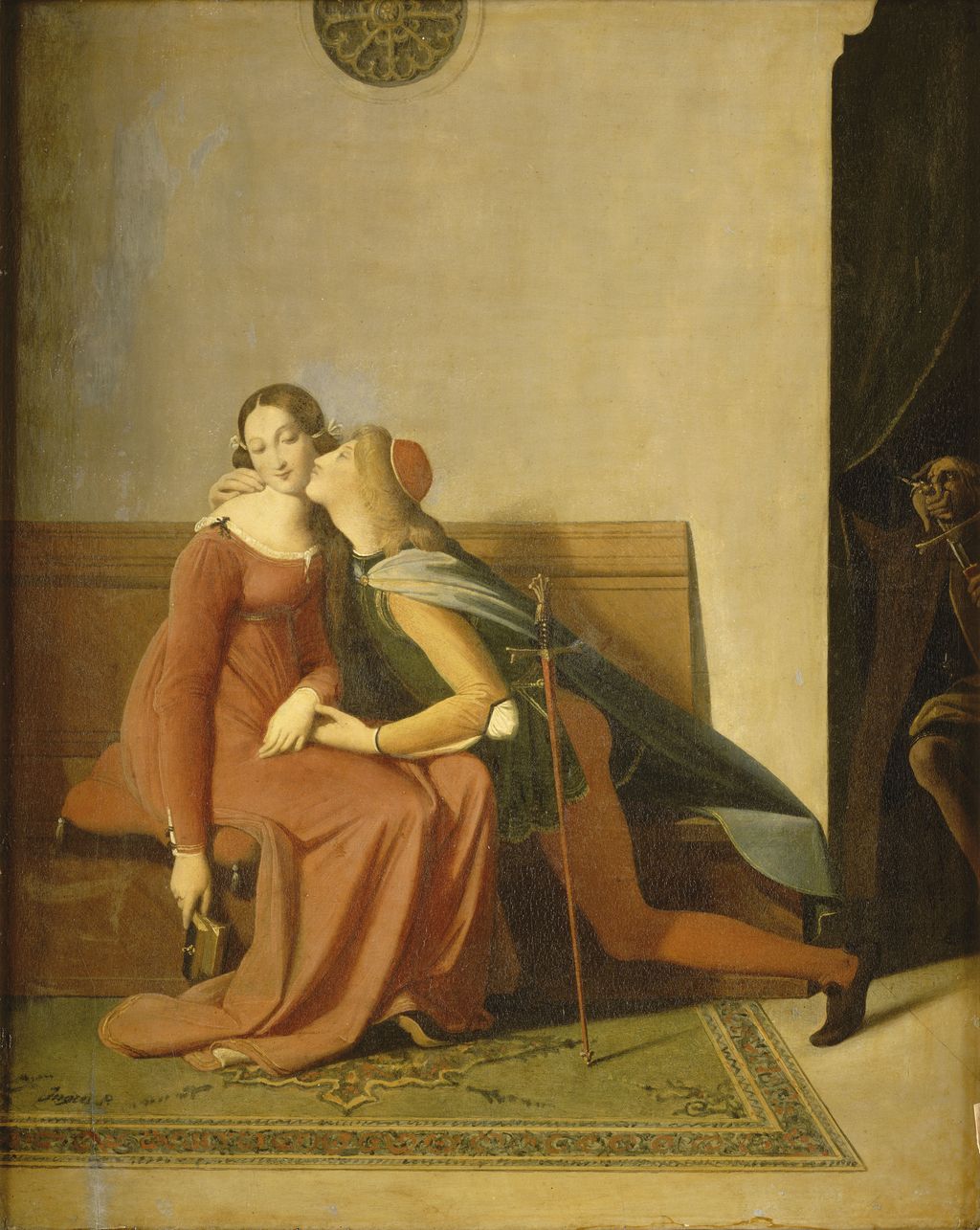
The kiss occupies a small corner of a large, quiet wall. Francesca sits with her eyes lowered as Paolo stretches towards her cheek. A book hangs beside her skirt. At the right, beyond the lovers' field of attention, another man emerges from a black curtain and draws his sword. The room holds an intimacy and a threat that its occupants cannot see together.
Ingres painted this version in 1814 for Caroline Murat, Queen of Naples; it belongs to the Musée Condé at Chantilly. [1] Its drama depends on unequal knowledge. We can see the approaching violence while the lovers remain enclosed in their encounter. Reading the picture means moving between those two experiences, then returning to the almost motionless faces.
At a Glance
- ArtistJean-Auguste-Dominique Ingres.
- Date and collection1814; Musée Condé, Chantilly, PE 434. [1]
- MediumOil on oak panel, following the museum's 2023 publication. [2]
- SubjectThe lovers whose story Francesca tells in Dante's Inferno, Canto V. [3]
- Look forThe lowered book, Paolo's extended neck, his sheathed sword and the armed figure behind the curtain.
This work across Ingres’s career
Agamemnon’s Ambassadors
1801 (competition)Grande Odalisque
1814Louis XIII’s Vow
1824Monsieur Bertin
1832The Princesse de Broglie
1851–1853The Turkish Bath
1859–1862Contents
- Reading with Francesca
- Looking through the Chantilly room
- A medieval story in a small painting
- Drawings and a changing composition
- The Angers version: the same kiss, another room
- A letter about neglect
- The four scenes Ingres planned
- From Naples to Chantilly, and beyond
- Annotated details
Reading with Francesca
Dante encounters the lovers after descending into the second circle of Hell. At its entrance Minos judges the dead and assigns their places. Beyond him an unceasing wind drives the souls who allowed appetite to govern reason. Before we hear Francesca speak, therefore, the poem has established judgement, suffering and the consequences of desire. [3]
The wind carries crowds of shades like flocks of birds. Dante asks to address two who travel together, and they approach like doves returning to their nest. That tender comparison changes the emotional register without changing their place in Hell. Francesca speaks; her companion weeps. The poem gives her the language in which their shared catastrophe will be remembered. [3]
Her speech repeatedly makes Love the active force. Love seized Paolo through her beauty; love seized her in return; love brought them to one death. Yet the surrounding canto has described souls who subordinated reason to appetite. Read together, these passages leave a difficult question: how much does the language of irresistible love explain, and how much does it excuse? That tension belongs to the encounter itself. We can feel the appeal of Francesca's account while recognising the moral setting in which Dante places it. [3]
Dante wants to know the beginning. Francesca recalls a day when she and Paolo read for pleasure, alone and without fear, about Lancelot. Their eyes met repeatedly; their faces lost colour. At the passage describing the desired kiss, Paolo kissed her on the mouth, trembling. In Longfellow's 1867 translation she ends: “That day no farther did we read therein.” Dante, overcome by pity as the other spirit weeps, falls unconscious. This later English translation allows us to follow the episode; it is not an identification of the edition Ingres read. [3]
The book makes the story unusually self-conscious. Francesca and Paolo encounter a romance, recognise their own desires within it and pass from reading to action. She calls both book and author Galeotto: the intermediary or go-between in their love. A written account has helped produce the event that she now recounts to another listener. Dante's reader occupies a further position in that chain. The attraction of a love story becomes one of the poem's subjects. [3]
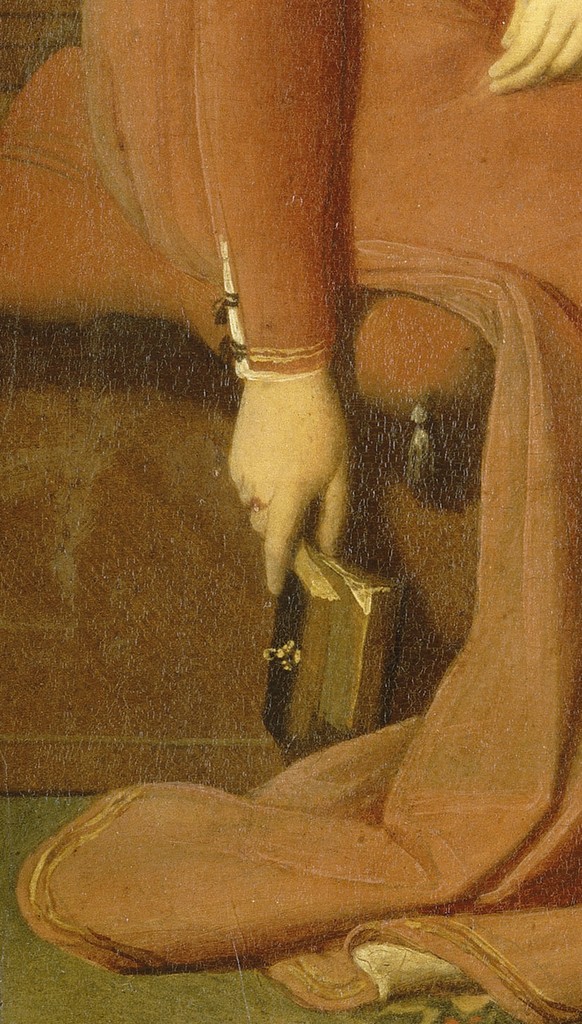
Ingres gives that chain a physical object. In the Chantilly picture the book is small, dark and nearly vertical, still close to Francesca's lowered fingers. Its pages are no longer presented for reading. Her hand and the book continue the downward line of her arm, carrying our eyes away from the meeting faces towards the floor. Once we know the literary episode, this inconspicuous object identifies the action more precisely than the sumptuous clothes could do.
There is also a revealing difference. Dante specifies a kiss on the mouth; Paolo's lips meet Francesca's cheek in this picture. The poem says that one death took both lovers and condemns their killer to Caïna. It does not narrate a husband entering with a sword at the very instant of the first kiss, or name him in this canto. [3] The painting combines the love scene with the murderous interruption familiar from the wider legend. Its dramatic simultaneity is a pictorial construction, rather than a literal transcription of Dante's sequence.
That distinction leaves room to appreciate the invention. The poem carries the lovers backwards from punishment to memory. The picture places us before the violence, with enough information to anticipate it. Francesca's remembrance has become an encounter we appear to witness, although neither poem nor painting supplies independent historical testimony for every detail of the legend.
Looking through the Chantilly room
The lovers occupy the lower left of the picture. Above them rises an expanse of ochre wall, interrupted high up by a small circular window. The long wooden bench fixes a horizontal line behind their shoulders. At the right, the pale wall ends against a deep black opening. Its shaped upper edge and gathered curtain make a distinct compartment for the intruder.
This division controls the pace of looking. The bright faces and Francesca's red dress catch the eye first; the dark figure can emerge only afterwards. Once discovered, he changes the meaning of the whole room. The large area of apparently empty wall begins to feel like the silence before an interruption. That is an effect of the arrangement, without needing to suppose that every architectural feature carries a separate symbolic message.
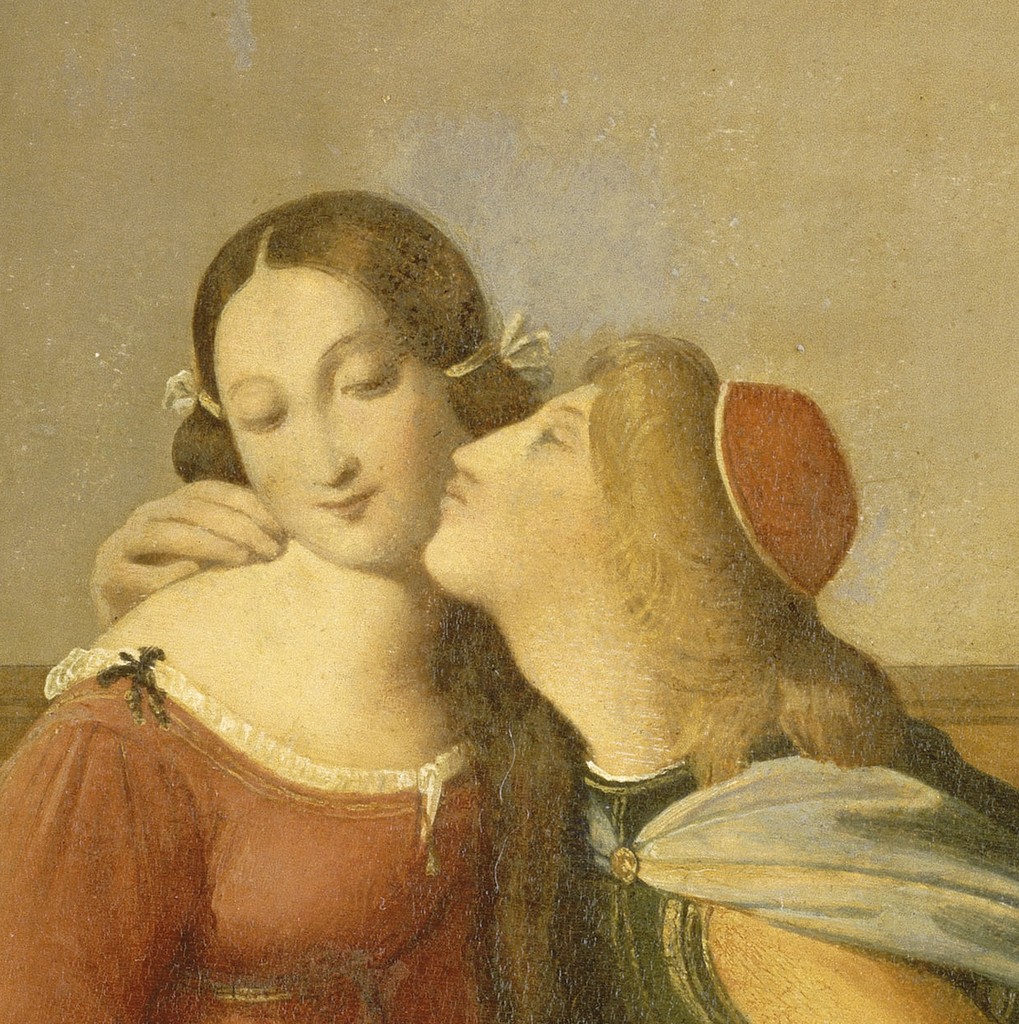
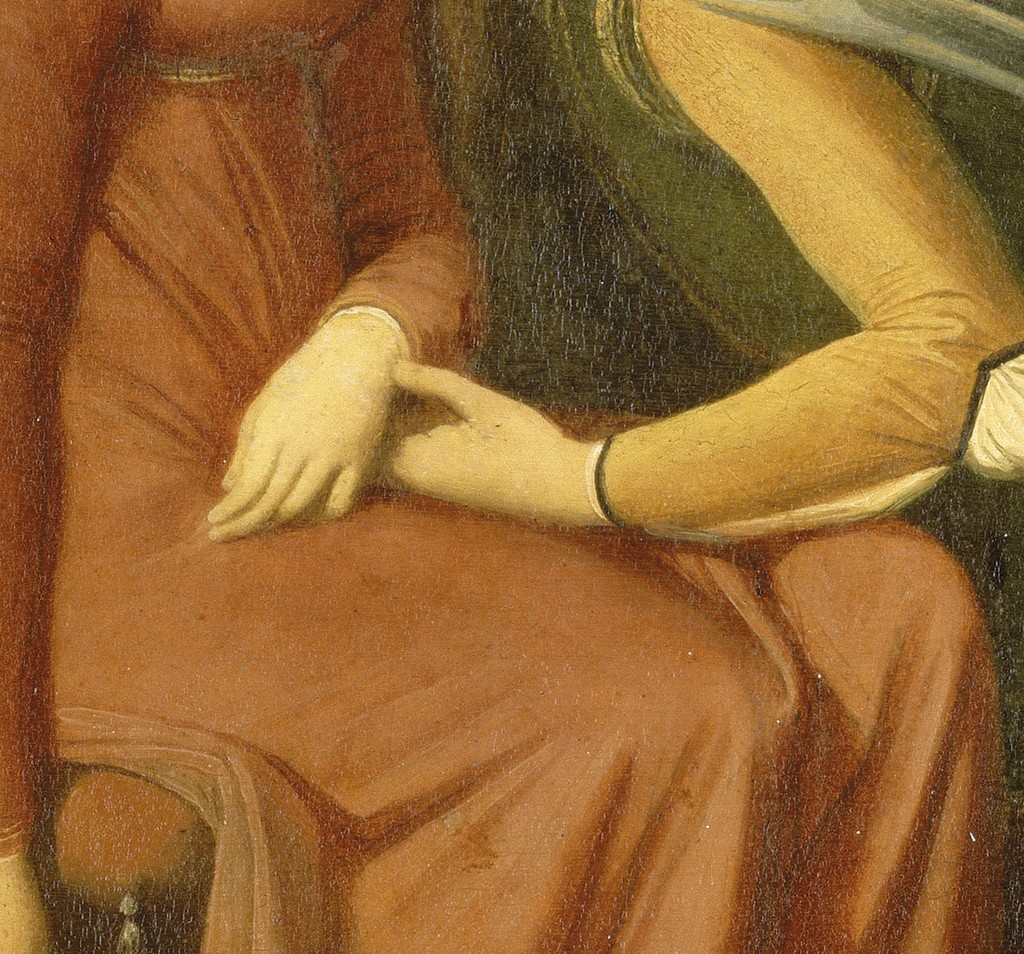
Francesca's dress falls into a broad pool of fabric. Its long sleeve leads down to the book, while her other hand rests over Paolo's at her lap. Paolo is a more complicated construction of directions. His body extends diagonally towards her, his head tilts upwards, and his neck appears extraordinarily long. One hand rises behind her shoulder; his other forearm crosses towards her hand. The blue-grey cloak spreads behind him like a second, wider outline of his movement.
Try following the contour from Paolo's red cap to the point of his trailing foot. The body seems suspended between the desire to reach Francesca and the need to stay balanced. The face approaches gently, but the extended pose requires effort. Beside it, her downward gaze and nearly upright torso offer a quieter rhythm. These differences make the exchange legible without supplying an unambiguous statement of her thoughts. Lowered eyelids and a poised hand cannot settle questions of consent or emotional surrender on their own.
The two swords reward a second look. Paolo's long weapon remains sheathed beside the foreground figures. It draws a fine line down towards the carpet. The husband, identified in the legend as Gianciotto, is taking his sword out behind the curtain. [1] A possession associated with Paolo's dress is answered by a weapon becoming active. Our knowledge of danger increases as we compare them; Paolo's hands remain occupied with Francesca.
The carpet gives the figures a firm rectangular footing. Its decorated borders lead back into the room, while the cloak, skirt and bent legs spread across that measured space. The result is a curious balance of compression and extension: the bodies reach and fold, but the room remains orderly. The architecture does not seem to react to what is happening inside it.
The surface invites slow scrutiny. Thin bands edge Francesca's neckline and sleeve; small ornaments fasten the clothing and hair; the sword fittings catch light. At the same time, the broad fields of red, green, yellow and blue-grey remain distinct. The picture can be read at a glance as an arrangement of coloured shapes, then inspected as a collection of minute decisions. Both scales of attention contribute to its tension.
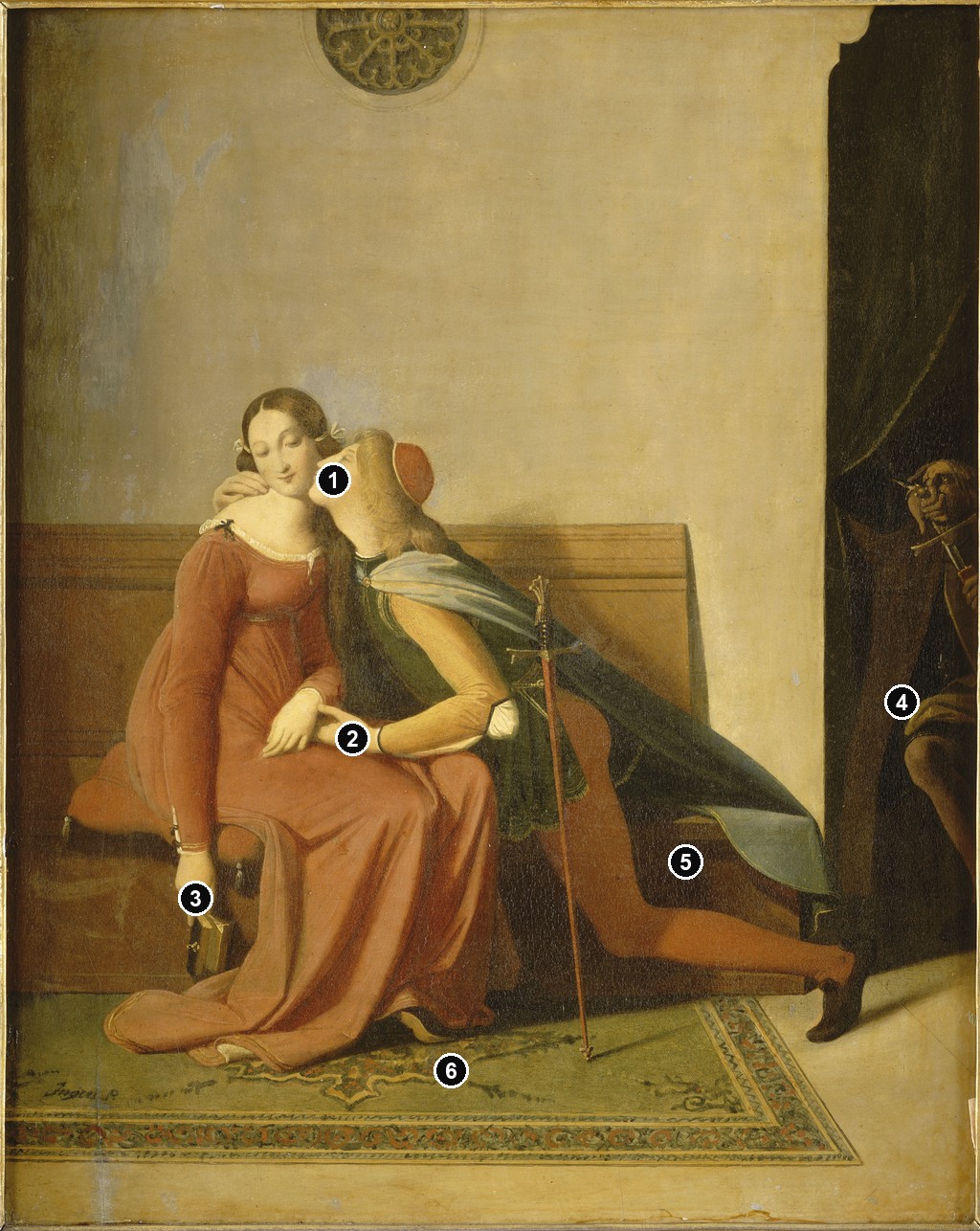
Annotated Details from Paolo and Francesca
The numbered points identify visible features discussed in this article. Return from each detail to the whole composition. Each caption identifies the work shown.
Paolo and Francesca — Chantilly
Ingres, Paolo and Francesca, 1814. Musée Condé, Chantilly, PE 434. Wikimedia Commons. Image source. Public domain.
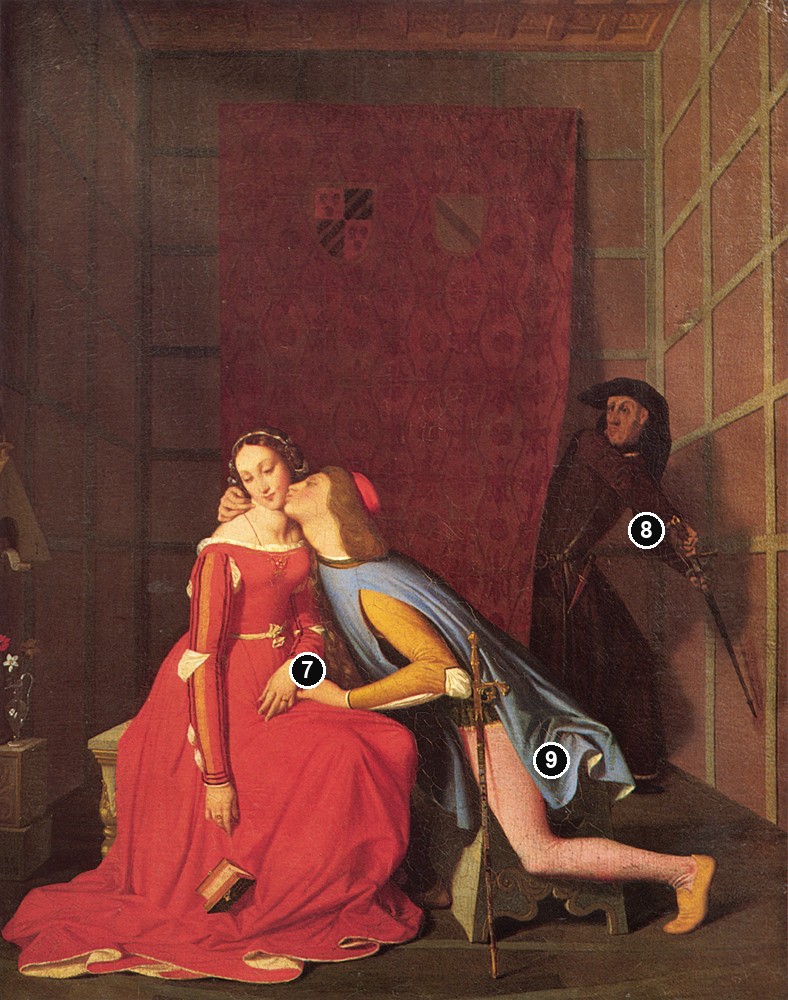
Paolo and Francesca — Angers
Ingres, Paolo and Francesca, 1819. Musée des Beaux-Arts d’Angers, MTC 19. Wikimedia Commons. Image source. Public domain.
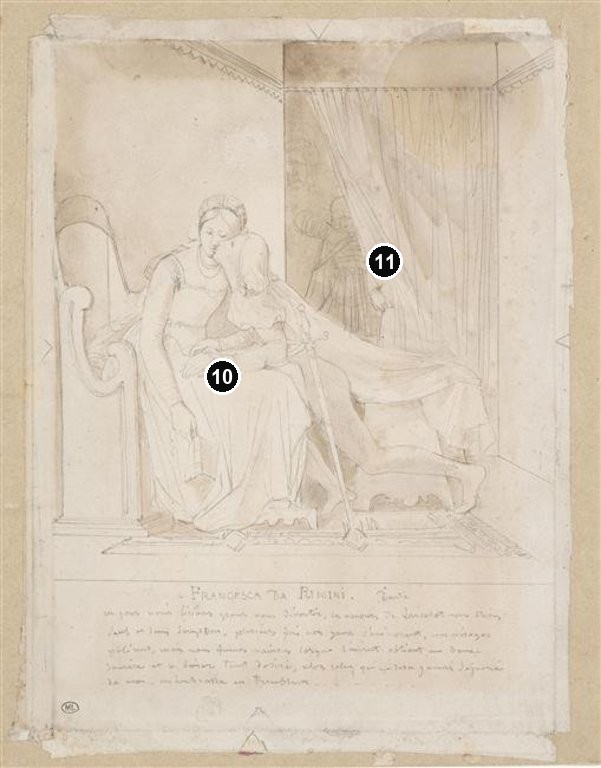
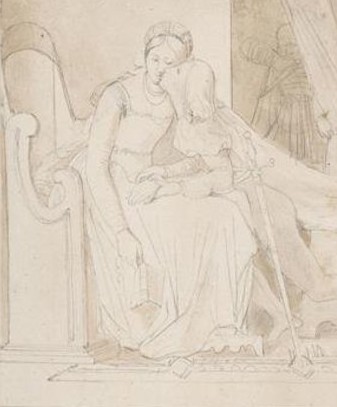
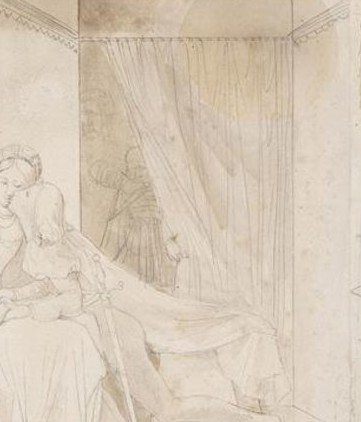
Paolo and Francesca — Drawing RF 23328
Ingres, Paolo and Francesca. Graphite and light brown wash, with handwritten text below. Musée du Louvre, RF 23328 recto. Dated around 1815 in the Louvre commentary; its chronology remains disputed. Michel Urtado; RMN-Grand Palais; Wikimedia Commons. Image source. Public domain.
Details from PAOLO AND FRANCESCA
Compare the Chantilly and Angers paintings with the separate Louvre composition drawing. The drawing has a disputed place in the sequence. Its faint outlines support broad comparisons of the grouped couple, chair and curtain.
Paolo and Francesca — Chantilly
The two faces at the moment of the kiss
The two heads lean together above the red dress and blue-grey cloak. The more upright face and the sharply bent neck give the kiss its uneven shape.
The joined hands across the lap
A lowered hand rests beside another hand extending across the lap. Their pale shapes connect the red dress with the bent yellow sleeve.
The lowered hand and small book
A small book hangs from the lowered hand beside the seat. Its straight edges and pale pages interrupt the long red sleeve and the folds beneath it.
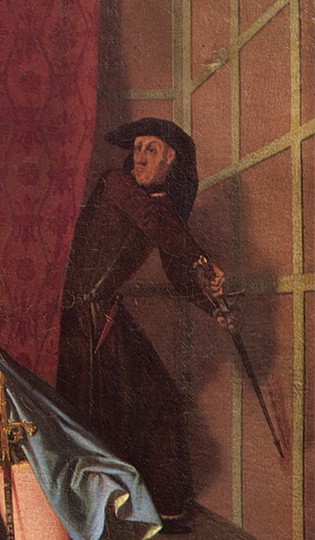
The husband behind the curtain
A third figure appears beyond the dark curtain beside the door. The small visible face and hand introduce another presence at the edge of the lovers’ room.
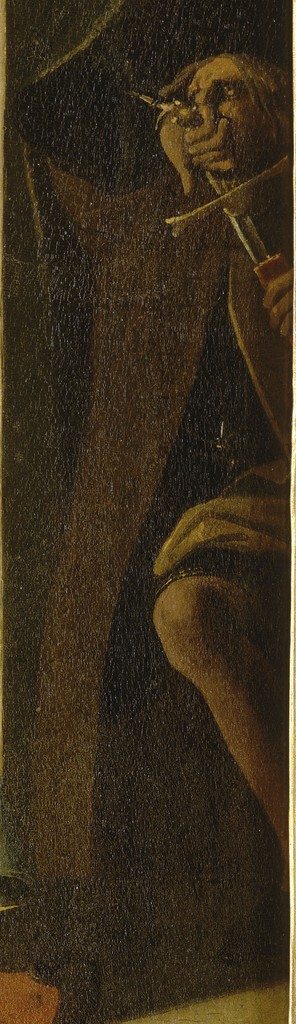
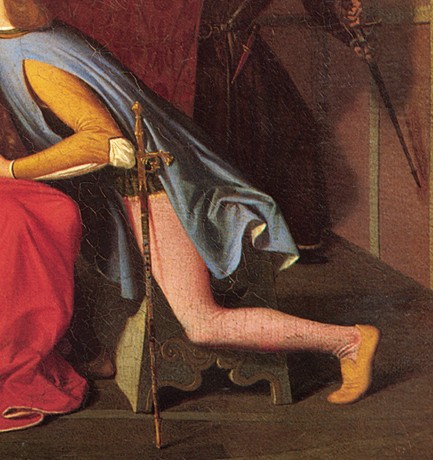
The long leg and upright sword
The kneeling figure’s long leg stretches beside the upright sword. Compare these two different directions with the bent upper body reaching towards Francesca.
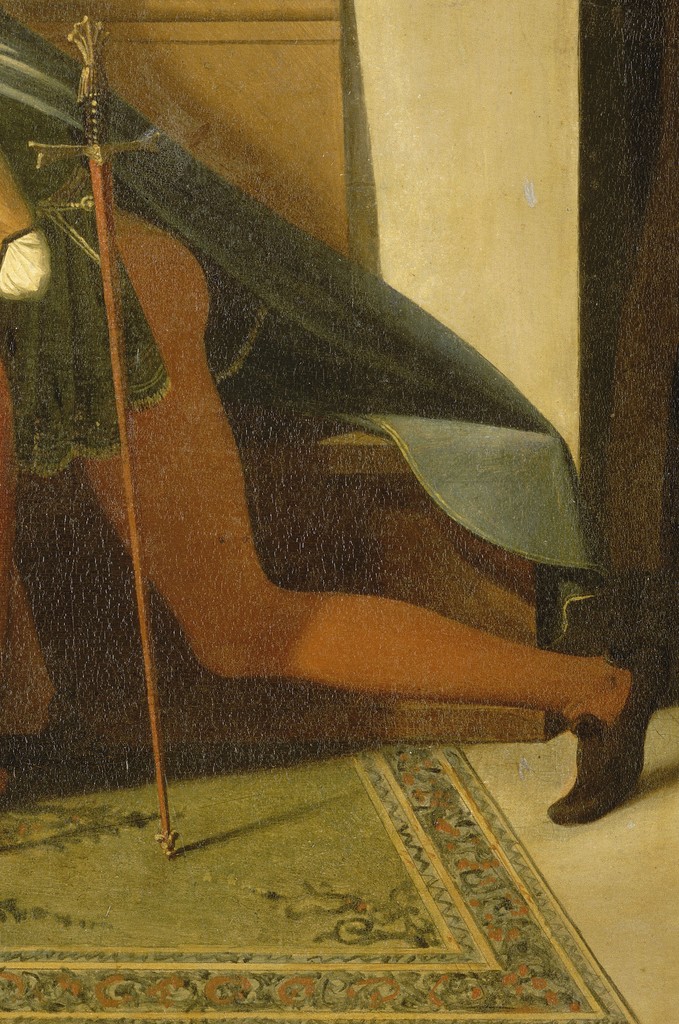
The patterned rug beneath the seat
A patterned rug spreads below the seat and standing sword. Repeated borders surround the larger curved folds of the red dress above it.
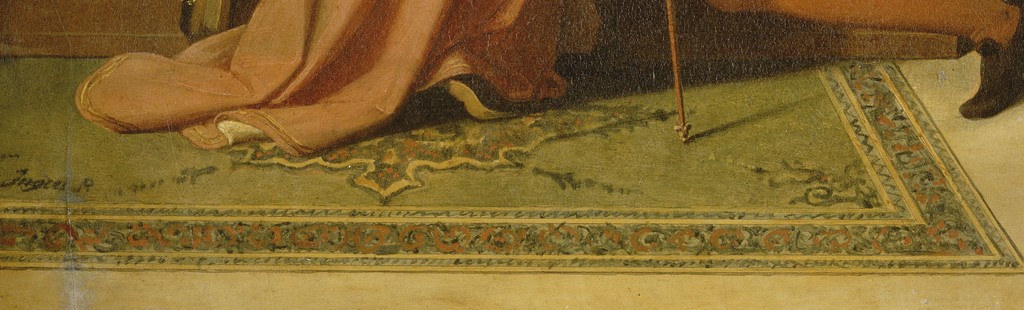
Paolo and Francesca — Angers
The lovers above the lowered book
The two heads meet above the long red dress and lowered book. Compare this larger sweep of red cloth with the tighter seated arrangement in the Chantilly painting.
The husband entering beside the red hanging
The dark-clad figure appears beside the red hanging with a sword in hand. The patterned wall and large curtain create a different doorway setting from the Chantilly version.
The leg and sword beside the seat
The pale stockinged leg extends beside the upright sword and blue cloak. Their broad light and dark shapes remain distinct within the smaller reproduction.
Paolo and Francesca — Drawing RF 23328
The leaning couple and the large chair
The leaning couple forms a close group beside the tall chair. Their overlapping arms and bodies contrast with the more upright lines of the furniture.
The figure behind the curtain
A faint standing figure appears beside the hanging curtain. The vertical cloth and enclosing room separate this figure from the closer group at the left.
A medieval story in a small painting
The Chantilly museum places the work within the taste for troubadour painting: intimate historical or literary scenes, often medieval, rendered with careful finish and detailed accessories. [1] The term helps explain the room's scale and the attention demanded by costume. Here a catastrophe is presented at the distance of a private encounter. No crowd is needed to make its consequences serious. The museum's 2023 publication identifies oak, associating it with early Italian panel painting. Its online record lists canvas. The material description here follows the exhibition account. [1][2] The same publication juxtaposes Flaxman's Dante drawings, made in 1792 and engraved by Piroli for an 1802 edition, with Coupin de la Couperie's treatment exhibited in 1812. [2] These comparisons suggest a visual context, without establishing one exclusive model.
The painting itself shows how much could be achieved with a limited cast. A book, a kiss and a partially revealed swordsman make a story intelligible. The severity of the enclosure and the lovers' continuous curves give it a formal concentration that the label troubadour does not fully describe. The tiny format still asks the questions associated with ambitious narrative painting: which moment to select, what spectators need to know, and how bodies can make an unseen future imaginable.
Drawings and a changing composition
A Louvre sheet, RF 23328 recto, brings text into the artist's working materials: graphite and light brown wash accompany six handwritten lines from Dante. Its catalogue discusses a date around 1815; Chantilly's 2023 publication places it before 1814. [4][2] Its catalogue also distinguishes the inscribed translation from Artaud de Montor's, which Ingres used subsequently. [4] The chronology prevents us from treating every related drawing as a securely dated first step towards the Chantilly panel.
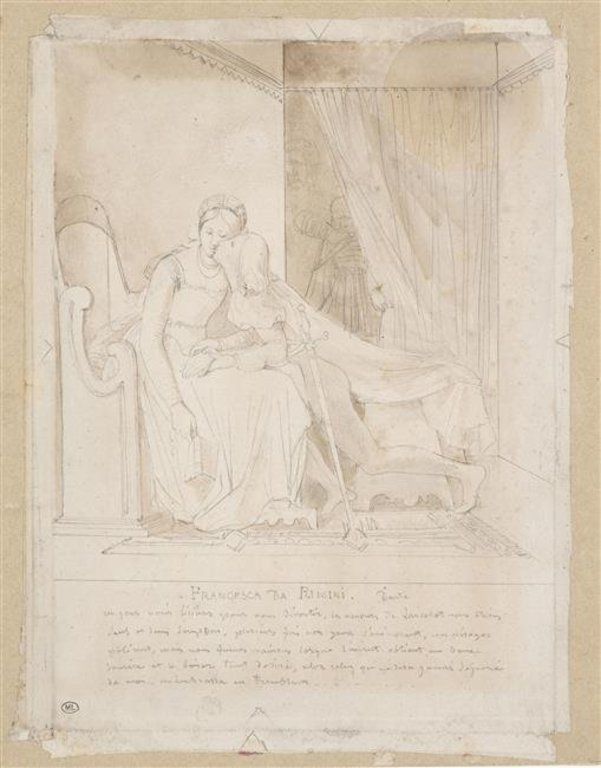
Ingres, Paolo and Francesca. Graphite and light brown wash, with handwritten text below. Musée du Louvre, RF 23328 recto. Dated around 1815 in the Louvre commentary; its chronology remains disputed. [5]
The same caution applies to the graphite Study for the Bust of Francesca, MI.867.1396. The Musée Ingres Bourdelle currently dates it to 1819 and connects it with Angers, whereas the 2023 exhibition publication labels it 1814. [6][2] The drawings belong to a sustained investigation of the subject, with their precise order still requiring care.
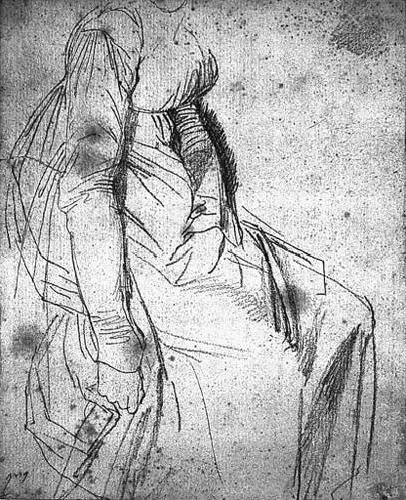
Ingres, Study for the Bust of Francesca, MI.867.1396. Graphite on laid paper. Musée Ingres Bourdelle. The current museum record dates it to 1819 and relates it to Angers; the 2023 exhibition publication gives 1814. No head is shown in this reproduction. [7]
Even within those limits, the evidence is revealing. An annotated composition and an isolated study of a bust represent different ways of working: relating figures to a story, then concentrating on one body's shape and attitude. The presence of Dante's words on the Louvre sheet also keeps the literary source close to the visual problem. Ingres's engagement cannot be reduced to selecting attractive medieval costumes. The relation between language and gesture remained part of the work. [4]
The drawings also help explain why a repeated composition need not be a mechanical duplicate. Once a painter has established a recognisable group, individual heads, hands, draperies and surroundings can be reconsidered. A change in any of these can alter the balance between intimacy and danger while leaving the subject immediately identifiable.
The Angers version: the same kiss, another room
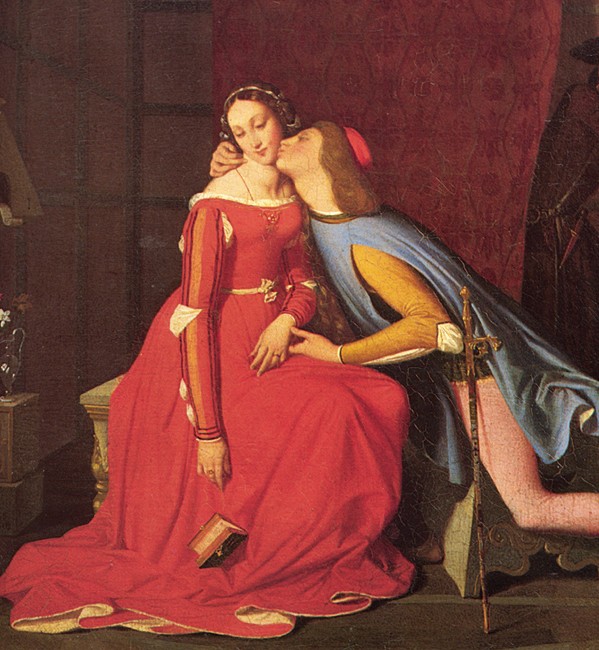
The Angers painting is signed and dated Rome, 1819. Its current record gives 50.3 × 40.7 cm and identifies it as MTC 19, from Turpin de Crissé's 1859 bequest. [8] It offers a particularly clear comparison with Chantilly because the principal group remains recognisable while the enclosure changes substantially.
At Angers, a large red hanging rises behind the lovers. Two heraldic shields appear near its top, and a patterned ceiling closes the space above. The wall at the right is divided by a conspicuous grid. The husband stands more fully within view beside the hanging, with his drawn weapon extending downwards. His body has a different weight in the scene: he is harder to miss.
Francesca's red dress spreads across much of the lower picture. The book is open and angled below her hand, its pale pages catching the light. Paolo's cloak forms a bright blue sweep across his back; his pale hose and yellow footwear stand out against the lower darkness. The lovers' faces remain gathered closely together, but their surroundings have become richer, more enclosed and more insistently patterned.
Comparing the two paintings changes the questions we ask of each. Chantilly's relatively bare wall makes the quiet around the group conspicuous. Angers surrounds the kiss with fabric, heraldry and architecture. In both, the spectator can see the intruder, but the route by which the eye discovers him differs. Repetition becomes a way to test the distribution of attention.
Angers's teaching guide reads the elongated neck and arm as expressive departures from ordinary bodily proportion and stresses the suspended fall of the book. [9] Those suggestions are useful starting points for looking. The extended limbs can make the kiss seem both graceful and precarious. The book introduces an action that cannot last: however still the painted object remains, gravity supplies the next movement in our imagination.
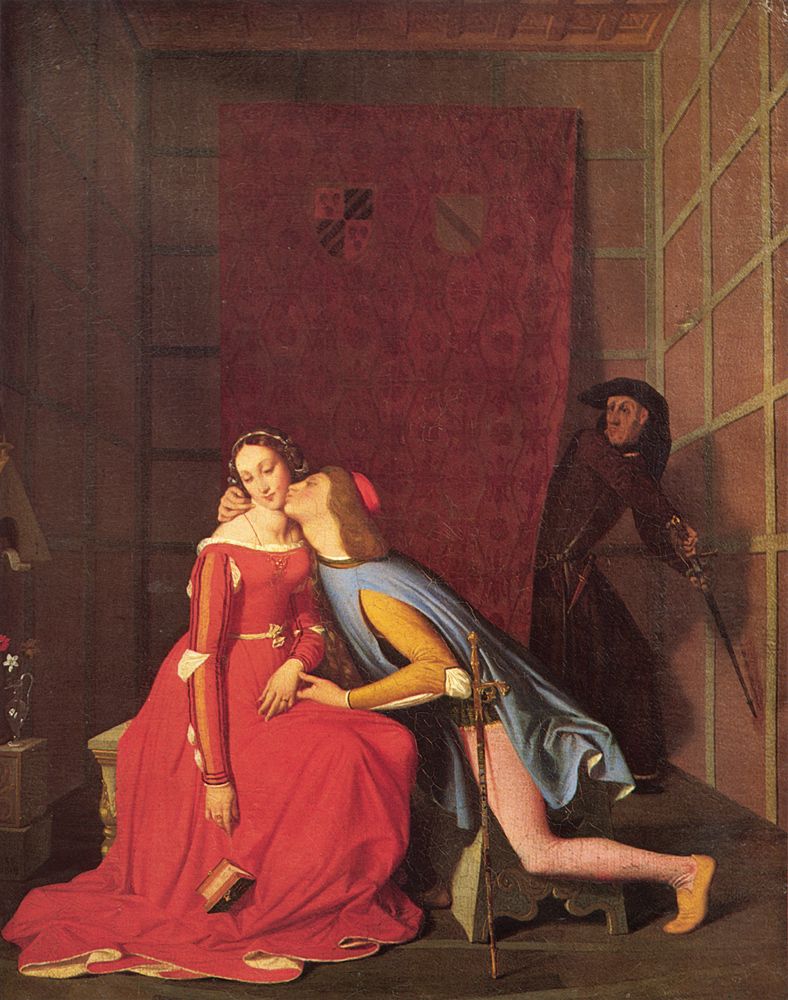
Ingres, Paolo and Francesca, 1819. Musée des Beaux-Arts d’Angers, MTC 19. [10]
A letter about neglect
The Angers version also has a documentary history that must be kept separate from Caroline Murat's picture. In his posthumous compilation of 1870, Henri Delaborde identifies the 1819 painting as the work belonging to Turpin de Crissé, shown in 1855 and subsequently bequeathed to Angers. His catalogue entry includes a letter Ingres wrote from Florence to Marcotte on 9 March 1822. [11]
Ingres asks why he has heard nothing, favourable or unfavourable, about the Francesca da Rimini he painted for the Société des Amis des Arts some three years earlier. His complaint proceeds through a defence of the picture's character, drawing, expression, grace and appropriate degree of colour. He invokes Poussin in support of attending to what is principal. Delaborde transmits an artist attempting to account for silence while asserting that he has fulfilled the demands of the subject. [11]
The letter complicates an easy division between a draughtsman concerned only with line and a painter indifferent to colour. Ingres includes colour in his defence, relating it to the proper measure of the whole. It also makes the small literary picture a useful witness to his ambitions: he expected its decisions to be understood and judged. The claim that it had pleased discerning viewers is his own testimony, not a neutral record of unanimous approval. [11]
Marcotte's marginal note supplies a sharper institutional response. According to the note as printed by Delaborde, Ingres sent the painting to the society for 500 francs. The committee was dissatisfied and exchanged it for a picture by Turpin de Crissé, an amateur artist who belonged to the committee. These are the price and reception of the 1819 work, not of the 1814 Chantilly panel. [11]
Delaborde also records its circulation through reproductions: partial images by Aubry-Lecomte and Kotterba, a complete lithograph by Gsell in 1848, and an outline engraving by Réveil in Magimel's publication. [11] Such translations into print offered different encounters with the same composition. A partial image could isolate the couple; an outline could foreground the contours that organise the action. Their existence extends the picture's history beyond the owners who possessed the painted object.
The four scenes Ingres planned
Delaborde preserves a more expansive project in a separate section devoted to subjects Ingres had considered. The artist outlined four paintings concerning Paolo and Francesca. The first was their moment of love, later marked as completed. The second would show the husband contemplating their fallen bodies as remorse begins. In the third, the dead would lie in a palace chapel while a solitary monk recited the Office of the Dead, illuminated by a single large iron candelabrum. The fourth would bring Dante before the lovers in the whirlwind, with Francesca recounting their story. [11]
This is evidence for a planned sequence, not four completed paintings. Delaborde describes further notes and sketches addressing manners, costume and Malatesta heraldry. He also corrects the kind of monk specified in the notes because its foundation belonged to a later period. The project combined a search for historical detail with a sequence that moved from earthly desire to killing, mourning and the afterlife. [11]
Seen against that plan, the familiar kiss occupies only the opening of a larger imaginative structure. The proposed second scene would turn attention towards the killer's response; the chapel would introduce ritual, stillness and the care of the dead; Dante's encounter would give Francesca her retrospective voice. These different centres of attention show how much the artist had left available beyond the moment he repeatedly painted. [11]
The Chantilly panel brings the beginning and approaching catastrophe close together. The projected series would have allowed consequences to unfold in separate spaces and kinds of light. We can compare those possibilities without pretending that the surviving panel contains every later scene in symbolic disguise. Its power lies in how much it lets us anticipate from the small amount of action it shows.
From Naples to Chantilly, and beyond
The Chantilly painting passed through the Prince of Salerno's collection before the Duke of Aumale acquired that collection in 1854. It formed part of Aumale's donation in 1886, with his lifetime right of use retained. [1] The 2023 publication reports that Alexandre Dumas admired it in Naples in 1834. [2] Delaborde remembered seeing a variant in the prince's collection at Naples in 1845. His account supports the historical setting, although it does not itself give that picture an 1814 date. [11]
Ingres dedicated a gold-enhanced drawing to Artaud de Montor in 1816; an 1820 drawing was intended for Thévenin's adopted daughter. The 2023 exhibition presented Birmingham's repetition and the tighter, half-length version at the Hyde Collection. [2] The subject travelled as gifts and changed format.
That continued reconsideration is easier to grasp by looking back at the book. Reading has ended, the kiss has begun and the sword is emerging. Each action points towards another moment. Ingres holds them together long enough for us to understand the danger, then leaves the next movement to the story we bring to the picture.
Artworks directory
Explore 150 paintings, drawings and an original lithograph. This selection includes related versions and studies; dates distinguish completed works from later revisions.
| Name | Date | Medium |
|---|---|---|
| The Apotheosis of Homer | 1827 | Painting |
| Grande Odalisque | 1814 | Painting |
| The Turkish Bath | 1859–1862 | Painting |
| Madame Moitessier Seated | 1856 | Painting |
| Portrait of Monsieur Bertin | 1832 | Painting |
| Napoleon I on His Imperial Throne | 1806 | Painting |
| Odalisque with Slave | 1839 | Painting |
| The Ambassadors of Agamemnon in the Tent of Achilles | 1801 (competition) | Painting |
| The Valpinçon Bather | 1808 | Painting |
| The Source | 1856 | Painting |
| Oedipus Explaining the Enigma of the Sphinx | 1808; revised probably before 1827 | Painting |
| The Vow of Louis XIII | 1824 | Painting |
| Antiochus and Stratonice | 1840 | Painting |
| The Comtesse d’Haussonville | 1845 | Painting |
| The Princesse de Broglie | 1851–1853 | Painting |
| Jupiter and Thetis | 1811 | Painting |
| The Dream of Ossian | 1813 | Painting |
| The Martyrdom of Saint Symphorian | 1834 | Painting |
| Venus Anadyomene | 1808–1848 | Painting |
| Portrait of Madame de Senonnes | 1814 | Painting |
| Madame Rivière | 1805 | Painting |
| Mademoiselle Caroline Rivière | 1805 | Painting |
| Portrait of Philibert Rivière | 1805 | Painting |
| Bonaparte First Consul | 1804 | Painting |
| The Death of Leonardo da Vinci | 1818 | Painting |
| Joan of Arc at the Coronation of Charles VII | 1854 | Painting |
| Madame Duvaucey | 1807 | Painting |
| La Belle Zélie | 1806 | Painting |
| Madame Panckoucke | 1811 | Painting |
| Portrait of Charles Marcotte d’Argenteuil | 1810 | Painting |
| Joseph Antoine Moltedo | c.1810 | Painting |
| Madame Leblanc | 1823 | Painting |
| Delphine Ingres-Ramel (Portrait of Madame Ingres) | 1859 | Painting |
| Portrait of Amédée de Pastoret | 1823–1826 | Painting |
| Portrait of Baronne de Rothschild | 1848 | Painting |
| Madame Marcotte de Sainte Marie | 1826 | Painting |
| Madame Gonse | 1852 | Painting |
| Aretino in the Studio of Tintoretto | 1848 | Painting |
| Don Pedro of Toledo Kissing Henry IV’s Sword | 1831/1832 | Painting |
| Raphael and La Fornarina | 1814 | Painting |
| Roger Freeing Angelica | 1819 | Painting |
| Romulus’ Victory over Acron | 1812 | Painting |
| Self-Portrait at the Age of Twenty-Four | 1804; revised 1841–1851 | Painting |
| Male Torso | c.1800 | Painting |
| Odalisque in Grisaille (Ingres and workshop) | c.1824–1834 | Painting |
| The Small Bather | 1826 | Painting |
| The Little Bather Harem Interior | 1828 | Painting |
| Jesus Among the Doctors | 1862 | Painting |
| The Virgin Adoring the Host | 1852 | Painting |
| The Virgin of the Host | 1841 | Painting |
| Virgin of the Adoption | 1858 | Painting |
| Paolo and Francesca | 1814 | Painting |
| Homer Deified (revised composition, Louvre RF5273) | 1865 | Drawing |
| Odalisque with Slave (Louvre RF4622) | 1858 | Drawing |
| Odalisque (Walters Art Museum; Ingres and Paul Flandrin) | 1842 | Painting |
| Madame Moitessier Standing (National Gallery of Art) | 1851 | Painting |
| Jacques-Louis Leblanc (The Metropolitan Museum of Art) | 1823 | Painting |
| Ferdinand-Philippe, Duke of Orléans (Louvre RF2005-13) | 1842 | Painting |
| Ferdinand-Philippe, Duke of Orléans (Versailles MV5207; Ingres and workshop) | 1843 | Painting |
| Ferdinand-Philippe, Duke of Orléans (Versailles MV5209; Ingres and workshop) | 1844 | Painting |
| Antiochus and Stratonice (Musée Fabre; Ingres and Raymond Balze) | 1866 | Painting |
| Antiochus and Stratonice (Kunstmuseum Bern, Gurlitt bequest) | Undated (early dating proposed) | Drawing |
| Composition study for Antiochus and Stratonice (MIB867.2193) | 1806 | Drawing |
| Study for the Figure of Stratonice (Met63.66) | 1834–1840 | Graphite, black chalk and charcoal |
| Nude figure study for Stratonice (Boijmans F II 36 PK) | c.1834–1840 | Drawing |
| Paolo and Francesca (The Barber Institute,54.6) | c.1814–1820 | Painting |
| Paolo and Francesca (The Hyde Collection,1971.24) | c.1855–1860 | Painting |
| Paolo and Francesca (Amsterdam Museum TA10970) | 1820 | Drawing |
| Paolo and Francesca (dedicated to Artaud de Montor) | 1816 | Drawing |
| Study for the Bust of Francesca (MIB867.1398) | 1819 | Drawing |
| Study for the Bust of Francesca (MIB867.1396) | 1819 | Drawing |
| The Archangel Raphael, first idea (MIB867.2488) | 1842 | Drawing |
| The Archangel Raphael (MIB867.2500) | 1842 | Drawing |
| The Archangel Raphael Carrying Human Prayers to God (Chantilly DE513) | 1844 | Drawing |
| Louis-Philippe as Saint Philip, stained-glass study | 1844 | Drawing |
| Marie Frédéric Eugène de Reiset (Ford Collection RBF171-2) | 1844 | Drawing |
| Virgil Reading the Aeneid (Toulouse) | Begun 1811 | Painting |
| Tu Marcellus Eris (Brussels, inv. 1836) | c.1814 (museum dating) | Painting |
| Jean-François Gilibert | 1804 | Painting |
| François-Marius Granet | 1807 (museum dating) | Painting |
| Count Nikolai Dmitrievich Guryev | 1821 | Painting |
| Caroline Murat, Queen of Naples | 1814 | Painting |
| Count Mathieu Molé | 1834 | Painting |
| Cherubini and the Muse of Lyric Poetry (Louvre) | 1842 | Painting |
| Luigi Cherubini (Cincinnati) | 1841 | Painting |
| Comtesse de Rayneval (Louvre RF4505) | 1841 | Drawing |
| Venus on Paphos (Antonie Balaÿ) | c.1852 | Painting |
| Prince Napoléon | 1855 | Painting |
| Study for The Apotheosis of Napoleon I (Petit Palais) | Late 1853 | Painting |
| The Apotheosis of Napoleon I (destroyed ceiling) | 1853 | Painting |
| The Journalist (MIB867.2733) | 1834? | Drawing |
| Henry VIII, after Holbein | c.1815–1820 (?) | Drawing |
| Madame Récamier, after David (MIB867.3637) | Undated (early Paris period) | Drawing |
| Study for Comtesse d’Haussonville (MIB867.259; background possibly by another hand) | 1842–1845 | Drawing |
| La Source (reduced version reported by Delaborde) | Date unrecorded; reported 1870 | Painting |
| Odalisque (autograph lithograph,NGA1946.21.117) | 1825; published1826 | Lithograph |
| Portrait of a Seated Lady | 1814 | Graphite |
| The Kaunitz Sisters (Leopoldine, Caroline, and Ferdinandine) | 1818 | Graphite |
| Portrait of a Man | 1814 | Graphite |
| Study for the Portrait of Louis-François Bertin (1766–1841) | n.d. | Black chalk and graphite |
| Studies for the Cadaver of Acron | ca. 1810–12 | Graphite on wove paper |
| Study for the Drapery of Molière in "The Apotheosis of Homer" | n.d. | Black chalk with stumping |
| Madame Guillaume Guillon Lethière, née Marie-Joseph-Honorée Vanzenne, and her son Lucien Lethière | 1808 | Graphite |
| Niccolò Paganini (1782–1840) | ca. 1830 | Counterproof or tracing strengthened with graphite and gouache on translucent paper |
| Lady Mary Cavendish-Bentinck (?-1843) | 1816 | Graphite |
| Madame Alexandre Lethière and Her Daughter Letizia | ca. 1815 | Graphite |
| Merry Joseph Blondel (1781–1853) | 1809 | Graphite |
| Ursin-Jules Vatinelle (1798–1881) | 1820 | Graphite |
| Bust of a Gypsy Girl (ascribed to Ingres) | 1819 | Graphite on wove paper |
| Study of a Seated Nude Male | n.d. | Graphite |
| The Archangel Raphael (Study for a stained-glass window in the chapel of Notre-Dame de la Compassion-Saint-Ferdinand, Neuilly) | ca. 1842 | Graphite |
| Lancelot-Théodore, comte Turpin de Crissé | probably 1818 | Graphite |
| Study for the Figure of the Iliad in "The Apotheosis of Homer" | ca. 1827 | Graphite and black chalk heightened with white chalk on brown paper |
| Comtesse Turpin de Crissé | probably 1818 | Graphite |
| Nude Figures for L'Âge d'Or, Château de Dampierre | n.d. | Graphite on brownish paper |
| Study of Figures (attributed to Ingres) | n.d. | Graphite |
| Study of Figures (attributed to Ingres) | n.d. | Graphite; squared in graphite |
| Admiral Sir Fleetwood Broughton Reynolds Pellew | 1817 | Graphite on wove paper |
| Madame Jean-Auguste-Dominique Ingres, née Madeleine Chapelle | 1814 | Graphite on off-white wove paper |
| Virgil Reading the Aeneid to Augustus, Livia, and Octavia | 1809/1819 (?) | Pen and black ink, graphite, brush and gray wash, white gouache heightening, Conté crayon on blue paper |
| General Louis-Étienne Dulong de Rosnay | 1818 | Graphite (hard and soft pencils) |
| Madame Alexandre Lethière, née Rosa Meli, and Her Daughter, Letizia | 1815 | Graphite |
| The Lawyer Paul Grand | 1834 | Graphite |
| Jean-Joseph Fournier | 1815 | Graphite |
| Armand Bertin | 1842 | Graphite |
| Madame Armand Bertin, née Marie-Anne-Cécile Dollfuss | 1843 | Graphite |
| The Architect Charles-Victor Famin | 1836 | Graphite |
| Henri Lehmann | 1850 | Graphite |
| Portrait of a Lady | ca. 1815–17 | Graphite |
| Edmond Cavé (1794–1852) | 1844 | Oil on canvas |
| Head of Saint John the Evangelist | probably ca. 1818–20 | Oil on canvas, laid down on wood |
| Madame Edmond Cavé (Marie-Elisabeth Blavot, ca. 1806–1883) | ca. 1831–34 | Oil on canvas |
| Madame Félix Gallois | 1852 | Graphite with touches of gold in oil to highlight jewelry, on buff wove paper. |
| Dr. François Mêlier | 1849 | Graphite with graphite framing lines, corrected with white, on buff wove paper |
| Portrait of Madame Rhode (Rhoda?) | 1810–20 | Graphite on pale buff wove paper |
| Study for "Raphael and the Fornarina"(?) | ca. 1814(?) | Graphite on white wove paper |
| Portrait of Madame Paul Meurice, née Palmyre Granger | ca. 1845–50 | Graphite on wove paper |
| Alexander the Great presenting Campaspe to Apelles | 1810 | Graphite, brush and brown wash; squared in graphite |
| Study of Hands for "Christ Among the Doctors" | 1852–62 | Graphite on tracing paper |
| Study for The Turkish Bath (RF34502) | about 1850 | Pen and brown ink with graphite, partially squared |
| Study for The Turkish Bath (RF23354) | Undated | Pen and brown ink with graphite on joined sheets |
| Study for The Turkish Bath (RF54702) | about 1859 | Pen and brown ink |
| Studies of women for The Turkish Bath (RF12292) | Undated | Black chalk |
| Achilles Receiving the Envoys of Agamemnon (Nationalmuseum sketch, NM2161) | 1801 | Oil on wood |
| Half-Length Bather (Musée Bonnat-Helleu,89) | 1807 | Oil on canvas |
| Oedipus and the Sphinx (National Gallery,NG3290) | about1826 | Oil on canvas |
| Oedipus and the Sphinx (Walters,37.9) | 1864 | Oil on canvas |
| Oedipus and the Valpinçon Bather, after David (MI.867.2035) | Undated | Graphite on tracing paper, after David |
| Study of the Virgin for The Vow of Louis XIII (Dijon,1758) | about1822 | Black chalk, stump and white chalk on brown wove paper |
| First Thought for The Vow of Louis XIII (MI.885.11.21) | 1822 | Oil on canvas |
Frequently Asked Questions
It draws on Francesca's account of reading Lancelot with Paolo in Inferno, Canto V. Dante describes a kiss on the mouth. The Chantilly picture shows a kiss on the cheek and adds the armed husband's simultaneous arrival, which the canto does not narrate. [3]
The long neck, reaching arms and tilted body let us follow Paolo's movement towards Francesca. They create a continuous, unstable-looking curve against the room's straight lines. Treating that arrangement as an expressive choice is more useful than measuring it as though it were a posed anatomical demonstration.
Delaborde records a four-scene plan running from the lovers' encounter to Dante's meeting with their souls. Only the first subject is marked as completed in the notes he publishes. The plan is not evidence for four finished pictures. [11]
Discussion
Look again at the images and ideas explored in Paolo and Francesca. These editorial prompts invite your observations.
Reader Insights
When you look from the lowered book to the kiss and then to the swordsman, where does the story seem to change? Does the nearly still arrangement make the approaching violence feel more distant, or more inevitable?
Compare the room in the Chantilly painting with the Angers version. Which change most affects the distance between the kiss and the approaching figure?
How does the lowered book connect the lovers’ reading to the moment Ingres chooses to show?
Join the Conversation
Share a detail, comparison or question about Paolo and Francesca below.
References
- Musée Condé, Paolo et Francesca, PE 434. Collection record: creation, description, former collections and acquisition. (In French.) View source.
- Château de Chantilly, Ingres: The Artist and His Princes. Exhibition press kit, May 2023, pp. 23–26. View source.
- Dante Alighieri, Divine Comedy, Inferno, Canto V. Translated by Henry Wadsworth Longfellow, 1867; especially lines 28–45, 73–108 and 115–142. Public-domain translation. View source.
- Musée du Louvre, Paolo et Francesca, RF 23328 recto. Collection record, commentary quoting Louis-Antoine Prat, Ingres, 2004, no. 9, p. 79; material description. (In French.) View source.
- Supporting image. Ingres, Paolo and Francesca. Graphite and light brown wash, with handwritten text below. Musée du Louvre, RF 23328 recto. Dated around 1815 in the Louvre commentary; its chronology remains disputed. Michel Urtado; RMN-Grand Palais; Wikimedia Commons. Image source. Public domain.
- Musée Ingres Bourdelle, Étude pour le buste de Francesca, MI.867.1396. Collection record: date, context and technique. (In French.) View source.
- Supporting image. Ingres, Study for the Bust of Francesca, MI.867.1396. Graphite on laid paper. Musée Ingres Bourdelle. The current museum record dates it to 1819 and relates it to Angers; the 2023 exhibition publication gives 1814. No head is shown in this reproduction. Wikimedia Commons. Image source. Public domain.
- Musées d'Angers, Paolo et Francesca, MTC 19. Collection record: signature date, dimensions and bequest. (In French.) View source.
- Musées d'Angers, Les incontournables du musée des Beaux-Arts. Teaching resource, pp. 10–11, incorporating the museum guide of December 2016. (In French.) View source.
- Supporting image. Ingres, Paolo and Francesca, 1819. Musée des Beaux-Arts d’Angers, MTC 19. Wikimedia Commons. Image source. Public domain.
- Henri Delaborde, Ingres, sa vie, ses travaux, sa doctrine, d'après les notes manuscrites et les lettres du maître. Paris: Henri Plon, 1870. Catalogue nos. 49–50, pp. 223–225, including Ingres's letter to Marcotte, 9 March 1822, and Marcotte's marginal note; projected subjects, no. 15, pp. 326–327. Posthumous documentary compilation. (In French.) View source.
- Splash image. Ingres, Paolo and Francesca, 1814. Musée Condé, Chantilly, PE 434. Wikimedia Commons. Image source. Public domain.