by Tom Gurney
Tom Gurney BSc (Hons) is an art history expert with over 20 years experience
Published on June 19, 2020 / Updated on October 22, 2026
Email: tomgurney1@gmail.com / Phone: +44 7429 011000
Madame Rivière
A pale shawl opens across Madame Rivière’s shoulders, then descends towards her hand in long, heavy folds. Against it, the blue velvet cushion seems almost intensely solid. Between these two expanses of cloth, her face remains quietly distinct: dark curls above a broad forehead, an unhurried gaze, a small mouth with the faintest suggestion of a smile. The painting invites attention to a person while continually drawing the eye away into the things that surround her.
Ingres painted Madame Rivière in 1805. The sitter, Françoise Jacquette Bibiane Blot de Beauregard, known as Sabine, was the wife of Philibert Rivière. Her portrait belongs to a family commission that also included her husband and their daughter Caroline. Today it is in the Louvre’s collection. [1][2] Its special interest lies in how completely Ingres brings face, furnishings and dress into one design, without allowing their different textures to lose their identity.
At a Glance
- ArtistJean-Auguste-Dominique Ingres.
- Date1805; exhibited at the Salon of 1806.
- Medium and sizeOil on canvas, 117 × 82 cm.
- FormatOval composition.
- CollectionMusée du Louvre, Paris, MI 1446. [1]
This work across Ingres’s career
Agamemnon’s Ambassadors
1801 (competition)Grande Odalisque
1814Louis XIII’s Vow
1824Monsieur Bertin
1832The Princesse de Broglie
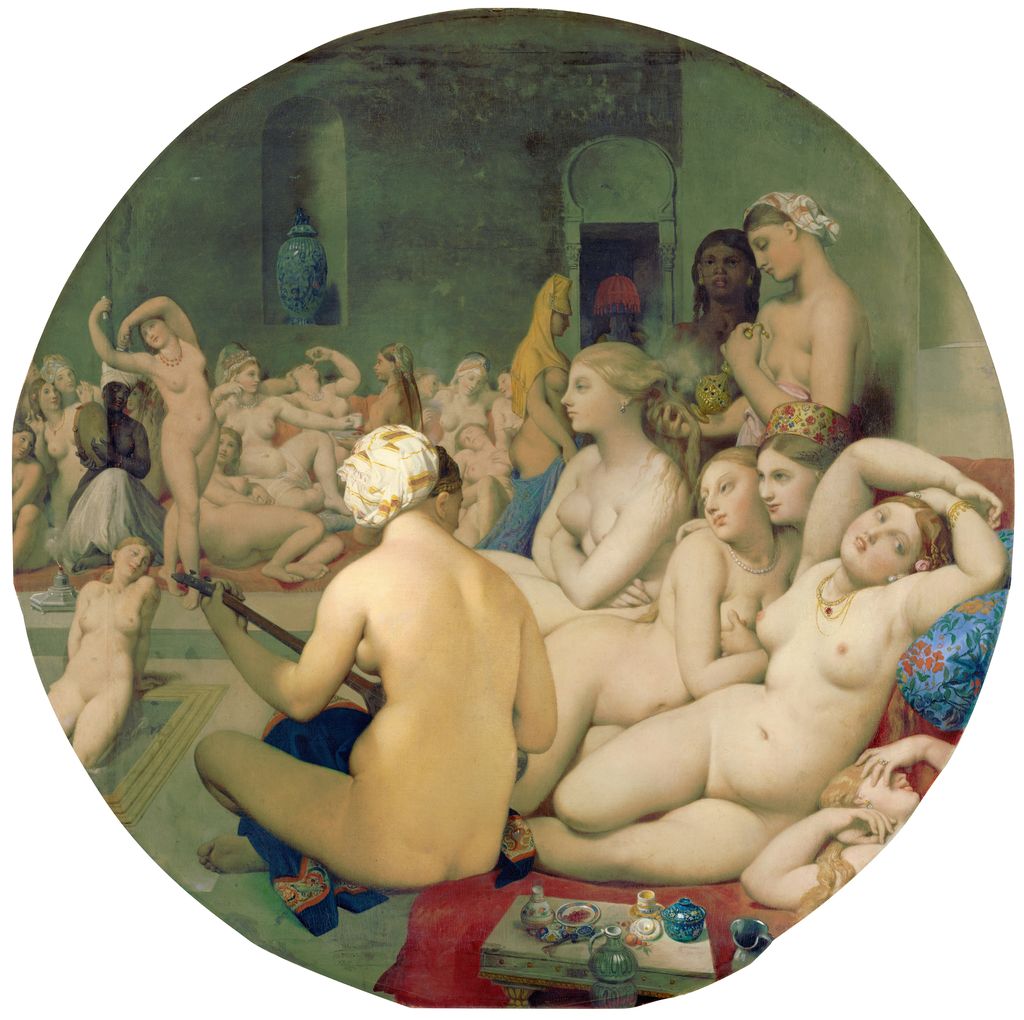
1851–1853The Turkish Bath
1859–1862Contents
- A portrait shaped by its oval
- Three fabrics, three kinds of weight
- The face, the hands and the small curves
- A pose developed through revision
- One family, three different portraits
- The Salon of 1806
- Lost from view and left to the state
- Annotated details
A portrait shaped by its oval
Start at the top, where the white veil rises behind Sabine’s dark hair. Follow it down towards the blue upholstery on the left. Across the other side of the picture, the bare upper arm reaches towards the cushion, the forearm turns downwards, and the hand hangs loosely over its edge. Lower down, another hand emerges from the shawl. These passages carry the eye around the face and bodice, without requiring a clearly described room.
The oval is important to that experience. A rectangle would leave corners in which a wall, a piece of furniture or an object might claim attention. Here the boundary presses inwards towards the sitter. At the bottom, it cuts through the dress and patterned shawl; at the sides, it comes close to the fabrics that seem to swell towards it. The body occupies a space that feels generous in its cushions and restricted in its extent.
There is little recession behind the figure. The dark background offers no distant doorway or window to travel towards, and the upper edge of the furniture runs close behind the shoulders. We can understand that Sabine reclines, yet we cannot easily reconstruct the entire seat or the position of her legs. Her immediate surroundings are more legible as areas of colour and pressure: the elbow resting, the cushion receiving it, the shawl pulled downwards, the skirt spreading out of view.
This produces a useful double reading. From a distance, the portrait has the coherence of a decorative object, with its dark upper zone, pale centre and bright blue flank. Move closer and that arrangement separates into different sensations of touch. The surface that looks initially like one expanse of white contains a dress, a veil and a substantial shawl. Following those differences makes the composition feel increasingly intricate. The Louvre describes the work as an oval composition. [1] That wording is more useful than calling it a round painting: the visible field is taller than it is wide.
Three fabrics, three kinds of weight
The most immediately arresting contrast is between the white satin dress and the blue velvet. The dress catches light in narrow ridges and crisp, bright passages. The cushion holds larger, darker folds, with small interruptions where its pile seems to change direction. Along the edge beneath the hanging hand, a fine light line helps the blue form retain its thickness. Cloth is doing the work that masonry or furniture might do elsewhere: it establishes where the body can rest.
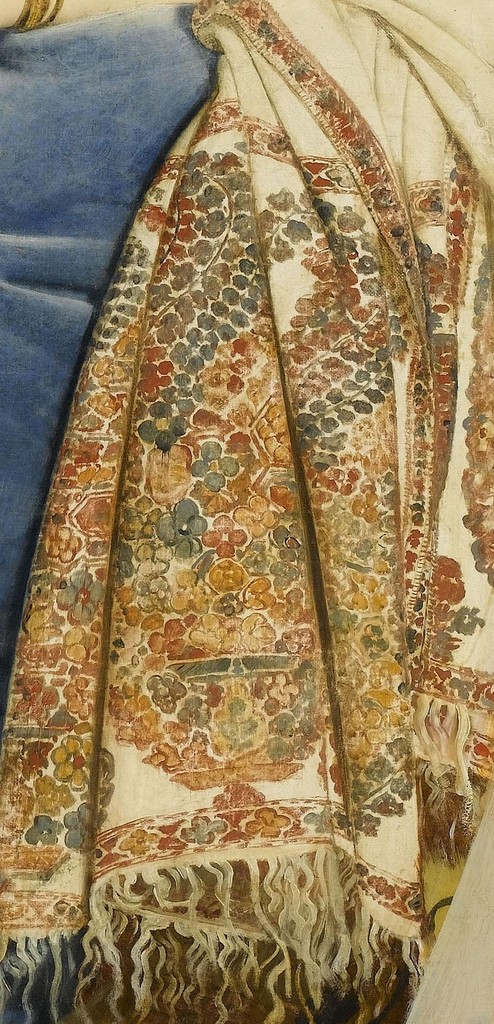
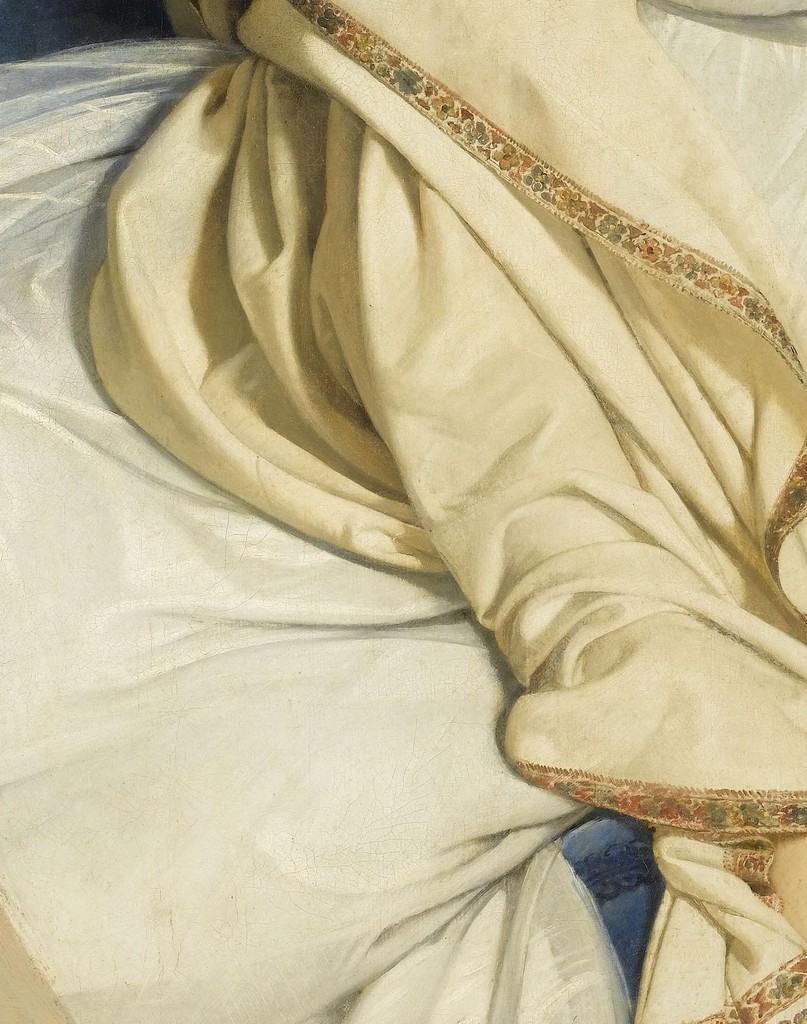
Across the lower half of the picture, the shawl behaves differently again. Its broad cream field bends into deeper channels, gathering towards the lower hand. The patterned border appears in several places, so that the viewer can try to follow a single textile through its changes of direction. On the right it falls beside the cushion, densely worked in red, orange and green. Beneath the hand it swings towards the bottom edge. At the shoulder it becomes a much narrower line.
That border helps measure the folds. A plain pale surface can be difficult to read when light and fabric share much the same colour; a line of pattern makes a bend more definite. The border disappears into a fold and emerges at another angle. Its repeated appearances let us experience the shawl as something continuous even where its full shape remains concealed.
The cashmere shawl is part of the sitter’s dress as identified by the Louvre. [1] Its pictorial role goes beyond providing an attractive accessory. It occupies much of the area in which we would otherwise expect to follow the outline of her body. The lower arm is visible through its surrounding folds; the torso becomes less certain as it approaches the skirt. Face and hands emerge clearly, while the cloth controls much of the connecting shape.
The veil introduces the lightest material. At the upper left it spreads across the darker background and the blue seat, allowing changes of colour underneath to remain perceptible. Beside the shoulder, its thin, overlapping passages are easy to confuse with the dress until one follows their edges. Unlike the shawl, it can seem to hover rather than hang. Its presence makes the dense velvet and weightier folds below feel still more substantial.
The painting’s pale colours therefore contain considerable variety. White can appear cool beside blue, warm beside skin, grey where it turns inward, or almost transparent against darkness. Ingres maintains these differences without making the portrait look broken into separate demonstrations of technique. The fabrics meet and overlap, and the eye repeatedly has to decide which edge belongs to which material.
The face, the hands and the small curves
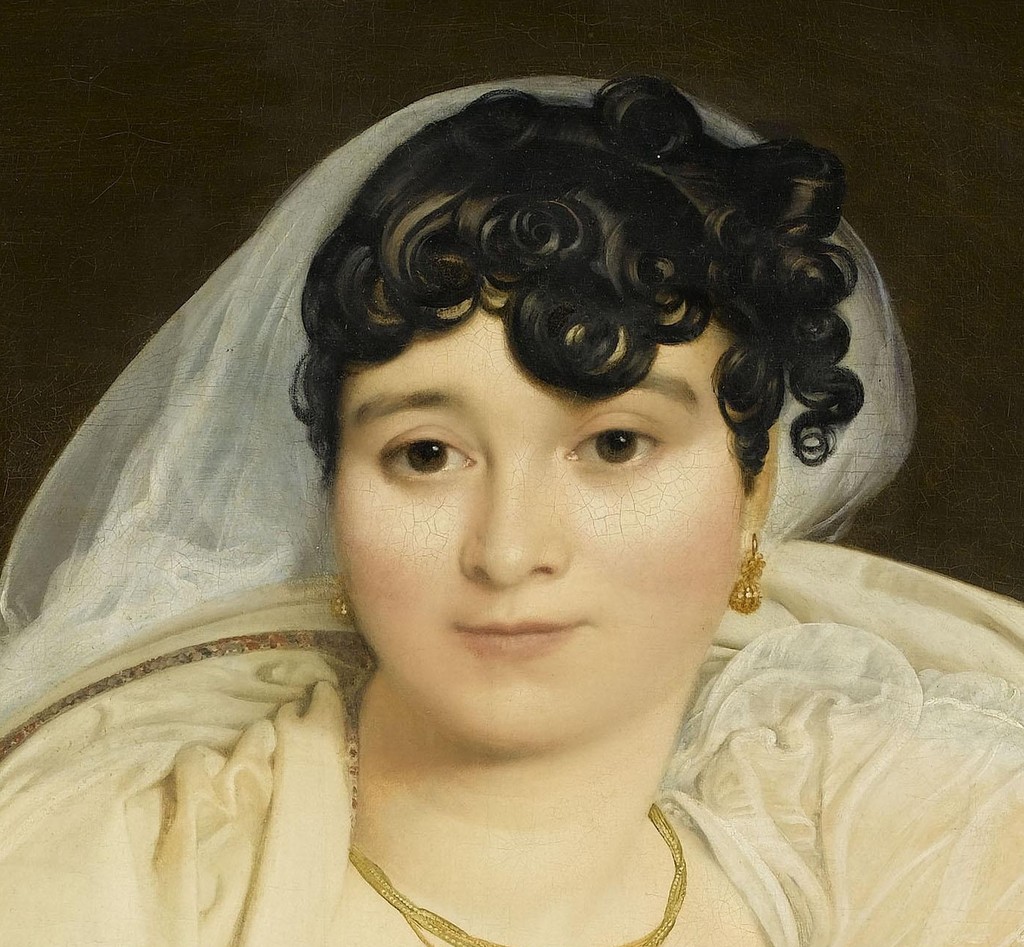
Sabine’s face is relatively uncomplicated beside the abundant clothing. Light describes the forehead, cheeks and chin without the deep shadows found in the upholstery. The eyebrows and eyes supply small, definite accents. The dark curls make a more animated silhouette above them: some gather into a compact mass, while others form small hooks against the skin.
Her expression is difficult to reduce to a single word. The mouth is composed, the head upright, and the eyes do not seem fixed with the same insistence as the crisply drawn jewellery. We can register that mildness without turning it into evidence of her temperament. The picture gives us a carefully sustained appearance; it cannot tell us how Sabine behaved during the sittings or what she thought of the result.
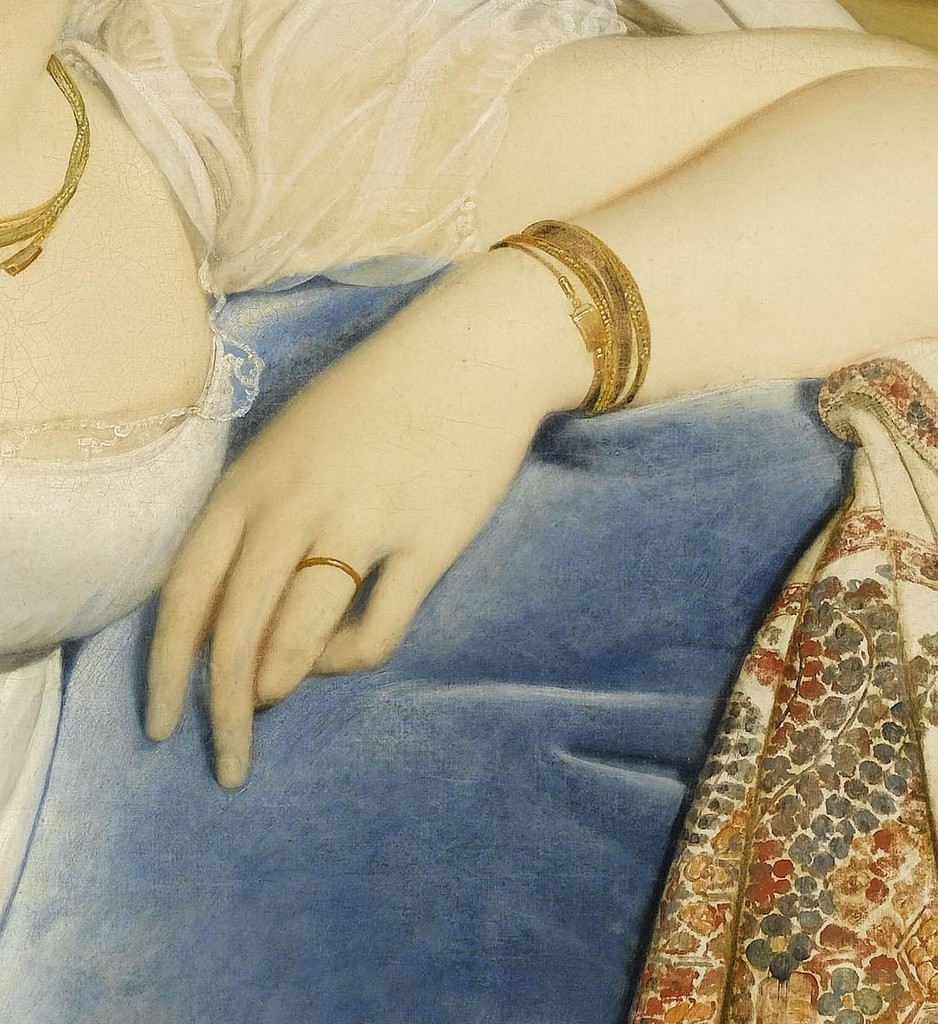
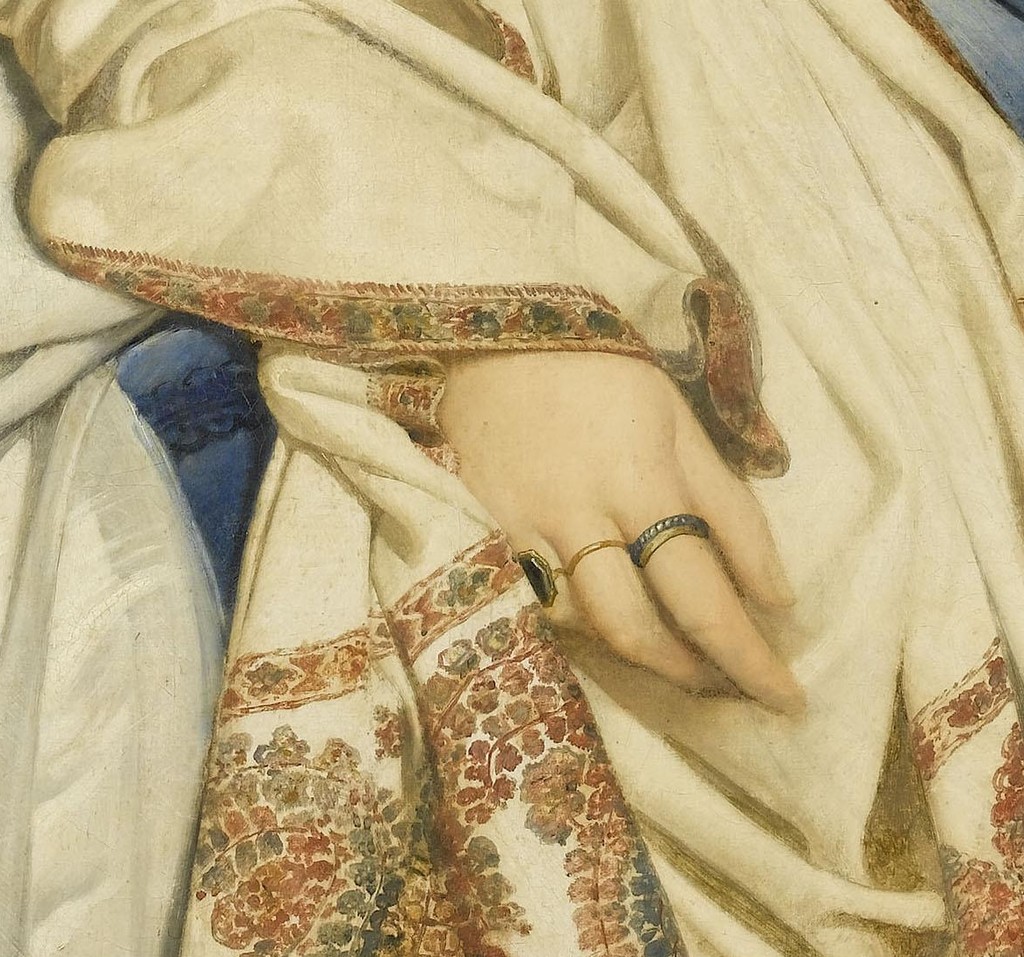
Her hands reward the same restraint in interpretation. The hand on the cushion hangs with the fingers separated enough to be individually legible. Its direction interrupts the horizontal sweep of the upper arm and leads towards the blue folds below. The lower hand points the eye further down through the shawl, close to the patterned edge. Both appear relaxed, although each has a precise function in the design.
Jewellery introduces another scale of drawing. The necklace marks the base of the neck with a clean, warm curve. The bracelets encircle the wrist, and the rings produce little concentrations of detail within the pale hands. These small circular forms make especially clear how much of the portrait depends on rounded contours.
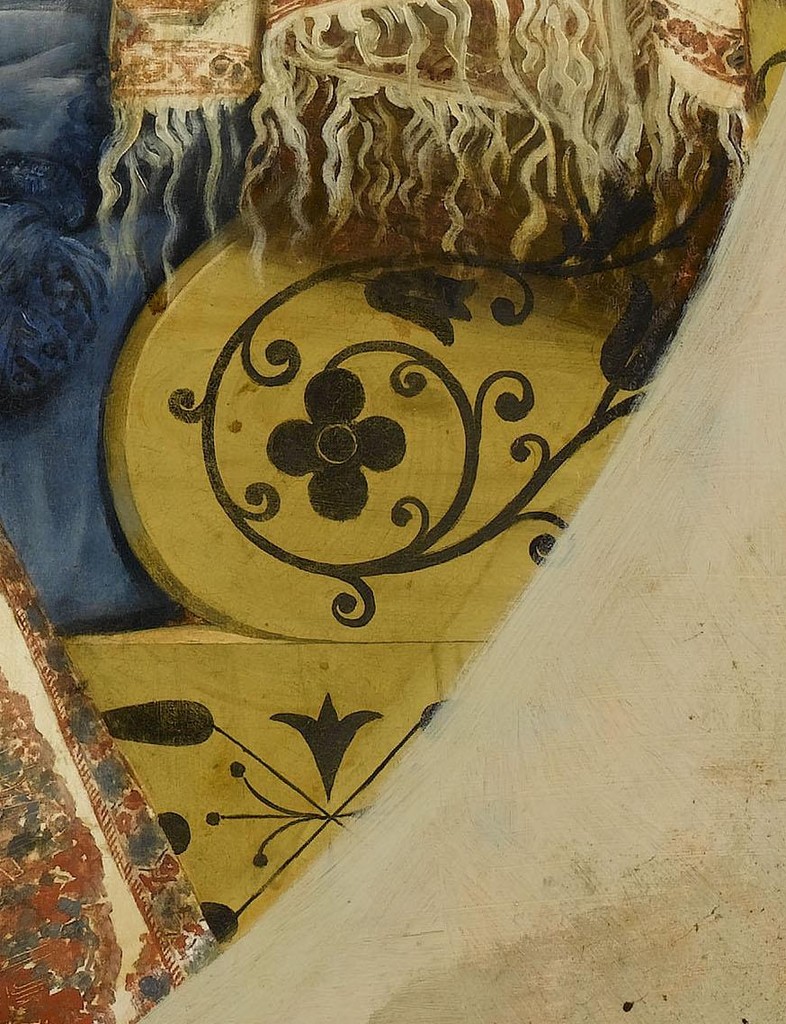
Look lower still, towards the exposed wood beside the cushion. Its ornamental scrolls have a firmer, more emphatic shape than the folds of the veil. They answer the curls of hair across a considerable distance. The connection does not require a symbolic explanation: it is a visible correspondence that helps the upper and lower portions belong together.
The oval, the sweep of the shoulder, the necklace and the ornament work at different scales. Seeing them together changes the way the sitter’s apparent repose feels. Her body rests, but the composition keeps circulating around it. The activity resides in the routes available to the eye.
Annotated Details from Madame Rivière
The numbered points identify visible features discussed in this article. Return from each detail to the whole composition. Madame Rivière. MI 1446. Wikimedia Commons. Image source. Public domain.
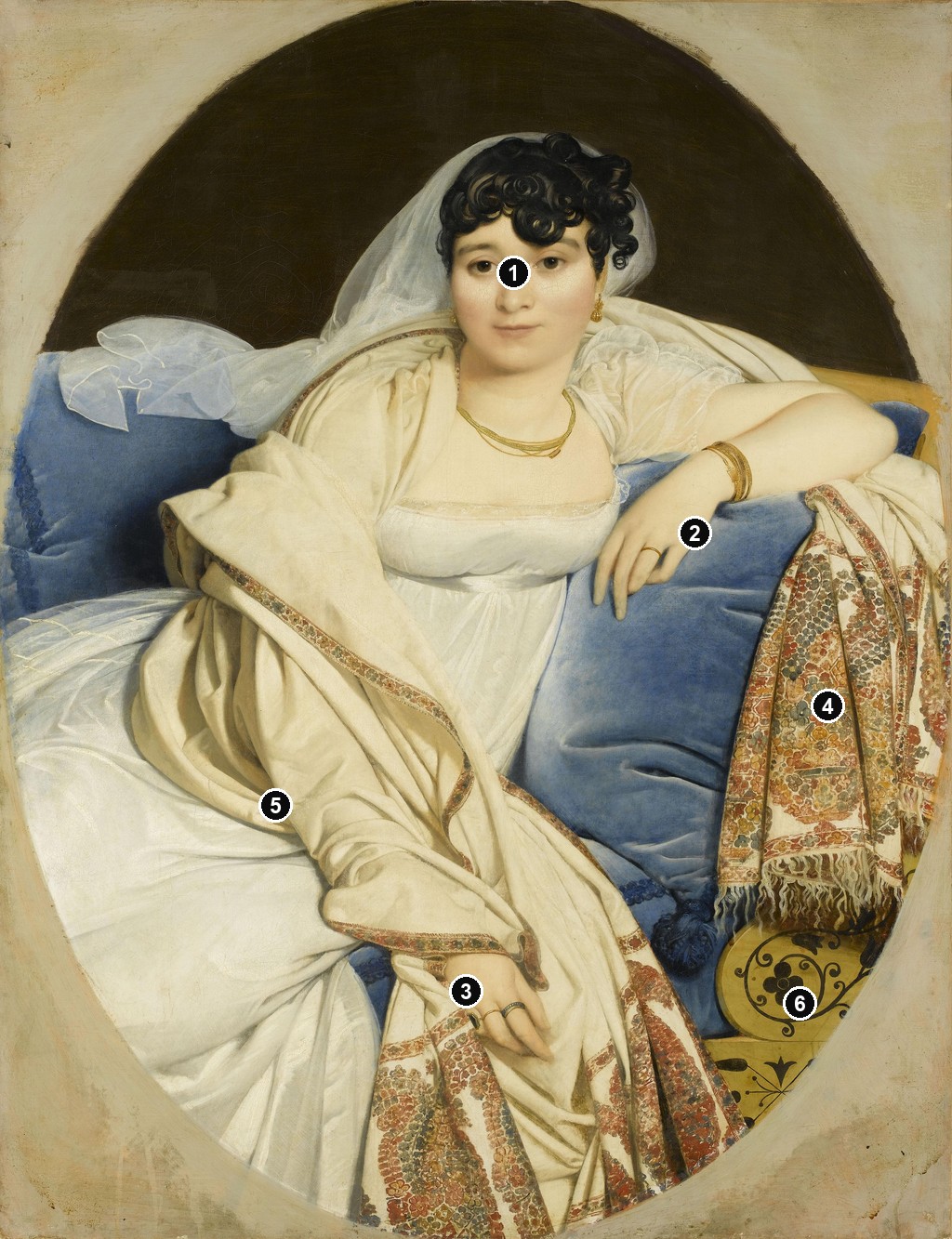
Details from MADAME RIVIÈRE
Trace the face, two hands and changing fabrics through the oval composition.
Curls, veil and face
Dark curls make small repeated loops above the face. The translucent veil opens into much broader pale folds at either side.
A hand lowered over the blue cushion
The fingers descend over the blue cushion beneath a bracelet and ring. Their long pale shapes contrast with the cushion’s softer changes of light.
The second hand within the shawl
The lower hand emerges between folds of the shawl. A ring and a few small highlights bring attention to this quieter group of fingers near the bottom of the oval.
Pattern and fringe at the right
Small red, green and cream motifs run down the hanging shawl. Loose fringe marks a different edge above the yellow seat.
White dress and the sweeping shawl
The broad diagonal of the shawl crosses the lighter dress. Follow its patterned border as it turns down towards the lower hand.
The painted seat at the oval edge
Dark floral shapes decorate the yellow seat beside the hanging blue tassel. Their flat pattern ends against the pale surround of the oval.
A pose developed through revision
The 1999 catalogue reports an earlier chair and arm position. Revisions to the shawl and a translucent scarf reshaped the pose, according to technical research published in 1985. [2] Those alterations matter because the finished pose can look so self-contained. Its apparent ease depended on choices about how one form would meet another. A chair back makes a firm boundary behind a body. A shawl can establish a boundary while remaining part of the sitter’s clothing, and a transparent fabric can connect areas without covering everything underneath.
The visible result supports a comparison between the crispness of individual details and the flexibility of the larger arrangement. A bracelet has a definite edge. The precise course of the arm beneath the shawl is harder to follow. The painting allows these different degrees of clarity to coexist. We need not invent a practical reason for the sitter’s posture to appreciate the pictorial problem Ingres was working through.
One family, three different portraits
Sabine married Philibert in 1792; their children were Caroline and Paul. The commission’s circumstances remain uncertain, as does Paul’s absence from the known portrait group. [2] The three surviving paintings offer an unusually clear opportunity to see how differently an artist can organise related commissions.
The Louvre’s educational discussion identifies three formats: rectangular for the father, oval for the mother and arched for the daughter. [3] Looking across them makes Sabine’s surrounding curves especially conspicuous. In Philibert Rivière, dark clothing gives the seated figure a strongly bounded shape. The table, chair and stacked objects establish a more articulated interior. His outward-facing head has the support of a setting full of distinct things to inspect.
In Mademoiselle Caroline Rivière, the pale dress is set against a landscape. The horizon and sky open the space behind the figure, while gloves and fur make a broad band across her middle. The face is framed by smoothly divided hair, quite different from her mother’s tightly grouped curls.
Sabine occupies the most enclosed of these settings. Her principal accessories seem to fold back towards her, and the cushion presses closely into the foreground. The eye finds relatively few objects that can be detached from her immediate physical surroundings. Her shawl is at once a possession, something worn and a major part of the painting’s structure.
The pictures also distribute attention differently. Books and papers can be recognised as separate objects; a landscape offers an outward prospect; layered cloth makes us follow surfaces close to the skin. These differences give each portrait its own pace. They remain individual paintings, rather than panels of a fixed triptych.

Ingres, Portrait of Philibert Rivière, 1805. [4]

Ingres, Mademoiselle Caroline Rivière, 1805. [5]
The Salon of 1806
Mother and daughter appeared at the 1806 Salon alongside Ingres’s imperial Napoleon. Philibert’s inclusion is uncertain. As the 1999 catalogue recounts, Clarac objected to Sabine’s shadowless draperies, while Chaussard responded more favourably to Caroline. Ingres encountered the hostile reviews after leaving for Italy. [2]
The complaint is revealing when set against the picture itself. The broad areas of illuminated fabric do make some transitions difficult to disentangle. A viewer expecting the body to be modelled throughout by deeper shadow might find the folds distracting or confusing. Yet the same quality can hold our attention today: the shawl offers strong material detail while refusing to settle into an entirely straightforward description of the form beneath it.
The complaint also directs us towards the difference between a body in space and a pattern across a surface. The blue cushion seems convincingly thick, while its large shape locks into the oval as a block of colour. The lower hand feels tangible, while its direction belongs to a network of lines. What confused a critic can become a starting point for looking more closely.
Lost from view and left to the state
In 1855, attempts to locate the portraits for Ingres’s retrospective display failed, according to the 1999 catalogue. [2] A later document gives a particularly direct sense of how far they had slipped from the artist’s public history. In his posthumous book on Ingres, published in 1870, Henri Delaborde grouped the three Rivière portraits in a single catalogue entry. He placed them before the artist’s departure for Rome but stated that he had no information about their fate or the sitters’ circumstances. [6]
This was a gap in knowledge, rather than evidence that the paintings had been destroyed. The Louvre records the acquisition of Madame Rivière through the 1870 bequest of Sophie Robillard, Madame Paul Rivière. Sabine herself had died in 1848. [1] The distinction between the two women matters: the sitter and the later benefactor belong to different generations of the family.
Delaborde’s sparse entry also makes a useful counterpart to the painting’s extraordinary abundance. A name and an approximate place in the artist’s development could survive while the object’s whereabouts remained unknown to an early biographer. Today the portrait allows a much more immediate encounter, in which even a small curl, a turn of the shawl or the angle of a finger can become the centre of attention.
Artworks directory
Explore 150 paintings, drawings and an original lithograph. This selection includes related versions and studies; dates distinguish completed works from later revisions.
| Name | Date | Medium |
|---|---|---|
| The Apotheosis of Homer | 1827 | Painting |
| Grande Odalisque | 1814 | Painting |
| The Turkish Bath | 1859–1862 | Painting |
| Madame Moitessier Seated | 1856 | Painting |
| Portrait of Monsieur Bertin | 1832 | Painting |
| Napoleon I on His Imperial Throne | 1806 | Painting |
| Odalisque with Slave | 1839 | Painting |
| The Ambassadors of Agamemnon in the Tent of Achilles | 1801 (competition) | Painting |
| The Valpinçon Bather | 1808 | Painting |
| The Source | 1856 | Painting |
| Oedipus Explaining the Enigma of the Sphinx | 1808; revised probably before 1827 | Painting |
| The Vow of Louis XIII | 1824 | Painting |
| Antiochus and Stratonice | 1840 | Painting |
| The Comtesse d’Haussonville | 1845 | Painting |
| The Princesse de Broglie | 1851–1853 | Painting |
| Jupiter and Thetis | 1811 | Painting |
| The Dream of Ossian | 1813 | Painting |
| The Martyrdom of Saint Symphorian | 1834 | Painting |
| Venus Anadyomene | 1808–1848 | Painting |
| Portrait of Madame de Senonnes | 1814 | Painting |
| Madame Rivière | 1805 | Painting |
| Mademoiselle Caroline Rivière | 1805 | Painting |
| Portrait of Philibert Rivière | 1805 | Painting |
| Bonaparte First Consul | 1804 | Painting |
| The Death of Leonardo da Vinci | 1818 | Painting |
| Joan of Arc at the Coronation of Charles VII | 1854 | Painting |
| Madame Duvaucey | 1807 | Painting |
| La Belle Zélie | 1806 | Painting |
| Madame Panckoucke | 1811 | Painting |
| Portrait of Charles Marcotte d’Argenteuil | 1810 | Painting |
| Joseph Antoine Moltedo | c.1810 | Painting |
| Madame Leblanc | 1823 | Painting |
| Delphine Ingres-Ramel (Portrait of Madame Ingres) | 1859 | Painting |
| Portrait of Amédée de Pastoret | 1823–1826 | Painting |
| Portrait of Baronne de Rothschild | 1848 | Painting |
| Madame Marcotte de Sainte Marie | 1826 | Painting |
| Madame Gonse | 1852 | Painting |
| Aretino in the Studio of Tintoretto | 1848 | Painting |
| Don Pedro of Toledo Kissing Henry IV’s Sword | 1831/1832 | Painting |
| Raphael and La Fornarina | 1814 | Painting |
| Roger Freeing Angelica | 1819 | Painting |
| Romulus’ Victory over Acron | 1812 | Painting |
| Self-Portrait at the Age of Twenty-Four | 1804; revised 1841–1851 | Painting |
| Male Torso | c.1800 | Painting |
| Odalisque in Grisaille (Ingres and workshop) | c.1824–1834 | Painting |
| The Small Bather | 1826 | Painting |
| The Little Bather Harem Interior | 1828 | Painting |
| Jesus Among the Doctors | 1862 | Painting |
| The Virgin Adoring the Host | 1852 | Painting |
| The Virgin of the Host | 1841 | Painting |
| Virgin of the Adoption | 1858 | Painting |
| Paolo and Francesca | 1814 | Painting |
| Homer Deified (revised composition, Louvre RF5273) | 1865 | Drawing |
| Odalisque with Slave (Louvre RF4622) | 1858 | Drawing |
| Odalisque (Walters Art Museum; Ingres and Paul Flandrin) | 1842 | Painting |
| Madame Moitessier Standing (National Gallery of Art) | 1851 | Painting |
| Jacques-Louis Leblanc (The Metropolitan Museum of Art) | 1823 | Painting |
| Ferdinand-Philippe, Duke of Orléans (Louvre RF2005-13) | 1842 | Painting |
| Ferdinand-Philippe, Duke of Orléans (Versailles MV5207; Ingres and workshop) | 1843 | Painting |
| Ferdinand-Philippe, Duke of Orléans (Versailles MV5209; Ingres and workshop) | 1844 | Painting |
| Antiochus and Stratonice (Musée Fabre; Ingres and Raymond Balze) | 1866 | Painting |
| Antiochus and Stratonice (Kunstmuseum Bern, Gurlitt bequest) | Undated (early dating proposed) | Drawing |
| Composition study for Antiochus and Stratonice (MIB867.2193) | 1806 | Drawing |
| Study for the Figure of Stratonice (Met63.66) | 1834–1840 | Graphite, black chalk and charcoal |
| Nude figure study for Stratonice (Boijmans F II 36 PK) | c.1834–1840 | Drawing |
| Paolo and Francesca (The Barber Institute,54.6) | c.1814–1820 | Painting |
| Paolo and Francesca (The Hyde Collection,1971.24) | c.1855–1860 | Painting |
| Paolo and Francesca (Amsterdam Museum TA10970) | 1820 | Drawing |
| Paolo and Francesca (dedicated to Artaud de Montor) | 1816 | Drawing |
| Study for the Bust of Francesca (MIB867.1398) | 1819 | Drawing |
| Study for the Bust of Francesca (MIB867.1396) | 1819 | Drawing |
| The Archangel Raphael, first idea (MIB867.2488) | 1842 | Drawing |
| The Archangel Raphael (MIB867.2500) | 1842 | Drawing |
| The Archangel Raphael Carrying Human Prayers to God (Chantilly DE513) | 1844 | Drawing |
| Louis-Philippe as Saint Philip, stained-glass study | 1844 | Drawing |
| Marie Frédéric Eugène de Reiset (Ford Collection RBF171-2) | 1844 | Drawing |
| Virgil Reading the Aeneid (Toulouse) | Begun 1811 | Painting |
| Tu Marcellus Eris (Brussels, inv. 1836) | c.1814 (museum dating) | Painting |
| Jean-François Gilibert | 1804 | Painting |
| François-Marius Granet | 1807 (museum dating) | Painting |
| Count Nikolai Dmitrievich Guryev | 1821 | Painting |
| Caroline Murat, Queen of Naples | 1814 | Painting |
| Count Mathieu Molé | 1834 | Painting |
| Cherubini and the Muse of Lyric Poetry (Louvre) | 1842 | Painting |
| Luigi Cherubini (Cincinnati) | 1841 | Painting |
| Comtesse de Rayneval (Louvre RF4505) | 1841 | Drawing |
| Venus on Paphos (Antonie Balaÿ) | c.1852 | Painting |
| Prince Napoléon | 1855 | Painting |
| Study for The Apotheosis of Napoleon I (Petit Palais) | Late 1853 | Painting |
| The Apotheosis of Napoleon I (destroyed ceiling) | 1853 | Painting |
| The Journalist (MIB867.2733) | 1834? | Drawing |
| Henry VIII, after Holbein | c.1815–1820 (?) | Drawing |
| Madame Récamier, after David (MIB867.3637) | Undated (early Paris period) | Drawing |
| Study for Comtesse d’Haussonville (MIB867.259; background possibly by another hand) | 1842–1845 | Drawing |
| La Source (reduced version reported by Delaborde) | Date unrecorded; reported 1870 | Painting |
| Odalisque (autograph lithograph,NGA1946.21.117) | 1825; published1826 | Lithograph |
| Portrait of a Seated Lady | 1814 | Graphite |
| The Kaunitz Sisters (Leopoldine, Caroline, and Ferdinandine) | 1818 | Graphite |
| Portrait of a Man | 1814 | Graphite |
| Study for the Portrait of Louis-François Bertin (1766–1841) | n.d. | Black chalk and graphite |
| Studies for the Cadaver of Acron | ca. 1810–12 | Graphite on wove paper |
| Study for the Drapery of Molière in "The Apotheosis of Homer" | n.d. | Black chalk with stumping |
| Madame Guillaume Guillon Lethière, née Marie-Joseph-Honorée Vanzenne, and her son Lucien Lethière | 1808 | Graphite |
| Niccolò Paganini (1782–1840) | ca. 1830 | Counterproof or tracing strengthened with graphite and gouache on translucent paper |
| Lady Mary Cavendish-Bentinck (?-1843) | 1816 | Graphite |
| Madame Alexandre Lethière and Her Daughter Letizia | ca. 1815 | Graphite |
| Merry Joseph Blondel (1781–1853) | 1809 | Graphite |
| Ursin-Jules Vatinelle (1798–1881) | 1820 | Graphite |
| Bust of a Gypsy Girl (ascribed to Ingres) | 1819 | Graphite on wove paper |
| Study of a Seated Nude Male | n.d. | Graphite |
| The Archangel Raphael (Study for a stained-glass window in the chapel of Notre-Dame de la Compassion-Saint-Ferdinand, Neuilly) | ca. 1842 | Graphite |
| Lancelot-Théodore, comte Turpin de Crissé | probably 1818 | Graphite |
| Study for the Figure of the Iliad in "The Apotheosis of Homer" | ca. 1827 | Graphite and black chalk heightened with white chalk on brown paper |
| Comtesse Turpin de Crissé | probably 1818 | Graphite |
| Nude Figures for L'Âge d'Or, Château de Dampierre | n.d. | Graphite on brownish paper |
| Study of Figures (attributed to Ingres) | n.d. | Graphite |
| Study of Figures (attributed to Ingres) | n.d. | Graphite; squared in graphite |
| Admiral Sir Fleetwood Broughton Reynolds Pellew | 1817 | Graphite on wove paper |
| Madame Jean-Auguste-Dominique Ingres, née Madeleine Chapelle | 1814 | Graphite on off-white wove paper |
| Virgil Reading the Aeneid to Augustus, Livia, and Octavia | 1809/1819 (?) | Pen and black ink, graphite, brush and gray wash, white gouache heightening, Conté crayon on blue paper |
| General Louis-Étienne Dulong de Rosnay | 1818 | Graphite (hard and soft pencils) |
| Madame Alexandre Lethière, née Rosa Meli, and Her Daughter, Letizia | 1815 | Graphite |
| The Lawyer Paul Grand | 1834 | Graphite |
| Jean-Joseph Fournier | 1815 | Graphite |
| Armand Bertin | 1842 | Graphite |
| Madame Armand Bertin, née Marie-Anne-Cécile Dollfuss | 1843 | Graphite |
| The Architect Charles-Victor Famin | 1836 | Graphite |
| Henri Lehmann | 1850 | Graphite |
| Portrait of a Lady | ca. 1815–17 | Graphite |
| Edmond Cavé (1794–1852) | 1844 | Oil on canvas |
| Head of Saint John the Evangelist | probably ca. 1818–20 | Oil on canvas, laid down on wood |
| Madame Edmond Cavé (Marie-Elisabeth Blavot, ca. 1806–1883) | ca. 1831–34 | Oil on canvas |
| Madame Félix Gallois | 1852 | Graphite with touches of gold in oil to highlight jewelry, on buff wove paper. |
| Dr. François Mêlier | 1849 | Graphite with graphite framing lines, corrected with white, on buff wove paper |
| Portrait of Madame Rhode (Rhoda?) | 1810–20 | Graphite on pale buff wove paper |
| Study for "Raphael and the Fornarina"(?) | ca. 1814(?) | Graphite on white wove paper |
| Portrait of Madame Paul Meurice, née Palmyre Granger | ca. 1845–50 | Graphite on wove paper |
| Alexander the Great presenting Campaspe to Apelles | 1810 | Graphite, brush and brown wash; squared in graphite |
| Study of Hands for "Christ Among the Doctors" | 1852–62 | Graphite on tracing paper |
| Study for The Turkish Bath (RF34502) | about 1850 | Pen and brown ink with graphite, partially squared |
| Study for The Turkish Bath (RF23354) | Undated | Pen and brown ink with graphite on joined sheets |
| Study for The Turkish Bath (RF54702) | about 1859 | Pen and brown ink |
| Studies of women for The Turkish Bath (RF12292) | Undated | Black chalk |
| Achilles Receiving the Envoys of Agamemnon (Nationalmuseum sketch, NM2161) | 1801 | Oil on wood |
| Half-Length Bather (Musée Bonnat-Helleu,89) | 1807 | Oil on canvas |
| Oedipus and the Sphinx (National Gallery,NG3290) | about1826 | Oil on canvas |
| Oedipus and the Sphinx (Walters,37.9) | 1864 | Oil on canvas |
| Oedipus and the Valpinçon Bather, after David (MI.867.2035) | Undated | Graphite on tracing paper, after David |
| Study of the Virgin for The Vow of Louis XIII (Dijon,1758) | about1822 | Black chalk, stump and white chalk on brown wove paper |
| First Thought for The Vow of Louis XIII (MI.885.11.21) | 1822 | Oil on canvas |
Frequently Asked Questions
Painted in 1805; exhibited in 1806. [1]
It has an oval composition, elongated vertically. [1] The enclosing curve is central to the way the sitter and her clothing fill the picture.
Its pattern helps us follow the folds, while its broad pale field carries much of the figure’s outline. Looking between that field, the satin dress and the transparent veil reveals how differently the painting describes cloth.
Discussion
Look again at the images and ideas explored in Madame Rivière. These editorial prompts invite your observations.
Reader Insights
Follow a continuous route from the veil behind Sabine’s hair, across the shoulder and arm, down to the hanging hand and into the shawl below. Where does the movement feel easiest to follow, and where do the overlapping fabrics make you pause?
Compare Sabine’s enclosing oval with the more open landscape behind Caroline. What different relationships between figure and setting do they create?
How does the patterned shawl behave as both a recognisable textile and a broad movement through the composition?
Join the Conversation
Share a detail, comparison or question about Madame Rivière below.
References
- Musée du Louvre, Madame Rivière, MI 1446. Object record, updated 28 April 2026; description, material characteristics and historical information. (In French.) View source.
- Metropolitan Museum of Art, Portraits by Ingres: Image of an Epoch. 1999, pp. 62–64. View source.
- Laurence Brosse, Musée du Louvre, “Prendre la pose et tirer le portrait”, Ingres, educational material, 2006; sections on the three Rivière portraits. (In French.) View source.
- Supporting image. Ingres, Portrait of Philibert Rivière, 1805. Musée du Louvre; Photograph: Didier Descouens; Wikimedia Commons. Image source. CC BY-SA 4.0. Resized and JPEG-optimised; image derivative licensed CC BY-SA 4.0.
- Supporting image. Ingres, Mademoiselle Caroline Rivière, 1805. Musée du Louvre; Reproduction: Shonagon; Wikimedia Commons. Image source. Public domain.
- Henri Delaborde, Ingres, sa vie, ses travaux, sa doctrine, d’après les notes manuscrites et les lettres du maître. Paris: Henri Plon, 1870, p. 260, catalogue no. 152. (In French.) View source.
- Splash image. Madame Rivière. MI 1446. Wikimedia Commons. Image source. Public domain.