by Tom Gurney
Tom Gurney BSc (Hons) is an art history expert with over 20 years experience
Published on June 19, 2020 / Updated on October 22, 2026
Email: tomgurney1@gmail.com / Phone: +44 7429 011000
Madame Marcotte de Sainte Marie
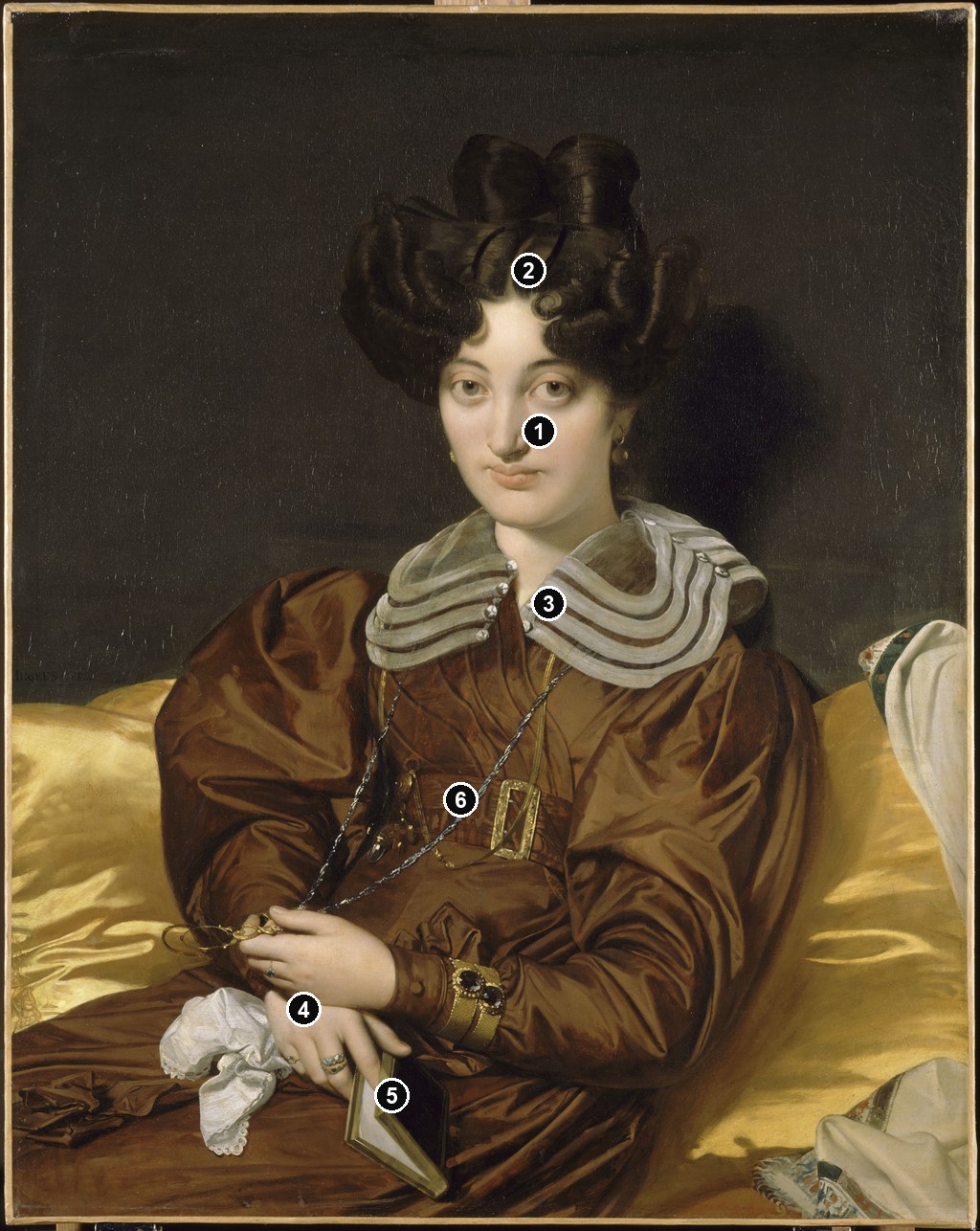
Madame Marcotte meets the viewer’s eyes above a spectacular arrangement of brown satin, white gauze and yellow cushions. Her face occupies a surprisingly small part of the picture, yet the surrounding folds and curves keep returning attention to it. Ingres signed and dated the canvas in 1826. [1] Its stillness rewards a slow look: a pair of folded glasses, the edge of a book and the precise turn of a wrist make the seated figure more complicated than her composed expression first suggests.
At a Glance
- ArtistJean-Auguste-Dominique Ingres
- Date1826
- MediumOil on canvas
- Dimensions93 × 74 cm
- CollectionMusée du Louvre, Paris; RF 2398
- SitterSuzanne-Clarisse de Salvaing de Boissieu (1803–1862), wife of Marie Marcotte de Sainte-Marie. [1]
This work across Ingres’s career
Agamemnon’s Ambassadors
1801 (competition)Grande Odalisque
1814Louis XIII’s Vow
1824Monsieur Bertin
1832The Princesse de Broglie
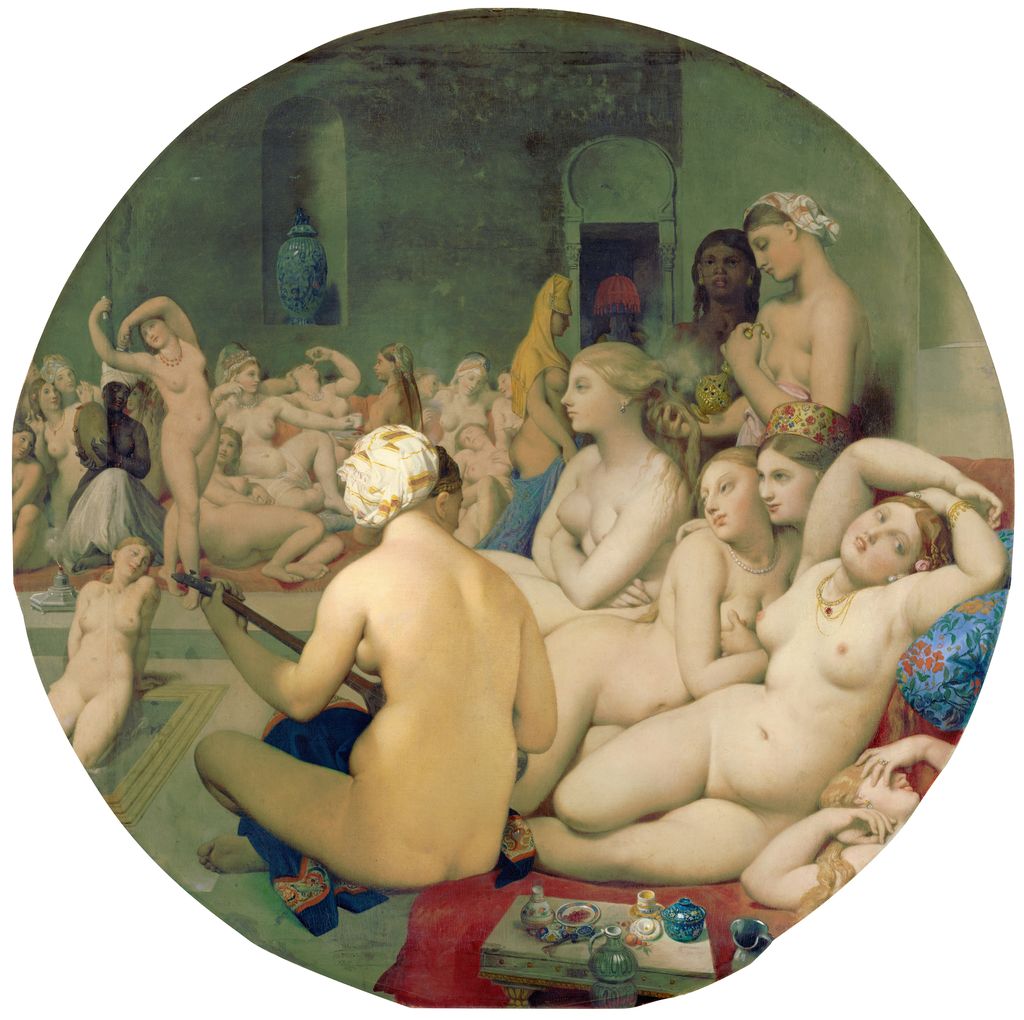
1851–1853The Turkish Bath
1859–1862Contents
- A portrait within the Marcotte family
- Looking closely at the figure
- Dress, reserve and the limits of biography
- From graphite portrait to revised painting
- At the Salon of 1827
- The painting and drawing enter the Louvre
- Annotated details
A portrait within the Marcotte family
Marie Marcotte de Sainte-Marie worked for the French Treasury. Despite the first name, Marie here identifies the sitter’s husband. [1] He commissioned her portrait and was the younger brother of Charles Marcotte d’Argenteuil, Ingres’s friend and patron. Suzanne-Clarisse and Marie married in 1823. [2] The family connection sits outside an apparently self-contained image. The picture supplies no group of relatives, heraldic explanation or view of the household. Almost everything we learn visually comes through the sitter’s dress, possessions and bodily presence.
The furnishings establish comfort without describing a complete room. Yellow cushions support her on either side; a pale patterned shawl falls at the right. Behind her, a dark wall gives very little information about the house. This selective setting concentrates attention on the woman and on the objects close enough to touch. The portrait offers an encounter at the scale of a person, without opening the rest of her domestic world to inspection.

Ingres, Portrait of Charles Marcotte d’Argenteuil, 1810. [3]
Looking closely at the figure
The face and its elaborate frame
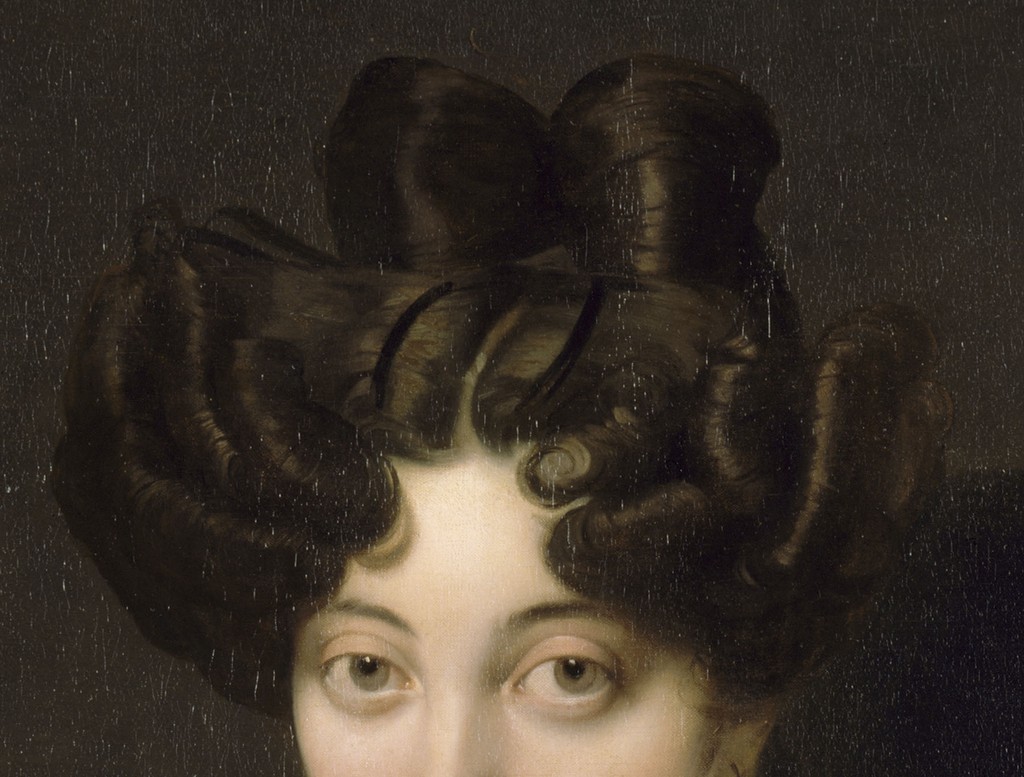
The hair is one of the painting’s largest and most emphatic shapes. Two raised loops stand above the head, with broad rolled forms at the temples and smaller curls near the forehead. Light glances across these dark surfaces. Against them, the relatively narrow face appears especially pale and exposed.
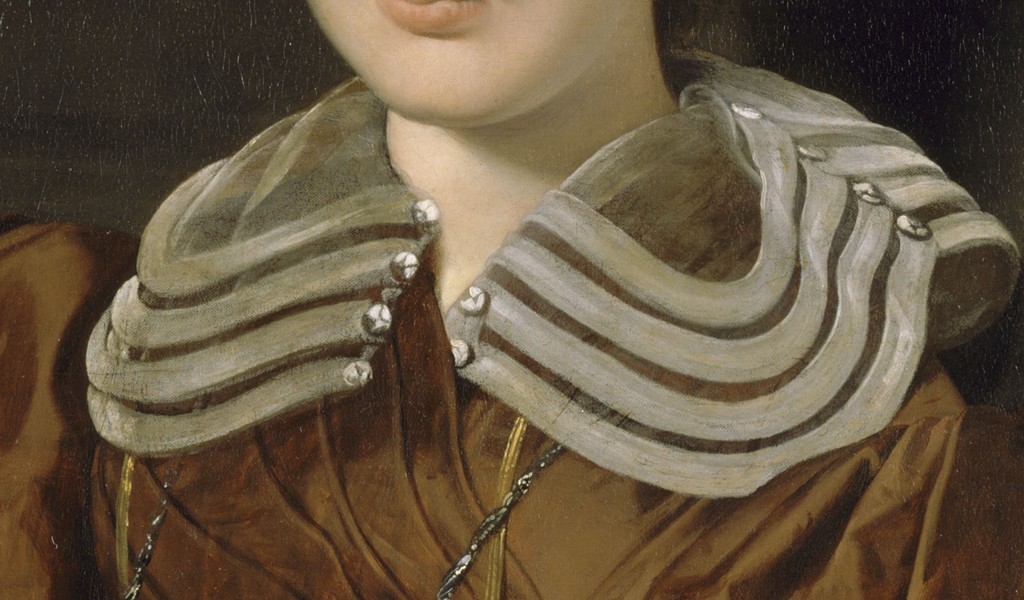
Below the chin, the collar spreads into another system of loops. Its alternating translucent and denser white bands curl over the brown dress; small round fastenings mark the opening at the centre. The hair and collar therefore frame the face in opposite ways. One surrounds it with dark volume, the other with pale, spreading lines. Between them, the eyes address us with remarkable directness.
The mouth is closed, its corners only lightly defined. There is no broad smile to tell us how to respond. That absence leaves room for different impressions: composure, watchfulness, perhaps a momentary pause. None can establish a personality. What the picture securely gives us is a carefully maintained relationship between her gaze and ours.
Brown satin and yellow cushions
The dress is far more varied than the word “brown” suggests. Across the sleeves, warm ochre passages meet almost black creases. Broad highlights describe the swelling fabric above the elbows; smaller, sharper folds gather around the forearms and waist. The same material can appear crisp at one edge and heavy at another.
These changes make the sleeves conspicuous. They extend the figure sideways, while the narrow waist draws the fabric back towards the centre. The body consequently reads through the architecture of the clothes: breadth at the shoulders, contraction at the belt, then the spreading skirt below. The dress gives the seated woman a substantial presence even though her head remains small within the composition.
The yellow upholstery answers this dark satin with a much brighter sheen. At the left, a cushion catches light beside the elbow; at the right, a larger expanse runs down towards the lower corner. Dark folds cut across both yellow and brown, joining sitter and seat through a shared pattern of light and shadow. Their colours remain distinct, but their surfaces belong to the same carefully observed world.
Look also at the plain wall. A shadow falls behind the head towards the right, setting the sitter forward from the background. The absence of a busy pattern there makes the curls and collar easier to follow. The wall’s restraint becomes particularly interesting when set beside the evidence of Ingres’s revisions.
Hands, glasses and the small book
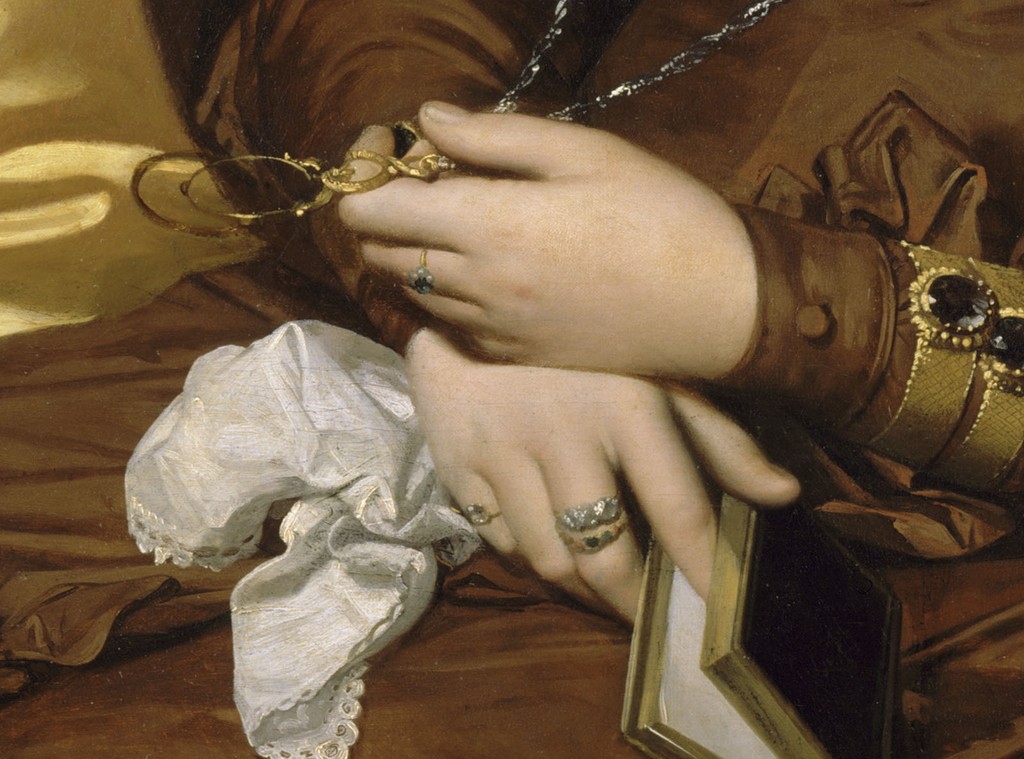
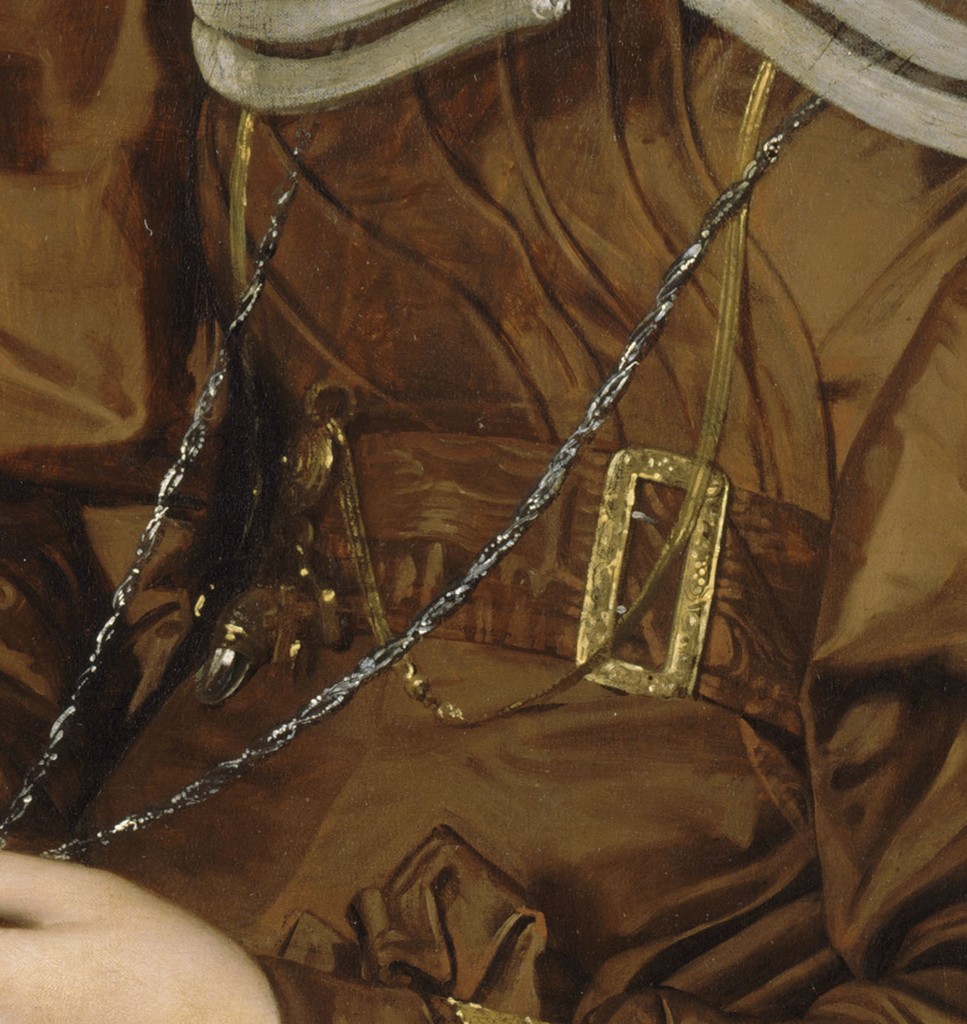
The hands form a second centre of attention below the face. One lies across the other wrist while holding a small pair of glasses by their handle, a lorgnette. Its fine metal outline extends towards the left, interrupting the broad sweep of satin. A chain rises from this area across the bodice, introducing a loose diagonal into the more firmly arranged clothing.
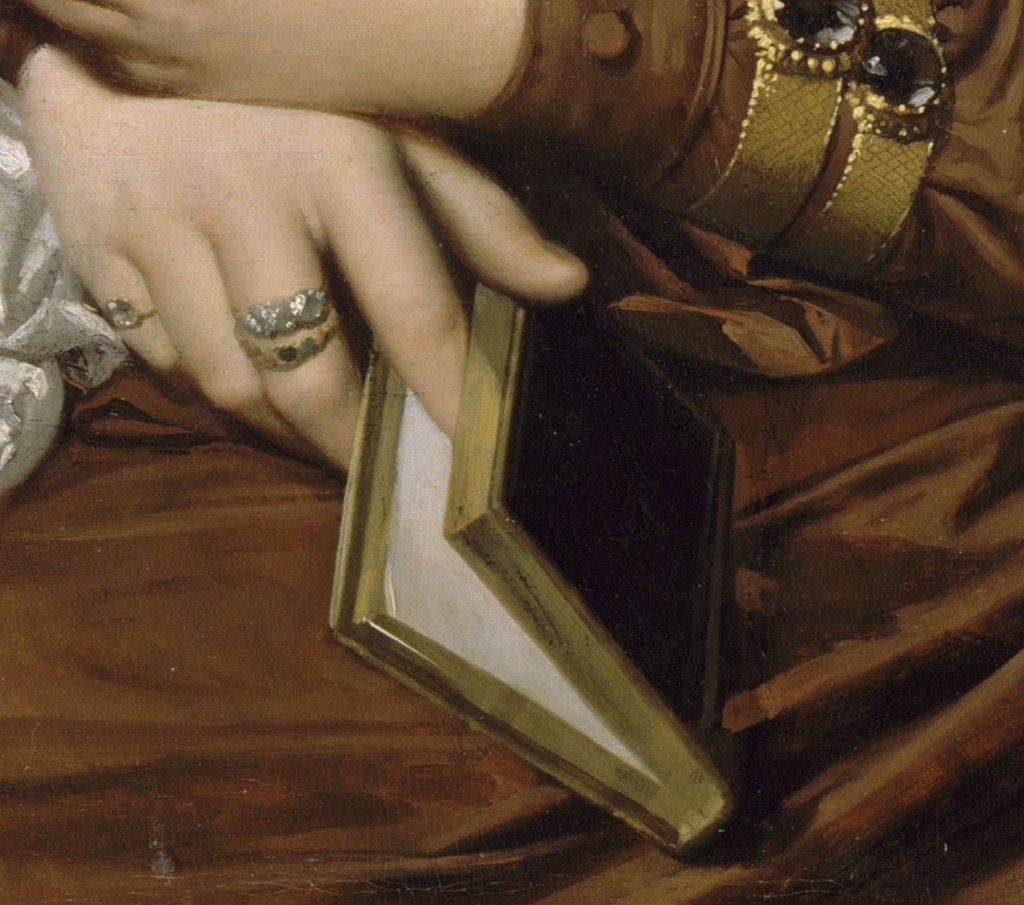
The lower hand reaches towards a small book. Its fingers spread against the dark cover and pale page edges; beside them, the white handkerchief opens into irregular folds and an embroidered border. The book has a comparatively hard, straight outline. The handkerchief collapses and wrinkles. Ingres brings these different kinds of touch together within a very small area.
Jewellery provides further changes of scale. A wide gold bracelet, with dark stones and bright surrounding settings, encircles the wrist. Rings punctuate individual fingers. Higher up, a rectangular gold buckle catches the light at the waist, and small earrings appear beside the cheeks. These details encourage the eye to move between the large masses of dress and hair and the much smaller forms through which the sitter is furnished as an individual.
The objects also complicate the apparent pause. Glasses can be lifted; a book can be turned or closed; a handkerchief can be gathered up. The portrait holds all of these possibilities in suspension. It does not show a continuous action or explain what she has just been doing. The suggestion of ordinary use gives the formal pose a quiet connection to daily life.
Annotated Details from Madame Marcotte de Sainte Marie
The numbered points identify visible features discussed in this article. Return from each detail to the whole composition. Each caption identifies the work shown.
Madame Marcotte de Sainte Marie
Jean-Auguste-Dominique Ingres, Madame Marcotte de Sainte-Marie, 1826. Oil on canvas, 93 × 74 cm. Musée du Louvre, RF 2398; purchased from the sitter’s descendants in 1923 with David-Weill’s assistance. Faithful reproduction via Wikimedia Commons. Image source. Public domain.
Madame Marcotte — Drawing RF 41393
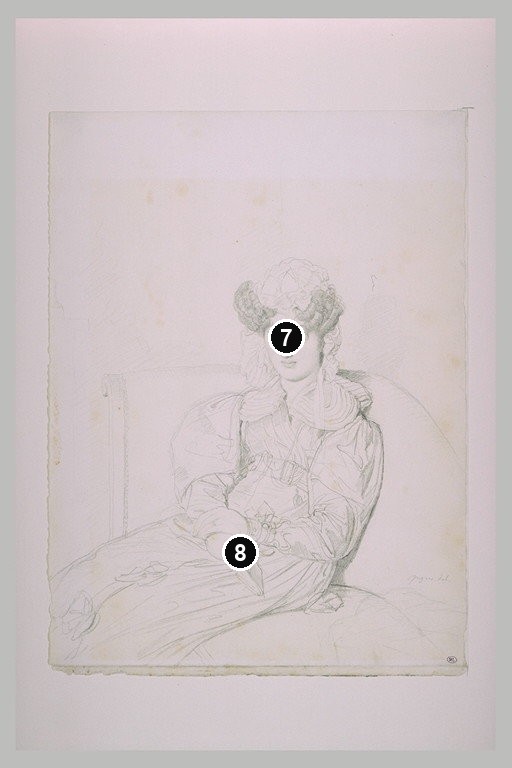
Ingres, Portrait of Madame Marie Marcotte de Sainte-Marie. Graphite, signed. Musée du Louvre, RF 41393 recto. The drawing related to the 1826 painting. RMN; Wikimedia Commons. Image source. Public domain.
Details from MADAME MARCOTTE DE SAINTE MARIE
Compare the painted portrait with the separate signed Louvre graphite drawing. The faint drawing supports broad views of the head, hands and seat; its differences should be considered alongside the complete images.
Madame Marcotte de Sainte Marie
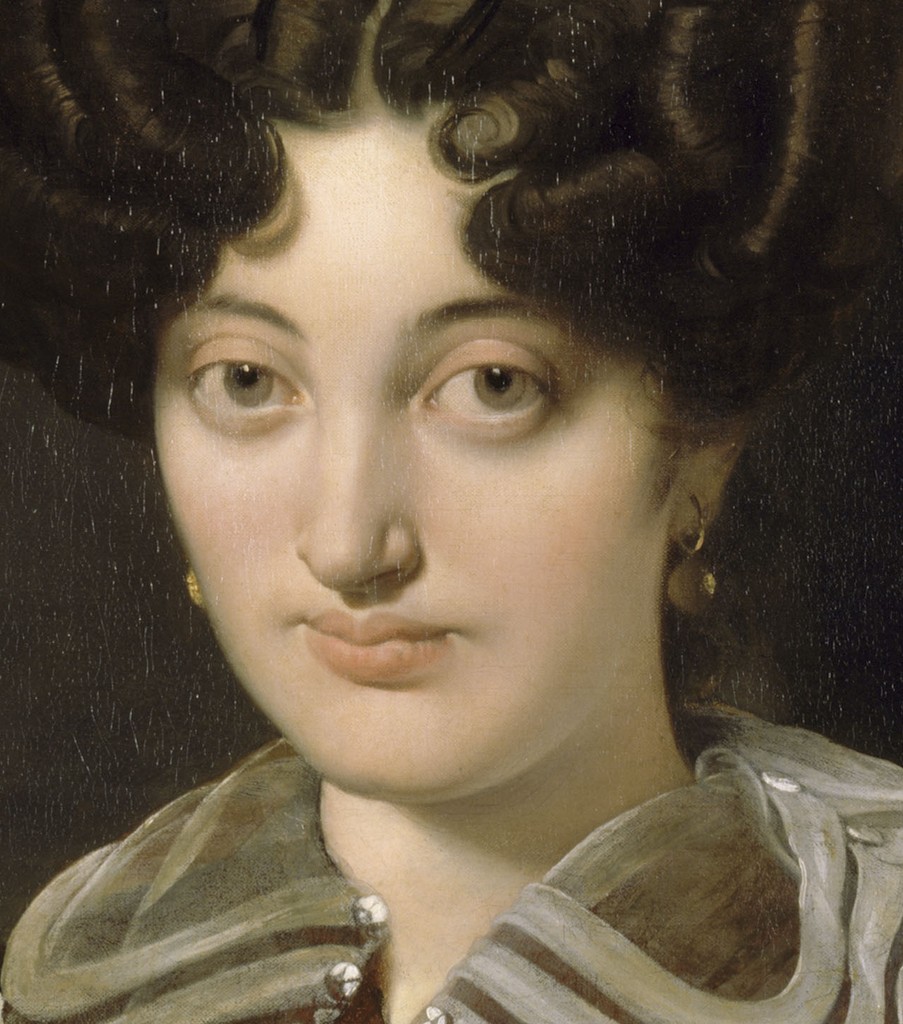
The face beneath the tall hairstyle
The face turns within large masses of dark hair. Small earrings provide bright accents beside the cheeks and the otherwise quiet outline of the head.
Loops and bows above the head
Several large loops rise above the central parting. Their rounded volumes build a much taller shape than the small curls beside the forehead.
The layered pale collar
Repeated pale bands curl around the neck and meet in two rows of small buttons. Their alternating dark and light edges bring a different rhythm to the upper body.
Hands, spectacles and white cloth
The hands gather spectacles and a white cloth near the lap. Rings and bracelets create small bright interruptions among the fingers, cuffs and folds.
The small book at the lower edge
A small book opens beside the lower hand. Its straight edges and pale pages interrupt the larger folds of the brown dress.
Chains across the brown bodice
Long chains cross the brown bodice and gather around a small rectangular object. Their narrow diagonals run against the dress’s broader folds.
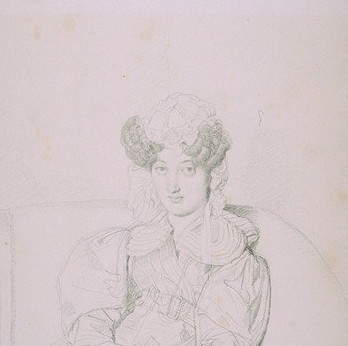
Madame Marcotte — Drawing RF 41393
The face framed by hair and collar
The face sits between rounded masses of hair and the curling lines of the collar. The pale graphite outlines remain faint; their broad arrangement is clearer than any minute detail.
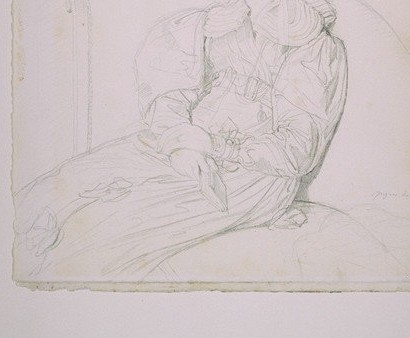
The hands above the long seat
The hands gather above the skirt near the curve of the seat. Long, lightly drawn folds lead away to the left, extending the pose across the lower sheet.
Dress, reserve and the limits of biography
Shelton, drawing on Paula Warrick’s research, reads the portrait in relation to fashionable dress and married respectability. This offers a social interpretation, rather than a documented statement of the commission’s purpose. [2] The collar covers much of the upper chest, yet its striped transparency and curving edges create one of the most decorative passages in the painting. Coverage and visual display coexist. The jewellery is similarly conspicuous, and the carefully arranged hair enlarges the sitter’s silhouette. A high neckline need not make the whole image austere.
Older accounts of illness, unbearable sittings and Ingres’s wife modelling the hands remain unverified; Shelton and Naef question their evidential basis. [2] They should not determine how we understand the face. Nor do the glasses establish a medical history. The picture records a visual appearance and a selection of possessions; it cannot tell us how the sitter felt about the sessions.
The strongest tension lies between an outwardly elaborate presentation and the face’s comparatively restrained expression. Small changes in where we look can alter the balance: the shimmering sleeves suggest abundance, while the still mouth and steady eyes draw attention back to the encounter with the sitter.
From graphite portrait to revised painting
The Louvre also owns a signed graphite portrait of Madame Marcotte, RF 41393, measuring 32.4 × 24 cm. Its catalogue commentary, quoting Louis-Antoine Prat, identifies significant differences in the seat, hands and hairstyle. The same commentary reports that imaging of the painting revealed an earlier seat resembling the small sofa in the drawing. [4]
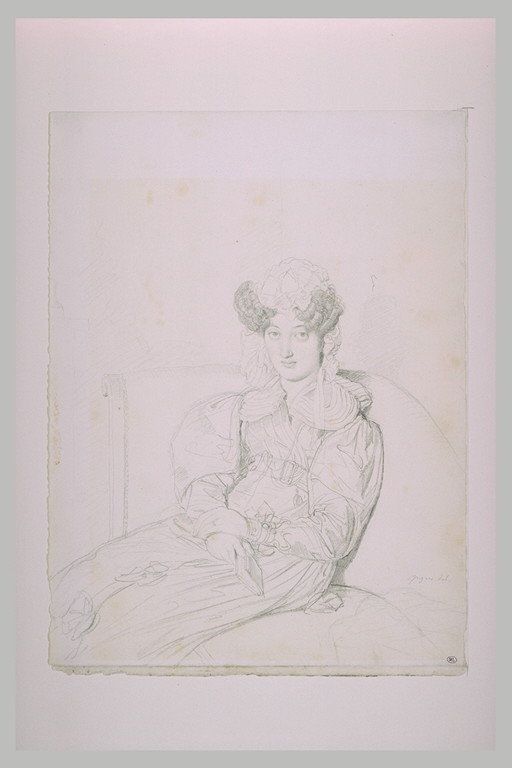
Ingres, Portrait of Madame Marie Marcotte de Sainte-Marie. Graphite, signed. Musée du Louvre, RF 41393 recto. The drawing related to the 1826 painting. [5]
This gives the drawing an unusually close relationship to the finished portrait. It preserves a considered arrangement that Ingres subsequently altered. The correspondence between the sheet and a concealed painted state is stronger evidence of their connection than a general resemblance of face or costume alone.
Dating still requires care. Naef places the undated sheet around 1826 by association with the painting. [2] Henri Delaborde’s posthumous catalogue, published in 1870, reports an artist’s note describing a Madame Sainte-Marie portrait as drawn in Paris around 1824. [6] That approximate documentary date concerns a drawing; it does not replace the date on the canvas. Nor should it be turned into an exact, continuously documented two-year campaign.
Shelton also reports an underlying floral wall pattern. His account describes Montauban alternatives with a more upright pose and an outdoor setting, one including a large open book. [2] These changes suggest how differently the sitter might have been presented. A larger book would occupy more of the composition; an outdoor setting would give the figure a different relationship to surrounding space.
One Montauban sheet, MI.867.247, is separately catalogued as a graphite drawing on paper, 17.6 × 13.5 cm, dated 1826. It entered the museum through Ingres’s bequest in 1867. [7] It is distinct from the larger, signed Louvre drawing. For a broader account of how such sheets function within his work, see Ingres’s drawings.
The revisions change how we experience the final painting. Its plain background and enclosing cushions can initially seem inevitable, as though they simply reproduce a settled scene. The preparatory evidence reveals an arrangement that could have taken other forms. The painter adjusted the sitter’s surroundings as well as her pose, shaping the balance between patterned surfaces, dark space and the figure herself.
At the Salon of 1827
The portrait appeared at the 1827 Salon as catalogue number 576, under the anonymous title Portrait de femme—“Portrait of a Woman”. Eric Bertin’s correction to the 1999 catalogue makes clear that the sitter’s name was not supplied in the exhibition title. [8]
That public presentation differs from our encounter with the named museum object. The title gave visitors a category of painting without explaining the woman’s family connections. They could judge a likeness, a costume and an arrangement of forms while knowing little about the person represented.
According to Shelton’s account of Pierre-Alexandre Coupin’s 1828 review, the critic preferred Pastoret’s portrait, finding problems with Madame Marcotte’s scale, contours and eye colour. [2] Those objections concern the effect of a painted image. They also remind us how readily close attention to a likeness can become a judgement on the person shown.
The neighbouring exhibition entry was the anonymous male portrait now known as Amédée de Pastoret, number 575. [8] The catalogue offered visitors two opportunities to assess Ingres’s portraiture without supplying either sitter’s identity. Today, their familiar names can make that initial anonymity easy to overlook.

Ingres, Portrait of Amédée de Pastoret, 1823–1826. [9]
The painting and drawing enter the Louvre
The Louvre purchased the painting from the sitter’s descendants in 1923 with David-Weill’s assistance. [1] Its passage from family ownership into a national collection changed the audience for a likeness originally rooted in personal connections. The possessions within the picture remained visible, while the household that had preserved it became part of its history.
The related graphite portrait followed a separate path: the Louvre acquired it from the Marcotte family in 1987. [4] Painting and drawing thus reached the same institution more than sixty years apart. Their shared collection now makes possible a comparison between a finished painted likeness and a closely related work on paper, while their separate inventory numbers preserve the distinction between the objects.
Artworks directory
Explore 150 paintings, drawings and an original lithograph. This selection includes related versions and studies; dates distinguish completed works from later revisions.
| Name | Date | Medium |
|---|---|---|
| The Apotheosis of Homer | 1827 | Painting |
| Grande Odalisque | 1814 | Painting |
| The Turkish Bath | 1859–1862 | Painting |
| Madame Moitessier Seated | 1856 | Painting |
| Portrait of Monsieur Bertin | 1832 | Painting |
| Napoleon I on His Imperial Throne | 1806 | Painting |
| Odalisque with Slave | 1839 | Painting |
| The Ambassadors of Agamemnon in the Tent of Achilles | 1801 (competition) | Painting |
| The Valpinçon Bather | 1808 | Painting |
| The Source | 1856 | Painting |
| Oedipus Explaining the Enigma of the Sphinx | 1808; revised probably before 1827 | Painting |
| The Vow of Louis XIII | 1824 | Painting |
| Antiochus and Stratonice | 1840 | Painting |
| The Comtesse d’Haussonville | 1845 | Painting |
| The Princesse de Broglie | 1851–1853 | Painting |
| Jupiter and Thetis | 1811 | Painting |
| The Dream of Ossian | 1813 | Painting |
| The Martyrdom of Saint Symphorian | 1834 | Painting |
| Venus Anadyomene | 1808–1848 | Painting |
| Portrait of Madame de Senonnes | 1814 | Painting |
| Madame Rivière | 1805 | Painting |
| Mademoiselle Caroline Rivière | 1805 | Painting |
| Portrait of Philibert Rivière | 1805 | Painting |
| Bonaparte First Consul | 1804 | Painting |
| The Death of Leonardo da Vinci | 1818 | Painting |
| Joan of Arc at the Coronation of Charles VII | 1854 | Painting |
| Madame Duvaucey | 1807 | Painting |
| La Belle Zélie | 1806 | Painting |
| Madame Panckoucke | 1811 | Painting |
| Portrait of Charles Marcotte d’Argenteuil | 1810 | Painting |
| Joseph Antoine Moltedo | c.1810 | Painting |
| Madame Leblanc | 1823 | Painting |
| Delphine Ingres-Ramel (Portrait of Madame Ingres) | 1859 | Painting |
| Portrait of Amédée de Pastoret | 1823–1826 | Painting |
| Portrait of Baronne de Rothschild | 1848 | Painting |
| Madame Marcotte de Sainte Marie | 1826 | Painting |
| Madame Gonse | 1852 | Painting |
| Aretino in the Studio of Tintoretto | 1848 | Painting |
| Don Pedro of Toledo Kissing Henry IV’s Sword | 1831/1832 | Painting |
| Raphael and La Fornarina | 1814 | Painting |
| Roger Freeing Angelica | 1819 | Painting |
| Romulus’ Victory over Acron | 1812 | Painting |
| Self-Portrait at the Age of Twenty-Four | 1804; revised 1841–1851 | Painting |
| Male Torso | c.1800 | Painting |
| Odalisque in Grisaille (Ingres and workshop) | c.1824–1834 | Painting |
| The Small Bather | 1826 | Painting |
| The Little Bather Harem Interior | 1828 | Painting |
| Jesus Among the Doctors | 1862 | Painting |
| The Virgin Adoring the Host | 1852 | Painting |
| The Virgin of the Host | 1841 | Painting |
| Virgin of the Adoption | 1858 | Painting |
| Paolo and Francesca | 1814 | Painting |
| Homer Deified (revised composition, Louvre RF5273) | 1865 | Drawing |
| Odalisque with Slave (Louvre RF4622) | 1858 | Drawing |
| Odalisque (Walters Art Museum; Ingres and Paul Flandrin) | 1842 | Painting |
| Madame Moitessier Standing (National Gallery of Art) | 1851 | Painting |
| Jacques-Louis Leblanc (The Metropolitan Museum of Art) | 1823 | Painting |
| Ferdinand-Philippe, Duke of Orléans (Louvre RF2005-13) | 1842 | Painting |
| Ferdinand-Philippe, Duke of Orléans (Versailles MV5207; Ingres and workshop) | 1843 | Painting |
| Ferdinand-Philippe, Duke of Orléans (Versailles MV5209; Ingres and workshop) | 1844 | Painting |
| Antiochus and Stratonice (Musée Fabre; Ingres and Raymond Balze) | 1866 | Painting |
| Antiochus and Stratonice (Kunstmuseum Bern, Gurlitt bequest) | Undated (early dating proposed) | Drawing |
| Composition study for Antiochus and Stratonice (MIB867.2193) | 1806 | Drawing |
| Study for the Figure of Stratonice (Met63.66) | 1834–1840 | Graphite, black chalk and charcoal |
| Nude figure study for Stratonice (Boijmans F II 36 PK) | c.1834–1840 | Drawing |
| Paolo and Francesca (The Barber Institute,54.6) | c.1814–1820 | Painting |
| Paolo and Francesca (The Hyde Collection,1971.24) | c.1855–1860 | Painting |
| Paolo and Francesca (Amsterdam Museum TA10970) | 1820 | Drawing |
| Paolo and Francesca (dedicated to Artaud de Montor) | 1816 | Drawing |
| Study for the Bust of Francesca (MIB867.1398) | 1819 | Drawing |
| Study for the Bust of Francesca (MIB867.1396) | 1819 | Drawing |
| The Archangel Raphael, first idea (MIB867.2488) | 1842 | Drawing |
| The Archangel Raphael (MIB867.2500) | 1842 | Drawing |
| The Archangel Raphael Carrying Human Prayers to God (Chantilly DE513) | 1844 | Drawing |
| Louis-Philippe as Saint Philip, stained-glass study | 1844 | Drawing |
| Marie Frédéric Eugène de Reiset (Ford Collection RBF171-2) | 1844 | Drawing |
| Virgil Reading the Aeneid (Toulouse) | Begun 1811 | Painting |
| Tu Marcellus Eris (Brussels, inv. 1836) | c.1814 (museum dating) | Painting |
| Jean-François Gilibert | 1804 | Painting |
| François-Marius Granet | 1807 (museum dating) | Painting |
| Count Nikolai Dmitrievich Guryev | 1821 | Painting |
| Caroline Murat, Queen of Naples | 1814 | Painting |
| Count Mathieu Molé | 1834 | Painting |
| Cherubini and the Muse of Lyric Poetry (Louvre) | 1842 | Painting |
| Luigi Cherubini (Cincinnati) | 1841 | Painting |
| Comtesse de Rayneval (Louvre RF4505) | 1841 | Drawing |
| Venus on Paphos (Antonie Balaÿ) | c.1852 | Painting |
| Prince Napoléon | 1855 | Painting |
| Study for The Apotheosis of Napoleon I (Petit Palais) | Late 1853 | Painting |
| The Apotheosis of Napoleon I (destroyed ceiling) | 1853 | Painting |
| The Journalist (MIB867.2733) | 1834? | Drawing |
| Henry VIII, after Holbein | c.1815–1820 (?) | Drawing |
| Madame Récamier, after David (MIB867.3637) | Undated (early Paris period) | Drawing |
| Study for Comtesse d’Haussonville (MIB867.259; background possibly by another hand) | 1842–1845 | Drawing |
| La Source (reduced version reported by Delaborde) | Date unrecorded; reported 1870 | Painting |
| Odalisque (autograph lithograph,NGA1946.21.117) | 1825; published1826 | Lithograph |
| Portrait of a Seated Lady | 1814 | Graphite |
| The Kaunitz Sisters (Leopoldine, Caroline, and Ferdinandine) | 1818 | Graphite |
| Portrait of a Man | 1814 | Graphite |
| Study for the Portrait of Louis-François Bertin (1766–1841) | n.d. | Black chalk and graphite |
| Studies for the Cadaver of Acron | ca. 1810–12 | Graphite on wove paper |
| Study for the Drapery of Molière in "The Apotheosis of Homer" | n.d. | Black chalk with stumping |
| Madame Guillaume Guillon Lethière, née Marie-Joseph-Honorée Vanzenne, and her son Lucien Lethière | 1808 | Graphite |
| Niccolò Paganini (1782–1840) | ca. 1830 | Counterproof or tracing strengthened with graphite and gouache on translucent paper |
| Lady Mary Cavendish-Bentinck (?-1843) | 1816 | Graphite |
| Madame Alexandre Lethière and Her Daughter Letizia | ca. 1815 | Graphite |
| Merry Joseph Blondel (1781–1853) | 1809 | Graphite |
| Ursin-Jules Vatinelle (1798–1881) | 1820 | Graphite |
| Bust of a Gypsy Girl (ascribed to Ingres) | 1819 | Graphite on wove paper |
| Study of a Seated Nude Male | n.d. | Graphite |
| The Archangel Raphael (Study for a stained-glass window in the chapel of Notre-Dame de la Compassion-Saint-Ferdinand, Neuilly) | ca. 1842 | Graphite |
| Lancelot-Théodore, comte Turpin de Crissé | probably 1818 | Graphite |
| Study for the Figure of the Iliad in "The Apotheosis of Homer" | ca. 1827 | Graphite and black chalk heightened with white chalk on brown paper |
| Comtesse Turpin de Crissé | probably 1818 | Graphite |
| Nude Figures for L'Âge d'Or, Château de Dampierre | n.d. | Graphite on brownish paper |
| Study of Figures (attributed to Ingres) | n.d. | Graphite |
| Study of Figures (attributed to Ingres) | n.d. | Graphite; squared in graphite |
| Admiral Sir Fleetwood Broughton Reynolds Pellew | 1817 | Graphite on wove paper |
| Madame Jean-Auguste-Dominique Ingres, née Madeleine Chapelle | 1814 | Graphite on off-white wove paper |
| Virgil Reading the Aeneid to Augustus, Livia, and Octavia | 1809/1819 (?) | Pen and black ink, graphite, brush and gray wash, white gouache heightening, Conté crayon on blue paper |
| General Louis-Étienne Dulong de Rosnay | 1818 | Graphite (hard and soft pencils) |
| Madame Alexandre Lethière, née Rosa Meli, and Her Daughter, Letizia | 1815 | Graphite |
| The Lawyer Paul Grand | 1834 | Graphite |
| Jean-Joseph Fournier | 1815 | Graphite |
| Armand Bertin | 1842 | Graphite |
| Madame Armand Bertin, née Marie-Anne-Cécile Dollfuss | 1843 | Graphite |
| The Architect Charles-Victor Famin | 1836 | Graphite |
| Henri Lehmann | 1850 | Graphite |
| Portrait of a Lady | ca. 1815–17 | Graphite |
| Edmond Cavé (1794–1852) | 1844 | Oil on canvas |
| Head of Saint John the Evangelist | probably ca. 1818–20 | Oil on canvas, laid down on wood |
| Madame Edmond Cavé (Marie-Elisabeth Blavot, ca. 1806–1883) | ca. 1831–34 | Oil on canvas |
| Madame Félix Gallois | 1852 | Graphite with touches of gold in oil to highlight jewelry, on buff wove paper. |
| Dr. François Mêlier | 1849 | Graphite with graphite framing lines, corrected with white, on buff wove paper |
| Portrait of Madame Rhode (Rhoda?) | 1810–20 | Graphite on pale buff wove paper |
| Study for "Raphael and the Fornarina"(?) | ca. 1814(?) | Graphite on white wove paper |
| Portrait of Madame Paul Meurice, née Palmyre Granger | ca. 1845–50 | Graphite on wove paper |
| Alexander the Great presenting Campaspe to Apelles | 1810 | Graphite, brush and brown wash; squared in graphite |
| Study of Hands for "Christ Among the Doctors" | 1852–62 | Graphite on tracing paper |
| Study for The Turkish Bath (RF34502) | about 1850 | Pen and brown ink with graphite, partially squared |
| Study for The Turkish Bath (RF23354) | Undated | Pen and brown ink with graphite on joined sheets |
| Study for The Turkish Bath (RF54702) | about 1859 | Pen and brown ink |
| Studies of women for The Turkish Bath (RF12292) | Undated | Black chalk |
| Achilles Receiving the Envoys of Agamemnon (Nationalmuseum sketch, NM2161) | 1801 | Oil on wood |
| Half-Length Bather (Musée Bonnat-Helleu,89) | 1807 | Oil on canvas |
| Oedipus and the Sphinx (National Gallery,NG3290) | about1826 | Oil on canvas |
| Oedipus and the Sphinx (Walters,37.9) | 1864 | Oil on canvas |
| Oedipus and the Valpinçon Bather, after David (MI.867.2035) | Undated | Graphite on tracing paper, after David |
| Study of the Virgin for The Vow of Louis XIII (Dijon,1758) | about1822 | Black chalk, stump and white chalk on brown wove paper |
| First Thought for The Vow of Louis XIII (MI.885.11.21) | 1822 | Oil on canvas |
Frequently Asked Questions
She was his sister-in-law. Her husband was Charles’s younger brother, Marie Marcotte de Sainte-Marie. [2]
A handled pair of glasses, or lorgnette, appears beside the upper hand. The lower hand rests against a small book, with a white handkerchief alongside it. The book’s contents are not legible enough to identify from the image.
Discussion
Look again at the images and ideas explored in Madame Marcotte de Sainte Marie. These editorial prompts invite your observations.
Reader Insights
Follow the picture from the eyes to the striped collar, then down the chain towards the hands. Which detail most changes your first impression of the sitter: the elaborate hair, the folded glasses, the book or the bright yellow cushions?
Compare the striped collar and yellow cushions with Madame Leblanc’s black dress. How do small areas of colour organise each portrait?
Do the glasses and book mainly suggest an interrupted activity, or do their shapes do more to direct your eye?
Join the Conversation
Share a detail, comparison or question about Madame Marcotte de Sainte Marie below.
References
- Musée du Louvre. Portrait de Madame Marcotte de Sainte-Marie, RF 2398. Collection record, updated 16 June 2026; description, inscriptions, material characteristics and acquisition history. (in French) View source.
- Andrew Carrington Shelton and Hans Naef. Entries 97 and 103 in Gary Tinterow and Philip Conisbee, eds, Portraits by Ingres: Image of an Epoch. New York: Metropolitan Museum of Art, 1999, pp. 292–295 and 309–310. View source.
- Supporting image. Ingres, Portrait of Charles Marcotte d’Argenteuil, 1810. National Gallery of Art, Washington, Samuel H. Kress Collection. Image source. Public domain.
- Musée du Louvre, Département des Arts graphiques. Portrait de Madame Marie Marcotte de Sainte-Marie, RF 41393, recto. Technique, dimensions, acquisition history and commentary quoting Louis-Antoine Prat, Ingres, Paris: Musée du Louvre / 5 Continents, 2004, no. 27, pp. 83–84. (in French) View source.
- Supporting image. Ingres, Portrait of Madame Marie Marcotte de Sainte-Marie. Graphite, signed. Musée du Louvre, RF 41393 recto. The drawing related to the 1826 painting. RMN; Wikimedia Commons. Image source. Public domain.
- Henri Delaborde. Ingres, sa vie, ses travaux, sa doctrine, d’après les notes manuscrites et les lettres du maître. Paris: Henri Plon, 1870, catalogue no. 411, p. 312. Posthumous compilation; drawing date paraphrased from the catalogue entry. (in French) View source.
- Ministère de la Culture, base Joconde. Madame Marcotte de Sainte-Marie, Musée Ingres Bourdelle, MI.867.247; notice 06070008309, updated 4 September 2026. Object identification, materials, dimensions and bequest history. (in French) View source.
- Eric Bertin. “Addenda and Corrigenda”, p. 213, catalogue entries 97–98, in Gary Tinterow, Charlotte Hale and Eric Bertin, “‘Portraits by Ingres: Image of an Epoch’: Reflections, Technical Observations, Addenda, and Corrigenda”, Metropolitan Museum Journal 35 (2000), pp. 193–219. View source.
- Supporting image. Ingres, Portrait of Amédée de Pastoret, 1823–1826. Art Institute of Chicago. Image source. CC0 / Public domain.
- Splash image. Jean-Auguste-Dominique Ingres, Madame Marcotte de Sainte-Marie, 1826. Oil on canvas, 93 × 74 cm. Musée du Louvre, RF 2398; purchased from the sitter’s descendants in 1923 with David-Weill’s assistance. Faithful reproduction via Wikimedia Commons. Image source. Public domain.