 by Tom Gurney
Tom Gurney BSc (Hons) is an art history expert with over 20 years experience
Published on June 19, 2020 / Updated on October 22, 2026
Email: tomgurney1@gmail.com / Phone: +44 7429 011000
Don Pedro of Toledo Kissing Henry IV’s Sword
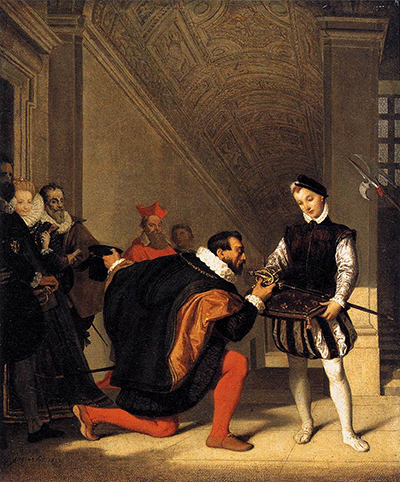
A grown man kneels before a boy, bringing his lips to the sword the boy carries. The contrast is immediate: the ambassador bends low under a heavy black cloak, while the young page stands upright in pale stockings. Behind them, a staircase climbs into shadow. Courtiers watch from the left, but the encounter belongs to these two figures and the narrow space between a face and a weapon.
Ingres makes a courtly anecdote legible through posture. The page holds the sword without assuming the authority it represents; the ambassador honours a king who does not occupy the centre of the picture. Power passes through an object and becomes visible in somebody else’s response to it.
At a Glance
- ArtistJean-Auguste-Dominique Ingres.
- Versionthe Louvre staircase composition, RF 1981 56.
- Datesigned 1832; the Louvre’s creation field gives 1831.
- Medium and sizeoil on canvas, 36 × 28 cm.
- CollectionMusée du Louvre, Paris. [1]
- Subjecta Spanish ambassador’s homage to Henry IV’s sword, carried by a page. [2]
This work across Ingres’s career
Agamemnon’s Ambassadors
1801 (competition)Grande Odalisque
1814Louis XIII’s Vow
1824Monsieur Bertin
1832The Princesse de Broglie
1851–1853The Turkish Bath
1859–1862Contents
- A gesture that rearranges the court
- The story behind the homage
- One subject, several paintings
- What Ingres defended in 1814
- From a private picture to the Louvre
- Annotated details
A gesture that rearranges the court
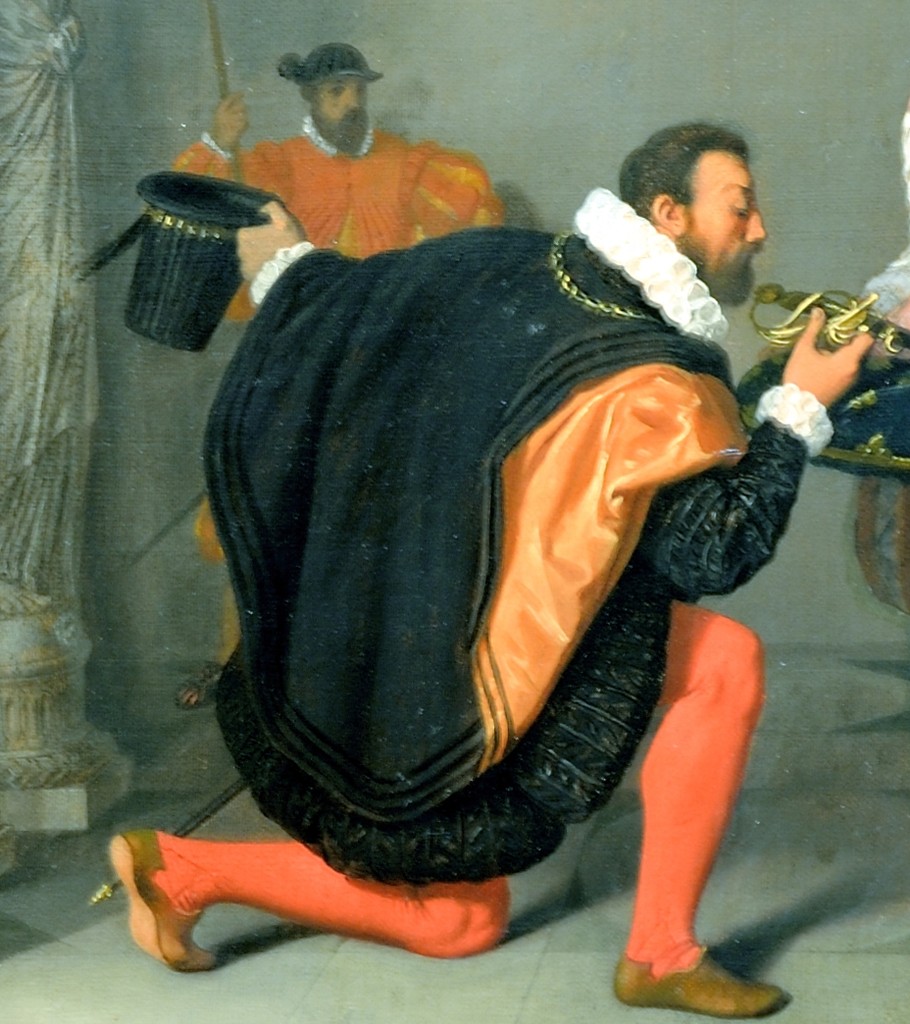
The kneeling ambassador occupies much of the lower half of the image. His cloak spreads across his back in a broad dark curve, while a warm brown sleeve and red hose keep the figure from dissolving into a single mass. One leg extends behind him, almost along the bottom edge; the other bends sharply beneath his body. His size and rich clothing give him weight, but his lowered position makes the smaller page appear taller.
The page’s pale legs form an open, upright shape against the stone floor. His black clothing connects him tonally with the ambassador, yet the white sleeves and stockings separate his outline from the surrounding darkness. The two bodies could hardly be more differently arranged. One folds and reaches; the other remains relatively still. The ambassador supplies the action, while the page supplies the object towards which that action moves.
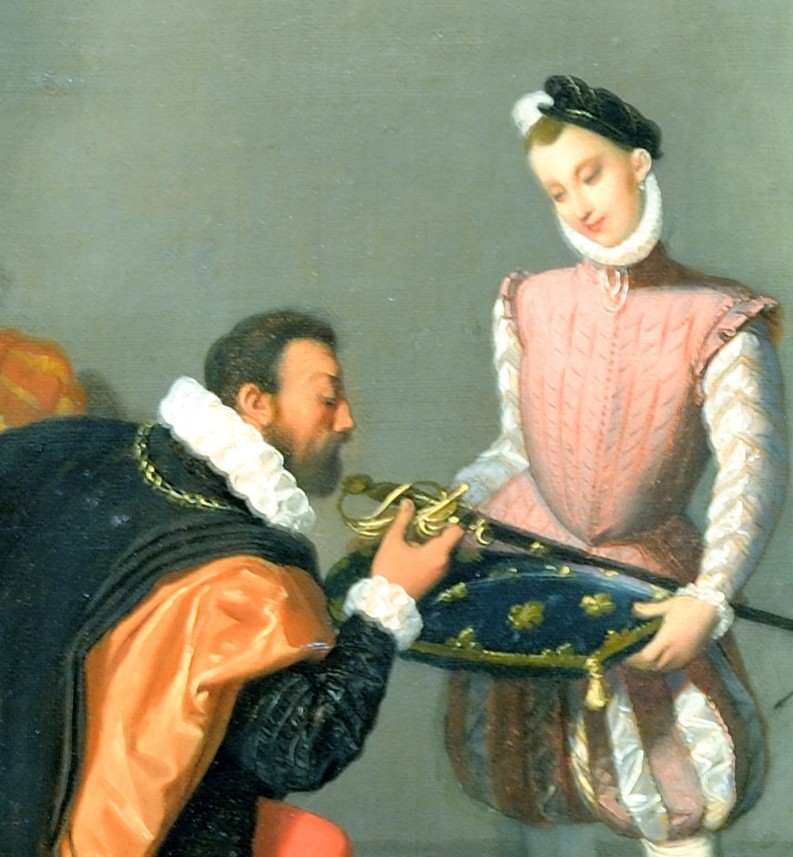
Look at how little distance separates the ambassador’s face from the sword’s hilt. The picture’s largest areas—the cloak, the vault, the floor—lead towards a very small point of contact. This is an economical way of organising a narrative: a viewer can recognise the broad action before examining the elaborate setting, then return to the meeting of lips and metal to understand what all that surrounding space is for.
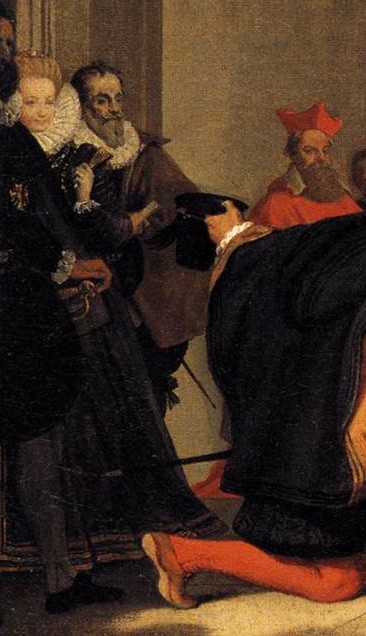
The witnesses contribute another kind of contrast. Their overlapping bodies crowd the left edge, whereas the page has room around his legs and head. A pale face, a white ruff, a red ecclesiastical hat and a bearded profile emerge from the group without competing equally for attention. They make the homage public. The ambassador’s gesture is being seen, and that turns a personal expression of admiration into a courtly event.
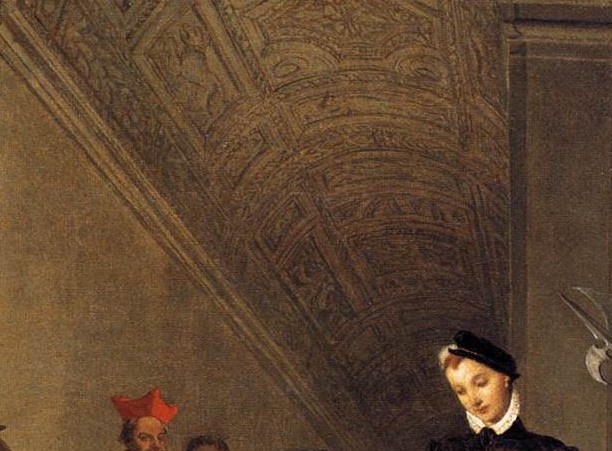
Above the figures, the decorated underside of the stair cuts diagonally through the room. Its repeated recessed panels carry the eye upwards and backwards, providing a large architectural counterweight to the people below. On the right, window divisions and the shafts of weapons introduce straighter vertical lines. The ambassador’s curved body sits between these firm structures. His kneeling interrupts the passage through a building designed for movement.
The result has a touch of surprise without becoming a joke. The page looks down towards the visitor; the visitor concentrates on the sword. Their unequal ages and exchanged heights give the scene its unusual balance. Honour belongs to the absent owner of the weapon, while the practical business of holding it falls to a youth.
Annotated Details from Don Pedro of Toledo Kissing Henry IV’s Sword
The numbered points identify visible features discussed in this article. Return from each detail to the whole composition. Each caption identifies the work shown.
Don Pedro — Louvre Version
Jean-Auguste-Dominique Ingres, Don Pedro of Toledo Kissing Henry IV’s Sword, signed 1832. Musée du Louvre, RF 1981 56. Web Gallery of Art via Wikimedia Commons. Image source. Public domain.
Don Pedro — Pau Version
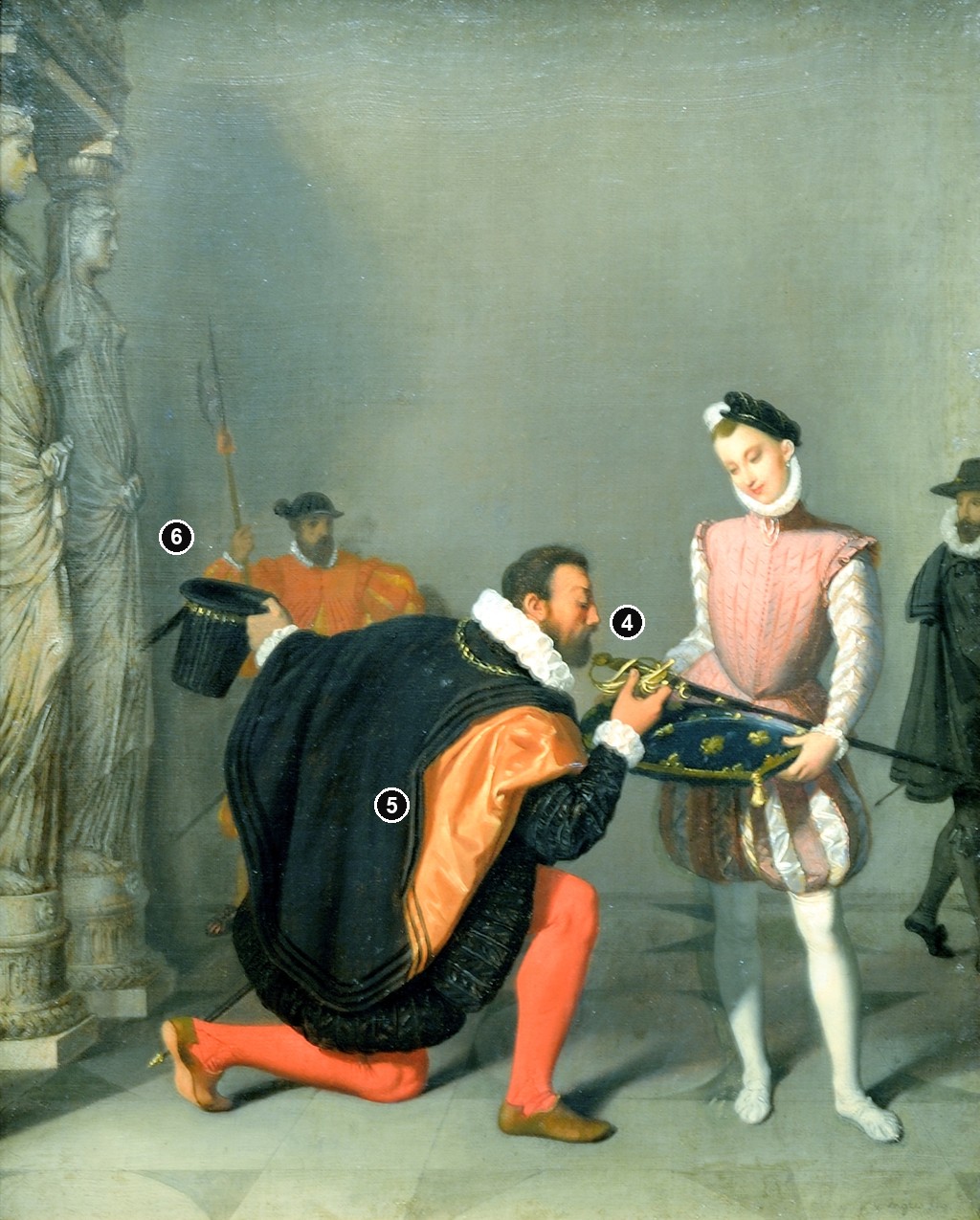
Ingres, Don Pedro of Toledo Kissing Henry IV’s Sword, 1819. Château de Pau, P.83.16.1. Photograph: François de Dijon; Wikimedia Commons; photographed at Lyon in 2014. Image source. Public domain.
Details from DON PEDRO OF TOLEDO KISSING HENRY IV’S SWORD
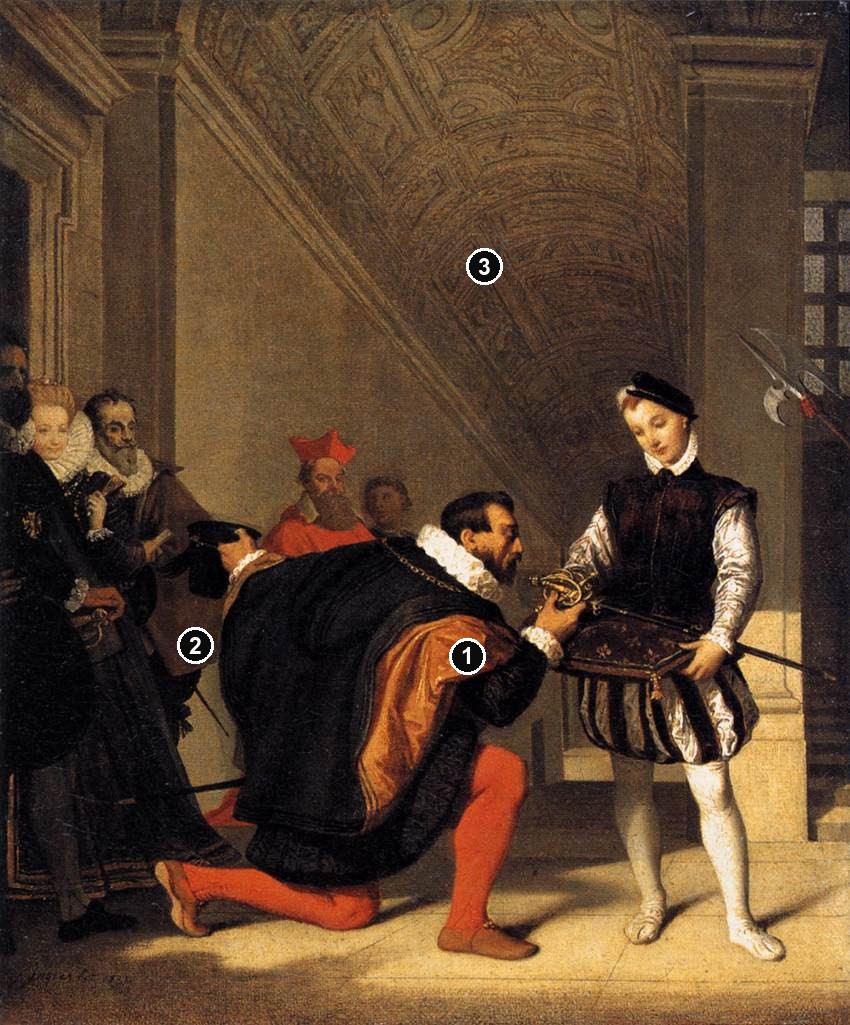
Compare the broad figures and architectural settings of the later Louvre painting and the separate 1819 Pau version.
Don Pedro — Louvre Version
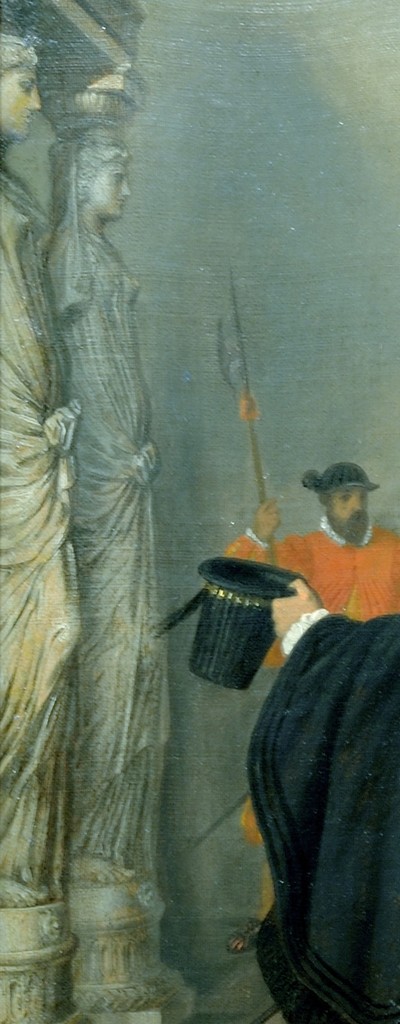
The kneeling figure and sword bearer
The kneeling body turns towards the standing page and the sword between them. The dark cloak, orange sleeve and pale stockings make the exchange readable in broad shapes.
Witnesses across the left side
Several standing figures occupy the left side behind the kneeling ambassador. Their overlapping heads and long garments make a contrasting group beside the more open floor.
The deep stairway and patterned vault
The curved, patterned vault recedes between the upright walls. Compare this deep passage with the larger, more closely gathered figures standing in front of it.
Don Pedro — Pau Version
The meeting of face, hands and sword
The kneeling ambassador brings his face towards the sword while the page supports it above a blue cushion. The same exchange appears within a different room and arrangement of figures.
The kneeling pose across the floor
The dark cloak spreads across the bent body while the two orange-clad legs extend in different directions. The more open floor makes the kneeling posture particularly easy to follow.
The carved figure at the edge of the hall
A tall carved figure stands beside the guard at the edge of the hall. Its pale upright body offers a different architectural setting from the deep vault in the later Louvre painting.
The story behind the homage
Henri Delaborde’s posthumous book on Ingres preserves the anecdote from one of the painter’s notebooks. Its first episode takes place at Fontainebleau. Henry IV walks the visiting Don Pedro through a gallery at a pace that leaves the ambassador breathless, then uses his own vigour to dismiss reports of failing health. He compares Spanish power to a statue with feet of clay. Their conversation becomes a contest of national pride: the king threatens to carry war into Spain, and the ambassador answers with the memory of Francis I’s captivity. Henry eventually checks the exchange by invoking their respective Spanish and Gascon tempers. [2]
The notebook then moves to another encounter. At the Louvre, Don Pedro meets an officer or page carrying Henry’s sword. He kneels and kisses it, acknowledging its exceptional glory. This second episode supplies the painting’s action. In the sequence recorded by Ingres, a man who has defended his country’s dignity also recognises the reputation of a rival sovereign. The homage gains force from the earlier confrontation. [2]
That sequence helps explain why the painting can combine deference with physical solidity. The ambassador is a substantial presence, with a strong profile and a wide cloak; nothing in his kneeling requires us to imagine a weak or defeated character. As a reading of the image, the gesture looks deliberate. The figure lowers himself to an object he judges worthy of respect.
It also explains the king’s indirect presence. A conventional audience scene could bring a ruler and diplomat face to face. Here, a sword carried through the palace is enough to make the ambassador stop. The weapon bears a reputation independently of the body that wields it. The picture allows the page to remain an attendant while placing him at the visual centre of an act of homage.
Delaborde published the notebooks and correspondence in 1870, after Ingres’s death. His book transmits the painter’s chosen story, whose vivid exchanges have the character of a royal legend. He identifies the later composition’s company as the duc d’Épernon, Cardinal du Perron, the poet Malherbe and Gabrielle d’Estrées. This is a catalogue’s account of a painted gathering, rather than evidence that all four witnessed the historical encounter. [2] Within the image, the spectators give the gesture the setting it needs: a court in which an exceptional act of respect can be recognised.
One subject, several paintings
The staircase picture is a later treatment of a subject Ingres had already painted. The first version appeared at the Salon of 1814 and is lost. The Château de Pau’s 1819 version, made for his friend Jean Alaux, is the earliest surviving treatment and is described by the museum as closest to that original. Pau also records Ingres’s selection of fourteen Henry IV subjects from Péréfixe’s history and other historical writings. The sword episode therefore belonged to a larger field of possible stories about the king. [3]
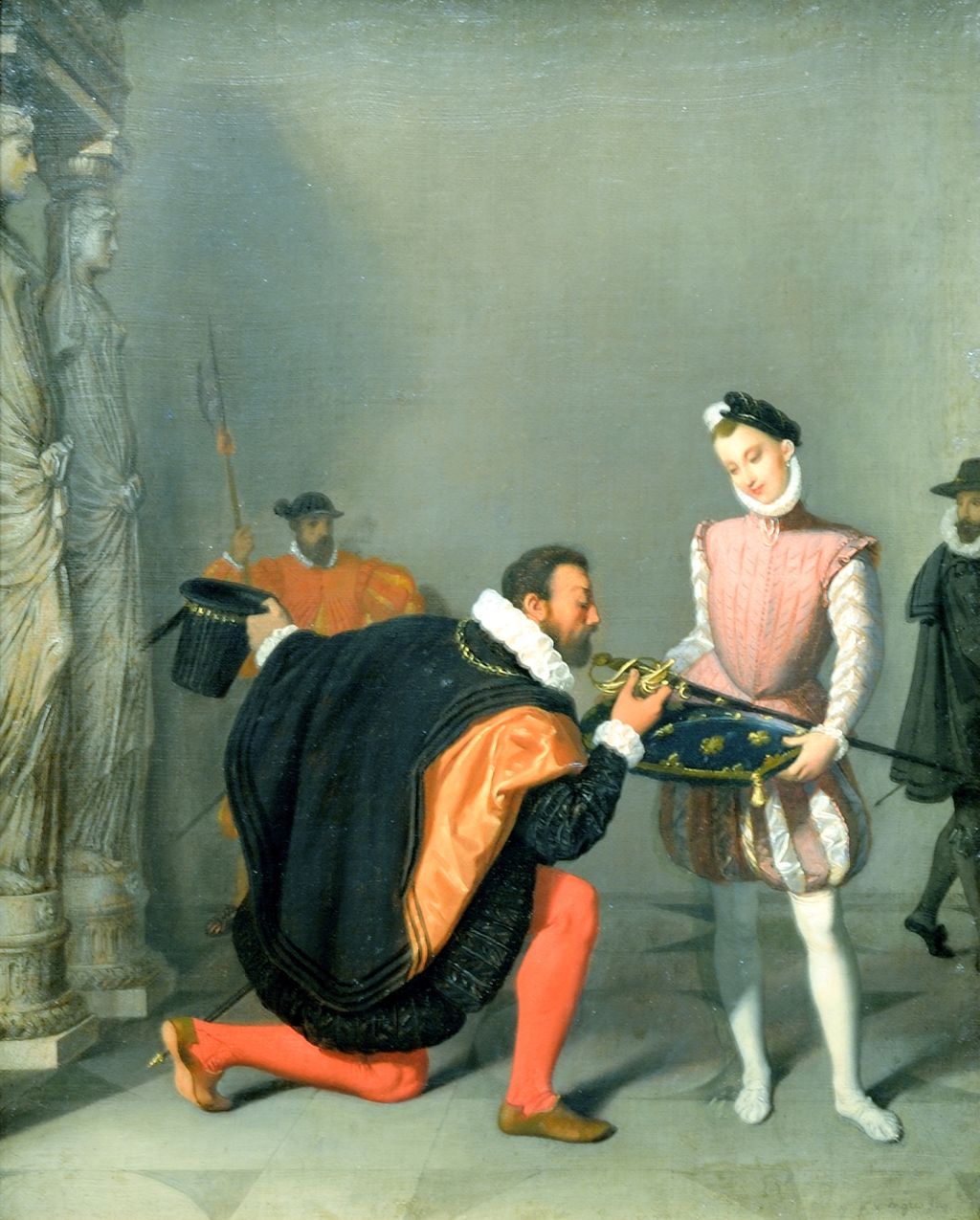
Ingres, Don Pedro of Toledo Kissing Henry IV’s Sword, 1819. Château de Pau, P.83.16.1. The earlier version in the Caryatids Hall. [4]
The Louvre distinguishes its staircase setting from the Caryatids Hall used in the earlier compositions, which also include a version dated 1820. [1] This change matters to the act of looking. In the later painting, the sloping vault rises directly over the homage and makes the encounter feel caught within the circulation of a palace. We see an action happening where people pass one another. The imposing architecture gives the small meeting a public, ceremonial setting without requiring a throne.
Delaborde catalogued the later picture separately as a variant painted in 1832, and recorded its appearance at the Universal Exhibition of 1855. [2] The shared title can obscure these differences. The earlier painting’s reception illuminates Ingres’s continuing interest in the story, while the staircase version represents a distinct return to it.
Repetition also changes what the subject asks of the painter. Once the anecdote is established, the arrangement of the room, witnesses and principal bodies can carry more of the interest. Here, the exchange of heights between kneeling envoy and standing page is framed by a striking upward sweep of architecture. The renewed setting gives the familiar action a different spatial rhythm.
What Ingres defended in 1814
The earlier painting prompted a revealing disagreement. Delaborde reports that it had less success at the Salon than Ingres’s Sistine Chapel, and that even friends hesitated over it. Marcotte wrote to express his dissatisfaction. Ingres replied on 26 May 1814 with a detailed defence of his little picture. This letter concerns the first treatment, eighteen years before the date inscribed on the Louvre canvas. [2]
Ingres began with the relationship between drawing and action. He defended the figures’ proportions, the truth of their gestures and the care taken over costume. His argument linked the story’s intelligibility to the way bodies and clothing had been arranged. The little narrative deserved judgment as a work of history painting, even though its scale and abundance of particulars might invite comparison with paintings of everyday life. [2]
Colour mattered just as much to his defence. He described the earlier picture’s colour as strong and truthful, associated it with the Venetian school, and presented that school as a continuing point of reference whenever he painted. The letter is useful evidence against reducing his artistic ambitions to contour alone. In this particular dispute, he argued for the combined effectiveness of drawing, gesture, dress and colour. [2]
He was equally specific about finish. Ingres insisted that the painting had been executed with great care, while rejecting the kind of exhaustive smoothness he associated with Gérard Dou. He preferred the aptly placed touches of Teniers and the handling of Metsu, whose work he discussed in terms of strength and softness. The distinction was between care that serves the image and labour whose visible polish becomes an end in itself. [2]
The comparison with Dutch and Flemish painters is particularly revealing because Ingres ends by defending his standing as a history painter. He could admire small-scale handling and detailed observation while claiming that his own narrative training added something to them. The subject’s modest dimensions did not make the ambition modest. A political relationship could be concentrated into a few bodies, a piece of metal and a gesture. [2]
Read beside the Louvre painting, the letter sharpens our attention to the relationship between particulars and the whole. The dark cloak gains shape through broad folds; the page’s white clothing establishes a clear silhouette; the ambassador’s warmer colours draw the kneeling body forward. The details give each figure an individual presence while keeping the action easy to follow.
From a private picture to the Louvre
The canvas has a wooden enlargement, bringing its dimensions to 37.5 × 30.5 cm. [1] The apparently spacious staircase belongs to a very small object. Its architectural elaboration invites a close view, so that the eye can travel from the distant vault to the foreground encounter and its minute point of contact.
The Louvre traces the work through Sanson Davilliers, by 1851; the Hartmann sale of 1909; Roger Marcuard; and his bequest to Odette Massigli. The museum acquired it at a Paris sale in 1981, with support from the Société des Amis du Louvre. [1]
The subject also circulated in reproduction. Delaborde lists an outline engraving in Magimel’s publication under the earlier composition, while giving the staircase variant its own catalogue entry. [2] This distinction helps explain why a familiar title may lead to an unfamiliar arrangement of figures or architecture. For more on that relationship between painted objects and their circulating images, see Ingres’s prints and reproductions.
Artworks directory
Explore 150 paintings, drawings and an original lithograph. This selection includes related versions and studies; dates distinguish completed works from later revisions.
| Name | Date | Medium |
|---|---|---|
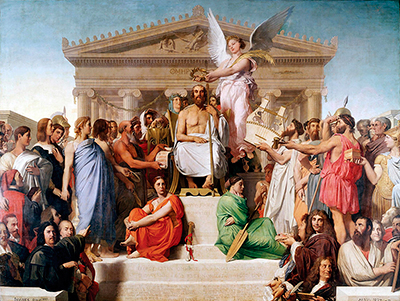
| The Apotheosis of Homer | 1827 | Painting |
| Grande Odalisque | 1814 | Painting |
| The Turkish Bath | 1859–1862 | Painting |
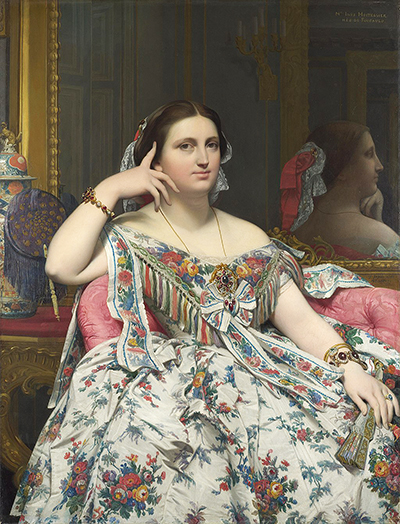
| Madame Moitessier Seated | 1856 | Painting |
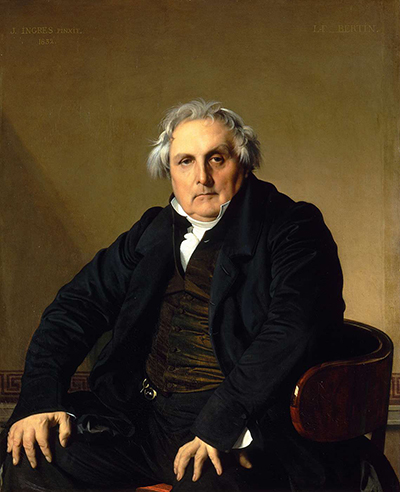
| Portrait of Monsieur Bertin | 1832 | Painting |
| Napoleon I on His Imperial Throne | 1806 | Painting |
| Odalisque with Slave | 1839 | Painting |
| The Ambassadors of Agamemnon in the Tent of Achilles | 1801 (competition) | Painting |
| The Valpinçon Bather | 1808 | Painting |
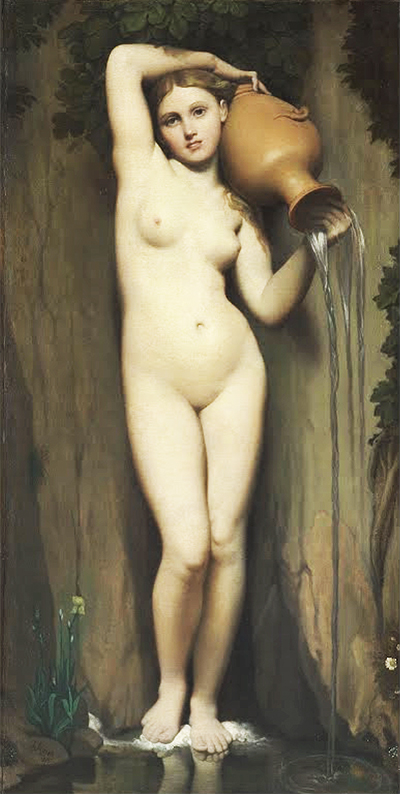
| The Source | 1856 | Painting |
| Oedipus Explaining the Enigma of the Sphinx | 1808; revised probably before 1827 | Painting |
| The Vow of Louis XIII | 1824 | Painting |
| Antiochus and Stratonice | 1840 | Painting |
| The Comtesse d’Haussonville | 1845 | Painting |
| The Princesse de Broglie | 1851–1853 | Painting |
| Jupiter and Thetis | 1811 | Painting |
| The Dream of Ossian | 1813 | Painting |
| The Martyrdom of Saint Symphorian | 1834 | Painting |
| Venus Anadyomene | 1808–1848 | Painting |
| Portrait of Madame de Senonnes | 1814 | Painting |
| Madame Rivière | 1805 | Painting |
| Mademoiselle Caroline Rivière | 1805 | Painting |
| Portrait of Philibert Rivière | 1805 | Painting |
| Bonaparte First Consul | 1804 | Painting |
| The Death of Leonardo da Vinci | 1818 | Painting |
| Joan of Arc at the Coronation of Charles VII | 1854 | Painting |
| Madame Duvaucey | 1807 | Painting |
| La Belle Zélie | 1806 | Painting |
| Madame Panckoucke | 1811 | Painting |
| Portrait of Charles Marcotte d’Argenteuil | 1810 | Painting |
| Joseph Antoine Moltedo | c.1810 | Painting |
| Madame Leblanc | 1823 | Painting |
| Delphine Ingres-Ramel (Portrait of Madame Ingres) | 1859 | Painting |
| Portrait of Amédée de Pastoret | 1823–1826 | Painting |
| Portrait of Baronne de Rothschild | 1848 | Painting |
| Madame Marcotte de Sainte Marie | 1826 | Painting |
| Madame Gonse | 1852 | Painting |
| Aretino in the Studio of Tintoretto | 1848 | Painting |
| Don Pedro of Toledo Kissing Henry IV’s Sword | 1831/1832 | Painting |
| Raphael and La Fornarina | 1814 | Painting |
| Roger Freeing Angelica | 1819 | Painting |
| Romulus’ Victory over Acron | 1812 | Painting |
| Self-Portrait at the Age of Twenty-Four | 1804; revised 1841–1851 | Painting |
| Male Torso | c.1800 | Painting |
| Odalisque in Grisaille (Ingres and workshop) | c.1824–1834 | Painting |
| The Small Bather | 1826 | Painting |
| The Little Bather Harem Interior | 1828 | Painting |
| Jesus Among the Doctors | 1862 | Painting |
| The Virgin Adoring the Host | 1852 | Painting |
| The Virgin of the Host | 1841 | Painting |
| Virgin of the Adoption | 1858 | Painting |
| Paolo and Francesca | 1814 | Painting |
| Homer Deified (revised composition, Louvre RF5273) | 1865 | Drawing |
| Odalisque with Slave (Louvre RF4622) | 1858 | Drawing |
| Odalisque (Walters Art Museum; Ingres and Paul Flandrin) | 1842 | Painting |
| Madame Moitessier Standing (National Gallery of Art) | 1851 | Painting |
| Jacques-Louis Leblanc (The Metropolitan Museum of Art) | 1823 | Painting |
| Ferdinand-Philippe, Duke of Orléans (Louvre RF2005-13) | 1842 | Painting |
| Ferdinand-Philippe, Duke of Orléans (Versailles MV5207; Ingres and workshop) | 1843 | Painting |
| Ferdinand-Philippe, Duke of Orléans (Versailles MV5209; Ingres and workshop) | 1844 | Painting |
| Antiochus and Stratonice (Musée Fabre; Ingres and Raymond Balze) | 1866 | Painting |
| Antiochus and Stratonice (Kunstmuseum Bern, Gurlitt bequest) | Undated (early dating proposed) | Drawing |
| Composition study for Antiochus and Stratonice (MIB867.2193) | 1806 | Drawing |
| Study for the Figure of Stratonice (Met63.66) | 1834–1840 | Graphite, black chalk and charcoal |
| Nude figure study for Stratonice (Boijmans F II 36 PK) | c.1834–1840 | Drawing |
| Paolo and Francesca (The Barber Institute,54.6) | c.1814–1820 | Painting |
| Paolo and Francesca (The Hyde Collection,1971.24) | c.1855–1860 | Painting |
| Paolo and Francesca (Amsterdam Museum TA10970) | 1820 | Drawing |
| Paolo and Francesca (dedicated to Artaud de Montor) | 1816 | Drawing |
| Study for the Bust of Francesca (MIB867.1398) | 1819 | Drawing |
| Study for the Bust of Francesca (MIB867.1396) | 1819 | Drawing |
| The Archangel Raphael, first idea (MIB867.2488) | 1842 | Drawing |
| The Archangel Raphael (MIB867.2500) | 1842 | Drawing |
| The Archangel Raphael Carrying Human Prayers to God (Chantilly DE513) | 1844 | Drawing |
| Louis-Philippe as Saint Philip, stained-glass study | 1844 | Drawing |
| Marie Frédéric Eugène de Reiset (Ford Collection RBF171-2) | 1844 | Drawing |
| Virgil Reading the Aeneid (Toulouse) | Begun 1811 | Painting |
| Tu Marcellus Eris (Brussels, inv. 1836) | c.1814 (museum dating) | Painting |
| Jean-François Gilibert | 1804 | Painting |
| François-Marius Granet | 1807 (museum dating) | Painting |
| Count Nikolai Dmitrievich Guryev | 1821 | Painting |
| Caroline Murat, Queen of Naples | 1814 | Painting |
| Count Mathieu Molé | 1834 | Painting |
| Cherubini and the Muse of Lyric Poetry (Louvre) | 1842 | Painting |
| Luigi Cherubini (Cincinnati) | 1841 | Painting |
| Comtesse de Rayneval (Louvre RF4505) | 1841 | Drawing |
| Venus on Paphos (Antonie Balaÿ) | c.1852 | Painting |
| Prince Napoléon | 1855 | Painting |
| Study for The Apotheosis of Napoleon I (Petit Palais) | Late 1853 | Painting |
| The Apotheosis of Napoleon I (destroyed ceiling) | 1853 | Painting |
| The Journalist (MIB867.2733) | 1834? | Drawing |
| Henry VIII, after Holbein | c.1815–1820 (?) | Drawing |
| Madame Récamier, after David (MIB867.3637) | Undated (early Paris period) | Drawing |
| Study for Comtesse d’Haussonville (MIB867.259; background possibly by another hand) | 1842–1845 | Drawing |
| La Source (reduced version reported by Delaborde) | Date unrecorded; reported 1870 | Painting |
| Odalisque (autograph lithograph,NGA1946.21.117) | 1825; published1826 | Lithograph |
| Portrait of a Seated Lady | 1814 | Graphite |
| The Kaunitz Sisters (Leopoldine, Caroline, and Ferdinandine) | 1818 | Graphite |
| Portrait of a Man | 1814 | Graphite |
| Study for the Portrait of Louis-François Bertin (1766–1841) | n.d. | Black chalk and graphite |
| Studies for the Cadaver of Acron | ca. 1810–12 | Graphite on wove paper |
| Study for the Drapery of Molière in "The Apotheosis of Homer" | n.d. | Black chalk with stumping |
| Madame Guillaume Guillon Lethière, née Marie-Joseph-Honorée Vanzenne, and her son Lucien Lethière | 1808 | Graphite |
| Niccolò Paganini (1782–1840) | ca. 1830 | Counterproof or tracing strengthened with graphite and gouache on translucent paper |
| Lady Mary Cavendish-Bentinck (?-1843) | 1816 | Graphite |
| Madame Alexandre Lethière and Her Daughter Letizia | ca. 1815 | Graphite |
| Merry Joseph Blondel (1781–1853) | 1809 | Graphite |
| Ursin-Jules Vatinelle (1798–1881) | 1820 | Graphite |
| Bust of a Gypsy Girl (ascribed to Ingres) | 1819 | Graphite on wove paper |
| Study of a Seated Nude Male | n.d. | Graphite |
| The Archangel Raphael (Study for a stained-glass window in the chapel of Notre-Dame de la Compassion-Saint-Ferdinand, Neuilly) | ca. 1842 | Graphite |
| Lancelot-Théodore, comte Turpin de Crissé | probably 1818 | Graphite |
| Study for the Figure of the Iliad in "The Apotheosis of Homer" | ca. 1827 | Graphite and black chalk heightened with white chalk on brown paper |
| Comtesse Turpin de Crissé | probably 1818 | Graphite |
| Nude Figures for L'Âge d'Or, Château de Dampierre | n.d. | Graphite on brownish paper |
| Study of Figures (attributed to Ingres) | n.d. | Graphite |
| Study of Figures (attributed to Ingres) | n.d. | Graphite; squared in graphite |
| Admiral Sir Fleetwood Broughton Reynolds Pellew | 1817 | Graphite on wove paper |
| Madame Jean-Auguste-Dominique Ingres, née Madeleine Chapelle | 1814 | Graphite on off-white wove paper |
| Virgil Reading the Aeneid to Augustus, Livia, and Octavia | 1809/1819 (?) | Pen and black ink, graphite, brush and gray wash, white gouache heightening, Conté crayon on blue paper |
| General Louis-Étienne Dulong de Rosnay | 1818 | Graphite (hard and soft pencils) |
| Madame Alexandre Lethière, née Rosa Meli, and Her Daughter, Letizia | 1815 | Graphite |
| The Lawyer Paul Grand | 1834 | Graphite |
| Jean-Joseph Fournier | 1815 | Graphite |
| Armand Bertin | 1842 | Graphite |
| Madame Armand Bertin, née Marie-Anne-Cécile Dollfuss | 1843 | Graphite |
| The Architect Charles-Victor Famin | 1836 | Graphite |
| Henri Lehmann | 1850 | Graphite |
| Portrait of a Lady | ca. 1815–17 | Graphite |
| Edmond Cavé (1794–1852) | 1844 | Oil on canvas |
| Head of Saint John the Evangelist | probably ca. 1818–20 | Oil on canvas, laid down on wood |
| Madame Edmond Cavé (Marie-Elisabeth Blavot, ca. 1806–1883) | ca. 1831–34 | Oil on canvas |
| Madame Félix Gallois | 1852 | Graphite with touches of gold in oil to highlight jewelry, on buff wove paper. |
| Dr. François Mêlier | 1849 | Graphite with graphite framing lines, corrected with white, on buff wove paper |
| Portrait of Madame Rhode (Rhoda?) | 1810–20 | Graphite on pale buff wove paper |
| Study for "Raphael and the Fornarina"(?) | ca. 1814(?) | Graphite on white wove paper |
| Portrait of Madame Paul Meurice, née Palmyre Granger | ca. 1845–50 | Graphite on wove paper |
| Alexander the Great presenting Campaspe to Apelles | 1810 | Graphite, brush and brown wash; squared in graphite |
| Study of Hands for "Christ Among the Doctors" | 1852–62 | Graphite on tracing paper |
| Study for The Turkish Bath (RF34502) | about 1850 | Pen and brown ink with graphite, partially squared |
| Study for The Turkish Bath (RF23354) | Undated | Pen and brown ink with graphite on joined sheets |
| Study for The Turkish Bath (RF54702) | about 1859 | Pen and brown ink |
| Studies of women for The Turkish Bath (RF12292) | Undated | Black chalk |
| Achilles Receiving the Envoys of Agamemnon (Nationalmuseum sketch, NM2161) | 1801 | Oil on wood |
| Half-Length Bather (Musée Bonnat-Helleu,89) | 1807 | Oil on canvas |
| Oedipus and the Sphinx (National Gallery,NG3290) | about1826 | Oil on canvas |
| Oedipus and the Sphinx (Walters,37.9) | 1864 | Oil on canvas |
| Oedipus and the Valpinçon Bather, after David (MI.867.2035) | Undated | Graphite on tracing paper, after David |
| Study of the Virgin for The Vow of Louis XIII (Dijon,1758) | about1822 | Black chalk, stump and white chalk on brown wove paper |
| First Thought for The Vow of Louis XIII (MI.885.11.21) | 1822 | Oil on canvas |
Frequently Asked Questions
He is a page carrying the king’s weapon. The kneeling ambassador honours its absent owner through the sword itself. The notebook account preserved by Delaborde makes that relationship explicit. [2]
No. It defends the earlier treatment after Marcotte criticised it. Delaborde gives the later staircase composition a separate entry, dated 1832. [2]
In the story Ingres recorded, Don Pedro recognises the glory of Henry’s sword. The gesture acknowledges a rival’s military reputation, following a separate episode of sharp exchanges between king and ambassador. [2]
Discussion
Look again at the images and ideas explored in Don Pedro of Toledo Kissing Henry IV’s Sword. These editorial prompts invite your observations.
Reader Insights
What makes the homage convincing to you: the ambassador’s lowered body, the page’s stillness, or the watching court? Look at the space around the sword before deciding.
Compare Don Pedro’s lowered body with the upright figures around him. How is the sword made important without dominating the picture’s size?
Which features communicate homage directly, and which become meaningful only after you learn the anecdote?
Join the Conversation
Share a detail, comparison or question about Don Pedro of Toledo Kissing Henry IV’s Sword below.
References
- Musée du Louvre, Don Pedro de Tolède … baisant l’épée d’Henri IV au Louvre, dans l’escalier Henri II. Collection record RF 1981 56, “Description”, “Caractéristiques matérielles”, “Lieux et dates” and “Données historiques”; updated 3 July 2026. (In French.) View source.
- Henri Delaborde, Ingres, sa vie, ses travaux, sa doctrine, d’après les notes manuscrites et les lettres du maître. Paris: Henri Plon, 1870, catalogue nos. 67–68, pp. 232–234: notebook anecdote, letter to Marcotte of 26 May 1814, earlier composition’s reproduction and later variant’s 1855 exhibition. A posthumous documentary compilation. (In French.) View source.
- Musée national du château de Pau, “Dix Chefs-d’œuvre”, section “Don Pedro de Tolède baisant l’épée d’Henri IV”, dated 1819. (In French.) View source.
- Supporting image. Ingres, Don Pedro of Toledo Kissing Henry IV’s Sword, 1819. Château de Pau, P.83.16.1. Photograph: François de Dijon; Wikimedia Commons; photographed at Lyon in 2014. Image source. Public domain.
- Splash image. Jean-Auguste-Dominique Ingres, Don Pedro of Toledo Kissing Henry IV’s Sword, signed 1832. Musée du Louvre, RF 1981 56. Web Gallery of Art via Wikimedia Commons. Image source. Public domain.