by Tom Gurney
Tom Gurney BSc (Hons) is an art history expert with over 20 years experience
Published on June 19, 2020 / Updated on October 22, 2026
Email: tomgurney1@gmail.com / Phone: +44 7429 011000
Virgin of the Adoption
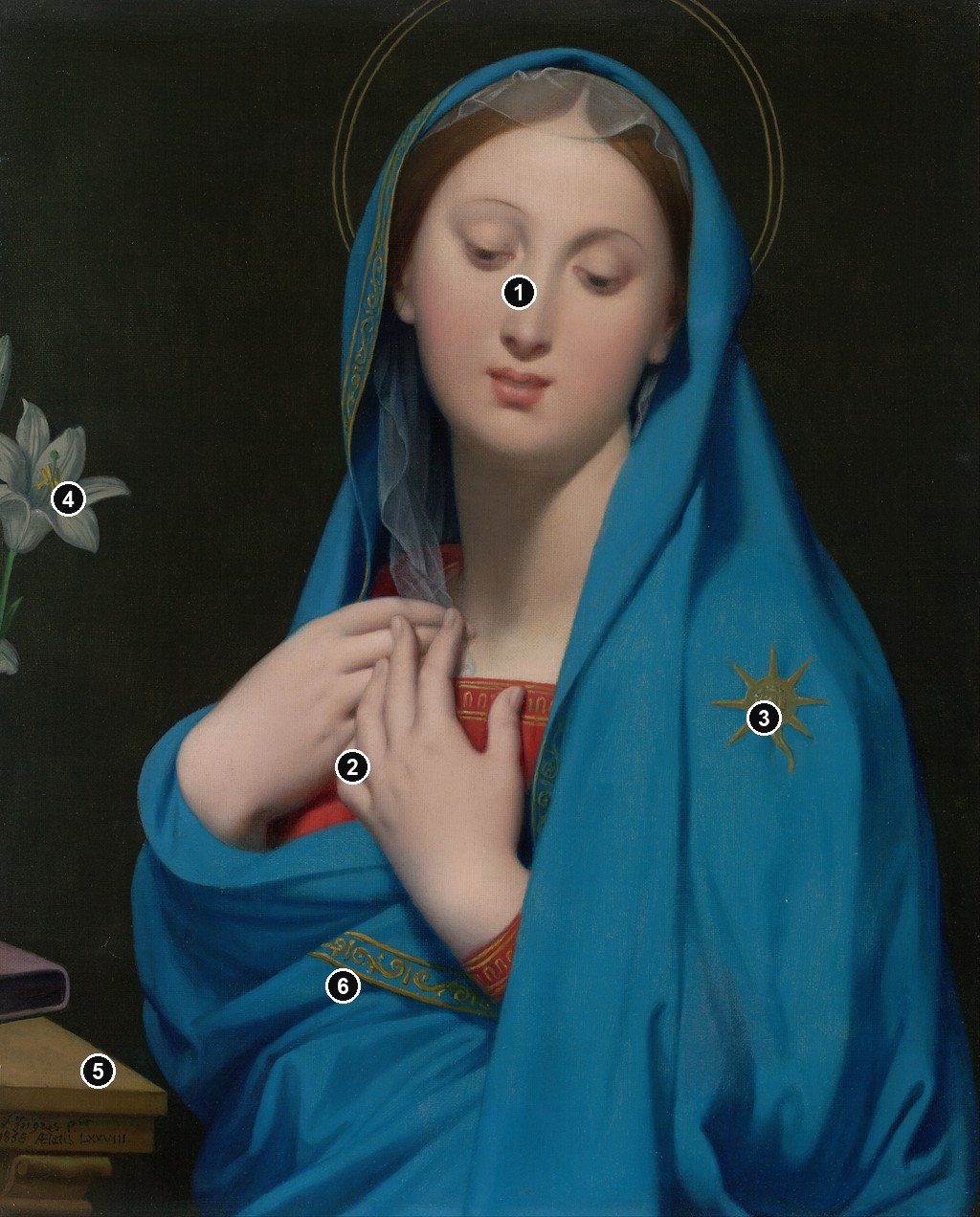
Mary holds a transparent veil against her chest. Her hands almost meet, her eyes turn downwards, and a great sweep of blue cloth surrounds the pale oval of her face. In Ingres’s Virgin of the Adoption, this small action gives the solitary figure a quiet physical presence. The delicate veil passes between flesh and fabric; the narrow gold halo opens into the darkness above her head. Looking moves between things that seem touchable and signs that belong to a sacred image.
At a Glance
- ArtistJean-Auguste-Dominique Ingres.
- Date1858.
- Medium and sizeOil on canvas, 69.5 × 56.8 cm.
- CollectionNational Gallery of Victoria, Melbourne, 2005.164. [1]
- Look closelyThe fingers gathering the veil, the halo cut by the upper edge, and the little book at the lower left.
This work across Ingres’s career
Agamemnon’s Ambassadors
1801 (competition)Grande Odalisque
1814Louis XIII’s Vow
1824Monsieur Bertin
1832The Princesse de Broglie
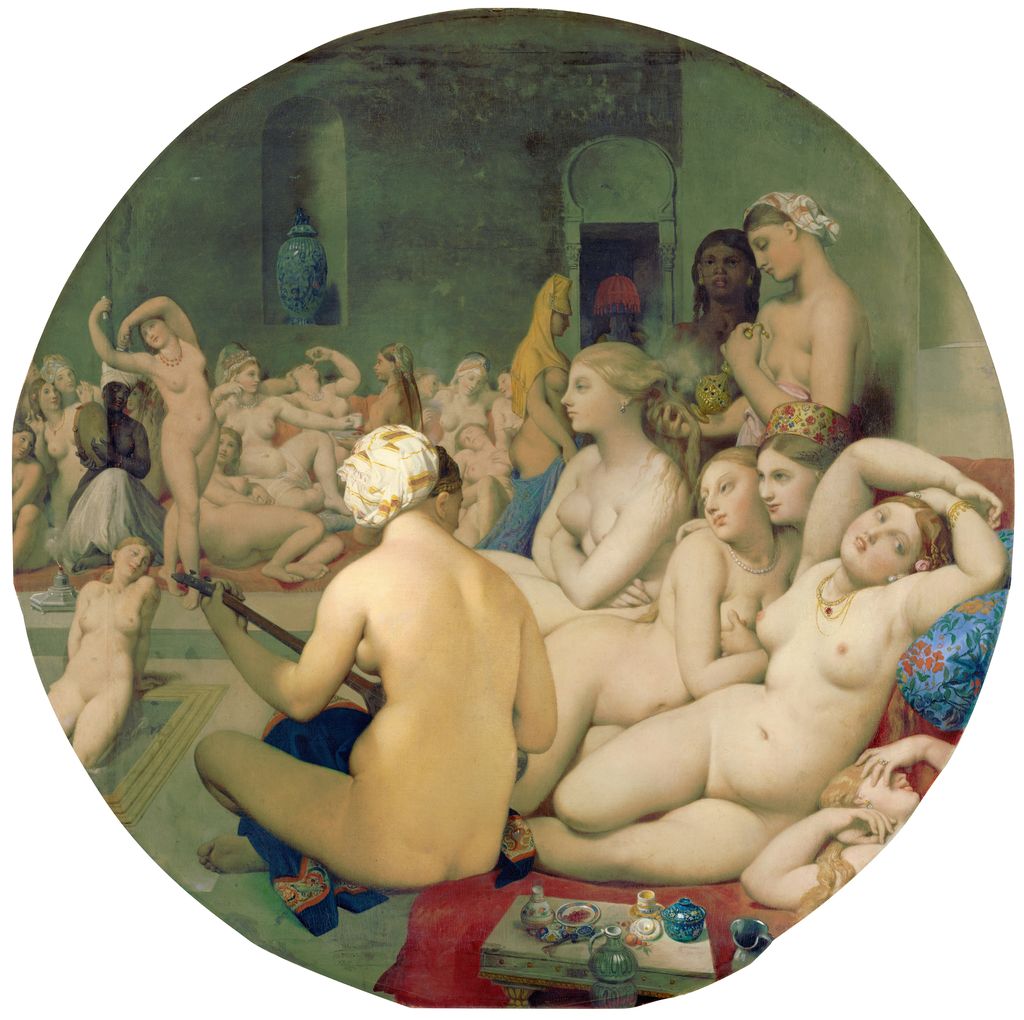
1851–1853The Turkish Bath
1859–1862Contents
- A face enclosed by blue
- The hands and the transparent veil
- Gold, flower and book
- The title and the dated inscription
- Comparing the Virgin Adoring the Host
- Owners, acquisition and frame
- Annotated details
A face enclosed by blue
The mantle supplies the painting’s largest shape. Its blue rises over Mary’s head, falls down either side of her face and expands across her shoulders and arms. Against the dark background, its outer edge makes a clear silhouette. Within that silhouette, folds open into deep shadow and then catch the light again. There is enough variation to suggest heavy cloth, while the broad, uninterrupted colour holds the composition together.
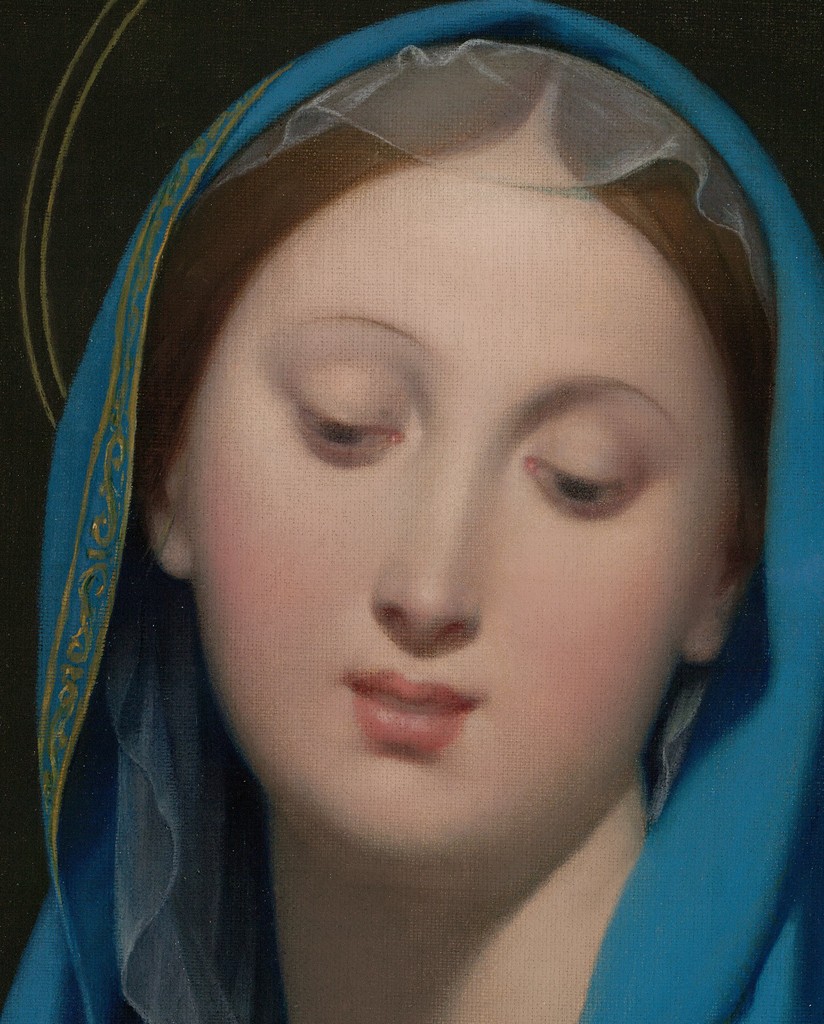
The face sits slightly to one side of this enclosing shape. Mary’s head inclines and turns, so that its two halves are subtly unequal. One cheek opens towards us; the other draws back towards the shadow beneath the veil. The eyes follow the tilt, but the delicately curved eyebrows keep their own gentle rhythm. The lips are parted. These small differences matter because so much else is calm and regular: a slight movement becomes conspicuous within the larger stillness.
The NGV relates Mary’s parted lips and lifted eyelids to its interpretation of ideal beauty and sensual presence. [1] The face remains small beside the swelling hood: the blue folds broaden towards the shoulders, while the veil makes a narrow pale border along the cheek. That contrast of widths can be followed without deciding what emotion the expression conveys.
There is no surrounding architecture to explain where she stands. The darkness contains neither a distant landscape nor a visible room. It allows the brightly coloured figure to fill the field, bringing the act of looking close to the scale of a personal encounter. The little ledge at the lower left offers just enough furniture to suggest an inhabited space.
Annotated Details from Virgin of the Adoption
The numbered points identify visible features discussed in this article. Return from each detail to the whole composition. Ingres, Virgin of the Adoption, 1858. National Gallery of Victoria, Melbourne, 2005.164. Google Art Project via Wikimedia Commons. Image source. Public domain.
Details from VIRGIN OF THE ADOPTION
Follow the transparent veil, hands, star, lilies and gold ornament around the blue mantle.
The lowered eyes beneath the veil
The face tilts beneath a transparent veil and blue covering. Small changes around the eyes and mouth sit inside the much larger rounded outline of the head.
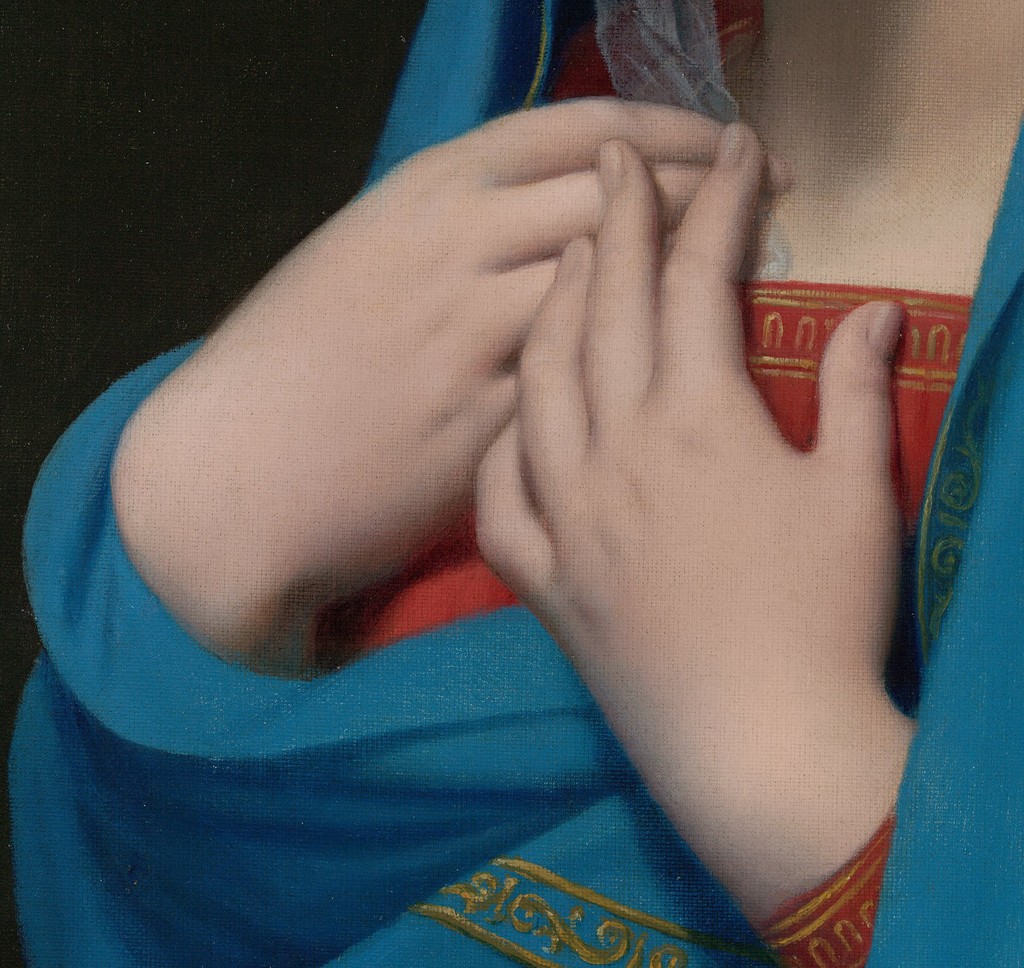
The hands holding the transparent cloth
The fingers meet near the chest while holding the edge of the transparent cloth. Compare their overlapping shapes with the long pale lines of the veil above.
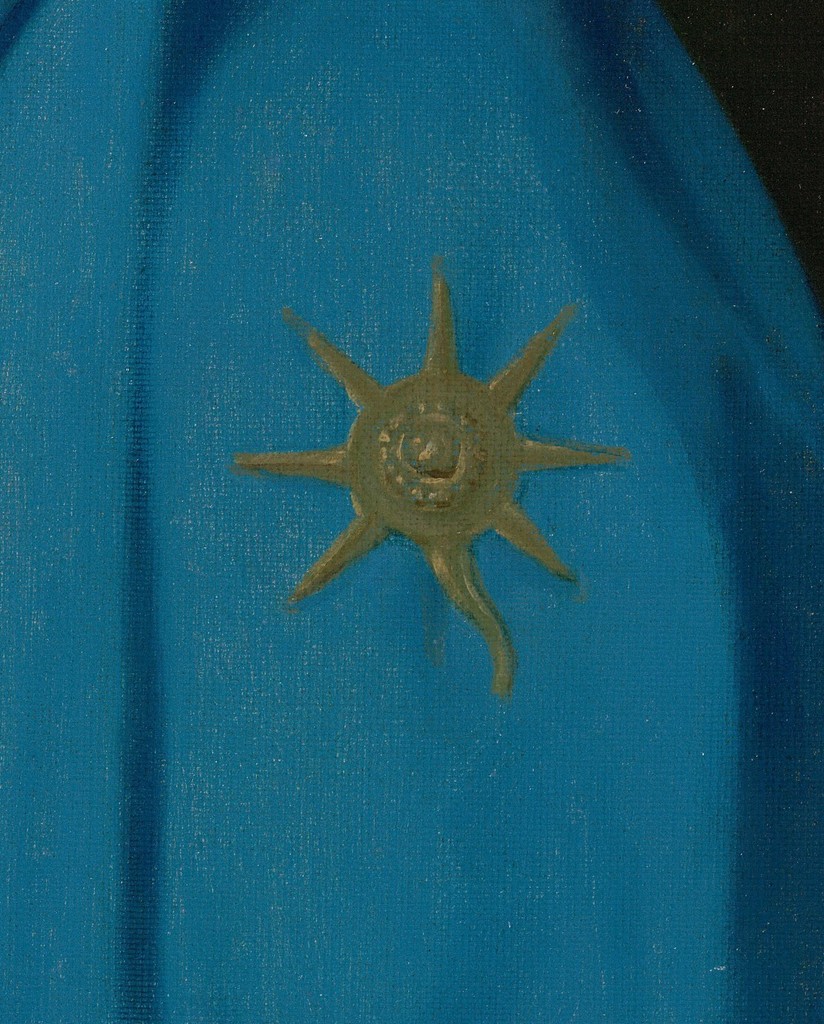
The gold star on the blue mantle
A gold star interrupts the broad blue mantle beside the hands. Its sharp rays and small central mark form a compact pattern within the much larger area of cloth.
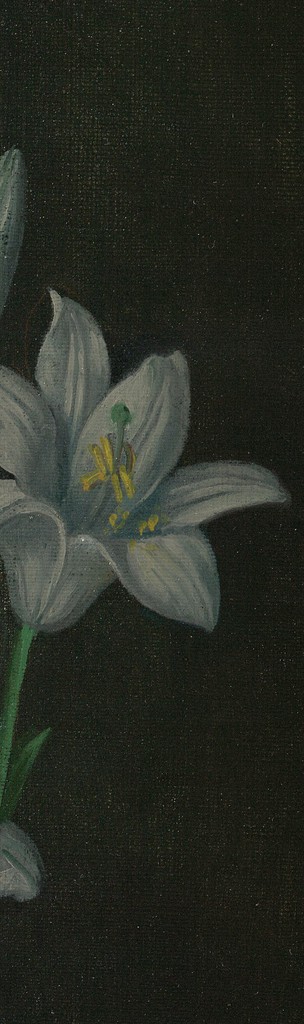
White lilies beside the face
White flowers open on slender green stems at the side. Their pointed petals form an irregular outline beside the smoother blue covering.
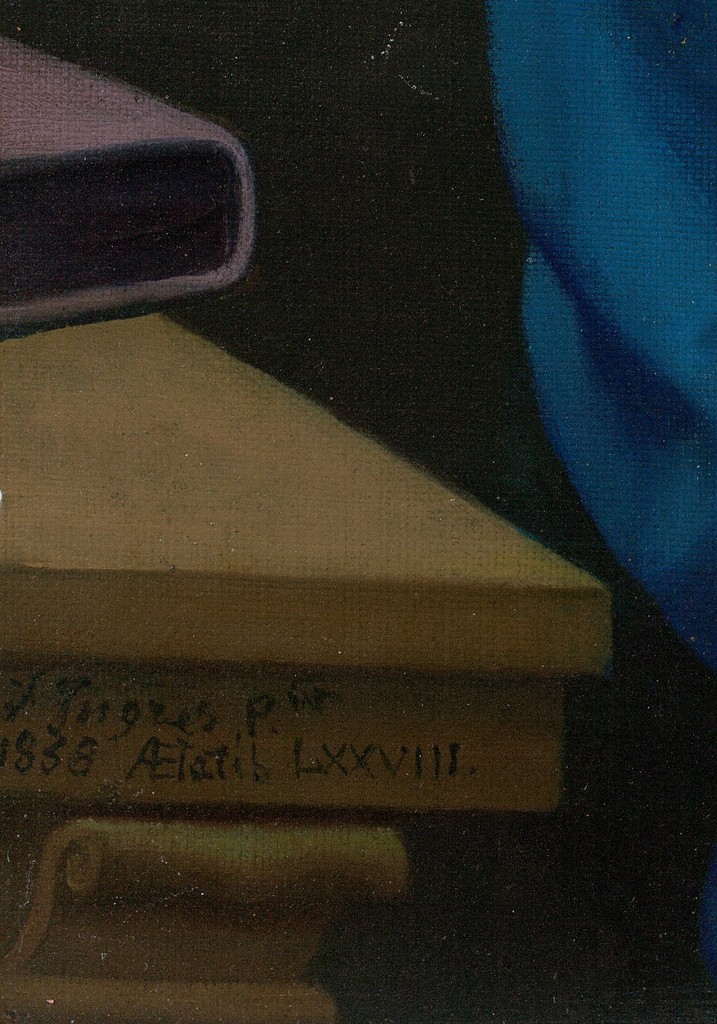
The book and inscribed ledge
A closed book rests above an inscribed ledge near the lower edge. Their straight lines contrast with the long folds of the blue mantle alongside them.
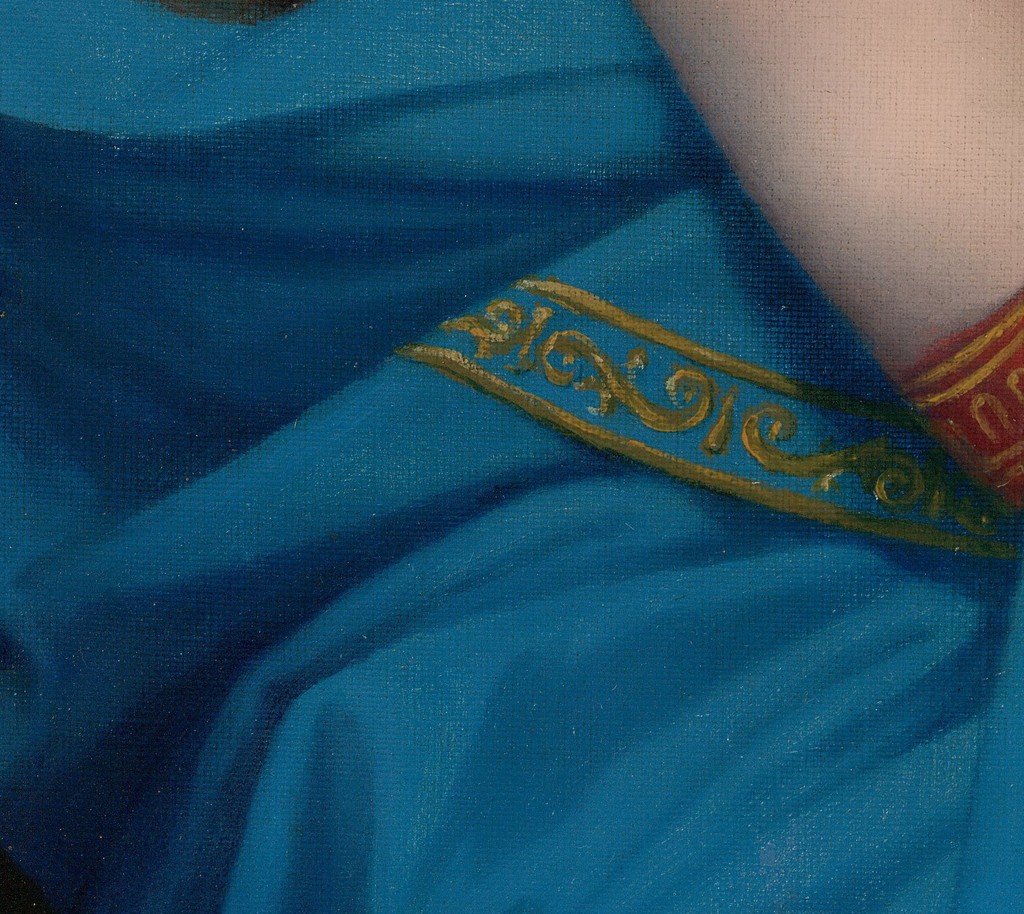
Gold ornament along the lower fold
A narrow gold ornament follows the turn of the blue cloth below the hands. Its repeated curves bend around a much broader fold.
The hands and the transparent veil
The hands provide the painting’s most concentrated passage of movement. One lies across the upper chest, its fingers curling towards the veil. The other rises more vertically, with long fingers that overlap the first hand near the centre. The palms do not press together. Instead, the fingers gather and touch the fine white fabric, making a gesture whose physical action can be followed even when its devotional meaning remains open.
Tracing the veil is rewarding. Above the forehead it forms small, pale folds beneath the blue hood. Beside the face, its edge becomes difficult to distinguish from the darker fabric behind it. Near the fingers, it gathers into a narrow, translucent strip. Its changing visibility makes it convincing as a material: we perceive it through the things it partly covers. The mantle’s weight and the veil’s lightness become especially clear where they meet the hands.
The two hands also shape the space below the face. Their pale surfaces create a second centre of attention, while the red neckline forms a short horizontal between them and the throat. That red reappears at the wrist, surrounded by gold decoration. Following those small intervals of warm colour takes the eye across an image otherwise dominated by blue.
The gesture helps distinguish this painting from a general image of a woman at prayer. Mary seems occupied with the cloth at her own body. That closeness gives the picture an inward quality, although the painting does not tell us what she thinks or which words a worshipper might have spoken before it.
Gold, flower and book
Two thin gold lines describe the halo. Their arcs continue beyond the top of the painted field, so the circle can be mentally completed even though it cannot be seen whole. The halo remains light and open: darkness shows through it. Below, the gold edging of the mantle follows the bends of cloth, becoming decorative pattern within the figure rather than a separate shape behind her.
A gold, sunlike ornament appears on the blue at the right of the image. Its radiating points interrupt a broad expanse of fabric. The contrast is immediately legible: a compact, sharply defined motif rests against soft folds. Together, the halo, ornament and embroidered borders distribute gold from the upper edge down towards the hands.
At the left, a white lily enters from outside the composition. Its petals turn in different directions, revealing pale interiors, green details and touches of yellow. The cropped stem makes it feel like part of something extending beyond the visible field. Below it, a closed book rests on the wooden ledge. These objects give the margin a different kind of detail from the central figure: flower, binding and wood offer distinct surfaces in a narrow strip of space.
It is tempting to turn every object into a complete explanation of the title. The picture itself supplies no such key. The flower and book enrich the setting, but neither shows an adoption taking place. Their placement also has a clear visual effect: the pale blossom balances the illuminated head, while the book and ledge give the lower left a firm horizontal against the flowing mantle.
The title and the dated inscription
Virgin of the Adoption is an early recorded title. Henri Delaborde included La Vierge de l’Adoption as catalogue number 8 in his posthumous book on Ingres, published in 1870. He recorded a signature dated 1858 and the artist’s age as seventy-eight. [2]
The painted inscription can still be seen at the lower left, on the front of the ledge. It gives 1858 and Ætatis LXXVIII, the Latin indication of age followed by seventy-eight in Roman numerals. This places the image firmly within Ingres’s late work. [3] The signature fits quietly into the design: the ledge gives the lettering a solid surface, distinct from both the dark background and the enveloping blue.
The historical title does not, by itself, identify a particular adopted child, family occasion or legal event. No child appears in the painting. Mary is alone, and the scene contains no exchange between people. Delaborde’s short entry records the title, inscription and ownership without explaining the word “Adoption”. [2] It is therefore more useful to begin with the solitary sacred figure than to invent a missing story that the image must illustrate.
Comparing the Virgin Adoring the Host
A revealing comparison is Ingres’s Virgin Adoring the Host, painted in 1852 and now in the Metropolitan Museum of Art. The Met identifies it as a gift to Louise Marcotte and places it within the tradition of intimate devotional painting, particularly Raphael’s art. [4]
The family resemblance is easy to see. Both Virgins have a pale face, lowered eyes and a blue mantle above red clothing. Gold marks sacred status and enriches the textiles. In each, the head and hands organise the figure. The comparison becomes more interesting, however, when we follow what those hands do.
In the Met painting, the fingers rise together beside the face. An altar stretches across the foreground, with a chalice and white Host at its centre, and saints stand on either side. The Met identifies the scene as adoration of the Eucharist. [4] These objects and accompanying figures give the gaze and gesture an explicit focus. Even in a small composition, the surrounding arrangement establishes a shared act of worship.
In Virgin of the Adoption, the hands return towards the chest and veil. There is no altar across the foreground and no pair of saints framing the body. The mantle expands to occupy the space that the companions and furnishings take in the other painting. Its folds become more prominent, and the solitary figure meets the viewer with fewer intervening objects.
This is a useful example of how closely related forms can produce different experiences of looking. The head, blue cloth and delicate fingers remain recognisable elements, yet their relationships change. One composition builds a small ceremonial gathering around a sacred object; the other concentrates attention on Mary’s presence and gesture. The difference is visible without assuming that the later painting copies the earlier canvas or that both arose from the same commission.

Ingres, The Virgin Adoring the Host, 1852. [5]
Owners, acquisition and frame
The NGV records Alexandre Roland-Gosselin as owner from 1858, then his daughter Marie Alexandrine until 1932. Later owners include the von Bodems in Vienna and unidentified collectors; the picture passed through Phillips’s London sale on 14 June 2000. The Felton Bequest acquired the painting in 2005, honouring Sir Gustav Nossal. [1]
Delaborde named Mademoiselle Roland-Gosselin as owner in 1870. [2] Her name follows the title and inscription in his catalogue entry. That short notice provides an early collection reference, but gives no purchase price, contract or account of the original commission.
Its nineteenth-century frame, maker unknown, has gold leaf over red bole and an ogee profile. It accompanied the 2005 acquisition. [1] Bole is the coloured preparation beneath the gilding; an ogee profile curves in opposing directions. This is a material part of the object’s later presentation, although the record does not establish that Ingres selected it.
The distinction between painted gold and a gilded frame is worth keeping in mind. Within the canvas, fine lines and embroidery belong to the represented world. A frame supplies a physical boundary around that world. Here, even before any surrounding frame is considered, the halo’s clipped circle and the cropped lily make the edges active parts of the composition.
Artworks directory
Explore 150 paintings, drawings and an original lithograph. This selection includes related versions and studies; dates distinguish completed works from later revisions.
| Name | Date | Medium |
|---|---|---|
| The Apotheosis of Homer | 1827 | Painting |
| Grande Odalisque | 1814 | Painting |
| The Turkish Bath | 1859–1862 | Painting |
| Madame Moitessier Seated | 1856 | Painting |
| Portrait of Monsieur Bertin | 1832 | Painting |
| Napoleon I on His Imperial Throne | 1806 | Painting |
| Odalisque with Slave | 1839 | Painting |
| The Ambassadors of Agamemnon in the Tent of Achilles | 1801 (competition) | Painting |
| The Valpinçon Bather | 1808 | Painting |
| The Source | 1856 | Painting |
| Oedipus Explaining the Enigma of the Sphinx | 1808; revised probably before 1827 | Painting |
| The Vow of Louis XIII | 1824 | Painting |
| Antiochus and Stratonice | 1840 | Painting |
| The Comtesse d’Haussonville | 1845 | Painting |
| The Princesse de Broglie | 1851–1853 | Painting |
| Jupiter and Thetis | 1811 | Painting |
| The Dream of Ossian | 1813 | Painting |
| The Martyrdom of Saint Symphorian | 1834 | Painting |
| Venus Anadyomene | 1808–1848 | Painting |
| Portrait of Madame de Senonnes | 1814 | Painting |
| Madame Rivière | 1805 | Painting |
| Mademoiselle Caroline Rivière | 1805 | Painting |
| Portrait of Philibert Rivière | 1805 | Painting |
| Bonaparte First Consul | 1804 | Painting |
| The Death of Leonardo da Vinci | 1818 | Painting |
| Joan of Arc at the Coronation of Charles VII | 1854 | Painting |
| Madame Duvaucey | 1807 | Painting |
| La Belle Zélie | 1806 | Painting |
| Madame Panckoucke | 1811 | Painting |
| Portrait of Charles Marcotte d’Argenteuil | 1810 | Painting |
| Joseph Antoine Moltedo | c.1810 | Painting |
| Madame Leblanc | 1823 | Painting |
| Delphine Ingres-Ramel (Portrait of Madame Ingres) | 1859 | Painting |
| Portrait of Amédée de Pastoret | 1823–1826 | Painting |
| Portrait of Baronne de Rothschild | 1848 | Painting |
| Madame Marcotte de Sainte Marie | 1826 | Painting |
| Madame Gonse | 1852 | Painting |
| Aretino in the Studio of Tintoretto | 1848 | Painting |
| Don Pedro of Toledo Kissing Henry IV’s Sword | 1831/1832 | Painting |
| Raphael and La Fornarina | 1814 | Painting |
| Roger Freeing Angelica | 1819 | Painting |
| Romulus’ Victory over Acron | 1812 | Painting |
| Self-Portrait at the Age of Twenty-Four | 1804; revised 1841–1851 | Painting |
| Male Torso | c.1800 | Painting |
| Odalisque in Grisaille (Ingres and workshop) | c.1824–1834 | Painting |
| The Small Bather | 1826 | Painting |
| The Little Bather Harem Interior | 1828 | Painting |
| Jesus Among the Doctors | 1862 | Painting |
| The Virgin Adoring the Host | 1852 | Painting |
| The Virgin of the Host | 1841 | Painting |
| Virgin of the Adoption | 1858 | Painting |
| Paolo and Francesca | 1814 | Painting |
| Homer Deified (revised composition, Louvre RF5273) | 1865 | Drawing |
| Odalisque with Slave (Louvre RF4622) | 1858 | Drawing |
| Odalisque (Walters Art Museum; Ingres and Paul Flandrin) | 1842 | Painting |
| Madame Moitessier Standing (National Gallery of Art) | 1851 | Painting |
| Jacques-Louis Leblanc (The Metropolitan Museum of Art) | 1823 | Painting |
| Ferdinand-Philippe, Duke of Orléans (Louvre RF2005-13) | 1842 | Painting |
| Ferdinand-Philippe, Duke of Orléans (Versailles MV5207; Ingres and workshop) | 1843 | Painting |
| Ferdinand-Philippe, Duke of Orléans (Versailles MV5209; Ingres and workshop) | 1844 | Painting |
| Antiochus and Stratonice (Musée Fabre; Ingres and Raymond Balze) | 1866 | Painting |
| Antiochus and Stratonice (Kunstmuseum Bern, Gurlitt bequest) | Undated (early dating proposed) | Drawing |
| Composition study for Antiochus and Stratonice (MIB867.2193) | 1806 | Drawing |
| Study for the Figure of Stratonice (Met63.66) | 1834–1840 | Graphite, black chalk and charcoal |
| Nude figure study for Stratonice (Boijmans F II 36 PK) | c.1834–1840 | Drawing |
| Paolo and Francesca (The Barber Institute,54.6) | c.1814–1820 | Painting |
| Paolo and Francesca (The Hyde Collection,1971.24) | c.1855–1860 | Painting |
| Paolo and Francesca (Amsterdam Museum TA10970) | 1820 | Drawing |
| Paolo and Francesca (dedicated to Artaud de Montor) | 1816 | Drawing |
| Study for the Bust of Francesca (MIB867.1398) | 1819 | Drawing |
| Study for the Bust of Francesca (MIB867.1396) | 1819 | Drawing |
| The Archangel Raphael, first idea (MIB867.2488) | 1842 | Drawing |
| The Archangel Raphael (MIB867.2500) | 1842 | Drawing |
| The Archangel Raphael Carrying Human Prayers to God (Chantilly DE513) | 1844 | Drawing |
| Louis-Philippe as Saint Philip, stained-glass study | 1844 | Drawing |
| Marie Frédéric Eugène de Reiset (Ford Collection RBF171-2) | 1844 | Drawing |
| Virgil Reading the Aeneid (Toulouse) | Begun 1811 | Painting |
| Tu Marcellus Eris (Brussels, inv. 1836) | c.1814 (museum dating) | Painting |
| Jean-François Gilibert | 1804 | Painting |
| François-Marius Granet | 1807 (museum dating) | Painting |
| Count Nikolai Dmitrievich Guryev | 1821 | Painting |
| Caroline Murat, Queen of Naples | 1814 | Painting |
| Count Mathieu Molé | 1834 | Painting |
| Cherubini and the Muse of Lyric Poetry (Louvre) | 1842 | Painting |
| Luigi Cherubini (Cincinnati) | 1841 | Painting |
| Comtesse de Rayneval (Louvre RF4505) | 1841 | Drawing |
| Venus on Paphos (Antonie Balaÿ) | c.1852 | Painting |
| Prince Napoléon | 1855 | Painting |
| Study for The Apotheosis of Napoleon I (Petit Palais) | Late 1853 | Painting |
| The Apotheosis of Napoleon I (destroyed ceiling) | 1853 | Painting |
| The Journalist (MIB867.2733) | 1834? | Drawing |
| Henry VIII, after Holbein | c.1815–1820 (?) | Drawing |
| Madame Récamier, after David (MIB867.3637) | Undated (early Paris period) | Drawing |
| Study for Comtesse d’Haussonville (MIB867.259; background possibly by another hand) | 1842–1845 | Drawing |
| La Source (reduced version reported by Delaborde) | Date unrecorded; reported 1870 | Painting |
| Odalisque (autograph lithograph,NGA1946.21.117) | 1825; published1826 | Lithograph |
| Portrait of a Seated Lady | 1814 | Graphite |
| The Kaunitz Sisters (Leopoldine, Caroline, and Ferdinandine) | 1818 | Graphite |
| Portrait of a Man | 1814 | Graphite |
| Study for the Portrait of Louis-François Bertin (1766–1841) | n.d. | Black chalk and graphite |
| Studies for the Cadaver of Acron | ca. 1810–12 | Graphite on wove paper |
| Study for the Drapery of Molière in "The Apotheosis of Homer" | n.d. | Black chalk with stumping |
| Madame Guillaume Guillon Lethière, née Marie-Joseph-Honorée Vanzenne, and her son Lucien Lethière | 1808 | Graphite |
| Niccolò Paganini (1782–1840) | ca. 1830 | Counterproof or tracing strengthened with graphite and gouache on translucent paper |
| Lady Mary Cavendish-Bentinck (?-1843) | 1816 | Graphite |
| Madame Alexandre Lethière and Her Daughter Letizia | ca. 1815 | Graphite |
| Merry Joseph Blondel (1781–1853) | 1809 | Graphite |
| Ursin-Jules Vatinelle (1798–1881) | 1820 | Graphite |
| Bust of a Gypsy Girl (ascribed to Ingres) | 1819 | Graphite on wove paper |
| Study of a Seated Nude Male | n.d. | Graphite |
| The Archangel Raphael (Study for a stained-glass window in the chapel of Notre-Dame de la Compassion-Saint-Ferdinand, Neuilly) | ca. 1842 | Graphite |
| Lancelot-Théodore, comte Turpin de Crissé | probably 1818 | Graphite |
| Study for the Figure of the Iliad in "The Apotheosis of Homer" | ca. 1827 | Graphite and black chalk heightened with white chalk on brown paper |
| Comtesse Turpin de Crissé | probably 1818 | Graphite |
| Nude Figures for L'Âge d'Or, Château de Dampierre | n.d. | Graphite on brownish paper |
| Study of Figures (attributed to Ingres) | n.d. | Graphite |
| Study of Figures (attributed to Ingres) | n.d. | Graphite; squared in graphite |
| Admiral Sir Fleetwood Broughton Reynolds Pellew | 1817 | Graphite on wove paper |
| Madame Jean-Auguste-Dominique Ingres, née Madeleine Chapelle | 1814 | Graphite on off-white wove paper |
| Virgil Reading the Aeneid to Augustus, Livia, and Octavia | 1809/1819 (?) | Pen and black ink, graphite, brush and gray wash, white gouache heightening, Conté crayon on blue paper |
| General Louis-Étienne Dulong de Rosnay | 1818 | Graphite (hard and soft pencils) |
| Madame Alexandre Lethière, née Rosa Meli, and Her Daughter, Letizia | 1815 | Graphite |
| The Lawyer Paul Grand | 1834 | Graphite |
| Jean-Joseph Fournier | 1815 | Graphite |
| Armand Bertin | 1842 | Graphite |
| Madame Armand Bertin, née Marie-Anne-Cécile Dollfuss | 1843 | Graphite |
| The Architect Charles-Victor Famin | 1836 | Graphite |
| Henri Lehmann | 1850 | Graphite |
| Portrait of a Lady | ca. 1815–17 | Graphite |
| Edmond Cavé (1794–1852) | 1844 | Oil on canvas |
| Head of Saint John the Evangelist | probably ca. 1818–20 | Oil on canvas, laid down on wood |
| Madame Edmond Cavé (Marie-Elisabeth Blavot, ca. 1806–1883) | ca. 1831–34 | Oil on canvas |
| Madame Félix Gallois | 1852 | Graphite with touches of gold in oil to highlight jewelry, on buff wove paper. |
| Dr. François Mêlier | 1849 | Graphite with graphite framing lines, corrected with white, on buff wove paper |
| Portrait of Madame Rhode (Rhoda?) | 1810–20 | Graphite on pale buff wove paper |
| Study for "Raphael and the Fornarina"(?) | ca. 1814(?) | Graphite on white wove paper |
| Portrait of Madame Paul Meurice, née Palmyre Granger | ca. 1845–50 | Graphite on wove paper |
| Alexander the Great presenting Campaspe to Apelles | 1810 | Graphite, brush and brown wash; squared in graphite |
| Study of Hands for "Christ Among the Doctors" | 1852–62 | Graphite on tracing paper |
| Study for The Turkish Bath (RF34502) | about 1850 | Pen and brown ink with graphite, partially squared |
| Study for The Turkish Bath (RF23354) | Undated | Pen and brown ink with graphite on joined sheets |
| Study for The Turkish Bath (RF54702) | about 1859 | Pen and brown ink |
| Studies of women for The Turkish Bath (RF12292) | Undated | Black chalk |
| Achilles Receiving the Envoys of Agamemnon (Nationalmuseum sketch, NM2161) | 1801 | Oil on wood |
| Half-Length Bather (Musée Bonnat-Helleu,89) | 1807 | Oil on canvas |
| Oedipus and the Sphinx (National Gallery,NG3290) | about1826 | Oil on canvas |
| Oedipus and the Sphinx (Walters,37.9) | 1864 | Oil on canvas |
| Oedipus and the Valpinçon Bather, after David (MI.867.2035) | Undated | Graphite on tracing paper, after David |
| Study of the Virgin for The Vow of Louis XIII (Dijon,1758) | about1822 | Black chalk, stump and white chalk on brown wove paper |
| First Thought for The Vow of Louis XIII (MI.885.11.21) | 1822 | Oil on canvas |
Frequently Asked Questions
No. The image shows Mary alone, with a lily and closed book beside her. The title does not turn it into a scene of a child being received by a family.
Her fingers touch and gather the veil against her chest, while the palms remain apart. Comparing them with the raised hands in Virgin Adoring the Host makes the difference especially clear.
Discussion
Look again at the images and ideas explored in Virgin of the Adoption. These editorial prompts invite your observations.
Reader Insights
Where does your eye settle first: the face, the hands or the blue mantle? Follow the veil from the forehead to the fingers, then look again at how the three parts hold together.
Compare the veil gathered at the chest with the joined hands in The Virgin Adoring the Host. What different movements do they establish around the face?
How much can the title guide your interpretation when the picture does not illustrate a single clearly unfolding event?
Join the Conversation
Share a detail, comparison or question about Virgin of the Adoption below.
References
- National Gallery of Victoria, Virgin of the Adoption. Collection 2005.164; commentary, provenance, frame. View source.
- Henri Delaborde, Ingres, sa vie, ses travaux, sa doctrine, d’après les notes manuscrites et les lettres du maître. Paris: Henri Plon, 1870, p. 180, catalogue no. 8. (In French.) View source.
- Jean-Auguste-Dominique Ingres, Virgin of the Adoption: painted inscription. 1858, lower-left ledge; National Gallery of Victoria, 2005.164. Faithful photographic reproduction via Google Art Project and Wikimedia Commons. View source.
- The Metropolitan Museum of Art, The Virgin Adoring the Host. 1852, 2005.186; collection commentary and object details. View source.
- Supporting image. Ingres, The Virgin Adoring the Host, 1852. The Metropolitan Museum of Art; Gift of Lila and Herman Shickman, 2005. Image source. CC0 / Public domain.
- Splash image. Ingres, Virgin of the Adoption, 1858. National Gallery of Victoria, Melbourne, 2005.164. Google Art Project via Wikimedia Commons. Image source. Public domain.