by Tom Gurney
Tom Gurney BSc (Hons) is an art history expert with over 20 years experience
Published on June 19, 2020 / Updated on October 22, 2026
Email: tomgurney1@gmail.com / Phone: +44 7429 011000
Romulus’ Victory over Acron
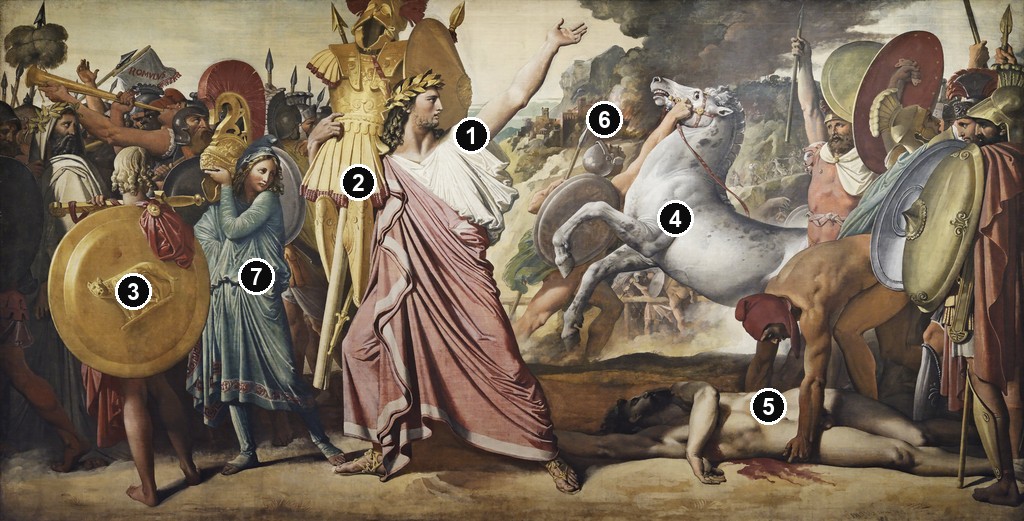
Romulus walks through the centre of Ingres’s painting with a dead king’s armour balanced against his shoulder. His open hand rises above the crowd; a white horse rears behind him; smoke thickens over a burning town. At his feet, the defeated Acron lies naked beside a pool of blood. Victory has acquired its ceremonial pose while the battlefield is still being cleared.
Painted in Rome in 1812, Romulus’ Victory over Acron is a monumental work in distemper on canvas, now in the collection of the Beaux-Arts de Paris. [1] Its extraordinary breadth accommodates a whole vocabulary of conquest: trophies, marching bodies, raised shields, children carrying military equipment and the exposed body of the vanquished. Looking from the triumphant figure to the corpse changes the character of the scene.
At a Glance
- ArtistJean-Auguste-Dominique Ingres.
- Date and medium1812; distemper on canvas. [1]
- CollectionBeaux-Arts de Paris, MU 2572. [2]
- SubjectRomulus carrying the armour of Acron, whom he has killed in single combat. [3]
- Original purposeDecoration of Napoleon’s Quirinal Palace in Rome. [4]
This work across Ingres’s career
Agamemnon’s Ambassadors
1801 (competition)Grande Odalisque
1814Louis XIII’s Vow
1824Monsieur Bertin
1832The Princesse de Broglie
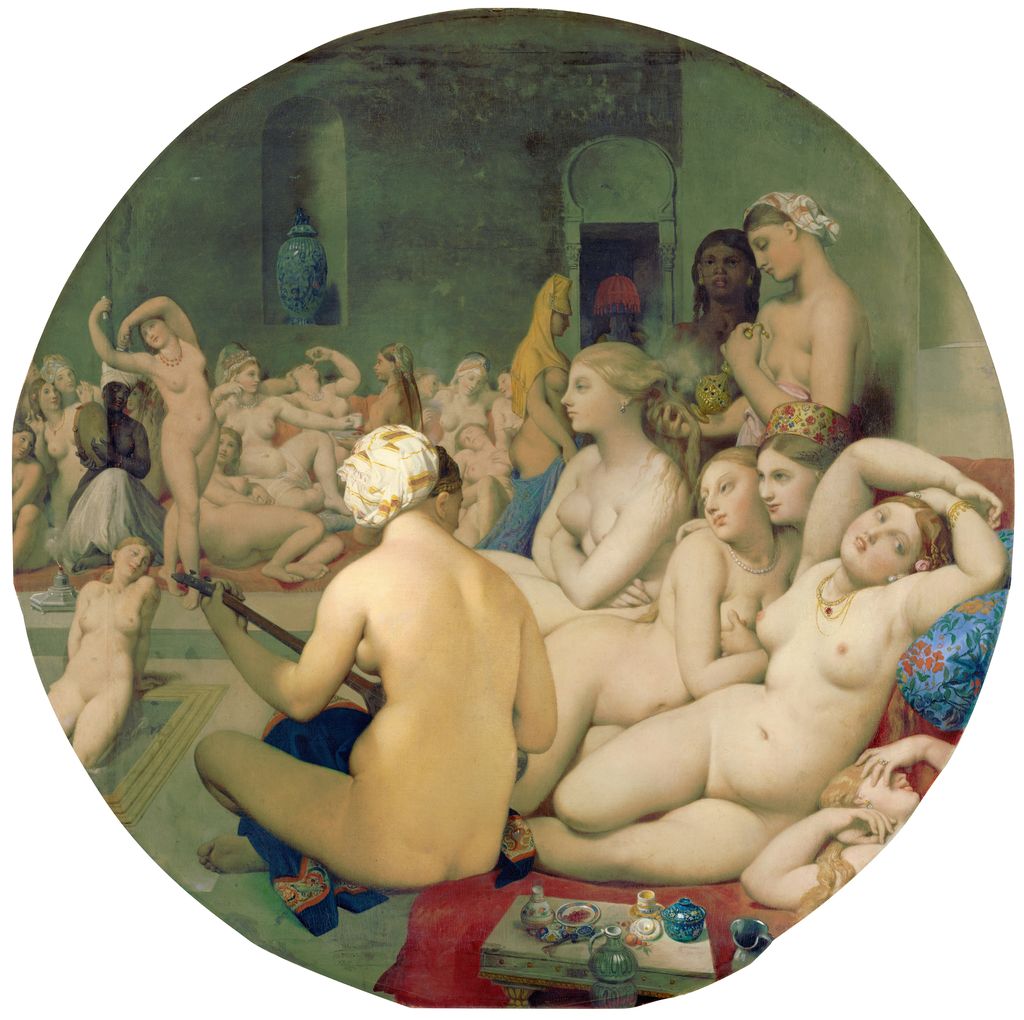
1851–1853The Turkish Bath
1859–1862Contents
- The story behind the trophy
- Reading the crowd from left to right
- A Roman founder for Napoleon’s palace
- Distemper and the ambition of a large painting
- Studying the fallen Acron
- From the papal palaces to the Beaux-Arts
- Annotated details
The story behind the trophy
The subject comes from Plutarch’s Life of Romulus. In his account, Acron, king of Caenina, attacks Rome following the Romans’ abduction of neighbouring peoples’ daughters. Romulus kills him in single combat, defeats his army and captures his city. The inhabitants must demolish their homes and move to Rome, with the promise of equal citizenship. Incorporation follows conquest under compulsion. [3]
Romulus then fastens Acron’s armour to a hewn oak trunk, crowns himself with laurel and carries the trophy on his right shoulder. His armed followers accompany him with a victory song. Plutarch presents this as the model for later triumphs, while stressing that Romulus proceeds on foot. The armour is dedicated to Jupiter Feretrius. These are the spolia opima: spoils taken by a commander who personally kills the opposing commander. [3]
Plutarch wrote centuries after Rome’s legendary foundation. His narrative explains Roman institutions through stories of their beginnings; it cannot serve as contemporary battlefield testimony. [3] Ingres’s picture gives that inherited narrative a visible body. The laurel, trophy and walking hero make the episode recognisable, but the painting places the procession close to the dead king and the destruction beyond him. Several stages of conquest share one continuous space.
The trophy itself repays attention. Gold armour surrounds an empty centre where a living torso ought to be. Its helmet and shield tower above the crowd, creating a second, artificial figure beside Romulus. Acron’s equipment has been raised into the light while his body has been lowered to the earth. The movement between those two forms, one glittering and upright, the other pale and horizontal, makes the meaning of the spoils unusually tangible.
Reading the crowd from left to right
Romulus and the ordered procession
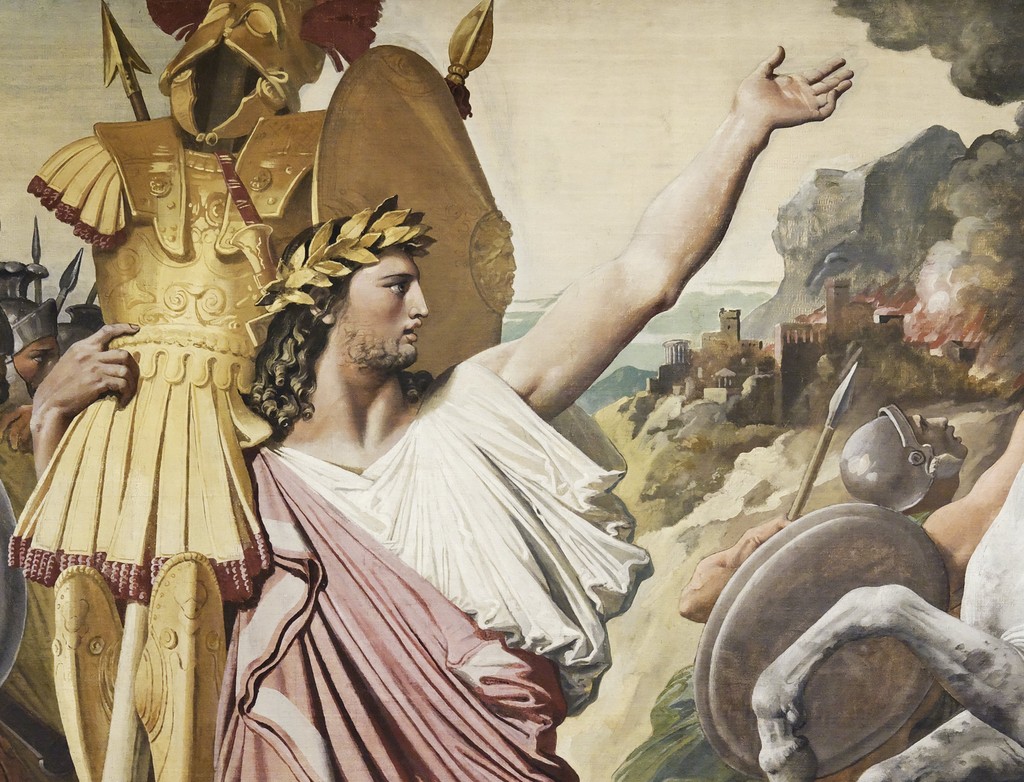
Ingres gives Romulus room to stand out without isolating him. His pale upper garment catches the light; the broad pink mantle opens into long diagonal folds; his sandalled feet make a deliberate stride across the foreground. Against the compact group behind him, the large sweep from his hip to his raised hand feels expansive. The palm faces outward, and the fingers remain open. The gesture can read as an address or proclamation, although the painting supplies no words.
His head turns towards the right, where men lift shields and weapons. The trophy occupies the opposite side of his body. Between the two, his figure joins the dense procession on the left to the more turbulent group on the right. He also links the highest ornaments of the armour to the clear strip of ground along the lower edge. The apparent ease of his walk holds this crowded arrangement together.
Behind him, spearheads and helmet crests interrupt the sky at short intervals. Overlapping shields repeat the curves of shoulders and heads. The bodies are packed into a shallow band, yet each change of metal, cloth and flesh makes a small separation. The effect resembles a sculpted frieze: a long sequence of figures designed to be read laterally. Colour keeps it from becoming a monochrome exercise. Copper, gold, dark steel, blue-green fabric and pink drapery distinguish overlapping forms.
At the far left, a bearded man looks inward beneath his wreath. Other heads turn in different directions; hands grip poles and weapons at different heights. This is a crowd with local actions, even though the broader rhythm remains controlled. Following those small changes prevents the procession from dissolving into an anonymous mass behind its leader.
Children under the armour
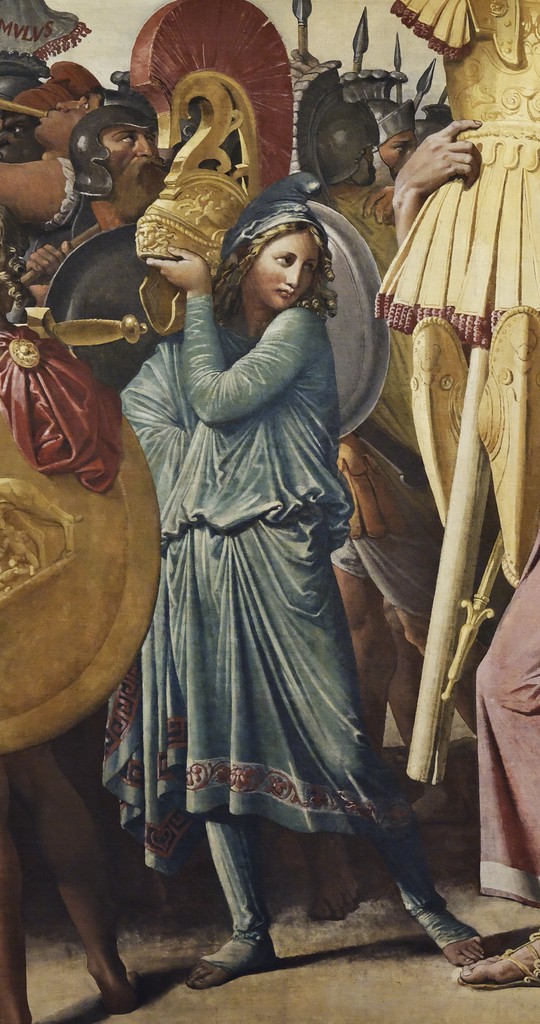
The young figures in front of the soldiers introduce another scale. One is almost hidden by an enormous golden shield. Its smooth disc occupies more space than the child’s torso, leaving the head, hands and bare legs to establish the human figure behind it. Beside this, another young bearer in a blue-green garment carries a crested helmet against the shoulder.
The oversized equipment makes weight visible. The adults carry spears and display shields as extensions of their bodies; the children have to fit themselves around the objects. Their presence also draws the eye down from helmet crests to feet and the procession’s route across the foreground. They participate in the victory through physical work.
It would be easy to treat this group as a charming interruption. In the composition, however, the children belong to the same military display as the armed adults. Their smaller bodies sharpen the disproportion between a person and the equipment of war. No additional story about their parentage or allegiance is needed to see the effect.
The horse, the corpse and the smoke
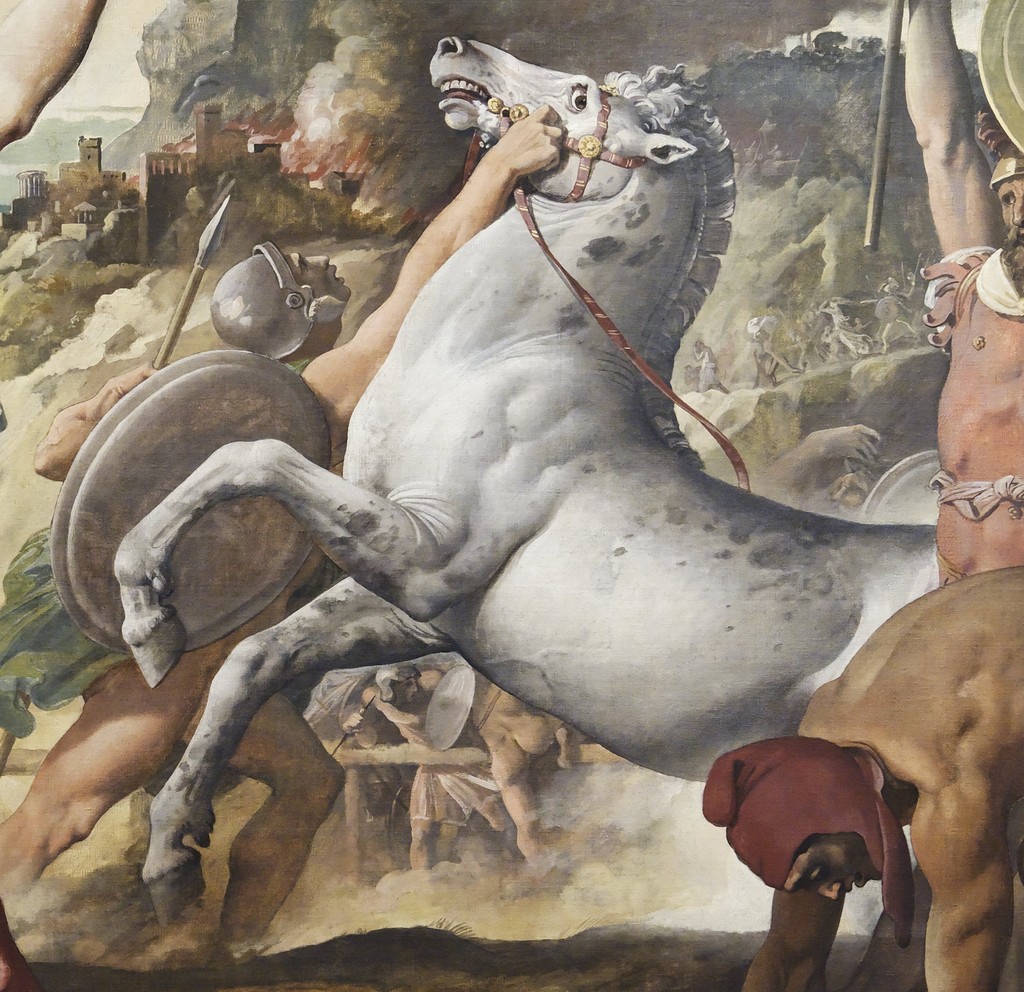
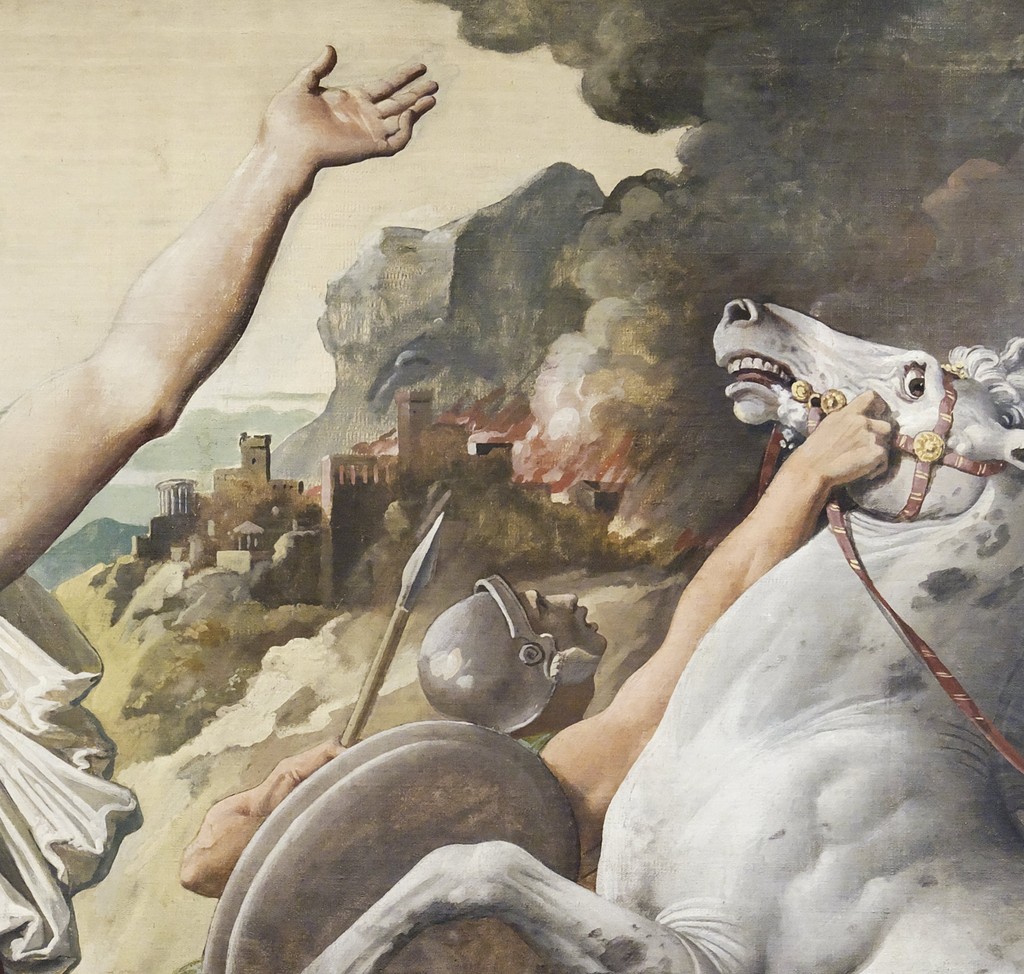
The white horse introduces a different kind of movement. Its neck arches, its mouth opens and its forelegs fold upwards. A handler reaches towards its head. The animal’s rounded, bright body breaks through the darker shields and the smoky distance, carrying the eye towards the right before the foreground corpse pulls it down again.
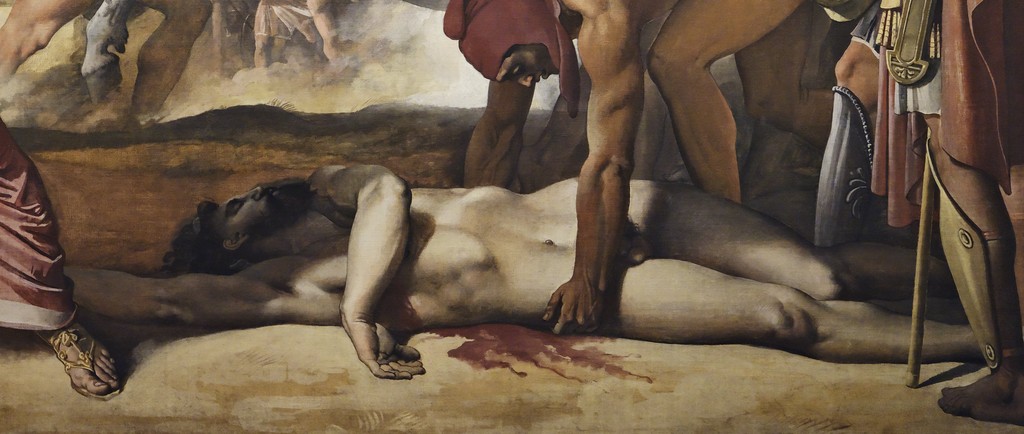
Acron’s dark hair spreads against the ground. His head turns back, his chest is exposed and one arm falls towards the viewer. Blood lies beside the body, low in the picture and close to the edge. The painter has given the defeated king almost as much horizontal reach as Romulus has vertical command. A viewer who attends only to the standing hero misses this counterweight.
A dark-skinned figure wearing a red head covering bends over the body. The bowed back makes a strong downward curve beneath the horse’s raised neck. Hands meet the fallen man’s flesh, bringing another kind of bodily contact into a scene dominated by shields and poles. The image alone does not establish this figure’s legal status, relationship to Acron or precise task. The visible action is enough to interrupt the triumph’s upright rhythm.
Beyond them, flames break out among buildings on a rocky height. Smoke spreads into the sky, and smaller figures extend the action into the distance. There is no clean boundary between the heroic foreground and the destruction behind it. Romulus’s lifted hand, the horse’s head and the burning settlement occupy the same sweep across the painting. Ceremonial order and violent disorder remain visible together.
Annotated Details from Romulus’ Victory over Acron
The numbered points identify visible features discussed in this article. Return from each detail to the whole composition. Each caption identifies the work shown.
Romulus’ Victory over Acron
Jean-Auguste-Dominique Ingres, Romulus’ Victory over Acron, 1812. Distemper on canvas. Beaux-Arts de Paris, MU 2572. Photograph: Shonagon2026; Wikimedia Commons. Image source. Public domain.
Acron cadaver studies
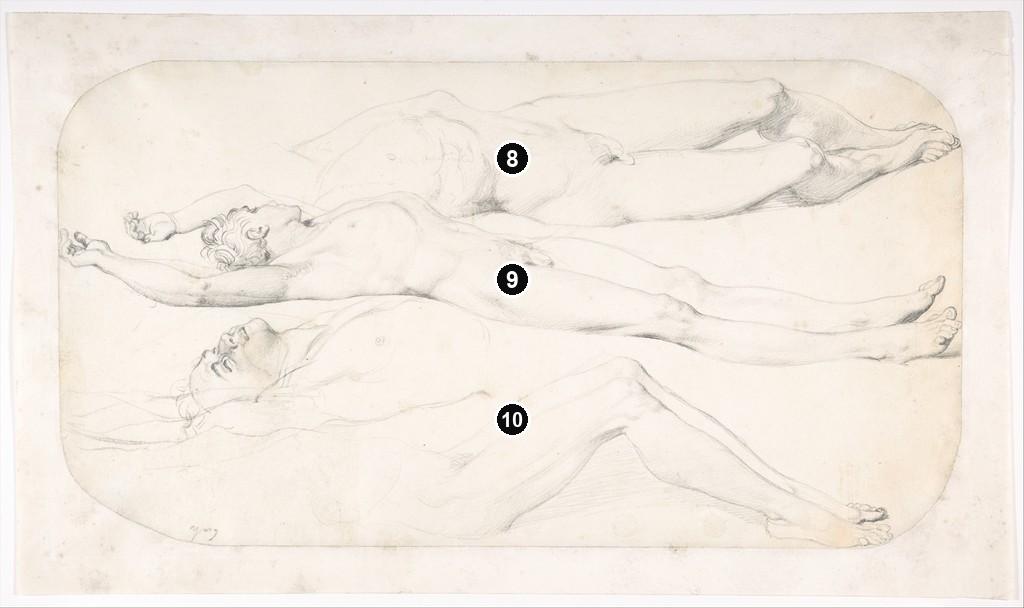
Ingres, Studies for the Cadaver of Acron, c. 1810–12. The Metropolitan Museum of Art, 19.125.2. Rogers Fund, 1919. Image source. CC0 / Public domain.
Details from ROMULUS’ VICTORY OVER ACRON
Compare the central trophy, shield, horse and fallen body, then the three different reclining poses on the separate study sheet.
Romulus’ Victory over Acron
The crowned head and raised arm
The laurel-crowned head turns beneath a long raised arm. Follow the open hand back towards the shoulder and the larger folds of pale cloth across the chest.
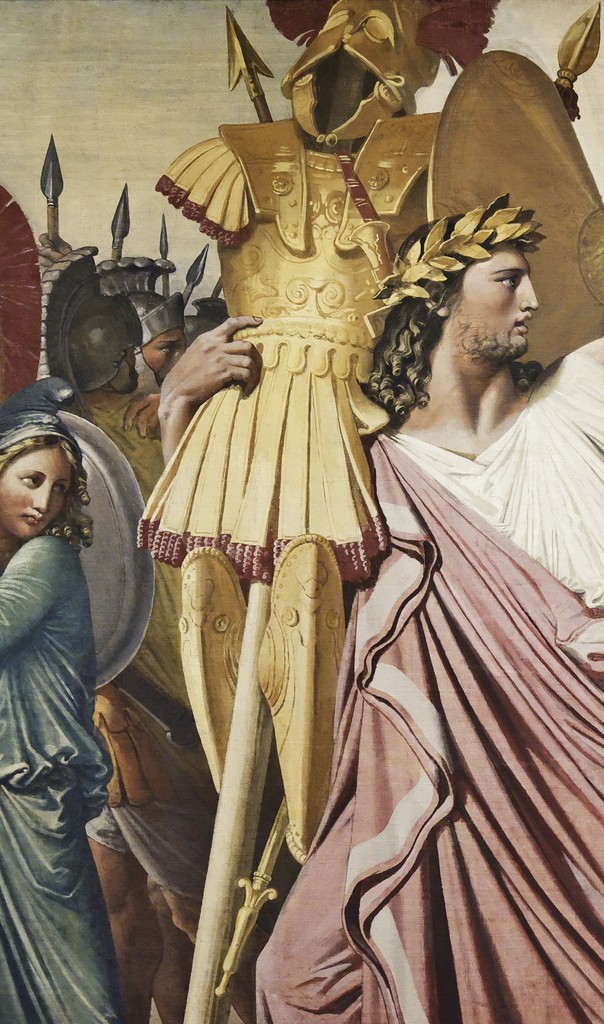
Golden armour carried above the crowd
Gold armour rises above the procession on a long support. Its small repeated ornaments contrast with the broad white and pink folds of the central figure’s clothing.
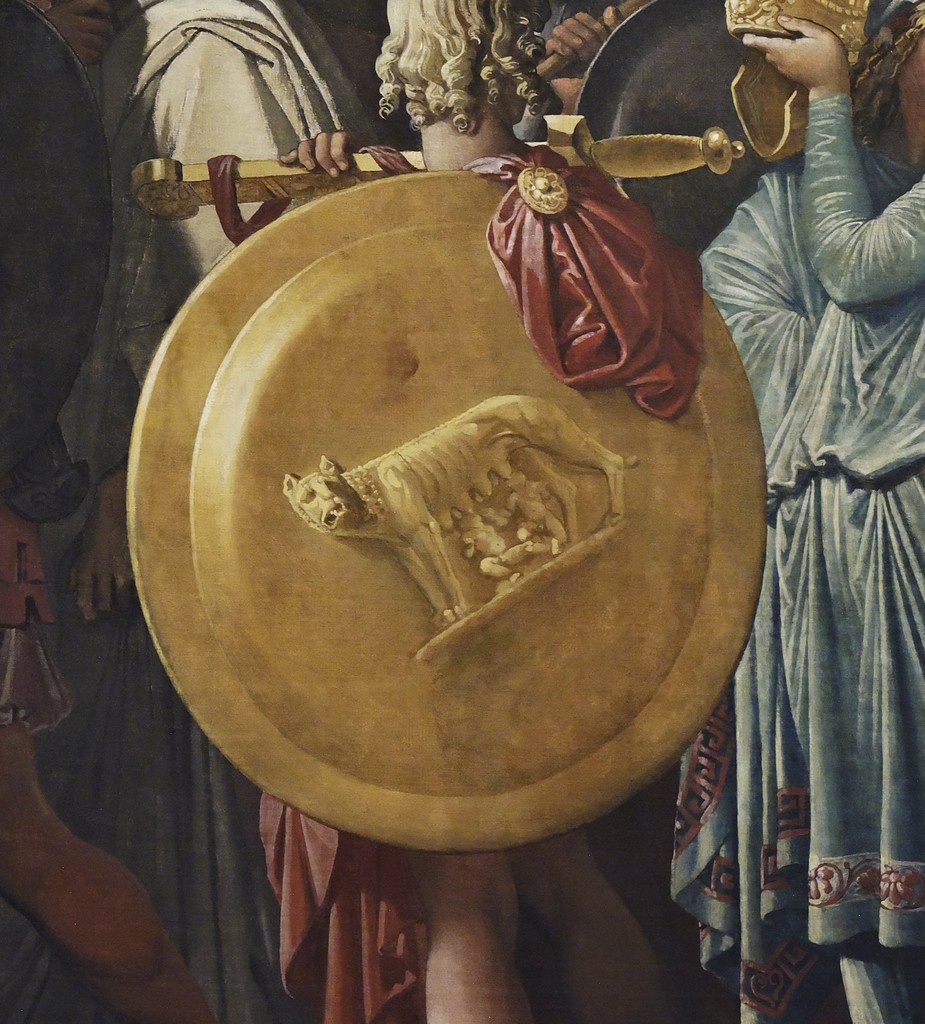
The wolf and twins on the round shield
A small wolf and two children appear in relief on the large round shield. The compact central group sits within a much broader golden disc.
The horse’s head and lifted forelegs
The pale horse lifts its forelegs and throws back its head beside the crowded procession. The curving body and bent legs interrupt the more upright figures at either side.
The fallen body near the lower edge
A pale body lies stretched across the foreground beneath a bending figure. Compare the lowered head and open hand with the raised arm and marching bodies above.
Smoke above the distant buildings
Dark and pale smoke rises from small buildings behind the central figure. The distant architecture and flames establish another scale beyond the close-packed foreground.
The child carrying a tall helmet
A child in blue-green clothing supports a tall golden helmet beside the central trophy. The lifted object extends the smaller figure’s reach into the procession above.
Acron cadaver studies
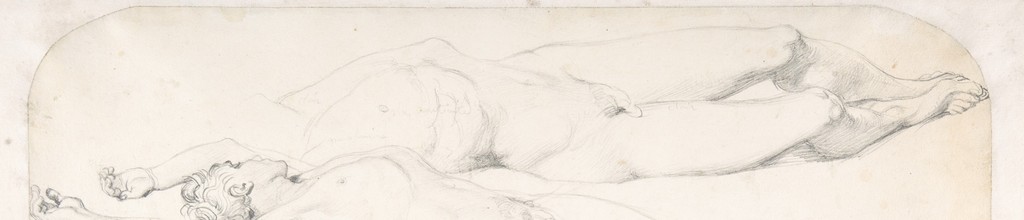
The reclining body at the top
The upper figure lies with the head tilted back and the legs extended. Light outlines and small shaded passages describe a different arrangement from the two bodies below.
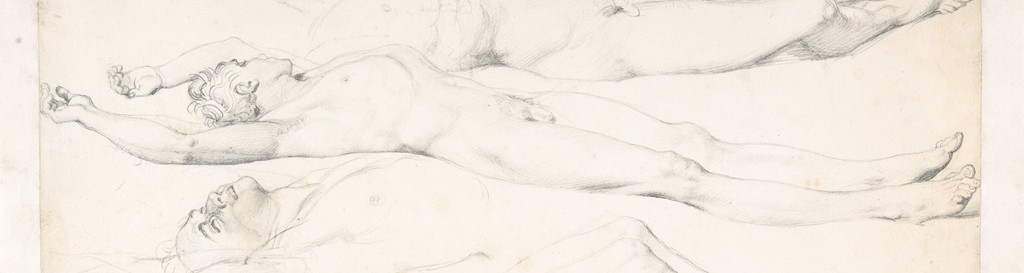
The long central pose
The central body stretches almost across the sheet, with both arms reaching beyond the head. Compare its long outer contour with the smaller changes around the elbows, knees and feet.
The lower figure with a bent knee
The lower body bends one knee while the head tilts towards the viewer. This change in the legs creates a different rhythm from the straighter central pose.
A Roman founder for Napoleon’s palace
The Beaux-Arts de Paris explains the commission through a parallel between Rome’s founder and Napoleon, who had made himself king of Italy. [4] Philip Conisbee places Romulus and The Dream of Ossian within General Miollis’s preparations for an anticipated imperial visit to the Quirinal. That visit did not take place. [5]
The palace context makes the subject more pointed. A victorious founder carrying the enemy leader’s armour offers a ruler an image of personal courage made public. Romulus’s body is easy to distinguish, the trophy rises high and the crowd visibly attends him. Authority becomes something that can be recognised across a large room.
At the same time, the picture’s own arrangement allows a less comfortable reading. The hero’s upright dignity depends on the naked, defeated body below. The burning town remains in view behind the gesture of command. This is a tension a viewer can observe without assuming that Ingres intended a covert criticism of his patron. A commission celebrating conquest may still show the physical conditions of conquest.
Conisbee relates the composition to Raphael and Domenichino, especially David’s Intervention of the Sabine Women. He records a studio provided in the tribune of Trinità dei Monti; a watercolour of Ingres painting Romulus is by an unidentified artist. In 1813, Ingres hoped to establish himself at the Paris Salon with this painting and other works. [5] The commission offered a prospect of recognition beyond the palace for which it was made.
The connection with David is useful as an account of Ingres’s artistic inheritance, rather than a complete explanation of the result. Here, the long bands of equipment and bodies have their own pressures and interruptions. The bright horse opens the middle distance, while the corpse stretches across the lower right. The painting’s order emerges from the management of those unequal forms.

Ingres, The Dream of Ossian, 1813. [6]
Distemper and the ambition of a large painting
The medium matters. The Beaux-Arts identifies the work as distemper on canvas, and Delaborde’s 1870 catalogue also describes it as painted in distemper and signed at Rome in 1812. [1][7] It should therefore be understood as a canvas made for an architectural setting; calling it a fresco would confuse its support and process with wall painting.
Delaborde reports that Ingres became so enthusiastic about distemper while making Romulus that he considered reserving oil painting for small, anecdotal subjects. A notebook passage, transmitted in Delaborde’s posthumous compilation, proposes executing his large pictures in distemper and subsequently varnishing them with oil. Delaborde says he abandoned this wider programme and admits that he does not know why. [7]
This is valuable evidence of an ambition at a particular moment. It does not establish that every step proposed in the notebook was carried out on Romulus. Nor does it identify the precise ingredients or layering of the surviving painting. The distinction matters because an artist’s desired method and an object’s demonstrable construction answer different questions.
The composition itself shows how seriously Ingres took the problem of making a large image coherent. At a distance, the eye can identify a small number of dominant shapes: the trophy, the pink mantle, the white horse and the horizontal nude. Closer attention reveals the folded fabrics, elaborate metalwork and shifting faces within that framework. The painting asks to work at both scales.
Delaborde also records many figure drawings, including studies for figures that Ingres considered introducing and then omitted. Most were in Gatteaux’s collection when he wrote. [7] That historical account suggests a composition developed through alternatives. It does not make every surviving drawing a record of the final arrangement, or establish a present ownership history for any particular sheet.
Studying the fallen Acron
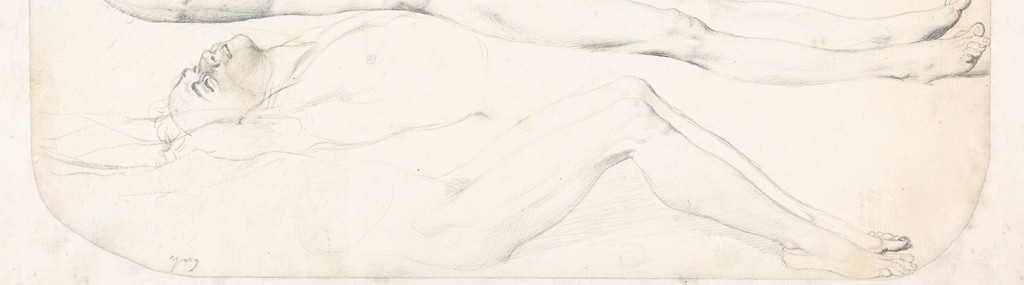
One especially revealing sheet is the Metropolitan Museum of Art’s Studies for the Cadaver of Acron, dated about 1810–12. It is graphite on wove paper, 19.6 × 37.4 cm, acquired through the Rogers Fund in 1919, object number 19.125.2. [8]
Three overlapping nude bodies stretch across the paper, with their heads towards the left and feet towards the right. They occupy closely related horizontal positions, but the turns of chest, hips and face change. In the upper figure, shading concentrates around the thigh and bent knee. The central body extends more continuously across the sheet. Below it, a face turns towards the viewer and the hip rises into a more pronounced curve.
The arms are less easily separated. Lightly drawn alternatives reach across and around the bodies, so that the eye has to distinguish a stronger contour from a faint possibility. The sheet does not offer three equally finished illustrations. Some passages are worked into volume with shading; others remain lines searching for a position.
Comparing it with the painting changes the way the foreground can be read. Acron’s final pose may first appear inevitable, as though a fallen body simply occupied an available strip of ground. The drawing makes that pose look chosen. The angle of the head, the opening of the chest and the arm’s direction all affect how readily the viewer sees the body beneath the standing men.
The comparison also restores attention to the defeated figure. The painting’s title belongs to the victor, yet this sheet concentrates on the cadaver. Acron had to be designed as carefully as the men who survive him. His long contour gives the right foreground its foundation, and the exposed flesh creates a visual difference from the armour gathered above it.
The sheet makes Ingres’s drawing tangible as a process of selection. Its overlapping alternatives preserve the effort to make a body carry a particular role within a larger composition, without disclosing an exact sequence of sessions or a method of transfer to canvas.
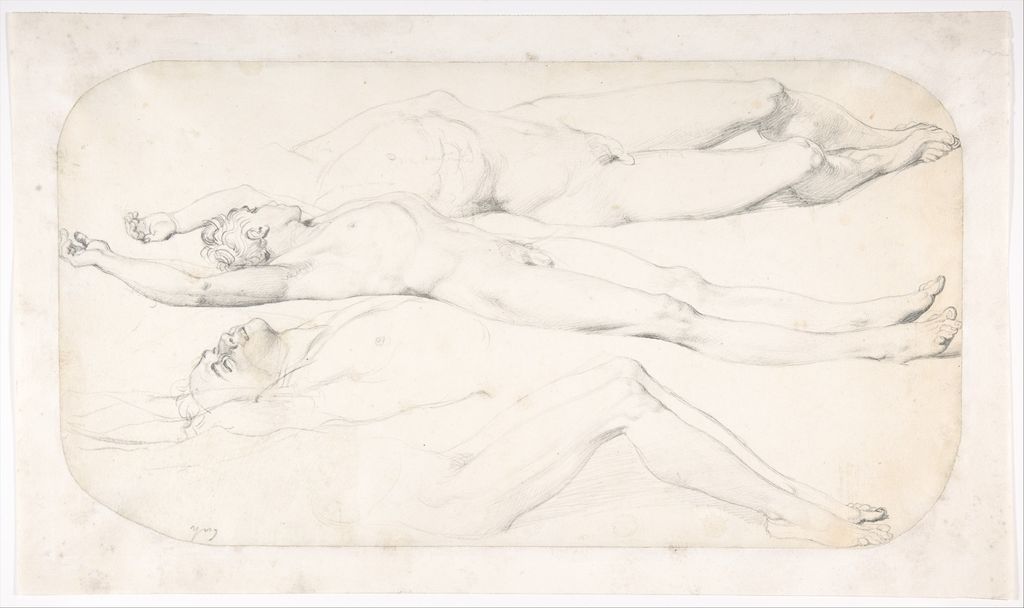
Ingres, Studies for the Cadaver of Acron, c. 1810–12. The Metropolitan Museum of Art, 19.125.2. [9]
From the papal palaces to the Beaux-Arts
Delaborde traces the painting from the palace of Monte Cavallo, the Quirinal, to Saint John Lateran. It remained there at the beginning of 1867, before being sent to Paris for the posthumous Ingres exhibition and given to France by the papal government. [7]
The Beaux-Arts presentation identifies Pius IX’s authorisation of the memorial loan and subsequent gift. Installed in the school’s amphitheatre, Romulus faced Paul Delaroche’s mural. A security deposit took it to the Louvre in the late 1960s; restoration in 2016 preceded its return in 2017. [4]
That history gave the imperial commission a second public life. A painting conceived for Napoleon’s Roman residence became a memorial to Ingres within a school of art. Its institutional setting placed a completed historical composition before later generations, with all the decisions about figures, scale and narrative that such a work embodied. The original political occasion had passed; the object continued to be looked at and used differently.
Artworks directory
Explore 150 paintings, drawings and an original lithograph. This selection includes related versions and studies; dates distinguish completed works from later revisions.
| Name | Date | Medium |
|---|---|---|
| The Apotheosis of Homer | 1827 | Painting |
| Grande Odalisque | 1814 | Painting |
| The Turkish Bath | 1859–1862 | Painting |
| Madame Moitessier Seated | 1856 | Painting |
| Portrait of Monsieur Bertin | 1832 | Painting |
| Napoleon I on His Imperial Throne | 1806 | Painting |
| Odalisque with Slave | 1839 | Painting |
| The Ambassadors of Agamemnon in the Tent of Achilles | 1801 (competition) | Painting |
| The Valpinçon Bather | 1808 | Painting |
| The Source | 1856 | Painting |
| Oedipus Explaining the Enigma of the Sphinx | 1808; revised probably before 1827 | Painting |
| The Vow of Louis XIII | 1824 | Painting |
| Antiochus and Stratonice | 1840 | Painting |
| The Comtesse d’Haussonville | 1845 | Painting |
| The Princesse de Broglie | 1851–1853 | Painting |
| Jupiter and Thetis | 1811 | Painting |
| The Dream of Ossian | 1813 | Painting |
| The Martyrdom of Saint Symphorian | 1834 | Painting |
| Venus Anadyomene | 1808–1848 | Painting |
| Portrait of Madame de Senonnes | 1814 | Painting |
| Madame Rivière | 1805 | Painting |
| Mademoiselle Caroline Rivière | 1805 | Painting |
| Portrait of Philibert Rivière | 1805 | Painting |
| Bonaparte First Consul | 1804 | Painting |
| The Death of Leonardo da Vinci | 1818 | Painting |
| Joan of Arc at the Coronation of Charles VII | 1854 | Painting |
| Madame Duvaucey | 1807 | Painting |
| La Belle Zélie | 1806 | Painting |
| Madame Panckoucke | 1811 | Painting |
| Portrait of Charles Marcotte d’Argenteuil | 1810 | Painting |
| Joseph Antoine Moltedo | c.1810 | Painting |
| Madame Leblanc | 1823 | Painting |
| Delphine Ingres-Ramel (Portrait of Madame Ingres) | 1859 | Painting |
| Portrait of Amédée de Pastoret | 1823–1826 | Painting |
| Portrait of Baronne de Rothschild | 1848 | Painting |
| Madame Marcotte de Sainte Marie | 1826 | Painting |
| Madame Gonse | 1852 | Painting |
| Aretino in the Studio of Tintoretto | 1848 | Painting |
| Don Pedro of Toledo Kissing Henry IV’s Sword | 1831/1832 | Painting |
| Raphael and La Fornarina | 1814 | Painting |
| Roger Freeing Angelica | 1819 | Painting |
| Romulus’ Victory over Acron | 1812 | Painting |
| Self-Portrait at the Age of Twenty-Four | 1804; revised 1841–1851 | Painting |
| Male Torso | c.1800 | Painting |
| Odalisque in Grisaille (Ingres and workshop) | c.1824–1834 | Painting |
| The Small Bather | 1826 | Painting |
| The Little Bather Harem Interior | 1828 | Painting |
| Jesus Among the Doctors | 1862 | Painting |
| The Virgin Adoring the Host | 1852 | Painting |
| The Virgin of the Host | 1841 | Painting |
| Virgin of the Adoption | 1858 | Painting |
| Paolo and Francesca | 1814 | Painting |
| Homer Deified (revised composition, Louvre RF5273) | 1865 | Drawing |
| Odalisque with Slave (Louvre RF4622) | 1858 | Drawing |
| Odalisque (Walters Art Museum; Ingres and Paul Flandrin) | 1842 | Painting |
| Madame Moitessier Standing (National Gallery of Art) | 1851 | Painting |
| Jacques-Louis Leblanc (The Metropolitan Museum of Art) | 1823 | Painting |
| Ferdinand-Philippe, Duke of Orléans (Louvre RF2005-13) | 1842 | Painting |
| Ferdinand-Philippe, Duke of Orléans (Versailles MV5207; Ingres and workshop) | 1843 | Painting |
| Ferdinand-Philippe, Duke of Orléans (Versailles MV5209; Ingres and workshop) | 1844 | Painting |
| Antiochus and Stratonice (Musée Fabre; Ingres and Raymond Balze) | 1866 | Painting |
| Antiochus and Stratonice (Kunstmuseum Bern, Gurlitt bequest) | Undated (early dating proposed) | Drawing |
| Composition study for Antiochus and Stratonice (MIB867.2193) | 1806 | Drawing |
| Study for the Figure of Stratonice (Met63.66) | 1834–1840 | Graphite, black chalk and charcoal |
| Nude figure study for Stratonice (Boijmans F II 36 PK) | c.1834–1840 | Drawing |
| Paolo and Francesca (The Barber Institute,54.6) | c.1814–1820 | Painting |
| Paolo and Francesca (The Hyde Collection,1971.24) | c.1855–1860 | Painting |
| Paolo and Francesca (Amsterdam Museum TA10970) | 1820 | Drawing |
| Paolo and Francesca (dedicated to Artaud de Montor) | 1816 | Drawing |
| Study for the Bust of Francesca (MIB867.1398) | 1819 | Drawing |
| Study for the Bust of Francesca (MIB867.1396) | 1819 | Drawing |
| The Archangel Raphael, first idea (MIB867.2488) | 1842 | Drawing |
| The Archangel Raphael (MIB867.2500) | 1842 | Drawing |
| The Archangel Raphael Carrying Human Prayers to God (Chantilly DE513) | 1844 | Drawing |
| Louis-Philippe as Saint Philip, stained-glass study | 1844 | Drawing |
| Marie Frédéric Eugène de Reiset (Ford Collection RBF171-2) | 1844 | Drawing |
| Virgil Reading the Aeneid (Toulouse) | Begun 1811 | Painting |
| Tu Marcellus Eris (Brussels, inv. 1836) | c.1814 (museum dating) | Painting |
| Jean-François Gilibert | 1804 | Painting |
| François-Marius Granet | 1807 (museum dating) | Painting |
| Count Nikolai Dmitrievich Guryev | 1821 | Painting |
| Caroline Murat, Queen of Naples | 1814 | Painting |
| Count Mathieu Molé | 1834 | Painting |
| Cherubini and the Muse of Lyric Poetry (Louvre) | 1842 | Painting |
| Luigi Cherubini (Cincinnati) | 1841 | Painting |
| Comtesse de Rayneval (Louvre RF4505) | 1841 | Drawing |
| Venus on Paphos (Antonie Balaÿ) | c.1852 | Painting |
| Prince Napoléon | 1855 | Painting |
| Study for The Apotheosis of Napoleon I (Petit Palais) | Late 1853 | Painting |
| The Apotheosis of Napoleon I (destroyed ceiling) | 1853 | Painting |
| The Journalist (MIB867.2733) | 1834? | Drawing |
| Henry VIII, after Holbein | c.1815–1820 (?) | Drawing |
| Madame Récamier, after David (MIB867.3637) | Undated (early Paris period) | Drawing |
| Study for Comtesse d’Haussonville (MIB867.259; background possibly by another hand) | 1842–1845 | Drawing |
| La Source (reduced version reported by Delaborde) | Date unrecorded; reported 1870 | Painting |
| Odalisque (autograph lithograph,NGA1946.21.117) | 1825; published1826 | Lithograph |
| Portrait of a Seated Lady | 1814 | Graphite |
| The Kaunitz Sisters (Leopoldine, Caroline, and Ferdinandine) | 1818 | Graphite |
| Portrait of a Man | 1814 | Graphite |
| Study for the Portrait of Louis-François Bertin (1766–1841) | n.d. | Black chalk and graphite |
| Studies for the Cadaver of Acron | ca. 1810–12 | Graphite on wove paper |
| Study for the Drapery of Molière in "The Apotheosis of Homer" | n.d. | Black chalk with stumping |
| Madame Guillaume Guillon Lethière, née Marie-Joseph-Honorée Vanzenne, and her son Lucien Lethière | 1808 | Graphite |
| Niccolò Paganini (1782–1840) | ca. 1830 | Counterproof or tracing strengthened with graphite and gouache on translucent paper |
| Lady Mary Cavendish-Bentinck (?-1843) | 1816 | Graphite |
| Madame Alexandre Lethière and Her Daughter Letizia | ca. 1815 | Graphite |
| Merry Joseph Blondel (1781–1853) | 1809 | Graphite |
| Ursin-Jules Vatinelle (1798–1881) | 1820 | Graphite |
| Bust of a Gypsy Girl (ascribed to Ingres) | 1819 | Graphite on wove paper |
| Study of a Seated Nude Male | n.d. | Graphite |
| The Archangel Raphael (Study for a stained-glass window in the chapel of Notre-Dame de la Compassion-Saint-Ferdinand, Neuilly) | ca. 1842 | Graphite |
| Lancelot-Théodore, comte Turpin de Crissé | probably 1818 | Graphite |
| Study for the Figure of the Iliad in "The Apotheosis of Homer" | ca. 1827 | Graphite and black chalk heightened with white chalk on brown paper |
| Comtesse Turpin de Crissé | probably 1818 | Graphite |
| Nude Figures for L'Âge d'Or, Château de Dampierre | n.d. | Graphite on brownish paper |
| Study of Figures (attributed to Ingres) | n.d. | Graphite |
| Study of Figures (attributed to Ingres) | n.d. | Graphite; squared in graphite |
| Admiral Sir Fleetwood Broughton Reynolds Pellew | 1817 | Graphite on wove paper |
| Madame Jean-Auguste-Dominique Ingres, née Madeleine Chapelle | 1814 | Graphite on off-white wove paper |
| Virgil Reading the Aeneid to Augustus, Livia, and Octavia | 1809/1819 (?) | Pen and black ink, graphite, brush and gray wash, white gouache heightening, Conté crayon on blue paper |
| General Louis-Étienne Dulong de Rosnay | 1818 | Graphite (hard and soft pencils) |
| Madame Alexandre Lethière, née Rosa Meli, and Her Daughter, Letizia | 1815 | Graphite |
| The Lawyer Paul Grand | 1834 | Graphite |
| Jean-Joseph Fournier | 1815 | Graphite |
| Armand Bertin | 1842 | Graphite |
| Madame Armand Bertin, née Marie-Anne-Cécile Dollfuss | 1843 | Graphite |
| The Architect Charles-Victor Famin | 1836 | Graphite |
| Henri Lehmann | 1850 | Graphite |
| Portrait of a Lady | ca. 1815–17 | Graphite |
| Edmond Cavé (1794–1852) | 1844 | Oil on canvas |
| Head of Saint John the Evangelist | probably ca. 1818–20 | Oil on canvas, laid down on wood |
| Madame Edmond Cavé (Marie-Elisabeth Blavot, ca. 1806–1883) | ca. 1831–34 | Oil on canvas |
| Madame Félix Gallois | 1852 | Graphite with touches of gold in oil to highlight jewelry, on buff wove paper. |
| Dr. François Mêlier | 1849 | Graphite with graphite framing lines, corrected with white, on buff wove paper |
| Portrait of Madame Rhode (Rhoda?) | 1810–20 | Graphite on pale buff wove paper |
| Study for "Raphael and the Fornarina"(?) | ca. 1814(?) | Graphite on white wove paper |
| Portrait of Madame Paul Meurice, née Palmyre Granger | ca. 1845–50 | Graphite on wove paper |
| Alexander the Great presenting Campaspe to Apelles | 1810 | Graphite, brush and brown wash; squared in graphite |
| Study of Hands for "Christ Among the Doctors" | 1852–62 | Graphite on tracing paper |
| Study for The Turkish Bath (RF34502) | about 1850 | Pen and brown ink with graphite, partially squared |
| Study for The Turkish Bath (RF23354) | Undated | Pen and brown ink with graphite on joined sheets |
| Study for The Turkish Bath (RF54702) | about 1859 | Pen and brown ink |
| Studies of women for The Turkish Bath (RF12292) | Undated | Black chalk |
| Achilles Receiving the Envoys of Agamemnon (Nationalmuseum sketch, NM2161) | 1801 | Oil on wood |
| Half-Length Bather (Musée Bonnat-Helleu,89) | 1807 | Oil on canvas |
| Oedipus and the Sphinx (National Gallery,NG3290) | about1826 | Oil on canvas |
| Oedipus and the Sphinx (Walters,37.9) | 1864 | Oil on canvas |
| Oedipus and the Valpinçon Bather, after David (MI.867.2035) | Undated | Graphite on tracing paper, after David |
| Study of the Virgin for The Vow of Louis XIII (Dijon,1758) | about1822 | Black chalk, stump and white chalk on brown wove paper |
| First Thought for The Vow of Louis XIII (MI.885.11.21) | 1822 | Oil on canvas |
Frequently Asked Questions
It is Acron’s armour, displayed as a trophy and religious offering after the king’s defeat. [7] The empty suit makes victory visible to the surrounding crowd.
Discussion
Look again at the images and ideas explored in Romulus’ Victory over Acron. These editorial prompts invite your observations.
Reader Insights
Where does your eye settle after the first impression of triumph: on Romulus’s raised hand, the children carrying armour, or Acron’s body? How does that choice change your reading of the procession?
Compare the triumphant figure with Acron’s fallen body. How do opposite directions organise the procession around them?
What changes when you imagine this crowded composition within an imperial palace rather than as a separate museum picture?
Join the Conversation
Share a detail, comparison or question about Romulus’ Victory over Acron below.
References
- Beaux-Arts de Paris, “Painting”, caption for Romulus vainqueur d’Acron: 1812, distemper on canvas. Collection presentation, consulted 17 October 2026. View source.
- Beaux-Arts de Paris, Catzarts, “Romulus vainqueur d’Acron”, MU 2572, particularly medium and inscription fields. The creation-date field conflicts with the transcribed 1812 inscription. Consulted 17 October 2026. (in French) View source.
- Plutarch, Life of Romulus, chapter 16, §§1–8. Translated by Bernadotte Perrin, Parallel Lives, Loeb Classical Library, vol. I, 1914, pp. 135–139. This translation postdates Ingres’s painting. View source.
- Beaux-Arts de Paris, Amphithéâtre d’honneur, printed pp. 2, 4 and 8; four-page PDF, especially final page, “Le tableau de Jean-Dominique Ingres”. The timeline and narrative differ by one year over the Louvre deposit; “late 1960s” is used here. (in French) View source.
- Philip Conisbee, “Rome, 1806–1820”, in Gary Tinterow and Philip Conisbee, eds., Portraits by Ingres: Image of an Epoch. New York: The Metropolitan Museum of Art, 1999, p. 106; fig. 97, p. 108. View source.
- Supporting image. Ingres, The Dream of Ossian, 1813. The Yorck Project; Wikimedia Commons. Image source. Public domain.
- Henri Delaborde, Ingres, sa vie, ses travaux, sa doctrine, d’après les notes manuscrites et les lettres du maître. Paris: Henri Plon, 1870, catalogue no. 40, pp. 214–215. Posthumous account incorporating Ingres’s notebook testimony; paraphrased here. (in French) View source.
- The Metropolitan Museum of Art, Studies for the Cadaver of Acron, about 1810–12, 19.125.2. Object details and collection image, consulted 17 October 2026. View source.
- Supporting image. Ingres, Studies for the Cadaver of Acron, c. 1810–12. The Metropolitan Museum of Art, 19.125.2. Rogers Fund, 1919. Image source. CC0 / Public domain.
- Splash image. Jean-Auguste-Dominique Ingres, Romulus’ Victory over Acron, 1812. Distemper on canvas. Beaux-Arts de Paris, MU 2572. Photograph: Shonagon2026 / Wikimedia Commons. Image source. Public domain.