by Tom Gurney
Tom Gurney BSc (Hons) is an art history expert with over 20 years experience
Published on June 19, 2020 / Updated on October 22, 2026
Email: tomgurney1@gmail.com / Phone: +44 7429 011000
The Dream of Ossian
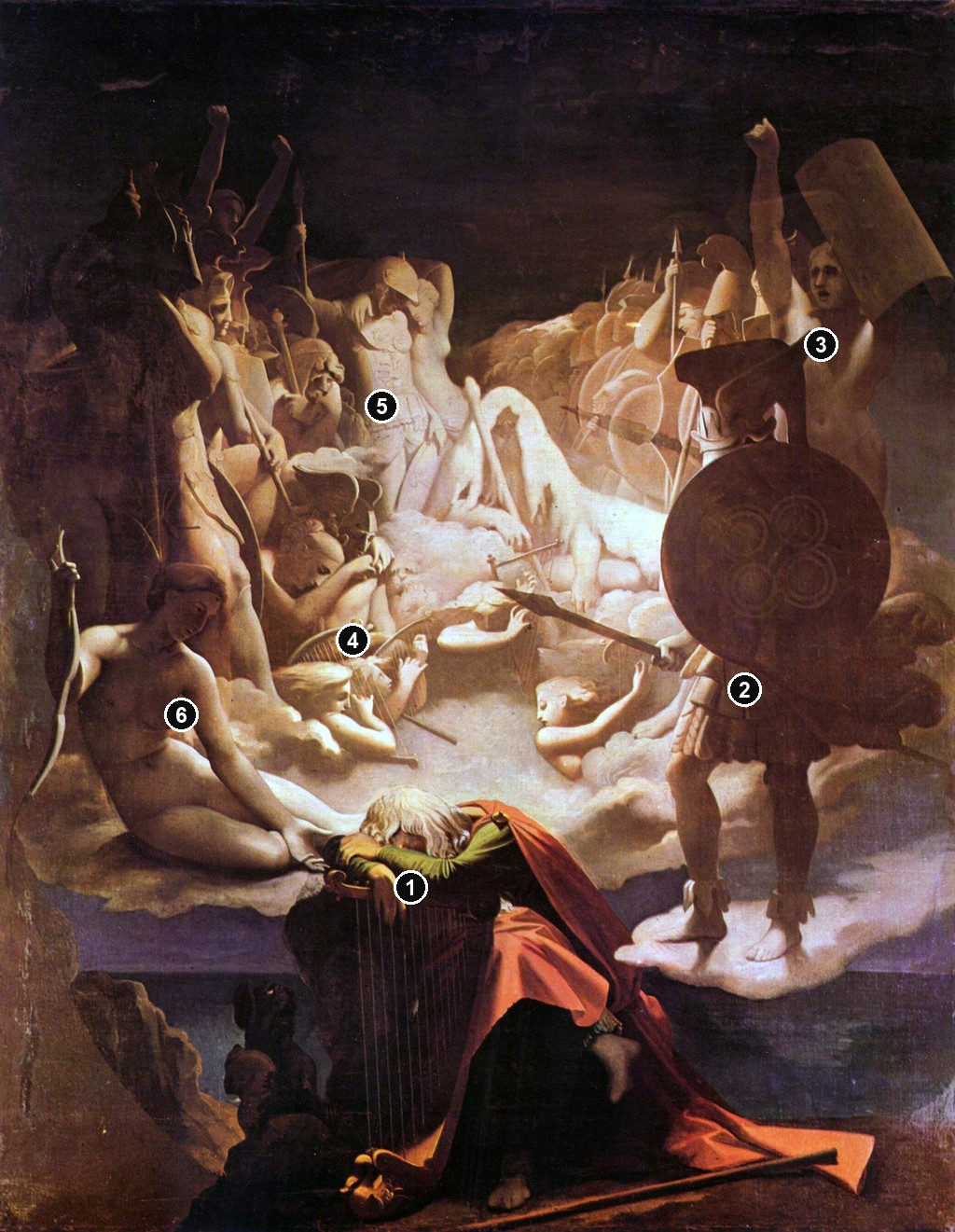
An old man sleeps with his face buried in his arms. Around him, a company of warriors, women and musicians takes shape in the clouds. His red cloak and green sleeve have the weight and colour of ordinary clothing; their pale bodies seem made from the same substance as the light. In Jean-Auguste-Dominique Ingres's The Dream of Ossian, the sleeper occupies only the foot of the picture, yet everything above him belongs to his dream.
The contrast is more unsettling the longer one looks. The apparitions have firm limbs, elaborate weapons and sharply defined profiles, but no dependable ground beneath their feet. The sleeper has a place in the physical world, yet his face is almost inaccessible. Between them stands his harp: a tangible support for an exhausted body and a visual link to the music-making spirits.
The large canvas belongs to the Musée Ingres Bourdelle in Montauban. Dated 1813, it also carries a later history of alteration under Ingres's direction. Its dream has survived through remaking as well as preservation. [1]
At a Glance
- ArtistJean-Auguste-Dominique Ingres; later transformation by Raymond Balze under Ingres's direction. [1]
- Date1813; altered after 1835. [1][2]
- Medium and sizeOil on canvas, 348 × 275 cm. [2]
- CollectionMusée Ingres Bourdelle, Montauban; inventory MI.867.70. [2]
- Original purposeA ceiling painting intended for Napoleon's bedroom at the Quirinal Palace in Rome. [3]
- SubjectThe imagined Scottish bard Ossian dreams of a vanished company of relatives, warriors and musicians. [2]
This work across Ingres’s career
Agamemnon’s Ambassadors
1801 (competition)Grande Odalisque
1814Louis XIII’s Vow
1824Monsieur Bertin
1832The Princesse de Broglie
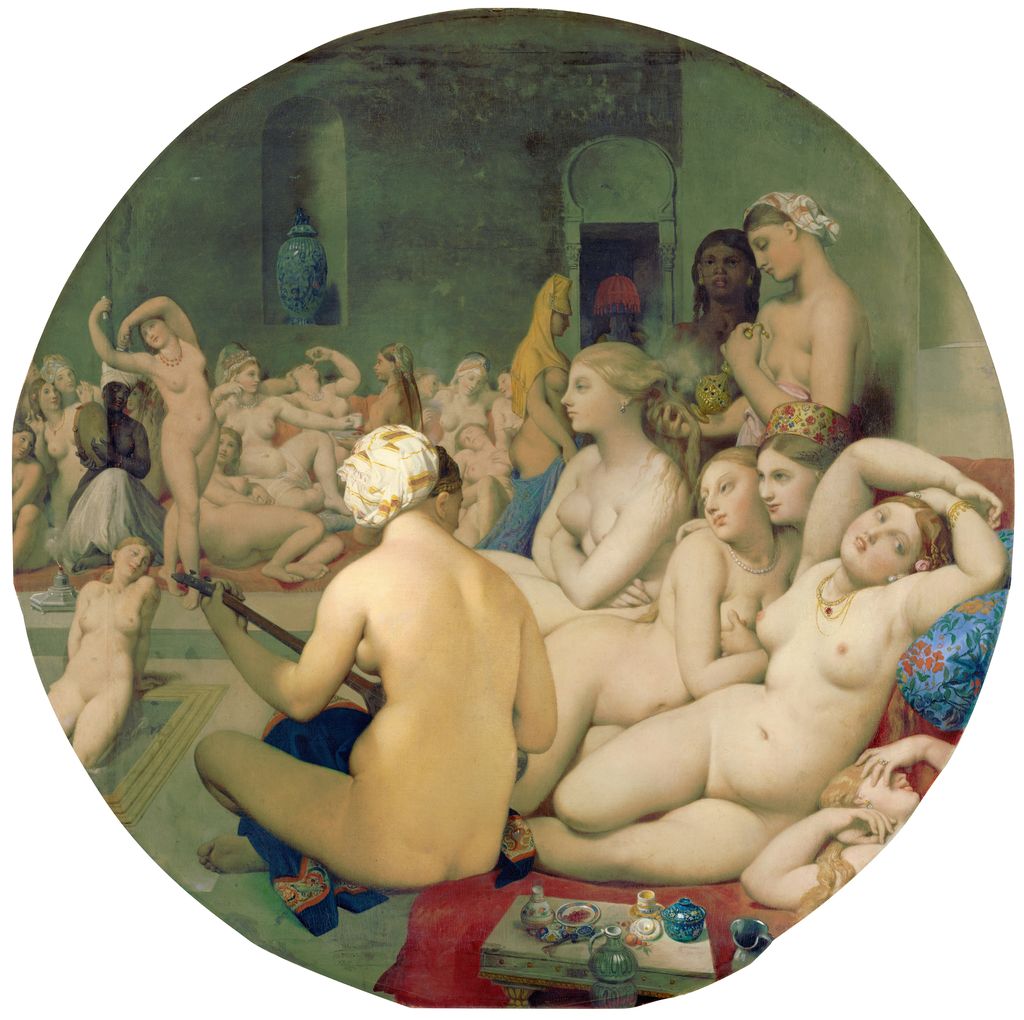
1851–1853The Turkish Bath
1859–1862Contents
- Who Was Ossian?
- Looking into the Dream
- Harps and the Sound of a Silent Picture
- An Imperial Commission in Rome
- The Canvas Ingres Wanted to Rework
- Why an 1812 Inscription Does Not Settle a Drawing's Date
- Classical Bodies, Romantic Apparitions
- Annotated details
Who Was Ossian?
Ossian entered eighteenth-century European reading through James Macpherson's Fragments of Ancient Poetry in 1760, presented as translations of ancient Gaelic material. Questions about the supposed originals accompanied their success from the beginning. The poems helped shape Romantic literature across national borders despite the authenticity dispute. The University of Galway's Ossian Online project also emphasises their changing forms across successive editions: readers encountered a developing body of writing, rather than one stable ancient text. [4]
It is useful to keep two kinds of history in view. The Ossian imagined within these poems is an old bard looking back towards a heroic past. Macpherson belongs to the much later history of collecting, translating, adapting and presenting that past to readers. The regional museum account describes his role as extending material by different poets. Gaelic traditions therefore belong to the story, alongside the controversy over what Macpherson claimed for his publications. Ingres's sleeper is a literary figure, not a portrait of an identifiable ancient author. [4][2]
That distinction changes how the painting can be approached. Its pale gathering does not need to authenticate a historical Scotland. It gives visible form to a world readers had already encountered through poetry. The age of the sleeper and the youth or vigour of the surrounding figures make the distance between present life and remembered life immediately intelligible, even without familiarity with the poems.
The Musée Ingres Bourdelle names the warrior Oscar as Ossian's son, Evirallina as his dead wife, and Fingal as his father. [1] The regional account places Oscar on one side of the sleeper and Evirallina on the other, with ancestral bards and warriors behind them. [2] These relationships give the assembly emotional focus. A crowd that might initially resemble a remote heroic pageant becomes the company of one man's lost world.
Looking into the Dream
The Weight of the Sleeper
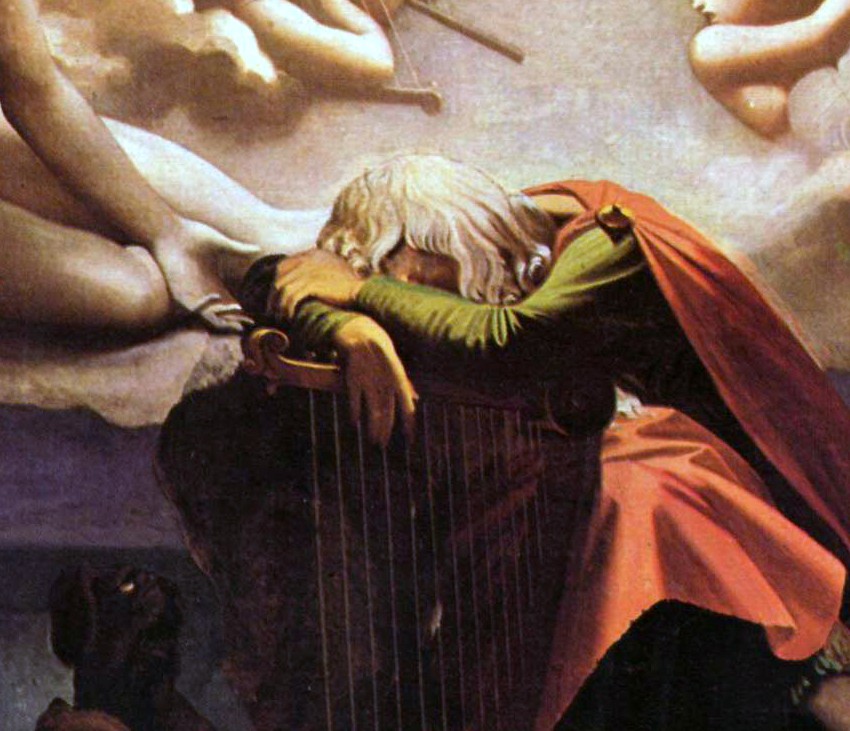
Begin at the bottom. Ossian bends forward over the harp, his white hair spreading above the green sleeve on which he rests. His body closes in upon itself. The red cloak, however, opens into broad folds and stretches out to the right, making a long diagonal across the dark foreground. The bent man and the spreading fabric give two different impressions of his presence: bodily withdrawal and a large, unmistakable area of colour.
The harp does more than identify his occupation. Its upright strings extend below his arms, drawing the eye down towards the instrument's base. Its curved wooden frame encloses darkness, while his sleeve runs almost horizontally across its top. Together they make a compact framework strong enough, visually, to bear his weight. The head that ought to command a singer's audience has disappeared into this arrangement of hair, cloth and wood.
Small foreground details strengthen the sense of an inhabited place. A dark dog sits beside the harp, almost absorbed by the surrounding shadows. Long rods lie diagonally near the lower edge. Rocks interrupt the space on the left. These things offer no elaborate narrative by themselves, but their low position and darkness help distinguish the sleeper's immediate surroundings from the luminous gathering above.
There is no neat doorway into the vision. Clouds begin close to Ossian's shoulders, and the lowest apparitions seem near enough to touch him. Yet he does not look up. His absorbed posture keeps the encounter internal: the figures can address the dreamer without requiring the ordinary exchange of glances that would connect people in a waking scene.
A Family Made of Light
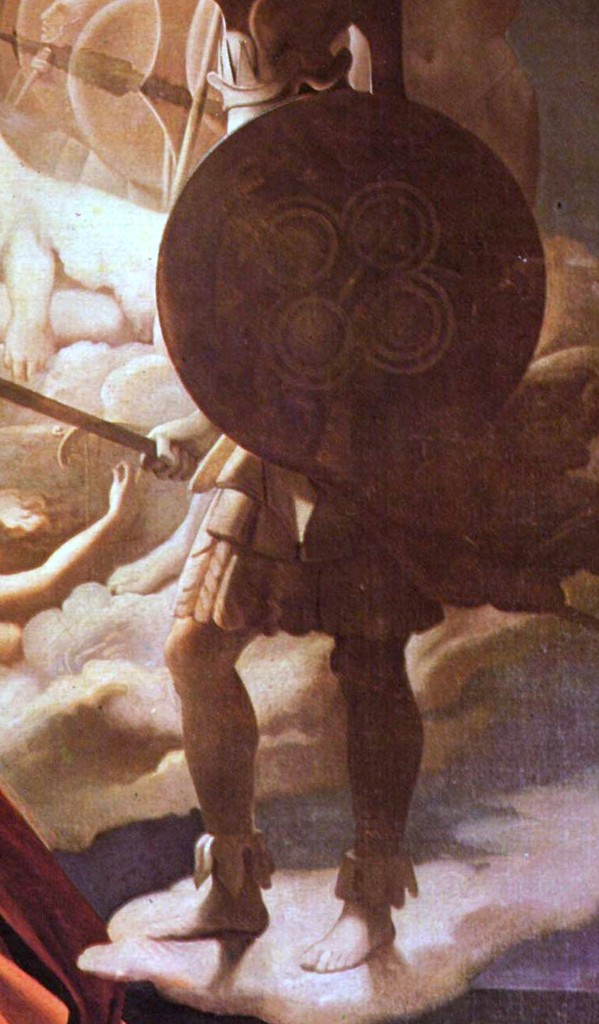
At the right, Oscar stands prominently with a winged helmet, a round shield and a sword angled across his body. [2] His legs are clearly formed, and his feet rest on a narrow cushion of cloud. The shield is almost as commanding as his torso. Its circular shape holds the right side of the picture while the sword directs attention back towards the centre.
Across the opening sits a pale woman whose body turns towards the sleeper. The regional account identifies the woman opposite Oscar as Evirallina. [2] Her seated pose provides a quieter counterweight to the standing warrior. One figure closes space with a shield; the other opens it through the exposed length of the body and the movement of an arm. The family arrangement is legible through these differences before every name has been learned.
Farther in, figures rise, recline, turn away or lift their arms. Some are isolated enough for a gesture to register clearly. Others become a succession of overlapping heads, helmets and shoulders. At the upper sides, raised arms point into the dark vault of the scene. Spears and helmet crests multiply the vertical accents. The crowded company surrounds an opening rather than filling the canvas evenly.
The strongest light appears within that opening. It catches a central figure's hair and shoulders, brightens clouds and picks out neighbouring limbs. Bodies farther from it sink towards brown shadow. The dream consequently has its own internal weather. It is possible to follow an outline with confidence and still be unsure how far away the figure stands or what supports the next one.
This uncertainty is part of the visual experience. Solid-looking bodies occupy spaces that refuse to behave like a solid room. A cloud may read as a ledge beneath one figure, then dissolve into light beside another. Ingres gives the viewer enough bodily definition to recognise a person, while withholding the continuous setting that would make the whole gathering physically plausible.
Curves, Weapons and the Dark Above
The painting's movement is organised through repeated curves. The harp's frame begins one sequence near the bottom; shoulders, arms, clouds and the round shield carry it upwards and outwards. Against those curves, weapons establish abrupt straight lines. The sword across the middle and the upright spears stop the company from becoming a soft, undifferentiated mist.
Look also at how differently the two halves of the image hold darkness. Below, it gathers around the harp, the dog and Ossian's bent body. Above, a broad dark area opens between the lifted arms and the upper edge. The figures form luminous banks around this space, so the dream feels enclosed and expansive at once. Its highest reaches remain less accessible than the clearly presented people below.
Colour draws a second boundary. Ossian's red and green stand apart from the restricted cream, grey and brown of the apparitions. The dream figures share a family of tones even when they face in different directions. This makes the sleeper seem materially distinct from the people he sees. The effect belongs to the canvas as it survives; its later alterations complicate any attempt to assign every colour decision to 1813. [1]
Annotated Details from The Dream of Ossian
The numbered points identify visible features discussed in this article. Return from each detail to the whole composition. Each caption identifies the work shown.
The Dream of Ossian
Ossian. MI.867.70. The Yorck Project; Wikimedia Commons. Image source. Public domain.
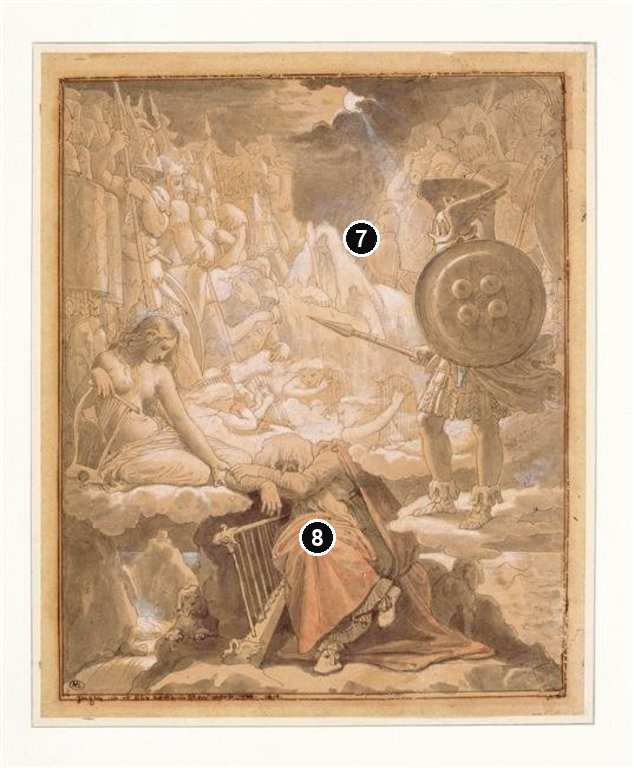
Dream of Ossian — Drawing RF 1446
Ossian. RF 1446. Inscribed 1812; date unresolved. Thierry Le Mage; RMN-Grand Palais; Wikimedia Commons. Image source. Public domain.
Details from THE DREAM OF OSSIAN
Compare the painting with the separate Louvre drawing RF 1446. The drawing bears an 1812 inscription, but the catalogue accounts disagree about its actual date. The broad views below describe visible relationships rather than settling that chronology.
The Dream of Ossian
The sleeper leaning on the harp
White hair, folded arms and the curved top of the harp gather into the sleeper’s lowered pose. His red cloak and green sleeve stand apart from the paler figures above.
The round shield and standing warrior
A large round shield covers much of the standing warrior’s body. Its repeated curves contrast with the long diagonals of the weapons and the two planted feet.
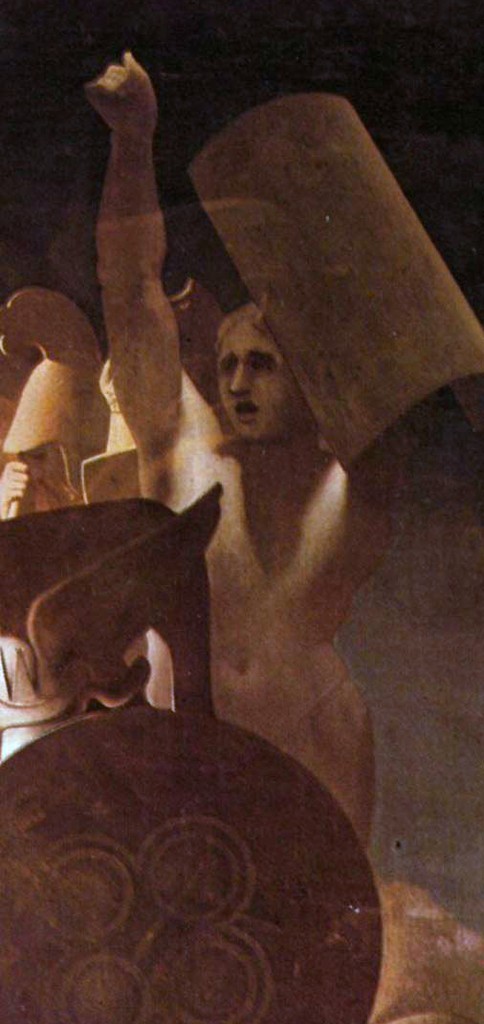
An open book and an upraised arm
The raised fist and large open book stand out against the darker upper field. Together they create a broad, emphatic gesture above the shield.
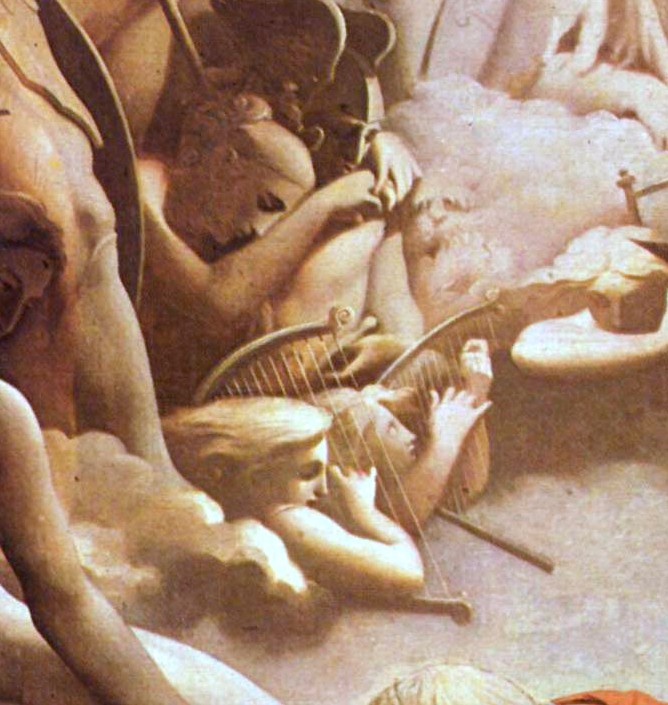
Music within the apparition
Small musicians appear around their curved instruments among the clouds. Compare these pale harps with the much larger, darker instrument supporting the sleeper below.
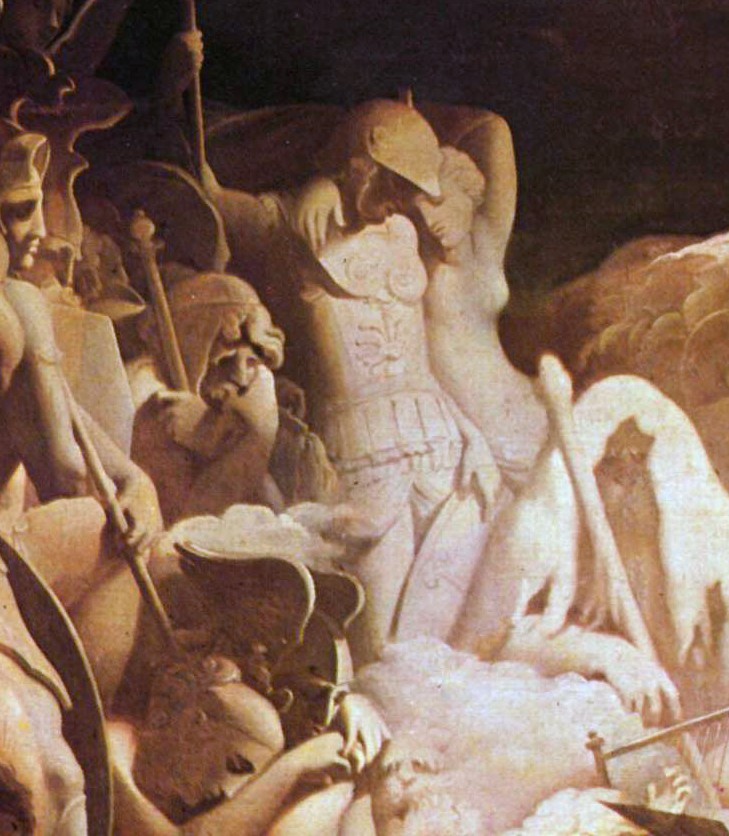
An armoured figure in the light
A helmeted figure stands within the brightest part of the gathering. Pale armour, limbs and nearby clouds share a close range of tones while remaining distinct shapes.
The seated figure at the left
A seated figure bends one arm towards a support and extends the other across the foreground. The body’s curves provide a different rhythm from the standing warrior on the opposite side.
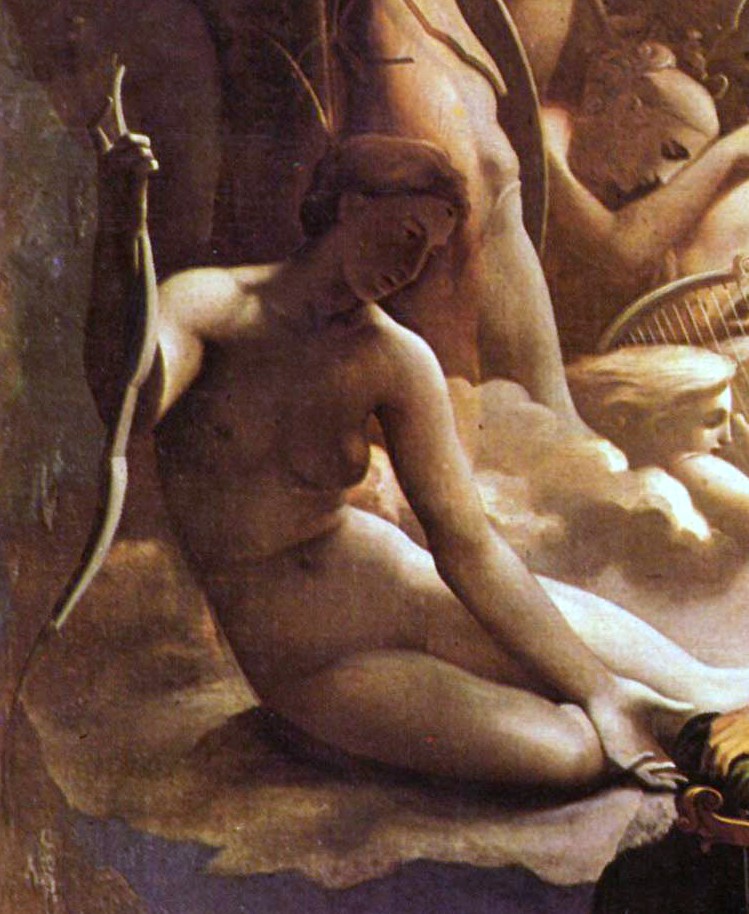
Dream of Ossian — Drawing RF 1446
The shield and the pale gathering
The large round shield forms a dark, compact shape beside the paler gathering. Compare its firm edge with the crowded outlines and lifted arms behind it.
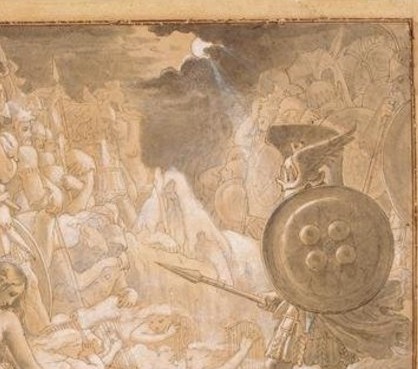
The sleeper, harp and dog
The sleeper bends towards the harp while the dog lies nearby. Their darker, earthbound forms contrast with the lighter figures gathered above.
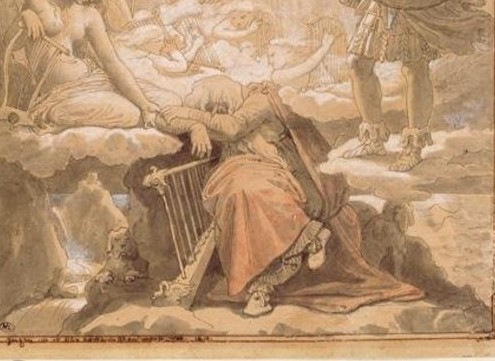
Harps and the Sound of a Silent Picture
Music occupies the dream as visibly as arms and armour. Near the centre-left, a small harp repeats the shape of the large instrument in the foreground. Hands reach towards strings; other hands rise in open gestures. These activities allow the eye to imagine sound moving through a picture in which everything is still.
The foreground harp remains especially affecting because Ossian is no longer playing it. The same object that could have accompanied a song now supports sleep. Above it, the company continues the association between poetry and music. The relationship is reciprocal: the sleeping bard seems to summon the figures, while their instruments seem capable of sustaining the world into which he has withdrawn. The gestures invite an imagined accompaniment without fixing its sound.
Ingres did connect musical understanding with painting in his teaching. Henri Delaborde's posthumous collection of his notes preserves the remark: “If I could make you all musicians, you would gain from it as painters” (our translation). [5] That statement does not explain every harp in Ossian. It does offer a useful way to consider the ordered recurrence of forms here: separate bodies and gestures can be seen together, much as separate musical parts can be heard together.
The picture also leaves room for a more troubled response. Raised arms may suggest song, invocation or lament, while the sleeper's covered face gives no answer. The gathering can feel consoling because his lost companions return, or painful because their pale appearance makes their distance from him so pronounced. Its silence accommodates both impressions.
An Imperial Commission in Rome
The intended setting changes the scale of this private-looking dream. In 1811 Ingres received two commissions for the former papal residence at Monte Cavallo, another name for the Quirinal Palace, as it was being transformed into an imperial palace for Napoleon. Rebecca Rabinow's chronology distinguishes The Dream of Ossian, intended for the bedroom ceiling, from Romulus' Victory over Acron, destined for another room. [3]
The Montauban museum traces the commission through General Miollis and dates its execution to 1812–13. [1] The regional account connects the choice of Ossian with Napoleon's fondness for the poems. [2] The commission therefore brought together imperial taste and a subject concerned with ancestral heroes. A family of warriors seen by a sleeping bard could carry associations of martial renown without requiring the emperor himself to appear in the picture. The martial associations grow from the chosen subject and destination; no likeness of the emperor is needed.
As a ceiling design, the painting would have placed the cloud-borne company above a viewer's real space. Its figures stand or recline on separate floating supports, and the gathering rises away from the sleeper towards the upper darkness. Seen today as a vertical image, it retains that sense of looking into another region. The intended position helps explain why its clouds matter structurally: they create places for bodies without supplying an ordinary floor.
Whether the canvas actually occupied the ceiling is disputed. Delaborde wrote in 1870 that it remained at Monte Cavallo until 1836; Xavier Salmon's 2019 account, quoted in the Louvre's drawing record, states that the painting never took its intended place at the Quirinal. [5][6] The commission and destination are secure; an image of Napoleon sleeping beneath the finished painting goes beyond that evidence.

Ingres, Romulus’ Victory over Acron, 1812. [7]
The Canvas Ingres Wanted to Rework
Ossian's imperial destination was only the beginning of the painting's material life. By the middle of the 1830s Ingres had recovered the canvas. In a letter to the engraver Édouard Gatteaux dated 15 June 1836, published by Delaborde, he described plans to send both his Virgil and his Ossian to Paris. He considered them in poor condition and intended to put them in order. His favourable assessment of Ossian in that letter makes clear that he still valued the work. [5]
The present museum record identifies Raymond Balze as responsible for a transformation after 1835 under Ingres's direction. [1] Delaborde describes preliminary work by pupils on the canvas itself, following changes Ingres wished to make to its arrangement or effect. According to his account, Ingres never supplied the completion he had planned. [5]
Delaborde judged the result harshly. He saw a picture whose first and later intentions were obscured by provisional alterations. That judgement belongs to a critic writing in 1870, three years after Ingres's death. It is valuable evidence for the work's unsettled afterlife, but it cannot serve as a present-day conservation assessment. [5]
For the viewer, this history changes the relationship between the date and the image. “1813” identifies the original painting; it does not promise that every visible passage has remained as Ingres first painted it. Equally, knowing that Balze took part does not allow individual figures or patches of colour to be assigned to him by appearance. The enduring composition and the later work on its surface belong to the history of the same canvas.
This makes The Dream of Ossian unusually resistant to a single moment of completion. The subject itself concerns the return of a vanished company, and the artist later returned to the picture that contained them. The parallel is suggestive, although the practical reasons for repair and alteration should remain distinct from a literary interpretation of the dream.
Why an 1812 Inscription Does Not Settle a Drawing's Date
Ingres also returned to Ossian on paper. Delaborde's catalogue lists several drawings of the composition, including a sheet inscribed 1812, watercolour versions and a drawing dated 1866. [5] Such sheets record the subject's continued life; they cannot all be treated automatically as preparations for the first canvas. RF 1446 is inscribed Rome 1812. Prat (2004), citing Ternois, places this repetition in 1835–41; Salmon (2019) dates it before Coutan’s death in 1830. The conflicting accounts leave its date unresolved. [6]
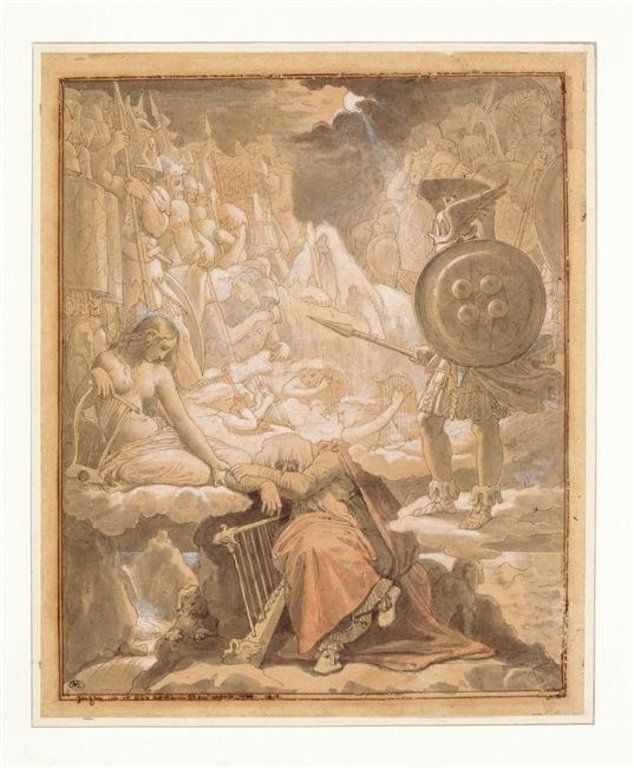
Ingres, The Dream of Ossian, Louvre RF 1446 recto. Pen, brown ink, watercolour and white on mounted tracing paper. Inscribed 1812; its actual date remains disputed. [8]
Prat identifies Gilibert’s watercolour, signed 1813, as the preparatory sheet. [6] That sheet’s relationship to the first painting is therefore different from the Louvre repetition, despite the latter’s apparently earlier inscription. The distinction matters whenever a small drawing and a large painting share a title. A date written by an artist can point back to an earlier invention. Repeating a composition may also mean changing it. An apparently early inscription therefore needs to be considered alongside the sheet's history and its relationship to other versions. The drawing is evidence of Ingres's continuing attention to Ossian, even when its place in the sequence remains uncertain.
A separate Louvre drawing, RF 30266, is securely catalogued as 1866. Executed in graphite, chalk and black ink, it was bought by the Louvre in 1954 and placed on deposit in Montauban that year. [9] It belongs to a much later stage of Ingres's career than the imperial commission. The span between the canvas and this sheet shows how long the composition remained available for reconsideration.
The subject circulated through reproduction too. Delaborde records an outline engraving in Magimel's publication of Ingres's works. [5] An image built from pale apparitions and darkness could thus also reach viewers through lines on a printed page. The composition's history includes changes of medium as well as changes to the canvas.
Classical Bodies, Romantic Apparitions
The Dream of Ossian complicates a rigid division between classical order and Romantic imagination. Its bodies have clear contours, deliberate poses and a sculptural presence. The warrior's equipment is precisely shaped, and the main figures occupy recognisable positions within an organised assembly. Yet these means serve a nocturnal subject whose space is unstable and whose people have returned from death within a dream.
The contrast can be felt within a single figure. Oscar's feet and legs look substantial; the cloud beneath them offers the faintest support. A carefully bounded body becomes stranger because its setting cannot sustain it. The painting does not have to abandon definition to make the supernatural convincing. Definition makes the viewer register the impossibility more sharply.
Macpherson's international influence helps explain the subject's place within Romantic culture, while the imperial commission anchors it in a specific episode of patronage. [4][3] Neither context requires every visible form to conform to a single stylistic label. Ingres's style and technique can accommodate a disciplined arrangement and an emotionally uncertain experience within the same image.
Return finally to the sleeper. The whole assembly is offered to the viewer, but his face remains hidden. We can inspect the company more easily than the man whose dream brings it into being. That imbalance gives the painting its particular intimacy: the vision is immense, while access to its dreamer is withheld.
Artworks directory
Explore 150 paintings, drawings and an original lithograph. This selection includes related versions and studies; dates distinguish completed works from later revisions.
| Name | Date | Medium |
|---|---|---|
| The Apotheosis of Homer | 1827 | Painting |
| Grande Odalisque | 1814 | Painting |
| The Turkish Bath | 1859–1862 | Painting |
| Madame Moitessier Seated | 1856 | Painting |
| Portrait of Monsieur Bertin | 1832 | Painting |
| Napoleon I on His Imperial Throne | 1806 | Painting |
| Odalisque with Slave | 1839 | Painting |
| The Ambassadors of Agamemnon in the Tent of Achilles | 1801 (competition) | Painting |
| The Valpinçon Bather | 1808 | Painting |
| The Source | 1856 | Painting |
| Oedipus Explaining the Enigma of the Sphinx | 1808; revised probably before 1827 | Painting |
| The Vow of Louis XIII | 1824 | Painting |
| Antiochus and Stratonice | 1840 | Painting |
| The Comtesse d’Haussonville | 1845 | Painting |
| The Princesse de Broglie | 1851–1853 | Painting |
| Jupiter and Thetis | 1811 | Painting |
| The Dream of Ossian | 1813 | Painting |
| The Martyrdom of Saint Symphorian | 1834 | Painting |
| Venus Anadyomene | 1808–1848 | Painting |
| Portrait of Madame de Senonnes | 1814 | Painting |
| Madame Rivière | 1805 | Painting |
| Mademoiselle Caroline Rivière | 1805 | Painting |
| Portrait of Philibert Rivière | 1805 | Painting |
| Bonaparte First Consul | 1804 | Painting |
| The Death of Leonardo da Vinci | 1818 | Painting |
| Joan of Arc at the Coronation of Charles VII | 1854 | Painting |
| Madame Duvaucey | 1807 | Painting |
| La Belle Zélie | 1806 | Painting |
| Madame Panckoucke | 1811 | Painting |
| Portrait of Charles Marcotte d’Argenteuil | 1810 | Painting |
| Joseph Antoine Moltedo | c.1810 | Painting |
| Madame Leblanc | 1823 | Painting |
| Delphine Ingres-Ramel (Portrait of Madame Ingres) | 1859 | Painting |
| Portrait of Amédée de Pastoret | 1823–1826 | Painting |
| Portrait of Baronne de Rothschild | 1848 | Painting |
| Madame Marcotte de Sainte Marie | 1826 | Painting |
| Madame Gonse | 1852 | Painting |
| Aretino in the Studio of Tintoretto | 1848 | Painting |
| Don Pedro of Toledo Kissing Henry IV’s Sword | 1831/1832 | Painting |
| Raphael and La Fornarina | 1814 | Painting |
| Roger Freeing Angelica | 1819 | Painting |
| Romulus’ Victory over Acron | 1812 | Painting |
| Self-Portrait at the Age of Twenty-Four | 1804; revised 1841–1851 | Painting |
| Male Torso | c.1800 | Painting |
| Odalisque in Grisaille (Ingres and workshop) | c.1824–1834 | Painting |
| The Small Bather | 1826 | Painting |
| The Little Bather Harem Interior | 1828 | Painting |
| Jesus Among the Doctors | 1862 | Painting |
| The Virgin Adoring the Host | 1852 | Painting |
| The Virgin of the Host | 1841 | Painting |
| Virgin of the Adoption | 1858 | Painting |
| Paolo and Francesca | 1814 | Painting |
| Homer Deified (revised composition, Louvre RF5273) | 1865 | Drawing |
| Odalisque with Slave (Louvre RF4622) | 1858 | Drawing |
| Odalisque (Walters Art Museum; Ingres and Paul Flandrin) | 1842 | Painting |
| Madame Moitessier Standing (National Gallery of Art) | 1851 | Painting |
| Jacques-Louis Leblanc (The Metropolitan Museum of Art) | 1823 | Painting |
| Ferdinand-Philippe, Duke of Orléans (Louvre RF2005-13) | 1842 | Painting |
| Ferdinand-Philippe, Duke of Orléans (Versailles MV5207; Ingres and workshop) | 1843 | Painting |
| Ferdinand-Philippe, Duke of Orléans (Versailles MV5209; Ingres and workshop) | 1844 | Painting |
| Antiochus and Stratonice (Musée Fabre; Ingres and Raymond Balze) | 1866 | Painting |
| Antiochus and Stratonice (Kunstmuseum Bern, Gurlitt bequest) | Undated (early dating proposed) | Drawing |
| Composition study for Antiochus and Stratonice (MIB867.2193) | 1806 | Drawing |
| Study for the Figure of Stratonice (Met63.66) | 1834–1840 | Graphite, black chalk and charcoal |
| Nude figure study for Stratonice (Boijmans F II 36 PK) | c.1834–1840 | Drawing |
| Paolo and Francesca (The Barber Institute,54.6) | c.1814–1820 | Painting |
| Paolo and Francesca (The Hyde Collection,1971.24) | c.1855–1860 | Painting |
| Paolo and Francesca (Amsterdam Museum TA10970) | 1820 | Drawing |
| Paolo and Francesca (dedicated to Artaud de Montor) | 1816 | Drawing |
| Study for the Bust of Francesca (MIB867.1398) | 1819 | Drawing |
| Study for the Bust of Francesca (MIB867.1396) | 1819 | Drawing |
| The Archangel Raphael, first idea (MIB867.2488) | 1842 | Drawing |
| The Archangel Raphael (MIB867.2500) | 1842 | Drawing |
| The Archangel Raphael Carrying Human Prayers to God (Chantilly DE513) | 1844 | Drawing |
| Louis-Philippe as Saint Philip, stained-glass study | 1844 | Drawing |
| Marie Frédéric Eugène de Reiset (Ford Collection RBF171-2) | 1844 | Drawing |
| Virgil Reading the Aeneid (Toulouse) | Begun 1811 | Painting |
| Tu Marcellus Eris (Brussels, inv. 1836) | c.1814 (museum dating) | Painting |
| Jean-François Gilibert | 1804 | Painting |
| François-Marius Granet | 1807 (museum dating) | Painting |
| Count Nikolai Dmitrievich Guryev | 1821 | Painting |
| Caroline Murat, Queen of Naples | 1814 | Painting |
| Count Mathieu Molé | 1834 | Painting |
| Cherubini and the Muse of Lyric Poetry (Louvre) | 1842 | Painting |
| Luigi Cherubini (Cincinnati) | 1841 | Painting |
| Comtesse de Rayneval (Louvre RF4505) | 1841 | Drawing |
| Venus on Paphos (Antonie Balaÿ) | c.1852 | Painting |
| Prince Napoléon | 1855 | Painting |
| Study for The Apotheosis of Napoleon I (Petit Palais) | Late 1853 | Painting |
| The Apotheosis of Napoleon I (destroyed ceiling) | 1853 | Painting |
| The Journalist (MIB867.2733) | 1834? | Drawing |
| Henry VIII, after Holbein | c.1815–1820 (?) | Drawing |
| Madame Récamier, after David (MIB867.3637) | Undated (early Paris period) | Drawing |
| Study for Comtesse d’Haussonville (MIB867.259; background possibly by another hand) | 1842–1845 | Drawing |
| La Source (reduced version reported by Delaborde) | Date unrecorded; reported 1870 | Painting |
| Odalisque (autograph lithograph,NGA1946.21.117) | 1825; published1826 | Lithograph |
| Portrait of a Seated Lady | 1814 | Graphite |
| The Kaunitz Sisters (Leopoldine, Caroline, and Ferdinandine) | 1818 | Graphite |
| Portrait of a Man | 1814 | Graphite |
| Study for the Portrait of Louis-François Bertin (1766–1841) | n.d. | Black chalk and graphite |
| Studies for the Cadaver of Acron | ca. 1810–12 | Graphite on wove paper |
| Study for the Drapery of Molière in "The Apotheosis of Homer" | n.d. | Black chalk with stumping |
| Madame Guillaume Guillon Lethière, née Marie-Joseph-Honorée Vanzenne, and her son Lucien Lethière | 1808 | Graphite |
| Niccolò Paganini (1782–1840) | ca. 1830 | Counterproof or tracing strengthened with graphite and gouache on translucent paper |
| Lady Mary Cavendish-Bentinck (?-1843) | 1816 | Graphite |
| Madame Alexandre Lethière and Her Daughter Letizia | ca. 1815 | Graphite |
| Merry Joseph Blondel (1781–1853) | 1809 | Graphite |
| Ursin-Jules Vatinelle (1798–1881) | 1820 | Graphite |
| Bust of a Gypsy Girl (ascribed to Ingres) | 1819 | Graphite on wove paper |
| Study of a Seated Nude Male | n.d. | Graphite |
| The Archangel Raphael (Study for a stained-glass window in the chapel of Notre-Dame de la Compassion-Saint-Ferdinand, Neuilly) | ca. 1842 | Graphite |
| Lancelot-Théodore, comte Turpin de Crissé | probably 1818 | Graphite |
| Study for the Figure of the Iliad in "The Apotheosis of Homer" | ca. 1827 | Graphite and black chalk heightened with white chalk on brown paper |
| Comtesse Turpin de Crissé | probably 1818 | Graphite |
| Nude Figures for L'Âge d'Or, Château de Dampierre | n.d. | Graphite on brownish paper |
| Study of Figures (attributed to Ingres) | n.d. | Graphite |
| Study of Figures (attributed to Ingres) | n.d. | Graphite; squared in graphite |
| Admiral Sir Fleetwood Broughton Reynolds Pellew | 1817 | Graphite on wove paper |
| Madame Jean-Auguste-Dominique Ingres, née Madeleine Chapelle | 1814 | Graphite on off-white wove paper |
| Virgil Reading the Aeneid to Augustus, Livia, and Octavia | 1809/1819 (?) | Pen and black ink, graphite, brush and gray wash, white gouache heightening, Conté crayon on blue paper |
| General Louis-Étienne Dulong de Rosnay | 1818 | Graphite (hard and soft pencils) |
| Madame Alexandre Lethière, née Rosa Meli, and Her Daughter, Letizia | 1815 | Graphite |
| The Lawyer Paul Grand | 1834 | Graphite |
| Jean-Joseph Fournier | 1815 | Graphite |
| Armand Bertin | 1842 | Graphite |
| Madame Armand Bertin, née Marie-Anne-Cécile Dollfuss | 1843 | Graphite |
| The Architect Charles-Victor Famin | 1836 | Graphite |
| Henri Lehmann | 1850 | Graphite |
| Portrait of a Lady | ca. 1815–17 | Graphite |
| Edmond Cavé (1794–1852) | 1844 | Oil on canvas |
| Head of Saint John the Evangelist | probably ca. 1818–20 | Oil on canvas, laid down on wood |
| Madame Edmond Cavé (Marie-Elisabeth Blavot, ca. 1806–1883) | ca. 1831–34 | Oil on canvas |
| Madame Félix Gallois | 1852 | Graphite with touches of gold in oil to highlight jewelry, on buff wove paper. |
| Dr. François Mêlier | 1849 | Graphite with graphite framing lines, corrected with white, on buff wove paper |
| Portrait of Madame Rhode (Rhoda?) | 1810–20 | Graphite on pale buff wove paper |
| Study for "Raphael and the Fornarina"(?) | ca. 1814(?) | Graphite on white wove paper |
| Portrait of Madame Paul Meurice, née Palmyre Granger | ca. 1845–50 | Graphite on wove paper |
| Alexander the Great presenting Campaspe to Apelles | 1810 | Graphite, brush and brown wash; squared in graphite |
| Study of Hands for "Christ Among the Doctors" | 1852–62 | Graphite on tracing paper |
| Study for The Turkish Bath (RF34502) | about 1850 | Pen and brown ink with graphite, partially squared |
| Study for The Turkish Bath (RF23354) | Undated | Pen and brown ink with graphite on joined sheets |
| Study for The Turkish Bath (RF54702) | about 1859 | Pen and brown ink |
| Studies of women for The Turkish Bath (RF12292) | Undated | Black chalk |
| Achilles Receiving the Envoys of Agamemnon (Nationalmuseum sketch, NM2161) | 1801 | Oil on wood |
| Half-Length Bather (Musée Bonnat-Helleu,89) | 1807 | Oil on canvas |
| Oedipus and the Sphinx (National Gallery,NG3290) | about1826 | Oil on canvas |
| Oedipus and the Sphinx (Walters,37.9) | 1864 | Oil on canvas |
| Oedipus and the Valpinçon Bather, after David (MI.867.2035) | Undated | Graphite on tracing paper, after David |
| Study of the Virgin for The Vow of Louis XIII (Dijon,1758) | about1822 | Black chalk, stump and white chalk on brown wove paper |
| First Thought for The Vow of Louis XIII (MI.885.11.21) | 1822 | Oil on canvas |
Frequently Asked Questions
Discussion
Look again at the images and ideas explored in The Dream of Ossian. These editorial prompts invite your observations.
Reader Insights
Does the pale company seem to console the sleeper, or make his solitude more intense? Consider how your response changes when you move between the coloured cloak and the cloud-borne figures, or imagine the sound of their harps.
Compare the solid sleeper with the pale assembly above him. Where does the picture make the transition between the two worlds most convincing?
How does imagining this composition overhead change the path you take through its figures?
Join the Conversation
Share a detail, comparison or question about The Dream of Ossian below.
References
- Musée Ingres Bourdelle, Ossian. MI.867.70. View source.
- Musées Occitanie / Musée Ingres Bourdelle, Le songe d'Ossian. Collection record, “En savoir plus”: Napoleon's commission, Macpherson's role and the figures in the painting. (in French) View source.
- Rebecca A. Rabinow, “Chronology,” in Gary Tinterow and Philip Conisbee, eds., Portraits by Ingres: Image of an Epoch. New York: Metropolitan Museum of Art, 1999, pp. 546–547, entries for 1811 and 1812–13. View source.
- Rebecca Barr and Justin Tonra, editors. “About the Project,” Ossian Online. University of Galway; “About Ossian” and “About Ossian Online” sections, on Macpherson, authenticity, international reception and successive editions. View source.
- Henri Delaborde, Ingres, sa vie, ses travaux, sa doctrine, d'après les notes manuscrites et les lettres du maître. Paris: Henri Plon, 1870. “Notes et pensées,” p. 123, on music; catalogue no. 31, pp. 206–207, including the letter to Gatteaux of 15 June 1836, alterations and the Magimel reproduction; drawing entries 199–202, p. 278. Posthumous editorial compilation. (in French) View source.
- Louvre, Ossian. RF 1446. View source.
- Supporting image. Ingres, Romulus’ Victory over Acron, 1812. Beaux-Arts de Paris; Photograph: Shonagon2026; Wikimedia Commons. Image source. Public domain.
- Supporting image. Ossian. RF 1446. Inscribed 1812; date unresolved. Thierry Le Mage; RMN-Grand Palais; Wikimedia Commons. Image source. Public domain.
- Musée du Louvre, Le songe d'Ossian, RF 30266. Collection record: 1866 drawing, materials, acquisition and deposit history. (in French) View source.
- Splash image. Ossian. MI.867.70. The Yorck Project / Wikimedia Commons. Image source. Public domain.