by Tom Gurney
Tom Gurney BSc (Hons) is an art history expert with over 20 years experience
Published on June 19, 2020 / Updated on October 22, 2026
Email: tomgurney1@gmail.com / Phone: +44 7429 011000
Portrait of Philibert Rivière
Philibert Rivière sits across the picture at an angle, his pale crossed legs projecting towards the right edge while his face turns towards us. A black coat gives his upper body a broad, dark outline. At its centre, a white cravat rises almost to his chin; below, one hand rests over the curved wooden arm of his chair. Ingres makes this meeting of body, clothes and furniture unusually vivid. The sitter seems comfortably installed, yet every turn of the pose holds the composition together.
The table beside him extends the portrait beyond a likeness. Books and a printed image introduce a world of reading, music and art, while red cloth, green wall and gilded furniture give these quiet activities a richly coloured setting. Looking between Rivière and his surroundings reveals how much a portrait can communicate through the arrangement of ordinary things.
At a Glance
- ArtistJean-Auguste-Dominique Ingres.
- Date1805; signed with the French Revolutionary date Year XIII, corresponding to 1804–05.
- Medium and sizeOil on canvas, transposed in 1938; 116 × 89 cm.
- CollectionMusée du Louvre, Paris; MI 1445. [1]
- Look forThe resting hand, the carved chair arm, the opposing diagonals of coat and legs, and the books and print on the red-covered table.
This work across Ingres’s career
Agamemnon’s Ambassadors
1801 (competition)Grande Odalisque
1814Louis XIII’s Vow
1824Monsieur Bertin
1832The Princesse de Broglie
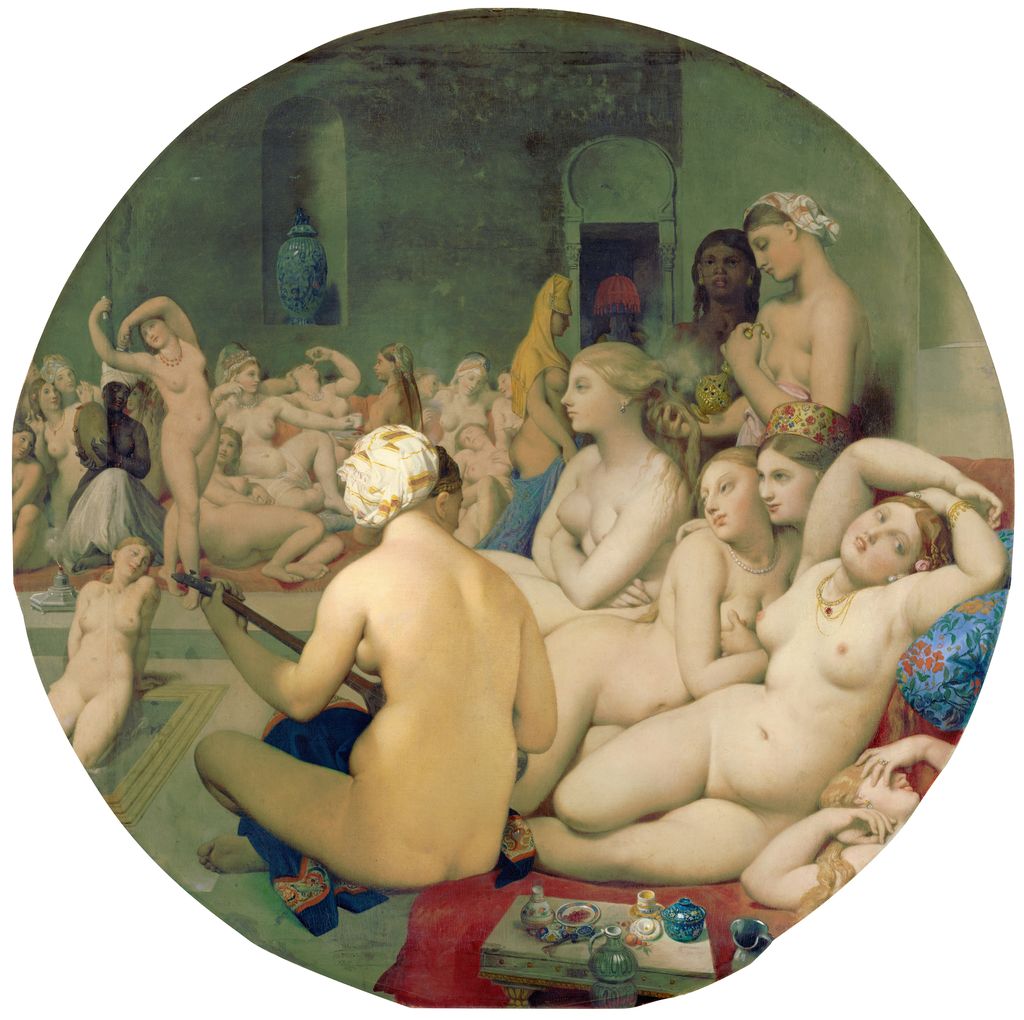
1851–1853The Turkish Bath
1859–1862Contents
- Who was Philibert Rivière?
- A seated body built from diagonals
- The hands and the chair
- Red, green, black and white
- Books, Mozart and Raphael on the table
- Three family portraits, three arrangements
- What can be said about the 1806 Salon?
- From a family possession to the Louvre
- Annotated details
Who was Philibert Rivière?
The Louvre identifies Rivière as an agent d’affaires, a businessman, and records him as a maître des requêtes at the Conseil du Roi in 1815. [1] That later office should not be backdated to the portrait. Rivière married Sabine in 1792; Caroline and Paul were born in 1793 and 1794. The commission’s circumstances remain unknown, as does the reason for Paul’s absence from the portraits. [2]
The portrait gives us a considered appearance rather than a transparent record of private life. Rivière’s clothes, chair and table place him within a furnished interior where possessions are plainly visible. His direct gaze creates an encounter with the viewer, while the arrangement offers selected information about the person we meet. It is worth keeping those two kinds of evidence distinct: what the picture presents and what surviving documents establish about its sitter.
A seated body built from diagonals
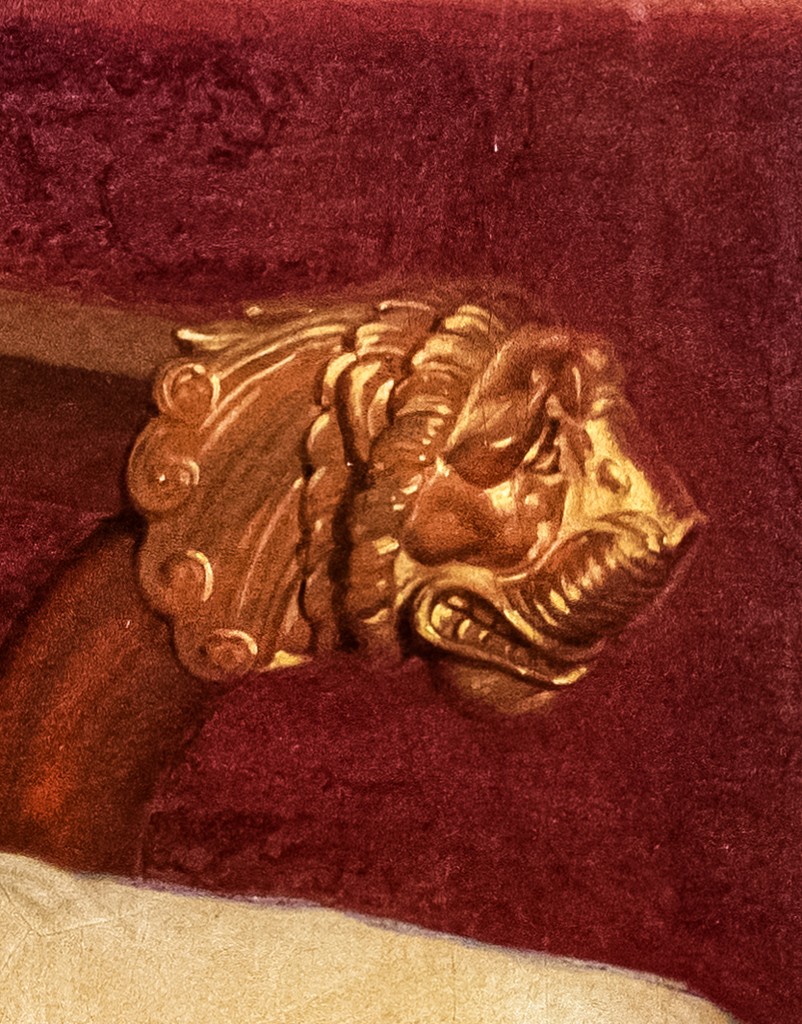
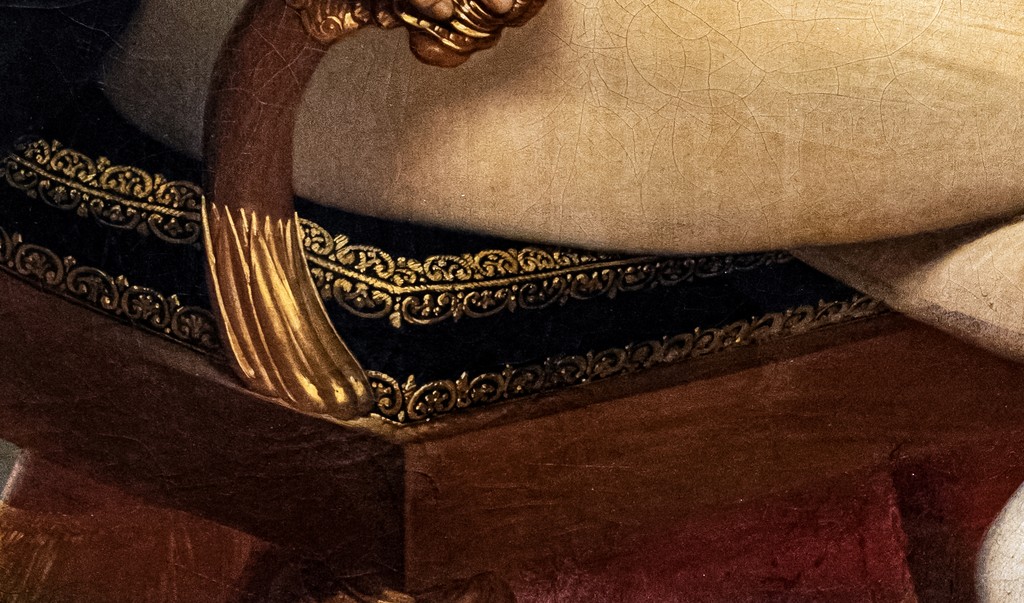
Begin with the chair. Its reddish back forms a firm upright behind the black coat, and its seat turns into the room beneath Rivière’s legs. The two visible arms reach towards different parts of the picture. One curves down beneath his resting hand; the other ends in a golden animal head beside the table. Together they give the sitter a substantial structure without enclosing him symmetrically.
The body moves across that structure. His upper torso occupies the left half of the painting, while his knees extend towards the right. The pale fabric of the nearer leg makes a broad band across the lower portion of the canvas. Below it, the other leg turns down and leaves the frame. This crossing creates depth through overlap: we can follow one limb passing in front of another even though the lower body is closely cropped.
Above, the coat establishes a counter-movement. Its lapels descend from the shoulders towards the narrow pale opening at the waist. The dark mass broadens at the shoulder, contracts near the hidden hand, then spreads again behind the chair. The figure’s outline therefore changes direction several times before reaching the lower edge. A simple seated pose becomes a succession of turns.
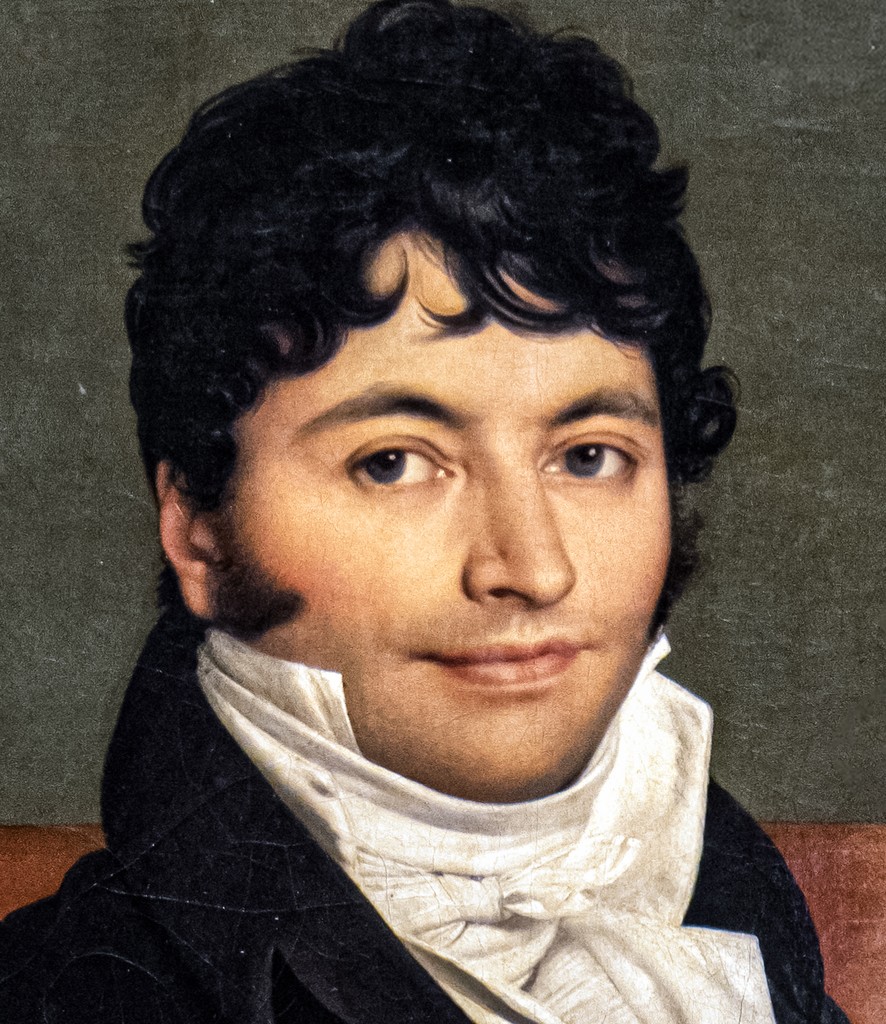
The head provides a quieter point within this movement. Dark curls rise against the green wall, while the face turns far enough towards us for both eyes to engage the viewer. Its soft transitions of light differ from the abrupt division between black coat and white linen below. The cravat acts almost as a bright platform for the face, drawing attention upwards from the centre of the chest.
There is little empty space around the sitter. His hair approaches the top edge; the chair nearly meets the left side; the knees press towards the right. This tight framing gives the large figure an immediate presence. The surrounding room remains sufficient to establish a setting, but we cannot wander far from the body before some edge, fold or piece of furniture returns us to it.
The hands and the chair
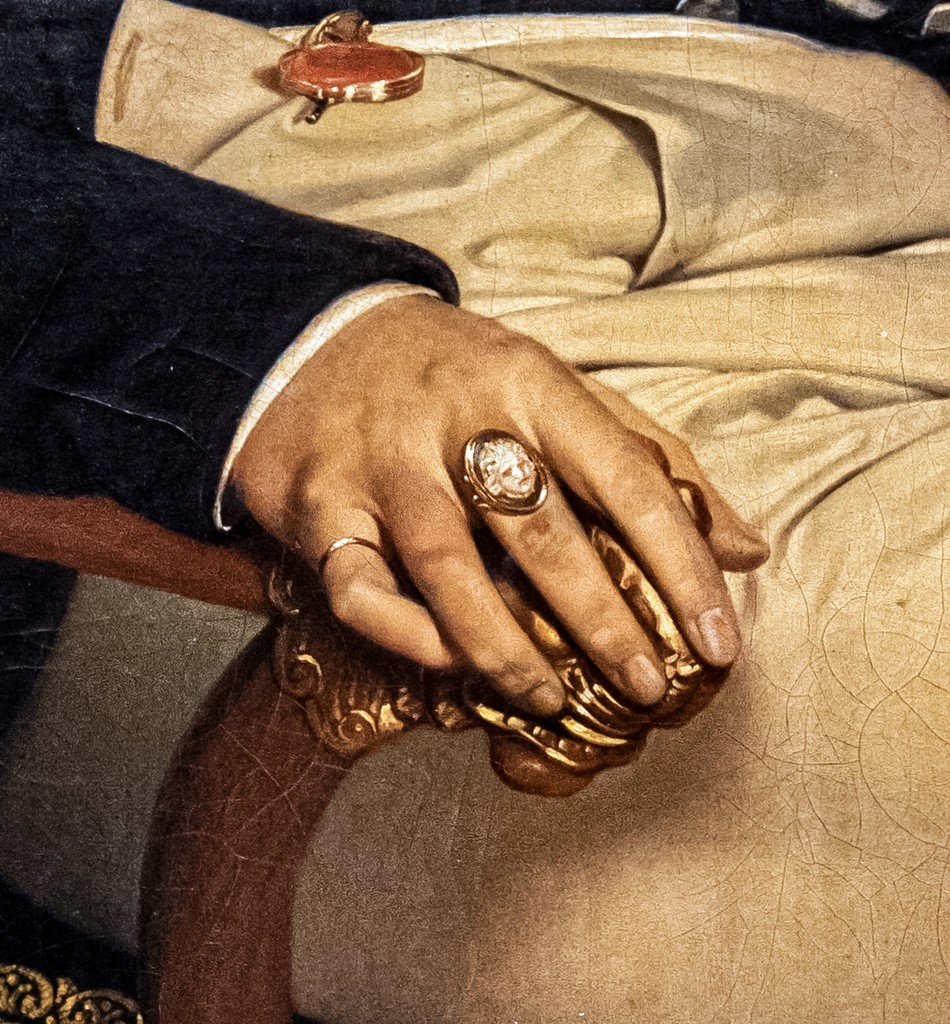
The visible hand is one of the painting’s most rewarding details. It rests over the end of the chair arm, with the fingers bending down around its rounded edge. A ring catches the light. Below the fingers, the polished wood continues in a curve towards the seat. Hand and furniture almost share an outline, although their different colours and surfaces keep them distinct.
This contact makes the sitter’s position easy to understand. We see where his arm is supported and where the weight of the hand comes to rest. The small highlights on the fingers interrupt the larger pale expanse of the trousers; the dark cuff separates skin from cloth. It is a compact passage in which several materials meet without becoming confused.
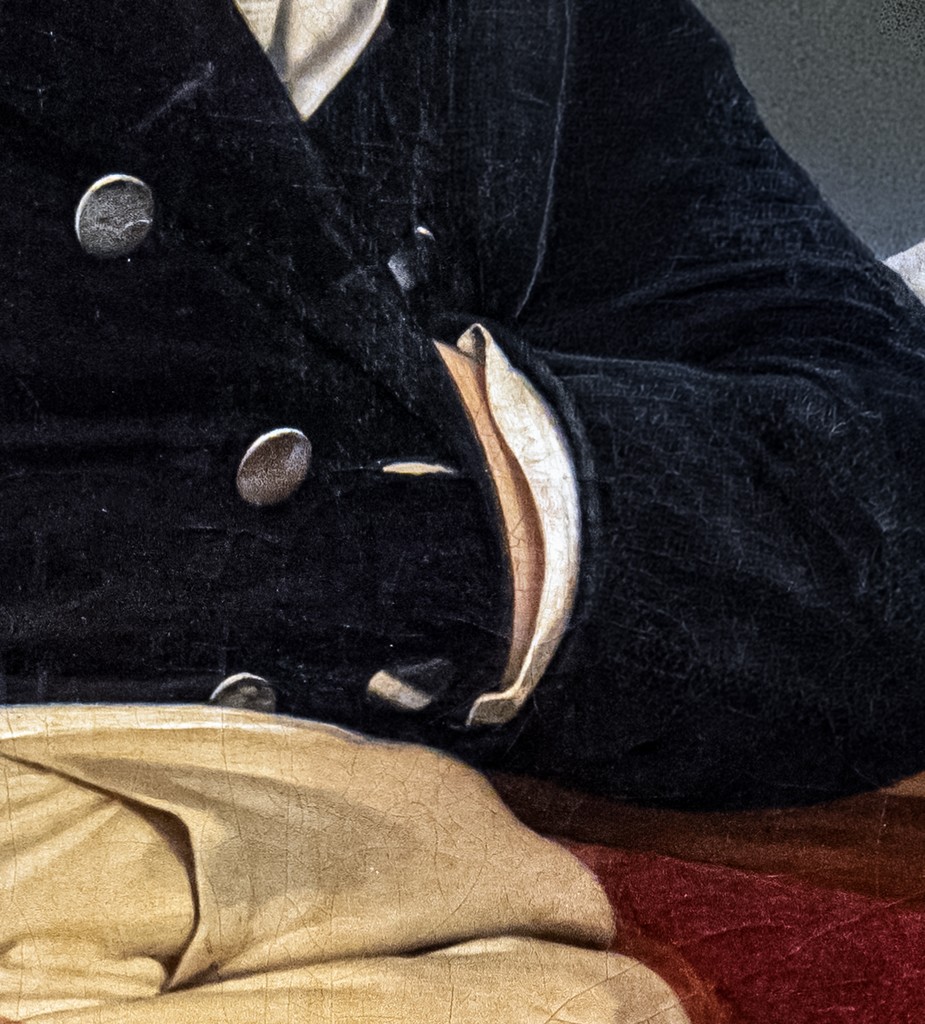
The other hand disappears inside the coat at the waist. Its position produces a smaller light interruption near the centre of the figure, where the white cuff and pale clothing emerge from the dark torso. The hands thus offer two different kinds of presence: one fully displayed against the chair and leg, the other largely concealed. Their unequal visibility helps prevent the pose from becoming a balanced, frontal arrangement. Philip Conisbee compares Rivière with David’s Philibert-Laurent de Joubert (around 1790), a possible studio precedent, without establishing direct copying. [2]
Within Rivière’s own portrait, the furniture does more than indicate an interior. Its curved arm gives the fingers something to follow; the horizontal seat supports the pale diagonal of the leg; the tall back steadies the left side. These relationships make the chair an active part of the figure’s design.
Red, green, black and white
Colour gives the portrait much of its structure. The green wall spreads broadly behind the head and shoulders, with little detail to distract from their contours. On the right, the red tablecloth creates a warmer, denser field. A strip of red beneath the chair continues that warmth near the bottom. The two colours divide the surroundings without making them seem like separate scenes.
The black coat sits between these large fields. Against the wall it forms an emphatic silhouette; beside the table its sleeve meets the red cloth almost directly. The coat’s darkness also makes small accents unusually noticeable: buttons, the edge of a cuff, the white linen and the light clothing at the waist. These details would carry less force in a more evenly illuminated arrangement.
The lower half has a different balance. The buff trousers occupy a large area, but their folds remain comparatively restrained. At the knee, gathering and small creases make the fabric seem supple. Along the thigh, a much smoother passage allows the diagonal to read as one broad shape. Below, a pale stocking changes direction as the leg descends beyond the frame.
Gold appears in smaller quantities. It catches on the animal-headed chair arm, curves around the seat supports and flickers along the patterned edge of the dark upholstery. These bright touches connect the near hand to the farther table. Their scattered rhythm enlivens the furniture without competing with the larger white passage beneath the face.
The portrait’s finish can make the scene look effortless at first. Following its colour relationships reveals how carefully the different parts depend on one another. The wall clears space around the head; the table warms the right side; the coat binds the upper body into a single mass; the pale legs carry the eye across the foreground.
Books, Mozart and Raphael on the table
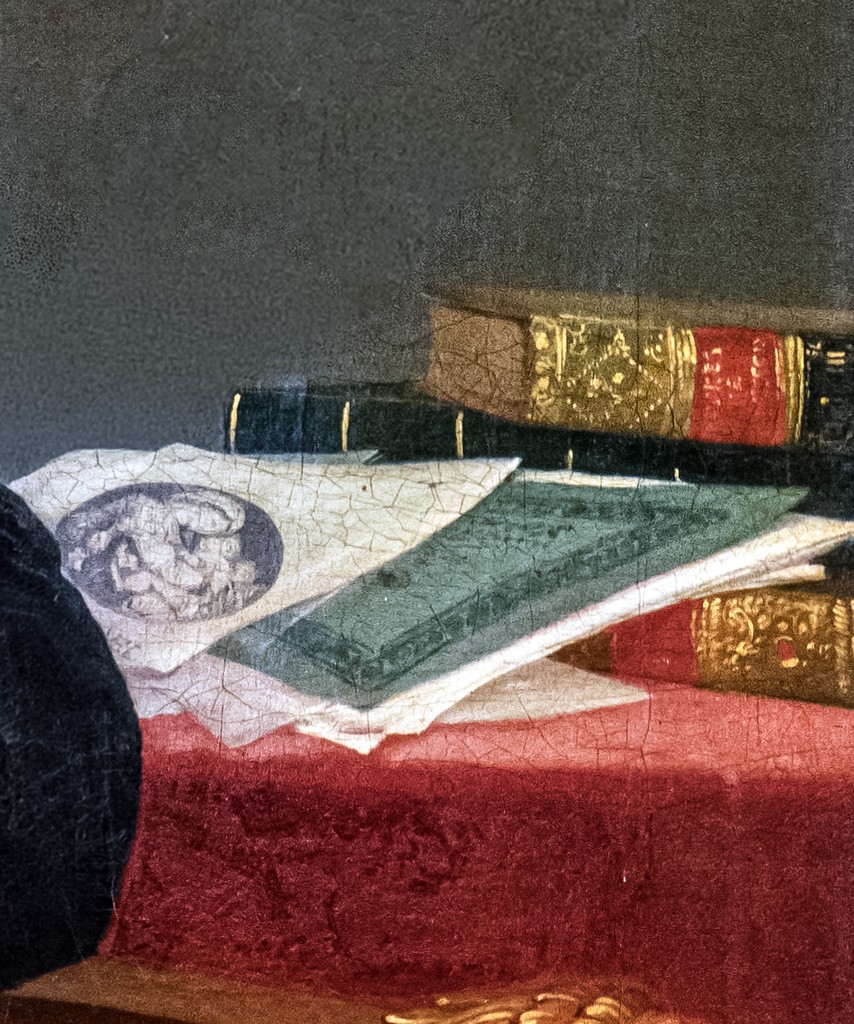
Laurence Brosse’s Louvre study identifies a volume of Rousseau’s Œuvres, a Mozart score and an engraving after Raphael’s Madonna della Sedia, also known as the Madonna of the Chair. [3] These identifications matter because the small objects can otherwise look like an undifferentiated collection of books and papers. Conisbee reports that Rivière owned a manuscript of Rousseau’s La Nouvelle Héloïse. More tentatively, he suggests shared musical enthusiasm and proposes that Ingres introduced the Raphael print. [2]
The table therefore requires several kinds of reading. A painted book title identifies an author within the image. A documented possession supplies information about the sitter outside it. A scholar’s suggestion about an accessory offers a possible explanation for its inclusion. These pieces of evidence can enrich one another without becoming interchangeable. The engraving does not establish that Rivière owned Raphael’s original painting, and the score alone cannot tell us whether he performed music.
Visually, the objects occupy an important hinge in the composition. The books lie near the far right edge, while the pale sheet opens towards the sitter. Its light surface breaks across the red cloth just above his arm. The small image upon it echoes the larger act of representation taking place around it: a painted portrait contains a printed reproduction of another painting.
Unlike the chair’s ornament, these accessories invite us to imagine acts of attention. A book can be opened, a score followed, a print examined. Their proximity to the sitter gives the interior the possibility of activity even though he is still. The picture leaves that possibility suspended; no reading or playing takes place before us.
Annotated Details from Portrait of Philibert Rivière
The numbered points identify visible features discussed in this article. Return from each detail to the whole composition. Portrait of Philibert Rivière. Louvre, MI 1445. Photograph: Didier Descouens; Wikimedia Commons. Image source. CC BY-SA 4.0. Numbered overview: resized, with markers added. Detail images: cropped and JPEG-optimised. All these image derivatives are licensed CC BY-SA 4.0.
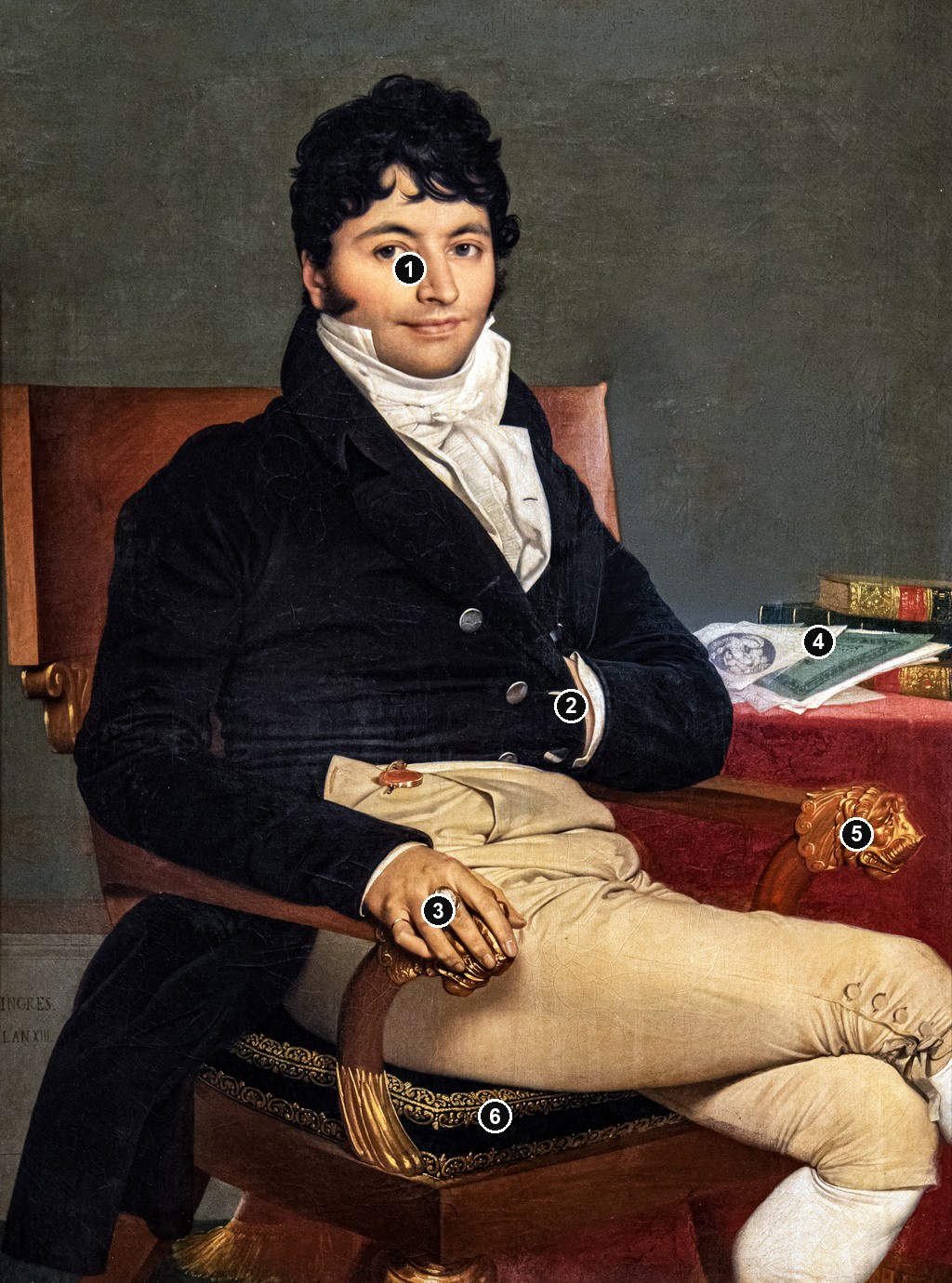
Details from PORTRAIT OF PHILIBERT RIVIÈRE
Follow the hands and furniture, then compare the small objects on the table with the larger diagonals of the seated figure.
The face above the white cravat
The dark curls frame a face turned towards the viewer. The tall white cravat forms a second pale shape immediately beneath the chin.
One hand tucked inside the coat
The bent arm ends at the open edge of the black coat. A narrow pale cuff makes the hand’s partly concealed position easier to follow.
Rings and the carved chair arm
The visible hand rests on a curved chair arm, with rings catching light above the carved ornament. Pale fingers, dark upholstery and gold-coloured carving meet in a small space.
Books and an open printed sheet
Books stand behind an open sheet and green-covered volume. These smaller rectangles bring a second set of diagonals to the red-covered table.
The gold-coloured head at the table edge
A carved head projects from the furniture beside the sitter’s knee. Its compact curls and open mouth contrast with the broad pale fabric of the breeches.
The chair beneath the crossed legs
The bent chair arm descends towards patterned dark upholstery and a warm wooden rail. Its curve supports the much broader diagonals of the crossed legs.
Three family portraits, three arrangements
The Louvre’s educational account distinguishes a rectangular format for Philibert, an oval for Sabine and an originally arched format for Caroline. [3] These separate portraits offer different ways of placing a person within a picture. In Madame Rivière, the seated figure spreads across pale drapery and blue cushions. A patterned shawl curves around the body, its repeated motifs setting up a much busier surface than Philibert’s plain coat. The bent arm joins a sequence of rounded shapes within the enclosing oval. Where his legs cut across the chair in a strong diagonal, her fabrics seem to fold the body into its surroundings.
Mademoiselle Caroline Rivière stands before a landscape. Her white dress falls vertically, interrupted by the warm brown of a gloved forearm and the broad loop of a fur wrap. Open sky surrounds the head, and distant water leads the eye behind her shoulders. Philibert has a table close at hand; Caroline has an outdoor distance beyond her.
Seen together, the pictures reveal the flexibility of Ingres’s portraiture. Family connection does not require identical poses or settings. Each sitter has a distinct relationship with the frame, and each arrangement makes clothing and accessories serve a different purpose. They are three individual portraits whose differences reward comparison.

Ingres, Madame Rivière, 1805. [4]

Ingres, Mademoiselle Caroline Rivière, 1805. [5]
What can be said about the 1806 Salon?
Sabine and Caroline appeared at the 1806 Salon alongside Ingres’s enthroned Napoleon. Philibert’s participation remains uncertain: the catalogue’s general listing and the absence of specific reviews do not settle it. Ingres was already in Rome when the hostile reviews arrived. [2]
This uncertainty limits the story we can tell about the father’s portrait. Silence in a review does not establish rejection by an exhibition jury, and an uncertain exhibition history cannot support a confident explanation of political exclusion. The picture’s later reputation should not supply missing evidence about its first public appearance.
From a family possession to the Louvre
In 1870 Henri Delaborde grouped the three Rivière portraits under one entry in his posthumous account of Ingres. Using their position in the artist’s notes, he placed them before the departure for Rome. He nevertheless acknowledged that he lacked information about the pictures’ whereabouts and the sitters’ circumstances. [6]
The entry preserves both knowledge and uncertainty. Delaborde could recognise a family group in Ingres’s written record without locating the actual works. That gap helps explain why the portraits’ modern familiarity should not be projected backwards: a memorable image can spend decades beyond the reach of an artist’s cataloguer. The 1999 catalogue reports Ingres’s unsuccessful search for the portraits for his 1855 retrospective. [2] Delaborde’s later uncertainty shows how long the pictures remained beyond their painter’s reach. Sophie Robillard, Paul Rivière’s widow and Philibert’s daughter-in-law, bequeathed the portraits to the state in 1870. [1][2] They passed from the Musée du Luxembourg to the Louvre in 1874. [2]
The Louvre also records a canvas transposition in 1938. [1] This means moving the paint layer to a replacement support. The record gives no reason for the procedure. It documents the picture’s material history without explaining its condition before treatment.
Artworks directory
Explore 150 paintings, drawings and an original lithograph. This selection includes related versions and studies; dates distinguish completed works from later revisions.
| Name | Date | Medium |
|---|---|---|
| The Apotheosis of Homer | 1827 | Painting |
| Grande Odalisque | 1814 | Painting |
| The Turkish Bath | 1859–1862 | Painting |
| Madame Moitessier Seated | 1856 | Painting |
| Portrait of Monsieur Bertin | 1832 | Painting |
| Napoleon I on His Imperial Throne | 1806 | Painting |
| Odalisque with Slave | 1839 | Painting |
| The Ambassadors of Agamemnon in the Tent of Achilles | 1801 (competition) | Painting |
| The Valpinçon Bather | 1808 | Painting |
| The Source | 1856 | Painting |
| Oedipus Explaining the Enigma of the Sphinx | 1808; revised probably before 1827 | Painting |
| The Vow of Louis XIII | 1824 | Painting |
| Antiochus and Stratonice | 1840 | Painting |
| The Comtesse d’Haussonville | 1845 | Painting |
| The Princesse de Broglie | 1851–1853 | Painting |
| Jupiter and Thetis | 1811 | Painting |
| The Dream of Ossian | 1813 | Painting |
| The Martyrdom of Saint Symphorian | 1834 | Painting |
| Venus Anadyomene | 1808–1848 | Painting |
| Portrait of Madame de Senonnes | 1814 | Painting |
| Madame Rivière | 1805 | Painting |
| Mademoiselle Caroline Rivière | 1805 | Painting |
| Portrait of Philibert Rivière | 1805 | Painting |
| Bonaparte First Consul | 1804 | Painting |
| The Death of Leonardo da Vinci | 1818 | Painting |
| Joan of Arc at the Coronation of Charles VII | 1854 | Painting |
| Madame Duvaucey | 1807 | Painting |
| La Belle Zélie | 1806 | Painting |
| Madame Panckoucke | 1811 | Painting |
| Portrait of Charles Marcotte d’Argenteuil | 1810 | Painting |
| Joseph Antoine Moltedo | c.1810 | Painting |
| Madame Leblanc | 1823 | Painting |
| Delphine Ingres-Ramel (Portrait of Madame Ingres) | 1859 | Painting |
| Portrait of Amédée de Pastoret | 1823–1826 | Painting |
| Portrait of Baronne de Rothschild | 1848 | Painting |
| Madame Marcotte de Sainte Marie | 1826 | Painting |
| Madame Gonse | 1852 | Painting |
| Aretino in the Studio of Tintoretto | 1848 | Painting |
| Don Pedro of Toledo Kissing Henry IV’s Sword | 1831/1832 | Painting |
| Raphael and La Fornarina | 1814 | Painting |
| Roger Freeing Angelica | 1819 | Painting |
| Romulus’ Victory over Acron | 1812 | Painting |
| Self-Portrait at the Age of Twenty-Four | 1804; revised 1841–1851 | Painting |
| Male Torso | c.1800 | Painting |
| Odalisque in Grisaille (Ingres and workshop) | c.1824–1834 | Painting |
| The Small Bather | 1826 | Painting |
| The Little Bather Harem Interior | 1828 | Painting |
| Jesus Among the Doctors | 1862 | Painting |
| The Virgin Adoring the Host | 1852 | Painting |
| The Virgin of the Host | 1841 | Painting |
| Virgin of the Adoption | 1858 | Painting |
| Paolo and Francesca | 1814 | Painting |
| Homer Deified (revised composition, Louvre RF5273) | 1865 | Drawing |
| Odalisque with Slave (Louvre RF4622) | 1858 | Drawing |
| Odalisque (Walters Art Museum; Ingres and Paul Flandrin) | 1842 | Painting |
| Madame Moitessier Standing (National Gallery of Art) | 1851 | Painting |
| Jacques-Louis Leblanc (The Metropolitan Museum of Art) | 1823 | Painting |
| Ferdinand-Philippe, Duke of Orléans (Louvre RF2005-13) | 1842 | Painting |
| Ferdinand-Philippe, Duke of Orléans (Versailles MV5207; Ingres and workshop) | 1843 | Painting |
| Ferdinand-Philippe, Duke of Orléans (Versailles MV5209; Ingres and workshop) | 1844 | Painting |
| Antiochus and Stratonice (Musée Fabre; Ingres and Raymond Balze) | 1866 | Painting |
| Antiochus and Stratonice (Kunstmuseum Bern, Gurlitt bequest) | Undated (early dating proposed) | Drawing |
| Composition study for Antiochus and Stratonice (MIB867.2193) | 1806 | Drawing |
| Study for the Figure of Stratonice (Met63.66) | 1834–1840 | Graphite, black chalk and charcoal |
| Nude figure study for Stratonice (Boijmans F II 36 PK) | c.1834–1840 | Drawing |
| Paolo and Francesca (The Barber Institute,54.6) | c.1814–1820 | Painting |
| Paolo and Francesca (The Hyde Collection,1971.24) | c.1855–1860 | Painting |
| Paolo and Francesca (Amsterdam Museum TA10970) | 1820 | Drawing |
| Paolo and Francesca (dedicated to Artaud de Montor) | 1816 | Drawing |
| Study for the Bust of Francesca (MIB867.1398) | 1819 | Drawing |
| Study for the Bust of Francesca (MIB867.1396) | 1819 | Drawing |
| The Archangel Raphael, first idea (MIB867.2488) | 1842 | Drawing |
| The Archangel Raphael (MIB867.2500) | 1842 | Drawing |
| The Archangel Raphael Carrying Human Prayers to God (Chantilly DE513) | 1844 | Drawing |
| Louis-Philippe as Saint Philip, stained-glass study | 1844 | Drawing |
| Marie Frédéric Eugène de Reiset (Ford Collection RBF171-2) | 1844 | Drawing |
| Virgil Reading the Aeneid (Toulouse) | Begun 1811 | Painting |
| Tu Marcellus Eris (Brussels, inv. 1836) | c.1814 (museum dating) | Painting |
| Jean-François Gilibert | 1804 | Painting |
| François-Marius Granet | 1807 (museum dating) | Painting |
| Count Nikolai Dmitrievich Guryev | 1821 | Painting |
| Caroline Murat, Queen of Naples | 1814 | Painting |
| Count Mathieu Molé | 1834 | Painting |
| Cherubini and the Muse of Lyric Poetry (Louvre) | 1842 | Painting |
| Luigi Cherubini (Cincinnati) | 1841 | Painting |
| Comtesse de Rayneval (Louvre RF4505) | 1841 | Drawing |
| Venus on Paphos (Antonie Balaÿ) | c.1852 | Painting |
| Prince Napoléon | 1855 | Painting |
| Study for The Apotheosis of Napoleon I (Petit Palais) | Late 1853 | Painting |
| The Apotheosis of Napoleon I (destroyed ceiling) | 1853 | Painting |
| The Journalist (MIB867.2733) | 1834? | Drawing |
| Henry VIII, after Holbein | c.1815–1820 (?) | Drawing |
| Madame Récamier, after David (MIB867.3637) | Undated (early Paris period) | Drawing |
| Study for Comtesse d’Haussonville (MIB867.259; background possibly by another hand) | 1842–1845 | Drawing |
| La Source (reduced version reported by Delaborde) | Date unrecorded; reported 1870 | Painting |
| Odalisque (autograph lithograph,NGA1946.21.117) | 1825; published1826 | Lithograph |
| Portrait of a Seated Lady | 1814 | Graphite |
| The Kaunitz Sisters (Leopoldine, Caroline, and Ferdinandine) | 1818 | Graphite |
| Portrait of a Man | 1814 | Graphite |
| Study for the Portrait of Louis-François Bertin (1766–1841) | n.d. | Black chalk and graphite |
| Studies for the Cadaver of Acron | ca. 1810–12 | Graphite on wove paper |
| Study for the Drapery of Molière in "The Apotheosis of Homer" | n.d. | Black chalk with stumping |
| Madame Guillaume Guillon Lethière, née Marie-Joseph-Honorée Vanzenne, and her son Lucien Lethière | 1808 | Graphite |
| Niccolò Paganini (1782–1840) | ca. 1830 | Counterproof or tracing strengthened with graphite and gouache on translucent paper |
| Lady Mary Cavendish-Bentinck (?-1843) | 1816 | Graphite |
| Madame Alexandre Lethière and Her Daughter Letizia | ca. 1815 | Graphite |
| Merry Joseph Blondel (1781–1853) | 1809 | Graphite |
| Ursin-Jules Vatinelle (1798–1881) | 1820 | Graphite |
| Bust of a Gypsy Girl (ascribed to Ingres) | 1819 | Graphite on wove paper |
| Study of a Seated Nude Male | n.d. | Graphite |
| The Archangel Raphael (Study for a stained-glass window in the chapel of Notre-Dame de la Compassion-Saint-Ferdinand, Neuilly) | ca. 1842 | Graphite |
| Lancelot-Théodore, comte Turpin de Crissé | probably 1818 | Graphite |
| Study for the Figure of the Iliad in "The Apotheosis of Homer" | ca. 1827 | Graphite and black chalk heightened with white chalk on brown paper |
| Comtesse Turpin de Crissé | probably 1818 | Graphite |
| Nude Figures for L'Âge d'Or, Château de Dampierre | n.d. | Graphite on brownish paper |
| Study of Figures (attributed to Ingres) | n.d. | Graphite |
| Study of Figures (attributed to Ingres) | n.d. | Graphite; squared in graphite |
| Admiral Sir Fleetwood Broughton Reynolds Pellew | 1817 | Graphite on wove paper |
| Madame Jean-Auguste-Dominique Ingres, née Madeleine Chapelle | 1814 | Graphite on off-white wove paper |
| Virgil Reading the Aeneid to Augustus, Livia, and Octavia | 1809/1819 (?) | Pen and black ink, graphite, brush and gray wash, white gouache heightening, Conté crayon on blue paper |
| General Louis-Étienne Dulong de Rosnay | 1818 | Graphite (hard and soft pencils) |
| Madame Alexandre Lethière, née Rosa Meli, and Her Daughter, Letizia | 1815 | Graphite |
| The Lawyer Paul Grand | 1834 | Graphite |
| Jean-Joseph Fournier | 1815 | Graphite |
| Armand Bertin | 1842 | Graphite |
| Madame Armand Bertin, née Marie-Anne-Cécile Dollfuss | 1843 | Graphite |
| The Architect Charles-Victor Famin | 1836 | Graphite |
| Henri Lehmann | 1850 | Graphite |
| Portrait of a Lady | ca. 1815–17 | Graphite |
| Edmond Cavé (1794–1852) | 1844 | Oil on canvas |
| Head of Saint John the Evangelist | probably ca. 1818–20 | Oil on canvas, laid down on wood |
| Madame Edmond Cavé (Marie-Elisabeth Blavot, ca. 1806–1883) | ca. 1831–34 | Oil on canvas |
| Madame Félix Gallois | 1852 | Graphite with touches of gold in oil to highlight jewelry, on buff wove paper. |
| Dr. François Mêlier | 1849 | Graphite with graphite framing lines, corrected with white, on buff wove paper |
| Portrait of Madame Rhode (Rhoda?) | 1810–20 | Graphite on pale buff wove paper |
| Study for "Raphael and the Fornarina"(?) | ca. 1814(?) | Graphite on white wove paper |
| Portrait of Madame Paul Meurice, née Palmyre Granger | ca. 1845–50 | Graphite on wove paper |
| Alexander the Great presenting Campaspe to Apelles | 1810 | Graphite, brush and brown wash; squared in graphite |
| Study of Hands for "Christ Among the Doctors" | 1852–62 | Graphite on tracing paper |
| Study for The Turkish Bath (RF34502) | about 1850 | Pen and brown ink with graphite, partially squared |
| Study for The Turkish Bath (RF23354) | Undated | Pen and brown ink with graphite on joined sheets |
| Study for The Turkish Bath (RF54702) | about 1859 | Pen and brown ink |
| Studies of women for The Turkish Bath (RF12292) | Undated | Black chalk |
| Achilles Receiving the Envoys of Agamemnon (Nationalmuseum sketch, NM2161) | 1801 | Oil on wood |
| Half-Length Bather (Musée Bonnat-Helleu,89) | 1807 | Oil on canvas |
| Oedipus and the Sphinx (National Gallery,NG3290) | about1826 | Oil on canvas |
| Oedipus and the Sphinx (Walters,37.9) | 1864 | Oil on canvas |
| Oedipus and the Valpinçon Bather, after David (MI.867.2035) | Undated | Graphite on tracing paper, after David |
| Study of the Virgin for The Vow of Louis XIII (Dijon,1758) | about1822 | Black chalk, stump and white chalk on brown wove paper |
| First Thought for The Vow of Louis XIII (MI.885.11.21) | 1822 | Oil on canvas |
Frequently Asked Questions
The Louvre dates the portrait to 1805. Its signature uses Year XIII of the French Revolutionary calendar, covering 1804–05. [1]
The Louvre identifies Rousseau’s collected works, a Mozart score and a print after Raphael’s Madonna della Sedia. [3] Together they give the furnished interior a particular cultural character.
No. Philibert, Sabine and Caroline have separate portraits in different formats. [3] Their shared family connection makes comparison useful, but they do not form a fixed triptych.
Discussion
Look again at the images and ideas explored in Portrait of Philibert Rivière. These editorial prompts invite your observations.
Reader Insights
Which detail most changes your impression of the sitter: the hand resting over the chair arm, the direct gaze or the objects on the table? Follow that detail into the surrounding shapes and colours. How much of its effect comes from what it represents, and how much from where Ingres places it?
Compare Philibert’s table and chair with Bertin’s spare setting. What changes when a portrait gives its objects more space?
Which objects invite you to think about the sitter’s interests, and which chiefly contribute colour, balance or direction?
Join the Conversation
Share a detail, comparison or question about Portrait of Philibert Rivière below.
References
- Musée du Louvre, Philibert Rivière (1766–1816), MI 1445. Collection record, updated 28 May 2026; description, inscriptions, material characteristics and historical information. (in French) View source.
- Metropolitan Museum of Art, Portraits by Ingres: Image of an Epoch. 1999, pp. 38–41, 62–64, 499–501. View source.
- Laurence Brosse, Musée du Louvre, “Prendre la pose et tirer le portrait”. Educational material for the 2006 Ingres exhibition; sections on the three Rivière portraits, especially “Monsieur Rivière”. (in French) View source.
- Supporting image. Ingres, Madame Rivière, 1805. Musée du Louvre; Wikimedia Commons. Image source. Public domain.
- Supporting image. Ingres, Mademoiselle Caroline Rivière, 1805. Musée du Louvre; Reproduction: Shonagon; Wikimedia Commons. Image source. Public domain.
- Henri Delaborde, Ingres, sa vie, ses travaux, sa doctrine, d’après les notes manuscrites et les lettres du maître. Paris: Henri Plon, 1870, catalogue no. 152, p. 260. Posthumous documentary compilation. (in French) View source.
- Splash image. Portrait of Philibert Rivière. Louvre, MI 1445. Photograph: Didier Descouens / Wikimedia Commons. Image source. CC BY-SA 4.0. Resized and JPEG-optimised; image derivative licensed CC BY-SA 4.0.