by Tom Gurney
Tom Gurney BSc (Hons) is an art history expert with over 20 years experience
Published on June 19, 2020 / Updated on October 22, 2026
Email: tomgurney1@gmail.com / Phone: +44 7429 011000
Portrait of Charles Marcotte d’Argenteuil
The hand is almost as memorable as the face. It hangs over the edge of a red-covered table, its loosely bent fingers emerging from an enormous blue sleeve. Above it, Charles Marcotte d’Argenteuil meets the viewer with a steady, unsmiling gaze. The clothes spread outwards while the head remains sharply contained: a pale oval between dark hair and an exceptionally high collar. Ingres builds the encounter through differences of weight, texture and scale.
Painted in Rome in 1810, this portrait belongs to the National Gallery of Art in Washington. [1] Its history reaches far beyond the moment of the sitting. Henri Delaborde, writing after Ingres’s death, traced the artist’s long friendship with Marcotte to the commission itself. [2]
At a Glance
- ArtistJean-Auguste-Dominique Ingres.
- Date and place1810, Rome.
- Medium and sizeOil on canvas, 93.7 × 69.4 cm.
- SitterCharles-Marie-Jean-Baptiste Marcotte d’Argenteuil (1773–1864).
- CollectionNational Gallery of Art, Washington, Samuel H. Kress Collection, 1952.2.24. [1]
- Look forThe yellow opening at the neck, the suspended hand, the black hat and the tiny red rosette.
This work across Ingres’s career
Agamemnon’s Ambassadors
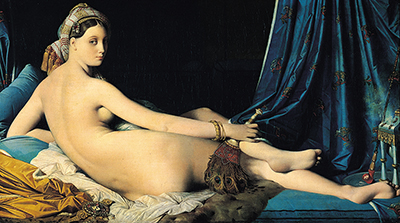
1801 (competition)Grande Odalisque
1814Louis XIII’s Vow
1824Monsieur Bertin
1832The Princesse de Broglie
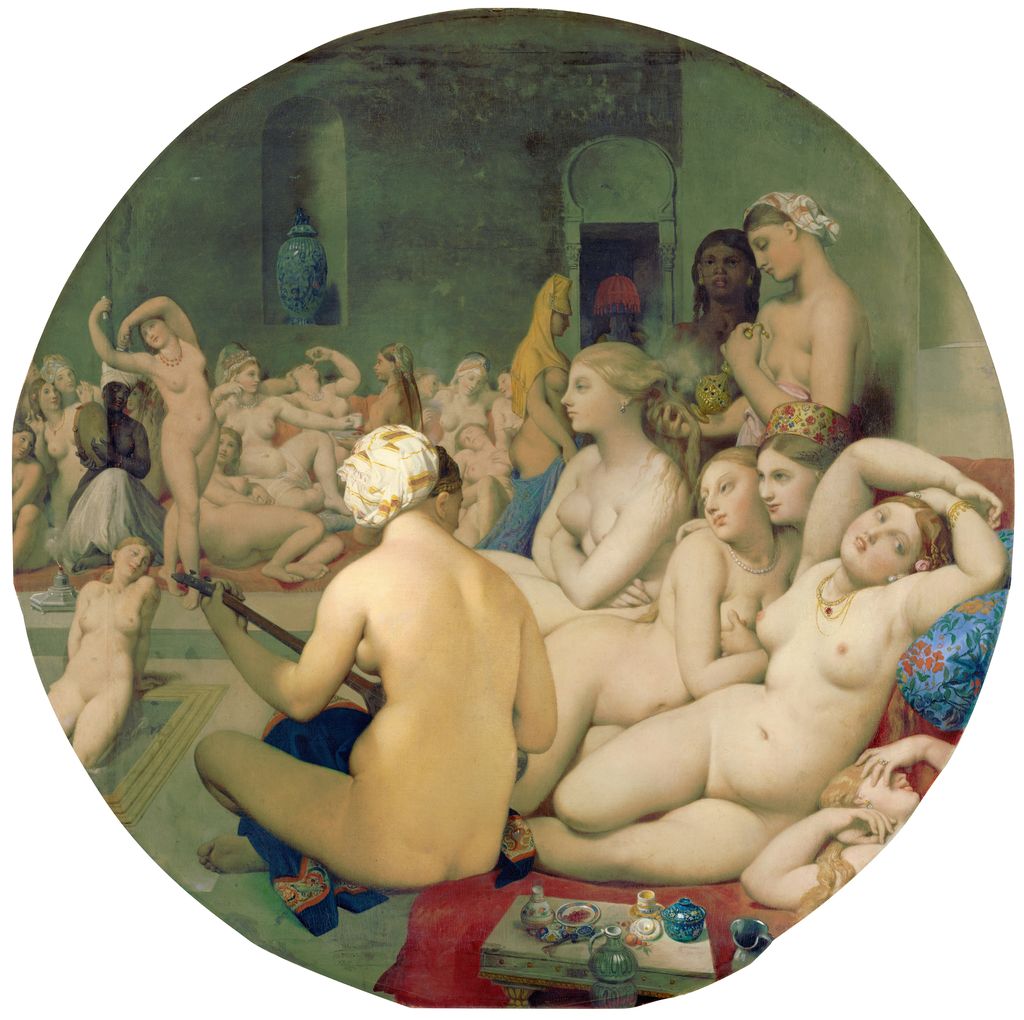
1851–1853The Turkish Bath
1859–1862Contents
- Looking at Marcotte
- A commission that became a friendship
- A likeness that changed
- An older language of portraiture
- Exhibition, reproduction and memory
- From a family portrait to Washington
- Annotated details
Looking at Marcotte
The first impression is of a figure too substantial to be contained comfortably by the frame. Blue fabric extends almost from side to side. The body turns slightly towards our left, yet the elbow reaches towards the table on the right, drawing the figure back across the picture. That uneven distribution gives the pose movement without requiring an action. Marcotte stands before us; the coat seems still to be settling around him.
The background offers little resistance. Its muted brown and greenish tones lighten around parts of the silhouette, then deepen above the head. There is no view through a window, no bookcase and no recognisable room. Against this quiet field, the silhouette becomes unusually legible. Look at the long slope from the shoulder on the left towards the outer edge of the coat, then at the lifted fold behind the opposite shoulder. One side falls; the other turns upwards. The two contours keep the great expanse of blue from becoming a symmetrical block.
Colour inside the dark clothes
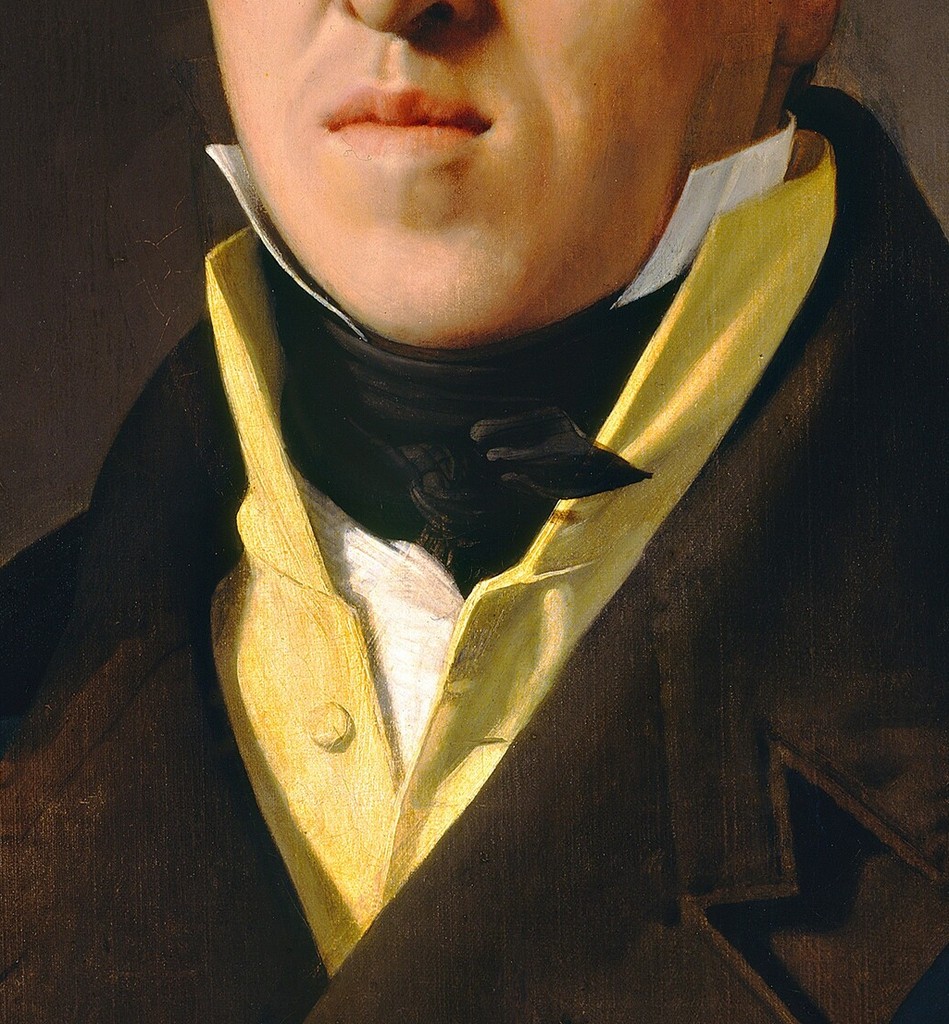
Much of the costume occupies a narrow range of dark values, but its colours remain distinct. The outer garment is a deep blue; inside it, the brown coat provides a warmer, more angular structure. Its lapels cross the torso in broad diagonals. Between them rises a yellow waistcoat, with pale highlights along its edges and small buttons that interrupt the smooth expanse. This bright opening leads the eye towards the face.
White appears sparingly. The shirt collar rises beside the jaw, framing a black cravat whose folds are discernible within the darkness. A separate strip of white at the wrist connects the face and hand across the picture. Both areas of flesh consequently appear to emerge through layers of cloth. The hand is lower and further to the right than the head; that spacing encourages the eye to travel through the costume rather than remain fixed on the expression.
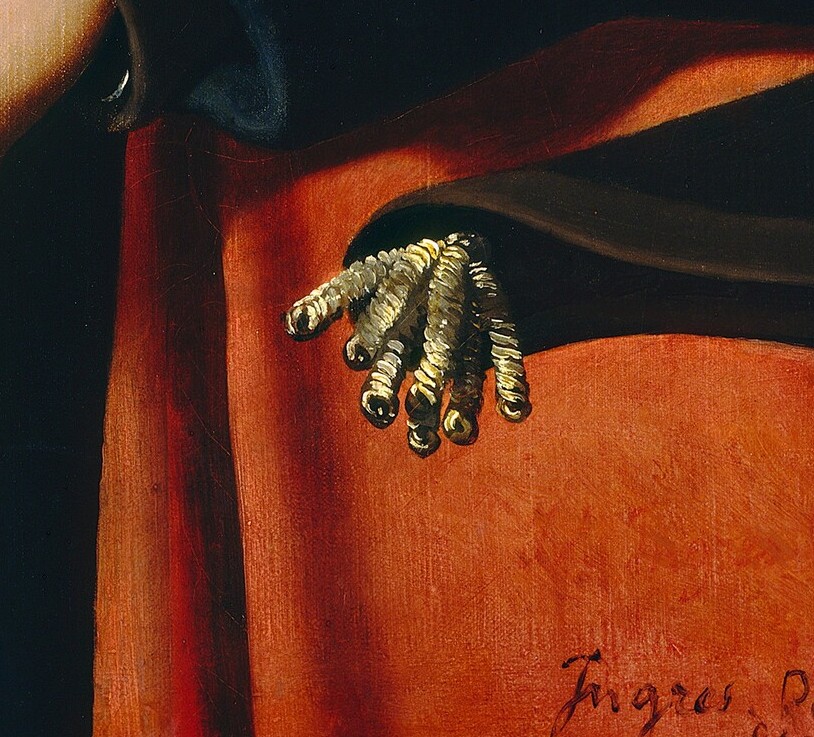
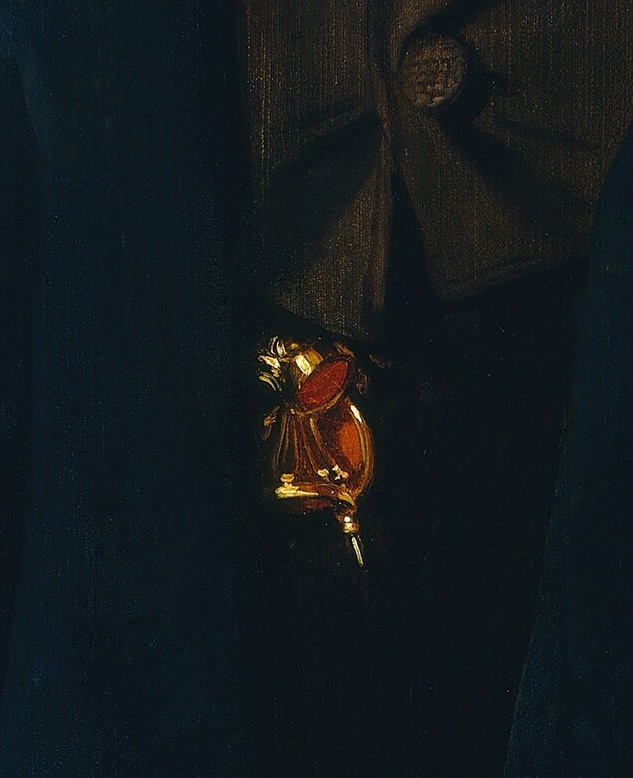
The tablecloth introduces the largest warm colour near the bottom. Its red is brighter where the cloth turns into the light, deeper near the elbow and along the edge. The tiny red accent on Marcotte’s chest makes a distant echo. Gold details offer another connection: the ornament near his waist and the tassel resting over the tablecloth answer one another without forming a conspicuous display of jewellery.
These relationships are easiest to see if the picture is considered first as an arrangement of coloured areas. The yellow is narrow and upright, the blue broad and enveloping, the red low and rectangular. Once the objects come back into focus, those simple shapes become clothing, a body and a place to rest an elbow. Ingres allows both ways of seeing to operate together.
The hand, the hat and the gaze
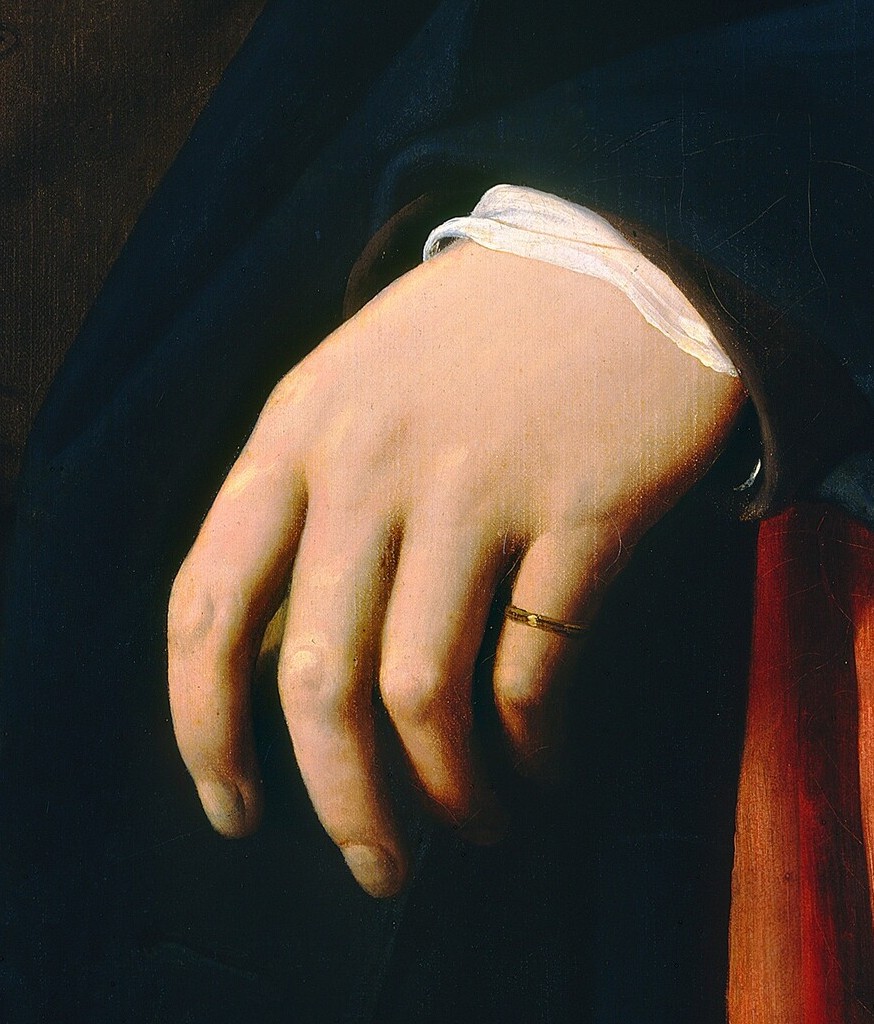
Marcotte’s left forearm is supported, but the hand drops freely. Its knuckles do not form a straight line; the fingers descend at different angles and lengths. A narrow ring crosses the little finger. The pale wrist is enclosed by a dark cuff, then released over the table’s edge. That change from support to suspension is one of the composition’s most persuasive physical effects.
Beside it lies a black bicorne, a hat with two raised points, with a gold tassel hanging towards the viewer. Its curved edge cuts across the straighter boundary of the table. The hat creates another variation on the painting’s repeated folds: a dark object whose shape has to be read from a few illuminated edges. Looking closely prevents this detail from dissolving into an anonymous accessory.
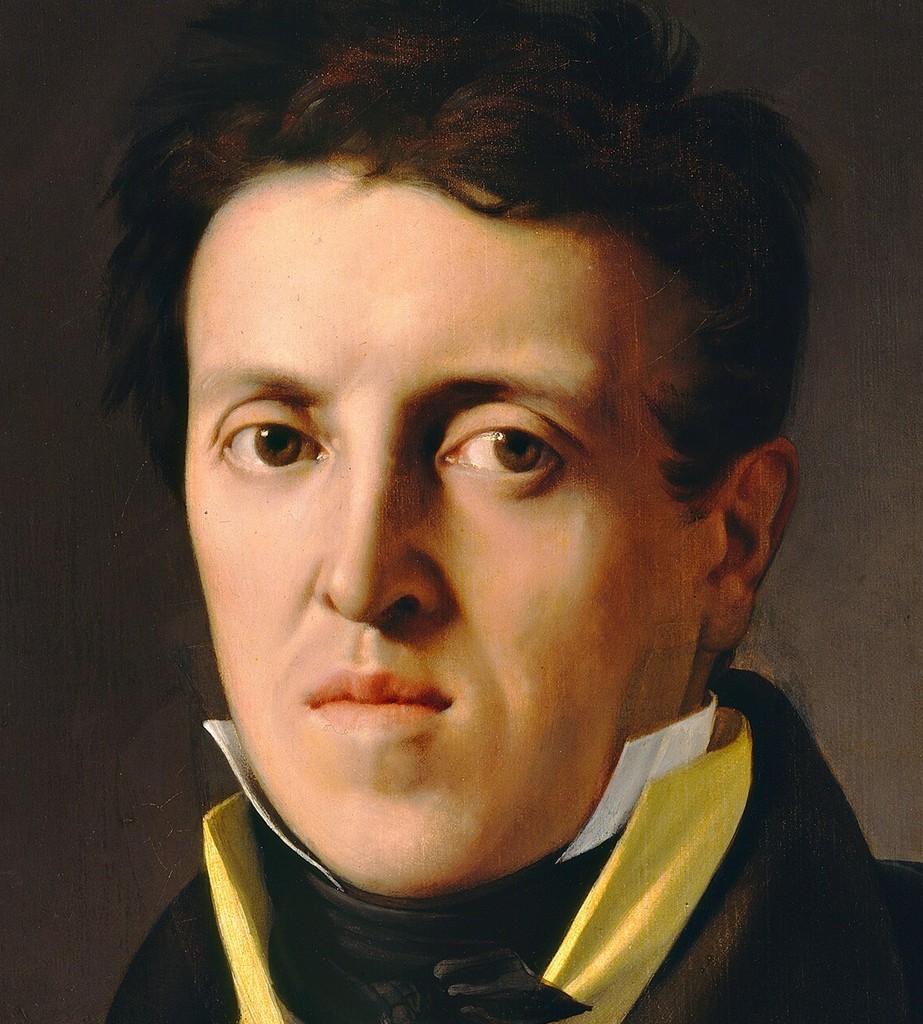
The face receives a different treatment. Light spreads across the forehead and cheek on our left, with a much narrower illumination towards the ear on the right. Small shifts around the eyes and nose give the head volume, while the mouth remains firmly closed. The hair rises in irregular waves above a comparatively smooth forehead. These particulars make the likeness arresting; they do not establish whether Marcotte was proud, irritable, reserved or simply holding a pose. The unhurried hand and concentrated gaze can be experienced together without turning them into a diagnosis of character.
Annotated Details from Portrait of Charles Marcotte d’Argenteuil
The numbered points identify visible features discussed in this article. Return from each detail to the whole composition. Jean-Auguste-Dominique Ingres, Portrait of Charles Marcotte d’Argenteuil, 1810, oil on canvas, 93.7 × 69.4 cm. National Gallery of Art, Washington, Samuel H. Kress Collection, 1952.2.24. Image source. Public domain.
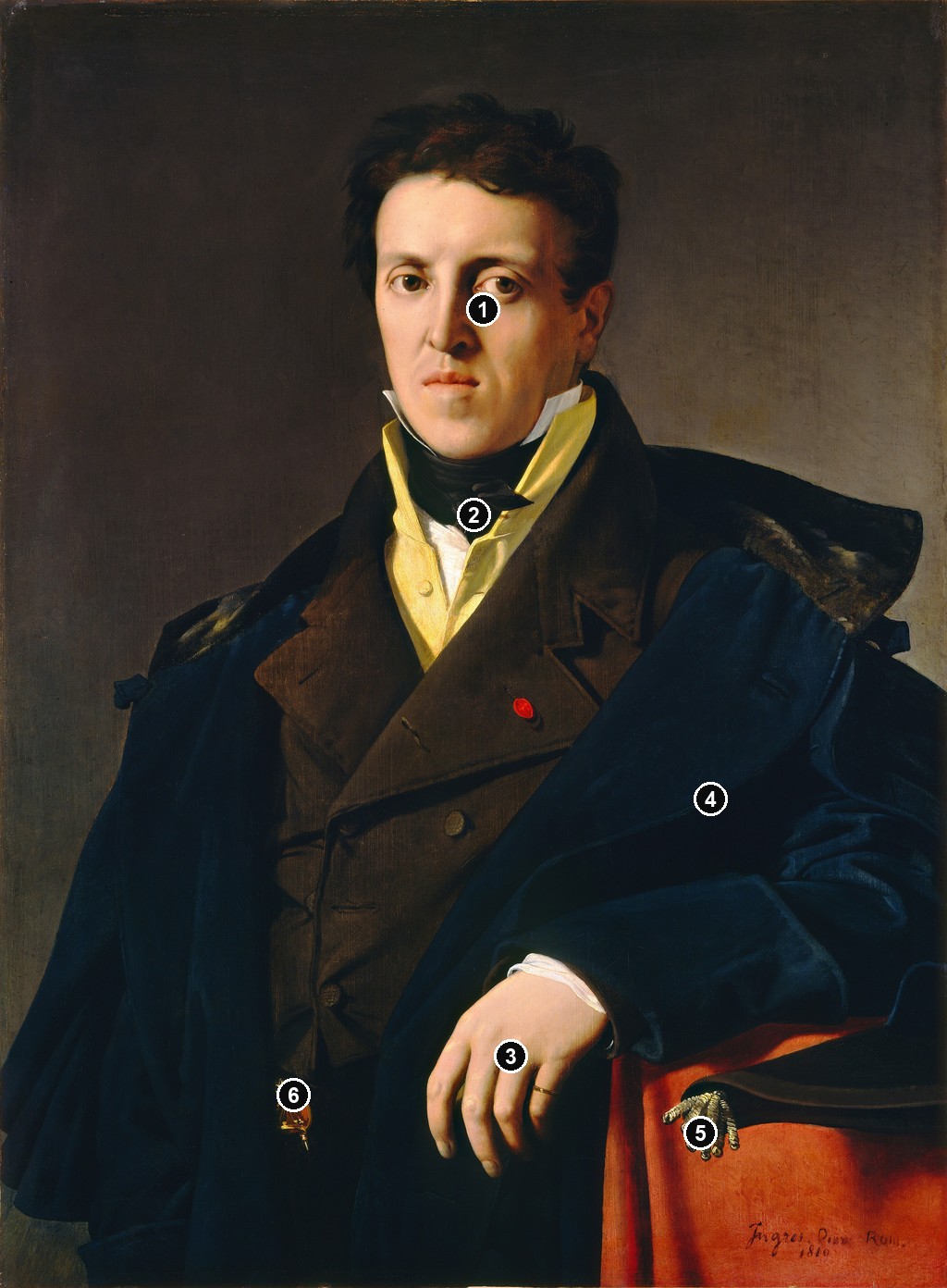
Details from PORTRAIT OF CHARLES MARCOTTE D’ARGENTEUIL
Compare the hand, clothing and table with the quieter face and background.
The face against a quiet background
Dark hair and a high collar surround the turned face. The plain background leaves small differences in the eyes, mouth and cheeks unusually exposed.
Yellow waistcoat and black neckcloth
The yellow waistcoat opens between dark lapels beneath a tightly gathered neckcloth. A small white triangle separates these stronger colours.
A relaxed hand and narrow ring
The fingers hang over the dark coat beside the red table. A narrow ring interrupts the smooth pale outline near the outer edge of the hand.
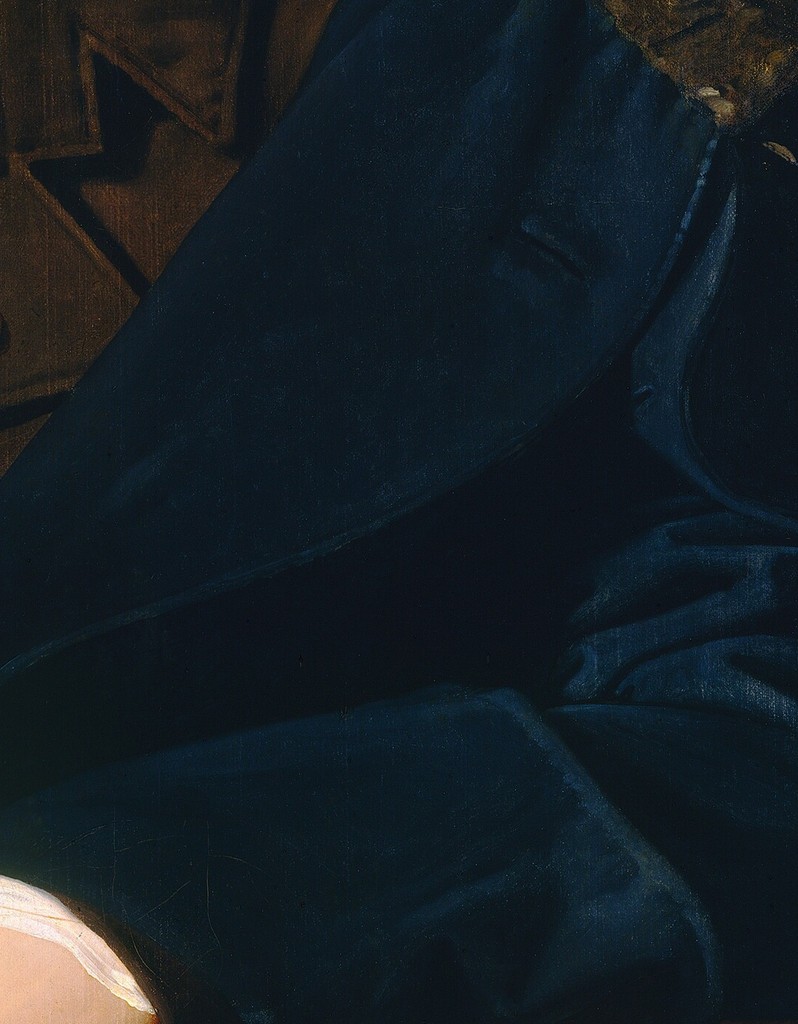
Blue cloth folding over brown
The broad blue outer coat crosses the browner garment beneath. Follow the large turning edge before looking into its darker folds.
A pale tassel against the table
A pale tassel lies against the warm red table beside the sleeve. Its several small cords contrast with the table’s broad area of colour.
A small ornament below the waistcoat
A small hanging ornament catches the light against the dark clothing. Its compact, bright outline makes a quiet counterpart to the much larger hand beside it.
A commission that became a friendship
Marcotte administered forests and waterways in French-occupied Italy; the portrait was intended for his mother. [3] Further portrait commissions followed within his circle, including Edme Bochet and Madame Panckoucke. [3] The setting brought French administrative and family connections into Ingres’s working life.
Delaborde’s account gives the choice of artist a contingent beginning. Marcotte had considered Merry-Joseph Blondel. He consulted the sculptor and medal engraver Édouard Gatteaux, who recommended Ingres for the task. According to Delaborde, Marcotte was following advice before he had developed a particular preference for Ingres’s painting. [2] This is a more revealing beginning than a story of instant recognition. An introduction made the portrait possible; the sustained relationship followed.
Delaborde then connects the likeness to a new commission: a painting of the Sistine Chapel during a service, intended for Marcotte’s private collection. He follows the relationship forward to the later Odalisque, presenting Marcotte as a friend who offered assistance during difficult years and continued to take an active interest when Ingres’s reputation had grown. [2] Portraiture here opened a route towards collecting other kinds of painting. The sitter’s involvement could extend from lending his own appearance to supporting the artist’s larger ambitions.
This testimony needs its historical frame. Delaborde published his book in 1870, after both men had died, and wrote in an openly admiring spirit. His claim that their friendship continued without interruption belongs to that commemorative account. [2] It should not be mistaken for independent access to every stage of their private lives. What it does preserve clearly is the importance attached to Marcotte within the early history of Ingres’s reputation.
The painting gives that relationship a strikingly formal point of departure. Nothing in the arrangement announces intimate friendship: there is no shared activity or reference to the painter within the scene. The viewer encounters an individual dressed for presentation. Knowing the later history changes our understanding of the commission, while the image retains the reserve of its original task.
A likeness that changed
The 1999 catalogue reproduces two 1811 pencil portraits, N64 and N65. [3] Their later date prevents their straightforward identification as preparatory studies for the canvas. Conisbee reports Ingres’s 1814 permission to recolour the trousers and a 1996 examination finding warm brown beneath an early dark glaze and later restoration overpaint. Cracks supported the glaze’s early dating. [3] The correspondence and examination thus concern the same small area, although the invisible layers cannot be recovered by looking at a reproduction alone.
A glaze is a thin, relatively transparent paint layer that can alter the colour beneath it while allowing some of its structure to remain visible. The reported change concerned a small part of the costume. Its interest lies in the negotiation it records. Once the portrait had left the artist’s immediate care, Marcotte could still seek an adjustment, and Ingres could consent to someone else carrying it out. The finished likeness was an object within a continuing relationship, subject to requests as well as admiration.
The Legion of Honour rosette was added in or after 1836. [3] Its bright oval now sits prominently against the brown lapel. Its later arrival gives the portrait more than one historical moment. The inscription records the portrait’s origin, while the surface also carries a later statement about the sitter. A portrait could preserve a younger face and acquire a subsequent distinction.
Visually, the addition is economical. The red mark is small enough to leave the arrangement of lapels undisturbed, yet intense enough to catch the eye. It introduces an asymmetry within the dark centre of the costume. We see it as part of the whole, even though the object’s history tells us that the whole did not arrive in a single moment.
An older language of portraiture
Conisbee records Eitner’s proposed Bronzino comparison: Portrait of a Young Man. [3] A suggested source remains distinct from documentary proof of copying. The suggestion directs attention towards the canvas’s formality. Marcotte’s pose depends on controlled edges, a carefully placed hand and clothing that gives the body a strong outline. The restrained background allows those elements to dominate. To a viewer considering the painting’s sense of formality, these are more useful points of comparison than a general claim that the sitter “looks Renaissance”. They identify how the picture holds attention.
At the same time, the portrait continually returns us to the particularities of its own encounter. The lifted collar presses close to Marcotte’s jaw. One finger bends away from its neighbour. The dark cloth has folds whose sizes exceed the small details of the face. A historical model, if used, would have had to accommodate this specific head, these clothes and this balance of the body.
The work is especially rewarding within Ingres’s wider portrait practice, where the representation of a sitter also becomes an exercise in arranging cloth, flesh, furniture and empty space. Here the coat almost supplies its own setting. Its encircling blue gives the figure breadth and surrounds the more compact structure of brown, yellow, white and black at the centre.
Exhibition, reproduction and memory
The portrait appeared at the Paris Salon of 1814, under catalogue number 535. [1] Conisbee reports Miel’s and Boutard’s criticism of its handling and archaism. [3] Those responses remind us that the severity now experienced as compelling could once provoke resistance.
A later reader encountered it through a different medium. Delaborde notes its reproduction in Magimel’s publication of Ingres’s works. [2] An outline reproduction offers a particularly revealing thought experiment for this painting. Remove the blue, yellow and red, and the silhouette, lapels, hand and table edge still provide an intelligible structure. Yet the relationships between those colours, and the movement from nearly black shadows into illuminated cloth, contribute substantially to the encounter with the canvas. A reproduction can carry the design forward while changing what the viewer is able to appreciate.
Marcotte also appears in a more personal surviving document. A letter dated 19 September 1840, now at the Musée Ingres Bourdelle, announces that Ingres had dispatched his Odalisque the previous day. He asks Marcotte and Gatteaux to judge it, apologises for the delay and sends affectionate greetings to the family. The museum identifies this sheet as probably a preliminary version; the letter finally sent is at the Fondation Custodia. [4]
Read beside Delaborde’s account of the original introduction, the letter gives the same three names a later, practical setting. Gatteaux remains part of the conversation; Marcotte is still an anticipated judge of the artist’s work. The friendship involved the transport, reception and evaluation of paintings. The Odalisque with Slave belongs to that continuing history, far beyond the making of Marcotte’s own likeness. [2][4]
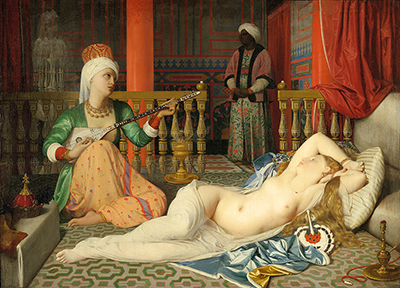
Ingres, Odalisque with Slave, 1839. [5]
From a family portrait to Washington
The painting descended through Marcotte’s family before passing through a London collection and Wildenstein. The Kress Foundation purchased it in June 1949 and gave it to the National Gallery of Art in 1952. The museum records uncertainty about the allocation of particular family works after a 1939 inheritance. [1]
That qualified provenance is preferable to an apparently seamless list. It distinguishes the broad continuity of family ownership from the less certain movement of an individual canvas. The eventual museum accession gives the portrait another role: an image originating in a personal commission now represents Ingres to a public far removed from Marcotte’s circle.
The signature remains low on the tablecloth, where the warm colour makes its dark strokes visible. Its placement encourages a final return to the lower half of the painting: hat, tassel, hand, cloth and name. These details anchor the imposing figure in an arrangement of tangible things. The most sustained encounter with Marcotte begins when the eye moves between those objects and the face, discovering how much of the portrait’s presence is built outside the expression itself.
Artworks directory
Explore 150 paintings, drawings and an original lithograph. This selection includes related versions and studies; dates distinguish completed works from later revisions.
| Name | Date | Medium |
|---|---|---|
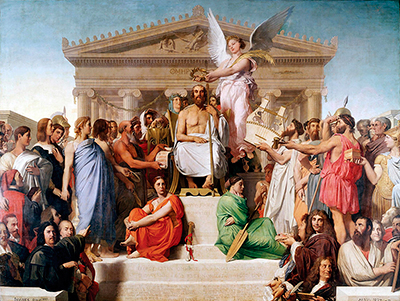
| The Apotheosis of Homer | 1827 | Painting |
| Grande Odalisque | 1814 | Painting |
| The Turkish Bath | 1859–1862 | Painting |
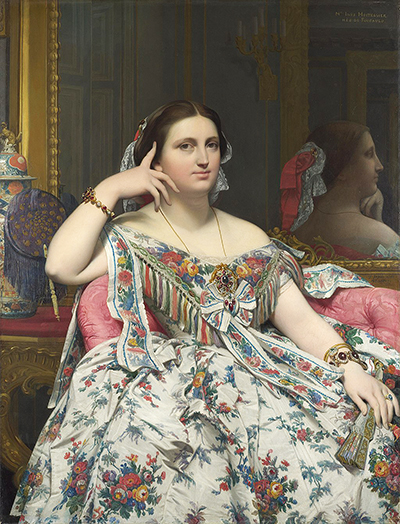
| Madame Moitessier Seated | 1856 | Painting |
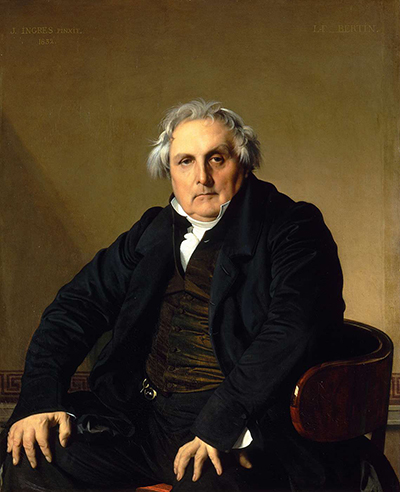
| Portrait of Monsieur Bertin | 1832 | Painting |
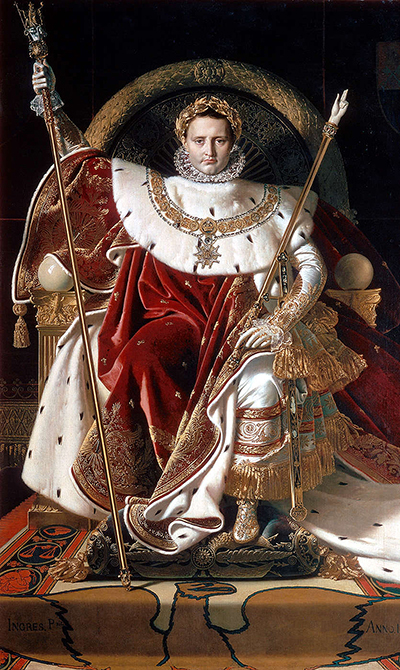
| Napoleon I on His Imperial Throne | 1806 | Painting |
| Odalisque with Slave | 1839 | Painting |
| The Ambassadors of Agamemnon in the Tent of Achilles | 1801 (competition) | Painting |
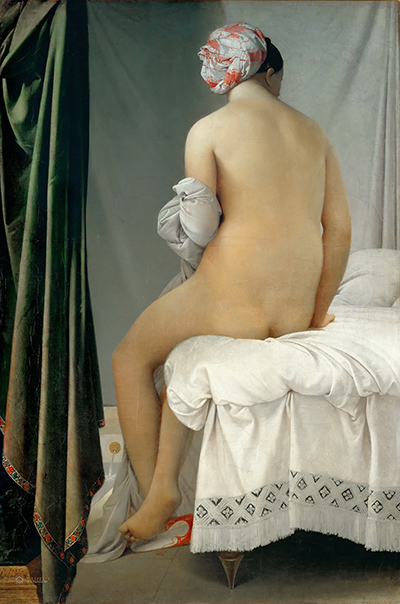
| The Valpinçon Bather | 1808 | Painting |
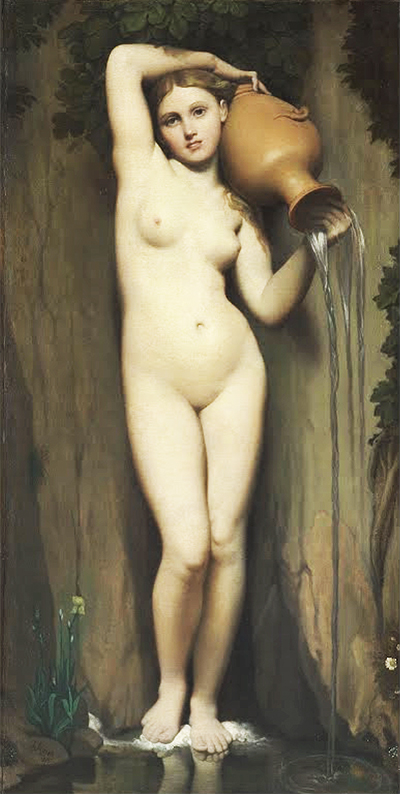
| The Source | 1856 | Painting |
| Oedipus Explaining the Enigma of the Sphinx | 1808; revised probably before 1827 | Painting |
| The Vow of Louis XIII | 1824 | Painting |
| Antiochus and Stratonice | 1840 | Painting |
| The Comtesse d’Haussonville | 1845 | Painting |
| The Princesse de Broglie | 1851–1853 | Painting |
| Jupiter and Thetis | 1811 | Painting |
| The Dream of Ossian | 1813 | Painting |
| The Martyrdom of Saint Symphorian | 1834 | Painting |
| Venus Anadyomene | 1808–1848 | Painting |
| Portrait of Madame de Senonnes | 1814 | Painting |
| Madame Rivière | 1805 | Painting |
| Mademoiselle Caroline Rivière | 1805 | Painting |
| Portrait of Philibert Rivière | 1805 | Painting |
| Bonaparte First Consul | 1804 | Painting |
| The Death of Leonardo da Vinci | 1818 | Painting |
| Joan of Arc at the Coronation of Charles VII | 1854 | Painting |
| Madame Duvaucey | 1807 | Painting |
| La Belle Zélie | 1806 | Painting |
| Madame Panckoucke | 1811 | Painting |
| Portrait of Charles Marcotte d’Argenteuil | 1810 | Painting |
| Joseph Antoine Moltedo | c.1810 | Painting |
| Madame Leblanc | 1823 | Painting |
| Delphine Ingres-Ramel (Portrait of Madame Ingres) | 1859 | Painting |
| Portrait of Amédée de Pastoret | 1823–1826 | Painting |
| Portrait of Baronne de Rothschild | 1848 | Painting |
| Madame Marcotte de Sainte Marie | 1826 | Painting |
| Madame Gonse | 1852 | Painting |
| Aretino in the Studio of Tintoretto | 1848 | Painting |
| Don Pedro of Toledo Kissing Henry IV’s Sword | 1831/1832 | Painting |
| Raphael and La Fornarina | 1814 | Painting |
| Roger Freeing Angelica | 1819 | Painting |
| Romulus’ Victory over Acron | 1812 | Painting |
| Self-Portrait at the Age of Twenty-Four | 1804; revised 1841–1851 | Painting |
| Male Torso | c.1800 | Painting |
| Odalisque in Grisaille (Ingres and workshop) | c.1824–1834 | Painting |
| The Small Bather | 1826 | Painting |
| The Little Bather Harem Interior | 1828 | Painting |
| Jesus Among the Doctors | 1862 | Painting |
| The Virgin Adoring the Host | 1852 | Painting |
| The Virgin of the Host | 1841 | Painting |
| Virgin of the Adoption | 1858 | Painting |
| Paolo and Francesca | 1814 | Painting |
| Homer Deified (revised composition, Louvre RF5273) | 1865 | Drawing |
| Odalisque with Slave (Louvre RF4622) | 1858 | Drawing |
| Odalisque (Walters Art Museum; Ingres and Paul Flandrin) | 1842 | Painting |
| Madame Moitessier Standing (National Gallery of Art) | 1851 | Painting |
| Jacques-Louis Leblanc (The Metropolitan Museum of Art) | 1823 | Painting |
| Ferdinand-Philippe, Duke of Orléans (Louvre RF2005-13) | 1842 | Painting |
| Ferdinand-Philippe, Duke of Orléans (Versailles MV5207; Ingres and workshop) | 1843 | Painting |
| Ferdinand-Philippe, Duke of Orléans (Versailles MV5209; Ingres and workshop) | 1844 | Painting |
| Antiochus and Stratonice (Musée Fabre; Ingres and Raymond Balze) | 1866 | Painting |
| Antiochus and Stratonice (Kunstmuseum Bern, Gurlitt bequest) | Undated (early dating proposed) | Drawing |
| Composition study for Antiochus and Stratonice (MIB867.2193) | 1806 | Drawing |
| Study for the Figure of Stratonice (Met63.66) | 1834–1840 | Graphite, black chalk and charcoal |
| Nude figure study for Stratonice (Boijmans F II 36 PK) | c.1834–1840 | Drawing |
| Paolo and Francesca (The Barber Institute,54.6) | c.1814–1820 | Painting |
| Paolo and Francesca (The Hyde Collection,1971.24) | c.1855–1860 | Painting |
| Paolo and Francesca (Amsterdam Museum TA10970) | 1820 | Drawing |
| Paolo and Francesca (dedicated to Artaud de Montor) | 1816 | Drawing |
| Study for the Bust of Francesca (MIB867.1398) | 1819 | Drawing |
| Study for the Bust of Francesca (MIB867.1396) | 1819 | Drawing |
| The Archangel Raphael, first idea (MIB867.2488) | 1842 | Drawing |
| The Archangel Raphael (MIB867.2500) | 1842 | Drawing |
| The Archangel Raphael Carrying Human Prayers to God (Chantilly DE513) | 1844 | Drawing |
| Louis-Philippe as Saint Philip, stained-glass study | 1844 | Drawing |
| Marie Frédéric Eugène de Reiset (Ford Collection RBF171-2) | 1844 | Drawing |
| Virgil Reading the Aeneid (Toulouse) | Begun 1811 | Painting |
| Tu Marcellus Eris (Brussels, inv. 1836) | c.1814 (museum dating) | Painting |
| Jean-François Gilibert | 1804 | Painting |
| François-Marius Granet | 1807 (museum dating) | Painting |
| Count Nikolai Dmitrievich Guryev | 1821 | Painting |
| Caroline Murat, Queen of Naples | 1814 | Painting |
| Count Mathieu Molé | 1834 | Painting |
| Cherubini and the Muse of Lyric Poetry (Louvre) | 1842 | Painting |
| Luigi Cherubini (Cincinnati) | 1841 | Painting |
| Comtesse de Rayneval (Louvre RF4505) | 1841 | Drawing |
| Venus on Paphos (Antonie Balaÿ) | c.1852 | Painting |
| Prince Napoléon | 1855 | Painting |
| Study for The Apotheosis of Napoleon I (Petit Palais) | Late 1853 | Painting |
| The Apotheosis of Napoleon I (destroyed ceiling) | 1853 | Painting |
| The Journalist (MIB867.2733) | 1834? | Drawing |
| Henry VIII, after Holbein | c.1815–1820 (?) | Drawing |
| Madame Récamier, after David (MIB867.3637) | Undated (early Paris period) | Drawing |
| Study for Comtesse d’Haussonville (MIB867.259; background possibly by another hand) | 1842–1845 | Drawing |
| La Source (reduced version reported by Delaborde) | Date unrecorded; reported 1870 | Painting |
| Odalisque (autograph lithograph,NGA1946.21.117) | 1825; published1826 | Lithograph |
| Portrait of a Seated Lady | 1814 | Graphite |
| The Kaunitz Sisters (Leopoldine, Caroline, and Ferdinandine) | 1818 | Graphite |
| Portrait of a Man | 1814 | Graphite |
| Study for the Portrait of Louis-François Bertin (1766–1841) | n.d. | Black chalk and graphite |
| Studies for the Cadaver of Acron | ca. 1810–12 | Graphite on wove paper |
| Study for the Drapery of Molière in "The Apotheosis of Homer" | n.d. | Black chalk with stumping |
| Madame Guillaume Guillon Lethière, née Marie-Joseph-Honorée Vanzenne, and her son Lucien Lethière | 1808 | Graphite |
| Niccolò Paganini (1782–1840) | ca. 1830 | Counterproof or tracing strengthened with graphite and gouache on translucent paper |
| Lady Mary Cavendish-Bentinck (?-1843) | 1816 | Graphite |
| Madame Alexandre Lethière and Her Daughter Letizia | ca. 1815 | Graphite |
| Merry Joseph Blondel (1781–1853) | 1809 | Graphite |
| Ursin-Jules Vatinelle (1798–1881) | 1820 | Graphite |
| Bust of a Gypsy Girl (ascribed to Ingres) | 1819 | Graphite on wove paper |
| Study of a Seated Nude Male | n.d. | Graphite |
| The Archangel Raphael (Study for a stained-glass window in the chapel of Notre-Dame de la Compassion-Saint-Ferdinand, Neuilly) | ca. 1842 | Graphite |
| Lancelot-Théodore, comte Turpin de Crissé | probably 1818 | Graphite |
| Study for the Figure of the Iliad in "The Apotheosis of Homer" | ca. 1827 | Graphite and black chalk heightened with white chalk on brown paper |
| Comtesse Turpin de Crissé | probably 1818 | Graphite |
| Nude Figures for L'Âge d'Or, Château de Dampierre | n.d. | Graphite on brownish paper |
| Study of Figures (attributed to Ingres) | n.d. | Graphite |
| Study of Figures (attributed to Ingres) | n.d. | Graphite; squared in graphite |
| Admiral Sir Fleetwood Broughton Reynolds Pellew | 1817 | Graphite on wove paper |
| Madame Jean-Auguste-Dominique Ingres, née Madeleine Chapelle | 1814 | Graphite on off-white wove paper |
| Virgil Reading the Aeneid to Augustus, Livia, and Octavia | 1809/1819 (?) | Pen and black ink, graphite, brush and gray wash, white gouache heightening, Conté crayon on blue paper |
| General Louis-Étienne Dulong de Rosnay | 1818 | Graphite (hard and soft pencils) |
| Madame Alexandre Lethière, née Rosa Meli, and Her Daughter, Letizia | 1815 | Graphite |
| The Lawyer Paul Grand | 1834 | Graphite |
| Jean-Joseph Fournier | 1815 | Graphite |
| Armand Bertin | 1842 | Graphite |
| Madame Armand Bertin, née Marie-Anne-Cécile Dollfuss | 1843 | Graphite |
| The Architect Charles-Victor Famin | 1836 | Graphite |
| Henri Lehmann | 1850 | Graphite |
| Portrait of a Lady | ca. 1815–17 | Graphite |
| Edmond Cavé (1794–1852) | 1844 | Oil on canvas |
| Head of Saint John the Evangelist | probably ca. 1818–20 | Oil on canvas, laid down on wood |
| Madame Edmond Cavé (Marie-Elisabeth Blavot, ca. 1806–1883) | ca. 1831–34 | Oil on canvas |
| Madame Félix Gallois | 1852 | Graphite with touches of gold in oil to highlight jewelry, on buff wove paper. |
| Dr. François Mêlier | 1849 | Graphite with graphite framing lines, corrected with white, on buff wove paper |
| Portrait of Madame Rhode (Rhoda?) | 1810–20 | Graphite on pale buff wove paper |
| Study for "Raphael and the Fornarina"(?) | ca. 1814(?) | Graphite on white wove paper |
| Portrait of Madame Paul Meurice, née Palmyre Granger | ca. 1845–50 | Graphite on wove paper |
| Alexander the Great presenting Campaspe to Apelles | 1810 | Graphite, brush and brown wash; squared in graphite |
| Study of Hands for "Christ Among the Doctors" | 1852–62 | Graphite on tracing paper |
| Study for The Turkish Bath (RF34502) | about 1850 | Pen and brown ink with graphite, partially squared |
| Study for The Turkish Bath (RF23354) | Undated | Pen and brown ink with graphite on joined sheets |
| Study for The Turkish Bath (RF54702) | about 1859 | Pen and brown ink |
| Studies of women for The Turkish Bath (RF12292) | Undated | Black chalk |
| Achilles Receiving the Envoys of Agamemnon (Nationalmuseum sketch, NM2161) | 1801 | Oil on wood |
| Half-Length Bather (Musée Bonnat-Helleu,89) | 1807 | Oil on canvas |
| Oedipus and the Sphinx (National Gallery,NG3290) | about1826 | Oil on canvas |
| Oedipus and the Sphinx (Walters,37.9) | 1864 | Oil on canvas |
| Oedipus and the Valpinçon Bather, after David (MI.867.2035) | Undated | Graphite on tracing paper, after David |
| Study of the Virgin for The Vow of Louis XIII (Dijon,1758) | about1822 | Black chalk, stump and white chalk on brown wove paper |
| First Thought for The Vow of Louis XIII (MI.885.11.21) | 1822 | Oil on canvas |
Frequently Asked Questions
It is Marcotte’s bicorne hat. Its curved brim lies above the red cloth, with a gold tassel falling towards the edge.
It spreads across almost the full width, enclosing the smaller shapes of the waistcoat and face. Its broad folds also make the exposed hand appear more delicate.
At the lower right, on the tablecloth. Its reference to Rome accompanies the date. [1]
Discussion
Look again at the images and ideas explored in Portrait of Charles Marcotte d’Argenteuil. These editorial prompts invite your observations.
Reader Insights
Which contributes most to Marcotte’s presence: his direct gaze, the loosely hanging hand or the spreading blue coat? Follow one of those elements through the picture and consider how the other two change its effect.
Compare Marcotte’s loosely hanging hand with Pastoret’s more differentiated gestures. How do they change the balance between ease and display?
Which parts of the portrait feel most individual when you set aside what you know about the sitter’s friendship with Ingres?
Join the Conversation
Share a detail, comparison or question about Portrait of Charles Marcotte d’Argenteuil below.
References
- National Gallery of Art, Washington, Marcotte d’Argenteuil, 1952.2.24. Collection record, inscriptions, provenance and exhibition history; accessed 17 October 2026. View source.
- Henri Delaborde, Ingres, sa vie, ses travaux, sa doctrine, d’après les notes manuscrites et les lettres du maître. Paris: Henri Plon, 1870, catalogue no. 139, pp. 254–255 (scan pp. 270–271). (In French.) View source.
- Philip Conisbee, “Charles-Marie-Jean-Baptiste Marcotte (Marcotte d’Argenteuil),” catalogue no. 26, in Gary Tinterow and Philip Conisbee, eds., Portraits by Ingres: Image of an Epoch. New York: The Metropolitan Museum of Art, 1999, pp. 122–125, especially p. 124 and notes 4, 6, 11–18. The 1996 conservation examination and the 1814 letters are reported through this entry. View source.
- Musée Ingres Bourdelle / Musées Occitanie, Lettre d’Ingres à Charles Marcotte, Rome, 19 septembre 1840, MI.2012.1.1. Transcription and commentary on the probable preliminary version; accessed 17 October 2026. (In French.) View source.
- Supporting image. Ingres, Odalisque with Slave, 1839. Harvard Art Museums; Wikimedia Commons. Image source. Public domain.
- Splash image. Jean-Auguste-Dominique Ingres, Portrait of Charles Marcotte d’Argenteuil, 1810, oil on canvas, 93.7 × 69.4 cm. National Gallery of Art, Washington, Samuel H. Kress Collection, 1952.2.24. Image source. Public domain.