by Tom Gurney
Tom Gurney BSc (Hons) is an art history expert with over 20 years experience
Published on June 19, 2020 / Updated on October 22, 2026
Email: tomgurney1@gmail.com / Phone: +44 7429 011000
The Ambassadors of Agamemnon in the Tent of Achilles
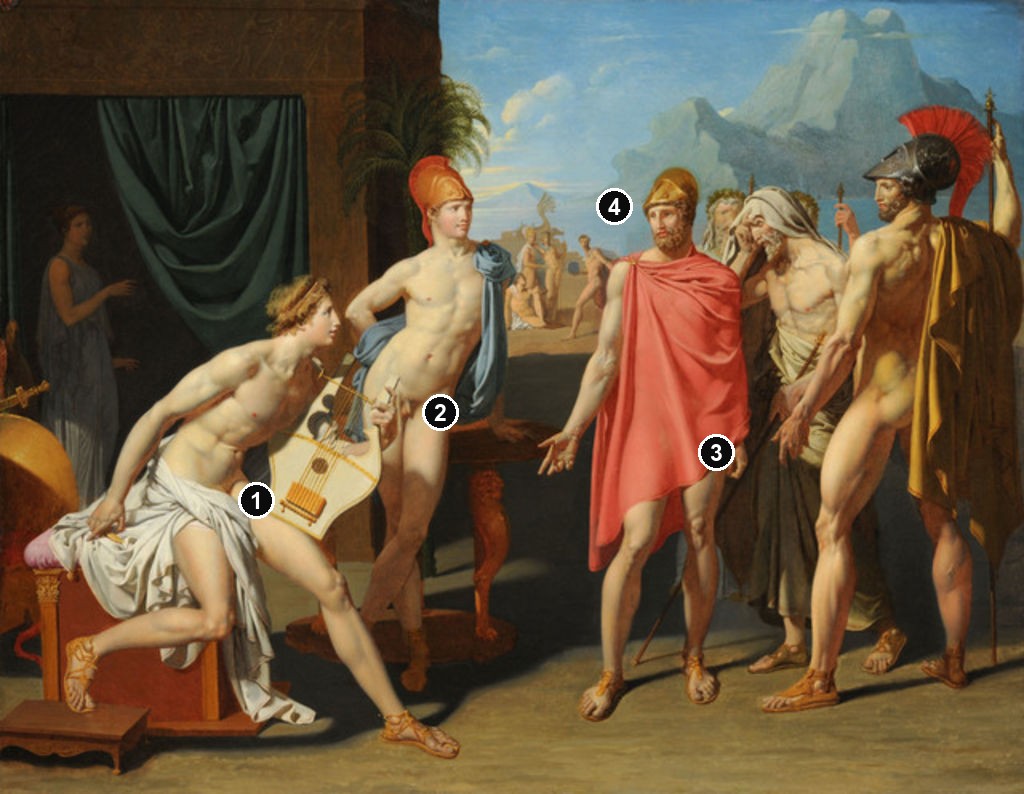
Achilles has put aside fighting and taken up music. Seated at the left of Ingres’s painting, with a lyre beside his turning body, he meets an embassy from the army whose battles he has left. The visitors bring the pressure of the camp into his private space: red and gold cloaks, helmets, spears and insistent gestures gather around a hero with his musical instrument still beside him. This encounter from Homer’s Iliad became the painting with which Jean-Auguste-Dominique Ingres won the Prix de Rome in 1801. The canvas belongs to the Beaux-Arts de Paris, where its identity as a prize-winning student work remains part of its history. [1]
The drama depends on a difficult distinction. Achilles can welcome these men as friends without accepting the command they represent. Knowing that the embassy will fail changes how we look at the apparent greeting: an opening between bodies need not become an agreement between people. [2]
At a Glance
- ArtistJean-Auguste-Dominique Ingres.
- Date and occasionwinning painting for the 1801 Prix de Rome competition. [1]
- Medium and collectionoil on canvas; Beaux-Arts de Paris, inventory PRP 40. [1]
- Subjectthe embassy to Achilles in Book IX of Homer’s Iliad. [2]
- Principal figuresAchilles and Patroclus at the left; Odysseus, Phoenix and Ajax approaching from the right. Agamemnon sends the delegation but does not appear in person. [2]
- Look forthe interruption of music by diplomacy, and the opening from the shaded tent to the crowded camp.
This work across Ingres’s career
Agamemnon’s Ambassadors (current article)
1801 (competition)Grande Odalisque
1814Louis XIII’s Vow
1824Monsieur Bertin
1832The Princesse de Broglie
1851–1853The Turkish Bath
1859–1862Contents
- Why the ambassadors have come
- Looking across the encounter
- A young painter’s bid for Rome
- What refusal costs
- A separate sketch in Stockholm
- Praise, prints and the painting’s later life
- From Achilles’s music to Homer’s honour
- Annotated details
Why the ambassadors have come
The men gathered before Achilles belong to the same army. Their disagreement has become dangerous because that army needs its strongest warrior back. Agamemnon, its commander, has taken Briseis from Achilles; Achilles has withdrawn from the fighting in anger at this affront. In Book IX, with the Greeks under severe pressure, Nestor urges Agamemnon to repair the breach. The commander offers compensation and agrees to send trusted intermediaries. Odysseus, also known as Ulysses, Ajax and the elderly Phoenix go to Achilles, accompanied by heralds. [2]
This is an appeal through personal relationships as well as an official mission. Phoenix helped bring Achilles up and taught him how to speak in council and act in battle. Odysseus can argue the practical case for saving the army; Ajax can speak as a fellow warrior. Agamemnon’s absence is essential to the arrangement. The men who stand before Achilles have not themselves committed the wrong for which they seek reconciliation. [2]
The proposed settlement is lavish. Agamemnon promises precious objects, horses, cities, a marriage alliance and the return of Briseis, together with other captive women. These women are enslaved people being treated by the commanders as transferable property. The proposed compensation makes their captivity part of the bargain between the two men. Achilles’s own grievance combines attachment to Briseis with the public loss of status involved in having his share of the spoils taken away. [2]
The offer therefore raises a question larger than whether a payment is generous enough. Can the commander restore trust by returning what he took and adding more? Achilles argues that the rewards of warfare have ceased to justify its labour and danger. In the English version by Alexander Pope, he weighs the possibility of returning home to a long life against remaining at Troy for lasting fame and an early death. His refusal reaches beyond a quarrel over possessions to the value of the life he is being asked to risk. [2]
The narrative can be followed in Alexander Pope’s English translation, used here to recount the episode. Which edition or translation Ingres consulted is a separate question. The connection with the painting lies in the situation: friends arrive at a withdrawn warrior’s tent, hoping to make him rejoin a common undertaking. [2]
Music, hospitality and an unsuccessful appeal
The ambassadors find Achilles singing the deeds of heroes to the accompaniment of a stringed instrument, with Patroclus listening. He rises to greet them, welcomes them warmly and arranges a meal. Only after they have eaten does Odysseus deliver the appeal. Phoenix then turns to memory and personal affection, while Ajax presses the claims of comradeship. Achilles refuses reconciliation. Phoenix stays overnight; the others return to report the failure. [2]
Ingres brings the arrival and its implications together in a single encounter. The lyre makes the interrupted activity recognisable, while the visitors’ assembled bodies and gestures make persuasion feel imminent. We do not see a sequence of greeting, meal and three speeches. The painting gives us the charged meeting from which that sequence unfolds.
It also resists a simple division between a peaceful musician and warlike intruders. In Homer, the instrument itself is spoil taken from a conquered city, and Achilles is singing about heroic exploits. His music remains connected to the world of warfare from which he has temporarily withdrawn. [2] In the painting, the lyre sits among idealised bodies and military equipment. The hero’s change of occupation creates the pause on which the whole composition depends.
Looking across the encounter
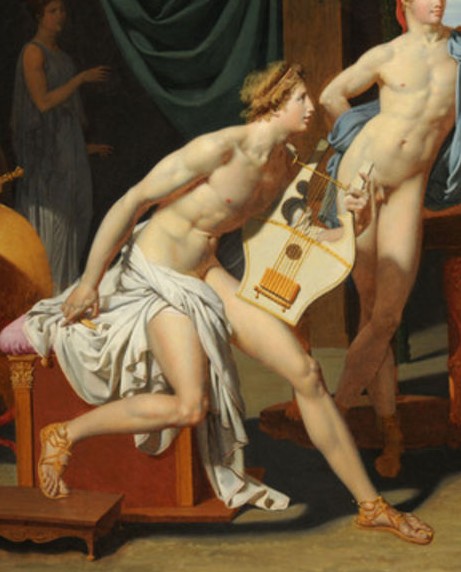
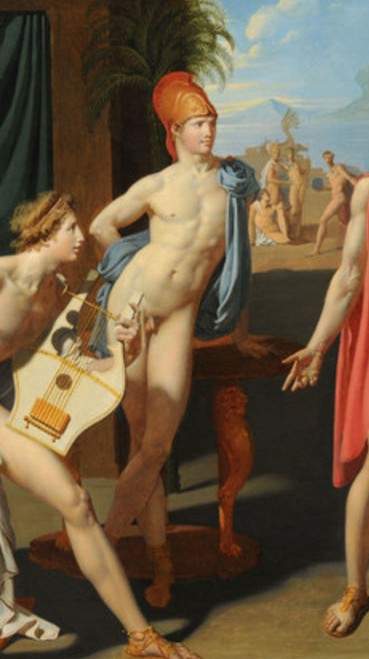
Begin at the left, where the tent’s dark interior frames Achilles’s pale torso. He sits on a richly coloured seat, with light drapery gathered across his thighs. His body travels in several directions at once: the upper body leans forward, one arm reaches back towards the seat, and a long leg extends into the space before him. The pose holds the moment of an interrupted action. He is seated, yet the figure has the energy of someone responding to an arrival.
The lyre is conspicuous because its angular frame cuts across these bodily curves. It occupies the narrow interval between Achilles and the standing Patroclus, giving the two figures a shared activity even as their attention turns outward. The instrument is large enough to register immediately. We can understand what has stopped before we know why the visitors have come.
Achilles and Patroclus: two ways of standing apart
Patroclus rises behind Achilles in a helmet and with much of his body uncovered. His upright form provides a clear counterweight to the seated figure’s diagonal movement. The two are closely grouped, but their outlines remain legible: Achilles’s head is lower and turned towards the embassy; Patroclus’s head occupies the higher band of faces that runs across the picture.
This placement makes Patroclus more than an accessory used to identify a passage from Homer. He stands between the inward world of music and the arriving men. An arm stretches across the space above Achilles, while the darker tent behind him gives his light body a firm edge. He helps draw our attention towards the point at which the visitors enter.
Homer’s account establishes him as the listener present before the embassy arrives. [2] Ingres’s grouping gives that prior companionship a visible shape. The two figures occupy a shared space against the dark tent, while their exposed bodies connect them to the classical figure language of the approaching warriors. Patroclus belongs to the hero’s retreat, but he also looks towards the men entering it.
Achilles is also still visibly part of a military setting. At the extreme left, a shield and a projecting shaft crowd the edge near his seat. Patroclus’s helmet brings martial equipment into the same small area as the lyre. The retreat is incomplete in spatial terms: the warrior has stopped fighting, but the material world of the army surrounds him.
Odysseus and the weight of the delegation
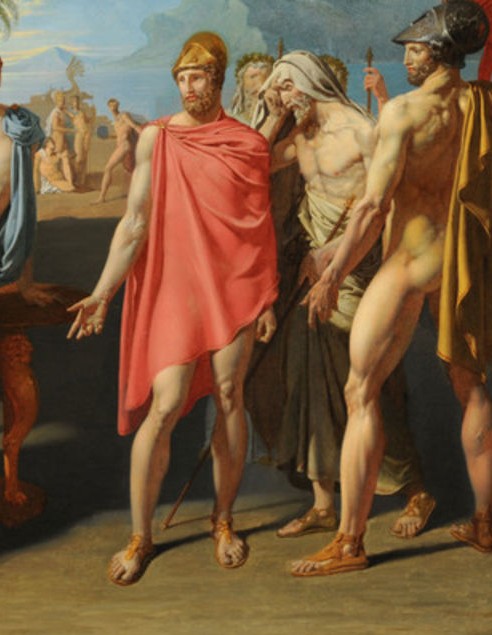
Near the centre, Odysseus wears a red cloak that forms a broad, nearly continuous field of colour. It gives him an immediate prominence different from the exposed torso of Achilles. Where Achilles is all turn and extension, Odysseus presents a more compact shape. His lowered, open hand reaches into the interval between the two groups.
That interval is one of the painting’s most active areas. The men do not need to touch for their positions to form a conversation. A hand moves into empty space; Achilles turns towards it; the lyre remains close enough to remind us what has just been interrupted. The gap allows a meeting while preserving the separation that makes negotiation necessary.
Behind Odysseus, the older Phoenix leans into the group, his white hair and beard distinguishing him from the younger, helmeted figures. His body is partly obscured. Ajax, at the right, stands more fully exposed, with a gold-coloured cloak falling beside and behind him, a crested helmet above and a spear rising near the outer edge. The delegation becomes denser as our eye moves across it: cloak, elder’s head, muscular torso, drapery and weapons overlap.
These differences help the three visitors remain individually readable. Odysseus takes the central, forward position; Phoenix’s age is conspicuous; Ajax gives the group its strong outer boundary. In the poem their arguments also differ, ranging from the army’s danger to remembered care and the obligations of friendship. [2] The painting does not assign each man a visible transcript of his speech, but the varied bodies give the gathering more character than a row of interchangeable messengers would have.
Colour and the pressure of the foreground
Red connects opposite sides of the encounter. The seat and fabric around Achilles find a much larger answer in Odysseus’s cloak. Across the picture, warm gold tones appear beside Ajax, while the green hanging in the tent offers a darker, cooler area at the left. Colour helps organise the men before any one face can be studied.
The contrast between drapery and flesh matters just as much. A cloak can make a solid vertical shape, conceal a limb or bring a sharp edge against a torso. Bare bodies give the arrangement longer, more continuous contours. Achilles’s light figure, Patroclus’s upright torso and Ajax’s warmer body establish a rhythm that the fabrics interrupt and bind together. Ingres’s clarity of outline works through colour here; reducing the picture to a demonstration of drawing would leave much of its organisation unexplained.
The main figures stand close to the front of the image. Their feet occupy a relatively shallow strip, while their heads gather across a narrow horizontal band. This compression makes their differences of attitude unusually easy to compare. A lean, an extended arm or a turn of the head registers against neighbouring bodies almost as clearly as a gesture on a stage. Yet the meeting does not feel sealed into an abstract diagram, because the central opening leads past them into another world.
The camp beyond the tent
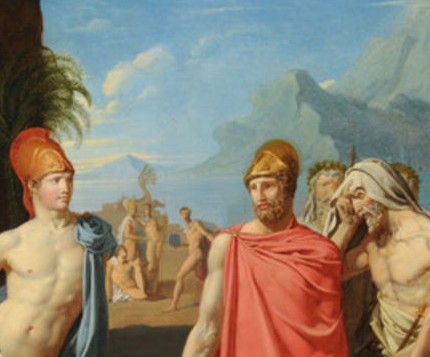
Between Patroclus and Odysseus, smaller soldiers gather in the distance. Beyond them are the shore, water and pale rocky heights under a blue sky. This opening is modest beside the foreground bodies, but it changes the subject’s reach. The men at the tent belong to a larger body of people who continue to wait and act outside.
The distant figures also measure the scale of the principal encounter. We pass quickly from bodies near enough to fill the picture to a much smaller, crowded group. The large foreground men acquire a sculptural weight, while the camp supplies depth and activity. Looking back from the distance, we can see the embassy as a narrow passage through which the army’s need enters Achilles’s retreat.
The light sky makes another departure from a literal reconstruction of Book IX, whose delegation travels through the night. [2] Ingres gives the encounter a visibly open setting in which the figures and their contrasts can be grasped. The tent’s shade and the illuminated distance establish two adjoining spaces: a place of withdrawal and the continuing life of the camp. The tension between them remains available to the eye even before the viewer learns the story.
Annotated Details from Achilles and the Ambassadors
The numbered points identify visible features discussed in this article. Return from each detail to the whole composition. Each caption identifies the work shown.
Achilles and the Ambassadors
Achilles and the Ambassadors. PRP 40. Wikimedia Commons. Image source. Public domain.
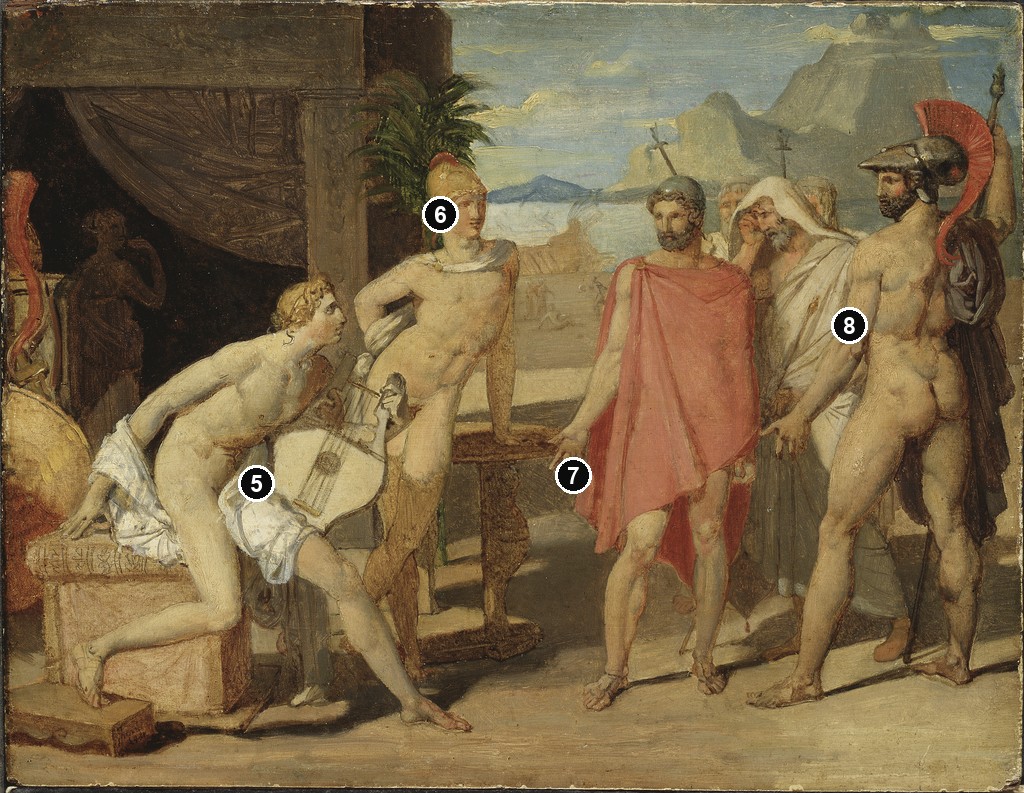
Achilles — Nationalmuseum Oil Sketch
Achilles sketch. NM 2161. Wikimedia Commons. Image source. Public domain.
Details from ACHILLES AND THE AMBASSADORS
Compare the figures and gestures in the large Paris painting with the separate small oil sketch on wood in Stockholm. Each caption identifies the object shown.
Achilles and the Ambassadors
Achilles turning from the lyre
The seated figure turns towards the visitors while the lyre remains across his lap. The angled instrument, bent torso and extended leg establish several different directions within this side of the encounter.
The standing figure beside Achilles
The upright figure stands beside the seated Achilles, with pale skin and dark drapery set against the tent opening. Compare his steadier outline with the seated figure’s turn.
The red-cloaked spokesman and his companions
The red cloak gives one visitor a broad, continuous shape among the overlapping figures. Hands and heads turn through the group towards the seated man on the other side.
The opening beyond the tent
Small figures, a pale sky and distant hills appear beyond the principal encounter. Their reduced scale makes the opening feel deeper than the closely gathered foreground bodies.
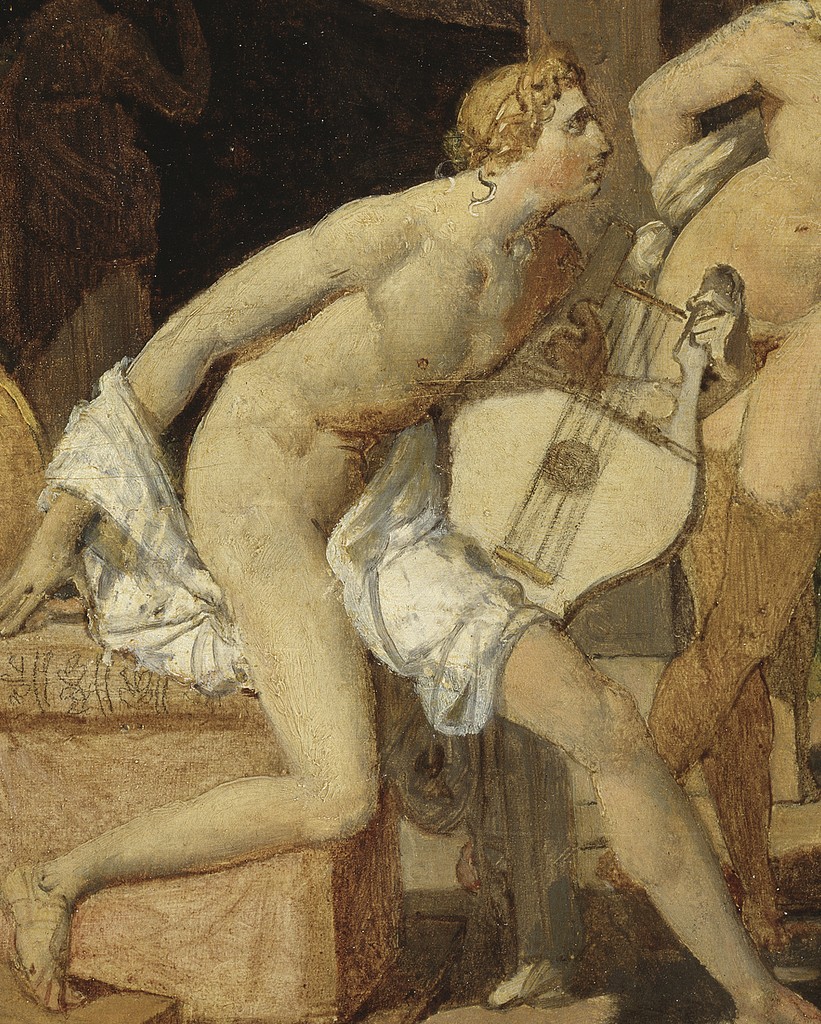
Achilles — Nationalmuseum Oil Sketch
The seated figure and pale lyre
The seated figure leans towards the visitors beside a pale lyre. The instrument’s curved frame and straight strings make a smaller pattern among the broader shapes of the body and cloth.
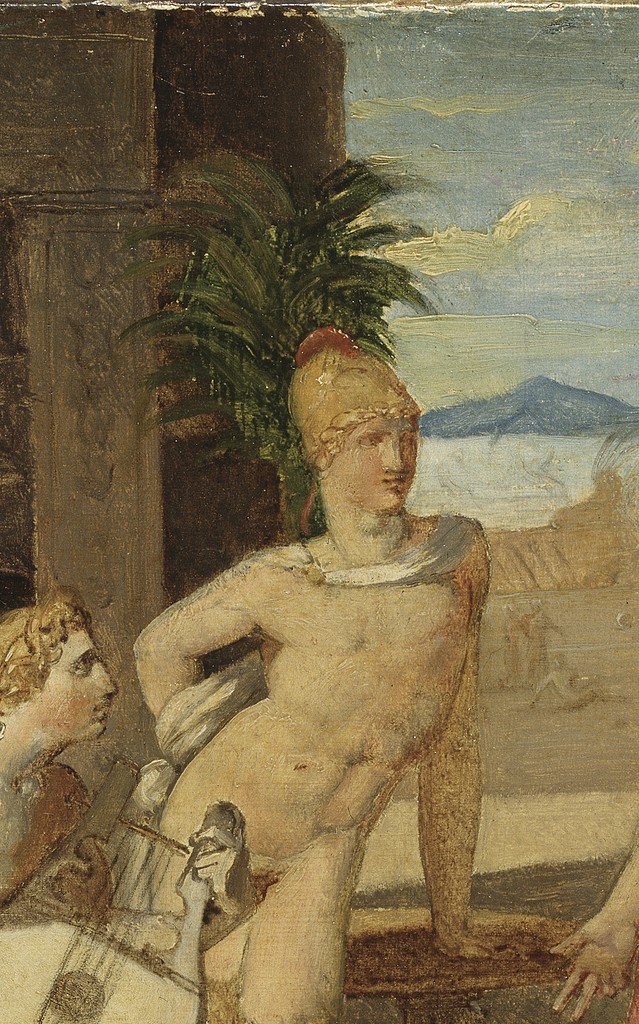
The plumed helmet and standing companion
A tall plume rises above the standing companion’s helmet. Its darker green shape meets the tent edge and contrasts with the pale body below.
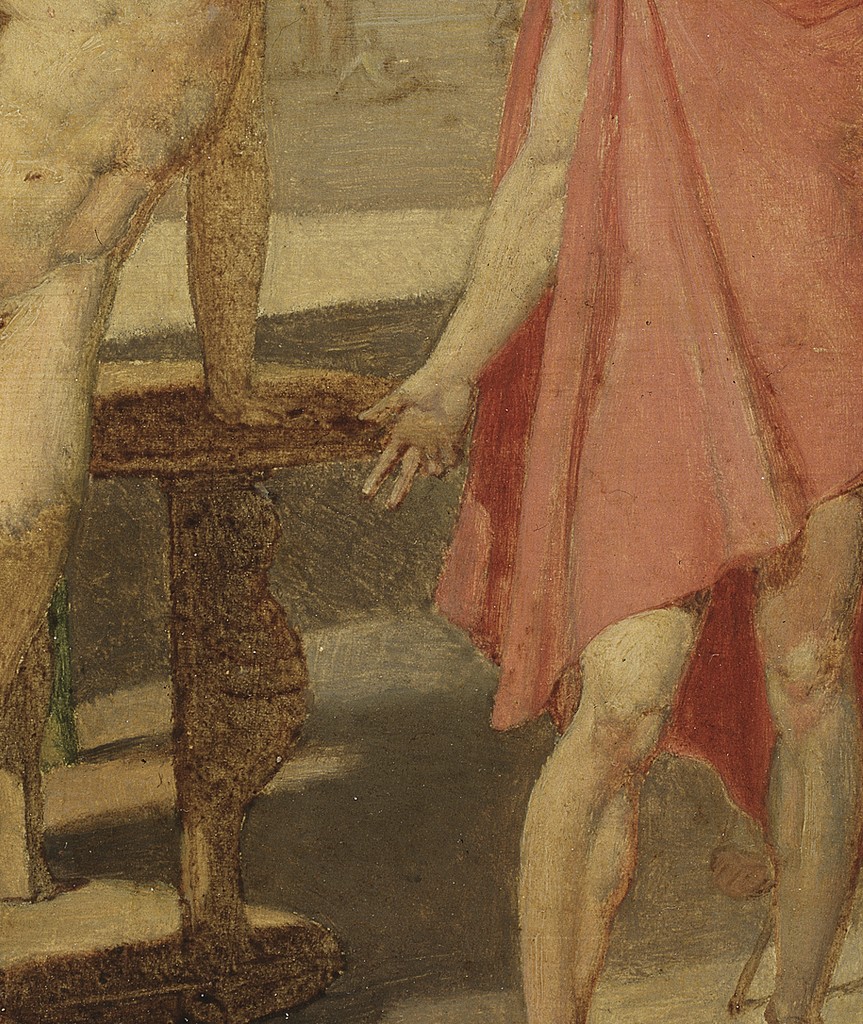
The red-cloaked visitor’s open hand
The red-cloaked visitor holds one hand open towards the seated figure. The small spreading fingers sit beside a larger, simpler expanse of warm cloth.
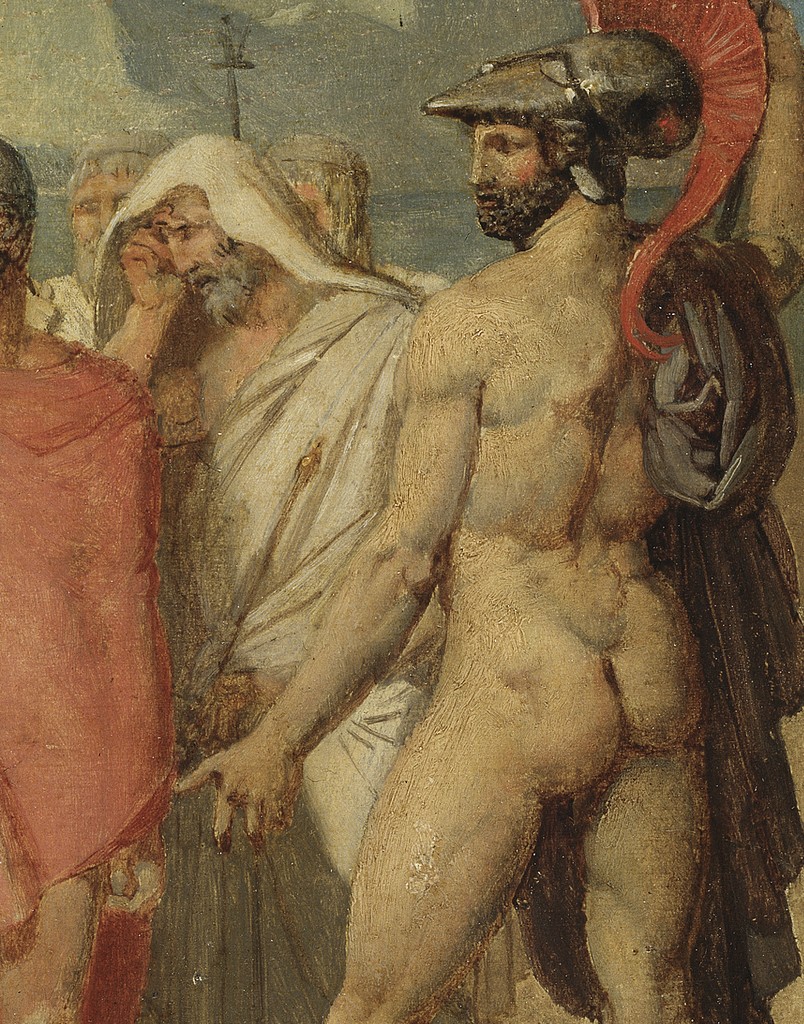
The hooded figure beside the helmeted visitor
A pale hood and robe lie beside the darker helmet and exposed shoulder of the outer visitor. Their different outlines help separate the figures within the closely gathered group.
A young painter’s bid for Rome
Ingres won the Grand Prix de Rome on 29 September 1801. He was twenty-one and had been studying in Paris with Jacques-Louis David since 1797. Earlier in 1801 he had also won the Prix du Torse, awarded for a half-length figure painting. The two successes belong to the same stage of training, when command of an individual body could be developed into the more complex work of arranging a narrative. [3]
The separately conceived Male Torso provides a useful comparison for that training. A figure exercise concentrates attention on pose, bodily structure and the handling of light; a history painting must make such bodies intelligible in relation to one another. In The Ambassadors, a seated hero, an upright companion, a cloaked intermediary, an elderly counsellor and a standing warrior each have a distinct place in the encounter.
“History painting” included subjects from ancient literature and mythology as well as historical events. Here the painter’s task was to make a complex episode readable through figures. The idealised nude bodies give it the elevated appearance associated with classical art; drapery and military equipment distinguish roles; the grouping makes the action available at a glance. These choices help explain the work’s neoclassical character and its place in the training Ingres received with David. [3]
There is an institutional success in the picture’s control of the group, but also a difficult story contained within it. No sword is being swung, no decisive blow struck. The action is an attempt to change another person’s mind. Ingres makes that attempt visible through unequal positions, the interruption of an activity and the space across which a greeting must pass.
The prize did not take him straight to Italy. French state finances delayed the journey, and he remained in Paris with a stipend and a studio. He travelled to Rome in 1806, reaching the Académie de France on 11 October. [3] The painting belongs to the achievement that earned the journey, five years before it happened.
The Beaux-Arts database associates PRP 40 with the 1801 competition but gives 1802 in its creation field, an unresolved discrepancy within the record. [1] The prize date of 1801 is corroborated by the chronology and Delaborde’s early catalogue. [3][4]
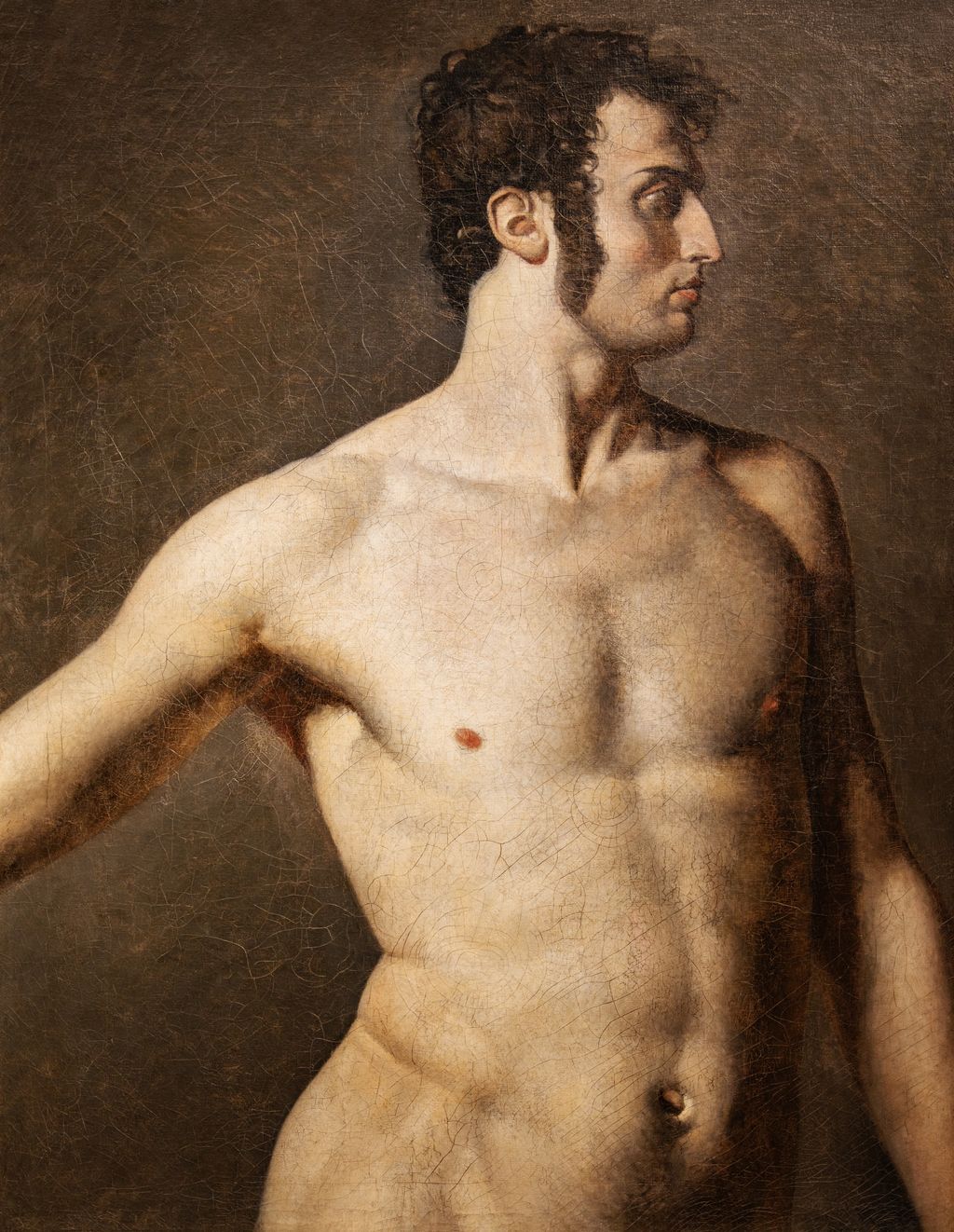
Ingres, Male Torso, c. 1800. [5]
What refusal costs
Once the encounter has been recognised, the arrangement invites a second look. The visitors are friends, and they appeal on behalf of men in danger. Achilles’s grievance has force, but so does the need from which he has withdrawn. Neither claim vanishes because the other exists.
Phoenix develops precisely this difficulty in Book IX. He tells Achilles about Meleager, another warrior who withdrew in anger while his city was threatened. Meleager eventually acted when his wife described the destruction and enslavement that defeat would bring, but his delay cost him the rewards previously offered. Phoenix presents this as a warning against waiting until catastrophe makes action unavoidable. Achilles still resists, asking Phoenix to share his loyalties instead of pleading for Agamemnon. [2]
The story within the story helps explain why the painting’s pause is consequential. The men have not come merely to exchange courtesies. They are trying to prevent the consequences of continued refusal. Yet the visible scene preserves the hospitality that comes before the arguments: Achilles’s bodily response can be read as welcome without being mistaken for surrender. The painting holds together personal regard and political disagreement.
Ajax’s final appeal changes the emphasis again. He rebukes Achilles for remaining unmoved by the people who honour him most. Achilles answers that the injury inflicted by Agamemnon still provokes his anger, and he will not take up the common struggle on the terms proposed. [2] The delegation’s failure is therefore indispensable to the subject. Ingres has painted a moment when agreement is being sought, not the restoration of harmony that the visitors desire.
A separate sketch in Stockholm
Nationalmuseum in Stockholm holds a small oil study for the composition, catalogued as Achilles Receiving in his Tent the Envoys of Agamemnon, inventory NM 2161. Signed 1801, it is painted on wood and measures 25 × 32.5 cm. It later belonged to Edgar Degas and entered Nationalmuseum as a gift from Nationalmusei Vänner in 1919. [6]
Its identity matters when reproductions of the subject circulate under similar titles. The Stockholm work is the small study; the prize-winning canvas is the painting in Paris. A date shared by related works does not make them interchangeable. The difference in support also gives a straightforward way to distinguish the catalogue entries: wood in Stockholm, canvas in Paris. [1][6]
Delaborde’s 1870 catalogue also records a small version of the subject, described as a reduced reproduction that Ingres sent to his father after winning the prize. Delaborde placed it in the possession of M. Combes père in Montauban. [4] That historical notice cannot by itself identify the Stockholm panel. Connecting the two would require evidence tracing one object to the other; the existence of two references to small versions is insufficient.
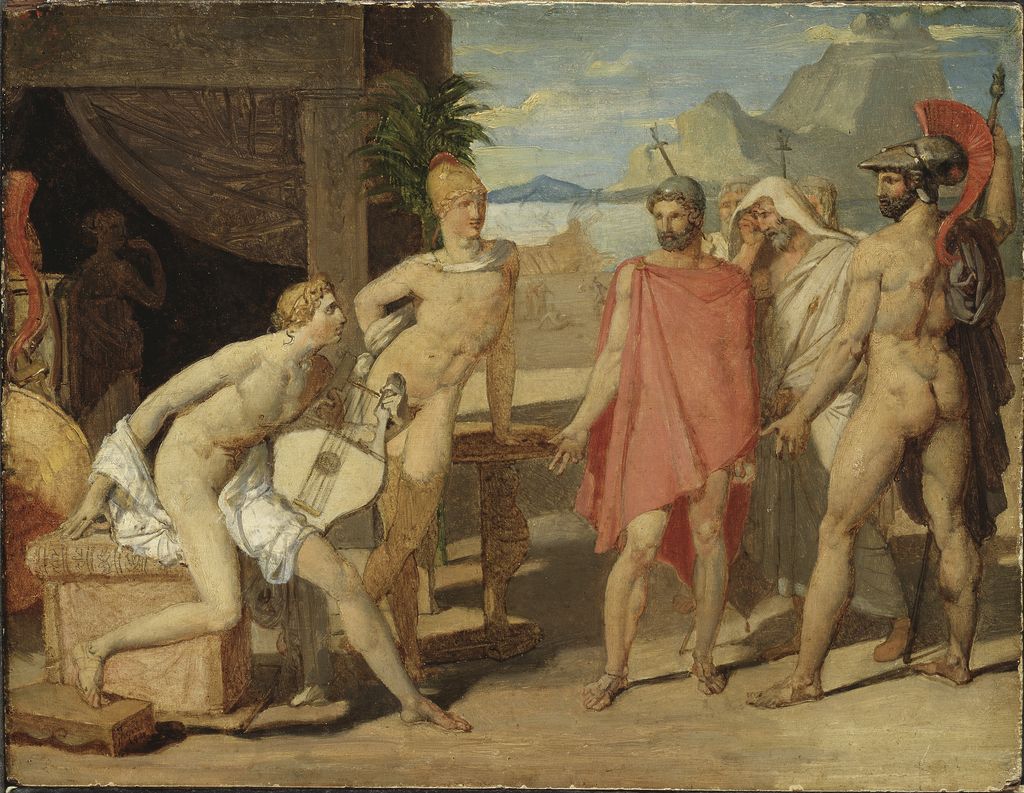
Ingres, Achilles Receiving in his Tent the Envoys of Agamemnon, 1801. Oil on wood, 25 × 32.5 cm. Nationalmuseum, Stockholm, NM 2161. The separate small sketch. [7]
Praise, prints and the painting’s later life
Delaborde’s account offers a vivid story of the young Ingres’s recognition. He reports that John Flaxman, visiting Paris soon after the competition, praised the winning painting enthusiastically. The praise was relayed to Ingres, who remembered it with gratitude. Delaborde then recounts that David heard it too and resented the comparison with contemporary French painting, suggesting that the incident cooled relations between master and pupil. [4]
This is a posthumous account of remarks passed from person to person. It establishes how the story was transmitted in the literature around Ingres, but it cannot securely establish the origin of David’s feelings or explain the whole relationship. The anecdote is more useful as evidence of the painting’s remembered prestige: an early prize canvas could become a touchstone in the later account of the artist’s emergence.
The catalogue’s reproduction history is more concrete. Delaborde records an outline engraving by C. Normand in 1802, published in the third volume of Landon’s Annales du Musée et de l’École moderne des beaux-arts, and another by Réveil in Albert Magimel’s 1851 collection of Ingres’s works. [4] Normand and Réveil translated Ingres’s painted composition into the medium of engraving.
The dates show the composition entering print soon after the competition and appearing again roughly half a century later. An outline engraving carries a painting into a different visual medium: a figure’s boundary and gesture can survive, while the relationship between flesh, red cloak, gold drapery and dark tent changes substantially. Returning from the idea of a linear reproduction to the painted image makes the contribution of colour especially clear.
Delaborde also located the canvas at the school of fine arts. Its present Beaux-Arts de Paris record gives that history a continuing institutional setting. [1][4] The object has a life beyond the moment of winning: it has been retained, catalogued and reproduced as a work through which an early stage of Ingres’s career can be encountered. Readers interested in those changes of medium can follow the wider history of his prints and reproductions.
From Achilles’s music to Homer’s honour
Homer returned on a much grander scale in Ingres’s The Apotheosis of Homer, painted in 1827 for a Louvre ceiling. There the poet sits enthroned before a temple, crowned by a winged Victory, while figures representing the Iliad and Odyssey sit at his feet. Artists and writers assemble around him. [8]
The comparison brings out the particular intimacy of the earlier canvas. The Ambassadors takes one episode from the epic and builds an uncertain human encounter around it. The Apotheosis turns to the authority of the poet and gives that authority a public, ceremonial form. In one, a hero sings the deeds of other heroes while withholding his own strength from the army; in the other, the maker of epic becomes the centre of a gathering devoted to his honour. [2][8]
The comparison shows how much range a sustained engagement with Homer could have. The prize canvas remains compelling at the scale of a few bodies meeting at a tent: a musician interrupted, friends arriving, and an army whose need can be glimpsed beyond them.

Ingres, The Apotheosis of Homer, 1827. [9]
Artworks directory
Explore 150 paintings, drawings and an original lithograph. This selection includes related versions and studies; dates distinguish completed works from later revisions.
| Name | Date | Medium |
|---|---|---|
| The Apotheosis of Homer | 1827 | Painting |
| Grande Odalisque | 1814 | Painting |
| The Turkish Bath | 1859–1862 | Painting |
| Madame Moitessier Seated | 1856 | Painting |
| Portrait of Monsieur Bertin | 1832 | Painting |
| Napoleon I on His Imperial Throne | 1806 | Painting |
| Odalisque with Slave | 1839 | Painting |
| The Ambassadors of Agamemnon in the Tent of Achilles | 1801 (competition) | Painting |
| The Valpinçon Bather | 1808 | Painting |
| The Source | 1856 | Painting |
| Oedipus Explaining the Enigma of the Sphinx | 1808; revised probably before 1827 | Painting |
| The Vow of Louis XIII | 1824 | Painting |
| Antiochus and Stratonice | 1840 | Painting |
| The Comtesse d’Haussonville | 1845 | Painting |
| The Princesse de Broglie | 1851–1853 | Painting |
| Jupiter and Thetis | 1811 | Painting |
| The Dream of Ossian | 1813 | Painting |
| The Martyrdom of Saint Symphorian | 1834 | Painting |
| Venus Anadyomene | 1808–1848 | Painting |
| Portrait of Madame de Senonnes | 1814 | Painting |
| Madame Rivière | 1805 | Painting |
| Mademoiselle Caroline Rivière | 1805 | Painting |
| Portrait of Philibert Rivière | 1805 | Painting |
| Bonaparte First Consul | 1804 | Painting |
| The Death of Leonardo da Vinci | 1818 | Painting |
| Joan of Arc at the Coronation of Charles VII | 1854 | Painting |
| Madame Duvaucey | 1807 | Painting |
| La Belle Zélie | 1806 | Painting |
| Madame Panckoucke | 1811 | Painting |
| Portrait of Charles Marcotte d’Argenteuil | 1810 | Painting |
| Joseph Antoine Moltedo | c.1810 | Painting |
| Madame Leblanc | 1823 | Painting |
| Delphine Ingres-Ramel (Portrait of Madame Ingres) | 1859 | Painting |
| Portrait of Amédée de Pastoret | 1823–1826 | Painting |
| Portrait of Baronne de Rothschild | 1848 | Painting |
| Madame Marcotte de Sainte Marie | 1826 | Painting |
| Madame Gonse | 1852 | Painting |
| Aretino in the Studio of Tintoretto | 1848 | Painting |
| Don Pedro of Toledo Kissing Henry IV’s Sword | 1831/1832 | Painting |
| Raphael and La Fornarina | 1814 | Painting |
| Roger Freeing Angelica | 1819 | Painting |
| Romulus’ Victory over Acron | 1812 | Painting |
| Self-Portrait at the Age of Twenty-Four | 1804; revised 1841–1851 | Painting |
| Male Torso | c.1800 | Painting |
| Odalisque in Grisaille (Ingres and workshop) | c.1824–1834 | Painting |
| The Small Bather | 1826 | Painting |
| The Little Bather Harem Interior | 1828 | Painting |
| Jesus Among the Doctors | 1862 | Painting |
| The Virgin Adoring the Host | 1852 | Painting |
| The Virgin of the Host | 1841 | Painting |
| Virgin of the Adoption | 1858 | Painting |
| Paolo and Francesca | 1814 | Painting |
| Homer Deified (revised composition, Louvre RF5273) | 1865 | Drawing |
| Odalisque with Slave (Louvre RF4622) | 1858 | Drawing |
| Odalisque (Walters Art Museum; Ingres and Paul Flandrin) | 1842 | Painting |
| Madame Moitessier Standing (National Gallery of Art) | 1851 | Painting |
| Jacques-Louis Leblanc (The Metropolitan Museum of Art) | 1823 | Painting |
| Ferdinand-Philippe, Duke of Orléans (Louvre RF2005-13) | 1842 | Painting |
| Ferdinand-Philippe, Duke of Orléans (Versailles MV5207; Ingres and workshop) | 1843 | Painting |
| Ferdinand-Philippe, Duke of Orléans (Versailles MV5209; Ingres and workshop) | 1844 | Painting |
| Antiochus and Stratonice (Musée Fabre; Ingres and Raymond Balze) | 1866 | Painting |
| Antiochus and Stratonice (Kunstmuseum Bern, Gurlitt bequest) | Undated (early dating proposed) | Drawing |
| Composition study for Antiochus and Stratonice (MIB867.2193) | 1806 | Drawing |
| Study for the Figure of Stratonice (Met63.66) | 1834–1840 | Graphite, black chalk and charcoal |
| Nude figure study for Stratonice (Boijmans F II 36 PK) | c.1834–1840 | Drawing |
| Paolo and Francesca (The Barber Institute,54.6) | c.1814–1820 | Painting |
| Paolo and Francesca (The Hyde Collection,1971.24) | c.1855–1860 | Painting |
| Paolo and Francesca (Amsterdam Museum TA10970) | 1820 | Drawing |
| Paolo and Francesca (dedicated to Artaud de Montor) | 1816 | Drawing |
| Study for the Bust of Francesca (MIB867.1398) | 1819 | Drawing |
| Study for the Bust of Francesca (MIB867.1396) | 1819 | Drawing |
| The Archangel Raphael, first idea (MIB867.2488) | 1842 | Drawing |
| The Archangel Raphael (MIB867.2500) | 1842 | Drawing |
| The Archangel Raphael Carrying Human Prayers to God (Chantilly DE513) | 1844 | Drawing |
| Louis-Philippe as Saint Philip, stained-glass study | 1844 | Drawing |
| Marie Frédéric Eugène de Reiset (Ford Collection RBF171-2) | 1844 | Drawing |
| Virgil Reading the Aeneid (Toulouse) | Begun 1811 | Painting |
| Tu Marcellus Eris (Brussels, inv. 1836) | c.1814 (museum dating) | Painting |
| Jean-François Gilibert | 1804 | Painting |
| François-Marius Granet | 1807 (museum dating) | Painting |
| Count Nikolai Dmitrievich Guryev | 1821 | Painting |
| Caroline Murat, Queen of Naples | 1814 | Painting |
| Count Mathieu Molé | 1834 | Painting |
| Cherubini and the Muse of Lyric Poetry (Louvre) | 1842 | Painting |
| Luigi Cherubini (Cincinnati) | 1841 | Painting |
| Comtesse de Rayneval (Louvre RF4505) | 1841 | Drawing |
| Venus on Paphos (Antonie Balaÿ) | c.1852 | Painting |
| Prince Napoléon | 1855 | Painting |
| Study for The Apotheosis of Napoleon I (Petit Palais) | Late 1853 | Painting |
| The Apotheosis of Napoleon I (destroyed ceiling) | 1853 | Painting |
| The Journalist (MIB867.2733) | 1834? | Drawing |
| Henry VIII, after Holbein | c.1815–1820 (?) | Drawing |
| Madame Récamier, after David (MIB867.3637) | Undated (early Paris period) | Drawing |
| Study for Comtesse d’Haussonville (MIB867.259; background possibly by another hand) | 1842–1845 | Drawing |
| La Source (reduced version reported by Delaborde) | Date unrecorded; reported 1870 | Painting |
| Odalisque (autograph lithograph,NGA1946.21.117) | 1825; published1826 | Lithograph |
| Portrait of a Seated Lady | 1814 | Graphite |
| The Kaunitz Sisters (Leopoldine, Caroline, and Ferdinandine) | 1818 | Graphite |
| Portrait of a Man | 1814 | Graphite |
| Study for the Portrait of Louis-François Bertin (1766–1841) | n.d. | Black chalk and graphite |
| Studies for the Cadaver of Acron | ca. 1810–12 | Graphite on wove paper |
| Study for the Drapery of Molière in "The Apotheosis of Homer" | n.d. | Black chalk with stumping |
| Madame Guillaume Guillon Lethière, née Marie-Joseph-Honorée Vanzenne, and her son Lucien Lethière | 1808 | Graphite |
| Niccolò Paganini (1782–1840) | ca. 1830 | Counterproof or tracing strengthened with graphite and gouache on translucent paper |
| Lady Mary Cavendish-Bentinck (?-1843) | 1816 | Graphite |
| Madame Alexandre Lethière and Her Daughter Letizia | ca. 1815 | Graphite |
| Merry Joseph Blondel (1781–1853) | 1809 | Graphite |
| Ursin-Jules Vatinelle (1798–1881) | 1820 | Graphite |
| Bust of a Gypsy Girl (ascribed to Ingres) | 1819 | Graphite on wove paper |
| Study of a Seated Nude Male | n.d. | Graphite |
| The Archangel Raphael (Study for a stained-glass window in the chapel of Notre-Dame de la Compassion-Saint-Ferdinand, Neuilly) | ca. 1842 | Graphite |
| Lancelot-Théodore, comte Turpin de Crissé | probably 1818 | Graphite |
| Study for the Figure of the Iliad in "The Apotheosis of Homer" | ca. 1827 | Graphite and black chalk heightened with white chalk on brown paper |
| Comtesse Turpin de Crissé | probably 1818 | Graphite |
| Nude Figures for L'Âge d'Or, Château de Dampierre | n.d. | Graphite on brownish paper |
| Study of Figures (attributed to Ingres) | n.d. | Graphite |
| Study of Figures (attributed to Ingres) | n.d. | Graphite; squared in graphite |
| Admiral Sir Fleetwood Broughton Reynolds Pellew | 1817 | Graphite on wove paper |
| Madame Jean-Auguste-Dominique Ingres, née Madeleine Chapelle | 1814 | Graphite on off-white wove paper |
| Virgil Reading the Aeneid to Augustus, Livia, and Octavia | 1809/1819 (?) | Pen and black ink, graphite, brush and gray wash, white gouache heightening, Conté crayon on blue paper |
| General Louis-Étienne Dulong de Rosnay | 1818 | Graphite (hard and soft pencils) |
| Madame Alexandre Lethière, née Rosa Meli, and Her Daughter, Letizia | 1815 | Graphite |
| The Lawyer Paul Grand | 1834 | Graphite |
| Jean-Joseph Fournier | 1815 | Graphite |
| Armand Bertin | 1842 | Graphite |
| Madame Armand Bertin, née Marie-Anne-Cécile Dollfuss | 1843 | Graphite |
| The Architect Charles-Victor Famin | 1836 | Graphite |
| Henri Lehmann | 1850 | Graphite |
| Portrait of a Lady | ca. 1815–17 | Graphite |
| Edmond Cavé (1794–1852) | 1844 | Oil on canvas |
| Head of Saint John the Evangelist | probably ca. 1818–20 | Oil on canvas, laid down on wood |
| Madame Edmond Cavé (Marie-Elisabeth Blavot, ca. 1806–1883) | ca. 1831–34 | Oil on canvas |
| Madame Félix Gallois | 1852 | Graphite with touches of gold in oil to highlight jewelry, on buff wove paper. |
| Dr. François Mêlier | 1849 | Graphite with graphite framing lines, corrected with white, on buff wove paper |
| Portrait of Madame Rhode (Rhoda?) | 1810–20 | Graphite on pale buff wove paper |
| Study for "Raphael and the Fornarina"(?) | ca. 1814(?) | Graphite on white wove paper |
| Portrait of Madame Paul Meurice, née Palmyre Granger | ca. 1845–50 | Graphite on wove paper |
| Alexander the Great presenting Campaspe to Apelles | 1810 | Graphite, brush and brown wash; squared in graphite |
| Study of Hands for "Christ Among the Doctors" | 1852–62 | Graphite on tracing paper |
| Study for The Turkish Bath (RF34502) | about 1850 | Pen and brown ink with graphite, partially squared |
| Study for The Turkish Bath (RF23354) | Undated | Pen and brown ink with graphite on joined sheets |
| Study for The Turkish Bath (RF54702) | about 1859 | Pen and brown ink |
| Studies of women for The Turkish Bath (RF12292) | Undated | Black chalk |
| Achilles Receiving the Envoys of Agamemnon (Nationalmuseum sketch, NM2161) | 1801 | Oil on wood |
| Half-Length Bather (Musée Bonnat-Helleu,89) | 1807 | Oil on canvas |
| Oedipus and the Sphinx (National Gallery,NG3290) | about1826 | Oil on canvas |
| Oedipus and the Sphinx (Walters,37.9) | 1864 | Oil on canvas |
| Oedipus and the Valpinçon Bather, after David (MI.867.2035) | Undated | Graphite on tracing paper, after David |
| Study of the Virgin for The Vow of Louis XIII (Dijon,1758) | about1822 | Black chalk, stump and white chalk on brown wove paper |
| First Thought for The Vow of Louis XIII (MI.885.11.21) | 1822 | Oil on canvas |
Frequently Asked Questions
It shows the arrival of the embassy to Achilles in Book IX of the Iliad. The visitors hope to persuade him to return to the fighting after his quarrel with Agamemnon. They find him occupied with music, with Patroclus present. [2]
Achilles sits at the left with the lyre, and Patroclus stands behind him. The approaching delegation consists of Odysseus in the red cloak, the elderly Phoenix and the helmeted Ajax at the right. Agamemnon is the sender of the embassy, not a figure standing in the tent. [2]
No. In Book IX he welcomes and feeds them but refuses their appeals. Phoenix stays overnight, while the other ambassadors return to the army with the unsuccessful result. [2]
He won in 1801, but a shortage of state funds delayed his departure. He travelled to Rome in 1806. [3]
Discussion
Look again at the images and ideas explored in The Ambassadors of Agamemnon in the Tent of Achilles. These editorial prompts invite your observations.
Reader Insights
Look from the lyre to the visitors’ hands, then through the opening towards the camp. Which part of the painting makes the strongest claim on Achilles: his private occupation, his friends or the distant army? Does his turning body suggest an opening for persuasion, or simply the courtesy of a welcome?
Compare Achilles’s turned body with Oedipus addressing the Sphinx. What can a speaking hand or a braced leg convey before the story is explained?
Which details distinguish the intimate encounter in the tent from the larger conflict beyond it?
Join the Conversation
Share a detail, comparison or question about The Ambassadors of Agamemnon in the Tent of Achilles below.
References
- Beaux-Arts de Paris, Achille recevant les ambassadeurs d’Agamemnon. PRP 40. View source.
- Homer, translated by Alexander Pope. The Iliad of Homer. Book IX, “The Embassy to Achilles”: Nestor’s advice; Agamemnon’s offer; the arrival, meal, speeches and unsuccessful return. Project Gutenberg eBook 6130. The English translation is used for the narrative account, not identified as Ingres’s source edition. View source.
- Rebecca A. Rabinow, “Chronology”, in Gary Tinterow and Philip Conisbee, eds., Portraits by Ingres: Image of an Epoch. New York: The Metropolitan Museum of Art, 1999, pp. 545–546: Paris training, the 1801 prizes and the delayed journey to Rome in 1806. View source.
- Henri Delaborde, Ingres, sa vie, ses travaux, sa doctrine, d’après les notes manuscrites et les lettres du maître. Paris: Henri Plon, 1870, catalogue nos. 37–38, pp. 212–214: prize canvas, engravings, transmitted Flaxman–David anecdote and small version sent to Ingres’s father. (in French) View source.
- Supporting image. Ingres, Male Torso. Musée Ingres Bourdelle; Photograph: Didier Descouens (Archaeodontosaurus); Wikimedia Commons. Image source. Public domain.
- Nationalmuseum, Achilles Receiving the Envoys. NM 2161. View source.
- Supporting image. Achilles sketch. NM 2161. Wikimedia Commons. Image source. Public domain.
- Musée du Louvre, Homère déifié, dit aussi L’Apothéose d’Homère. Collection record, INV 5417; 1827, iconography and original Louvre ceiling commission. (in French) View source.
- Supporting image. Ingres, The Apotheosis of Homer, 1827. Photograph: Shonagon; Wikimedia Commons, 2025. Image source. Public domain.
- Splash image. Achilles and the Ambassadors. PRP 40. Wikimedia Commons. Image source. Public domain.