by Tom Gurney
Tom Gurney BSc (Hons) is an art history expert with over 20 years experience
Published on June 19, 2020 / Updated on October 22, 2026
Email: tomgurney1@gmail.com / Phone: +44 7429 011000
Napoleon I on His Imperial Throne
Napoleon’s pale face seems almost suspended inside his coronation robes. Gold embroidery spreads across red velvet; ermine pools over the throne; two long staffs bracket the seated figure. The emperor looks straight at us, while the immense circular chair back gives his head a second, larger crown. In Napoleon I on His Imperial Throne, signed 1806, Ingres made the equipment of sovereignty so commanding that the man wearing it becomes strangely difficult to grasp. [1]
The portrait offers a difficult encounter between a particular face and an overwhelming arrangement of things. Its early reception was no less divided between admiration for skilled execution and objection to the whole effect. Lapauze’s historical account reproduces criticism that acknowledged the painter’s ability while attacking his choices. [2] The dispute sends us back to the objects, the pose and the relation between them, rather than supplying a single verdict with which to begin.
At a Glance
- ArtistJean-Auguste-Dominique Ingres.
- Date1806.
- MediumOil on canvas.
- SizeAbout 2.60 × 1.63 metres.
- CollectionMusée de l’Armée, Paris; inventory 4; Ea 89/1.
- SubjectNapoleon in coronation regalia, seated frontally on an imperial throne.[3]
- First public exhibitionParis Salon of 1806.[1]
- Original commissionUnresolved.[4]
This work across Ingres’s career
Agamemnon’s Ambassadors
1801 (competition)Grande Odalisque
1814Louis XIII’s Vow
1824Monsieur Bertin
1832The Princesse de Broglie
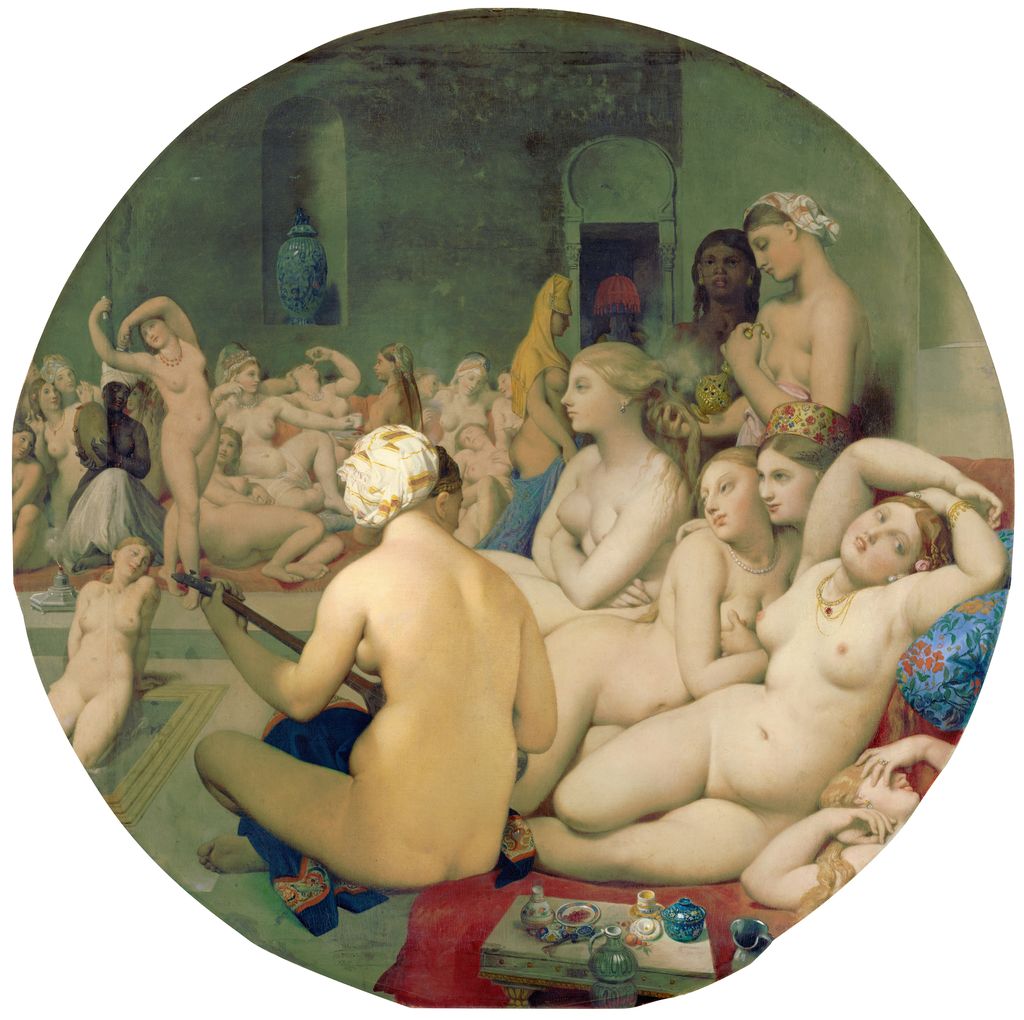
1851–1853The Turkish Bath
1859–1862Contents
- A face inside an empire of objects
- A new emperor looking for a past
- The regalia: ancient authority made present
- How Ingres built an image of majesty
- What the polished surface does
- Why the portrait troubled viewers in 1806
- Between a modern statesman and an enthroned god
- From the Palais Bourbon to the Invalides
- Annotated details
A face inside an empire of objects
Begin with the face, then let your eye move outwards. The laurel wreath closes around Napoleon’s short dark hair. A white lace collar separates his head from the broad expanse of ermine below it. Beyond that comes the great sweep of the throne back, filled with gilded patterns. These successive enclosures make the face the centre of attention while emphasising how little of the canvas it occupies.
His gaze is direct, his lips closed. Almost everything that would reveal the body’s structure disappears beneath clothing. We can see a raised arm, a resting hand and one elaborately decorated shoe, but we have to imagine the connections between them. The robe seems to possess a shape and weight of its own. It swells across the lap, drops in deep folds and gathers at the floor, turning the seated body into a broad, nearly pyramidal mass.
The arrangement is strongly balanced without being mechanically symmetrical. Napoleon’s right arm, on our left, lifts the sceptre almost to the top of the canvas. His other hand rests lower down beside the sword, while the staff carrying the hand of Justice runs diagonally upwards. One ivory ball on the throne catches bright light; its partner recedes into shadow. The right side of the mantle spreads into a long white-lined train, whereas the raised arm opens the red fabric on the left. These differences keep the rigid pose from becoming a diagram.
The chair contributes as much as the clothing to the sensation of majesty. Its round back rises like an enormous disc behind the head, while the globes and carved supports establish a second frame around the body. Look at the gap between the face and that outer enclosure. The eye has to cross a wide field of ornament before reaching the edge of the throne. Furniture becomes a means of making the sitter seem both central and remote.
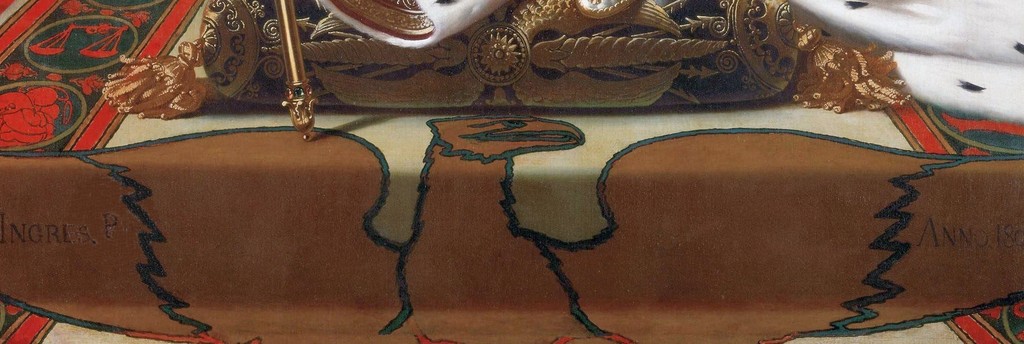
At the bottom, the carpet offers a different kind of encounter. Its border turns towards us, and an eagle spreads its wings across the foreground. We look slightly down at the floor but almost directly into Napoleon’s eyes. The carpet gives us a route towards the throne; the frontal figure stops that movement. We can approach the surface of the picture with our eyes, following tassels and embroidery, without ever feeling that we have entered an ordinary room. That tension is central to the portrait’s effect. The individual things are intensely tangible, but the whole arrangement feels ceremonially inaccessible. The small pale head supplies the likeness; the fabric, furniture and regalia supply the scale of power.
Annotated Details from Napoleon I on His Imperial Throne
The numbered points identify visible features discussed in this article. Return from each detail to the whole composition. Napoleon enthroned. Image source. CC0 / Public domain.
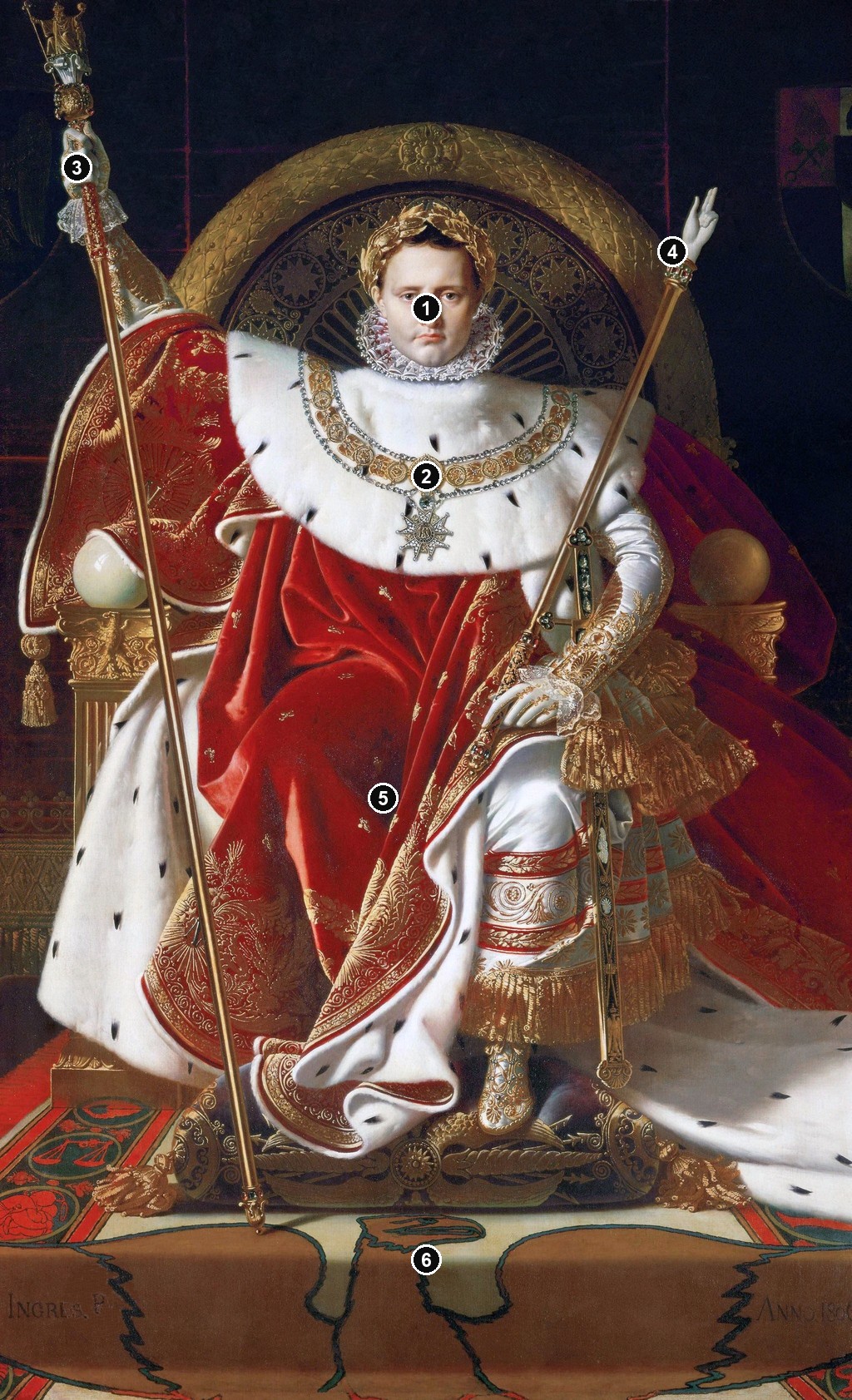
Details from NAPOLEON I ON HIS IMPERIAL THRONE
Look from the central face to the surrounding emblems, fabrics and objects, then return to the complete portrait.
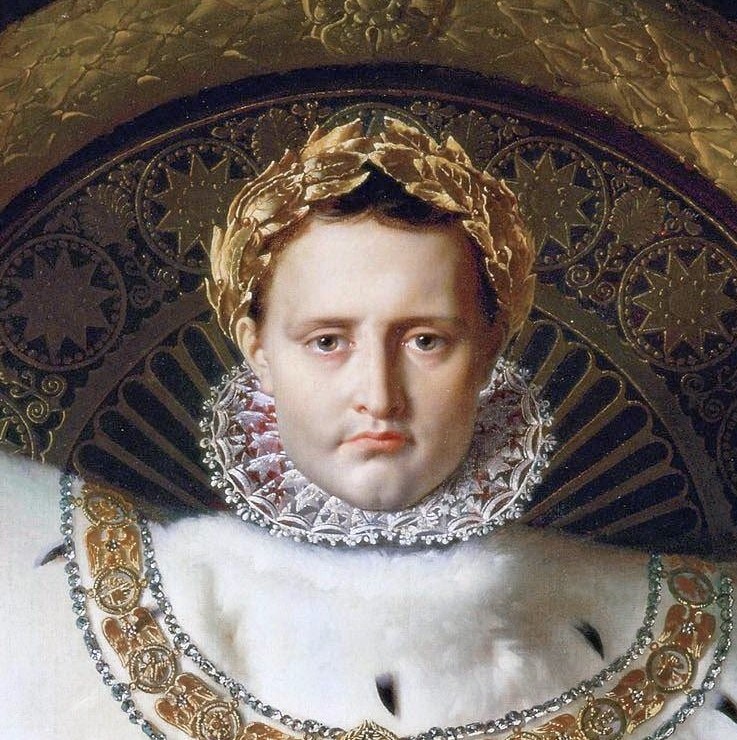
The face within the throne
The pale face lies inside successive arcs of leaves, lace and gold. Compare the almost level eyes with the many radiating lines in the back of the throne.
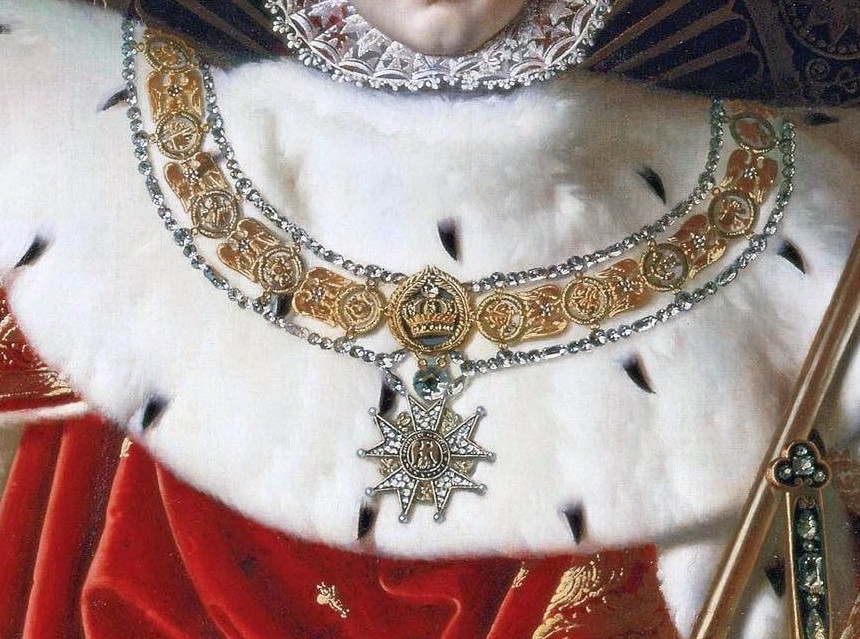
The chain across the ermine
The gold chain descends across a broad white field. Small dark marks in the fur and the hanging decoration introduce repeated accents around the centre of the chest.
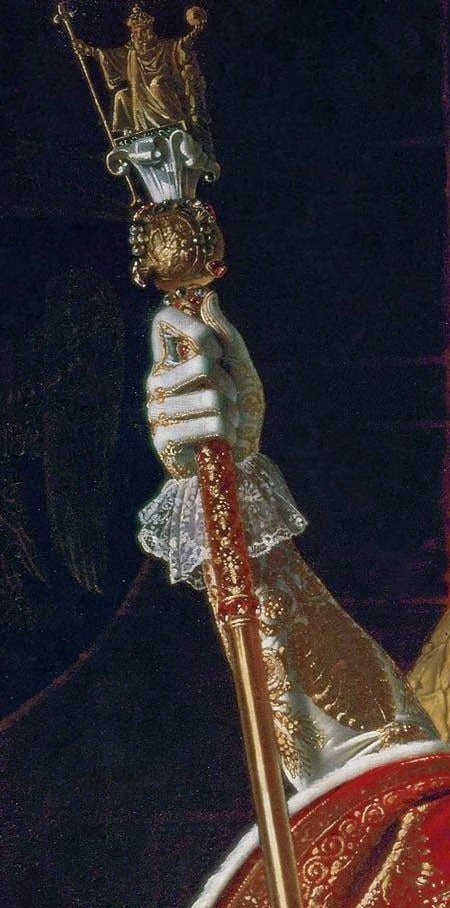
The raised sceptre and glove
The tall ornament and the gloved hand form a narrow upright along the left edge. Gold, white fabric and bright stones make several distinct surfaces within this small area.
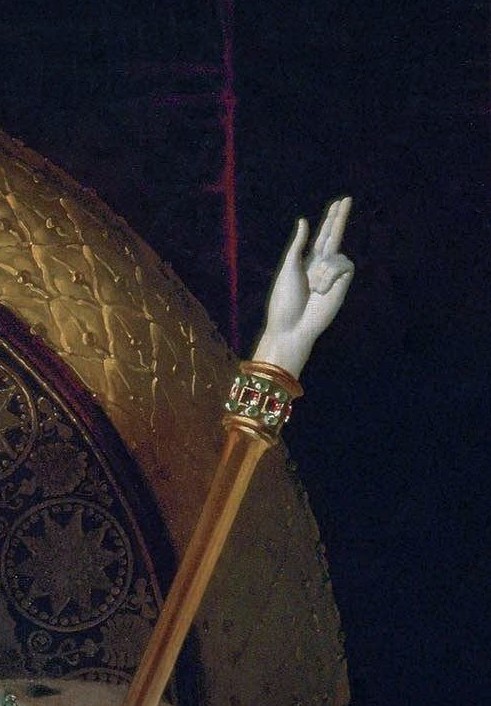
The white hand above the rod
A small white hand crowns the diagonal rod at the right. Its raised fingers make a sharp silhouette against the dark background, above the patterned cuff.
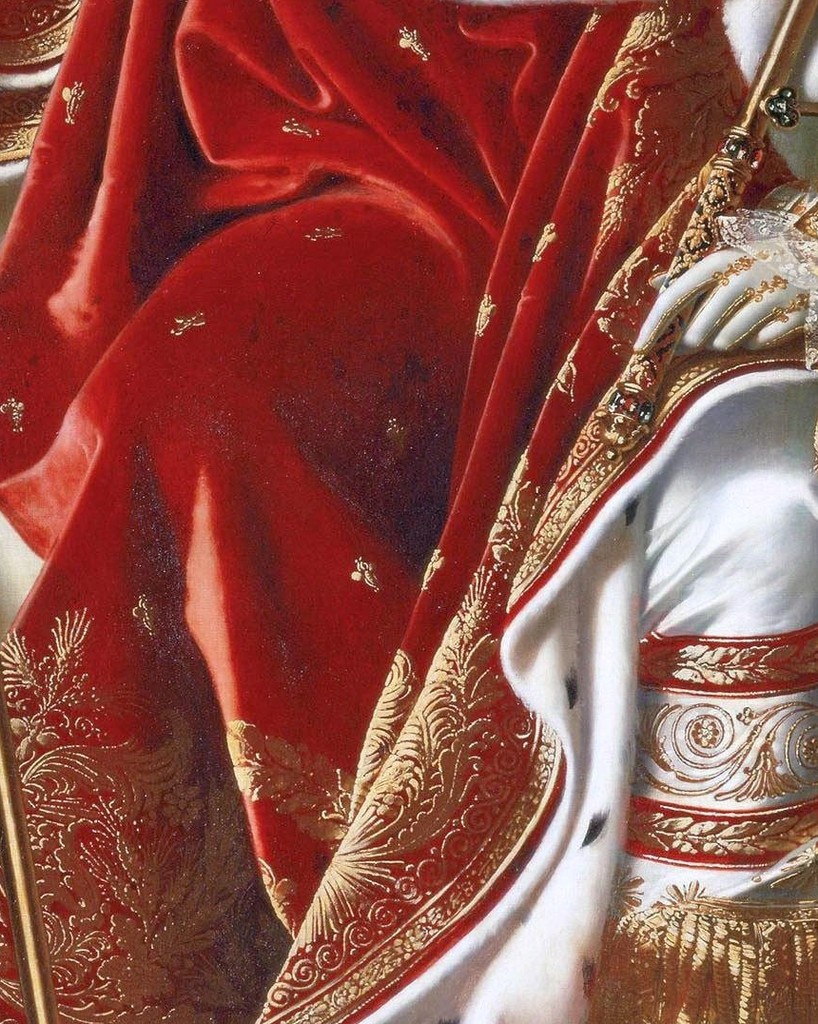
Gold motifs across the red robe
Small gold motifs recur across the red folds. Larger embroidered borders turn around the cloth, making the weight and direction of the robe easier to follow.
The eagle on the carpet
The eagle’s head rises between broad wing shapes across the foreground carpet. Dark outlines distinguish the pale form from the surrounding ground beneath the throne.
A new emperor looking for a past
The Fondation Napoléon dates the coronation at Notre-Dame to 2 December 1804. [5] This later portrait represents him in coronation costume. It is a composed image of sovereignty, rather than a record of a particular instant during the ceremony. The stillness, direct gaze and carefully spread robes ask to be considered together: they arrange the ruler for a continuing encounter with the spectator.
What kind of authority does that arrangement ask us to recognise? The painter gives the objects exceptional room. They frame the head, cross the clothing and reach above it, making a web of forms around a body largely hidden from view. The material splendour can seem to magnify the person, yet it also makes his physical presence harder to grasp. The image holds both possibilities in tension.
A comparison reproduced in the 1999 catalogue makes the choices particularly clear: David’s imperial portrait study presents a standing figure beside the throne. [4] In that image, a visible leg and the raised arm give the body a more immediately readable structure. Ingres’s seated figure gathers the robes into a broad mass. The difference is something to examine across the two arrangements, rather than an explanation that one artist simply borrowed a complete solution from another.
In the standing study, the throne remains a separate object with its own curve, placed beside a figure whose height we can follow. Here, the huge circular back rises directly around Napoleon. The seat seems to contain the person, costume and insignia within one encompassing form. That relationship makes the picture’s stillness more insistent. Our eye can travel through a standing figure, but it repeatedly returns to the centre of this seated one.
Who commissioned the portrait?
Conisbee leaves the original commission unresolved. [4] The distinction between a commission and a later purchase is consequential: an institution can find a use for an image it did not originally order. The face, robes and throne themselves cannot identify the first intended patron. The picture’s present authority should therefore be kept separate from the question of how its making was initially arranged.
The Musée de l’Armée proposes an Italian destination from the background arms. [3] That remains a hypothesis, rather than the name of a patron. The qualification matters because a small painted emblem can guide an enquiry without settling the history of the entire canvas. It would take more than a plausible reading of that detail to prove who ordered the portrait or how the painter expected it to be used.
The Fondation Napoléon records its purchase by the Corps Législatif on 26 August 1806 for the president’s reception room. [5] That supplied an official setting for the encounter with the painted emperor. A viewer approaching the portrait there would have met an image already assigned a ceremonial function. The purchase establishes a use for the finished work; it cannot, by itself, resolve the circumstances in which Ingres began it.
The distinction matters. A purchase by a major institution demonstrates that the picture found an official function; it does not establish who first conceived its destination. Nor does it prove that Napoleon sat to Ingres for this portrait. The portrait’s imposing authority coexists with an unresolved history of its origins.
The regalia: ancient authority made present
The Fondation Napoléon connects the laurel and purple with Rome and identifies the Légion d’honneur collar. [5] The museum identifies the bees and eagle as imperial emblems. [3] Those names help distinguish the objects within the crowded arrangement. Their visual relationships remain just as important: gold cuts across white fur, repeated insects break up the velvet, and the crown supplies an irregular edge close to the small pale face.
The teaching sheet connects the bees with insects found in Childeric’s tomb. [6] A repeated ornament thus carries a historical claim as well as a decorative effect. Look at how widely the motif spreads across the cloth. Its small scale lets it recur without breaking the robe into separate compartments; an emblem becomes a pattern, accompanying the eye as it moves over the larger folds.
Look at the difference between the crown and the collar. The gold leaves make a sharp, irregular fringe against Napoleon’s hair. The chain describes a heavy curve across a soft field of fur. One points back to antiquity; the other makes honour look like an object that can be worn, weighed and displayed. Both draw the eye towards the head, but their materials work very differently.
A sceptre containing another emperor
Conisbee identifies the sceptre of Charles V, topped by an enthroned Charlemagne. [4] At the end of the long shaft, a tiny seated figure echoes the much larger figure beneath it. The repetition makes the staff more than a vertical line. A small image of sovereignty has been placed inside a large one, with Napoleon’s hand providing the visible link between them.
The detail rewards a second look. At first, the staff helps balance the long diagonal on the other side. Closer attention finds a miniature body within the ornament. The scale of looking changes: the object that seemed to frame the emperor becomes a small figure to inspect in its own right. Its precision asks the eye to pause high above the sitter’s face before returning down the shaft to his hand.
The hand of Justice and the remaking of tradition
The other staff ends in the hand of Justice. The Louvre identifies the hand remade for the coronation as Biennais’s work. [7] The pale fingers stand out sharply against the darker surrounding forms. Their gesture is legible at a distance, yet the rings and surrounding ornament reward attention close to the painted surface. The object joins a clear sign to an elaborate material presence.
A newly made object can carry the appearance of inherited authority. That difference between age and appearance matters when looking at a picture so crowded with ceremonial forms. Paint gives the objects a shared present, bringing them into one encounter even when their histories differ. The viewer has to look beyond the apparent unity of the costume to ask what each part claims to represent.
The Fondation Napoléon identifies an allusion to Joyeuse in the sword’s design. [5] Its straight edge supplies a contrast to the pliable cloth around it. The weapon appears partly contained within the robe’s spread, while the nearby hand rests among folds and brilliant surfaces. Looking at the relation between those forms keeps the object attached to the body that carries it, even as the costume makes that body difficult to follow.
How Ingres built an image of majesty
Conisbee discusses tracings after older printed images among the preparatory material. [4] The illustrated sheets let us compare ways of isolating a figure or an object from a larger setting. They do not form a continuous record of every stage of the canvas. Their usefulness lies in the particular decisions they make visible: a contour followed, an attribute separated out, a seated form made available for another arrangement.
One reproduced engraving gives a seated figure a strong central axis, with a raised arm and a long staff. The enclosing oval makes the grouping especially compact. Compare that small, self-contained arrangement with the expanse of cloth around Napoleon. A similar concern with a commanding central presence can serve very different proportions and surfaces. The comparison is formal; it does not prove that a single image supplied every part of the painting.
A reproduced tracing sets another frontal figure inside a narrow rectangular structure, flanked by smaller figures and framed by ornament. The repeated verticals make the central position emphatic. In the imperial portrait, the chair back and long staffs establish a different enclosure, wider and more circular. Looking between these arrangements makes the central figure’s relation to its frame a practical compositional question, as well as a question of symbolism.
The sheets of regalia work at a smaller scale. A hand, a staff and a small seated figure can be followed as separate outlines before we encounter them among the painted folds. Their isolation makes their shapes easier to compare. It also shows a limit of the evidence: a careful drawing of an object does not tell us how every passage of the large canvas was painted, or establish the order in which all its effects were achieved.
A Northern European presence
The Fondation Napoléon compares the portrait with the Ghent Altarpiece, then available in Paris. [5] Its reproduced enthroned figure offers a comparison between a remote presence and a surface dense with material detail. In Napoleon’s picture, too, the central face occupies only a small part of a wide assembly of cloth and ornament. Close scrutiny of individual things coexists with an arrangement that holds the principal figure apart from ordinary movement.
The comparison is especially useful because it joins composition to surface. A remote, enthroned presence can coexist with intensely observed jewels, textiles and reflected light. Ingres’s painting likewise invites scrutiny of tiny material distinctions while holding its principal figure apart from ordinary bodily action. This affinity helps us see the portrait’s effects without requiring a single source for its whole design.
This kind of comparison has a useful limit. Similarities in frontality, enclosure and finish need not make one image a complete explanation of another. The spectator can move between the two while continuing to ask what Ingres’s particular chair, clothing and small face do together. The borrowed or comparable form becomes a starting point for looking, rather than a substitute for examining the painted relationships.
Raphael at the emperor’s feet
The Louvre identifies the carpet motif with Raphael’s Madonna della Sedia. [7] The mother-and-child grouping has become a small part of the furnishing beneath the emperor. At that scale, the motif can first register as ornament. Recognition then gives it another identity, introducing a figure group within the much larger arrangement of the portrait.
The detail changes the scale at which we look. From a distance, the border contributes to the carpet’s richness. Closer attention separates the little grouping from the surrounding pattern. The viewer moves from an encompassing display to a small image inside it, then back to the whole. That shift gives the foreground an activity of its own, even though the emperor remains immobile above it. The range of these borrowings is itself revealing. Ingres combined published models, ceremonial objects, admired paintings and his own arrangements. A portrait intended for a specific political present acquired a remarkably expansive visual past.
What the polished surface does
Follow the edge of the mantle across Napoleon’s knees. A narrow band of gold embroidery marks its turn, while white lining curls out beneath it. The cloth seems both heavy and pliable. Nearby, the sword remains straight, its hard edge interrupting the soft folds. The pale glove rests among these competing textures, its fingers made unusually conspicuous by the dark and brilliant objects around them.
The painting’s richness depends on such differences. A highlight on metal behaves differently from a glint on a jewel or a pale patch on fur. Lace breaks into small points against dark hair and red cloth. The ermine’s black markings interrupt wide areas of white; the bees form a finer scatter across the velvet. Ingres gives each material a distinctive visual rhythm.
Conisbee also notes tiny reflections in the globe and gilding. [4] Bright patches make those hard surfaces appear responsive to things around them, rather than merely coloured emblems. The eye can pause at a small light, then follow a curve back towards the throne or the robes. Such accents give the still composition a succession of local encounters.
They also complicate the portrait’s compressed space. There is enough observational information to make a reflective surface convincing, even when the arrangement as a whole refuses easy spatial depth. Close attention and formal abstraction work together. The same spectator can be persuaded by a polished ball and unsettled by the relation between Napoleon’s head, shoulders and enormous robe.
The polished finish rewards both distant and close viewing. Seen as a whole, the robes create a massive red-and-white silhouette. Examined more slowly, that mass separates into fur, velvet, lace, embroidery and jewels. The image’s ceremonial stillness contains a great deal of activity for the eye.
Why the portrait troubled viewers in 1806
The report reproduced by the Fondation Napoléon questions the likeness and prospects at court. [5] The problem involved more than the painter’s ability to finish a surface. A portrait could command admiration for particular passages while still appearing unsuitable as the ruler’s public image. The distinction remains useful when looking at the face surrounded by its immense costume: precision in individual things does not ensure that the whole effect will persuade every viewer.
Official use and critical objection therefore need to be kept in view together. Neither the purchase nor the reservations provide a verdict shared by everyone involved. A ceremonial picture could acquire a place and a function while its way of presenting the sitter remained disputed. Its authority was something the painting attempted to establish, rather than something every contemporary spectator automatically recognised.
The charge of making art go backwards
Lapauze’s historical account reproduces attacks on the portrait alongside acknowledgements of Ingres’s skill. Chaussard objected to the painter’s pursuit of singularity and to his departure from the path of established masters. Other criticism questioned the compressed figure and pale head. [2] These accounts distinguish a practised brush from a persuasive picture. The very qualities that attracted attention could become grounds for denying the success of the whole.
The objections also expose different expectations about the work of detail. A sharp distinction between cloth and metal might reward scrutiny, yet still fail to make the body convincing. The painting invites a viewer to move from one local effect to another while keeping the emperor almost immobile. Shelton’s reception study places such judgements within contemporary ideals of painting. [8] Looking at a precious surface was not necessarily the same as endorsing the image it helped construct.
The Publiciste review reproduced by Lapauze praises Lefèvre’s standing imperial portrait before attacking Ingres’s. [2] That comparison gives the criticism a concrete alternative. Viewers were not merely deciding whether they liked a pale face or a richly painted robe; they could set different presentations of the emperor beside each other. The existence of another solution made Ingres’s choices appear especially deliberate, whether those choices prompted admiration or resistance.
Lapauze records the charge that Ingres was “Gothic”, associating the work with an art his opponents wanted him to leave behind. [2] The word carries a judgement within that dispute. It does not give us a precise explanation of every old form or carefully rendered accessory in the picture. The criticism is most informative when returned to the particular features it condemned: the pose, the pale colouring, the enclosed body and the insistence on small things.
A political problem within a political portrait
Conisbee, following Siegfried, reads the reception against a move from Charlemagne imagery towards contemporary military leadership. [4] This is a political interpretation of the picture’s circumstances. It supplies a reason to question whether an image so rich in historical authority could nevertheless seem ill suited to its moment. The distinction between the amount of symbolism and the effect of that symbolism is central to the argument.
That reading should not be made into the unrecorded thought of every official or critic. The painting gives us a particular balance of face, body, clothing and objects; the historical argument asks how that balance might have been understood. A small, restrained face within an enormous ceremonial enclosure can support more than one response. The same stillness can appear commanding to one viewer and remote to another.
Conisbee notes that Chaussard supported the Empire. [4] Political sympathy therefore did not guarantee approval of its painted representative. A viewer could endorse the ruler while questioning the means used to make him present. The dispute concerned the forms through which power should be seen, as well as the success of the painter’s drawing, colour and material effects.
Ingres had already left for Italy
Ingres left Paris before the Salon opened on 15 September 1806 and reached Rome on 11 October. [9] The hostile reviews reached him in Italy; they did not cause his departure from Paris. Keeping that order clear prevents an attractive but misleading story in which public rejection immediately sends the painter abroad.
Lapauze reproduces Ingres’s letters to the Forestier family. A message from Florence on 5 October asks for frank reports of the reception; the letter of 22 October expresses his distress and anger at criticism reaching him in Rome. [2] These are the painter’s reactions transmitted through a later editor. They let us hear his sense of injury without making his interpretation of every opponent’s motive an established fact.
The criticism reproduced by Lapauze reaches beyond the imperial portrait to other likenesses, including Ingres’s self-portrait. [2] The encounter with the Salon therefore involved more than one experiment in presenting a person. The imperial subject made the question of public authority particularly conspicuous, but it belonged to a wider difficulty over how this young painter’s finished pictures should be judged.
Between a modern statesman and an enthroned god
Compare the earlier Bonaparte First Consul with the imperial portrait. The standing figure, the placement of the hands and the relation between body and furnishing make the change of presentation clear. In the later image, the robe spreads much farther across the spectator’s field of view. The face is contained by a chair that seems almost too large to belong to an ordinary encounter between people.
The change is therefore more specific than an artist suddenly discovering detail. The earlier work offered a model for presenting a contemporary political figure; the imperial image gave older types of enthroned sovereignty much greater weight. The robe’s immense spread and the encircling throne make an office appear almost larger than the person who occupies it.
The Musée Granet dates Jupiter and Thetis to 1811. [10] Its large seated figure offers another comparison with Napoleon’s frontality. Look at the breadth of the torso, the raised arm and the relation of the head to the enclosing space. The paintings organise the body differently, but each makes a central presence emphatic through the shapes around it. A comparison between them can remain precise without turning the emperor into a simple code for the god.
This traffic between genres is part of what makes the imperial portrait difficult to categorise. It has the particular face and sumptuous possessions of a ceremonial likeness, yet it also attempts the concentrated authority of a sacred or mythological image. The historical borrowings are active ingredients in its strangeness.

Ingres, Bonaparte First Consul, 1804. [11]

Ingres, Jupiter and Thetis, 1811. [12]
From the Palais Bourbon to the Invalides
The Fondation Napoléon traces the portrait from the Corps Législatif to the royal collections, then to the Invalides in 1832. [5] Delaborde’s 1870 catalogue locates it at the Invalides. [1] These records give the picture an institutional history beyond its first public dispute. A change of setting also changes the circumstances in which a spectator meets the painted figure.
The posthumous exhibition catalogue of 1867 lists the portrait as no. 102, identifying its 1806 signature and the Invalides. [13] That is evidence for a particular later appearance. It should not become a story of uninterrupted public familiarity, but it also prevents the picture’s reception from being compressed into a single event at the Salon.
Eric Bertin’s corrections confirm an uncatalogued Paris exhibition in 1935 and reject the earlier catalogue’s 1900 entry. [14] The correction is a useful reminder that an exhibition list can change with research. Several dates in a modern sequence are not interchangeable evidence: each refers to a particular occasion, and each needs to be considered on its own terms.
The painting’s present familiarity can make its original difficulty hard to recover. Reproductions often flatten its material ambition into an emblem of Napoleon, easily recognised at a glance. Sustained looking restores a less settled experience. The almost fragile pale face sits within a vast architecture of cloth and gold; convincing things inhabit a space that feels deliberately remote. Its power remains bound to those tensions, the very qualities that made so many of its first reviewers uneasy.
Artworks directory
Explore 150 paintings, drawings and an original lithograph. This selection includes related versions and studies; dates distinguish completed works from later revisions.
| Name | Date | Medium |
|---|---|---|
| The Apotheosis of Homer | 1827 | Painting |
| Grande Odalisque | 1814 | Painting |
| The Turkish Bath | 1859–1862 | Painting |
| Madame Moitessier Seated | 1856 | Painting |
| Portrait of Monsieur Bertin | 1832 | Painting |
| Napoleon I on His Imperial Throne | 1806 | Painting |
| Odalisque with Slave | 1839 | Painting |
| The Ambassadors of Agamemnon in the Tent of Achilles | 1801 (competition) | Painting |
| The Valpinçon Bather | 1808 | Painting |
| The Source | 1856 | Painting |
| Oedipus Explaining the Enigma of the Sphinx | 1808; revised probably before 1827 | Painting |
| The Vow of Louis XIII | 1824 | Painting |
| Antiochus and Stratonice | 1840 | Painting |
| The Comtesse d’Haussonville | 1845 | Painting |
| The Princesse de Broglie | 1851–1853 | Painting |
| Jupiter and Thetis | 1811 | Painting |
| The Dream of Ossian | 1813 | Painting |
| The Martyrdom of Saint Symphorian | 1834 | Painting |
| Venus Anadyomene | 1808–1848 | Painting |
| Portrait of Madame de Senonnes | 1814 | Painting |
| Madame Rivière | 1805 | Painting |
| Mademoiselle Caroline Rivière | 1805 | Painting |
| Portrait of Philibert Rivière | 1805 | Painting |
| Bonaparte First Consul | 1804 | Painting |
| The Death of Leonardo da Vinci | 1818 | Painting |
| Joan of Arc at the Coronation of Charles VII | 1854 | Painting |
| Madame Duvaucey | 1807 | Painting |
| La Belle Zélie | 1806 | Painting |
| Madame Panckoucke | 1811 | Painting |
| Portrait of Charles Marcotte d’Argenteuil | 1810 | Painting |
| Joseph Antoine Moltedo | c.1810 | Painting |
| Madame Leblanc | 1823 | Painting |
| Delphine Ingres-Ramel (Portrait of Madame Ingres) | 1859 | Painting |
| Portrait of Amédée de Pastoret | 1823–1826 | Painting |
| Portrait of Baronne de Rothschild | 1848 | Painting |
| Madame Marcotte de Sainte Marie | 1826 | Painting |
| Madame Gonse | 1852 | Painting |
| Aretino in the Studio of Tintoretto | 1848 | Painting |
| Don Pedro of Toledo Kissing Henry IV’s Sword | 1831/1832 | Painting |
| Raphael and La Fornarina | 1814 | Painting |
| Roger Freeing Angelica | 1819 | Painting |
| Romulus’ Victory over Acron | 1812 | Painting |
| Self-Portrait at the Age of Twenty-Four | 1804; revised 1841–1851 | Painting |
| Male Torso | c.1800 | Painting |
| Odalisque in Grisaille (Ingres and workshop) | c.1824–1834 | Painting |
| The Small Bather | 1826 | Painting |
| The Little Bather Harem Interior | 1828 | Painting |
| Jesus Among the Doctors | 1862 | Painting |
| The Virgin Adoring the Host | 1852 | Painting |
| The Virgin of the Host | 1841 | Painting |
| Virgin of the Adoption | 1858 | Painting |
| Paolo and Francesca | 1814 | Painting |
| Homer Deified (revised composition, Louvre RF5273) | 1865 | Drawing |
| Odalisque with Slave (Louvre RF4622) | 1858 | Drawing |
| Odalisque (Walters Art Museum; Ingres and Paul Flandrin) | 1842 | Painting |
| Madame Moitessier Standing (National Gallery of Art) | 1851 | Painting |
| Jacques-Louis Leblanc (The Metropolitan Museum of Art) | 1823 | Painting |
| Ferdinand-Philippe, Duke of Orléans (Louvre RF2005-13) | 1842 | Painting |
| Ferdinand-Philippe, Duke of Orléans (Versailles MV5207; Ingres and workshop) | 1843 | Painting |
| Ferdinand-Philippe, Duke of Orléans (Versailles MV5209; Ingres and workshop) | 1844 | Painting |
| Antiochus and Stratonice (Musée Fabre; Ingres and Raymond Balze) | 1866 | Painting |
| Antiochus and Stratonice (Kunstmuseum Bern, Gurlitt bequest) | Undated (early dating proposed) | Drawing |
| Composition study for Antiochus and Stratonice (MIB867.2193) | 1806 | Drawing |
| Study for the Figure of Stratonice (Met63.66) | 1834–1840 | Graphite, black chalk and charcoal |
| Nude figure study for Stratonice (Boijmans F II 36 PK) | c.1834–1840 | Drawing |
| Paolo and Francesca (The Barber Institute,54.6) | c.1814–1820 | Painting |
| Paolo and Francesca (The Hyde Collection,1971.24) | c.1855–1860 | Painting |
| Paolo and Francesca (Amsterdam Museum TA10970) | 1820 | Drawing |
| Paolo and Francesca (dedicated to Artaud de Montor) | 1816 | Drawing |
| Study for the Bust of Francesca (MIB867.1398) | 1819 | Drawing |
| Study for the Bust of Francesca (MIB867.1396) | 1819 | Drawing |
| The Archangel Raphael, first idea (MIB867.2488) | 1842 | Drawing |
| The Archangel Raphael (MIB867.2500) | 1842 | Drawing |
| The Archangel Raphael Carrying Human Prayers to God (Chantilly DE513) | 1844 | Drawing |
| Louis-Philippe as Saint Philip, stained-glass study | 1844 | Drawing |
| Marie Frédéric Eugène de Reiset (Ford Collection RBF171-2) | 1844 | Drawing |
| Virgil Reading the Aeneid (Toulouse) | Begun 1811 | Painting |
| Tu Marcellus Eris (Brussels, inv. 1836) | c.1814 (museum dating) | Painting |
| Jean-François Gilibert | 1804 | Painting |
| François-Marius Granet | 1807 (museum dating) | Painting |
| Count Nikolai Dmitrievich Guryev | 1821 | Painting |
| Caroline Murat, Queen of Naples | 1814 | Painting |
| Count Mathieu Molé | 1834 | Painting |
| Cherubini and the Muse of Lyric Poetry (Louvre) | 1842 | Painting |
| Luigi Cherubini (Cincinnati) | 1841 | Painting |
| Comtesse de Rayneval (Louvre RF4505) | 1841 | Drawing |
| Venus on Paphos (Antonie Balaÿ) | c.1852 | Painting |
| Prince Napoléon | 1855 | Painting |
| Study for The Apotheosis of Napoleon I (Petit Palais) | Late 1853 | Painting |
| The Apotheosis of Napoleon I (destroyed ceiling) | 1853 | Painting |
| The Journalist (MIB867.2733) | 1834? | Drawing |
| Henry VIII, after Holbein | c.1815–1820 (?) | Drawing |
| Madame Récamier, after David (MIB867.3637) | Undated (early Paris period) | Drawing |
| Study for Comtesse d’Haussonville (MIB867.259; background possibly by another hand) | 1842–1845 | Drawing |
| La Source (reduced version reported by Delaborde) | Date unrecorded; reported 1870 | Painting |
| Odalisque (autograph lithograph,NGA1946.21.117) | 1825; published1826 | Lithograph |
| Portrait of a Seated Lady | 1814 | Graphite |
| The Kaunitz Sisters (Leopoldine, Caroline, and Ferdinandine) | 1818 | Graphite |
| Portrait of a Man | 1814 | Graphite |
| Study for the Portrait of Louis-François Bertin (1766–1841) | n.d. | Black chalk and graphite |
| Studies for the Cadaver of Acron | ca. 1810–12 | Graphite on wove paper |
| Study for the Drapery of Molière in "The Apotheosis of Homer" | n.d. | Black chalk with stumping |
| Madame Guillaume Guillon Lethière, née Marie-Joseph-Honorée Vanzenne, and her son Lucien Lethière | 1808 | Graphite |
| Niccolò Paganini (1782–1840) | ca. 1830 | Counterproof or tracing strengthened with graphite and gouache on translucent paper |
| Lady Mary Cavendish-Bentinck (?-1843) | 1816 | Graphite |
| Madame Alexandre Lethière and Her Daughter Letizia | ca. 1815 | Graphite |
| Merry Joseph Blondel (1781–1853) | 1809 | Graphite |
| Ursin-Jules Vatinelle (1798–1881) | 1820 | Graphite |
| Bust of a Gypsy Girl (ascribed to Ingres) | 1819 | Graphite on wove paper |
| Study of a Seated Nude Male | n.d. | Graphite |
| The Archangel Raphael (Study for a stained-glass window in the chapel of Notre-Dame de la Compassion-Saint-Ferdinand, Neuilly) | ca. 1842 | Graphite |
| Lancelot-Théodore, comte Turpin de Crissé | probably 1818 | Graphite |
| Study for the Figure of the Iliad in "The Apotheosis of Homer" | ca. 1827 | Graphite and black chalk heightened with white chalk on brown paper |
| Comtesse Turpin de Crissé | probably 1818 | Graphite |
| Nude Figures for L'Âge d'Or, Château de Dampierre | n.d. | Graphite on brownish paper |
| Study of Figures (attributed to Ingres) | n.d. | Graphite |
| Study of Figures (attributed to Ingres) | n.d. | Graphite; squared in graphite |
| Admiral Sir Fleetwood Broughton Reynolds Pellew | 1817 | Graphite on wove paper |
| Madame Jean-Auguste-Dominique Ingres, née Madeleine Chapelle | 1814 | Graphite on off-white wove paper |
| Virgil Reading the Aeneid to Augustus, Livia, and Octavia | 1809/1819 (?) | Pen and black ink, graphite, brush and gray wash, white gouache heightening, Conté crayon on blue paper |
| General Louis-Étienne Dulong de Rosnay | 1818 | Graphite (hard and soft pencils) |
| Madame Alexandre Lethière, née Rosa Meli, and Her Daughter, Letizia | 1815 | Graphite |
| The Lawyer Paul Grand | 1834 | Graphite |
| Jean-Joseph Fournier | 1815 | Graphite |
| Armand Bertin | 1842 | Graphite |
| Madame Armand Bertin, née Marie-Anne-Cécile Dollfuss | 1843 | Graphite |
| The Architect Charles-Victor Famin | 1836 | Graphite |
| Henri Lehmann | 1850 | Graphite |
| Portrait of a Lady | ca. 1815–17 | Graphite |
| Edmond Cavé (1794–1852) | 1844 | Oil on canvas |
| Head of Saint John the Evangelist | probably ca. 1818–20 | Oil on canvas, laid down on wood |
| Madame Edmond Cavé (Marie-Elisabeth Blavot, ca. 1806–1883) | ca. 1831–34 | Oil on canvas |
| Madame Félix Gallois | 1852 | Graphite with touches of gold in oil to highlight jewelry, on buff wove paper. |
| Dr. François Mêlier | 1849 | Graphite with graphite framing lines, corrected with white, on buff wove paper |
| Portrait of Madame Rhode (Rhoda?) | 1810–20 | Graphite on pale buff wove paper |
| Study for "Raphael and the Fornarina"(?) | ca. 1814(?) | Graphite on white wove paper |
| Portrait of Madame Paul Meurice, née Palmyre Granger | ca. 1845–50 | Graphite on wove paper |
| Alexander the Great presenting Campaspe to Apelles | 1810 | Graphite, brush and brown wash; squared in graphite |
| Study of Hands for "Christ Among the Doctors" | 1852–62 | Graphite on tracing paper |
| Study for The Turkish Bath (RF34502) | about 1850 | Pen and brown ink with graphite, partially squared |
| Study for The Turkish Bath (RF23354) | Undated | Pen and brown ink with graphite on joined sheets |
| Study for The Turkish Bath (RF54702) | about 1859 | Pen and brown ink |
| Studies of women for The Turkish Bath (RF12292) | Undated | Black chalk |
| Achilles Receiving the Envoys of Agamemnon (Nationalmuseum sketch, NM2161) | 1801 | Oil on wood |
| Half-Length Bather (Musée Bonnat-Helleu,89) | 1807 | Oil on canvas |
| Oedipus and the Sphinx (National Gallery,NG3290) | about1826 | Oil on canvas |
| Oedipus and the Sphinx (Walters,37.9) | 1864 | Oil on canvas |
| Oedipus and the Valpinçon Bather, after David (MI.867.2035) | Undated | Graphite on tracing paper, after David |
| Study of the Virgin for The Vow of Louis XIII (Dijon,1758) | about1822 | Black chalk, stump and white chalk on brown wove paper |
| First Thought for The Vow of Louis XIII (MI.885.11.21) | 1822 | Oil on canvas |
Frequently Asked Questions
The signature gives 1806; Delaborde records its appearance at that year’s Salon. [1]
He was twenty-six. [9]
The original commission remains unresolved. [4]
The sceptre and the hand of Justice. [7]
Lapauze reproduces objections to the pale face, compressed figure and conspicuously painstaking execution. [2] The dispute concerned the whole effect of the portrait, alongside admiration for the painter’s ability.
Musée de l’Armée, Paris. [3]
Discussion
Look again at the images and ideas explored in Napoleon I on His Imperial Throne. These editorial prompts invite your observations.
Reader Insights
Where do you feel the portrait’s authority most strongly: in Napoleon’s gaze, the huge throne, or the spread of the robes? Look again at the size of his head in relation to the surrounding objects. Does that relationship make him seem more powerful, or more remote?
Compare this frontal figure with the standing Bonaparte First Consul. Where does each portrait place the signs of political power?
How do recognisable objects and an almost immobile body work together to make Napoleon seem remote?
Join the Conversation
Share a detail, comparison or question about Napoleon I on His Imperial Throne below.
References
- Henri Delaborde, Ingres, sa vie, ses travaux, sa doctrine. Paris, 1870, catalogue no. 145, pp. 257–258. Historical signature, Salon and location record. (In French.) View source.
- Henry Lapauze, Ingres, sa vie et son œuvre. Paris, 1911, pp. 66–70. Historical account reproducing 1806 criticism and letters to Forestier; no original clipping or autograph inspection. (In French.) View source.
- Musée de l’Armée, Napoléon Ier sur le trône impérial. View source.
- Philip Conisbee, Portraits by Ingres, 1999, cat. 10, pp. 65–71. View source.
- Rebecca Young, translated by Marie de Bruchard. Napoléon Ier sur le trône impérial. Fondation Napoléon, January 2017. Selected collecting history, regalia and reproduced Mérimée report; conflicting commission claims and incorrect genealogy are not adopted. (In French.) View source.
- Musée de l’Armée, Fiche-objet: Napoléon. View source.
- Musée du Louvre, “Portrait de Napoléon Ier sur le trône impérial”. Ingres, 2006 exhibition website. Regalia and Raphael motif; its assertion of a definite commission is not adopted. (In French.) View source.
- A. C. Shelton, “Critical Reception”, in Portraits by Ingres, 1999, pp. 499–501. View source.
- Rabinow, “Chronology”, in Portraits by Ingres, 1999, pp. 545–546. View source.
- Musée Granet, Peinture française du XIXe, Granet, Ingres, peinture provençale. Collection presentation, caption for Jupiter et Thétis, 1811; consulted 17 October 2026. (In French.) View source.
- Supporting image. Ingres, Bonaparte First Consul, 1804. La Boverie, Liège; Photograph: Didier Descouens; Wikimedia Commons. Image source. CC BY-SA 4.0. Resized and JPEG-optimised; image derivative licensed CC BY-SA 4.0.
- Supporting image. Ingres, Jupiter and Thetis, 1811. Musée Granet; Wikimedia Commons. Image source. Public domain.
- Exhibition organising committee, Catalogue des tableaux, études peintes, dessins et croquis de J.-A.-D. Ingres. Paris, 1867, p. 21, no. 102. Original posthumous exhibition catalogue. (In French.) View source.
- Eric Bertin, Addenda and corrigenda, “Portraits by Ingres”. Metropolitan Museum Journal 35, 2000, p. 210. View source.
- Splash image. Napoleon enthroned. Image source. CC0 / Public domain.