by Tom Gurney
Tom Gurney BSc (Hons) is an art history expert with over 20 years experience
Published on June 19, 2020 / Updated on October 22, 2026
Email: tomgurney1@gmail.com / Phone: +44 7429 011000
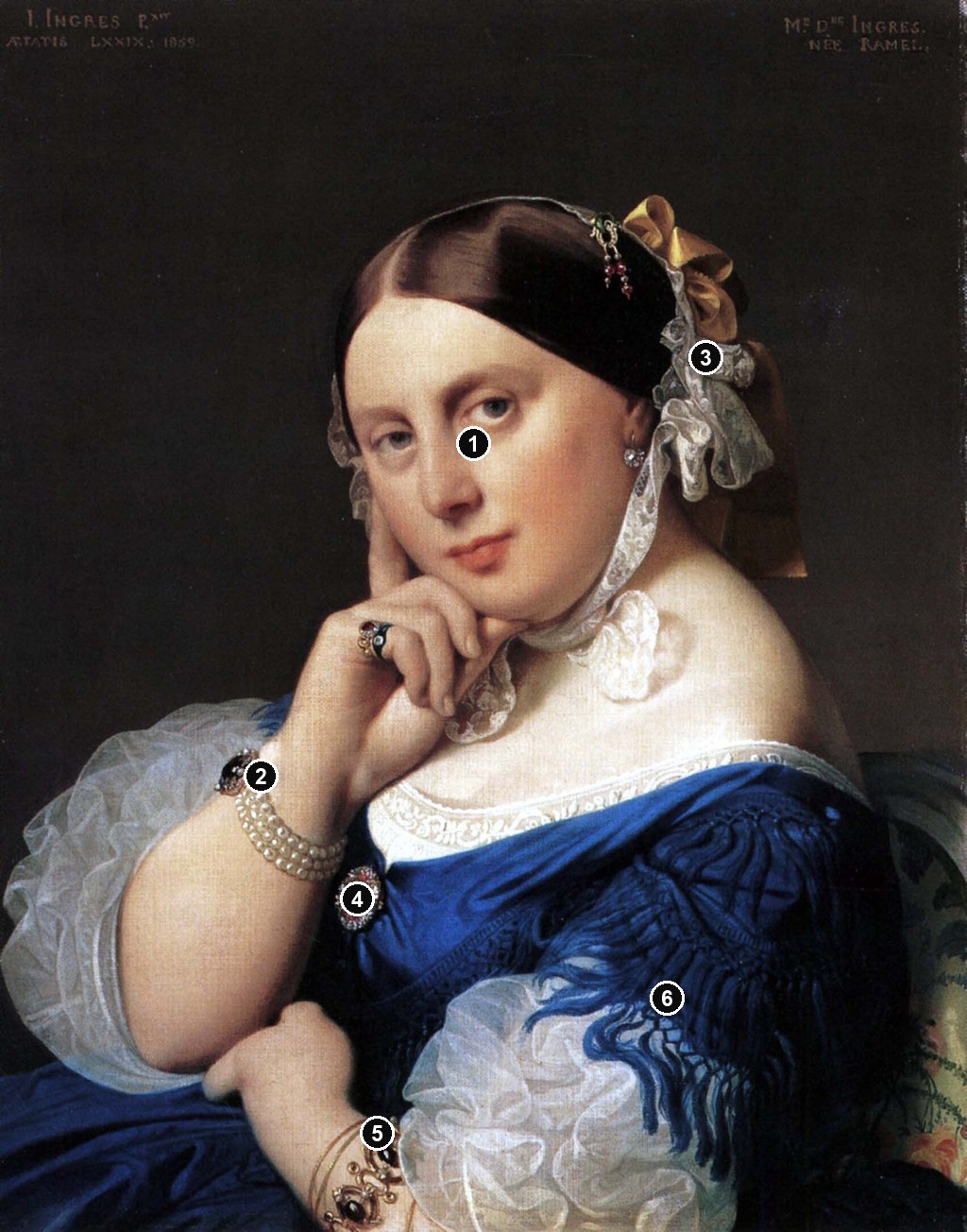
Portrait of Madame Ingres
An index finger resting against a cheek gives this portrait its quiet centre. Around it, lace spreads across pale skin, bracelets catch the light and a blue shawl breaks into long strands of fringe.
Ingres painted his second wife, Delphine Ramel, in 1859. The picture belongs to the Sammlung Oskar Reinhart «Am Römerholz» in Winterthur, Switzerland. [1]
Its combination of a close, conversational pose and elaborate dress makes it especially rewarding to look at slowly.
At a Glance
- ArtistJean-Auguste-Dominique Ingres
- SitterDelphine Ingres, née Ramel
- Date1859
- MediumOil on canvas
- Size65.2 × 53.3 cm
- CollectionSammlung Oskar Reinhart «Am Römerholz», Winterthur
- Inventory numberSOR1924.6. [1]
This work across Ingres’s career
Agamemnon’s Ambassadors
1801 (competition)Grande Odalisque
1814Louis XIII’s Vow
1824Monsieur Bertin
1832The Princesse de Broglie
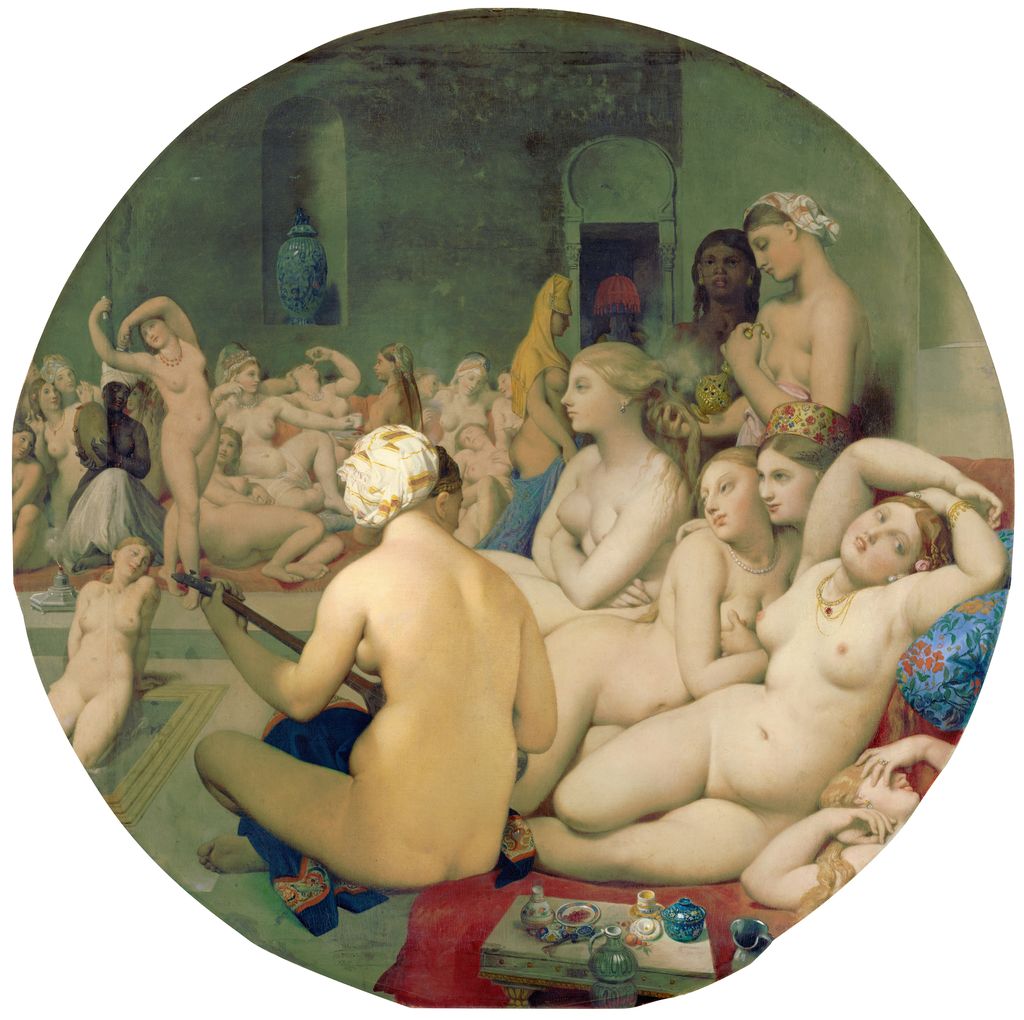
1851–1853The Turkish Bath
1859–1862Contents
- A face held between two hands
- Blue cloth, white lace and points of light
- Delphine Ramel and the family at Meung
- The drawings and a question of evidence
- A companion portrait and its later relatives
- Testimony, reproduction and the painting’s afterlife
- Annotated details
A face held between two hands
Delphine turns slightly across the picture while looking towards us. Her shoulders establish a diagonal, but her face comes round to meet the viewer. The resulting pose has a gentle twist: body and attention do not travel in quite the same direction. Her raised hand helps join them. The forearm rises from the lower left, the fingers gather beneath the chin and one finger follows the cheek upwards, bringing the eye back to her gaze.
The gesture seems simple until one follows its construction. Hand and face touch without merging into a single pale shape. The line of the finger remains distinct against the cheek, while the bent fingers make a small cluster of curves below the mouth. A dark ring adds a concentrated accent near the centre of this arrangement. Ingres gives the hand enough prominence to become part of the likeness: the way Delphine occupies the picture includes the way she holds herself.
Below, the other hand rests across the raised arm. This creates a second point of contact and closes the arrangement into a loose loop. Our attention can travel from the lower hand up the forearm, past the bracelet to the cheek, and then down through the shoulder and dress. The body feels settled within that circuit even though several parts of the pose turn in different directions.
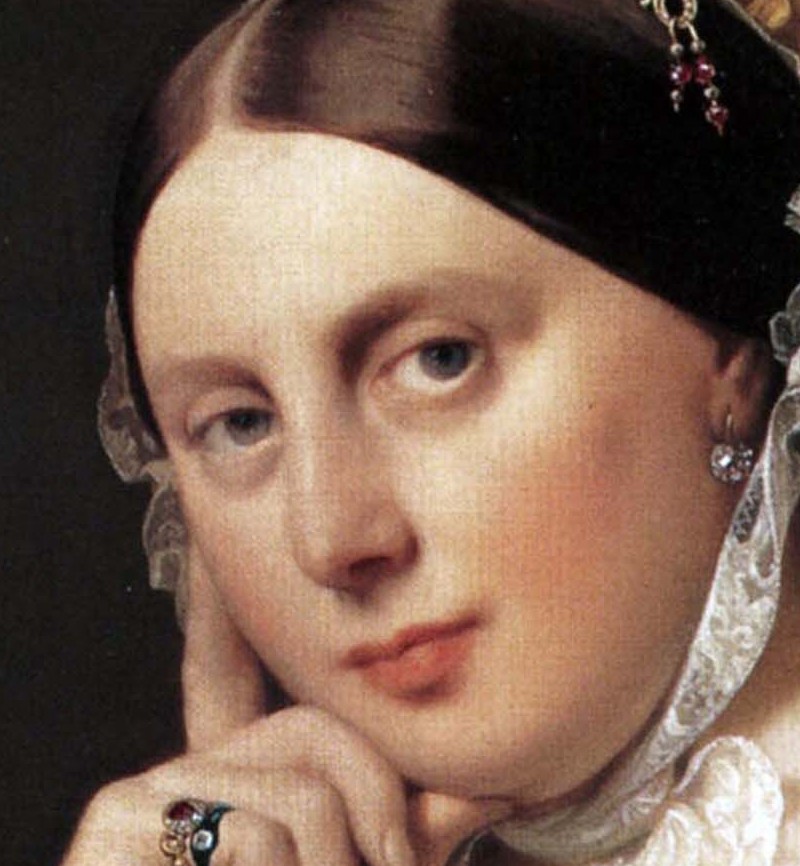
Her expression is open to more than one reading. The mouth is closed, the head slightly inclined; the eyes give the impression of meeting ours without a conspicuous display of feeling. A viewer might find the pose thoughtful, sociable or simply comfortable. None of these responses establishes Delphine’s character. What the painting makes available is a carefully sustained encounter, in which direct eye contact and the supporting hand hold our attention together.
The glossy, centrally parted hair supplies another kind of order. Broad dark sections frame the forehead, contrasting with the lighter, more irregular lace beside the ears. Against these larger shapes, the eyebrows, eyelids and lips become small but decisive changes of direction. Looking from the blue folds back to the face, one notices how little movement the facial features need to carry.
Blue cloth, white lace and points of light
Colour structures the portrait as strongly as contour. The blue dress occupies much of its lower half, while the pale skin and white fabric gather around the face and shoulders. Behind them is a deep, dark ground. This limited arrangement allows quite different surfaces to remain legible without filling the setting with furniture or ornaments.
The blue changes as it passes across the body. Some folds make sharp, bright ridges; others fall into almost black recesses. Near the neckline, the cloth draws together into a firm band. Across the lower part of the picture, it opens into broader passages. Following these changes gives a sense of weight and direction even where the boundaries between dress and shawl are difficult to disentangle at first glance.
The fringe is particularly useful to the composition. Long dark-blue strands descend over the white sleeve on the right, giving a strong surface pattern to an otherwise pale area. They also connect the blue mass around the shoulder with the lower edge of the canvas. Their narrow, wavering lines differ from both the broad folds and the rounded forms of the arm. Three ways of describing shape meet in a small space.
The translucent sleeves behave differently again. Their outer edges spread beyond the arms, creating a soft, puffed silhouette. Within them, overlapping light and shadow suggest layers of thin material. In places the flesh remains perceptible through the fabric. The painted sleeve therefore has to describe both an object and something seen through it. That double effect helps make the skin seem solid while the sleeve appears airy.
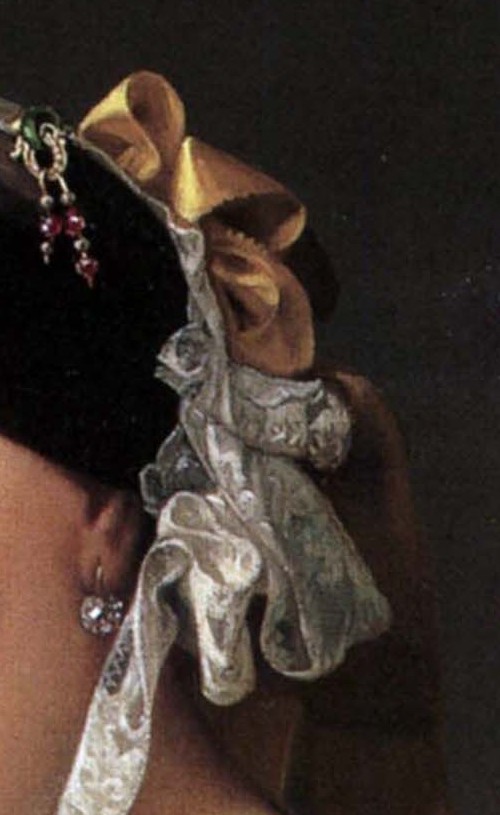
Lace continues around the neckline and rises in ribbons beside the head. It links areas that might otherwise read separately: hair, cheek, neck and shoulder. The narrow strip across the chest gives a delicate boundary to the heavier blue dress. Near the face, the lace interrupts the dark hair with little light shapes. The same pale material takes on a different role according to what lies behind it.
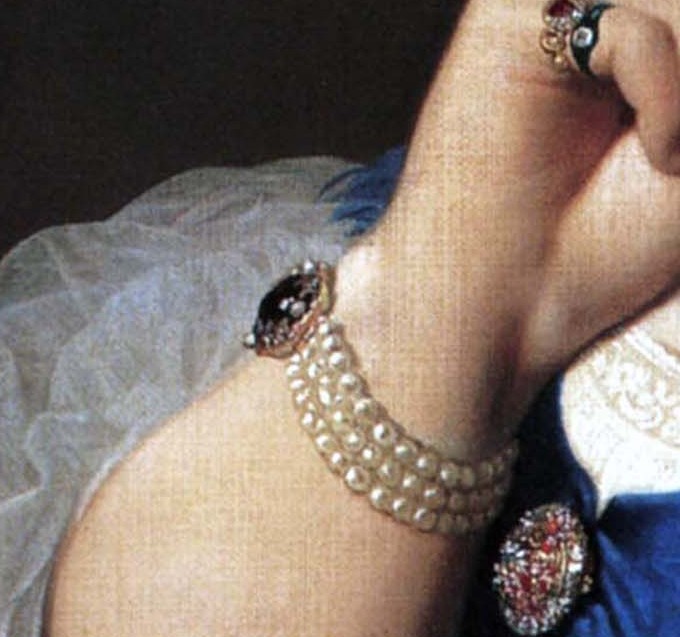
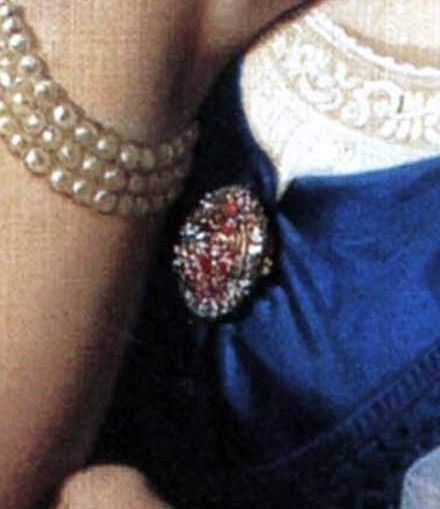
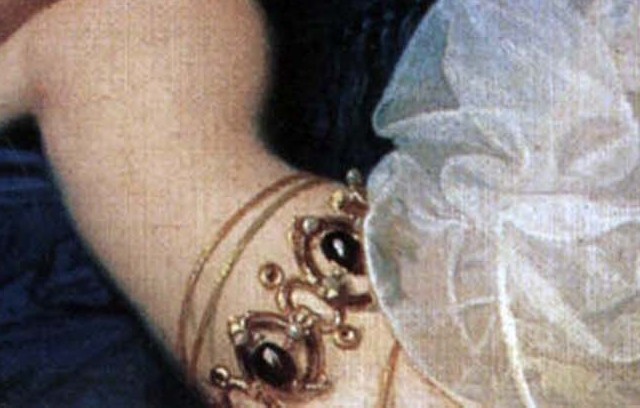
Jewellery introduces a more concentrated brightness. The bracelets form bands around the wrists; the rings and brooch create smaller accents among fingers and folds. Their position matters as much as their apparent richness. A bracelet marks the turn from forearm to hand, while the brooch punctuates the area where skin, lace and blue cloth converge. These details help articulate the body rather than serving as a separate inventory of possessions.
Try looking briefly at the picture with attention fixed on its edges. The sleeves expand towards the sides, the blue cloth fills the bottom and the head has comparatively generous dark space above it. This gives the lower half a broad, anchored shape while allowing the face to emerge more freely. The close crop brings Delphine near, yet the surrounding darkness preserves a little distance. The picture balances those two experiences throughout.
Annotated Details from Portrait of Madame Ingres
The numbered points identify visible features discussed in this article. Return from each detail to the whole composition. Each caption identifies the work shown.
Madame Ingres — Delphine Ramel
Jean-Auguste-Dominique Ingres, Portrait of Madame Ingres (Delphine Ingres, née Ramel), 1859. Sammlung Oskar Reinhart «Am Römerholz», Winterthur, SOR1924.6. Wikimedia Commons. Image source. Public domain.
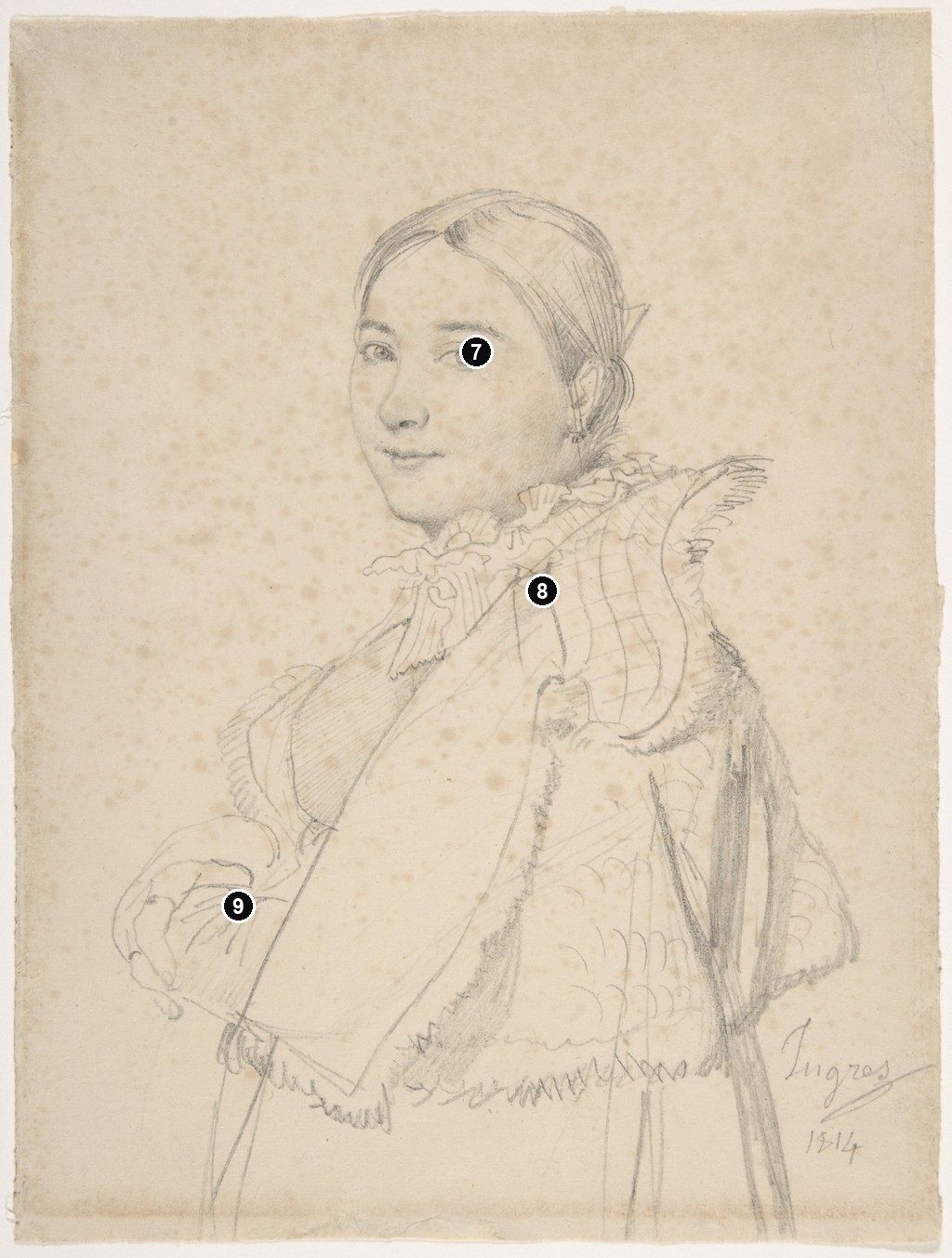
Madeleine Chapelle — Madame Ingres, 1814
Ingres, Madeleine Chapelle, Madame Ingres, 1814. Graphite portrait. The Metropolitan Museum of Art, 2004.475.2. Gift of Mrs. Charles Wrightsman, in honor of Philippe de Montebello, 2004. Image source. CC0 / Public domain.
Details from PORTRAIT OF MADAME INGRES
Compare the painted portrait of Delphine Ramel with the separate 1814 drawing of Madeleine Chapelle. These are two different women, Ingres’s second and first wives.
Madame Ingres — Delphine Ramel
The face resting beside raised fingers
The tilted face meets a raised hand beside the cheek. The fingers, chin and dark hair form a compact set of overlapping curves.
Jewellery around the raised wrist
Several pale strands circle the raised wrist below a darker central ornament. Their repeated small highlights contrast with the broad, softly shaded forearm.
Lace and ribbon beside the hair
Pale lace descends beside the dark hair, with a warm ribbon above it. Their folded and irregular edges make a separate frame around the head.
A brooch against deep blue cloth
A bright brooch gathers small coloured points against the blue dress. Its compact oval interrupts the larger sweep of the neckline.
The lower wrist and white sleeve
The lower wrist emerges beside a full white sleeve. Bracelets and a fine cuff bring small loops and bright accents to the bottom of the portrait.
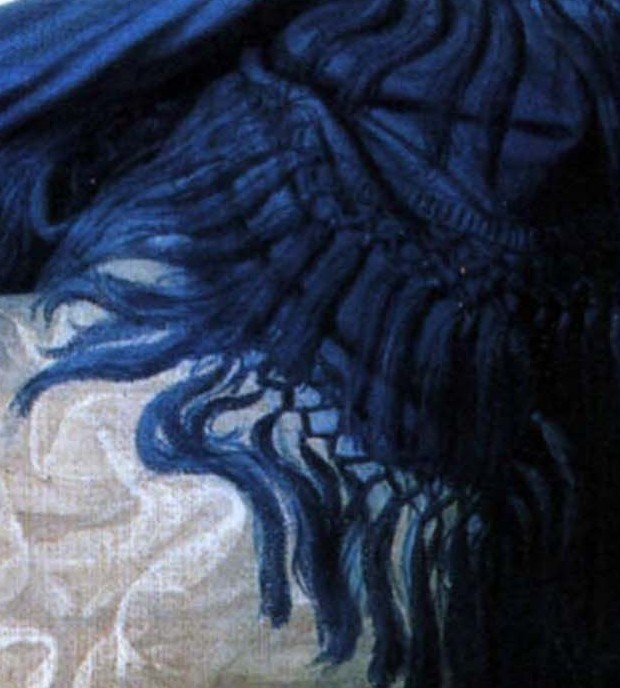
Blue fringe over a pale sleeve
Dark blue fringe falls across the white sleeve. Its narrow hanging strands repeat the direction of the larger folds while remaining visibly separate from them.
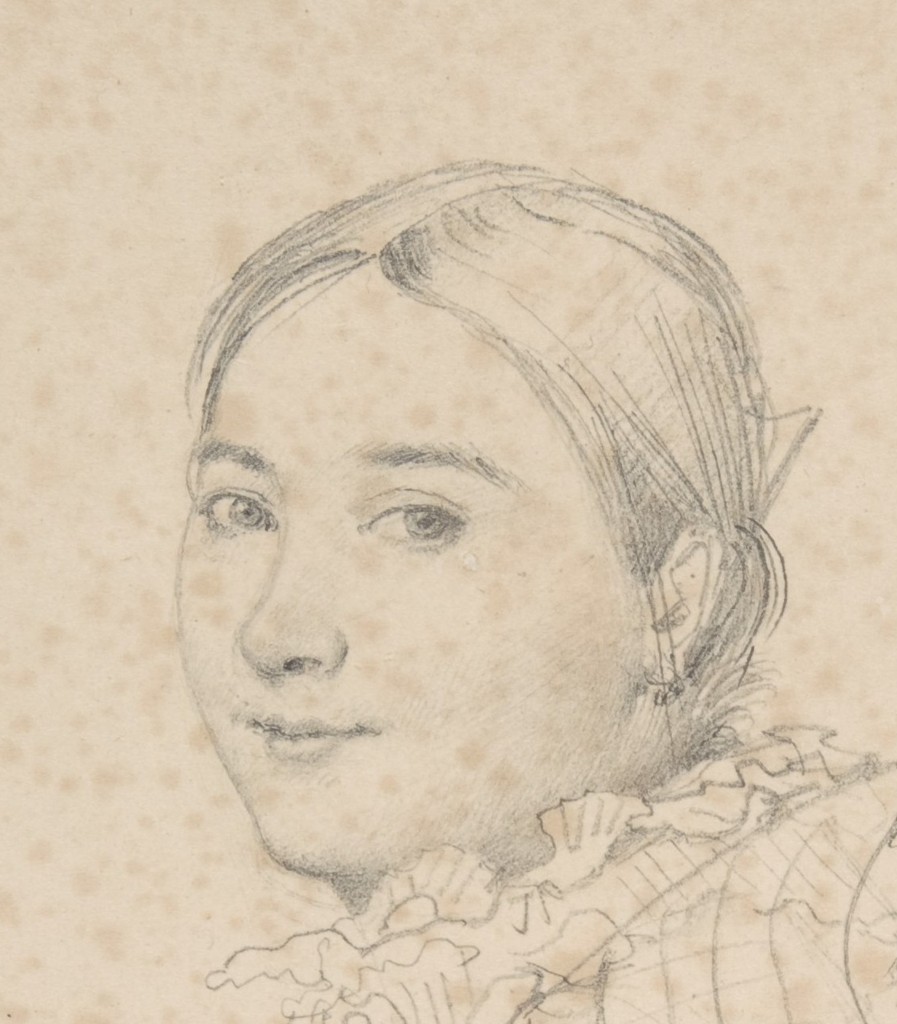
Madeleine Chapelle — Madame Ingres, 1814
The face beneath smoothly parted hair
The face turns towards the viewer beneath smoothly parted hair. Light shading around the eyes and cheek sits beside the more definite outline of the head.
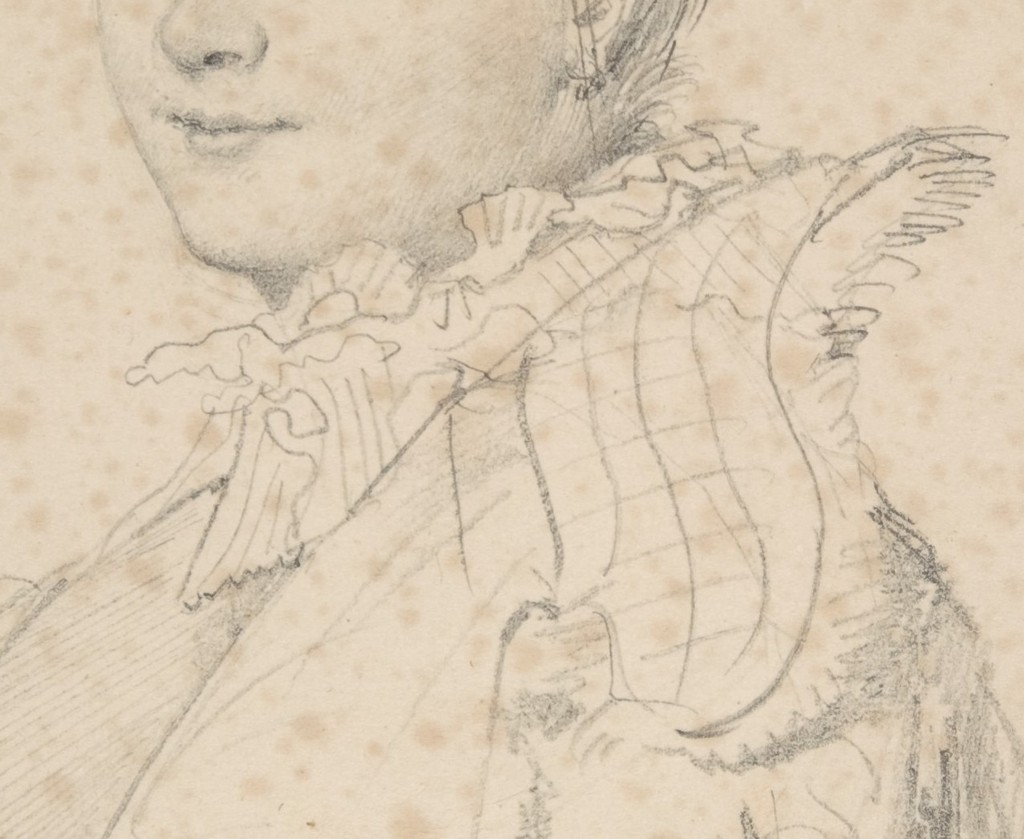
The ruff and broad patterned collar
A frilled ruff meets a broad collar crossed by repeated lines. Their pointed and curved edges spread out around the neck and shoulder.
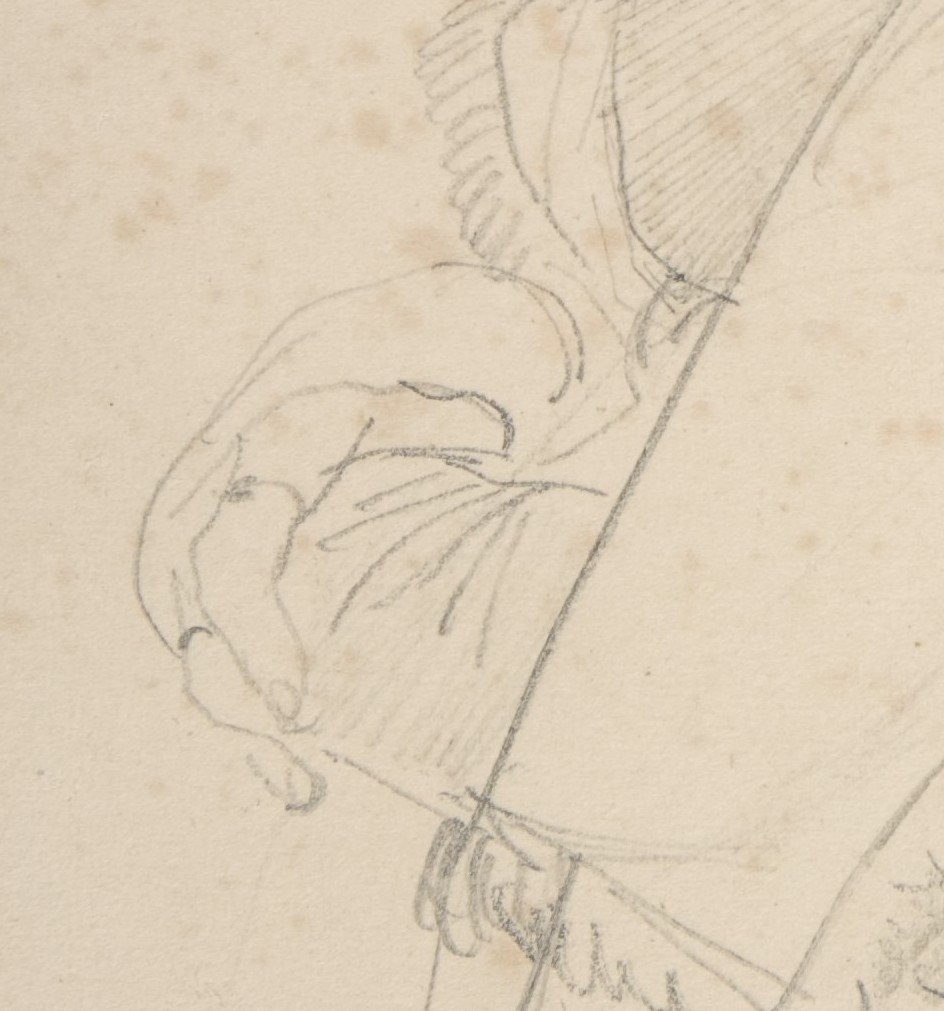
The hand and folds beside the elbow
A few curved lines describe the hand beside the elbow and the gathered clothing below it. Compare these economical marks with the more concentrated shading in the face.
Delphine Ramel and the family at Meung
Delphine married Ingres on 15 April 1852; his first wife, Madeleine Chapelle, had died in 1849. Charles Marcotte helped arrange the match. Hans Naef’s account recalls Delphine’s help with correspondence and her piano playing, giving a glimpse of the couple’s shared daily life. [2]
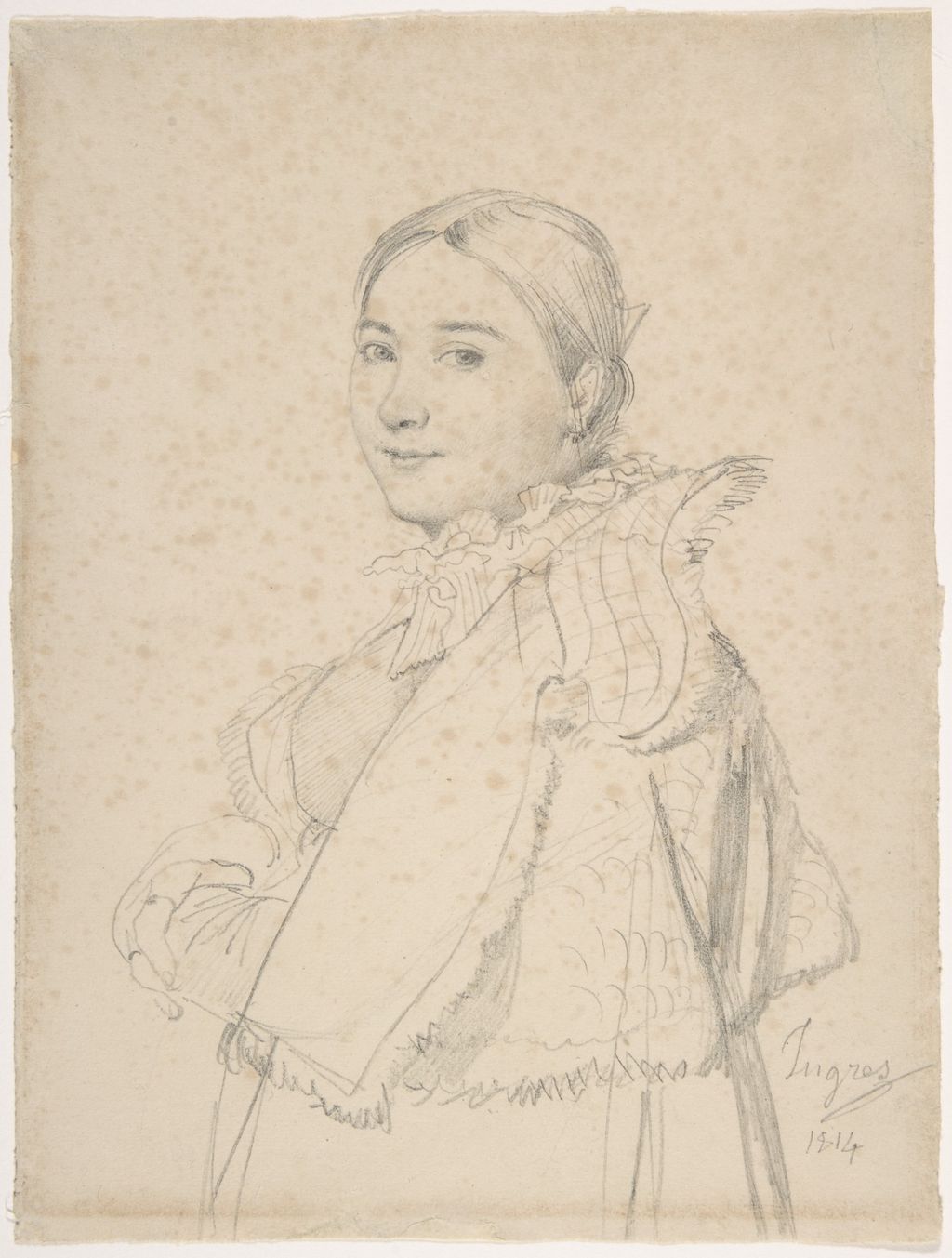
Ingres, Madeleine Chapelle, Madame Ingres, 1814. Graphite portrait. The Metropolitan Museum of Art, 2004.475.2. [3]
The painting’s domestic setting becomes unusually tangible in a letter printed by Henri Delaborde in his posthumous book on Ingres. Writing from Meung on 21 July 1859, Ingres described being surrounded by the family and the noise and charm of the children. He had brought objects to furnish a small studio there and intended to inaugurate it by beginning Delphine’s portrait. [4]
That brief account gives the work a place within the ordinary arrangements of a working household. A room had to be made usable; familiar objects had to be transported; painting continued alongside the presence of relatives and children. It also provides a useful distinction between the environment of production and the image that eventually emerged. The portrait contains none of that surrounding activity. Its dark background concentrates the encounter on Delphine alone.
The letter describes an intention to begin, rather than a day-by-day record of the painting’s progress. It cannot tell us how long a sitting lasted, which objects Ingres placed in the studio or what conversations accompanied the work. Its value is more concrete: it places the planned portrait in Meung in the summer of its dated year, and allows us to connect the finished, composed image with a particular domestic circumstance. [4] The Swiss collection identifies the picture as an intended companion to a self-portrait. [1] An intimate purpose could accommodate considerable formality. Delphine’s careful arrangement of hands, jewellery and fabric gives the encounter its shape, while the absence of a descriptive room keeps the setting from competing with her.
The drawings and a question of evidence
Ingres had drawn Delphine before making the oil portrait. Delaborde lists a graphite likeness signed and dated 1852, the year of their marriage. This provides a separate documentary anchor for the earlier portrait; it does not establish that the drawing was made in preparation for the painting of seven years later. [4]
A different sheet at the Fogg, dated 1855, shows the painting’s pose. Naef questioned its uniform authorship, suggesting additions to an original bust-length drawing. He distinguished an apparently original inscription from a second, false inscription misdated 1844. Its status as preparation for the oil portrait requires caution. [2] These are distinct objects: a documented 1852 likeness, a questioned 1855 sheet and the finished 1859 painting. They cannot simply be arranged into an uninterrupted sequence of preparatory stages. [2][4]
The visible painting offers a different kind of evidence. It shows how convincingly the raised hand, angled shoulders and crossing arms work together in the final arrangement. That is something we can examine directly, without assuming that every surviving related image records an earlier step towards it. For the broader place of such sheets in his practice, see Ingres’s drawings.
A companion portrait and its later relatives
The intended pendant—a picture made to accompany another—was Ingres’s 1859 self-portrait now at the Fogg. The Royal Museum of Fine Arts Antwerp distinguishes this from both the 1858 Uffizi self-portrait and its own modified version of 1864–65. Its account connects the three late self-portraits with a photograph taken around 1855 by Gerotwohl and Tanner. [5] The Antwerp canvas is a separate object from Delphine’s original companion. [5] Those dates matter because reproductions of the later self-portraits can easily stand in for one another. The pairing gives her portrait an additional frame of reference, placing her likeness alongside the painter’s image of himself.
The relationship also encourages a more deliberate way of looking. Seen alone, Delphine appears to occupy a complete and self-contained world. Knowing that another portrait was intended beside her introduces a second imagined presence outside the edges. The raised hand and direct gaze still govern the picture, but the encounter now has a place within a pair. That context need not determine a single interpretation of her expression.
Testimony, reproduction and the painting’s afterlife
Naef juxtaposed Calamatta’s approval of the marriage with Étex’s hostility. These responses concern the couple, rather than this canvas. The painting was reproduced as figure 213 in the 1999 Portraits by Ingres catalogue. [2] The distinction matters when looking back from a familiar reproduction. A sitter’s biography, a critic’s feelings about the painter and the reception of an individual work are related subjects, but they answer different questions. Hostility towards the remarriage cannot tell us how contemporary viewers responded to the blue dress, the gesture or the finished likeness. The portrait repays attention without requiring those opinions to explain it.
The Swiss federal collection record traces ownership from Mme Albert Ramel, Delphine’s sister-in-law, through Galerie Paul Rosenberg in New York, where Oskar Reinhart bought it in 1924. It subsequently passed to the Swiss Confederation through Reinhart’s gift, recorded as 1958/1965. Today it belongs to his Am Römerholz collection in Winterthur. [1]
Its passage from family ownership through the art market to a collection also changes the circumstances of the encounter. The picture can now be approached independently of any knowledge of Delphine or the Ramels. Yet its most immediate means of holding a viewer remain specific: the dark hair against lace, the forearm rising towards the cheek, the blue fringe over a translucent sleeve. Those details give the work its presence before a name or a family history is supplied.
Artworks directory
Explore 150 paintings, drawings and an original lithograph. This selection includes related versions and studies; dates distinguish completed works from later revisions.
| Name | Date | Medium |
|---|---|---|
| The Apotheosis of Homer | 1827 | Painting |
| Grande Odalisque | 1814 | Painting |
| The Turkish Bath | 1859–1862 | Painting |
| Madame Moitessier Seated | 1856 | Painting |
| Portrait of Monsieur Bertin | 1832 | Painting |
| Napoleon I on His Imperial Throne | 1806 | Painting |
| Odalisque with Slave | 1839 | Painting |
| The Ambassadors of Agamemnon in the Tent of Achilles | 1801 (competition) | Painting |
| The Valpinçon Bather | 1808 | Painting |
| The Source | 1856 | Painting |
| Oedipus Explaining the Enigma of the Sphinx | 1808; revised probably before 1827 | Painting |
| The Vow of Louis XIII | 1824 | Painting |
| Antiochus and Stratonice | 1840 | Painting |
| The Comtesse d’Haussonville | 1845 | Painting |
| The Princesse de Broglie | 1851–1853 | Painting |
| Jupiter and Thetis | 1811 | Painting |
| The Dream of Ossian | 1813 | Painting |
| The Martyrdom of Saint Symphorian | 1834 | Painting |
| Venus Anadyomene | 1808–1848 | Painting |
| Portrait of Madame de Senonnes | 1814 | Painting |
| Madame Rivière | 1805 | Painting |
| Mademoiselle Caroline Rivière | 1805 | Painting |
| Portrait of Philibert Rivière | 1805 | Painting |
| Bonaparte First Consul | 1804 | Painting |
| The Death of Leonardo da Vinci | 1818 | Painting |
| Joan of Arc at the Coronation of Charles VII | 1854 | Painting |
| Madame Duvaucey | 1807 | Painting |
| La Belle Zélie | 1806 | Painting |
| Madame Panckoucke | 1811 | Painting |
| Portrait of Charles Marcotte d’Argenteuil | 1810 | Painting |
| Joseph Antoine Moltedo | c.1810 | Painting |
| Madame Leblanc | 1823 | Painting |
| Delphine Ingres-Ramel (Portrait of Madame Ingres) | 1859 | Painting |
| Portrait of Amédée de Pastoret | 1823–1826 | Painting |
| Portrait of Baronne de Rothschild | 1848 | Painting |
| Madame Marcotte de Sainte Marie | 1826 | Painting |
| Madame Gonse | 1852 | Painting |
| Aretino in the Studio of Tintoretto | 1848 | Painting |
| Don Pedro of Toledo Kissing Henry IV’s Sword | 1831/1832 | Painting |
| Raphael and La Fornarina | 1814 | Painting |
| Roger Freeing Angelica | 1819 | Painting |
| Romulus’ Victory over Acron | 1812 | Painting |
| Self-Portrait at the Age of Twenty-Four | 1804; revised 1841–1851 | Painting |
| Male Torso | c.1800 | Painting |
| Odalisque in Grisaille (Ingres and workshop) | c.1824–1834 | Painting |
| The Small Bather | 1826 | Painting |
| The Little Bather Harem Interior | 1828 | Painting |
| Jesus Among the Doctors | 1862 | Painting |
| The Virgin Adoring the Host | 1852 | Painting |
| The Virgin of the Host | 1841 | Painting |
| Virgin of the Adoption | 1858 | Painting |
| Paolo and Francesca | 1814 | Painting |
| Homer Deified (revised composition, Louvre RF5273) | 1865 | Drawing |
| Odalisque with Slave (Louvre RF4622) | 1858 | Drawing |
| Odalisque (Walters Art Museum; Ingres and Paul Flandrin) | 1842 | Painting |
| Madame Moitessier Standing (National Gallery of Art) | 1851 | Painting |
| Jacques-Louis Leblanc (The Metropolitan Museum of Art) | 1823 | Painting |
| Ferdinand-Philippe, Duke of Orléans (Louvre RF2005-13) | 1842 | Painting |
| Ferdinand-Philippe, Duke of Orléans (Versailles MV5207; Ingres and workshop) | 1843 | Painting |
| Ferdinand-Philippe, Duke of Orléans (Versailles MV5209; Ingres and workshop) | 1844 | Painting |
| Antiochus and Stratonice (Musée Fabre; Ingres and Raymond Balze) | 1866 | Painting |
| Antiochus and Stratonice (Kunstmuseum Bern, Gurlitt bequest) | Undated (early dating proposed) | Drawing |
| Composition study for Antiochus and Stratonice (MIB867.2193) | 1806 | Drawing |
| Study for the Figure of Stratonice (Met63.66) | 1834–1840 | Graphite, black chalk and charcoal |
| Nude figure study for Stratonice (Boijmans F II 36 PK) | c.1834–1840 | Drawing |
| Paolo and Francesca (The Barber Institute,54.6) | c.1814–1820 | Painting |
| Paolo and Francesca (The Hyde Collection,1971.24) | c.1855–1860 | Painting |
| Paolo and Francesca (Amsterdam Museum TA10970) | 1820 | Drawing |
| Paolo and Francesca (dedicated to Artaud de Montor) | 1816 | Drawing |
| Study for the Bust of Francesca (MIB867.1398) | 1819 | Drawing |
| Study for the Bust of Francesca (MIB867.1396) | 1819 | Drawing |
| The Archangel Raphael, first idea (MIB867.2488) | 1842 | Drawing |
| The Archangel Raphael (MIB867.2500) | 1842 | Drawing |
| The Archangel Raphael Carrying Human Prayers to God (Chantilly DE513) | 1844 | Drawing |
| Louis-Philippe as Saint Philip, stained-glass study | 1844 | Drawing |
| Marie Frédéric Eugène de Reiset (Ford Collection RBF171-2) | 1844 | Drawing |
| Virgil Reading the Aeneid (Toulouse) | Begun 1811 | Painting |
| Tu Marcellus Eris (Brussels, inv. 1836) | c.1814 (museum dating) | Painting |
| Jean-François Gilibert | 1804 | Painting |
| François-Marius Granet | 1807 (museum dating) | Painting |
| Count Nikolai Dmitrievich Guryev | 1821 | Painting |
| Caroline Murat, Queen of Naples | 1814 | Painting |
| Count Mathieu Molé | 1834 | Painting |
| Cherubini and the Muse of Lyric Poetry (Louvre) | 1842 | Painting |
| Luigi Cherubini (Cincinnati) | 1841 | Painting |
| Comtesse de Rayneval (Louvre RF4505) | 1841 | Drawing |
| Venus on Paphos (Antonie Balaÿ) | c.1852 | Painting |
| Prince Napoléon | 1855 | Painting |
| Study for The Apotheosis of Napoleon I (Petit Palais) | Late 1853 | Painting |
| The Apotheosis of Napoleon I (destroyed ceiling) | 1853 | Painting |
| The Journalist (MIB867.2733) | 1834? | Drawing |
| Henry VIII, after Holbein | c.1815–1820 (?) | Drawing |
| Madame Récamier, after David (MIB867.3637) | Undated (early Paris period) | Drawing |
| Study for Comtesse d’Haussonville (MIB867.259; background possibly by another hand) | 1842–1845 | Drawing |
| La Source (reduced version reported by Delaborde) | Date unrecorded; reported 1870 | Painting |
| Odalisque (autograph lithograph,NGA1946.21.117) | 1825; published1826 | Lithograph |
| Portrait of a Seated Lady | 1814 | Graphite |
| The Kaunitz Sisters (Leopoldine, Caroline, and Ferdinandine) | 1818 | Graphite |
| Portrait of a Man | 1814 | Graphite |
| Study for the Portrait of Louis-François Bertin (1766–1841) | n.d. | Black chalk and graphite |
| Studies for the Cadaver of Acron | ca. 1810–12 | Graphite on wove paper |
| Study for the Drapery of Molière in "The Apotheosis of Homer" | n.d. | Black chalk with stumping |
| Madame Guillaume Guillon Lethière, née Marie-Joseph-Honorée Vanzenne, and her son Lucien Lethière | 1808 | Graphite |
| Niccolò Paganini (1782–1840) | ca. 1830 | Counterproof or tracing strengthened with graphite and gouache on translucent paper |
| Lady Mary Cavendish-Bentinck (?-1843) | 1816 | Graphite |
| Madame Alexandre Lethière and Her Daughter Letizia | ca. 1815 | Graphite |
| Merry Joseph Blondel (1781–1853) | 1809 | Graphite |
| Ursin-Jules Vatinelle (1798–1881) | 1820 | Graphite |
| Bust of a Gypsy Girl (ascribed to Ingres) | 1819 | Graphite on wove paper |
| Study of a Seated Nude Male | n.d. | Graphite |
| The Archangel Raphael (Study for a stained-glass window in the chapel of Notre-Dame de la Compassion-Saint-Ferdinand, Neuilly) | ca. 1842 | Graphite |
| Lancelot-Théodore, comte Turpin de Crissé | probably 1818 | Graphite |
| Study for the Figure of the Iliad in "The Apotheosis of Homer" | ca. 1827 | Graphite and black chalk heightened with white chalk on brown paper |
| Comtesse Turpin de Crissé | probably 1818 | Graphite |
| Nude Figures for L'Âge d'Or, Château de Dampierre | n.d. | Graphite on brownish paper |
| Study of Figures (attributed to Ingres) | n.d. | Graphite |
| Study of Figures (attributed to Ingres) | n.d. | Graphite; squared in graphite |
| Admiral Sir Fleetwood Broughton Reynolds Pellew | 1817 | Graphite on wove paper |
| Madame Jean-Auguste-Dominique Ingres, née Madeleine Chapelle | 1814 | Graphite on off-white wove paper |
| Virgil Reading the Aeneid to Augustus, Livia, and Octavia | 1809/1819 (?) | Pen and black ink, graphite, brush and gray wash, white gouache heightening, Conté crayon on blue paper |
| General Louis-Étienne Dulong de Rosnay | 1818 | Graphite (hard and soft pencils) |
| Madame Alexandre Lethière, née Rosa Meli, and Her Daughter, Letizia | 1815 | Graphite |
| The Lawyer Paul Grand | 1834 | Graphite |
| Jean-Joseph Fournier | 1815 | Graphite |
| Armand Bertin | 1842 | Graphite |
| Madame Armand Bertin, née Marie-Anne-Cécile Dollfuss | 1843 | Graphite |
| The Architect Charles-Victor Famin | 1836 | Graphite |
| Henri Lehmann | 1850 | Graphite |
| Portrait of a Lady | ca. 1815–17 | Graphite |
| Edmond Cavé (1794–1852) | 1844 | Oil on canvas |
| Head of Saint John the Evangelist | probably ca. 1818–20 | Oil on canvas, laid down on wood |
| Madame Edmond Cavé (Marie-Elisabeth Blavot, ca. 1806–1883) | ca. 1831–34 | Oil on canvas |
| Madame Félix Gallois | 1852 | Graphite with touches of gold in oil to highlight jewelry, on buff wove paper. |
| Dr. François Mêlier | 1849 | Graphite with graphite framing lines, corrected with white, on buff wove paper |
| Portrait of Madame Rhode (Rhoda?) | 1810–20 | Graphite on pale buff wove paper |
| Study for "Raphael and the Fornarina"(?) | ca. 1814(?) | Graphite on white wove paper |
| Portrait of Madame Paul Meurice, née Palmyre Granger | ca. 1845–50 | Graphite on wove paper |
| Alexander the Great presenting Campaspe to Apelles | 1810 | Graphite, brush and brown wash; squared in graphite |
| Study of Hands for "Christ Among the Doctors" | 1852–62 | Graphite on tracing paper |
| Study for The Turkish Bath (RF34502) | about 1850 | Pen and brown ink with graphite, partially squared |
| Study for The Turkish Bath (RF23354) | Undated | Pen and brown ink with graphite on joined sheets |
| Study for The Turkish Bath (RF54702) | about 1859 | Pen and brown ink |
| Studies of women for The Turkish Bath (RF12292) | Undated | Black chalk |
| Achilles Receiving the Envoys of Agamemnon (Nationalmuseum sketch, NM2161) | 1801 | Oil on wood |
| Half-Length Bather (Musée Bonnat-Helleu,89) | 1807 | Oil on canvas |
| Oedipus and the Sphinx (National Gallery,NG3290) | about1826 | Oil on canvas |
| Oedipus and the Sphinx (Walters,37.9) | 1864 | Oil on canvas |
| Oedipus and the Valpinçon Bather, after David (MI.867.2035) | Undated | Graphite on tracing paper, after David |
| Study of the Virgin for The Vow of Louis XIII (Dijon,1758) | about1822 | Black chalk, stump and white chalk on brown wove paper |
| First Thought for The Vow of Louis XIII (MI.885.11.21) | 1822 | Oil on canvas |
Frequently Asked Questions
The gesture supports the head and joins the face to the crossing arms below. It may suggest thoughtfulness or ease, but it does not prove a particular emotion or personality.
It is in the Sammlung Oskar Reinhart «Am Römerholz» in Winterthur, Switzerland. [1]
Discussion
Look again at the images and ideas explored in Portrait of Madame Ingres. These editorial prompts invite your observations.
Reader Insights
Where does your eye return first: Delphine’s face, the hand beside it or the bright blue dress? Follow one route between them, then look for the lace or jewellery that helps carry your attention across the picture.
Compare Delphine’s hand beside her face with Madame Moitessier’s more conspicuous gesture. What does each surrounding sleeve contribute?
How much of the intimacy you perceive comes from the arrangement of the figure, and how much from knowing the sitter’s relationship to the artist?
Join the Conversation
Share a detail, comparison or question about Portrait of Madame Ingres below.
References
- Bundesamt für Kultur, Bildnis Delphine Ingres-Ramel, SOR1924.6. Swiss federal collections online: object details, description and provenance. Consulted 17 October 2026. (in German) View source.
- Gary Tinterow and Philip Conisbee, eds. Portraits by Ingres: Image of an Epoch. New York: The Metropolitan Museum of Art, 1999. Gary Tinterow, late-portrait discussion, pp. 367–368, fig. 213; Hans Naef, catalogue 159, pp. 484–485, and selected family context in catalogue 160, pp. 486–487. Drawings entries translated by Russell Stockman. View source.
- Supporting image. Ingres, Madeleine Chapelle, Madame Ingres, 1814. Graphite portrait. The Metropolitan Museum of Art, 2004.475.2. Gift of Mrs. Charles Wrightsman, in honor of Philippe de Montebello, 2004. Image source. CC0 / Public domain.
- Henri Delaborde, Ingres, sa vie, ses travaux, sa doctrine, d’après les notes manuscrites et les lettres du maître. Paris: Henri Plon, 1870. Catalogue 132, p. 253, including the letter from Meung of 21 July 1859; catalogue 337, p. 302, the 1852 drawing of Delphine. (in French) View source.
- Koninklijk Museum voor Schone Kunsten Antwerpen, Self Portrait, 1864–1865, inventory 1526. “About this work” and “More about this work”, distinguishing the Antwerp, Fogg and Uffizi versions and describing their photographic source. Consulted 17 October 2026. View source.
- Splash image. Jean-Auguste-Dominique Ingres, Portrait of Madame Ingres (Delphine Ingres, née Ramel), 1859. Sammlung Oskar Reinhart «Am Römerholz», Winterthur, SOR1924.6. Wikimedia Commons. Image source. Public domain.