by Tom Gurney
Tom Gurney BSc (Hons) is an art history expert with over 20 years experience
Published on June 19, 2020 / Updated on October 22, 2026
Email: tomgurney1@gmail.com / Phone: +44 7429 011000
Jesus Among the Doctors
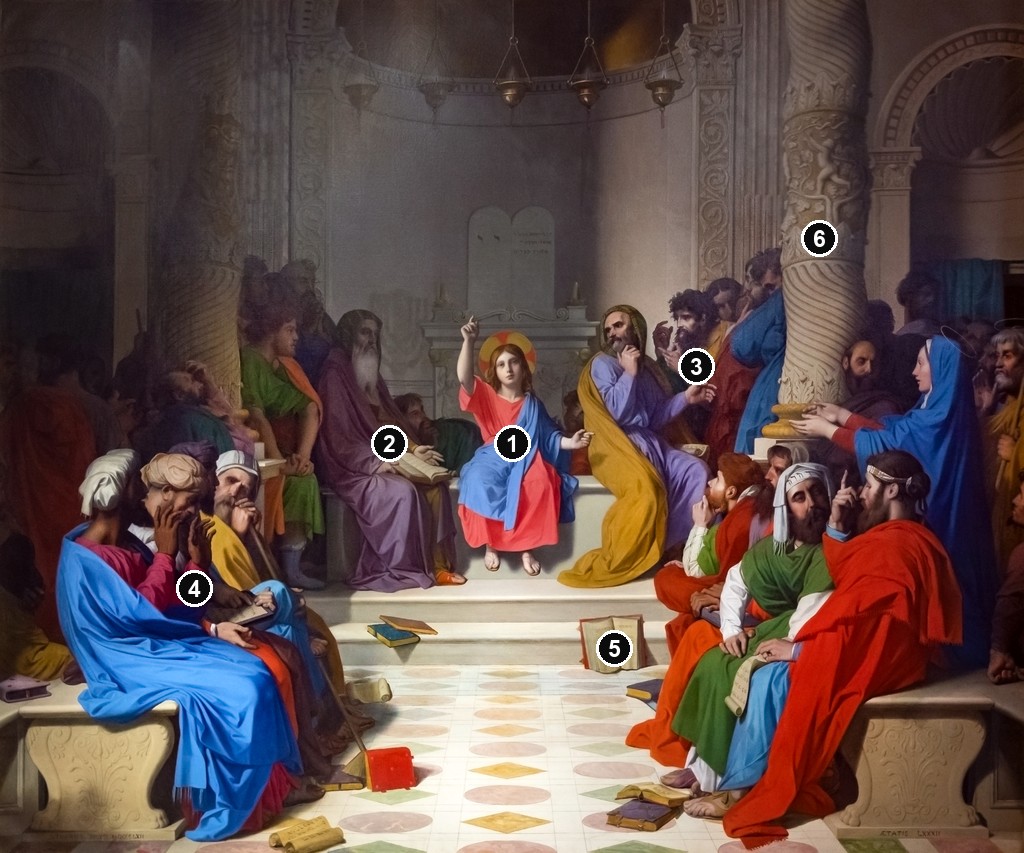
A child sits at the centre of a gathering of learned men, his bare feet resting above a broad flight of steps. One finger points upwards; his other hand opens towards the company. Around him, books lie open, readers pause and conversations spread through the crowd. Ingres makes an encounter about understanding visible through the movements of hands, heads and eyes.
Jesus Among the Doctors, completed in 1862, belongs to the Musée Ingres Bourdelle in Montauban. Its history stretches back to a royal commission twenty years earlier. [1] The painting invites two kinds of attention: to the exchange unfolding around Jesus, and to the long process through which Ingres gave that exchange its form.
At a Glance
- ArtistJean-Auguste-Dominique Ingres.
- Completed1862.
- Medium and sizeOil on canvas, 265 × 320 cm.
- CollectionMusée Ingres Bourdelle, Montauban; MI.867.71. [1]
- SubjectThe twelve-year-old Jesus found among the teachers in the Temple, from Luke 2:41–52. [2]
This work across Ingres’s career
Agamemnon’s Ambassadors
1801 (competition)Grande Odalisque
1814Louis XIII’s Vow
1824Monsieur Bertin
1832The Princesse de Broglie
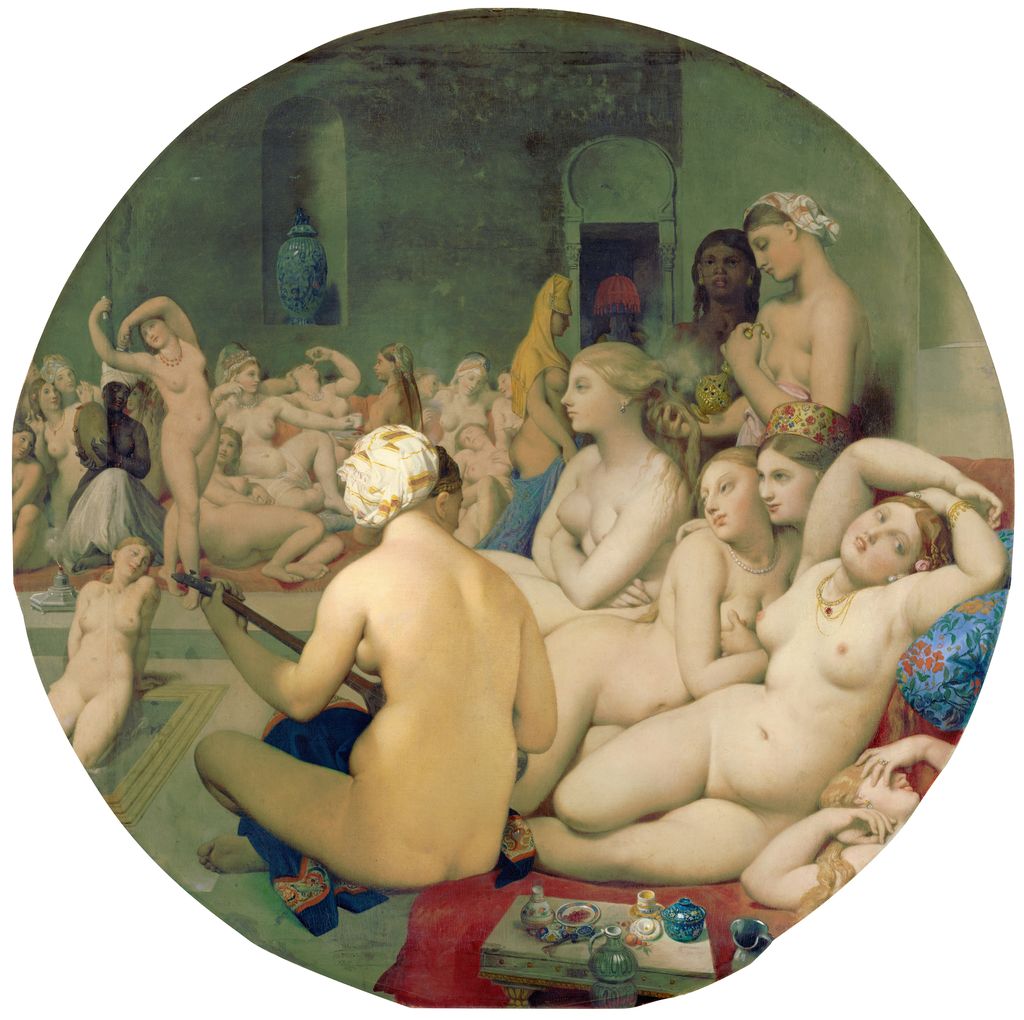
1851–1853The Turkish Bath
1859–1862Contents
- The child who listens and asks questions
- How Ingres gathers the room around Jesus
- A commission that outlasted its royal destination
- From early studies to a late change
- Raphael and the company of learning
- The painting's life beyond the studio
- Annotated details
The child who listens and asks questions
Luke places the encounter during the family's annual Passover journey to Jerusalem. Jesus remains behind when his parents leave; they initially suppose him to be travelling with their companions. After discovering his absence, they return and find him in the Temple after three days. He sits among the teachers, listening and asking questions, and his understanding and answers astonish those who hear him. [2]
That combination of actions matters when looking at Ingres's picture. The raised finger is so legible that it can dominate our first impression: a small figure appears to command an entire assembly. Yet the painted company contains several sorts of attention. Some men look towards the child; others consult a book, turn to a neighbour or hold a hand against the face. Their responses give the encounter duration. We can imagine a question passing through the group without supplying the words that Ingres leaves unheard.
Mary's outstretched hands introduce another register. In Luke, she describes the distress of the search; Jesus answers by referring to his Father's business. His parents do not understand, and he returns obediently with them to Nazareth. [2] The picture brings the child's public presence into contact with a family's anxiety. At the right, Mary's reaching gesture has an urgency different from the measured movements of the seated men.
The traditional word doctors means learned teachers here. The setting belongs to Jewish religious life; these figures are neither physicians nor the later Christian saints called Doctors of the Church. The subject is an episode from Jesus's childhood. Reading it alongside the painting keeps both the astonishing child and the activity of learning in view.
How Ingres gathers the room around Jesus
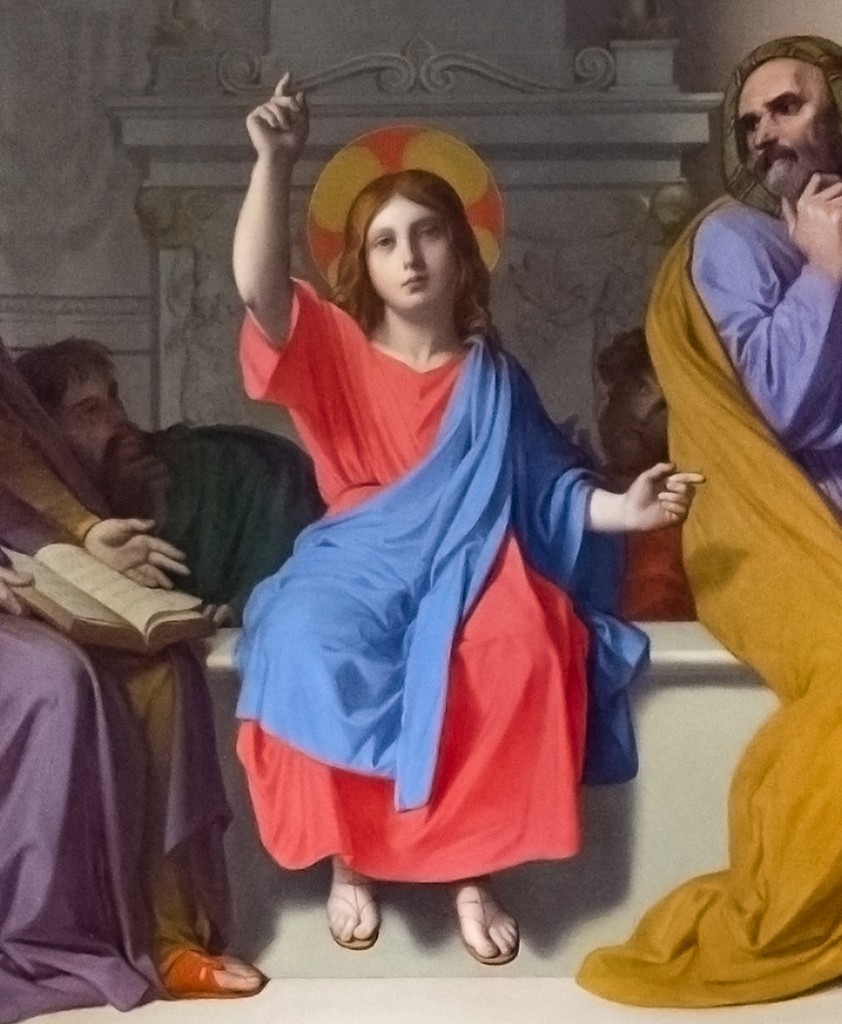
The centre is unusually clear within a crowded picture. Jesus wears red beneath blue drapery, and a yellow halo lifts his head from the pale architecture behind him. His body occupies a narrow interval between two seated adults. Their much larger robes spread across the platform, while his exposed feet emphasise his smaller scale. Authority and physical size pull in different directions.
The right arm rises above the surrounding shoulders. Its exposed forearm forms a clean, pale shape against the darker recess, ending in the upward finger. The other arm reaches sideways, with the hand open. Together they extend the figure beyond the compact triangle of his robes. One gesture draws attention above him; the other holds the company in a shared space. Neither requires us to treat the scene as a transcript of a single spoken sentence.
Look down from the child and the steps lead towards an open stretch of patterned floor. The foreground figures sit to either side, leaving a central approach. Their bodies make a threshold through which the eye enters the assembly. On the left, a brilliant blue mantle spills towards the lower edge. On the right, a red cloak answers it across the aisle. These broad areas of colour give weight to the corners and make the central figure easier to locate.
The symmetry is flexible. A tall, pale-bearded man sits close to Jesus on the left; the corresponding figure on the right turns his body and lifts a hand towards his beard. Faces and gestures interrupt any simple pairing. At the front, some heads incline together, while others pull away. The room remains ordered, but the people resist becoming identical ornaments within it.
Hands, books and the work of attention
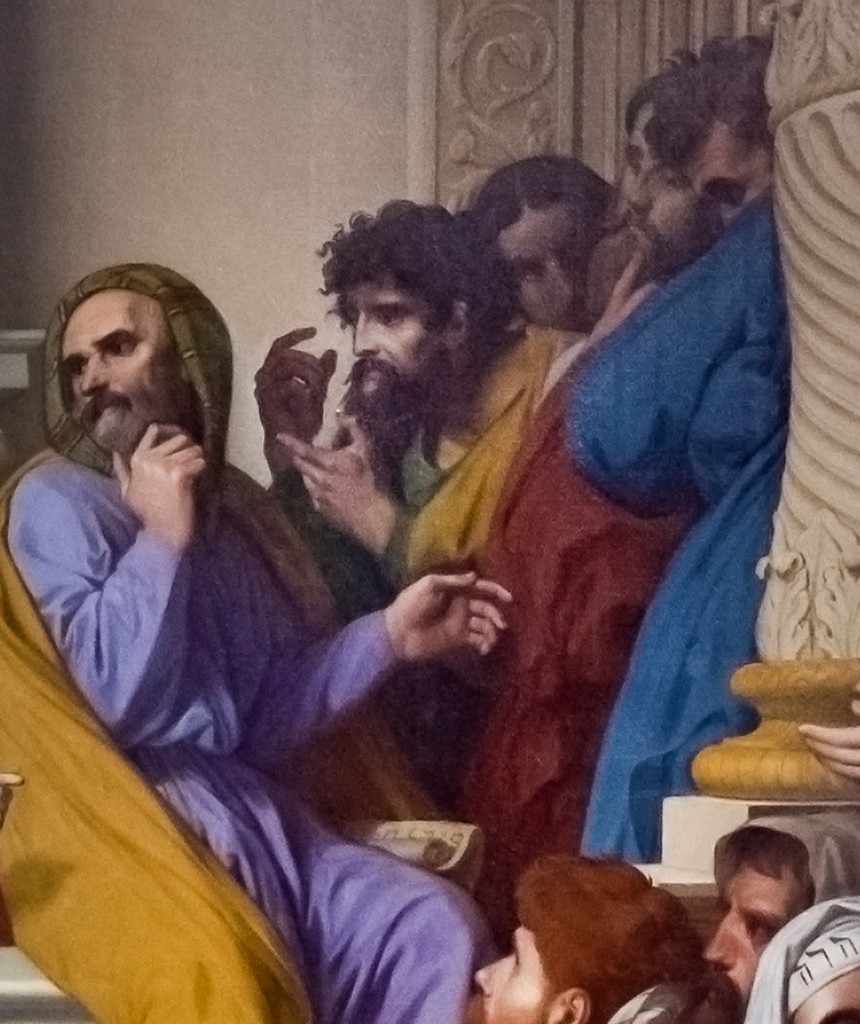
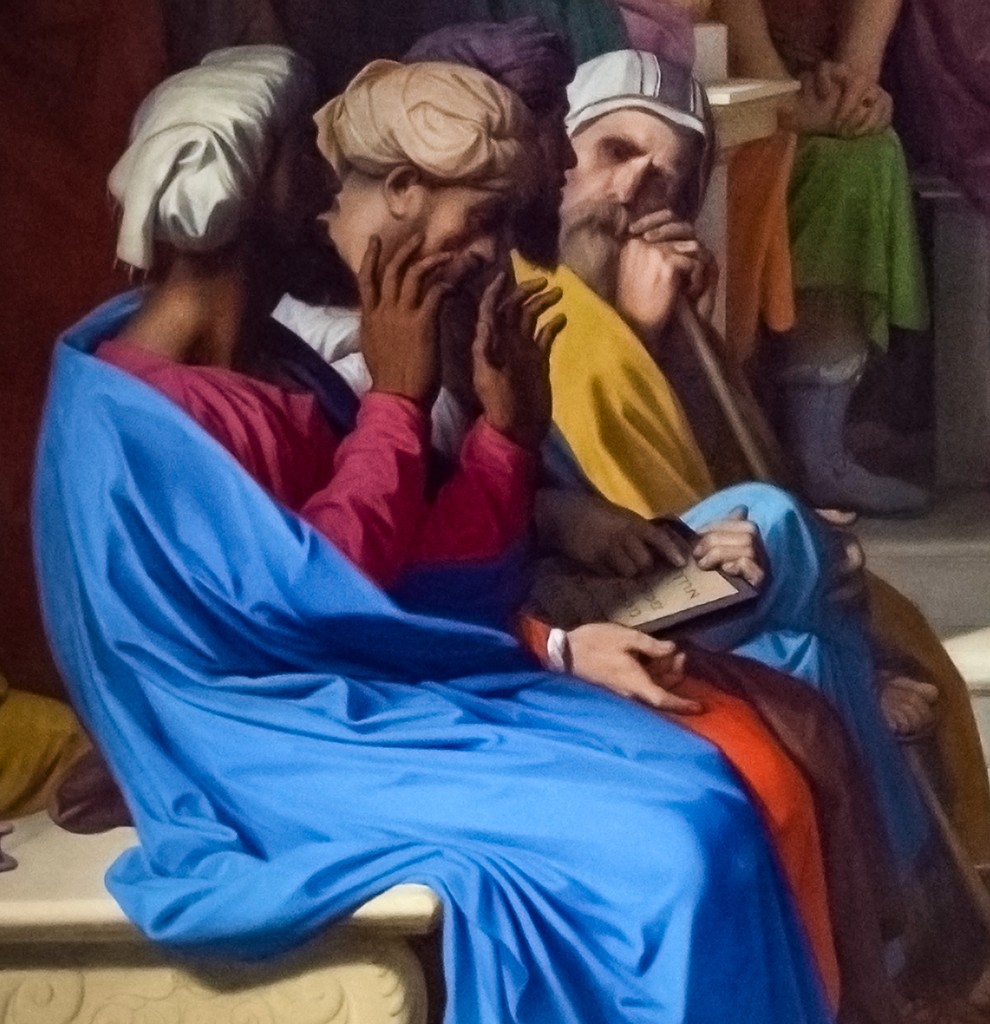
The hands offer a second route through the picture. Fingers touch a chin, hover over a page, point, spread or curl towards a cheek. In the right foreground, a raised index finger echoes Jesus's gesture at a smaller scale and lower level. Across the aisle, a man presses his hands close to his face. The repetition gives the gathering a common visual language without making every figure seem to say the same thing.
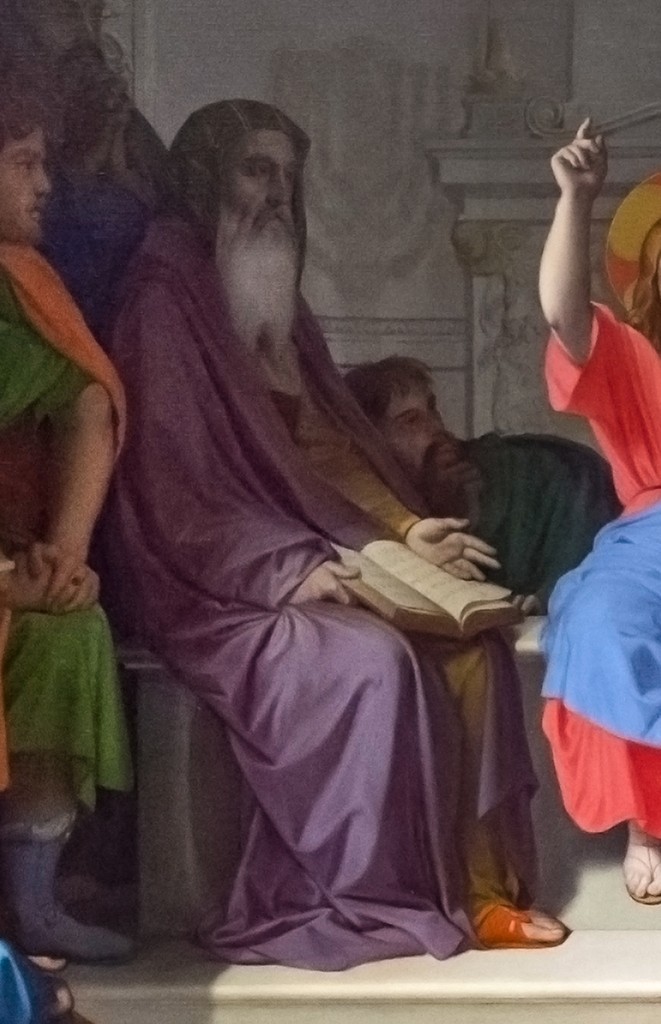
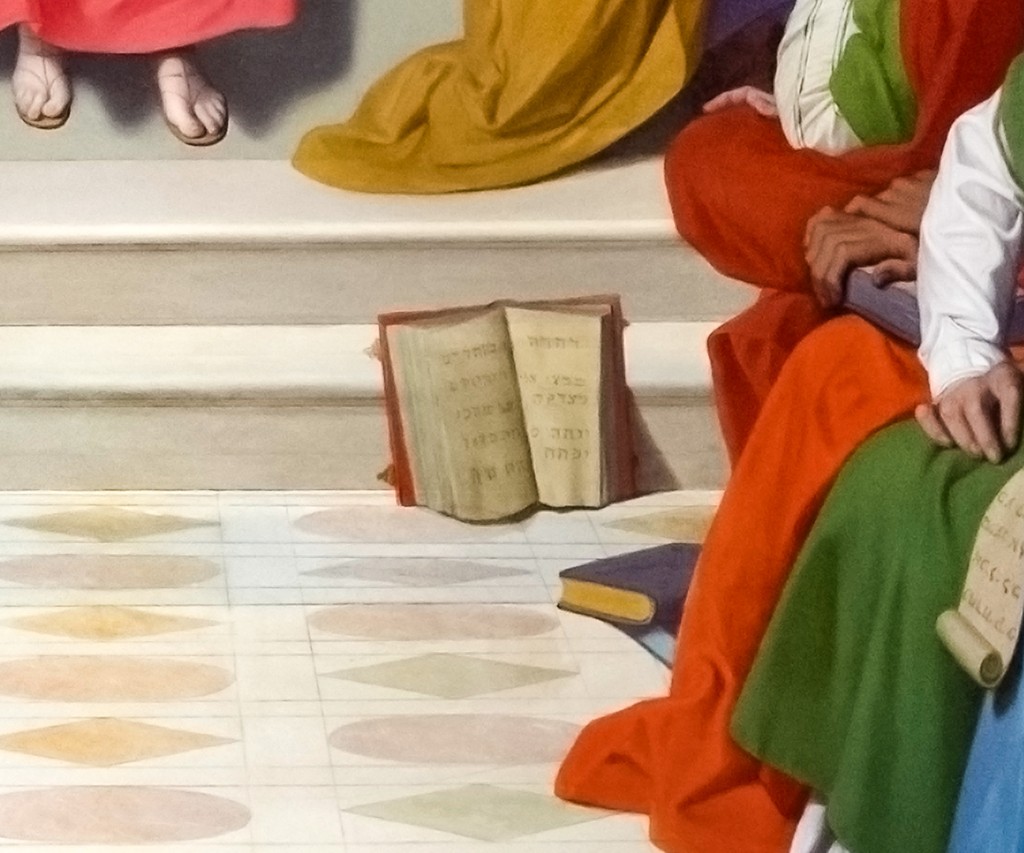
Books and scrolls extend that language into the spaces between bodies. A large open volume rests on the lap of the bearded man beside Jesus. Another book stands open on a step, its pages facing outwards. Closed bindings lie at different angles on the floor, and a scroll curls near the foreground. These objects break up the geometric pavement with irregular edges and soft curves.
Their placement lets learning appear as a physical activity: holding, opening, reading, turning and comparing. The painting does not identify every text for us. Its writing should not be used to invent a precise doctrinal dispute. What is immediately available is the relationship between the volumes and the people around them. Some readers retain contact with a page while looking elsewhere, as though the conversation has momentarily drawn their attention away.
The most useful way to explore this crowd is to follow such small interruptions. Begin with a book, move to the hand resting on it, then to the reader's face and the direction of his gaze. The eye repeatedly returns to Jesus, but it acquires other centres of interest on the way.
A magnificent imagined Temple
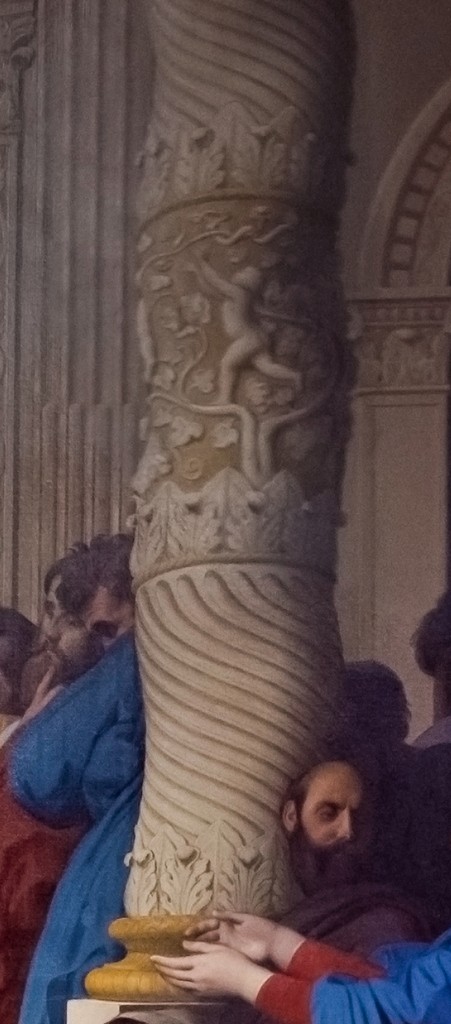
Two great spiral columns frame the inner assembly. Their twisting shafts contrast with the horizontal steps and the regular floor. Above Jesus, hanging lamps and rounded tablets occupy the quieter upper part of the scene. Curved architectural openings and dark curtains lead towards the sides, giving the crowded foreground an enclosing setting.
The ornament is elaborate, yet its colours are subdued beside the robes. Stone, shadow and pale surfaces allow the red, blue, green and yellow clothing to remain distinct. The depth also changes as the eye rises. The near figures have large, strongly separated shapes; the heads behind them cluster into darker groups; the upper architecture offers a comparatively open field.
This is an artist's setting for a sacred encounter. Its richness does not establish an archaeologically exact reconstruction of the Temple. The architecture works visibly as a framework for the assembly: it contains the multitude, marks the centre and gives a small seated child a monumental stage.
Annotated Details from Jesus Among the Doctors
The numbered points identify visible features discussed in this article. Return from each detail to the whole composition. Each caption identifies the work shown.
Jesus Among the Doctors
Ingres, Jesus Among the Doctors, 1862. Oil on canvas, 265 × 320 cm. Musée Ingres Bourdelle, Montauban, MI.867.71. Photograph: Didier Descouens (Archaeodontosaurus); Wikimedia Commons. Image source. CC BY-SA 4.0. Numbered overview: resized, with markers added. Detail images: cropped and JPEG-optimised. All these image derivatives are licensed CC BY-SA 4.0.
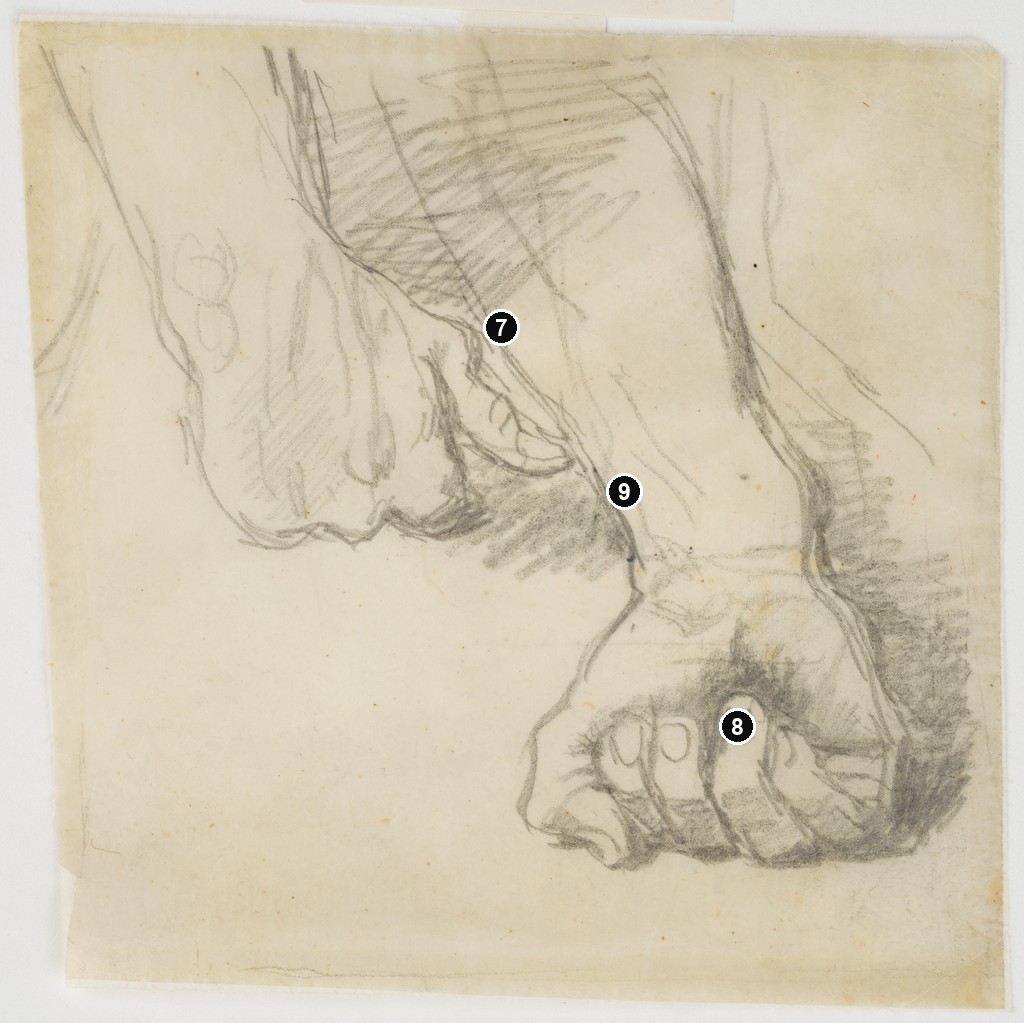
Hand study
Ingres, Study of Hands for Christ Among the Doctors, 1852–62. Graphite on tracing paper. The Metropolitan Museum of Art, 2022.25.11. Bequest of Harvey Salzman, 2020. Image source. CC0 / Public domain.
Details from JESUS AMONG THE DOCTORS
Compare the gestures, books and carved architecture in the finished painting, then the concentrated forms on the separate hand study.
Jesus Among the Doctors
The child’s raised hand and coloured halo
The child lifts one hand beside the coloured halo while extending the other towards the seated men. The bright red and blue clothing gathers these gestures into one central figure.
The elderly reader beside the child
An elderly figure leans over an open book beside the child. Pale pages, an extended hand and the long white beard gather several smaller shapes within the purple drapery.
Hands raised around a listening face
One bearded man lifts his hands near his face among the listeners. Compare his compact gestures with the child’s more extended arms across the centre.
Two readers in the left foreground
Two seated men lean towards one another above a small book. Their bent heads and differently placed hands form a close exchange near the viewer.
The open book on the steps
An open book stands on a step among other closed volumes and scrolls. Its upright pages interrupt the receding floor and low horizontal steps.
The carved column beside Mary
Bands of ornament wind around the tall column beside the blue-clad figure. Its upright mass separates groups of people while the carved motifs repeat smaller curves.
Hand study
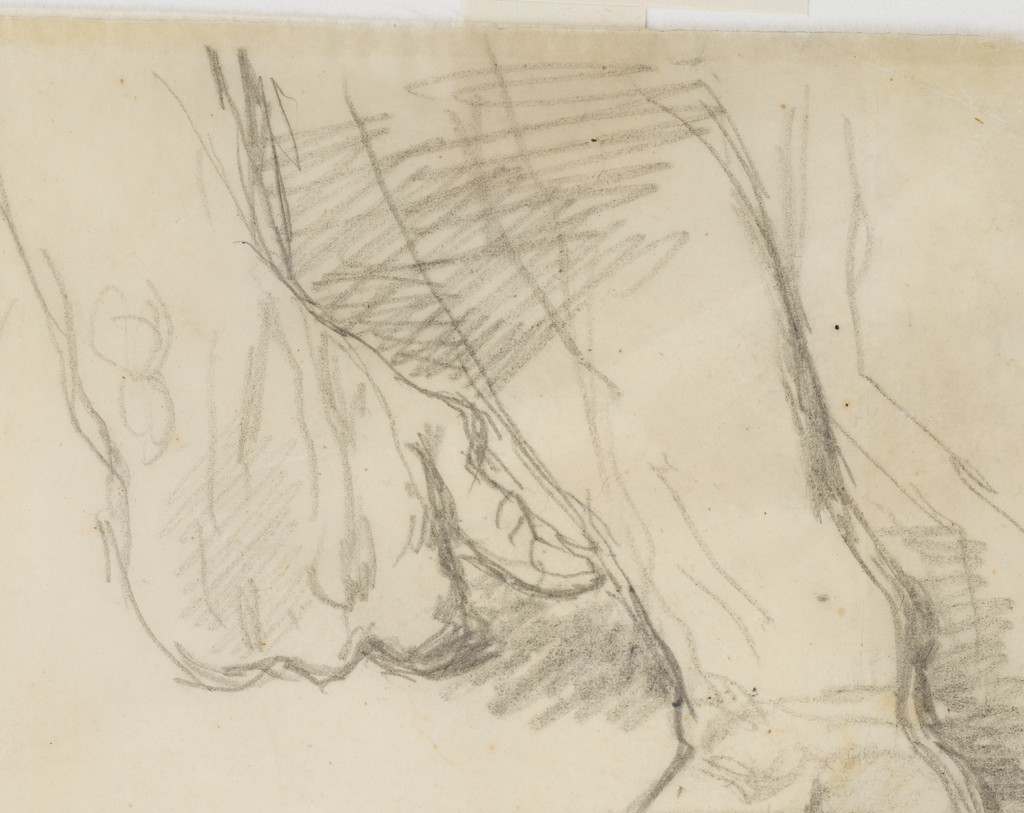
The upper pair of hands
Two hands meet near the upper part of the sheet. Repeated contours and diagonal shaded strokes describe their overlap without building a complete surrounding figure.
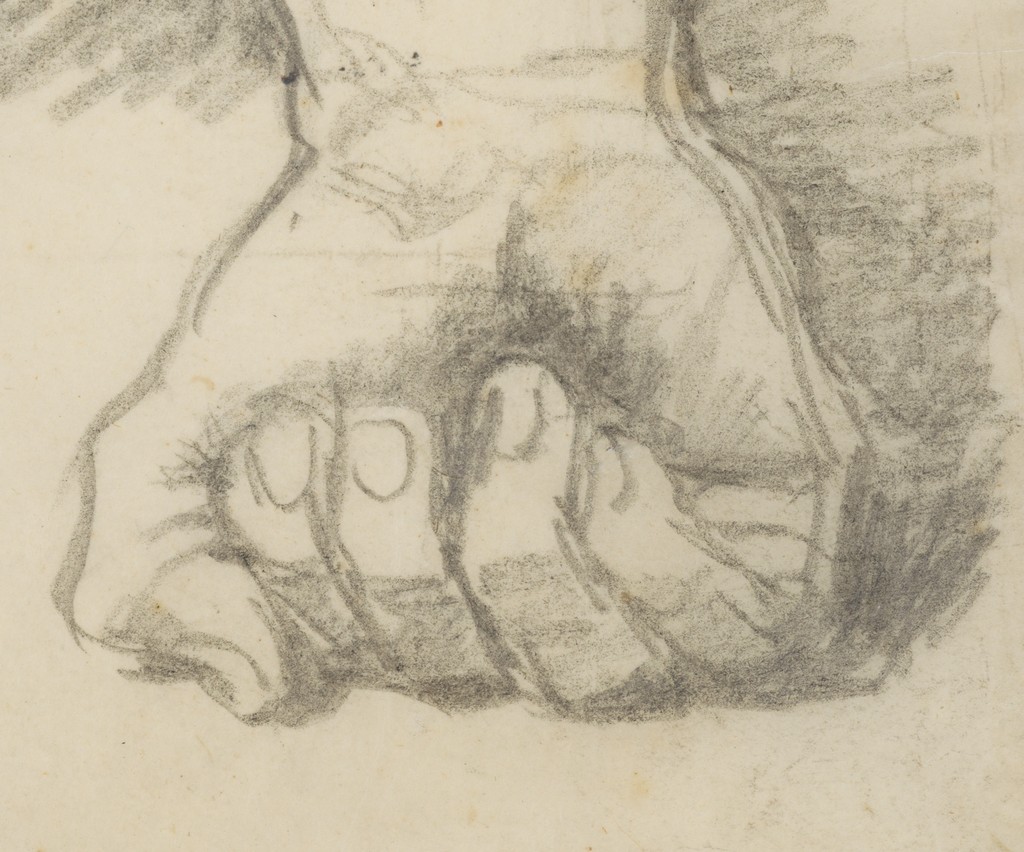
The lower closed hand
The lower hand closes into a compact shape beneath a long wrist. Follow the curved fingers and small outlined nails beside the darker mass of shading.
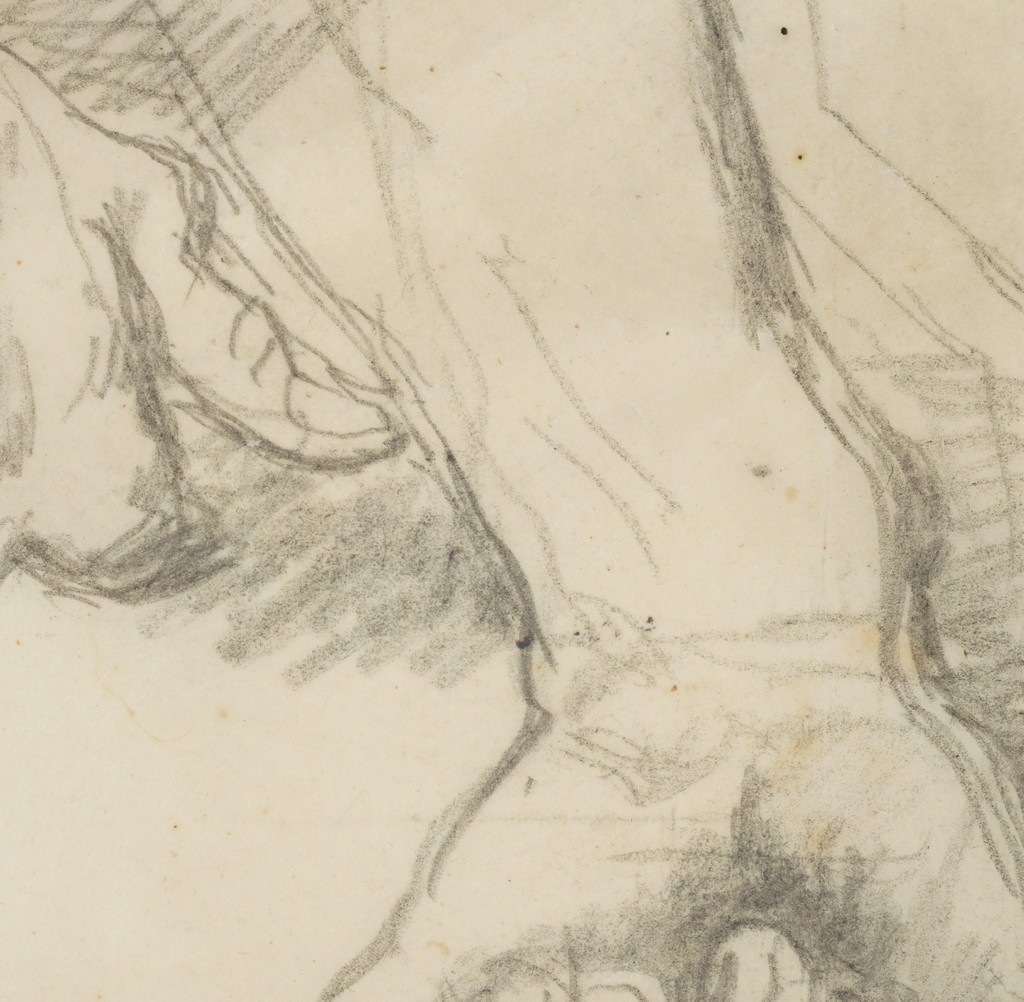
Contours joining hand and wrist
Several lines pass from the upper hand towards the lower wrist. Compare these long, changing contours with the shorter marks around the fingers.
A commission that outlasted its royal destination
The painting began with a commission from Louis-Philippe and Queen Marie-Amélie for the chapel at the château de Bizy, in memory of their son Ferdinand, Duke of Orléans, who died in 1842. The regional museum account dates the beginning of painting to 1845 and connects its non-delivery with the events of 1848. [3]
These dates describe different parts of the work's history. The commission belongs to 1842; the painting's execution stretched far beyond its original circumstances. Henri Delaborde's posthumous account, published in 1870, states that twenty years passed before completion. He also records that Ingres obtained the right to dispose of the picture as he wished. [4] That change in the artist's freedom helps explain why the finished canvas cannot be understood solely through the requirements of its first destination.
Delaborde transcribes a signature giving 1862 and the artist's age as eighty-two. [4] The inscription makes the passage of time part of the object itself. We need not imagine twenty years of uninterrupted work: the surviving evidence points instead to a composition revisited across distinct stages. The long interval allowed a royal chapel commission to acquire a separate life in the artist's possession. The memorial commission gives the child's encounter a family association. [3] The image supplies no portraits of the bereaved royal family.
From early studies to a late change
The Musée Ingres Bourdelle reports that it preserves a hundred drawings connected with the composition. [1] Individual sheets reveal more than that total alone can explain. These drawings make the stages tangible. They show different kinds of work: arranging figures, isolating a contour and returning to a small part of the crowd.
One Montauban sheet, Docteurs n°1, 2 et 4, belongs to the first composition, around 1842. It combines graphite and brown ink on wove paper and carries a grid. The museum distinguishes this early group from a subsequent phase in the design and labels the figures as nudes. [5] Their bodily structure receives separate attention from the abundant robes that cover the assembly in the painting.
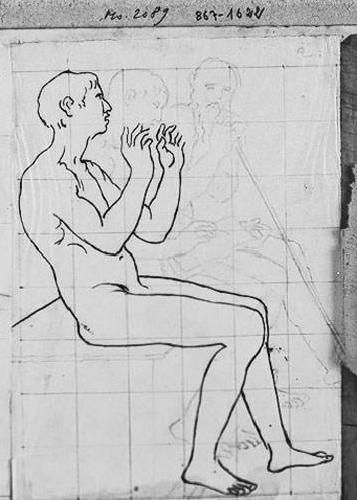
Ingres, Doctors 1, 2 and 4, c. 1842. Graphite and brown ink on squared wove paper, 16 × 11.3 cm. Musée Ingres Bourdelle, MI.867.1622. Studies for the first composition of Jesus Among the Doctors. [6]
On the squared sheet, one dark contour traces a seated body in profile, from the forehead to the toes. Fainter figures sit behind it. Follow a horizontal grid line through both the darker outline and those lighter marks. A second sheet, Jésus, traces the head, halo and clothed arm. The museum assigns it to preparations for Réveil’s 1851 engraving: graphite on tracing paper, retraced with a stylus. [7] The record shows that an outline for a print belonged to the picture’s development before the painting was finished.
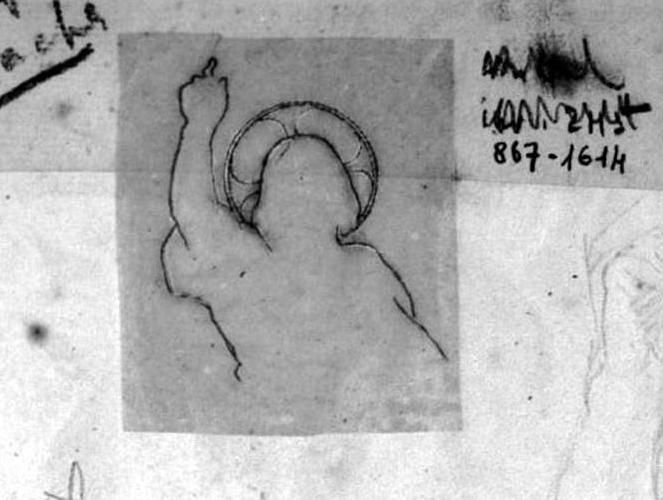
Ingres, Jesus, 1842–1851. Graphite on tracing paper, with lines retraced using a stylus, 6 × 5.1 cm. Musée Ingres Bourdelle, MI.867.1614. The head, halo and arm outline associated with the engraving stage. [8]
The print therefore belongs within the picture's development. It offers a dated record of an earlier arrangement, rather than an automatic substitute for the finished work. The Met links its 1852–62 hand study to a figure added at the lower right. The sheet is graphite on tracing paper, 11.1 × 11.3 cm. [9]
The upper cluster contains several rounded finger ends beside a long wrist. Below, a closed hand has a much darker underside. Short strokes gather at the knuckles, while longer lines continue beyond the hand towards the upper edge of the sheet.
At the lower-right border, only part of another figure is visible. The body disappears behind the foreground man, while hands reach into the remaining strip. Follow that narrow opening back towards the child to see how many layers overlap at the edge.
Delaborde also mentions painted studies gathered on one canvas in Haro's possession, alongside other studies in Montauban. [4] His account broadens the surviving history of preparation beyond drawings alone. It does not provide a secure date or identity for every object now associated with the subject. The records let us follow selected parts of the preparation, while leaving gaps between them.
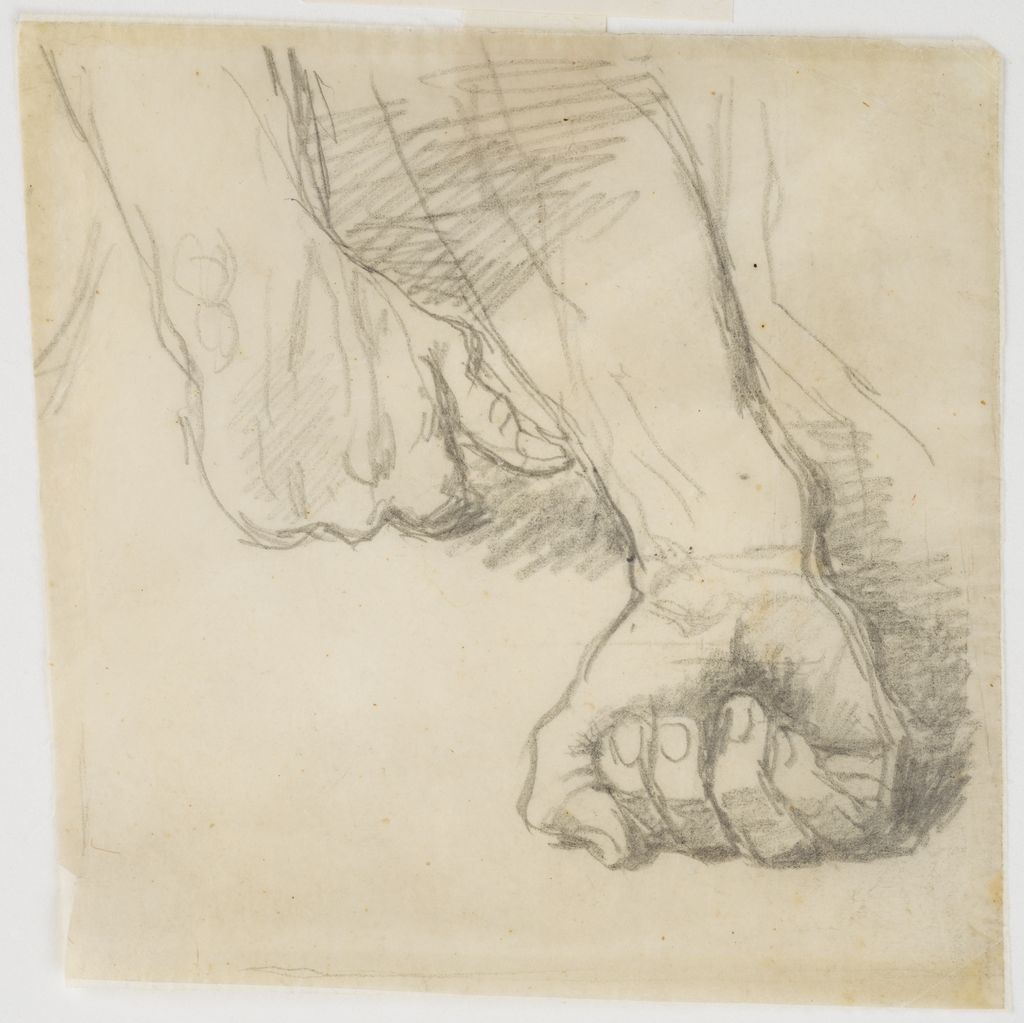
Ingres, Study of Hands for Christ Among the Doctors, 1852–62. Graphite on tracing paper. The Metropolitan Museum of Art, 2022.25.11. [10]
Raphael and the company of learning
The regional museum commentary relates the composition to Raphael’s School of Athens and proposes models from Ingres’s circle of friends, critics and pupils. [3] Follow the open central aisle up to the child's feet. At either side, broad robes face one another, while the heads turn along different lines. The clear approach keeps these smaller exchanges visible around the centre.
The coloured halo is divided into red and yellow sections. Beneath it, blue cloth crosses the red tunic and falls towards the bare feet. Around those bright surfaces, darker heads overlap against the wall, with several faces partly hidden by shoulders. This is a curatorial interpretation, not an identification key for individual faces. [3]
The painting's life beyond the studio
Ingres retained the work, and it entered the Montauban museum through his bequest. [5] The owning museum records its inclusion in the Paris posthumous exhibition of 1867 and in Ingres et son temps at Montauban in 1967. [1] These appearances place the picture within the public assessment of his career, beyond the chapel for which it was first intended.
Its scale asks for an expansive view, but the studies invite close inspection. Those two experiences belong together. From a distance, the child, steps and opposed masses of colour organise the scene. At closer range, a bent finger or an interrupted contour shows how much that organisation depends on small decisions. The painting's enduring interest lies in the movement between those distances: an assembly that reads immediately, and individual encounters that take time to discover.
Artworks directory
Explore 150 paintings, drawings and an original lithograph. This selection includes related versions and studies; dates distinguish completed works from later revisions.
| Name | Date | Medium |
|---|---|---|
| The Apotheosis of Homer | 1827 | Painting |
| Grande Odalisque | 1814 | Painting |
| The Turkish Bath | 1859–1862 | Painting |
| Madame Moitessier Seated | 1856 | Painting |
| Portrait of Monsieur Bertin | 1832 | Painting |
| Napoleon I on His Imperial Throne | 1806 | Painting |
| Odalisque with Slave | 1839 | Painting |
| The Ambassadors of Agamemnon in the Tent of Achilles | 1801 (competition) | Painting |
| The Valpinçon Bather | 1808 | Painting |
| The Source | 1856 | Painting |
| Oedipus Explaining the Enigma of the Sphinx | 1808; revised probably before 1827 | Painting |
| The Vow of Louis XIII | 1824 | Painting |
| Antiochus and Stratonice | 1840 | Painting |
| The Comtesse d’Haussonville | 1845 | Painting |
| The Princesse de Broglie | 1851–1853 | Painting |
| Jupiter and Thetis | 1811 | Painting |
| The Dream of Ossian | 1813 | Painting |
| The Martyrdom of Saint Symphorian | 1834 | Painting |
| Venus Anadyomene | 1808–1848 | Painting |
| Portrait of Madame de Senonnes | 1814 | Painting |
| Madame Rivière | 1805 | Painting |
| Mademoiselle Caroline Rivière | 1805 | Painting |
| Portrait of Philibert Rivière | 1805 | Painting |
| Bonaparte First Consul | 1804 | Painting |
| The Death of Leonardo da Vinci | 1818 | Painting |
| Joan of Arc at the Coronation of Charles VII | 1854 | Painting |
| Madame Duvaucey | 1807 | Painting |
| La Belle Zélie | 1806 | Painting |
| Madame Panckoucke | 1811 | Painting |
| Portrait of Charles Marcotte d’Argenteuil | 1810 | Painting |
| Joseph Antoine Moltedo | c.1810 | Painting |
| Madame Leblanc | 1823 | Painting |
| Delphine Ingres-Ramel (Portrait of Madame Ingres) | 1859 | Painting |
| Portrait of Amédée de Pastoret | 1823–1826 | Painting |
| Portrait of Baronne de Rothschild | 1848 | Painting |
| Madame Marcotte de Sainte Marie | 1826 | Painting |
| Madame Gonse | 1852 | Painting |
| Aretino in the Studio of Tintoretto | 1848 | Painting |
| Don Pedro of Toledo Kissing Henry IV’s Sword | 1831/1832 | Painting |
| Raphael and La Fornarina | 1814 | Painting |
| Roger Freeing Angelica | 1819 | Painting |
| Romulus’ Victory over Acron | 1812 | Painting |
| Self-Portrait at the Age of Twenty-Four | 1804; revised 1841–1851 | Painting |
| Male Torso | c.1800 | Painting |
| Odalisque in Grisaille (Ingres and workshop) | c.1824–1834 | Painting |
| The Small Bather | 1826 | Painting |
| The Little Bather Harem Interior | 1828 | Painting |
| Jesus Among the Doctors | 1862 | Painting |
| The Virgin Adoring the Host | 1852 | Painting |
| The Virgin of the Host | 1841 | Painting |
| Virgin of the Adoption | 1858 | Painting |
| Paolo and Francesca | 1814 | Painting |
| Homer Deified (revised composition, Louvre RF5273) | 1865 | Drawing |
| Odalisque with Slave (Louvre RF4622) | 1858 | Drawing |
| Odalisque (Walters Art Museum; Ingres and Paul Flandrin) | 1842 | Painting |
| Madame Moitessier Standing (National Gallery of Art) | 1851 | Painting |
| Jacques-Louis Leblanc (The Metropolitan Museum of Art) | 1823 | Painting |
| Ferdinand-Philippe, Duke of Orléans (Louvre RF2005-13) | 1842 | Painting |
| Ferdinand-Philippe, Duke of Orléans (Versailles MV5207; Ingres and workshop) | 1843 | Painting |
| Ferdinand-Philippe, Duke of Orléans (Versailles MV5209; Ingres and workshop) | 1844 | Painting |
| Antiochus and Stratonice (Musée Fabre; Ingres and Raymond Balze) | 1866 | Painting |
| Antiochus and Stratonice (Kunstmuseum Bern, Gurlitt bequest) | Undated (early dating proposed) | Drawing |
| Composition study for Antiochus and Stratonice (MIB867.2193) | 1806 | Drawing |
| Study for the Figure of Stratonice (Met63.66) | 1834–1840 | Graphite, black chalk and charcoal |
| Nude figure study for Stratonice (Boijmans F II 36 PK) | c.1834–1840 | Drawing |
| Paolo and Francesca (The Barber Institute,54.6) | c.1814–1820 | Painting |
| Paolo and Francesca (The Hyde Collection,1971.24) | c.1855–1860 | Painting |
| Paolo and Francesca (Amsterdam Museum TA10970) | 1820 | Drawing |
| Paolo and Francesca (dedicated to Artaud de Montor) | 1816 | Drawing |
| Study for the Bust of Francesca (MIB867.1398) | 1819 | Drawing |
| Study for the Bust of Francesca (MIB867.1396) | 1819 | Drawing |
| The Archangel Raphael, first idea (MIB867.2488) | 1842 | Drawing |
| The Archangel Raphael (MIB867.2500) | 1842 | Drawing |
| The Archangel Raphael Carrying Human Prayers to God (Chantilly DE513) | 1844 | Drawing |
| Louis-Philippe as Saint Philip, stained-glass study | 1844 | Drawing |
| Marie Frédéric Eugène de Reiset (Ford Collection RBF171-2) | 1844 | Drawing |
| Virgil Reading the Aeneid (Toulouse) | Begun 1811 | Painting |
| Tu Marcellus Eris (Brussels, inv. 1836) | c.1814 (museum dating) | Painting |
| Jean-François Gilibert | 1804 | Painting |
| François-Marius Granet | 1807 (museum dating) | Painting |
| Count Nikolai Dmitrievich Guryev | 1821 | Painting |
| Caroline Murat, Queen of Naples | 1814 | Painting |
| Count Mathieu Molé | 1834 | Painting |
| Cherubini and the Muse of Lyric Poetry (Louvre) | 1842 | Painting |
| Luigi Cherubini (Cincinnati) | 1841 | Painting |
| Comtesse de Rayneval (Louvre RF4505) | 1841 | Drawing |
| Venus on Paphos (Antonie Balaÿ) | c.1852 | Painting |
| Prince Napoléon | 1855 | Painting |
| Study for The Apotheosis of Napoleon I (Petit Palais) | Late 1853 | Painting |
| The Apotheosis of Napoleon I (destroyed ceiling) | 1853 | Painting |
| The Journalist (MIB867.2733) | 1834? | Drawing |
| Henry VIII, after Holbein | c.1815–1820 (?) | Drawing |
| Madame Récamier, after David (MIB867.3637) | Undated (early Paris period) | Drawing |
| Study for Comtesse d’Haussonville (MIB867.259; background possibly by another hand) | 1842–1845 | Drawing |
| La Source (reduced version reported by Delaborde) | Date unrecorded; reported 1870 | Painting |
| Odalisque (autograph lithograph,NGA1946.21.117) | 1825; published1826 | Lithograph |
| Portrait of a Seated Lady | 1814 | Graphite |
| The Kaunitz Sisters (Leopoldine, Caroline, and Ferdinandine) | 1818 | Graphite |
| Portrait of a Man | 1814 | Graphite |
| Study for the Portrait of Louis-François Bertin (1766–1841) | n.d. | Black chalk and graphite |
| Studies for the Cadaver of Acron | ca. 1810–12 | Graphite on wove paper |
| Study for the Drapery of Molière in "The Apotheosis of Homer" | n.d. | Black chalk with stumping |
| Madame Guillaume Guillon Lethière, née Marie-Joseph-Honorée Vanzenne, and her son Lucien Lethière | 1808 | Graphite |
| Niccolò Paganini (1782–1840) | ca. 1830 | Counterproof or tracing strengthened with graphite and gouache on translucent paper |
| Lady Mary Cavendish-Bentinck (?-1843) | 1816 | Graphite |
| Madame Alexandre Lethière and Her Daughter Letizia | ca. 1815 | Graphite |
| Merry Joseph Blondel (1781–1853) | 1809 | Graphite |
| Ursin-Jules Vatinelle (1798–1881) | 1820 | Graphite |
| Bust of a Gypsy Girl (ascribed to Ingres) | 1819 | Graphite on wove paper |
| Study of a Seated Nude Male | n.d. | Graphite |
| The Archangel Raphael (Study for a stained-glass window in the chapel of Notre-Dame de la Compassion-Saint-Ferdinand, Neuilly) | ca. 1842 | Graphite |
| Lancelot-Théodore, comte Turpin de Crissé | probably 1818 | Graphite |
| Study for the Figure of the Iliad in "The Apotheosis of Homer" | ca. 1827 | Graphite and black chalk heightened with white chalk on brown paper |
| Comtesse Turpin de Crissé | probably 1818 | Graphite |
| Nude Figures for L'Âge d'Or, Château de Dampierre | n.d. | Graphite on brownish paper |
| Study of Figures (attributed to Ingres) | n.d. | Graphite |
| Study of Figures (attributed to Ingres) | n.d. | Graphite; squared in graphite |
| Admiral Sir Fleetwood Broughton Reynolds Pellew | 1817 | Graphite on wove paper |
| Madame Jean-Auguste-Dominique Ingres, née Madeleine Chapelle | 1814 | Graphite on off-white wove paper |
| Virgil Reading the Aeneid to Augustus, Livia, and Octavia | 1809/1819 (?) | Pen and black ink, graphite, brush and gray wash, white gouache heightening, Conté crayon on blue paper |
| General Louis-Étienne Dulong de Rosnay | 1818 | Graphite (hard and soft pencils) |
| Madame Alexandre Lethière, née Rosa Meli, and Her Daughter, Letizia | 1815 | Graphite |
| The Lawyer Paul Grand | 1834 | Graphite |
| Jean-Joseph Fournier | 1815 | Graphite |
| Armand Bertin | 1842 | Graphite |
| Madame Armand Bertin, née Marie-Anne-Cécile Dollfuss | 1843 | Graphite |
| The Architect Charles-Victor Famin | 1836 | Graphite |
| Henri Lehmann | 1850 | Graphite |
| Portrait of a Lady | ca. 1815–17 | Graphite |
| Edmond Cavé (1794–1852) | 1844 | Oil on canvas |
| Head of Saint John the Evangelist | probably ca. 1818–20 | Oil on canvas, laid down on wood |
| Madame Edmond Cavé (Marie-Elisabeth Blavot, ca. 1806–1883) | ca. 1831–34 | Oil on canvas |
| Madame Félix Gallois | 1852 | Graphite with touches of gold in oil to highlight jewelry, on buff wove paper. |
| Dr. François Mêlier | 1849 | Graphite with graphite framing lines, corrected with white, on buff wove paper |
| Portrait of Madame Rhode (Rhoda?) | 1810–20 | Graphite on pale buff wove paper |
| Study for "Raphael and the Fornarina"(?) | ca. 1814(?) | Graphite on white wove paper |
| Portrait of Madame Paul Meurice, née Palmyre Granger | ca. 1845–50 | Graphite on wove paper |
| Alexander the Great presenting Campaspe to Apelles | 1810 | Graphite, brush and brown wash; squared in graphite |
| Study of Hands for "Christ Among the Doctors" | 1852–62 | Graphite on tracing paper |
| Study for The Turkish Bath (RF34502) | about 1850 | Pen and brown ink with graphite, partially squared |
| Study for The Turkish Bath (RF23354) | Undated | Pen and brown ink with graphite on joined sheets |
| Study for The Turkish Bath (RF54702) | about 1859 | Pen and brown ink |
| Studies of women for The Turkish Bath (RF12292) | Undated | Black chalk |
| Achilles Receiving the Envoys of Agamemnon (Nationalmuseum sketch, NM2161) | 1801 | Oil on wood |
| Half-Length Bather (Musée Bonnat-Helleu,89) | 1807 | Oil on canvas |
| Oedipus and the Sphinx (National Gallery,NG3290) | about1826 | Oil on canvas |
| Oedipus and the Sphinx (Walters,37.9) | 1864 | Oil on canvas |
| Oedipus and the Valpinçon Bather, after David (MI.867.2035) | Undated | Graphite on tracing paper, after David |
| Study of the Virgin for The Vow of Louis XIII (Dijon,1758) | about1822 | Black chalk, stump and white chalk on brown wove paper |
| First Thought for The Vow of Louis XIII (MI.885.11.21) | 1822 | Oil on canvas |
Frequently Asked Questions
The title uses doctors in the sense of learned teachers. They belong to the Temple encounter described in Luke's Gospel. [2]
No. Delaborde records its completion twenty years after the 1842 commission, once Ingres had obtained the right to decide its destination. [4]
It concerns an added figure at the lower right. [9]
Discussion
Look again at the images and ideas explored in Jesus Among the Doctors. These editorial prompts invite your observations.
Reader Insights
Follow the hands around the assembly. Which gesture most changes your understanding of the encounter: Jesus's raised finger, Mary's reaching palms, or a teacher's hand paused beside a book?
Compare the cluster of hands around Jesus with the quieter spaces above the figures. Where does the picture make conversation visible?
How does knowing the Gospel account concerns listening and questioning affect your response to the child’s raised finger?
Join the Conversation
Share a detail, comparison or question about Jesus Among the Doctors below.
References
- Musée Ingres Bourdelle, Jésus parmi les docteurs, MI.867.71. Object details, associated drawings and exhibition history; updated 7 August 2025. (in French) View source.
- Gospel of Luke, Luke 2:41–52, King James Version. Biblical narrative; this translation is not identified as the edition used by Ingres. View source.
- Musées Occitanie / Musée Ingres Bourdelle, Jésus au milieu des docteurs. Commission, development and curatorial interpretation. (in French) View source.
- Henri Delaborde, Ingres, sa vie, ses travaux, sa doctrine, d'après les notes manuscrites et les lettres du maître. Paris: Henri Plon, 1870, catalogue of paintings, religious subjects, no. 1, p. 177. Posthumous historical account. (in French) View source.
- Musée Ingres Bourdelle, Docteurs n°1, 2 et 4, MI.867.1622. Materials, first-composition dating and bequest context. (in French) View source.
- Supporting image. Ingres, Doctors 1, 2 and 4, c. 1842. Graphite and brown ink on squared wove paper, 16 × 11.3 cm. Musée Ingres Bourdelle, MI.867.1622. Studies for the first composition of Jesus Among the Doctors. Wikimedia Commons. Image source. Public domain.
- Musée Ingres Bourdelle, Jésus, MI.867.1614. Second series for Réveil's 1851 engraving; materials and subject. (in French) View source.
- Supporting image. Ingres, Jesus, 1842–1851. Graphite on tracing paper, with lines retraced using a stylus, 6 × 5.1 cm. Musée Ingres Bourdelle, MI.867.1614. The head, halo and arm outline associated with the engraving stage. Wikimedia Commons. Image source. Public domain.
- The Metropolitan Museum of Art, Study of Hands for Christ Among the Doctors, 1852–62, 2022.25.11. Object details and curatorial account of the late addition. View source.
- Supporting image. Ingres, Study of Hands for Christ Among the Doctors, 1852–62. Graphite on tracing paper. The Metropolitan Museum of Art, 2022.25.11. Bequest of Harvey Salzman, 2020. Image source. CC0 / Public domain.
- Splash image. Ingres, Jesus Among the Doctors, 1862. Oil on canvas, 265 × 320 cm. Musée Ingres Bourdelle, Montauban, MI.867.71. Photograph: Didier Descouens (Archaeodontosaurus) / Wikimedia Commons. Image source. CC BY-SA 4.0. Resized and JPEG-optimised; derivative image licensed CC BY-SA 4.0.