by Tom Gurney
Tom Gurney BSc (Hons) is an art history expert with over 20 years experience
Published on June 19, 2020 / Updated on October 22, 2026
Email: tomgurney1@gmail.com / Phone: +44 7429 011000
La Belle Zélie
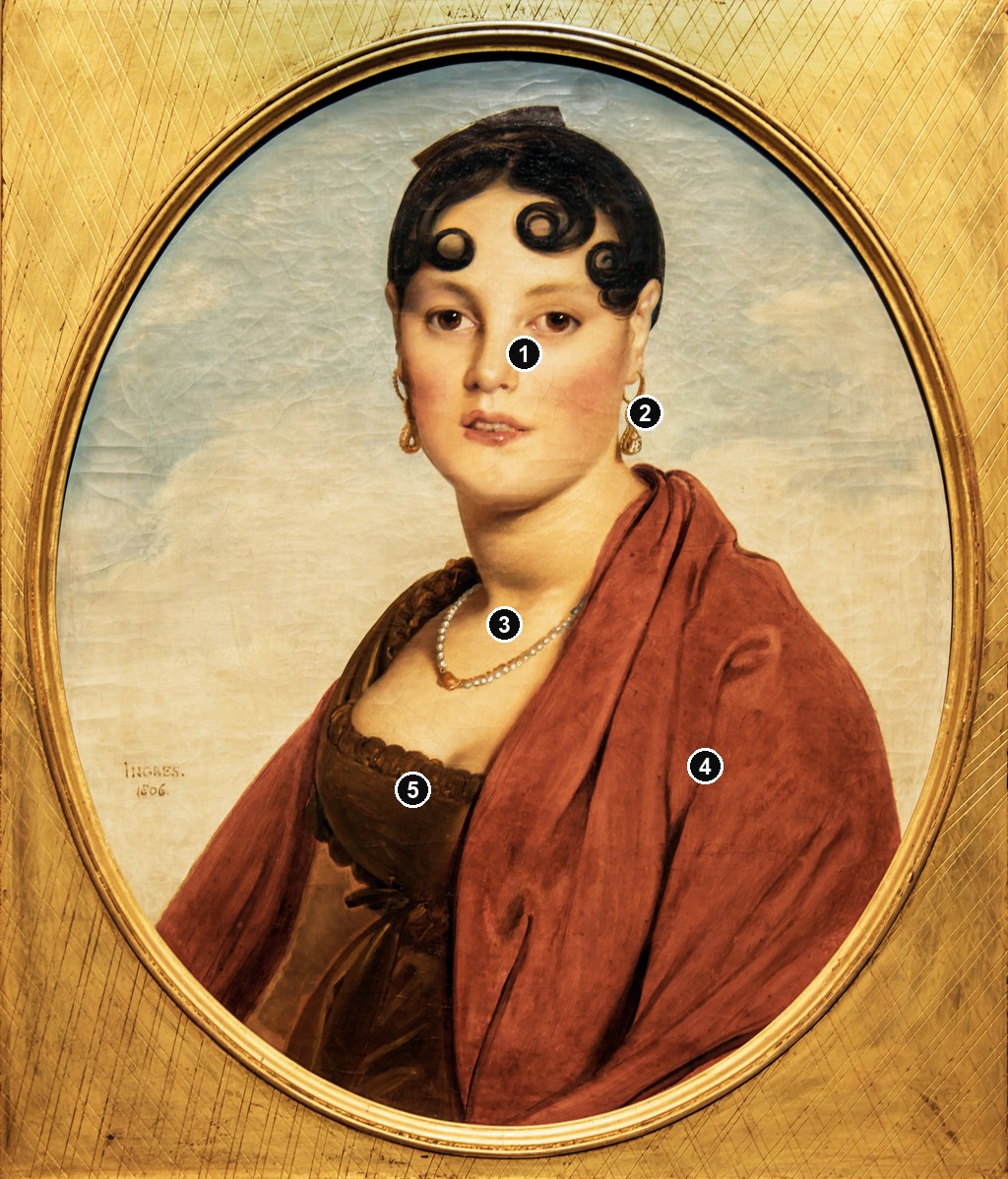
The red shawl gives this portrait its first jolt of colour. Then the face takes over: eyes directed towards us, lips slightly open, dark curls coiling against the forehead. Everything is close. There is little space above the hair, and the broad shoulder presses towards the oval edge. Ingres painted La Belle Zélie in 1806; it belongs to the Musée des Beaux-Arts in Rouen. The museum rejects the traditional identification of its sitter as Madame Aymon. Her presence is vivid, although her name remains unknown. [1]
At a Glance
- ArtistJean-Auguste-Dominique Ingres.
- Date and medium1806; oil on canvas. [1]
- Dimensions59 × 49 cm. [2]
- CollectionMusée des Beaux-Arts, Rouen; inventory 870.1.1. [1]
- SubjectAn unidentified woman, formerly misidentified as Madame Aymon. [1]
- Look forThe unequal curls, the small bright necklace clasp, and the red shawl's changing folds.
This work across Ingres’s career
Agamemnon’s Ambassadors
1801 (competition)Grande Odalisque
1814Louis XIII’s Vow
1824Monsieur Bertin
1832The Princesse de Broglie
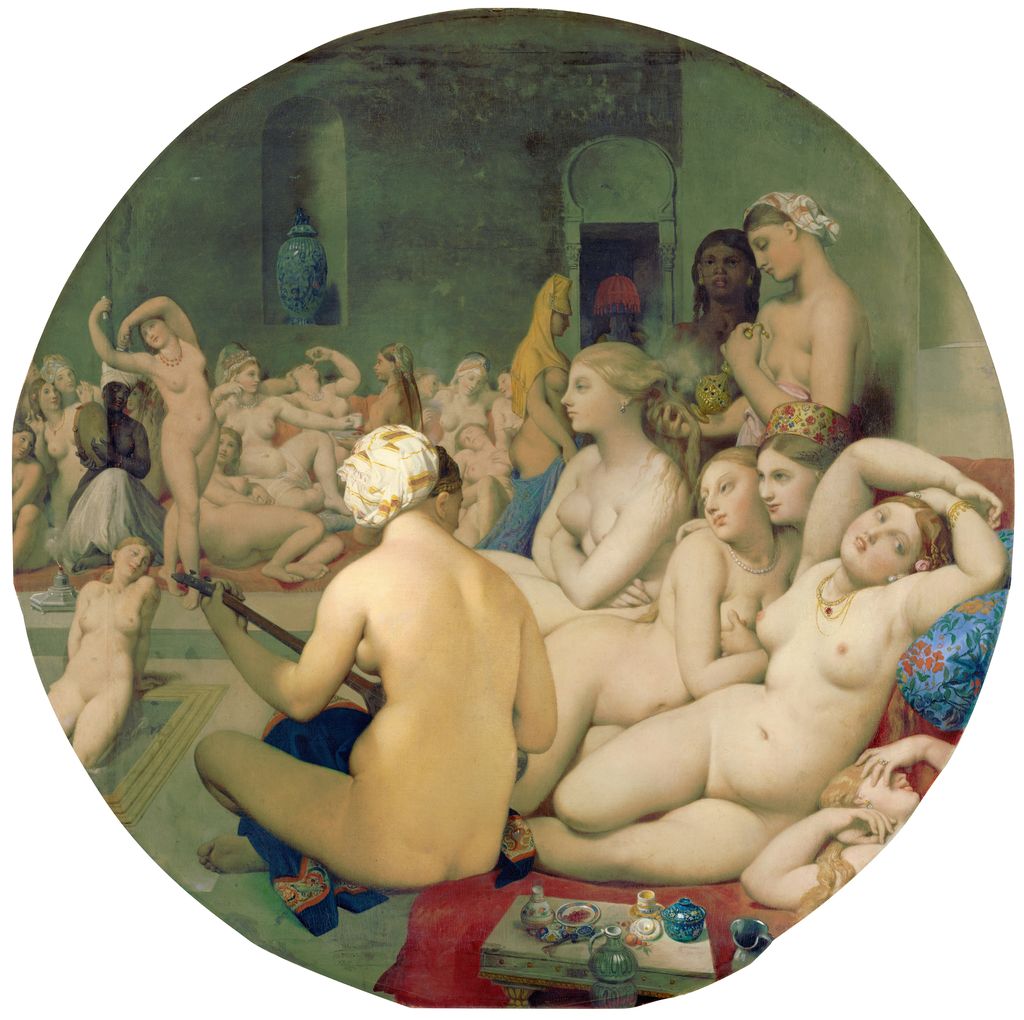
1851–1853The Turkish Bath
1859–1862Contents
- A face brought close
- Red cloth, brown dress, open sky
- Who was La Belle Zélie?
- An early portrait, with an uncertain commission
- How Ingres made the portrait
- From private collections to Rouen
- Annotated details
A face brought close
The portrait is organised around a slight disagreement between head and body. The torso turns across the picture, making one shoulder much more prominent than the other, while the face comes round towards the viewer. This small turn gives the image movement without requiring a gesture. The hands fall outside the composition. The encounter depends on the head, the exposed neck and chest, and the clothing gathered around them.
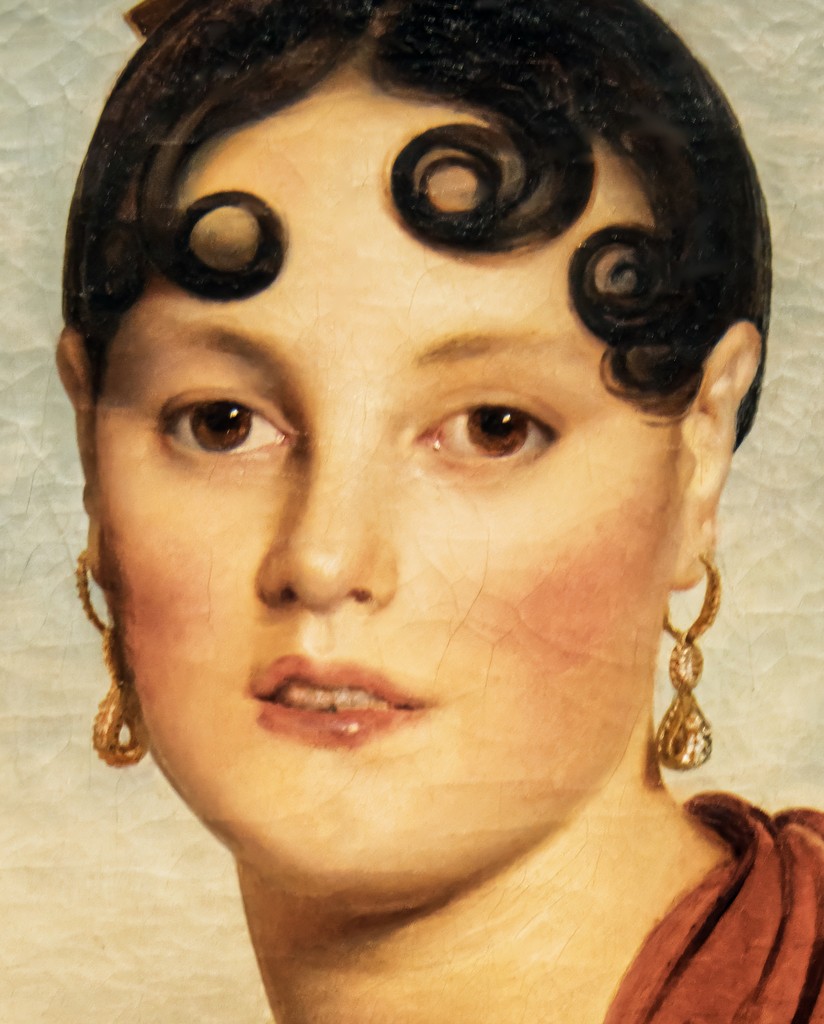
At first, the woman's face can seem almost evenly balanced. Look longer and the differences become absorbing. Her eyes do not sit within identical shapes; the brows rise differently, and the shadows beside the nose vary from side to side. The mouth is set between a softly shaded chin and the clearer light across the cheeks. Tiny touches of brightness separate the lips. These variations keep the frontal presentation from becoming a mask.
The curls offer a different kind of precision. One sits as a compact dark ring above the eye on the left of the image. The larger curl nearer the centre is less regular, with a pale opening enclosed by black hair. A third turns down close to the opposite temple. Rather than making a continuous fringe, they place dark accents at intervals across the forehead. The smooth mass of hair behind them makes their individual edges especially easy to follow.
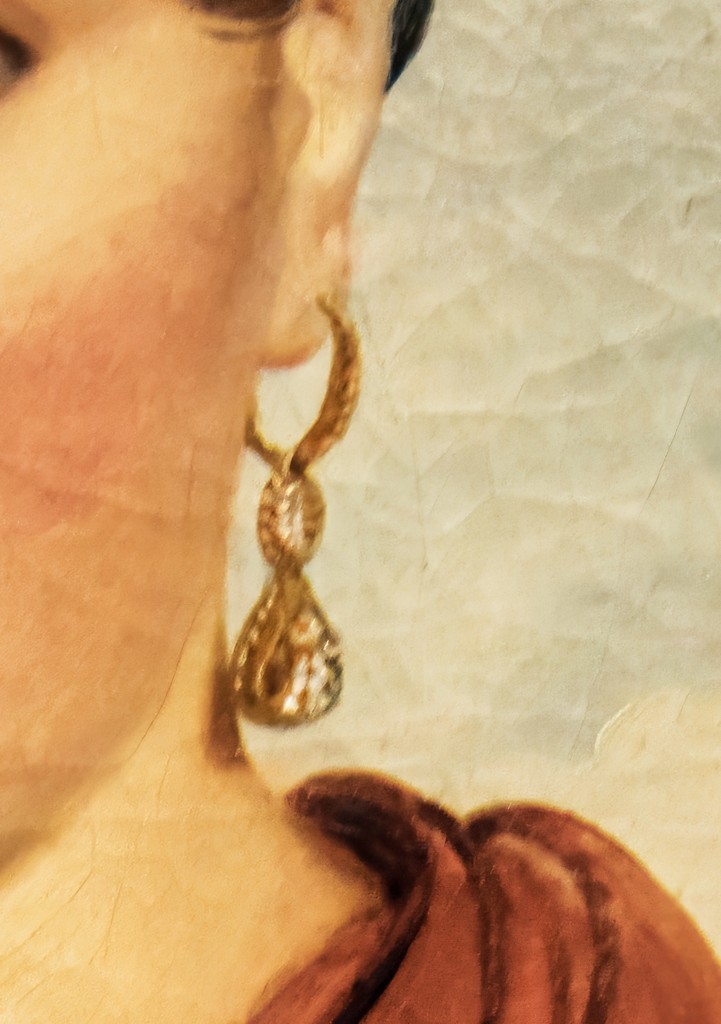
An angled comb rises behind the crown, breaking the head's rounded outline. Its slant is a small but effective interruption: without it, the hair might settle into an almost unbroken cap. Below, the long earrings hang clear of the neck. They create narrow passages of sky between jewellery and flesh, adding lightness beside the much larger dark shape above.
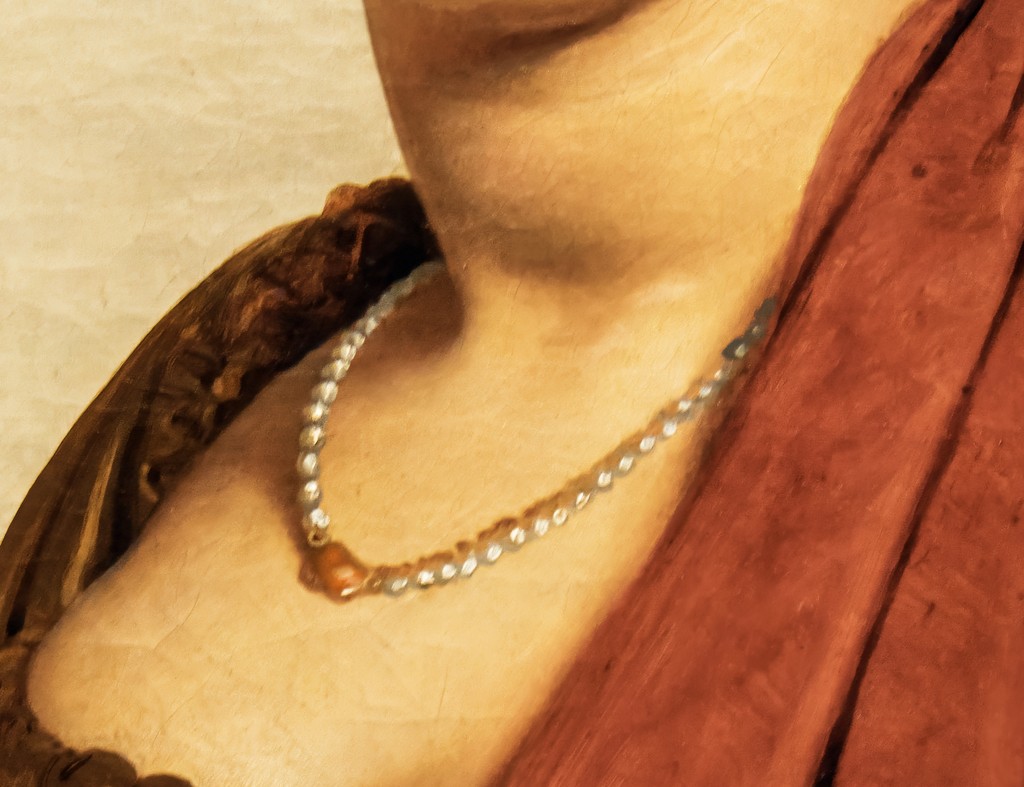
The necklace requires a closer look. Its small beads catch separate points of light, while the warmer clasp at the bottom briefly interrupts their sequence. It lies well above the dress, in an expanse of exposed skin. The necklace and neckline therefore establish two different boundaries across the chest, with a quiet interval between them. Jewellery does more here than record an accessory; its placement helps us judge the spacing of the entire figure.
Red cloth, brown dress, open sky
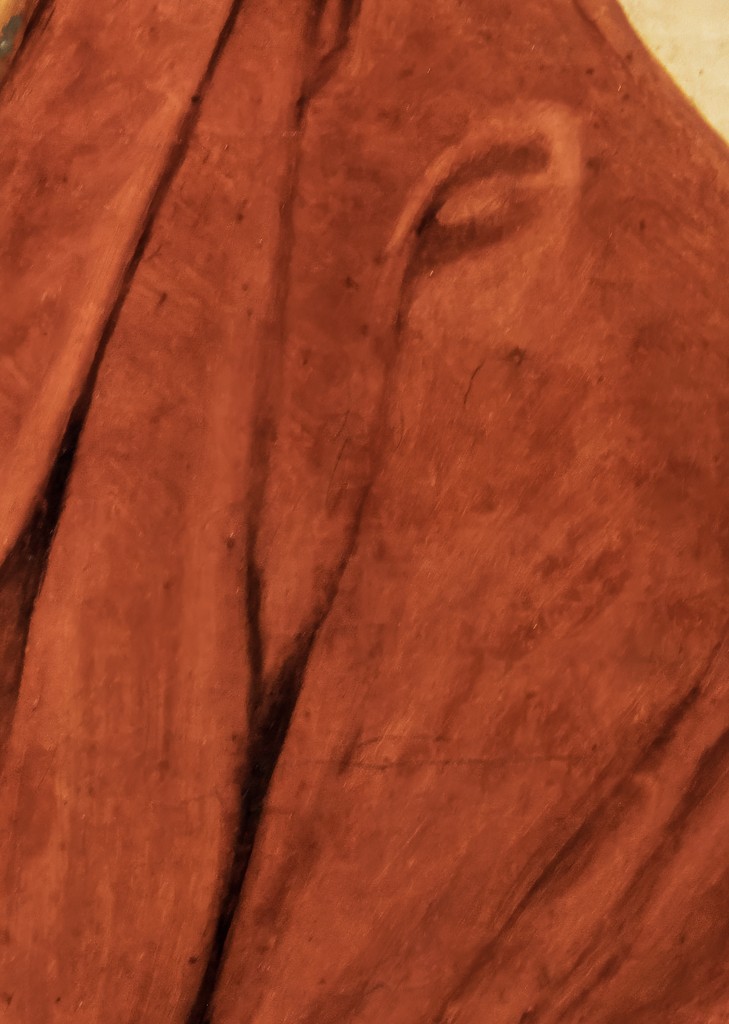
The shawl occupies much of the lower and right-hand portions of the oval. Near the neck it gathers into short, compact ridges. Further down, the folds lengthen, opening into broader red surfaces separated by darker lines. The outer shoulder is rounded and relatively continuous; nearer the centre, the cloth breaks into smaller changes of direction. A single garment can consequently feel both heavy and mobile.
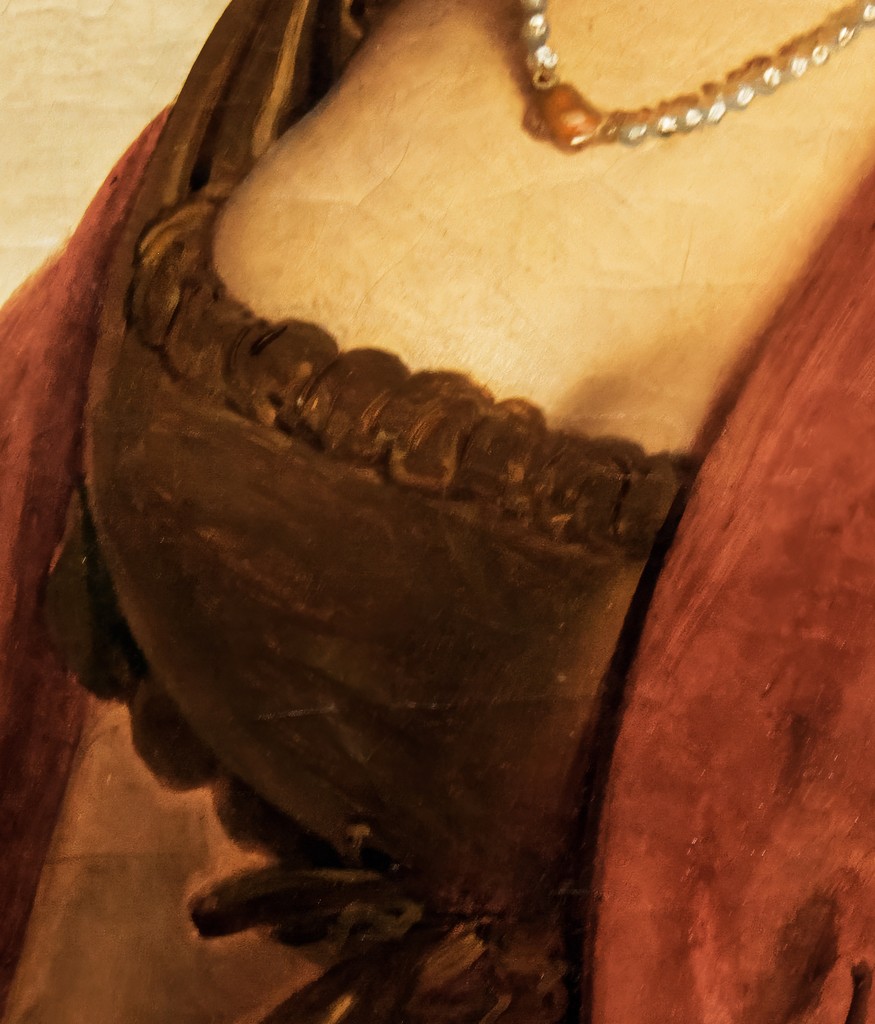
Across the opposite side, a thinner sweep of red runs diagonally towards the lower edge. The two passages of shawl frame the brown bodice without enclosing it symmetrically. At the waist, dark ribbons gather into a bow, with hanging ends crossing the dress. Their narrow, angular shapes provide a useful counterweight to the shawl's expansive folds. The scalloped trim at the neckline introduces a still smaller rhythm.
These differences in scale make the clothing rewarding to explore. We move from the shoulder's broad red area to the bodice, then to a ribbon or an individual scallop, before returning to the face. The brown dress does not compete equally with the shawl. Its darker, quieter surface leaves the red especially assertive, while supplying a setting for the illuminated chest and necklace.
Behind the sitter, blue gives way to loose bands of pale cloud. There is no horizon, building or piece of furniture to establish a location. The sky offers depth without supplying a story about where the woman stands or sits. Its lighter areas also make the outline of the hair and shawl unusually legible. Along the right shoulder, the meeting of red cloth and pale sky is one of the picture's strongest boundaries.
The oval draws these relationships together. Its narrowing lower end compresses the fabric, while the curved upper edge leaves just enough sky around the head. The woman seems large within this field, although the canvas itself is modest in size. Looking at the outline first, then following the ribbons and jewellery inward, reveals how much variety Ingres has placed within a tightly limited space.
Annotated Details from La Belle Zélie
The numbered points identify visible features discussed in this article. Return from each detail to the whole composition. La Belle Zélie. 870.1.1. Photograph: Didier Descouens; Wikimedia Commons. Image source. CC BY-SA 4.0. Numbered overview: resized, with markers added. Detail images: cropped and JPEG-optimised. All these image derivatives are licensed CC BY-SA 4.0.
Details from LA BELLE ZÉLIE
Compare the curls, jewellery and neckline with the broader folds of red and brown cloth.
The face beneath rounded curls
Dark curls make several rounded loops above the face. The open eyes and slightly parted lips sit within a much broader outline of cheek and chin.
An earring beside the red shawl
A small hanging earring meets the turn of the neck above the red cloth. Its bright, compact loops contrast with the wider folds beneath it.
The necklace across the neckline
Small pale beads descend towards a warmer central ornament. Follow their curve between the bare chest and the dark edge of the dress.
Broad folds of the red shawl
Long red folds run down from the shoulder and turn across the body. Their broad changes of light differ from the necklace’s repeated small accents.
The dark dress inside the shawl
The dark dress forms a quieter inner shape between the red edges. Small gathers along the neckline give way to broader bands and folds below.
Who was La Belle Zélie?
The familiar title is a nickname derived from a popular song, rather than a securely established personal name. Rouen's account explicitly describes the earlier identification as Madame Aymon as mistaken. Neither name therefore supplies a sound basis for reconstructing the sitter's family, marriage or occupation. [1]
The older name has a substantial history of its own. In his posthumous book on Ingres, published in 1870, Henri Delaborde catalogued the painting as a portrait of Madame Aymon and recorded its signed date of 1806. His brief entry shows that the identification was already circulating in the nineteenth century; it does not explain how it had been established. [3] An early label can be valuable evidence about a painting's reception while still failing to identify the person represented.
There is a particular temptation to fill that gap because the face appears so immediate. The slightly parted lips might suggest a moment before speech, and the steady eyes can encourage a sense of acquaintance. These are responses to a painted arrangement. They cannot tell us whether the woman was candid, reserved, flirtatious or shy. Clothing and jewellery offer visible particulars, but they do not by themselves disclose a biography.
The title also invites judgement: “belle” already asks us to approach the sitter through her beauty. It is worth looking once without that verbal cue. The uneven curls, the tilt of the comb, the dark bow and the broad shoulder then become independent points of interest. Her anonymity need not reduce the portrait to an attractive face or turn it into a mystery with an invented solution.
An early portrait, with an uncertain commission
The painting belongs to the final months of Ingres's early Paris period, before his departure for Rome in September 1806. The circumstances of its commission and the identity of its patron remain unresolved. [2] There is no secure occasion to narrate, or documented relationship between painter and sitter to explain the pose.
A useful comparison is Madame Rivière, dated 1805 by the Louvre. It also has an oval composition. [4] In that portrait, the seated woman's arms and hands extend through a generous arrangement of blue upholstery, pale dress and patterned shawl. Her surroundings give the eye several routes away from her face. The Rouen portrait crops the body much more closely and dispenses with those furnishings. Red cloth carries the outward movement, while the face remains close to the centre of attention.
Seen together, the paintings show how differently an oval can contain a figure. In Madame Rivière, fabric and furniture help build a place for the sitter to occupy. Here, the shawl meets the edge so directly that the whole image feels more compressed. This comparison makes the Rouen portrait's concentration easier to appreciate without requiring a theory about its unknown commission.

Ingres, Madame Rivière, 1805. [5]
How Ingres made the portrait
Charlotte Hale's technical study describes thin, direct painting over a dense lead-white ground, with minor revisions. Infrared reflectography revealed little underdrawing: the mouth had first been placed slightly lower, and another earring was drawn near the painted one on the right. The openings within the curls were re-established with flesh-coloured paint. Hale also found stronger sky and shawl colours beneath the protecting oval frame, showing that exposed areas had faded. Limited detected underdrawing does not establish that no drawing was used. [6]
Those findings give particular interest to the curls visible today. Each pale centre has its own shape; their edges are as consequential as the black hair enclosing them. Looking from one to another, the sequence feels deliberately varied. The smallest intervals can affect the expression of the whole head.
The protected edges cannot give us an exact reconstruction of the complete painting. [6] As it appears now, the red dominates the clothing, the brown steadies it, and the blue-white sky opens a lighter field around the head. The strongest contrast is between the dark hair and the clouds immediately beside it; the largest area of colour belongs to the shawl. Attention shifts between the two.
From private collections to Rouen
The recorded ownership history passes through the Marcille collection, a Prince Troubetskoy and Jacques Reiset. After Reiset's sale in April 1870, the painting passed through Féral-Cussac to the Rouen museum that year. [2] Eric Bertin corrected the 1857 sale owner's name to Martial-François Marcille, father of Eudoxe, and documented a Marseille exhibition in 1862. [6]
The painting appeared in the posthumous Ingres exhibition in Paris in 1867. Its later bibliography records illustrated publications by Gonse in 1900, Lapauze in 1911 and Hourticq in 1928, tracing its growing circulation through reproductions. [2] These references chart the image's availability; they do not establish a single, shared critical response. Bertin records an anonymous copy in an 1888 sale, tentatively connecting it with one later destroyed in 1940. He also clarified that the original's 1928 Scandinavian exhibition appearance was in Copenhagen only, without the Stockholm and Oslo stops sometimes listed. [6]
The museum and reproduction histories alter the terms of our encounter. A portrait whose original patron remains obscure became an image that could circulate independently of its sitter's name. Its recognisable arrangement—dark curls, red shawl, pale sky—helps explain how easily it holds together at a reduced scale. Yet a small reproduction can make the clothing read as a few flat areas and obscure the transitions within the face. Returning to the folds, neckline and tiny points of light restores some of that complexity.
Artworks directory
Explore 150 paintings, drawings and an original lithograph. This selection includes related versions and studies; dates distinguish completed works from later revisions.
| Name | Date | Medium |
|---|---|---|
| The Apotheosis of Homer | 1827 | Painting |
| Grande Odalisque | 1814 | Painting |
| The Turkish Bath | 1859–1862 | Painting |
| Madame Moitessier Seated | 1856 | Painting |
| Portrait of Monsieur Bertin | 1832 | Painting |
| Napoleon I on His Imperial Throne | 1806 | Painting |
| Odalisque with Slave | 1839 | Painting |
| The Ambassadors of Agamemnon in the Tent of Achilles | 1801 (competition) | Painting |
| The Valpinçon Bather | 1808 | Painting |
| The Source | 1856 | Painting |
| Oedipus Explaining the Enigma of the Sphinx | 1808; revised probably before 1827 | Painting |
| The Vow of Louis XIII | 1824 | Painting |
| Antiochus and Stratonice | 1840 | Painting |
| The Comtesse d’Haussonville | 1845 | Painting |
| The Princesse de Broglie | 1851–1853 | Painting |
| Jupiter and Thetis | 1811 | Painting |
| The Dream of Ossian | 1813 | Painting |
| The Martyrdom of Saint Symphorian | 1834 | Painting |
| Venus Anadyomene | 1808–1848 | Painting |
| Portrait of Madame de Senonnes | 1814 | Painting |
| Madame Rivière | 1805 | Painting |
| Mademoiselle Caroline Rivière | 1805 | Painting |
| Portrait of Philibert Rivière | 1805 | Painting |
| Bonaparte First Consul | 1804 | Painting |
| The Death of Leonardo da Vinci | 1818 | Painting |
| Joan of Arc at the Coronation of Charles VII | 1854 | Painting |
| Madame Duvaucey | 1807 | Painting |
| La Belle Zélie | 1806 | Painting |
| Madame Panckoucke | 1811 | Painting |
| Portrait of Charles Marcotte d’Argenteuil | 1810 | Painting |
| Joseph Antoine Moltedo | c.1810 | Painting |
| Madame Leblanc | 1823 | Painting |
| Delphine Ingres-Ramel (Portrait of Madame Ingres) | 1859 | Painting |
| Portrait of Amédée de Pastoret | 1823–1826 | Painting |
| Portrait of Baronne de Rothschild | 1848 | Painting |
| Madame Marcotte de Sainte Marie | 1826 | Painting |
| Madame Gonse | 1852 | Painting |
| Aretino in the Studio of Tintoretto | 1848 | Painting |
| Don Pedro of Toledo Kissing Henry IV’s Sword | 1831/1832 | Painting |
| Raphael and La Fornarina | 1814 | Painting |
| Roger Freeing Angelica | 1819 | Painting |
| Romulus’ Victory over Acron | 1812 | Painting |
| Self-Portrait at the Age of Twenty-Four | 1804; revised 1841–1851 | Painting |
| Male Torso | c.1800 | Painting |
| Odalisque in Grisaille (Ingres and workshop) | c.1824–1834 | Painting |
| The Small Bather | 1826 | Painting |
| The Little Bather Harem Interior | 1828 | Painting |
| Jesus Among the Doctors | 1862 | Painting |
| The Virgin Adoring the Host | 1852 | Painting |
| The Virgin of the Host | 1841 | Painting |
| Virgin of the Adoption | 1858 | Painting |
| Paolo and Francesca | 1814 | Painting |
| Homer Deified (revised composition, Louvre RF5273) | 1865 | Drawing |
| Odalisque with Slave (Louvre RF4622) | 1858 | Drawing |
| Odalisque (Walters Art Museum; Ingres and Paul Flandrin) | 1842 | Painting |
| Madame Moitessier Standing (National Gallery of Art) | 1851 | Painting |
| Jacques-Louis Leblanc (The Metropolitan Museum of Art) | 1823 | Painting |
| Ferdinand-Philippe, Duke of Orléans (Louvre RF2005-13) | 1842 | Painting |
| Ferdinand-Philippe, Duke of Orléans (Versailles MV5207; Ingres and workshop) | 1843 | Painting |
| Ferdinand-Philippe, Duke of Orléans (Versailles MV5209; Ingres and workshop) | 1844 | Painting |
| Antiochus and Stratonice (Musée Fabre; Ingres and Raymond Balze) | 1866 | Painting |
| Antiochus and Stratonice (Kunstmuseum Bern, Gurlitt bequest) | Undated (early dating proposed) | Drawing |
| Composition study for Antiochus and Stratonice (MIB867.2193) | 1806 | Drawing |
| Study for the Figure of Stratonice (Met63.66) | 1834–1840 | Graphite, black chalk and charcoal |
| Nude figure study for Stratonice (Boijmans F II 36 PK) | c.1834–1840 | Drawing |
| Paolo and Francesca (The Barber Institute,54.6) | c.1814–1820 | Painting |
| Paolo and Francesca (The Hyde Collection,1971.24) | c.1855–1860 | Painting |
| Paolo and Francesca (Amsterdam Museum TA10970) | 1820 | Drawing |
| Paolo and Francesca (dedicated to Artaud de Montor) | 1816 | Drawing |
| Study for the Bust of Francesca (MIB867.1398) | 1819 | Drawing |
| Study for the Bust of Francesca (MIB867.1396) | 1819 | Drawing |
| The Archangel Raphael, first idea (MIB867.2488) | 1842 | Drawing |
| The Archangel Raphael (MIB867.2500) | 1842 | Drawing |
| The Archangel Raphael Carrying Human Prayers to God (Chantilly DE513) | 1844 | Drawing |
| Louis-Philippe as Saint Philip, stained-glass study | 1844 | Drawing |
| Marie Frédéric Eugène de Reiset (Ford Collection RBF171-2) | 1844 | Drawing |
| Virgil Reading the Aeneid (Toulouse) | Begun 1811 | Painting |
| Tu Marcellus Eris (Brussels, inv. 1836) | c.1814 (museum dating) | Painting |
| Jean-François Gilibert | 1804 | Painting |
| François-Marius Granet | 1807 (museum dating) | Painting |
| Count Nikolai Dmitrievich Guryev | 1821 | Painting |
| Caroline Murat, Queen of Naples | 1814 | Painting |
| Count Mathieu Molé | 1834 | Painting |
| Cherubini and the Muse of Lyric Poetry (Louvre) | 1842 | Painting |
| Luigi Cherubini (Cincinnati) | 1841 | Painting |
| Comtesse de Rayneval (Louvre RF4505) | 1841 | Drawing |
| Venus on Paphos (Antonie Balaÿ) | c.1852 | Painting |
| Prince Napoléon | 1855 | Painting |
| Study for The Apotheosis of Napoleon I (Petit Palais) | Late 1853 | Painting |
| The Apotheosis of Napoleon I (destroyed ceiling) | 1853 | Painting |
| The Journalist (MIB867.2733) | 1834? | Drawing |
| Henry VIII, after Holbein | c.1815–1820 (?) | Drawing |
| Madame Récamier, after David (MIB867.3637) | Undated (early Paris period) | Drawing |
| Study for Comtesse d’Haussonville (MIB867.259; background possibly by another hand) | 1842–1845 | Drawing |
| La Source (reduced version reported by Delaborde) | Date unrecorded; reported 1870 | Painting |
| Odalisque (autograph lithograph,NGA1946.21.117) | 1825; published1826 | Lithograph |
| Portrait of a Seated Lady | 1814 | Graphite |
| The Kaunitz Sisters (Leopoldine, Caroline, and Ferdinandine) | 1818 | Graphite |
| Portrait of a Man | 1814 | Graphite |
| Study for the Portrait of Louis-François Bertin (1766–1841) | n.d. | Black chalk and graphite |
| Studies for the Cadaver of Acron | ca. 1810–12 | Graphite on wove paper |
| Study for the Drapery of Molière in "The Apotheosis of Homer" | n.d. | Black chalk with stumping |
| Madame Guillaume Guillon Lethière, née Marie-Joseph-Honorée Vanzenne, and her son Lucien Lethière | 1808 | Graphite |
| Niccolò Paganini (1782–1840) | ca. 1830 | Counterproof or tracing strengthened with graphite and gouache on translucent paper |
| Lady Mary Cavendish-Bentinck (?-1843) | 1816 | Graphite |
| Madame Alexandre Lethière and Her Daughter Letizia | ca. 1815 | Graphite |
| Merry Joseph Blondel (1781–1853) | 1809 | Graphite |
| Ursin-Jules Vatinelle (1798–1881) | 1820 | Graphite |
| Bust of a Gypsy Girl (ascribed to Ingres) | 1819 | Graphite on wove paper |
| Study of a Seated Nude Male | n.d. | Graphite |
| The Archangel Raphael (Study for a stained-glass window in the chapel of Notre-Dame de la Compassion-Saint-Ferdinand, Neuilly) | ca. 1842 | Graphite |
| Lancelot-Théodore, comte Turpin de Crissé | probably 1818 | Graphite |
| Study for the Figure of the Iliad in "The Apotheosis of Homer" | ca. 1827 | Graphite and black chalk heightened with white chalk on brown paper |
| Comtesse Turpin de Crissé | probably 1818 | Graphite |
| Nude Figures for L'Âge d'Or, Château de Dampierre | n.d. | Graphite on brownish paper |
| Study of Figures (attributed to Ingres) | n.d. | Graphite |
| Study of Figures (attributed to Ingres) | n.d. | Graphite; squared in graphite |
| Admiral Sir Fleetwood Broughton Reynolds Pellew | 1817 | Graphite on wove paper |
| Madame Jean-Auguste-Dominique Ingres, née Madeleine Chapelle | 1814 | Graphite on off-white wove paper |
| Virgil Reading the Aeneid to Augustus, Livia, and Octavia | 1809/1819 (?) | Pen and black ink, graphite, brush and gray wash, white gouache heightening, Conté crayon on blue paper |
| General Louis-Étienne Dulong de Rosnay | 1818 | Graphite (hard and soft pencils) |
| Madame Alexandre Lethière, née Rosa Meli, and Her Daughter, Letizia | 1815 | Graphite |
| The Lawyer Paul Grand | 1834 | Graphite |
| Jean-Joseph Fournier | 1815 | Graphite |
| Armand Bertin | 1842 | Graphite |
| Madame Armand Bertin, née Marie-Anne-Cécile Dollfuss | 1843 | Graphite |
| The Architect Charles-Victor Famin | 1836 | Graphite |
| Henri Lehmann | 1850 | Graphite |
| Portrait of a Lady | ca. 1815–17 | Graphite |
| Edmond Cavé (1794–1852) | 1844 | Oil on canvas |
| Head of Saint John the Evangelist | probably ca. 1818–20 | Oil on canvas, laid down on wood |
| Madame Edmond Cavé (Marie-Elisabeth Blavot, ca. 1806–1883) | ca. 1831–34 | Oil on canvas |
| Madame Félix Gallois | 1852 | Graphite with touches of gold in oil to highlight jewelry, on buff wove paper. |
| Dr. François Mêlier | 1849 | Graphite with graphite framing lines, corrected with white, on buff wove paper |
| Portrait of Madame Rhode (Rhoda?) | 1810–20 | Graphite on pale buff wove paper |
| Study for "Raphael and the Fornarina"(?) | ca. 1814(?) | Graphite on white wove paper |
| Portrait of Madame Paul Meurice, née Palmyre Granger | ca. 1845–50 | Graphite on wove paper |
| Alexander the Great presenting Campaspe to Apelles | 1810 | Graphite, brush and brown wash; squared in graphite |
| Study of Hands for "Christ Among the Doctors" | 1852–62 | Graphite on tracing paper |
| Study for The Turkish Bath (RF34502) | about 1850 | Pen and brown ink with graphite, partially squared |
| Study for The Turkish Bath (RF23354) | Undated | Pen and brown ink with graphite on joined sheets |
| Study for The Turkish Bath (RF54702) | about 1859 | Pen and brown ink |
| Studies of women for The Turkish Bath (RF12292) | Undated | Black chalk |
| Achilles Receiving the Envoys of Agamemnon (Nationalmuseum sketch, NM2161) | 1801 | Oil on wood |
| Half-Length Bather (Musée Bonnat-Helleu,89) | 1807 | Oil on canvas |
| Oedipus and the Sphinx (National Gallery,NG3290) | about1826 | Oil on canvas |
| Oedipus and the Sphinx (Walters,37.9) | 1864 | Oil on canvas |
| Oedipus and the Valpinçon Bather, after David (MI.867.2035) | Undated | Graphite on tracing paper, after David |
| Study of the Virgin for The Vow of Louis XIII (Dijon,1758) | about1822 | Black chalk, stump and white chalk on brown wove paper |
| First Thought for The Vow of Louis XIII (MI.885.11.21) | 1822 | Oil on canvas |
Frequently Asked Questions
Unidentified; the Madame Aymon identification is rejected. [1]
Rouen, inventory 870.1.1. [1]
Compare the broad, almost uninterrupted area of red over the shoulder with the smaller folds beside the neck. Then follow the necklace upwards to the earrings and curls. The shifts between large shapes and tiny details give the portrait much of its visual energy.
Discussion
Look again at the images and ideas explored in La Belle Zélie. These editorial prompts invite your observations.
Reader Insights
Does the portrait feel more animated when you concentrate on the turn between head and shoulders, or when you follow the small differences between the curls, eyes and brows? Which detail most changes your first impression of the sitter?
Compare the open sky here with the interiors of the Rivière portraits. How does the setting change the apparent closeness of the face?
What remains available to close looking when the sitter’s identity and commission are uncertain?
Join the Conversation
Share a detail, comparison or question about La Belle Zélie below.
References
- Rouen, La Belle Zélie. 870.1.1. View source.
- Conisbee/Yeide; Rabinow, Portraits by Ingres, 1999, pp. 60–62, 546. View source.
- Henri Delaborde, Ingres, sa vie, ses travaux, sa doctrine, d'après les notes manuscrites et les lettres du maître. Paris: Henri Plon, 1870, p. 244, catalogue no. 103. Posthumous documentary compilation; historical identification, not confirmation of the sitter's name. (in French) View source.
- Musée du Louvre, Madame Rivière. Collection record, MI 1446; 1805 date and oval composition. Consulted 17 October 2026. (in French) View source.
- Supporting image. Ingres, Madame Rivière, 1805. Musée du Louvre; Wikimedia Commons. Image source. Public domain.
- Hale/Bertin, “Portraits by Ingres”. Metropolitan Museum Journal 35 (2000), pp. 198, 210, cat. 8. View source.
- Splash image. La Belle Zélie. 870.1.1. Photograph: Didier Descouens / Wikimedia Commons. Image source. CC BY-SA 4.0. Resized and JPEG-optimised; image derivative licensed CC BY-SA 4.0.