by Tom Gurney
Tom Gurney BSc (Hons) is an art history expert with over 20 years experience
Published on June 19, 2020 / Updated on October 22, 2026
Email: tomgurney1@gmail.com / Phone: +44 7429 011000
The Princesse de Broglie
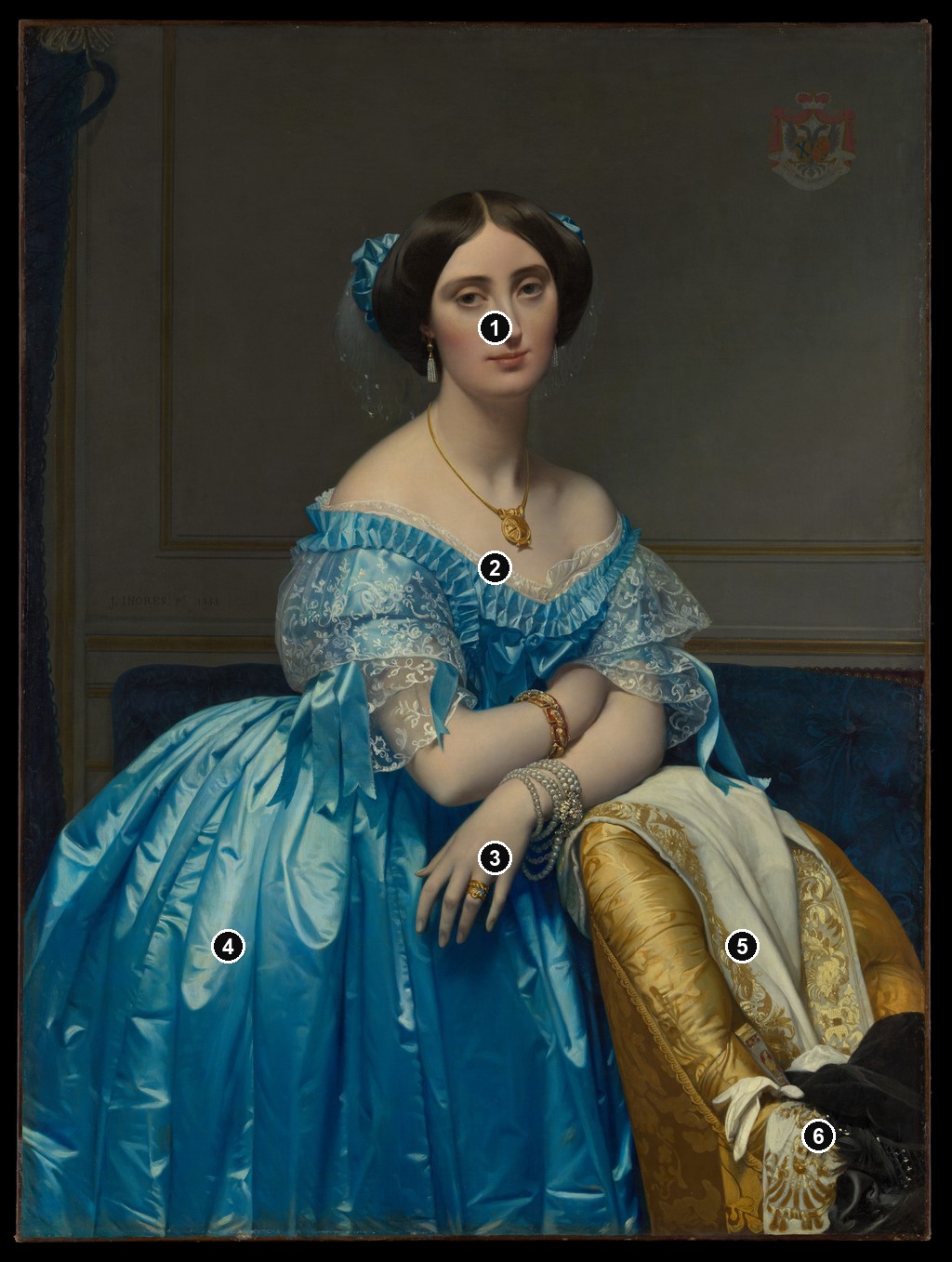
The blue dress reaches us before the face. Its bright folds spread across almost the whole lower half of Ingres’s The Princesse de Broglie, catching light in long, shifting streaks. Above this expanse, a woman rests her folded arms on the back of a golden chair and looks towards us. Her face is quieter than everything surrounding it. The longer we look, the more the picture’s brilliance seems to depend on the small interval between that still gaze and the restless fabric below.
Painted in 1851–53, the portrait belongs to the Metropolitan Museum of Art’s Robert Lehman Collection.[1] Albert de Broglie commissioned his wife’s portrait.[1] Pauline, Louise’s sister-in-law,[2] appears amid costly materials with the composed bearing of an aristocratic household, yet its strongest effects come from unusually intimate details: a shaded eyelid, the blue reflected on a hand, and fingers suspended above the satin.
At a Glance
- ArtistJean-Auguste-Dominique Ingres.
- Date1851–53; signed and dated 1853.[1][3]
- SitterJoséphine-Éléonore-Marie-Pauline de Galard de Brassac de Béarn (1825–1860), Princesse de Broglie, usually called Pauline.[1]
- Medium and sizeOil on canvas, 121.3 × 90.8 cm.[1]
- CollectionThe Metropolitan Museum of Art, New York; Robert Lehman Collection, 1975, accession 1975.1.186.[1]
- Look forThe unequal eyelids, blue reflections on the skin, the overlapping forearms, and the contrast between broad satin folds and minute jewellery.
This work across Ingres’s career
Agamemnon’s Ambassadors
1801 (competition)Grande Odalisque
1814Louis XIII’s Vow
1824Monsieur Bertin
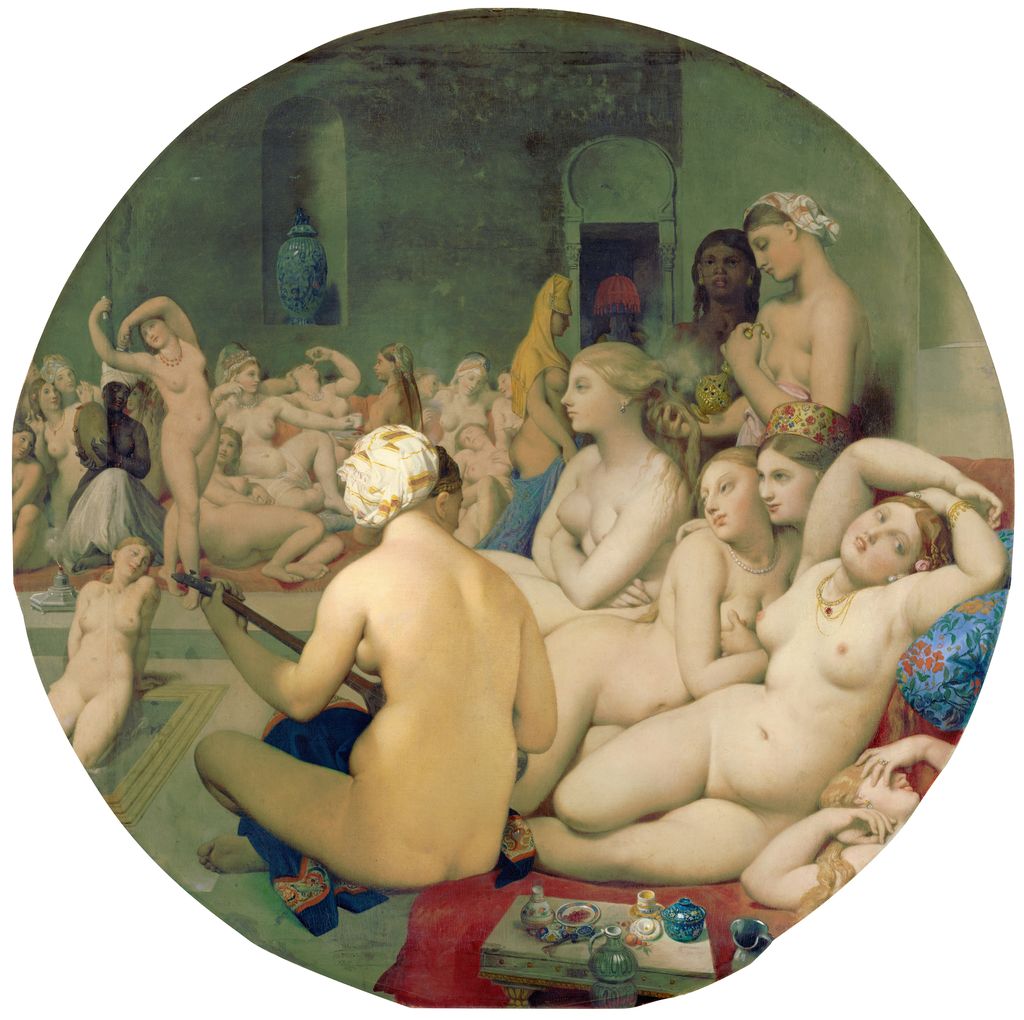
1832The Turkish Bath
1859–1862Contents
- Looking at Pauline
- A commission within the family
- How the pose was made
- Silk, jewellery and things set aside
- Admiration and disagreement
- From a family portrait to the Met
- Annotated details
Looking at Pauline
Pauline’s head sits within a large area of grey wall. The gilded mouldings make a restrained frame behind her shoulders, while a dark blue curtain closes the picture at the left. A low blue seat extends behind the figure. The family coat of arms appears high on the wall at the right, well away from her face; the painter’s signature occupies a lower, quieter position on the opposite side. There is considerable empty space above her, but very little below. Her dress presses towards the lower edge, while her head seems to have room to breathe.
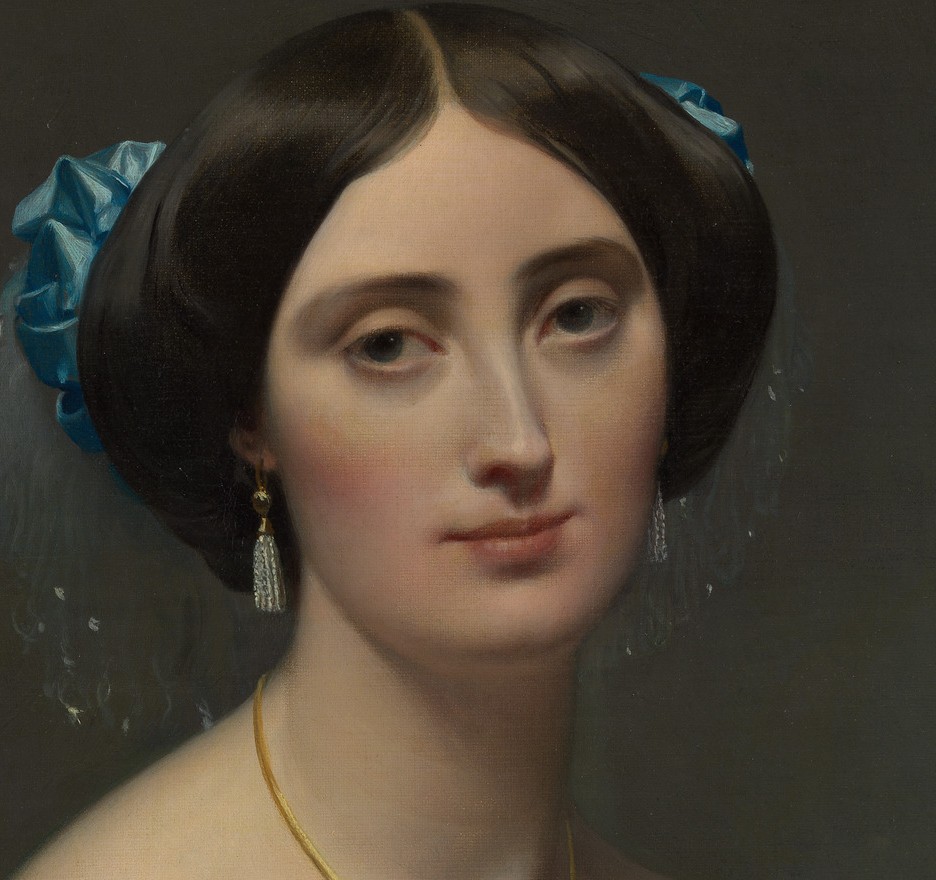
Her pose combines a slight turn with a direct encounter. The centre parting and smooth, rounded masses of dark hair give the head a firm outline. One upper eyelid hangs more heavily than the other. The eyes do not quite repeat each other’s shape, and the mouth is closed without appearing rigid. Those differences keep the face from becoming a perfectly balanced emblem of elegance. They invite attention to this particular person.
The Met interprets the expression as reserve.[1] That description gives the portrait a human context, although shyness itself cannot be established from painted eyes. The visible effect is more elusive: she meets the viewer without any large gesture of welcome, and her hands appear occupied with maintaining the pose.
The chair is essential to that pose. Pauline leans across its back, and its thick upholstery supports the meeting of her forearms. One hand disappears partly beneath the opposite arm, while the other drops into view, its long fingers spread against blue. Following those limbs is more complicated than recognising the general impression of folded arms. Lace obscures their upper beginnings; jewels interrupt the wrists; the dress absorbs the hanging hand into its folds. The arrangement feels graceful at a glance and slightly strained when traced slowly.
That tension gives the portrait much of its life. The body has to be imagined beneath sleeves, lace and the enormous skirt. The shoulders provide a clear beginning, but the fabric expands far beyond the narrow waist suggested by the bodice. We recognise a person inhabiting the clothes, while also becoming aware of the clothes as a separate painted construction.
A painting permeated by blue
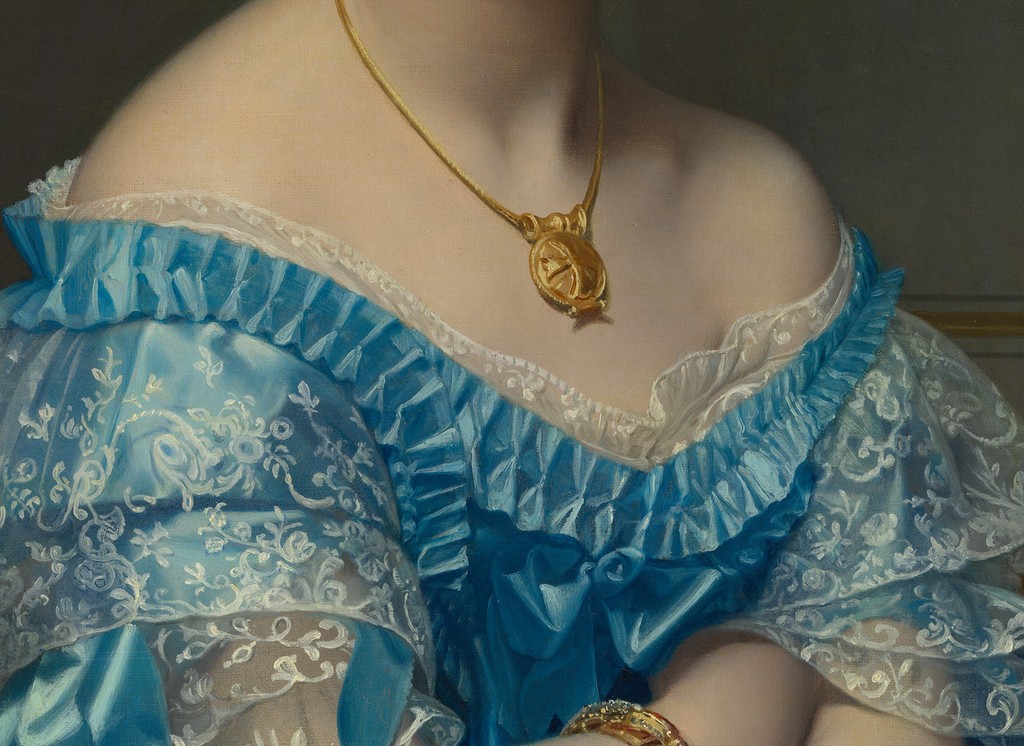
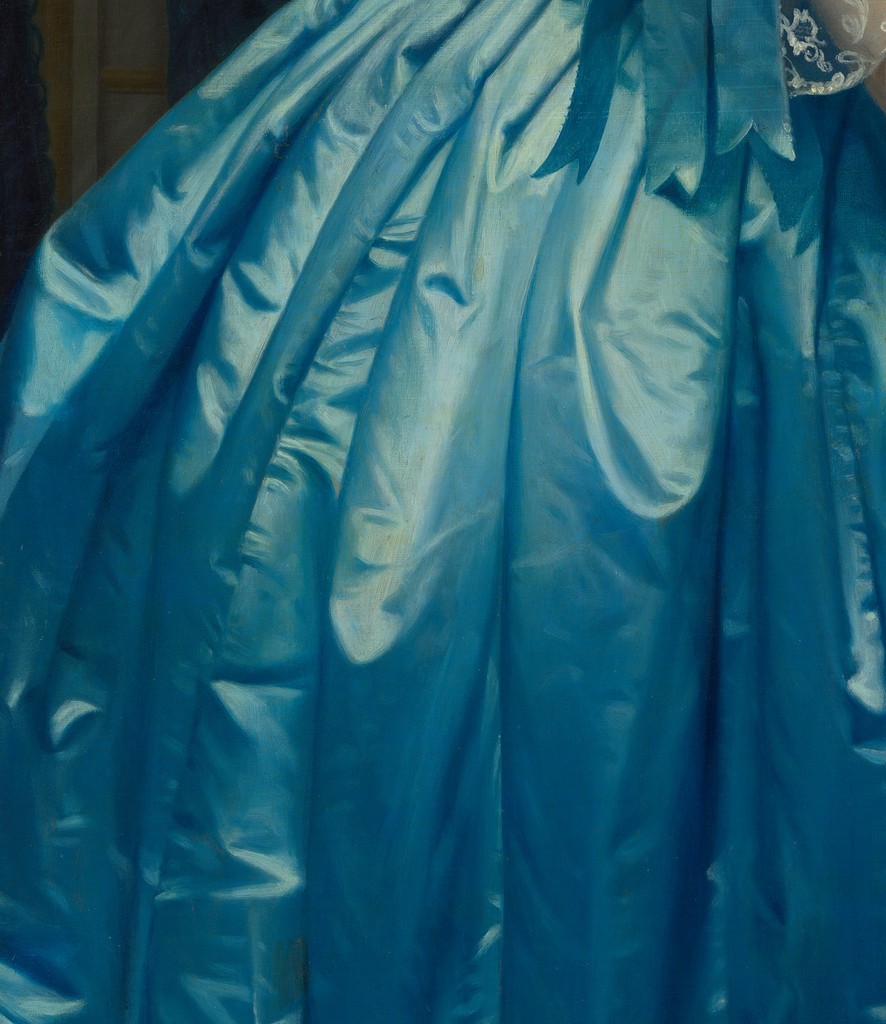
The gown’s blue changes according to the direction and depth of each fold. Some ridges turn almost white; deep hollows approach the darkness of the curtain. Between them are cool silver passages and saturated bands of colour. The lace works differently. Its curling pale pattern remains visible over the darker sleeves, making a delicate screen between skin and satin.
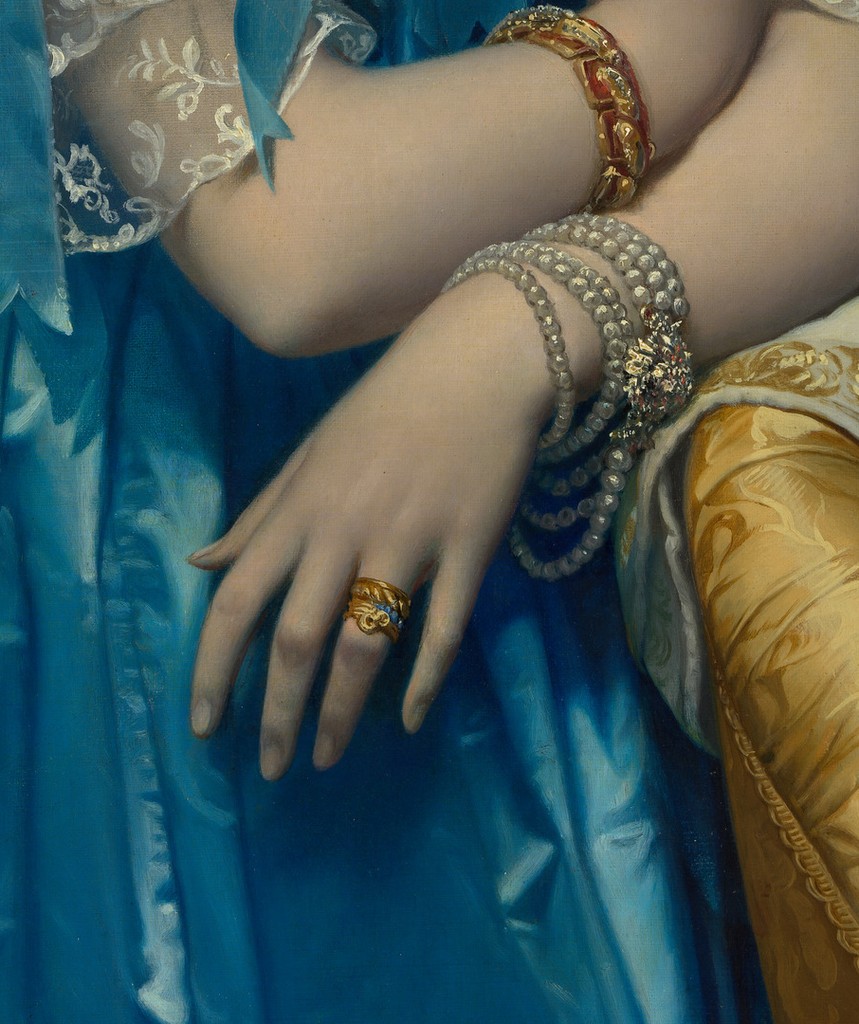
Look especially at the hanging hand. Its colour is affected by the dress beneath and beside it. The skin does not occupy an isolated, flesh-coloured zone: it participates in the same light as the fabric. The gold upholstery offers a warmer counterweight, strongest where the curved chair back emerges below the wrist. Against these broad, changing surfaces, each pearl and metal setting is a small, sharply defined point.
The face is also less uniformly pale than it first appears. Warmth around the cheeks and mouth and cooler shadows around the eyes give it structure. Its relative calm results partly from its surroundings. The skirt is full of abrupt changes; the face turns through much smaller gradations. Looking back from the jewellery or the satin, we experience those subdued transitions more strongly.
A commission within the family
The connection with the Comtesse d’Haussonville gives Pauline a place within an extended family network. The Met places the work among Ingres’s portraits of Orléanist aristocrats.[1] Here, the formal occasion absorbs our first attention. Looking at the portrait, we encounter a woman represented through a demanding social presentation: evening dress, jewellery, heraldry, and a carefully maintained pose.
Albert published her religious writing posthumously.[2] She was also the mother of five sons.[1] Family life and writing occupied her alongside the formal social role presented here. Remembering those activities changes our encounter with the image. The hands arranged over the chair belonged to someone whose life included books and children, though neither is illustrated in the portrait.
Painting had begun by June 1851; eye trouble interrupted a drawing in March 1852.[2] His background letter describes painting at Pauline’s apartment, struggling with sunlight and the demands on his eyes.[3] He worked at 90 rue de l’Université.[2] The room therefore has a connection to the circumstances of making the picture, as well as a role within its composition. Its quietness can make us forget the activity required to construct it: a painter working from life while the light changes.
Delaborde printed the background letter with a June 1855 date.[3] Tinterow corrects it to 19 June 1852.[2] On 20 June 1853, Ingres told Charles Marcotte that the portrait was finished. He carefully qualified its success: relatives and friends had approved it, but the wider public had yet to see it. He intended to keep it out of general view until Pauline returned.[3] There is something engaging about the gap between his satisfaction and his awareness that this first audience was a particular, sympathetic one.
The Met calls this Ingres’s final commission.[1] The context is commissioned portraiture, rather than his work as a whole. His background letter promises to abandon portraits while making an exception for Delphine, his second wife, whose likeness Delaborde notes he painted later.[3] His irritation makes completion here feel like release from an arduous obligation.

Ingres, The Comtesse d’Haussonville, 1845. [4]
How the pose was made
Look again at the relationship between the arms and the skirt. The arms occupy a small, clearly bounded area, but the sleeves disperse their beginnings into lace and folds. We can follow the hanging fingers to the wrist; farther up, clothing interrupts the body’s outline. Understanding how the body fits within that enormous gown is one of the picture’s pleasures, and one of its difficulties.
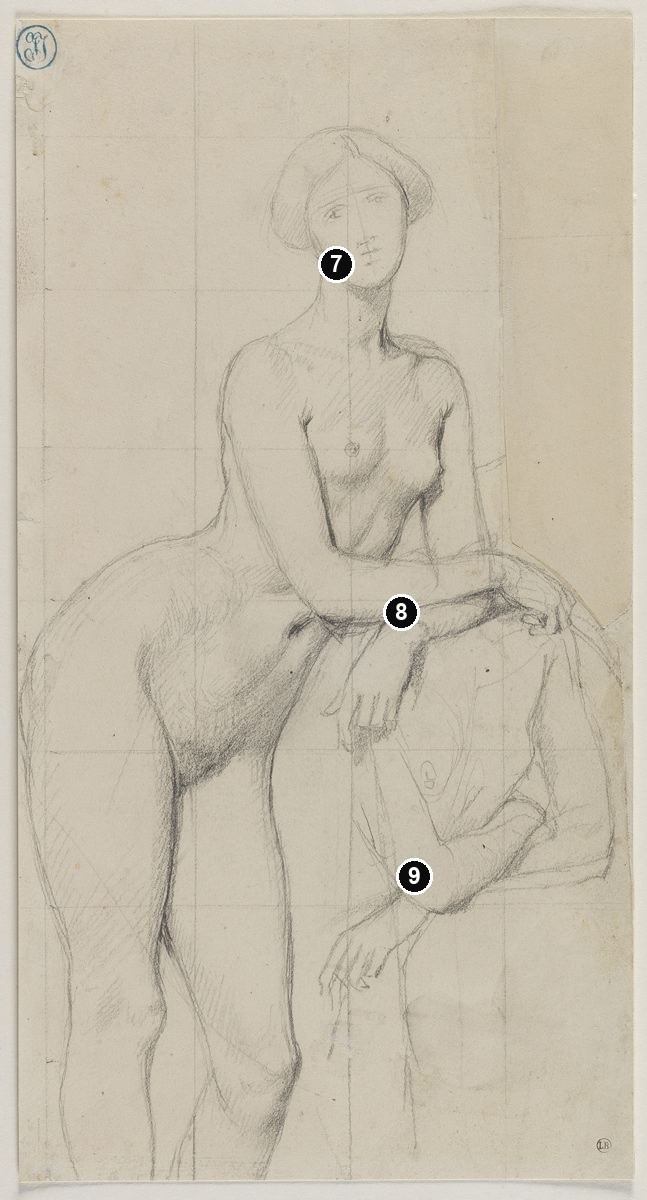
Conservator Charlotte Hale linked matching grids on nude and dressed studies to infrared lines across the canvas’s chest and left shoulder. A full-size charcoal arm tracing supplied transfer contours; the painted thumb and little finger narrowed. Infrared showed throat and bodice lines, but none in the head; absence cannot prove there was no drawing.[5] Infrared reflectography can reveal carbon-based marks beneath paint; X-rays distinguish denser materials.[5]
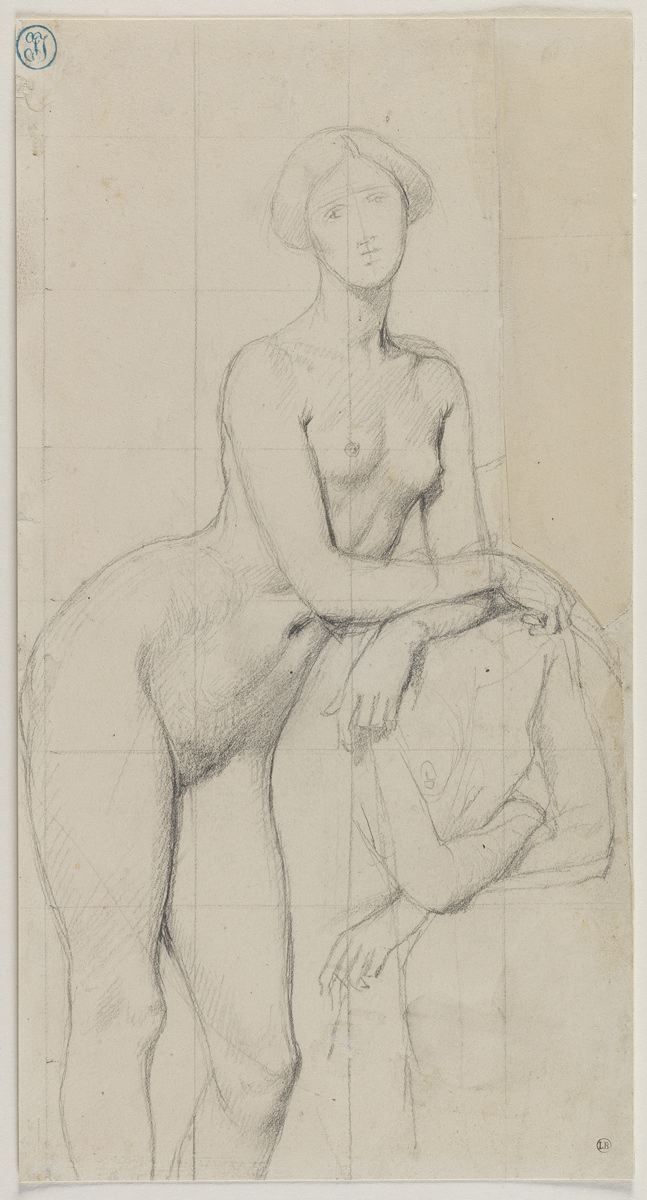
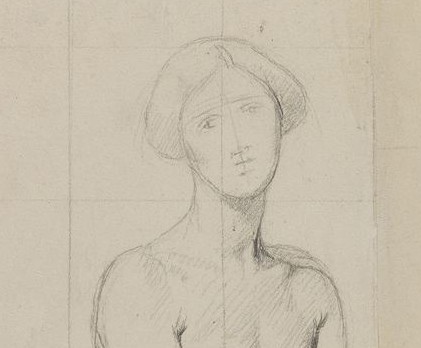
Ingres, Nude Study for The Princesse de Broglie, c. 1852–53. Graphite on squared paper. Musée Bonnat-Helleu, Bayonne; reproduced as figure 277 in the 1999 catalogue. The model’s identity is not established. [6]
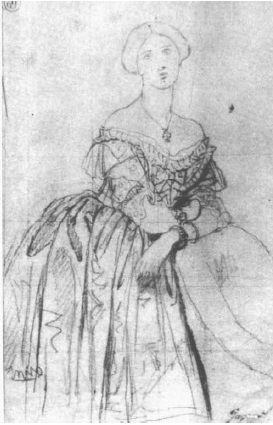
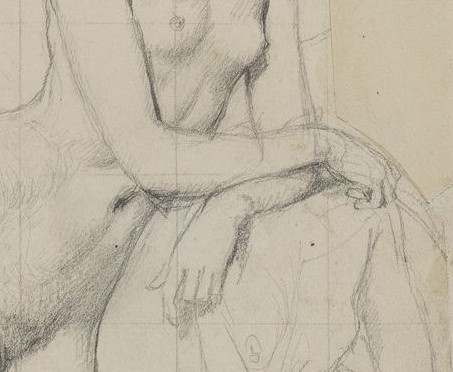
Ingres, Dressed Study for The Princesse de Broglie, c. 1852–53. Graphite and red chalk on paper. Reproduced as figure 278 in Portraits by Ingres, 1999; location then unknown. Complete small reproduction. [7]
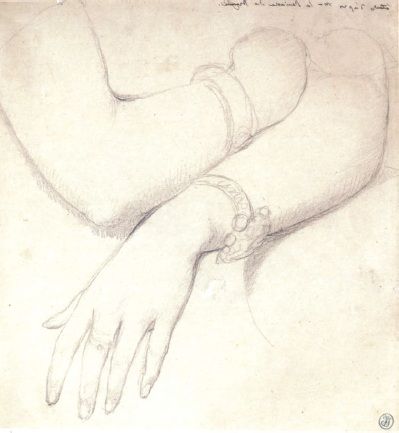
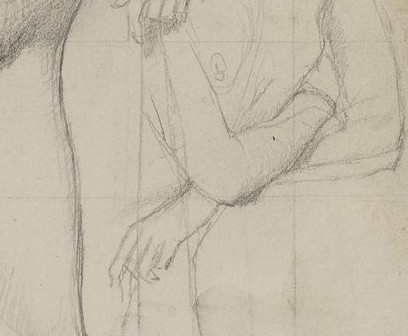
Ingres, Study of Arms for The Princesse de Broglie. Charcoal on tracing paper. Reproduced as catalogue 146 in Portraits by Ingres, 1999. Complete small reproduction. [8]
The nude study concerns bodily structure without establishing the model’s identity or showing that Pauline posed nude.[5] A grid provides a practical way of keeping the relationships between parts when a design changes scale. Imagine dividing any image into squares: locating a wrist within one square and an elbow within another helps preserve their distance and direction. The curve still has to be drawn, and the surface still has to be painted. Measurement can organise an image without dictating the character of every mark.
Tinterow proposed tracing the painting.[2] Hale’s later evidence supports transfer towards the canvas.[5] That change in understanding matters because it changes the drawing’s role: from a possible record of work already done to an instrument for constructing the image.
Changes beneath the surface
Magnification revealed deep blue beneath thin or abraded grey, interpreted as local preparation. X-radiography showed narrower initial hair and a 2.5 cm yellow band at earring level, possibly an earlier moulding. The chair’s right contour expanded; black headwear covered chair and shawl.[5]
On the surface we can see how forcefully those shapes organise the picture. The dark hair encloses the face, bringing the brighter skin forward. At the other end of the composition, the black accessory weighs down the lower corner. Between them, the gold chair describes a broad curve, echoing the curve of the sleeve above it. These are visible relationships in the finished image, whose balance we can experience without trying to reconstruct an earlier version of the room.
One useful way to look is to follow the silhouettes before attending to detail. The outside edge of the hair is simpler than the curls of lace. The chair has a large, rounded outline, while the fingers make a series of small downward points. Each kind of shape has its own pace. The picture moves between them without giving every part equal emphasis.
Silk, jewellery and things set aside
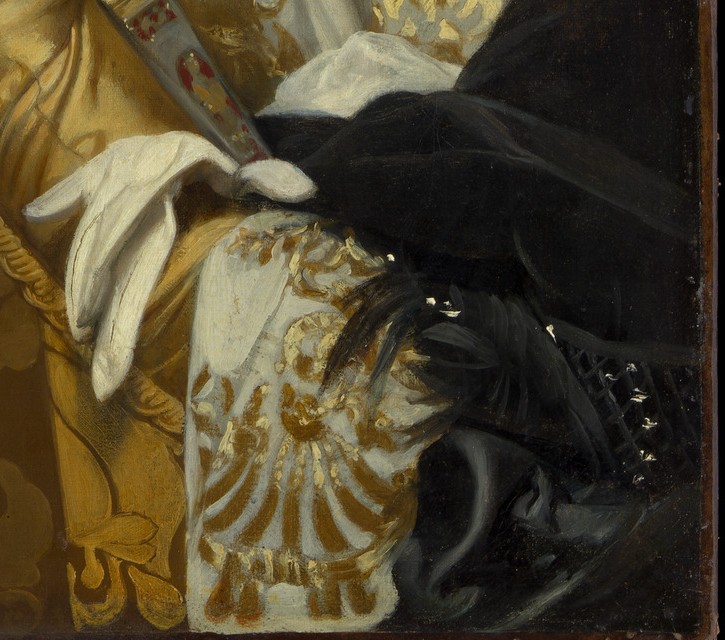
The accessories beside Pauline create a small still life of objects she might put on or take up. Pale glints punctuate the darker accessories. Some of these details emerge only after the eye has travelled down the chair. The pale gloves are particularly easy to miss, resting near its lower edge beside the dark folds and feathers.
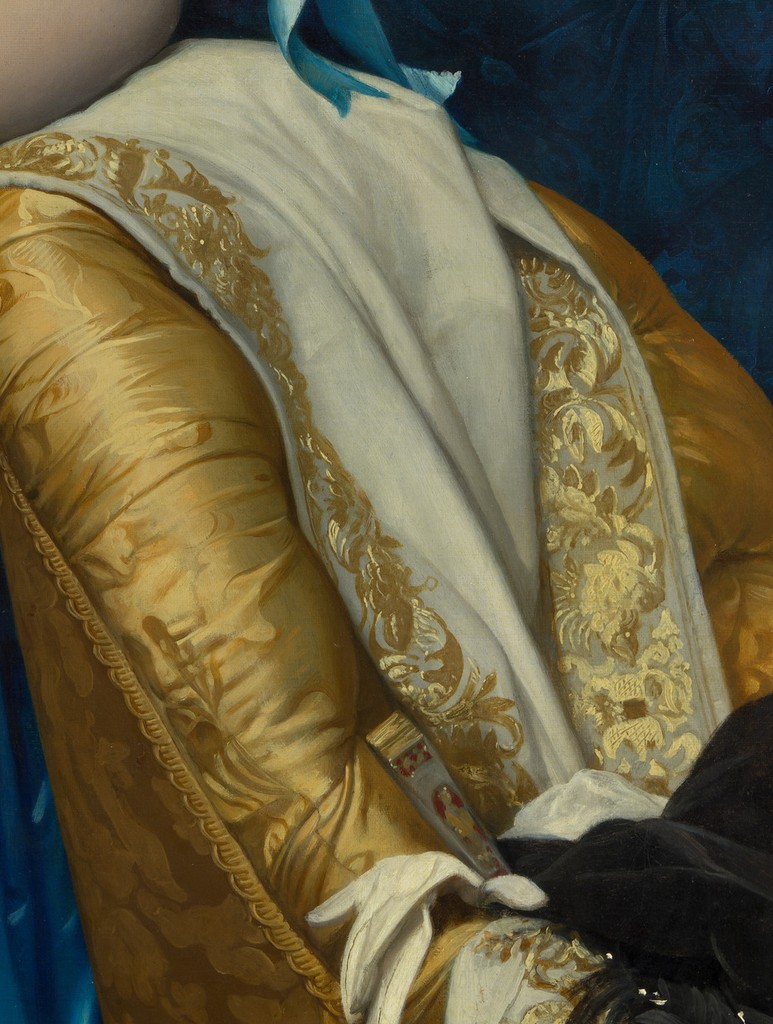
Their different surfaces ask for different kinds of attention. The shawl’s gold ornament continues the warm colour of the chair, but its white ground separates one fabric from the other. The gloves make a second, empty version of the fingers hanging above. The fan’s fine structure contrasts with the headwear’s loose, dark feathers. These things extend the portrait’s interest in the hand: objects for holding, covering and adorning it surround the hand itself.
The jewellery is equally varied. Long pearl earrings flank the face; a gold pendant rests against the exposed chest. The bracelets make bright, interrupted bands around the wrists. Tinterow proposes Castellani for the Early Christian-style pendant.[2] Its warm, rounded form and delicate surface are clear; the proposed maker remains uncertain.
Look from each small ornament to the wider surface around it: the scale of the marks changes abruptly. The pearls make isolated pale points, while the lace crosses the sleeve in a more continuous pattern. Both interrupt the broad blue folds without breaking the larger outline of the dress.
Tinterow considers the floral frame apparently original.[2] Its ornament extends the picture’s presentation of richness. Within the painted rectangle, the setting is relatively spare. The dress, the arms and the chair can therefore carry an exceptional share of the picture’s activity.

Ingres, Madame Moitessier Seated, 1856. [9]
Annotated Details from The Princesse de Broglie
The numbered points identify visible features discussed in this article. Return from each detail to the whole composition. Each caption identifies the work shown.
The Princesse de Broglie
Princesse de Broglie. Met 1975.1.186. Image source. CC0 / Public domain.
Princesse de Broglie — Nude Study
Nude study. The model’s identity is not established. Wikimedia Commons. Image source. Public domain.
Details from THE PRINCESSE DE BROGLIE
Compare the blue silk, lace, jewellery and objects beside the sitter with the separate squared nude study. The body and alternative arms help explain the construction of a pose; the drawing does not establish the model’s identity.
The Princesse de Broglie
The face framed by dark hair
The centre parting and rounded masses of hair frame a quietly turned face. Small earrings extend the arrangement down towards the bare neck.
Lace and a pendant at the neckline
A gold pendant rests within the open neckline. Pale lace follows its own irregular edge across the stronger blue folds beneath it.
Bracelets beside the lowered hand
Pearls, gold-coloured bands and a ring concentrate bright detail around the wrist and fingers. Follow the long fingers into the softer folds of the skirt.
Light travelling across blue silk
Broad pale reflections run along the skirt beside narrower dark folds. Their changing widths give the large area of blue a varied rhythm.
The gold cushion beneath white cloth
A pale cloth crosses the rounded gold cushion. Its broad folds contrast with the small repeated pattern and fine edging of the upholstery.
Gloves and dark fabric set aside
Light gloves lie across the cushion beside a dark bundle. Their small fingers and folded shapes introduce another arrangement below the sitter’s resting hand.
Princesse de Broglie — Nude Study
The head, shoulders and grid
The head tilts above the long neck and uneven shoulder line. Light grid lines cross the figure and surrounding paper, offering a framework within which the broad shapes can be compared.
The folded arms and lowered fingers
The principal figure folds one arm across the torso while the other hand hangs down. The long fingers and crossing forearms create a compact group against the more open body.
The separate arm arrangement
A second arrangement of arms appears beside the lower body. The hand bends differently, allowing another version of the gesture to be considered on the same sheet.
Admiration and disagreement
The studio display followed in December 1854.[2] It appeared at the Exposition Universelle in 1855.[2][3] A private likeness was becoming an image seen by people outside the family, who could bring their own expectations to its treatment of clothes, expression and social position.
Théophile Gautier admired the harmony between the pale, pearly arms and the blue satin.[10] Edmond About interpreted Pauline’s pose and features as the expression of inherited nobility.[11] These responses attend to different aspects of the same image. One invites us to experience a relationship between colours. The other turns outward appearance into a claim about the person’s social identity. The portrait certainly displays rank through heraldry and costly possessions. Whether the sitter’s bearing embodies nobility is a judgement about class, made by a viewer, rather than a quality we can establish from the position of an arm.
Perrier admired the head but criticised the blue reflection; Silvestre attacked the finger joints.[2] These objections return us to passages that still slow down our looking. The reflected colour binds hand and dress together, but it can also make the hand look strange. The fingers form a flowing pattern, but that pattern can seem uncomfortable. We can find the picture convincing as a whole and still notice such local tensions.
Try covering the skirt with a hand or a sheet of paper while looking at a reproduction. The face and shoulders seem calmer when separated from the expanse below. Restore the whole composition, and the dress draws the eye downwards again. The relationship between these experiences is central to the portrait: the face sustains the encounter, while the fabric keeps changing the route by which we reach it.
Contemporary disagreement preserves a productive question about the painting. How far can elegance reshape a body before our attention shifts from the sitter to the painter’s design? The sharply described jewellery may encourage confidence in the accuracy of everything we see, while the arrangement of the arms makes us look more closely at the terms on which that confidence rests.
From a family portrait to the Met
Eric Bertin confirms Pauline’s death at Cannes on 28 November 1860, aged thirty-five.[12] The Met records tuberculosis.[1] Her death came seven years after the painting’s completion. Knowledge of it changes how many viewers encounter the portrait, but the pale complexion and uneven eyelids cannot establish her medical condition in 1853.
Albert reportedly covered it, yet lent it in 1867, 1885 and 1900.[2] The two histories can coexist. A portrait could be painful to keep constantly visible at home and still be lent for public appreciation. The curtain story is a record of remembered mourning, not evidence that the painting vanished from sight for the rest of Albert’s life. Lehman’s 1958 Wildenstein purchase passed to his foundation in 1969.[2] It entered the Met with the Robert Lehman Collection in 1975.[1] The museum’s accession date therefore marks a later stage than Lehman’s purchase.[1]
The move from family possession to a public collection changed the circumstances in which Pauline’s likeness could be encountered. Her identity, the marriage and the later mourning remain part of its history. At the same time, the picture offers a remarkably direct experience to someone who knows none of those details. The face holds our attention across the brilliant blue, and the hanging fingers keep drawing our eyes back into the painted fabric.
Artworks directory
Explore 150 paintings, drawings and an original lithograph. This selection includes related versions and studies; dates distinguish completed works from later revisions.
| Name | Date | Medium |
|---|---|---|
| The Apotheosis of Homer | 1827 | Painting |
| Grande Odalisque | 1814 | Painting |
| The Turkish Bath | 1859–1862 | Painting |
| Madame Moitessier Seated | 1856 | Painting |
| Portrait of Monsieur Bertin | 1832 | Painting |
| Napoleon I on His Imperial Throne | 1806 | Painting |
| Odalisque with Slave | 1839 | Painting |
| The Ambassadors of Agamemnon in the Tent of Achilles | 1801 (competition) | Painting |
| The Valpinçon Bather | 1808 | Painting |
| The Source | 1856 | Painting |
| Oedipus Explaining the Enigma of the Sphinx | 1808; revised probably before 1827 | Painting |
| The Vow of Louis XIII | 1824 | Painting |
| Antiochus and Stratonice | 1840 | Painting |
| The Comtesse d’Haussonville | 1845 | Painting |
| The Princesse de Broglie | 1851–1853 | Painting |
| Jupiter and Thetis | 1811 | Painting |
| The Dream of Ossian | 1813 | Painting |
| The Martyrdom of Saint Symphorian | 1834 | Painting |
| Venus Anadyomene | 1808–1848 | Painting |
| Portrait of Madame de Senonnes | 1814 | Painting |
| Madame Rivière | 1805 | Painting |
| Mademoiselle Caroline Rivière | 1805 | Painting |
| Portrait of Philibert Rivière | 1805 | Painting |
| Bonaparte First Consul | 1804 | Painting |
| The Death of Leonardo da Vinci | 1818 | Painting |
| Joan of Arc at the Coronation of Charles VII | 1854 | Painting |
| Madame Duvaucey | 1807 | Painting |
| La Belle Zélie | 1806 | Painting |
| Madame Panckoucke | 1811 | Painting |
| Portrait of Charles Marcotte d’Argenteuil | 1810 | Painting |
| Joseph Antoine Moltedo | c.1810 | Painting |
| Madame Leblanc | 1823 | Painting |
| Delphine Ingres-Ramel (Portrait of Madame Ingres) | 1859 | Painting |
| Portrait of Amédée de Pastoret | 1823–1826 | Painting |
| Portrait of Baronne de Rothschild | 1848 | Painting |
| Madame Marcotte de Sainte Marie | 1826 | Painting |
| Madame Gonse | 1852 | Painting |
| Aretino in the Studio of Tintoretto | 1848 | Painting |
| Don Pedro of Toledo Kissing Henry IV’s Sword | 1831/1832 | Painting |
| Raphael and La Fornarina | 1814 | Painting |
| Roger Freeing Angelica | 1819 | Painting |
| Romulus’ Victory over Acron | 1812 | Painting |
| Self-Portrait at the Age of Twenty-Four | 1804; revised 1841–1851 | Painting |
| Male Torso | c.1800 | Painting |
| Odalisque in Grisaille (Ingres and workshop) | c.1824–1834 | Painting |
| The Small Bather | 1826 | Painting |
| The Little Bather Harem Interior | 1828 | Painting |
| Jesus Among the Doctors | 1862 | Painting |
| The Virgin Adoring the Host | 1852 | Painting |
| The Virgin of the Host | 1841 | Painting |
| Virgin of the Adoption | 1858 | Painting |
| Paolo and Francesca | 1814 | Painting |
| Homer Deified (revised composition, Louvre RF5273) | 1865 | Drawing |
| Odalisque with Slave (Louvre RF4622) | 1858 | Drawing |
| Odalisque (Walters Art Museum; Ingres and Paul Flandrin) | 1842 | Painting |
| Madame Moitessier Standing (National Gallery of Art) | 1851 | Painting |
| Jacques-Louis Leblanc (The Metropolitan Museum of Art) | 1823 | Painting |
| Ferdinand-Philippe, Duke of Orléans (Louvre RF2005-13) | 1842 | Painting |
| Ferdinand-Philippe, Duke of Orléans (Versailles MV5207; Ingres and workshop) | 1843 | Painting |
| Ferdinand-Philippe, Duke of Orléans (Versailles MV5209; Ingres and workshop) | 1844 | Painting |
| Antiochus and Stratonice (Musée Fabre; Ingres and Raymond Balze) | 1866 | Painting |
| Antiochus and Stratonice (Kunstmuseum Bern, Gurlitt bequest) | Undated (early dating proposed) | Drawing |
| Composition study for Antiochus and Stratonice (MIB867.2193) | 1806 | Drawing |
| Study for the Figure of Stratonice (Met63.66) | 1834–1840 | Graphite, black chalk and charcoal |
| Nude figure study for Stratonice (Boijmans F II 36 PK) | c.1834–1840 | Drawing |
| Paolo and Francesca (The Barber Institute,54.6) | c.1814–1820 | Painting |
| Paolo and Francesca (The Hyde Collection,1971.24) | c.1855–1860 | Painting |
| Paolo and Francesca (Amsterdam Museum TA10970) | 1820 | Drawing |
| Paolo and Francesca (dedicated to Artaud de Montor) | 1816 | Drawing |
| Study for the Bust of Francesca (MIB867.1398) | 1819 | Drawing |
| Study for the Bust of Francesca (MIB867.1396) | 1819 | Drawing |
| The Archangel Raphael, first idea (MIB867.2488) | 1842 | Drawing |
| The Archangel Raphael (MIB867.2500) | 1842 | Drawing |
| The Archangel Raphael Carrying Human Prayers to God (Chantilly DE513) | 1844 | Drawing |
| Louis-Philippe as Saint Philip, stained-glass study | 1844 | Drawing |
| Marie Frédéric Eugène de Reiset (Ford Collection RBF171-2) | 1844 | Drawing |
| Virgil Reading the Aeneid (Toulouse) | Begun 1811 | Painting |
| Tu Marcellus Eris (Brussels, inv. 1836) | c.1814 (museum dating) | Painting |
| Jean-François Gilibert | 1804 | Painting |
| François-Marius Granet | 1807 (museum dating) | Painting |
| Count Nikolai Dmitrievich Guryev | 1821 | Painting |
| Caroline Murat, Queen of Naples | 1814 | Painting |
| Count Mathieu Molé | 1834 | Painting |
| Cherubini and the Muse of Lyric Poetry (Louvre) | 1842 | Painting |
| Luigi Cherubini (Cincinnati) | 1841 | Painting |
| Comtesse de Rayneval (Louvre RF4505) | 1841 | Drawing |
| Venus on Paphos (Antonie Balaÿ) | c.1852 | Painting |
| Prince Napoléon | 1855 | Painting |
| Study for The Apotheosis of Napoleon I (Petit Palais) | Late 1853 | Painting |
| The Apotheosis of Napoleon I (destroyed ceiling) | 1853 | Painting |
| The Journalist (MIB867.2733) | 1834? | Drawing |
| Henry VIII, after Holbein | c.1815–1820 (?) | Drawing |
| Madame Récamier, after David (MIB867.3637) | Undated (early Paris period) | Drawing |
| Study for Comtesse d’Haussonville (MIB867.259; background possibly by another hand) | 1842–1845 | Drawing |
| La Source (reduced version reported by Delaborde) | Date unrecorded; reported 1870 | Painting |
| Odalisque (autograph lithograph,NGA1946.21.117) | 1825; published1826 | Lithograph |
| Portrait of a Seated Lady | 1814 | Graphite |
| The Kaunitz Sisters (Leopoldine, Caroline, and Ferdinandine) | 1818 | Graphite |
| Portrait of a Man | 1814 | Graphite |
| Study for the Portrait of Louis-François Bertin (1766–1841) | n.d. | Black chalk and graphite |
| Studies for the Cadaver of Acron | ca. 1810–12 | Graphite on wove paper |
| Study for the Drapery of Molière in "The Apotheosis of Homer" | n.d. | Black chalk with stumping |
| Madame Guillaume Guillon Lethière, née Marie-Joseph-Honorée Vanzenne, and her son Lucien Lethière | 1808 | Graphite |
| Niccolò Paganini (1782–1840) | ca. 1830 | Counterproof or tracing strengthened with graphite and gouache on translucent paper |
| Lady Mary Cavendish-Bentinck (?-1843) | 1816 | Graphite |
| Madame Alexandre Lethière and Her Daughter Letizia | ca. 1815 | Graphite |
| Merry Joseph Blondel (1781–1853) | 1809 | Graphite |
| Ursin-Jules Vatinelle (1798–1881) | 1820 | Graphite |
| Bust of a Gypsy Girl (ascribed to Ingres) | 1819 | Graphite on wove paper |
| Study of a Seated Nude Male | n.d. | Graphite |
| The Archangel Raphael (Study for a stained-glass window in the chapel of Notre-Dame de la Compassion-Saint-Ferdinand, Neuilly) | ca. 1842 | Graphite |
| Lancelot-Théodore, comte Turpin de Crissé | probably 1818 | Graphite |
| Study for the Figure of the Iliad in "The Apotheosis of Homer" | ca. 1827 | Graphite and black chalk heightened with white chalk on brown paper |
| Comtesse Turpin de Crissé | probably 1818 | Graphite |
| Nude Figures for L'Âge d'Or, Château de Dampierre | n.d. | Graphite on brownish paper |
| Study of Figures (attributed to Ingres) | n.d. | Graphite |
| Study of Figures (attributed to Ingres) | n.d. | Graphite; squared in graphite |
| Admiral Sir Fleetwood Broughton Reynolds Pellew | 1817 | Graphite on wove paper |
| Madame Jean-Auguste-Dominique Ingres, née Madeleine Chapelle | 1814 | Graphite on off-white wove paper |
| Virgil Reading the Aeneid to Augustus, Livia, and Octavia | 1809/1819 (?) | Pen and black ink, graphite, brush and gray wash, white gouache heightening, Conté crayon on blue paper |
| General Louis-Étienne Dulong de Rosnay | 1818 | Graphite (hard and soft pencils) |
| Madame Alexandre Lethière, née Rosa Meli, and Her Daughter, Letizia | 1815 | Graphite |
| The Lawyer Paul Grand | 1834 | Graphite |
| Jean-Joseph Fournier | 1815 | Graphite |
| Armand Bertin | 1842 | Graphite |
| Madame Armand Bertin, née Marie-Anne-Cécile Dollfuss | 1843 | Graphite |
| The Architect Charles-Victor Famin | 1836 | Graphite |
| Henri Lehmann | 1850 | Graphite |
| Portrait of a Lady | ca. 1815–17 | Graphite |
| Edmond Cavé (1794–1852) | 1844 | Oil on canvas |
| Head of Saint John the Evangelist | probably ca. 1818–20 | Oil on canvas, laid down on wood |
| Madame Edmond Cavé (Marie-Elisabeth Blavot, ca. 1806–1883) | ca. 1831–34 | Oil on canvas |
| Madame Félix Gallois | 1852 | Graphite with touches of gold in oil to highlight jewelry, on buff wove paper. |
| Dr. François Mêlier | 1849 | Graphite with graphite framing lines, corrected with white, on buff wove paper |
| Portrait of Madame Rhode (Rhoda?) | 1810–20 | Graphite on pale buff wove paper |
| Study for "Raphael and the Fornarina"(?) | ca. 1814(?) | Graphite on white wove paper |
| Portrait of Madame Paul Meurice, née Palmyre Granger | ca. 1845–50 | Graphite on wove paper |
| Alexander the Great presenting Campaspe to Apelles | 1810 | Graphite, brush and brown wash; squared in graphite |
| Study of Hands for "Christ Among the Doctors" | 1852–62 | Graphite on tracing paper |
| Study for The Turkish Bath (RF34502) | about 1850 | Pen and brown ink with graphite, partially squared |
| Study for The Turkish Bath (RF23354) | Undated | Pen and brown ink with graphite on joined sheets |
| Study for The Turkish Bath (RF54702) | about 1859 | Pen and brown ink |
| Studies of women for The Turkish Bath (RF12292) | Undated | Black chalk |
| Achilles Receiving the Envoys of Agamemnon (Nationalmuseum sketch, NM2161) | 1801 | Oil on wood |
| Half-Length Bather (Musée Bonnat-Helleu,89) | 1807 | Oil on canvas |
| Oedipus and the Sphinx (National Gallery,NG3290) | about1826 | Oil on canvas |
| Oedipus and the Sphinx (Walters,37.9) | 1864 | Oil on canvas |
| Oedipus and the Valpinçon Bather, after David (MI.867.2035) | Undated | Graphite on tracing paper, after David |
| Study of the Virgin for The Vow of Louis XIII (Dijon,1758) | about1822 | Black chalk, stump and white chalk on brown wove paper |
| First Thought for The Vow of Louis XIII (MI.885.11.21) | 1822 | Oil on canvas |
Frequently Asked Questions
Pauline was Albert de Broglie’s wife.[1] The full name given by the Met distinguishes her from other members of the family.
The different shapes of the eyelids are visible, but they do not provide a medical diagnosis. Pauline died in 1860, seven years after the portrait was completed. Her later illness should not be projected back onto the painting as something established by its appearance.[1]
The Met, New York.[1]
Discussion
Look again at the images and ideas explored in The Princesse de Broglie. These editorial prompts invite your observations.
Reader Insights
Where does your eye return after the first impression of the blue gown: to Pauline’s face or to the arrangement of her hands? Does the colour reflected on the skin make the figure feel more present, or make you more aware of the painting’s design?
Compare the blue satin with the quieter wall behind Pauline. How does the contrast change the apparent weight of the dress and the presence of the face?
What do the preparatory drawings allow you to ask about the relationship between the clothed figure and the body beneath it?
Join the Conversation
Share a detail, comparison or question about The Princesse de Broglie below.
References
- The Metropolitan Museum of Art, Princesse de Broglie. 1975.1.186. View source.
- Gary Tinterow, Portraits by Ingres, 1999, pp. 447–454. View source.
- Henri Delaborde, Ingres, 1870, catalogue 112, pp. 246–247. Posthumous compilation. (In French.) View source.
- Supporting image. Ingres, The Comtesse d’Haussonville, 1845. The Frick Collection; Google Art Project via Wikimedia Commons. Image source. Public domain.
- Charlotte Hale, “Technical Observations”, Metropolitan Museum Journal 35, 2000, pp. 206–207, note 22. View source.
- Supporting image. Nude study. The model’s identity is not established. Wikimedia Commons. Image source. Public domain.
- Supporting image. Dressed study. Wikimedia Commons. Image source. Public domain.
- Supporting image. Arm study. Wikimedia Commons. Image source. Public domain.
- Supporting image. Ingres, Madame Moitessier Seated, 1856. Image source. CC0 / Public domain.
- Théophile Gautier, Les Beaux-Arts en Europe, 1855, première série. Paris: Michel Lévy frères, 1855, pp. 165–166, concluding passage on Ingres’s portraits. (In French.) View source.
- Edmond About, Voyage à travers l’Exposition des beaux-arts (peinture et sculpture). Paris: L. Hachette, 1855, p. 134, paragraph on the Princesse de Broglie. (In French.) View source.
- Eric Bertin, “Addenda and Corrigenda”, Metropolitan Museum Journal 35, 2000, p. 217, catalogue 145. View source.
- Splash image. Princesse de Broglie. Met 1975.1.186. Image source. CC0 / Public domain.