 Buy Art Prints Now
from Amazon
* As an Amazon Associate I earn from qualifying purchases.
 by Tom Gurney
Tom Gurney BSc (Hons) is an art history expert with over 20 years experience
Published on June 19, 2020 / Updated on October 16, 2026
Email: tomgurney1@gmail.com / Phone: +44 7429 011000
Portrait of Pierre Sériziat: Introduction
Portrait of Pierre Sériziat is one of Jacques-Louis David's most engaging portraits from 1795, the year in which the artist emerged from imprisonment, illness and political uncertainty. The Louvre records the painting as Portrait de Pierre Sériziat, beau-frère de l'artiste, identifies the sitter as Pierre Sériziat, 1757-1847, and catalogues the work as RF 1281 in the Department of Paintings. It is currently displayed in the Denon wing, Salle 702. [1]
The painting belongs with its pendant, Portrait of Émilie Sériziat and Her Son, but it has its own character. Émilie's portrait is domestic and maternal. Pierre's is outdoor, informal and quietly theatrical. Together they show the family household that gave David refuge in a period of personal recovery; alone, Pierre's portrait offers a rare image of David treating leisure, confidence and friendship as serious portrait subjects. [1]
At a Glance
- ArtistJacques-Louis David [1]
- Louvre TitlePortrait de Pierre Sériziat (1757-1847), beau-frère de l'artiste [1]
- Active URL/jacques-louis-david/portrait-of-pierre-seriziat/ [1]
- Date1795 [1] [4]
- MediumOil on wood in the Louvre record; canvas appears in some secondary routes [1] [3] [4]
- CollectionMusée du Louvre, Department of Paintings [1]
- InventoryRF 1281 [1] [2] [3]
- Dimensions1.29 m by 0.955 m [1]
- SitterPierre Sériziat, 1757-1847 [1]
- Family RelationDavid's brother-in-law and the husband of Émilie Pécoul [1]
- DisplayDenon wing, Salle 702 [1]
- PendantPortrait of Émilie Sériziat and Her Son, RF 1282 [1]
- SalonShown at the Salon of 1795, opened 2 October [1]
- ProvenanceSériziat family descent; Pierre-Emmanuel Sériziat; Joseph Sosthène Moreau; Louvre purchase in 1902 [1]
- Image CautionLouvre/GrandPalaisRmn route and Commons file candidates remain amber for later image review [1] [3] [5]
Contents
- Introduction
- Object Identity
- David and the Sériziat Household
- Looking at the Portrait
- A Pendant with a Difference
- Portraiture After the Terror
- Provenance and Image Caveats
- Image and Source Cautions
- Why the Portrait Matters
Object Identity
The Louvre gives the work's date as 1795 and records its dimensions as 1.29 m high by 0.955 m wide. The current Louvre record identifies the medium as oil on wood. That detail matters because some older or secondary image summaries have treated the Sériziat pair as canvas works. For this page, the Louvre's current object record is the safest authority, while the variant remains useful for later image and metadata review. [1] [2] [3]
The sitter was David's brother-in-law. The Louvre identifies Pierre Sériziat as the husband of Émilie Pécoul, sister of David's wife. That family relationship explains the portrait's warmth. It is not a portrait of an unknown gentleman in fashionable riding clothes. It is an image of someone who hosted the artist at a vulnerable moment. [1] [2] [3]
The work's history closely matches the Émilie pendant. The Louvre records that David painted the pair during two stays at Pierre Sériziat's property at Saint-Ouen, Favières, north of Tournan-en-Brie, from late April to late May and again in August 1795. The two portraits were shown at the Salon of 1795, which opened on 2 October. The painting stayed with the sitters and their family, passed through their descendants, and was purchased by the Louvre with its pendant in 1902. [1] [2] [3]
David and the Sériziat Household
The Sériziat portraits belong to one of the most fragile moments in David's life. After the fall of Robespierre, David's Jacobin identity placed him in danger. He had been imprisoned, released, imprisoned again, and then forced to rebuild his life and art in a political world that had changed around him. The Saint-Ouen visits offered rest, family shelter and a chance to paint close relations rather than public heroes. [1] [4]
That context gives Portrait of Pierre Sériziat its unusual emotional charge. Pierre is not presented as a martyr, legislator or military leader. He sits outdoors, relaxed and alert, in the dress of country leisure. Yet the portrait is not superficial. It shows David finding a new form of dignity after the Revolution's most violent years, one rooted in friendship, hospitality and the everyday signs of recovery. [1] [4]
The Salon of 1795 made that private recovery public. Exhibiting the pair announced that David remained an active painter after political reversal. The works did not deny his recent history; they answered it indirectly. Instead of a severe revolutionary body or an antique drama, viewers saw the people who had helped him return to ordinary life. [1] [4]
Looking at the Portrait
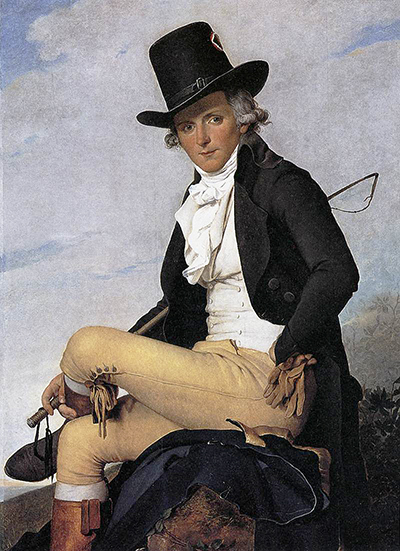
David presents Pierre Sériziat seated outdoors, turned in profile but looking back toward the viewer. His legs are crossed, one hand rests at his side, and the other holds the accoutrements of leisure. He wears a dark coat, pale breeches, riding boots and a tall hat with a red accent. The pose is informal, but it is not careless. David makes ease look deliberate. [1] [3] [4]
The low viewpoint gives Pierre physical presence. He appears elevated against the sky and landscape, with the hat rising close to the top of the composition. The setting is spare, but the hints of foliage, open air and uneven ground make the portrait feel far removed from courtly interiors. This is a gentleman outside, staged in the country, but still measured with David's severe sense of design. [1] [3] [4]
The clothing does much of the portrait's work. The dark coat gives the figure weight. The white shirt and cravat brighten the torso and draw attention to the head. The pale breeches and boots mark Pierre's leisure identity without turning him into a caricature of rural sport. The hat adds wit and vertical energy. The red accent, small but sharp, prevents the black-and-white structure from feeling dry. [1] [3] [4]
Pierre's expression is central. He looks confident, perhaps amused, but not vain. David gives him enough directness to feel present and enough ease to feel known. That balance separates the portrait from official male likenesses. It does not need desk, papers, uniform or office. Its authority comes from posture, social assurance and the painter's evident affection. [1] [3] [4]
A Pendant with a Difference
The pendant with Émilie Sériziat and her son matters, but the two paintings are not interchangeable. Émilie's portrait places mother and child indoors, with flowers, pale dress and domestic intimacy. Pierre's places the husband outdoors, with riding clothes, open air and the language of country leisure. The pair builds a household through contrast. [1] [4]
That contrast tells readers a great deal about David's portrait practice. He could use the same moment, the same family and the same general format to make two different arguments about identity. Émilie's portrait turns care and family continuity into the centre of the image. Pierre's turns masculine ease and hospitality into a kind of social grace. [1] [4]
The pair also belongs near other portraits of the 1790s. In Portrait of Jacobus Blauw, David shows political identity through work and writing. In Madame de Pastoret and Her Son, family portraiture is shadowed by political division. In Pierre Sériziat, the emphasis falls on recovery and informal trust. [1] [4]
Portraiture After the Terror
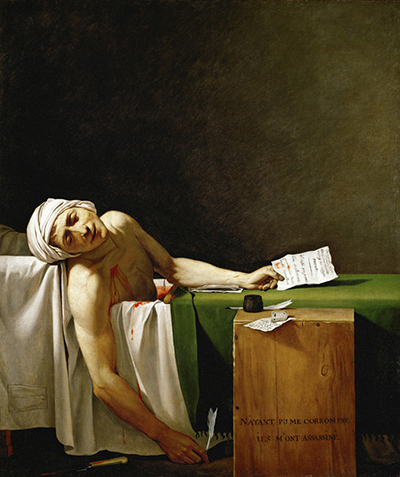
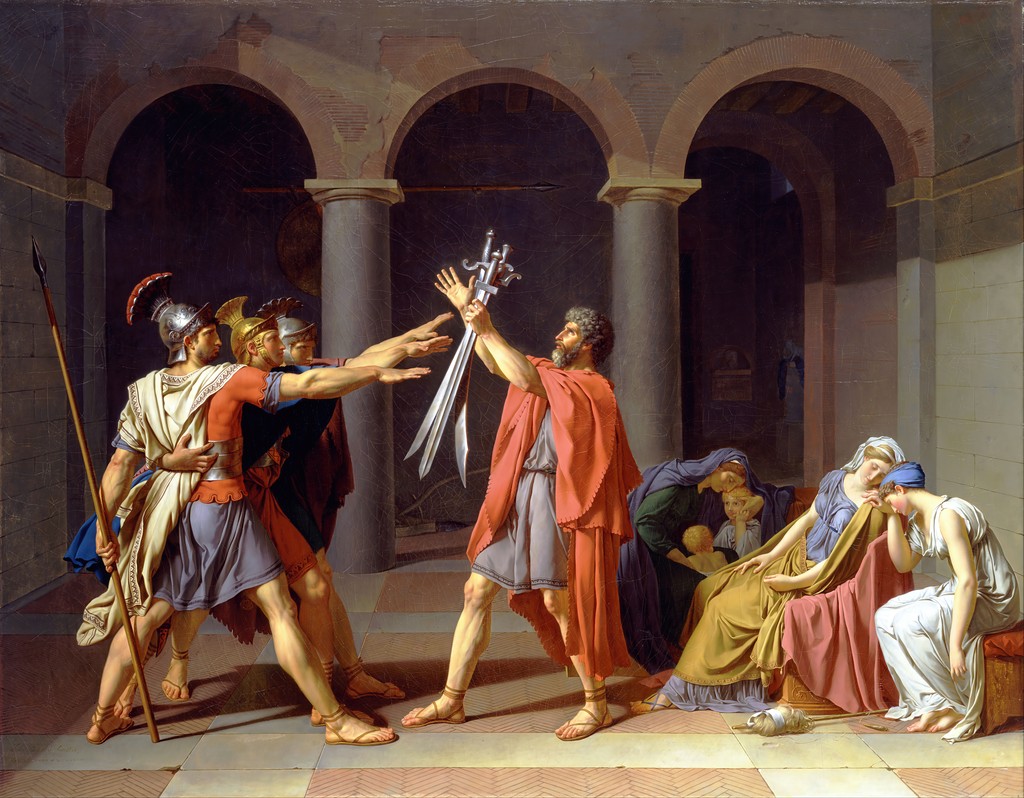
Portrait of Pierre Sériziat has often been valued for its charm, but charm is not its only significance. David's public career had been built on moral severity, from The Oath of the Horatii to The Death of Marat. In 1795, a portrait of a brother-in-law relaxing in the countryside could become a different kind of statement. [1] [4]
The painting shows that David did not abandon discipline when he turned to intimacy. The composition is carefully controlled, the figure is strongly placed, and the outdoor setting is simplified enough to keep the sitter dominant. What changes is the emotional temperature. Pierre is not forced into antique heroism. He is allowed to be sociable, confident and alive. [1] [4]
This makes the portrait a useful bridge to the later Directoire portraits, including Portrait of Madame de Verninac and Madame Récamier. Those later images would push elegance, fashion and social display in different directions. Pierre Sériziat is earlier and more familial, but it already shows David testing how modern presence could replace revolutionary theatre. [1] [4]
Provenance and Image Caveats
The Louvre record is the main authority for the painting's title, date, dimensions, medium, sitter identity, pendant relationship, Salon history and provenance. Wikimedia Commons supplies a useful RF 1281 category with image candidates and metadata, while the Web Gallery of Art provides a secondary reading of David's release, illness, Saint-Ouen convalescence and the portrait's role as a statement of continuing artistic strength. [1] [2] [3] [4] [5]
The British Museum also records an early twentieth-century print after David's Portrait of Pierre Sériziat. That later print is not evidence for the 1795 painting's making, but it shows that the image had an afterlife beyond the Louvre painting itself. For the manuscript, the print belongs in the source map rather than the main account unless a later feature needs a reproduction-history note. [1] [2] [3] [4] [5]
Available reproductions of the painting usually trace back to the Louvre object or to public museum-image aggregators. Because Louvre photography can carry specific credit requirements, image use is best tied to a clearly identified museum or Commons record rather than to an unattributed copy. That caution is especially important for a portrait where the texture, hat, riding clothes and outdoor setting all depend on accurate colour and cropping. [1] [2] [3] [4] [5]
Image and Source Cautions
Image reference: the page image follows the Louvre RF 1281 object route, while Commons provides a useful category with several file candidates rather than one single licence decision. The Louvre record includes GrandPalaisRmn, musée du Louvre and Franck Raux credit language, so image credit should stay tied to the selected Louvre or Commons source. The British Museum print record is valuable evidence for later reproduction history, but it is not primary evidence for the 1795 painting's making, medium or provenance. [1] [2] [3] [5]
Why the Portrait Matters
Portrait of Pierre Sériziat matters because it gives David a human way out of crisis. The sitter is family, host and friend. The setting is country leisure rather than revolutionary ceremony. The pose is relaxed without losing authority. The painting shows David using portraiture to rebuild trust after a period when public identity had become dangerous. [1] [4]
It also gives the David cluster a valuable male portrait that is neither political office nor imperial power. Pierre is not Jacobus Blauw at a desk, Napoleon in His Study at work, or Pope Pius VII under the pressure of church and empire. He is a private gentleman whose importance comes from relationship and presence. [1] [4]
For David's wider life, see the Jacques-Louis David biography. For the wider artwork route, use the David paintings hub. Portrait of Pierre Sériziat is best read with Émilie's pendant, but it stands on its own as a portrait of friendship, recovery and the surprising grace David could find in informal life. [1] [4]
Frequently Asked Questions
Discussion
Portrait of Pierre Sériziat turns David's post-Terror recovery into a family image rather than a public monument.
Use the prompts below to think about hospitality, pendant portraiture and informal dignity.
Reader Insights
How does knowing that Pierre hosted David in 1795 change the portrait's tone?
What does Pierre's outdoor ease gain when read beside Émilie Sériziat's domestic companion portrait?
Where does David make leisure feel like a serious form of post-revolutionary identity?
Join the Conversation
Share your reading of Portrait of Pierre Sériziat below.
References
- Louvre Collections, Portrait de Pierre Sériziat (1757-1847), beau-frère de l'artiste, RF 1281, accessed 27 July 2026.
- Louvre Collections JSON, Portrait de Pierre Sériziat, accessed 27 July 2026.
- Wikimedia Commons category, Pierre Sériziat (Louvre RF 1281), accessed 27 July 2026.
- Web Gallery of Art, Portrait of Pierre Sériziat, accessed 27 July 2026.
- British Museum, Portrait of Pierre Sériziat print after Jacques-Louis David, accessed 27 July 2026.