 by Tom Gurney
Tom Gurney BSc (Hons) is an art history expert with over 20 years experience
Published on June 19, 2020 / Page Updated on November 6, 2026
Email: tomgurney1@gmail.com / Phone: +44 7429 011000
Introduction
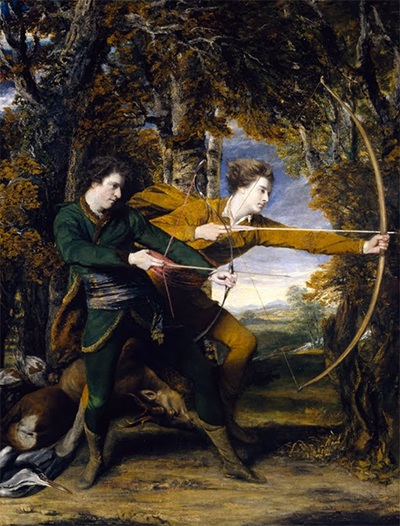
Joshua Reynolds’s Colonel Acland and Lord Sydney: The Archers is one of his most theatrical double portraits. Painted in 1769, it is now in Tate’s collection as T12033 and is recorded through Tate’s Google Arts & Culture partner record as an oil on canvas acquired in 2005 with support from the National Heritage Memorial Fund, Tate Members, Art Fund, the Wolfson Foundation and other donors.[1] Art Fund gives the dimensions as 238.7 x 184.2 cm, a scale that makes the two men almost stage-sized as they advance through woodland with bows drawn.[2]
The sitters are Colonel John Dyke Acland and Dudley Alexander Sydney Cosby, Lord Sydney of Leix. That second identification needs care. A Mannings-linked reconstruction of the 1813 British Institution display notes that the second sitter has sometimes been wrongly identified as Thomas Townshend, Baron Sydney of Chislehurst, but is more likely Dudley Alexander Sydney Cosby, the diplomat who was created Lord Sydney of Leix, Baron of Stradbally, in 1768.[5] Reynolds’s painting is therefore not just a sporting portrait of two unnamed aristocrats. It is an image of two particular men, transformed into figures of friendship, motion and aristocratic performance.
The painting belongs to the year in which Reynolds’s public authority was being consolidated. The Royal Academy had been founded in 1768, Reynolds became its first president, and in 1769 he was knighted. The Archers shows what his art could do at that moment. It takes portraiture, the genre by which he earned his reputation, and loads it with the ambition of history painting. The men are recognisable sitters, but they move through a landscape as if they have stepped into a mythological hunt.
That movement is the first thing that separates the picture from the safer double portraits Reynolds might have painted. Many eighteenth-century portraits turn rank into composure: the sitter stands, gestures, leans or occupies a room with carefully measured ease. Here, Reynolds makes rank kinetic. The men are caught in action, and the action is not accidental decoration. It is the means by which social identity becomes visible. They appear trained, elegant and mutually attuned, but also deliberately costumed. The picture asks the viewer to believe in the vitality of aristocratic friendship while also noticing that such vitality has been staged through art.
At a Glance
- TitleColonel Acland and Lord Sydney: The Archers
- ArtistJoshua Reynolds
- Date1769 [1]
- MediumOil on canvas [1]
- CollectionTate Britain [1]
- AccessionT12033 [6]
- Dimensions238.7 × 184.2 cm [2]
- SittersJohn Dyke Acland and Dudley Alexander Sydney Cosby
- Acquired2005 [2][3]
- Painting typeFull-length double portrait
Contents
- Introduction
- The Tate painting
- The two sitters
- Why archery matters
- Costume, game and woodland
- Reynolds and the Grand Manner
- 1813 and later memory
- The 2005 rescue
- Why The Archers still matters
The Tate painting
The current Tate identity is clear even though some online records repeat slightly different measurements or date ranges. The Google Arts & Culture partner record gives the title Colonel Acland and Lord Sydney: The Archers, the creator Sir Joshua Reynolds, the date 1769, the type as painting and the medium as oil on canvas.[1] Wikimedia metadata derived from Tate and Google Art Project sources gives Tate Britain, accession T12033, and records the work as 236 x 180 cm.[6] Art Fund’s acquisition record gives the larger dimensions of 238.7 x 184.2 cm.[2]
Those differences do not alter the basic object. It is a very large, full-length double portrait in oil on canvas, now held by Tate. Its modern public status was secured only in 2005, after an export-stop campaign. The National Heritage Memorial Fund announced a £1.6 million pledge that year, adding to pledges from Tate Members and Art Fund, so Tate could approach the £3.2 million needed to match the agreed price.[3] Art Fund records its own £400,000 grant and the same total cost.[2]
That modern acquisition history matters because the picture had been at risk of leaving Britain. NHMF reported that an export licence was stopped after sale to a German institution and that the Reviewing Committee on the Export of Works of Art gave the painting a starred rating, signalling exceptional importance.[3] The 2005 campaign placed The Archers back into a national collection, where it could be read not as a private heirloom but as a major statement in British portraiture.
The acquisition also sharpened the painting’s public role. A private owner might value the work as inheritance, rarity or market asset; Tate could present it as a problem in British art: how does portraiture become heroic, how does leisure become authority, and how does an artist use old-master memory to remake contemporary identity? Those questions are especially vivid because the picture looks instantly appealing. Its drama is easy to grasp, but its construction is sophisticated. Reynolds makes the double portrait behave like a fragment of epic.
The two sitters
John Dyke Acland was born in 1746 and died in 1778. Art Fund identifies him as the figure on the right, an aristocrat and soldier, while NHMF describes him as an MP.[2][3] What Jane Saw adds that he was the son of Sir Thomas Acland, third baronet, and Elizabeth Dyke, served as a soldier in the Devon Militia, and married Lady Harriot Fox-Strangways in 1770.[5] His identity brings military, political and West Country family status into the picture.
Dudley Alexander Sydney Cosby, born in 1732 and dead by 1774, was a diplomat. NHMF identifies him as the second sitter, and What Jane Saw gives the fuller Mannings-linked correction: he was created Lord Sydney of Leix, Baron of Stradbally, in 1768 and married Isabella, daughter of the Earl of Howth.[3][5] This matters because the title “Lord Sydney” has invited confusion with Thomas Townshend, a better-known political figure connected with the name Sydney. Reynolds’s painting, however, belongs to Cosby.
The two men are not presented in ordinary dress. What Jane Saw notes the theatrical quality of the costumes: fur-lined wrap-around tunics, Acland’s prominent sash and tights that suggest Reynolds’s invention.[5] The effect is to detach the sitters from everyday Georgian clothing and place them in a quasi-historical world. They are still modern men, but the painting asks viewers to imagine them through older codes of nobility, courage and companionship.
That transformation is central to Reynolds’s achievement. Acland and Sydney could have been shown as politicians, soldiers, landowners or diplomats with the usual attributes of rank. Instead, they become archers. Their shared action becomes more important than office. The portrait turns identity into performance.
Yet the performance is not empty disguise. Acland’s military and political associations and Sydney’s diplomatic identity give the painting a social charge that costume alone could not supply. These were men formed by public roles, family networks and imperial Britain’s expanding political world. Reynolds does not describe those roles literally. He converts them into a fiction of poise, courage and coordination. The portrait therefore flatters without merely listing achievements. It imagines the sitters as men capable of command because they can command themselves in action.
Why archery matters
Art Fund notes that Reynolds carefully chose bows even though a shotgun was the more popular weapon at the time.[2] This is the key to the painting. Archery makes the image archaic, ceremonial and poetic. A gun would have placed the sitters in a more contemporary world of sporting technology; the bow sends them toward chivalry, classical hunt imagery and myth.
The bow also gives Reynolds a compositional device. Two men with arrows ready create tension across the canvas. Their bodies lean, turn and aim; their arms extend; the diagonals of bows and arrows animate the woodland space. The portrait is not static. It is built from anticipation. The viewer arrives just before release.
That poised instant lets Reynolds make friendship visible as coordination. The two sitters do not simply stand side by side. They share a pursuit, a direction and a rhythm. The image imagines aristocratic friendship as disciplined movement through nature. The hunt becomes a theatre of mutual purpose.
Even the delay before the shot feels meaningful, because it makes control more important than direct visible physical violence.
This is why the painting is more than sporting decoration. It is not a neutral record of a pastime. Reynolds uses sport to construct character. Archery becomes a language for controlled energy, masculine elegance and heroic play. The old weapon gives the modern sitters an antique aura.
There is also a subtle difference between hunting with a gun and hunting with a bow. A gun can imply distance, mechanism and modern efficiency. A bow requires the body to be visibly involved. It displays pull, balance, stance and timing. Reynolds needed that visibility. The bow lets him turn the male body into a formal argument: stretched arms, braced legs, angled torsos and focused attention. Archery makes the sitters readable as disciplined bodies, not simply as owners of land and costume.
Costume, game and woodland
The costumes are not archaeological reconstructions. They are pictorial inventions designed to lift the sitters out of ordinary time. The fur, sashes and close-fitting legwear make the men seem like actors in a noble hunt. Their clothing gives them unity without making them identical. One figure advances with stronger forward pressure; the other complements and steadies the action. Together they form a paired image of motion.
The dead game at their feet is equally important. NHMF describes the game as a “Flemish” still-life element and links it to Reynolds’s bravura handling.[3] It gives the painting a material density that offsets the theatricality of the figures. The animals remind us that hunting has consequence, not merely style. They also announce social privilege: the right to hunt, to command land and to display leisure as power.
The woodland is not a casual backdrop. NHMF points to the freely painted landscape and to old-master allusions that connect the scene with mythological hunting pictures by Titian and Claude Lorraine.[3] The Art Fund’s Reynolds story, drawing on Martin Postle, specifies Titian’s poesie and especially Death of Actaeon as a context for understanding the picture.[4] Reynolds is not copying those works. He is borrowing their grandeur of setting and mythic pressure.
The result is a landscape portrait that behaves like a staged event. The trees enclose and dramatise the sitters. Light catches bodies, costume and game. The men appear to move through an invented forest in which aristocratic friendship can look ancient, vigorous and almost legendary.
The landscape also gives Reynolds a way to avoid the stiffness that can burden full-length portraits. Instead of placing the sitters before architecture, he lets the forest absorb and energise them. Branches, shadows and open distance create a world through which the men can move. The setting is natural, but not casual. It has the compression of theatre scenery and the breadth of an old-master hunt. Reynolds uses it to make motion plausible and grandeur persuasive.
Reynolds and the Grand Manner
The Archers is an object lesson in Reynolds’s Grand Manner, though it works differently from his more formal portraits. Instead of elevating a sitter through column, curtain and antique pose, Reynolds elevates two men through action. Their rank is not merely announced; it is performed. They become heroic because they move as if they belong to a larger pictorial tradition.
The timing is important. Art Fund notes that the portrait was begun in 1769, the year Reynolds became first president of the Royal Academy.[2] His authority as artist, lecturer and institutional leader was being newly defined. In his Discourses, Reynolds would urge artists to rise above mere copying and to shape nature through general, elevated forms.[8] The Archers demonstrates that principle in paint. It turns two contemporary men into a generalized image of noble action.
The painting also shows how Reynolds could make portraiture compete with history painting. The sitters remain named individuals, but the scene borrows the energy of mythological narrative. The bow, the forest and the dead game all push the image toward poetry. The viewer is invited to admire Acland and Sydney not only as men of rank but as participants in a timeless drama of youth, friendship and pursuit.
This is why the picture feels more experimental than many society portraits. Reynolds asks a double portrait to do a great deal: preserve likeness, celebrate companionship, display costume, evoke the old masters, and create a moment of physical suspense. Its ambition lies in that mixture.
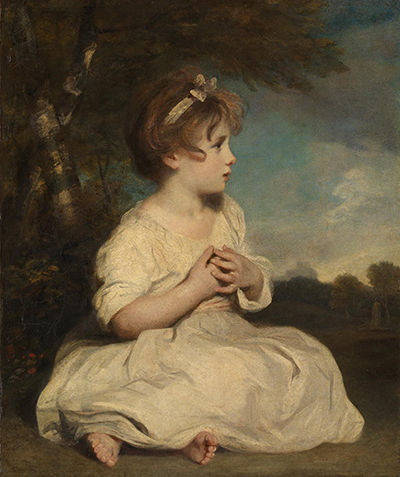
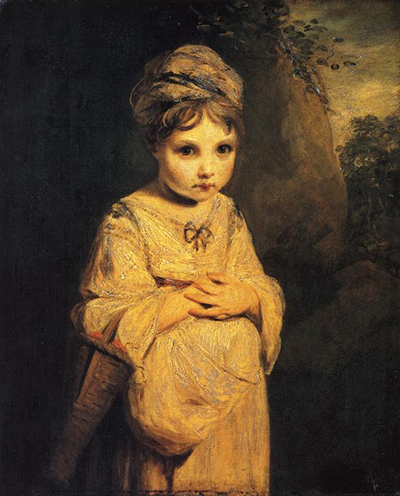
The painting also complicates the boundary between portrait and fancy. It is not a fancy picture in the child-subject sense of The Strawberry Girl or The Age of Innocence, because the sitters are named and socially specific. But it uses fancy dress, imagined action and a quasi-mythic setting to create an identity that is more than documentary. Reynolds is testing how far portraiture can travel toward fiction while still returning to the sitter with increased force. In The Archers, fiction does not obscure likeness; it enlarges it.
1813 and later memory
The painting’s later reception helps explain why its identities had to be handled carefully. In the 1813 British Institution exhibition reconstructed by What Jane Saw, the work appeared as No. 59 under the title “Portraits of Lord Sidney and Col. Ackland, in a landscape, as archers.”[5] That wording preserves an older spelling and title form, while Mannings #41 provides the catalogue anchor for the modern identification.[5][7]
The 1813 ownership context is also revealing. What Jane Saw records the Earl of Carnarvon as owner in the exhibition catalogue, and explains that Carnarvon was Acland’s son-in-law.[5] This places the picture within family inheritance and dynastic memory. It was not merely an image of sporting companions; it became part of the social fabric of families connected by marriage, mourning and display.
At the same time, the 1813 description already emphasised theatrical costume and mythological suggestion. What Jane Saw notes Acland in green and Sydney in brown, the wrap-around tunics, the sash, the tights and the outdated weapon.[5] Viewers in the early nineteenth century could recognise that this was not simple reportage. Reynolds’s fiction was legible.
That legibility has helped the painting remain powerful. The men’s names require explanation, but the image itself is immediately readable: two figures in motion, a shared aim, a forest, a kill, a moment before release. Reynolds built a portrait whose narrative energy outlived the everyday fame of its sitters.
The 1813 context also reminds us that the painting was already being historicised within Reynolds’s own posthumous reputation. The British Institution display gathered earlier works into a retrospective field, allowing viewers to compare costumes, subjects and ambitions across his career. In that environment, The Archers would have looked like a daring example of theatrical male portraiture: less domestic than family portraits, less official than state images, but more charged than simple sporting likeness. Its strangeness was part of its prestige.
The 2005 rescue
The modern story of The Archers is unusually dramatic. NHMF’s 2005 announcement describes the work as export stopped after sale to a German institution and as a picture every effort should be made to keep in the country.[3] The target price was £3.2 million, with public and charitable support assembled quickly to allow Tate to acquire it.[2][3]
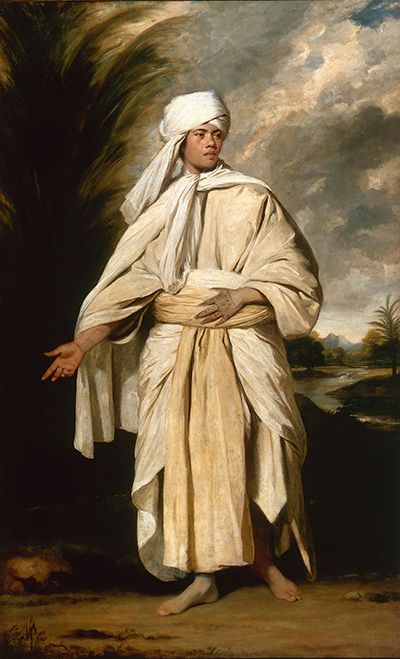
Art Fund later framed the acquisition as part of a wider Reynolds story. Its account notes that Tate acquired the picture after the export stop with Art Fund support, and that The Archers and Portrait of Mai (Omai) became centrepieces of Tate Britain’s 2005 exhibition Joshua Reynolds: The Creation of Celebrity.[4] That pairing is suggestive. Both works show Reynolds turning an individual sitter, or sitters, into a public image charged with theatrical identity.
The export-stop episode also changed the painting’s meaning. Once in Tate, it could be seen alongside the broader history of British art rather than within a private line of descent. The picture’s national importance was argued not because Acland and Sydney were household names, but because the work shows Reynolds at a high pitch of invention.
In that sense, the 2005 rescue confirmed what the painting already claimed for itself. The Archers is a portrait that wants to be more than private commemoration. It wants to belong to the public history of painting, ambition and display.
The campaign also underlined a broader truth about Reynolds. His greatest portraits can become nationally important even when their sitters are no longer widely known. The value lies not only in biography but in pictorial intelligence. The Archers condenses a whole set of eighteenth-century concerns: land, leisure, masculinity, performance, old-master culture, institutional ambition and the social theatre of portraiture. That density explains why the work could satisfy the export criteria and why public funding bodies argued for its retention.
Why The Archers still matters
Colonel Acland and Lord Sydney: The Archers matters because it shows Reynolds expanding the possibilities of portraiture. He does not abandon likeness, status or social identity. He intensifies them by placing two men inside a fiction of heroic sport. The image is artificial, but its artificiality is its method.
The painting also captures a particular eighteenth-century idea of masculinity. Acland and Sydney are not shown in battle, parliament or diplomacy. They are shown as active, coordinated and theatrical. Their world is one in which leisure can become proof of breeding, costume can become history, and friendship can be staged as shared danger.
At the same time, the picture is too strange to be reduced to simple aristocratic self-praise. The outdated bows, invented dress and mythological atmosphere make the scene knowingly performative. Reynolds lets us see that identity is being made. The men are not just archers; they are modern sitters acting the part of ancient hunters.
That is the lasting force of the work. It turns a double portrait into a moving image of aspiration. In the forest of The Archers, Reynolds gives Georgian portraiture a pulse: bodies leaning forward, arrows flexed, friendship dressed as legend, and social rank transformed into pictorial drama.
The painting’s theatricality may even be what keeps it fresh. Modern viewers do not need to share Acland and Sydney’s social assumptions to understand the image’s energy. We can see the performance, the elegance and the artifice at once. Reynolds’s brilliance lies in making that artifice productive. He does not hide the staging; he makes staging the subject. The portrait becomes a demonstration of how eighteenth-century identity could be composed, costumed and launched into motion.
Frequently Asked Questions
Discussion
Does Reynolds make aristocratic friendship look natural, or does the painting invite us to notice how carefully it is staged?
Reader Insights
How does the corrected identification of Lord Sydney of Leix change the historical reading?
What do bows, costume and coordinated movement add that an ordinary sporting portrait could not?
Why did the painting's pictorial ambition matter more than the later fame of its sitters in the 2005 rescue?
Join the Conversation
Share your reading below.
References
- Tate / Google Arts & Culture, Colonel Acland and Lord Sydney: The Archers, https://artsandculture.google.com/asset/colonel-acland-and-lord-sydney-the-archers-sir-joshua-reynolds/WQEH3jlvQHLJFg?hl=en
- Art Fund, Colonel Acland and Lord Sydney: The Archers, https://www.artfund.org/our-purpose/art-funded-by-you/colonel-acland-and-lord-sydney-the-archers
- National Heritage Memorial Fund, “NHMF helps Tate to save Joshua Reynolds’ The Archers,” 20 July 2005, https://www.memorialfund.org.uk/news/nhmf-helps-tate-save-joshua-reynolds-archers
- Art Fund, “The story of Joshua Reynolds and Art Fund,” https://www.artfund.org/explore/get-inspired/features/the-story-of-joshua-reynolds-and-art-fund
- What Jane Saw, British Institution 1813, No. 59, “Portraits of Lord Sidney and Col. Ackland, in a landscape, as archers,” https://www.whatjanesaw.org/1813/rooms.php?location=MRSE
- Wikimedia Commons metadata after Tate / Google Art Project, Colonel Acland and Lord Sydney: The Archers, https://commons.wikimedia.org/wiki/File:Sir_Joshua_Reynolds_-_Colonel_Acland_and_Lord_Sydney-_The_Archers_-_Google_Art_Project.jpg
- David Mannings, Sir Joshua Reynolds: A Complete Catalogue of His Paintings, with subject pictures catalogued by Martin Postle, 2 vols, Yale University Press / Paul Mellon Centre for Studies in British Art, 2000.
- Joshua Reynolds, Fifteen Discourses Delivered in the Royal Academy, Project Gutenberg edition, https://www.gutenberg.org/files/52436/52436-h/52436-h.htm