 by Tom Gurney
Tom Gurney BSc (Hons) is an art history expert with over 20 years experience
Published on June 19, 2020 / Updated on August 2, 2026
Email: tomgurney1@gmail.com / Phone: +44 7429 011000
Flying Machine
Leonardo da Vinci's Flying Machine is a design known through manuscript evidence and later reconstruction, not a surviving aircraft. The title points to Leonardo's attempt to imagine human flight, but the evidence needs a stricter frame. The Museo Leonardiano record describes a 1929 model related to Manuscript B (France), f. 74 v; it does not document a fifteenth-century machine built by Leonardo [1].
The distinction matters throughout the work. Leonardo's design belongs to the late 1480s, during an early phase of his study of flight, when he was considering machines with beating wings powered by the human body [1] [2]. The object now used to explain that design is modern: made by the Scuola di Costruzioni ed Esperienze Aeronautiche di Guidonia in 1929 and donated to the Museo Leonardiano in 1938 [1].
The design brings together observation, anatomy, mechanics and ambition. Leonardo studied birds, imagined wings, considered cords, pulleys and the pilot's body, and tried to translate living movement into a mechanical system. It was not a successful airplane, but it remains an important record of how he approached flight as a technical problem.
At a Glance
- Familiar titleFlying Machine
- CategoryManuscript design and model interpretation
- Governing sourceMuseo Leonardiano, Flying machine
- Exact folio evidenceManuscript B (France), f. 74 v
- Model date1929
- Model makerScuola di Costruzioni ed Esperienze Aeronautiche di Guidonia
- CollectionFlight studies
- MaterialWalnut wood, leather, cotton rope and iron
- DimensionsHeight 35 cm; length 87 cm
- Public cautionNo working-aircraft or Leonardo-built-machine claim
- ImageModern model after a Leonardo manuscript design
Contents
- What the Page Is Really About
- Leonardo's Manuscript B Lane
- The 1929 Museo Leonardiano Model
- How the Mechanism Was Imagined
- Why Birds Mattered
- The Feasibility Problem
- Study of a Beating Wing
- Codex Atlanticus and Source Discipline
- Why the Flying Machine Matters
What the Page Is Really About
The phrase Flying Machine is useful, but it can make Leonardo's flight studies sound like one invention with one outcome. His manuscripts contain several approaches to flight: flapping wings, gliding and soaring, wind measurement, and the behaviour of air as a physical medium [3]. This route focuses on the Manuscript B design represented by the Museo Leonardiano model.
The governing source is the Museo Leonardiano model record. It describes a Flying machine model made in 1929, held in the museum's Flight studies collection, and related to Leonardo's Manuscript B (France), f. 74 v [1]. The linked Leonardo Digitale page provides the exact folio endpoint, while the interpretation remains limited to details supported by the cited sources [2].
The subject therefore has two parts: Leonardo's manuscript design and the modern model that makes it visible. The model can clarify structure and movement, but it remains an interpretive object. It should not be treated as a Leonardo-made machine, as evidence of successful flight, or as a stand-in for every flying device in his notebooks.
That restraint matters because Leonardo's flight studies attract spectacular language. They are often described as if he anticipated aviation whole, as if the history of flight simply waited for materials and engines to catch up with him. There is a grain of truth in the fascination, but not in the shortcut. Leonardo's importance lies in the quality of his questions: how wings beat, how air resists, how a human body might move a machine, how a pilot might be positioned, and how mechanical parts could imitate living anatomy.
Leonardo's Manuscript B Lane
The central source context is Manuscript B (France), f. 74 v [1] [2]. Manuscript B is one of the key places where Leonardo explored architecture, military engineering and mechanical devices during his Milanese period. The folio reference distinguishes this design from other flight studies that often circulate under similar modern titles.
That precision avoids two mistakes: vague references to flying machines somewhere in Leonardo's notebooks, and overreach that treats every Leonardo flight drawing as the same design. The Manuscript B reference anchors the subject while still allowing broader context from the Flight studies collection [1] [3].
The Museo Leonardiano record states the relationship directly: its model is sourced to Leonardo's Manuscript B (France), f. 74 v [1]. The Leonardo Digitale endpoint identifies the same folio context [2]. That evidence supports the source relationship; it does not by itself resolve reproduction rights for manuscript imagery.
The safest summary is direct: Leonardo conceived a beating-wing flying machine in the late 1480s, and the Museo Leonardiano model represents that design through a later reconstruction [1]. The manuscript does not provide a complete engineering specification, and the modern model necessarily involves interpretation.
The 1929 Museo Leonardiano Model
The Museo Leonardiano object is a modern model, not Leonardo's machine. It was made by the Scuola di Costruzioni ed Esperienze Aeronautiche di Guidonia in 1929 and donated to the museum in 1938 [1]. It belongs to the Flight studies collection and is displayed at the Museo Leonardiano in the Counts Guidi's castle [1].
The model's material facts are useful because they keep the object grounded. The record gives carved and partially painted walnut wood, leather, cotton rope and iron; it measures 35 centimetres high and 87 centimetres long; and it carries inventory record OA: 00000005 [1]. Those details remind the reader that the museum object is an interpretive model made for display and study. It is not a surviving Renaissance artifact.
The model itself is visually direct. It consists of a rectangular platform for the pilot, with straps, stirrups, cords and pulleys connected to two wings [1]. The pilot would be positioned on the platform, secured, and would operate the mechanism by thrusting with his feet into the stirrups [1]. The movement would make the wings rise and fall, while the same system would help the wings flex and rotate so that they cut through the air on the rise and press against it on the descent [1].
The evidence supports a limited description. The Museo Leonardiano record explains the motion, materials and scale of the model, but it does not establish lift, stability, sustained flight, test flights or practical performance.
The museum model is valuable because it makes a manuscript idea legible. Leonardo's drawing and notes become easier to imagine when translated into wood, leather, rope and iron. That translation is also an interpretation, and the model belongs to the twentieth century.
How the Mechanism Was Imagined
The mechanism belongs to Leonardo's early flapping-wing phase. The Museo Leonardiano describes the design as a flying machine with beating wings, conceived in the late 1480s and characterised by the use of human power alone [1]. That phrase is important. The machine imagines flight by mechanical imitation: a human body drives a system that tries to reproduce the movement of wings.
The pilot's body is part of the machine. He is not a passive passenger. He supplies the energy by pushing with his feet into stirrups. Cords and pulleys transmit that energy to the wings, making them move up and down [1]. The mechanism also changes the attitude of the wings. During the upward movement, the wing surface turns edge-on to cut more easily through the air. During the downward movement, the surface becomes flatter to compress the air [1].
Springs at the joints help return the wing sections to their starting position [1]. That detail matters because it shows Leonardo thinking about cyclical movement, recovery and repetition. A wing is not simply a board that flaps. It needs articulation. It needs to change shape or angle through the cycle. It needs a way to reset.
Even in this simplified public explanation, the design feels characteristically Leonardo. It begins with the body and the living world, then turns toward mechanical translation. Birds do not fly by a single rigid motion. Their wings bend, twist and recover. Leonardo tried to imagine how a machine might do something analogous, using ropes, pulleys, stirrups and springs.
The limitation is equally important. Museo Leonardiano's broader Flight studies page places flapping-wing machines in a phase ultimately constrained by human power [3]. Human beings could not generate enough energy to move large wings mechanically in the way the early designs imagined [3]. The beauty of the idea and the impossibility of the power source belong together.
Why Birds Mattered
Leonardo's flying-machine studies begin with birds because birds offered the most persuasive evidence that bodies could move through air. He observed their wings, their structure and their movements. The goal was not only to admire flight, but to understand the mechanics behind it. If a bird could rise, turn, beat and glide, then perhaps those actions could be analysed and translated.
The Museo Leonardiano Flight studies page describes Leonardo's fascination with flight as something that followed him throughout life, leaving designs for flying machines and reflections on birds in his manuscripts [3]. During his first stay in Milan, it says, he worked on flapping-wing machines capable of imitating the structure and propulsive movement of bird wings [3]. That is the mental world of the Flying Machine.
The machine therefore belongs to biomimicry before the word existed. Leonardo was not designing from pure abstraction. He was looking at living forms and asking what made them work. Wings had structure. Wings had movement. Wings had surfaces that met air differently at different moments. A machine had to answer those problems mechanically.
This is also why the design remained difficult. Birds are not merely machines with wings attached. They have bodies adapted to flight: light skeletons, muscles, feathers, balance and instinctive control. A human body tied to a wooden platform has a very different relation to weight and power. Leonardo could observe a bird's motion with extraordinary intelligence, but the mechanical imitation of that motion was another matter.
That gap between observation and feasibility should be part of the article's tone. It prevents the page from becoming either hype or mockery. Leonardo was not foolish because the design could not fly. He was asking a real mechanical question with the tools, materials and conceptual framework available to him. The result is a page about disciplined imagination.
The Feasibility Problem
The most important caveat is power. Museo Leonardiano's Flight studies context says that humans cannot generate enough energy to move wings mechanically, so flapping-wing flight was not feasible [3]. That statement should govern the public article's feasibility language.
The design's limitation is instructive. Leonardo explored how muscular action might be converted into wing movement, and he understood that air resistance and wing position mattered. He imagined ways to move, flex and reset the wings, but a human pilot could not supply the power required by a large mechanical bird.
The design should not be framed as a functioning machine or as an airplane in the modern sense. It belongs instead to the history of imagined flight, mechanical analogy and observational engineering. Its importance lies in the problem it formulates, not in any evidence that it flew.
The later shift in Leonardo's flight studies also matters. Museo Leonardiano notes that, after the limits of human-powered flapping became clear, Leonardo turned toward gliding or soaring flight, where movement depends on air currents [3]. That development helps the page show Leonardo's thought changing. He did not stay with one romantic idea forever. His notebooks record a mind revising its questions as the physical problem became clearer.
Leonardo did not invent the airplane if the word means a practical powered aircraft. His achievement is different: he investigated flight with unusual persistence and produced designs that relate anatomy, air, motion and mechanism.
Study of a Beating Wing
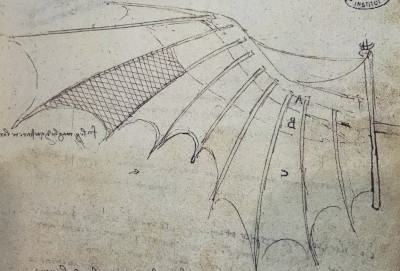
The Museo Leonardiano Study of a beating wing record gives a related support lane, but it must not take over the page [4]. That object is also a model from 1929, but its original-work relationship is different: it is sourced to Codex Atlanticus, f. 747 r [4]. The Flying Machine page is sourced to Manuscript B (France), f. 74 v [1].
The distinction between folios is important. The related beating-wing study helps explain Leonardo's interest in wing articulation, and its model imitates bird-wing anatomy through movable segments, springs, control lines and a crank system [4]. It is related context, not the same object as the Manuscript B flying-machine design.
The related Study of a beating wing shows that Leonardo's flight studies were not isolated sketches. He returned to problems of wing movement, articulation and the behaviour of surfaces in air: how a wing bends, how it resists air, and how a mechanism might reproduce the complex movement of a living creature.
That related material remains secondary. The main subject is still the flying-machine model and Manuscript B f. 74v. Related images and links need to remain tied to their own sources rather than being used as proof of the flying-machine design itself.
Codex Atlanticus and Source Discipline
The Codex Atlanticus is a crucial Leonardo resource, but it is contextual here rather than governing. Museo Galileo's Leonardo 500 project describes it as the largest surviving collection of Leonardo autograph folios, with more than 1,100 loose sheets gathered by Pompeo Leoni at the end of the sixteenth century [5]. It also notes the difficulty of studying the codex because of its scale, disorder and range of subjects [5].
Exact folio control matters because Leonardo's notes include technical solutions, natural observations, draft treatises, sketches and practical memoranda [5]. A general phrase such as "in Leonardo's codices" blurs many different sheets into one authority. The clearer account names the specific folio and keeps related material separate.
Manuscript B f. 74v remains the governing design reference through the Museo Leonardiano record [1] [2]. Codex Atlanticus f. 747r belongs to the related Study of a beating wing context [4]. The broader Codex Atlanticus material explains the manuscript landscape, but it does not replace the Manuscript B source for this design [5].
The exact folio matters because it identifies the design under discussion. Leonardo's reputation is often described in broad terms, but the evidence is specific: pages, records, models and later interpretive traditions.
What to Notice First
Start with the pilot. In the reconstructed model, the pilot lies or is positioned on a rectangular platform and is strapped into the apparatus [1]. That arrangement makes the human body part of the mechanism. The machine does not replace the body; it extends it and asks it to provide power.
Next look at the wings. They are not simply decorative symbols of flight. Their movement is the point. The system is meant to raise and lower them, while also changing their orientation so they cut through the air on the upward stroke and press against it on the downward stroke [1]. The idea shows Leonardo thinking about the wing stroke as a cycle of different surfaces meeting air differently.
Then notice the cords, pulleys, stirrups and springs. These are the mechanical vocabulary of the design. Leonardo's imagination did not leap directly from bird to airplane. It passed through transmission, leverage, recovery and articulation. He had to ask how a pilot's movement could become a wing's movement.
The ambition and the limit belong together. The design is bold, but it is not a working aircraft. Leonardo was imagining a path to human flight, while the available power source could not solve the problem [3].
Why the Flying Machine Matters
The Flying Machine matters because it captures Leonardo's method in miniature. He looks at nature, studies movement, imagines a mechanical analogy, tests the idea on paper, and leaves behind a design that later generations can reconstruct, question and display. It is an invention page, but it is also a page about thinking.
The design belongs naturally beside pages such as Ornithopter, Helicopter, Parachute and Inventions, but it should not be flattened into them. The aerial screw has its own source context. Parachute designs have their own manuscript and modern-test questions. The ornithopter page will need its own folio discipline. Flying Machine should be allowed to be specific.
Its significance is not that Leonardo solved aviation. He did not. Its significance is that he treated flight as a problem that could be studied through observation, anatomy, mechanics and repeated drawing. He understood that air was something to work with, not emptiness. He understood that wings had to move in complex ways. He understood that a machine for flight would have to translate bodily force into controlled surfaces.
The modern Museo Leonardiano model gives readers a way to see that thought. It turns the manuscript problem into a visible object, while also reminding us that the object is interpretive and modern [1]. Both parts remain essential: Leonardo's late-fifteenth-century idea and the twentieth-century model that helps explain it.
Read this way, Flying Machine is not a failed aircraft waiting to be excused. It is a focused record of Leonardo's study of flight: a manuscript design, a later model, and a set of mechanical questions that remained difficult until the modern age.
Frequently Asked Questions
Discussion
Discuss Leonardo's flying-machine design, its manuscript evidence and its place within his wider study of flight.
Keep comments focused on the model, the Manuscript B source, related flight studies and the limits of the evidence.
Reader Insights
Which detail in the model most changes how you read the design?
How does this design connect to Leonardo's drawings, inventions or wider study of nature?
Where should the wording stay cautious because the source evidence is qualified?
Join the Conversation
Share your reading of Flying Machine below.
References
- Museo Leonardiano di Vinci, Flying machine, model record, accessed 29 July 2026.
- Leonardo Digitale, Manuscript B (France), f. 74 v, digital folio endpoint, accessed 29 July 2026.
- Museo Leonardiano di Vinci, Flight studies, collection record, accessed 29 July 2026.
- Museo Leonardiano di Vinci, Study of a beating wing, model record, accessed 29 July 2026.
- Museo Galileo / Leonardo 500, Navigate in the Codex Atlanticus, accessed 29 July 2026.