 by Tom Gurney
Tom Gurney BSc (Hons) is an art history expert with over 20 years experience
Published on June 19, 2020 / Updated on July 28, 2026
Email: tomgurney1@gmail.com / Phone: +44 7429 011000
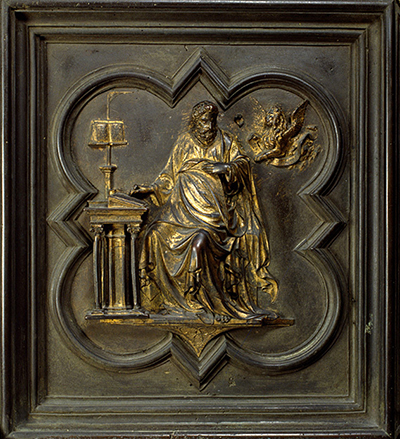
Lorenzo Ghiberti transforms Mark's seated author portrait through the dramatic presence of the lion. Mark sits beside a lectern at the left and turns toward the animal rising at the right. The lion's mane and lifted body fill the upper lobe, creating a more animated encounter than the quieter symbols of the other Evangelists.
Contents
Position and chronology
Mark is on the right leaf in the Evangelist register, directly above Ambrose. Luke sits beside him; John and Matthew occupy the corresponding register on the opposite leaf.
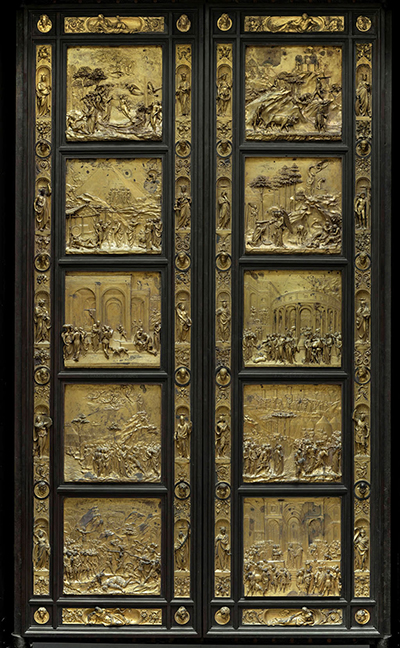
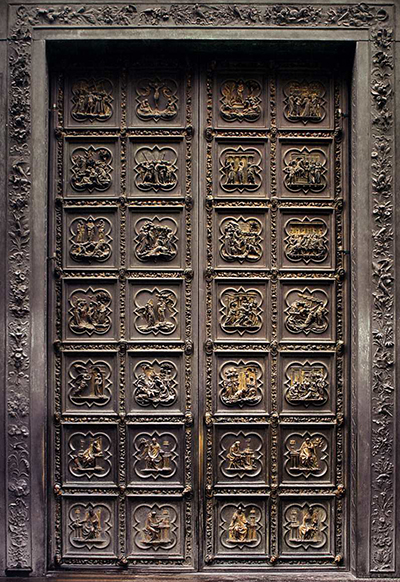
The North Door was made between 1403 and 1424 and is now in the Museo dell'Opera del Duomo. A copy occupies the Baptistery's exterior. Opera del Duomo reports the Evangelist panels within a proposed Krautheimer phase around 1407–1413/15. This is a stylistic reconstruction rather than a documented date for Mark.[1][2]
Mark and the lion
The lion is Mark's traditional Evangelist symbol. Here it is not reduced to a small attribute at the saint's feet. It rises alongside him, enlarging the encounter and making the right side of the quatrefoil visually active.
Mark answers with a turned body and gesture. The relationship is reciprocal: animal and author face one another across the seated figure's working space.
Calm and animation
The lectern at the left establishes writing and study, while the lion introduces movement. Mark remains seated between those poles. Drapery gives his body weight, but the turn prevents the pose from becoming static.
The contrast with Luke is useful. Luke bends along a horizontal axis toward his book; Mark's attention breaks away from the lectern toward the symbol. Matthew also turns toward a winged figure, but Mark's lion has greater mass and upward energy.
Start with the lectern, move through Mark's gesture, and finish with the lion's head and mane. The panel makes sacred authorship an encounter in which the traditional symbol becomes a forceful participant rather than a label.
Discussion
Ghiberti rewards slow looking: relief, gilding, narrative structure, workshop practice and conservation evidence can all change how a work is read.
Join the Conversation
Have an observation about Mark, a source to add, or a comparison that sharpens the reading? Share it below.