 by Tom Gurney
Tom Gurney BSc (Hons) is an art history expert with over 20 years experience
Published on June 19, 2020 / Updated on July 28, 2026
Email: tomgurney1@gmail.com / Phone: +44 7429 011000
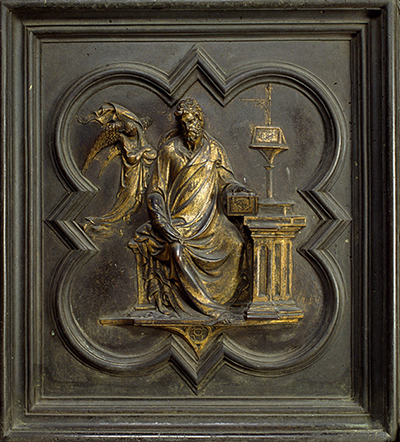
Lorenzo Ghiberti represents Matthew's authorship as dialogue. The Evangelist sits beside a compact lectern and book, but turns his head toward a winged human figure approaching from the left. His body remains anchored at the desk while attention moves outward toward the messenger.
Contents
Position and chronology
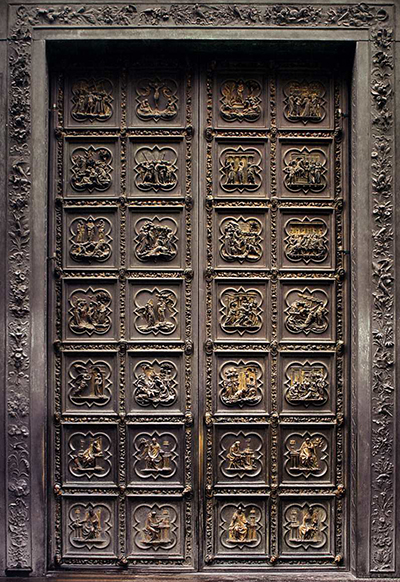
Matthew is on the North Door's left leaf in the Evangelist register, directly above Jerome. John sits beside him on the same leaf; Luke and Mark occupy the corresponding level on the right.
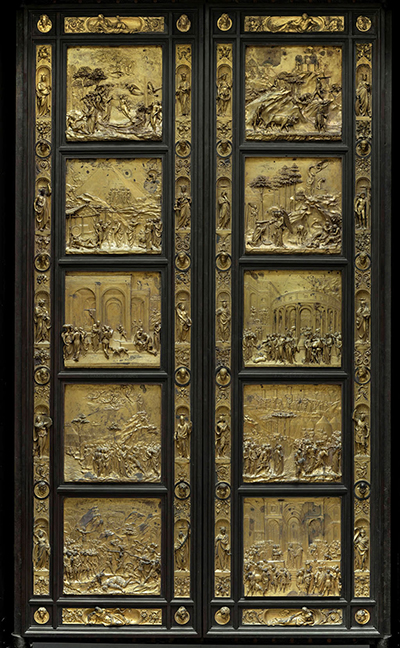
The original North Door, made between 1403 and 1424, is now in the Museo dell'Opera del Duomo. A copy stands outside on the Baptistery. Opera del Duomo reports the Evangelists within a proposed Krautheimer phase around 1407–1413/15. This stylistic reconstruction is not a documented individual panel date.[1][2]
Author and symbol
The winged human figure is Matthew's traditional Evangelist symbol. Ghiberti gives it an active role rather than placing it as a small label. The figure leans toward Matthew, creating a direct encounter across the left side of the quatrefoil.
Matthew's turned head completes the exchange. The writing desk establishes authorship, but inspiration appears relational: attention passes between two bodies.
Book, lectern and gesture
The book and lectern occupy the right side, balancing the winged figure at the left. Matthew sits between symbol and text. This arrangement makes the figure a hinge connecting received inspiration to written work.
The panel differs from John's inward pose. John rests in concentrated thought beside the eagle; Matthew visibly responds. It also differs from Mark, whose lion rises with greater physical drama.
Begin with Matthew's face and follow his gaze toward the winged figure. Then return across his torso to the book and stand. That route reveals the relief's concise argument: sacred authorship is neither solitary portraiture nor simple transcription, but an exchange translated into text.
Discussion
Ghiberti rewards slow looking: relief, gilding, narrative structure, workshop practice and conservation evidence can all change how a work is read.
Join the Conversation
Have an observation about Matthew, a source to add, or a comparison that sharpens the reading? Share it below.