 by Tom Gurney
Tom Gurney BSc (Hons) is an art history expert with over 20 years experience
Published on July 10, 2026 / Updated on July 28, 2026
Email: tomgurney1@gmail.com / Phone: +44 7429 011000
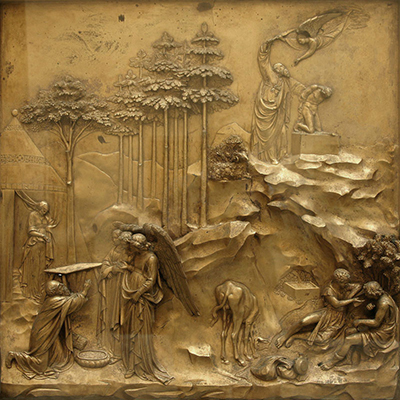
Ghiberti made the Sacrifice of Isaac in 1401 for the competition to select an artist for a new set of Florence Baptistery doors. The gilded bronze relief is contained within a quatrefoil frame and is now preserved in the Museo Nazionale del Bargello beside Filippo Brunelleschi's competing panel. Their survival offers a rare opportunity to compare two artists responding to the same subject, format and commission. [1]
Contents
- The competition and its uncertain result
- Ghiberti's composition
- One-piece casting
- Comparing Ghiberti and Brunelleschi
- From trial panel to the doors
The competition and its uncertain result
The Arte di Calimala required competitors to represent Abraham's near-sacrifice of his son Isaac, including the angel, ram, servants and donkey. Ghiberti later named seven competitors and described his success emphatically. A later account associated with Antonio Manetti concentrated on Ghiberti and Brunelleschi and presented the judging differently.
The safest wording is straightforward: Ghiberti received the commission formalized in 1403, but the precise deliberations are not securely recoverable. Claims of a unanimous victory or a forced joint commission belong to particular narratives and should be attributed, not repeated as settled fact.
Ghiberti's composition
Ghiberti divides the quatrefoil diagonally with a rocky ridge. Abraham and Isaac occupy the upper right, while the servants and donkey fill the lower left. The angel enters from above at the decisive instant. This organization separates sacred crisis from waiting attendants while allowing the eye to move continuously through the relief.
Isaac's nude body draws on classical sculpture. His pose is elegant and exposed, set against the angular movement of Abraham's drapery. The ancient reference does not displace the late Gothic refinement of the whole: slender contours, carefully described hair and ornament, and a composition adjusted closely to the curved frame coexist within one object.
One-piece casting
The national catalogue records that Ghiberti's relief was cast substantially in one piece, whereas Brunelleschi assembled his panel from several separately cast elements. Ghiberti's approach may have reduced metal and simplified aspects of assembly, but technical economy alone cannot prove why he received the commission.
The distinction is more valuable as evidence of artistic thinking. Ghiberti coordinated most figures, landscape and ground within a unified wax model and cast. Brunelleschi's separate elements contribute to the sharper physical collision and projection of his scene. Technique and expression are related, but neither panel can be reduced to a manufacturing statistic.
Comparing Ghiberti and Brunelleschi
Brunelleschi places the central action under greater physical pressure. Abraham grips Isaac forcefully, the angel intervenes abruptly, and bodies push toward the viewer. Ghiberti distributes the figures more smoothly across the field and gives the classical nude a poised clarity.
This familiar contrast should not become a contest between “Gothic” Ghiberti and “Renaissance” Brunelleschi. Both panels combine inherited forms, new observation and classical reference. Their difference lies in how each artist organizes drama, body, space and casting within the same demanding frame.
From trial panel to the doors
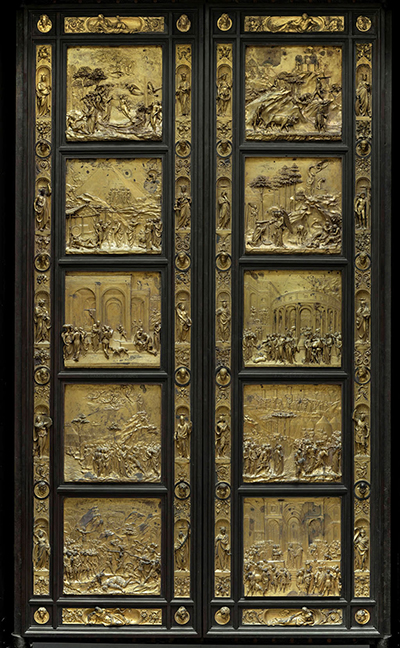
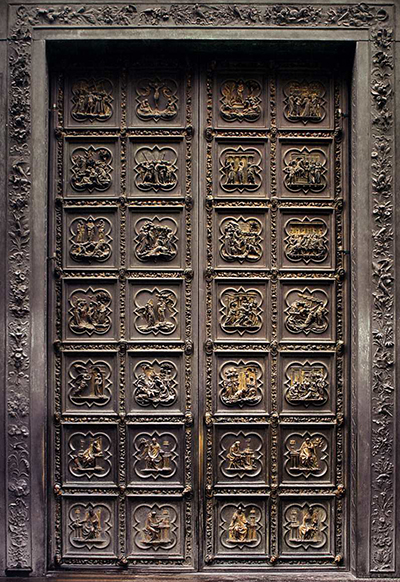
The competition relief was not inserted into the executed North Doors because the programme changed from Old Testament subjects to the life of Christ. It was preserved by Calimala and later entered grand-ducal and Uffizi collections before moving to the Bargello after 1859.
Its importance is therefore both historical and artistic. It marks Ghiberti's entry into monumental public patronage, but the long development of the North Doors should not be read as predetermined by this single panel. The relief opened an opportunity; the workshop, techniques and narrative language of the doors developed over the next two decades.
Discussion
Ghiberti rewards slow looking: relief, gilding, narrative structure, workshop practice and conservation evidence can all change how a work is read.
Join the Conversation
Have an observation about Sacrifice of Isaac, a source to add, or a comparison that sharpens the reading? Share it below.