 by Tom Gurney
Tom Gurney BSc (Hons) is an art history expert with over 20 years experience
Published on July 10, 2026 / Updated on July 28, 2026
Email: tomgurney1@gmail.com / Phone: +44 7429 011000
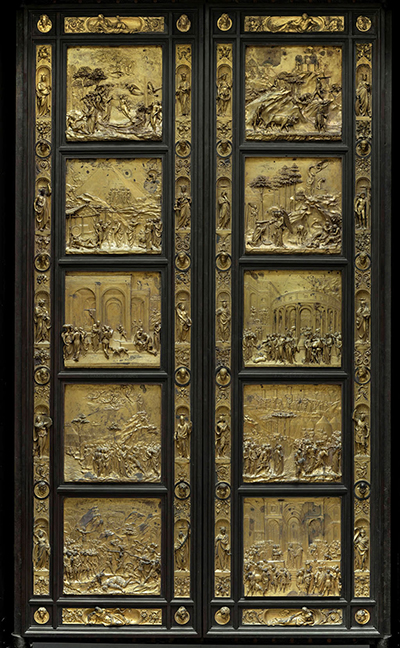
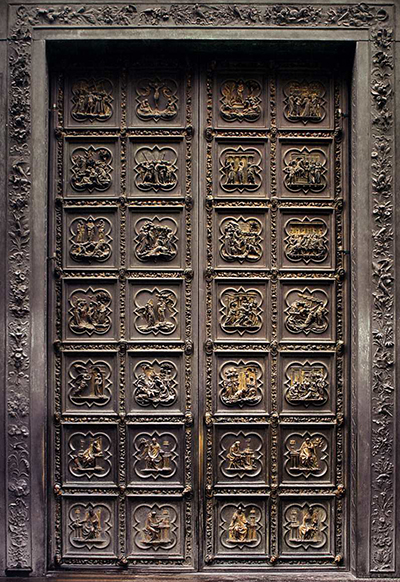
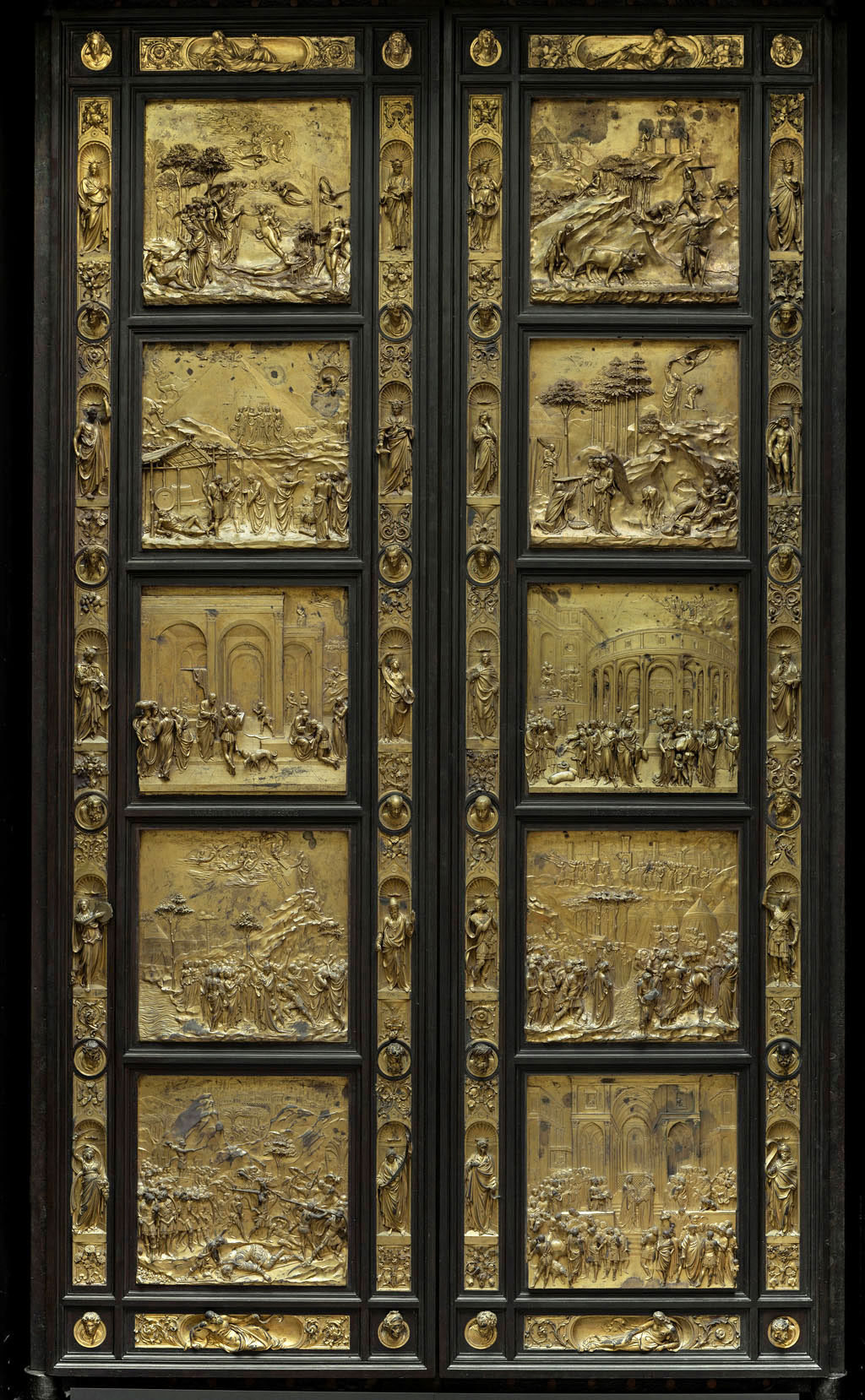
Ghiberti's art joins the precision of a goldsmith to the scale of architectural sculpture. His bronzes use casting, chasing, gilding, inlay and changing relief depth to control how stories and figures appear in light. There is no single “Ghiberti technique,” however. A competition panel, a monumental statue and a five-metre door imposed different material problems and were made through different combinations of workshop labor.
Contents
- Designing for bronze
- Chasing and surface
- Gilding and metallic color
- High, low and very low relief
- Architecture and perspective
- Workshop practice and authorship
- What conservation has revealed
Designing for bronze
Bronze sculpture begins with modelling and planning for casting. Complex forms must be translated into moulds and metal, then cleaned and finished after they leave the casting pit. Large projects may combine separately cast reliefs, frames, backing structures and architectural elements.
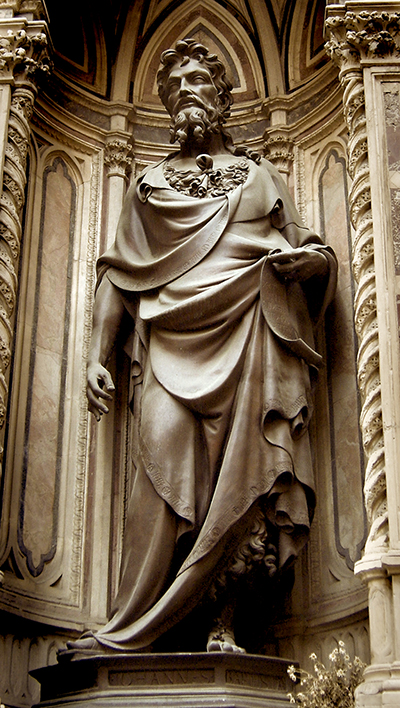
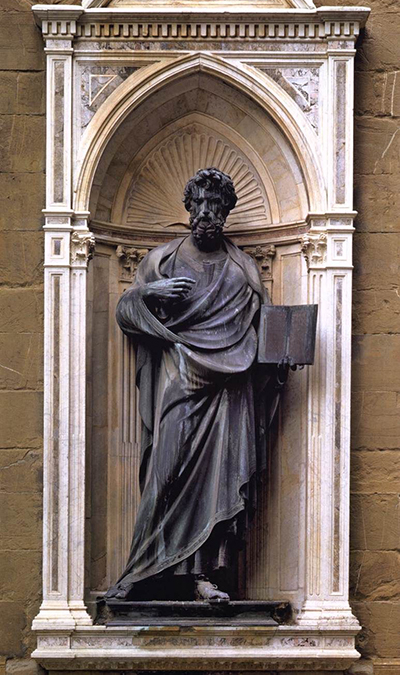
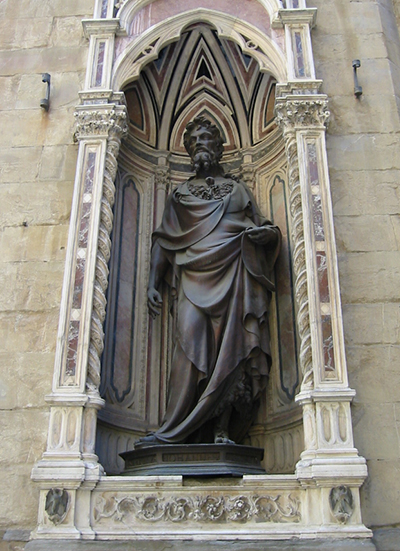
Ghiberti's 1401 Sacrifice of Isaac was cast substantially in one piece. St Matthew, by contrast, demonstrates the risk of monumental casting: its upper portion failed and had to be remade. The Gates of Paradise combine ten panels, framing strips, heads, statuettes and massive structural elements produced over many years. These cases should be compared, not collapsed into one universal procedure.
Chasing and surface
Casting did not produce a finished artwork. Chasing refined contours, corrected irregularities and articulated hair, features, drapery and ornament. On the Gates, the years after the principal panels were cast involved extensive cleaning and chasing before gilding and assembly.
This finishing helps explain the goldsmith quality often associated with Ghiberti. Fine detail was not merely transferred intact from model to bronze; it was recovered and sharpened through sustained work on the metal surface, frequently by workshop specialists under Ghiberti's direction.
Gilding and metallic color
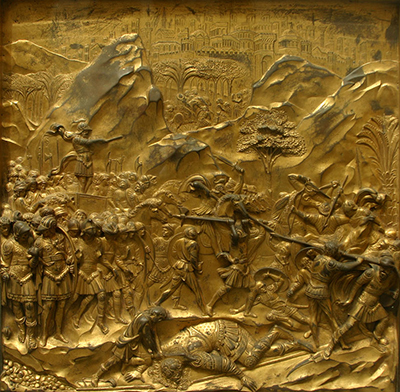
Ghiberti used gold differently across objects. Restoration of the North Doors established selective mercury-amalgam gilding on reliefs against darker bronze ground. The Gates of Paradise employ gilding much more extensively. St Matthew preserves evidence of silver inlay in the eyes and Gospel lettering and traces of leaf gilding on the garment.
These distinctions matter. Mercury-amalgam gilding and leaf gilding are not interchangeable terms, and a technique documented on one sculpture should not be assigned automatically to another. Together, the evidence shows Ghiberti designing with metallic color: gold and silver directed attention, clarified detail and altered the response of sculpture to light.
High, low and very low relief
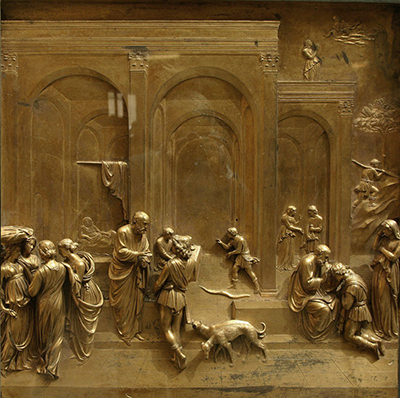
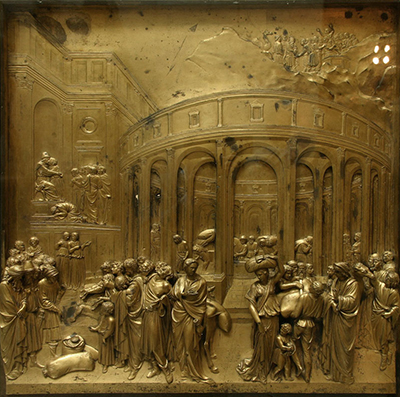
The Gates of Paradise exploit a broad range of projection. Foreground figures may approach high relief; middle-ground bodies are shallower; distant architecture and figures can be traced in extremely low relief. The transition allows a solid bronze surface to suggest deep space.
Relief depth also carries narrative meaning. Strong projection gives physical urgency to foreground encounters, while shallow passages place other episodes at a distance in space or time. Ghiberti's panels often contain several moments from one story, and the modulation of relief helps viewers distinguish them without rigid internal borders.
Architecture and perspective
Ghiberti used receding floors, colonnades, stairs and diminishing scale to organize complex scenes. His interest in optics and spatial representation is also evident in the Commentarii. Yet it is misleading to claim that he simply invented perspective. His work belongs to a wider Florentine investigation of space and draws on ancient, medieval and contemporary visual knowledge.
His distinctive contribution was to make spatial construction serve bronze narrative. Architecture can divide episodes, gather crowds, frame important gestures and establish routes through a panel. Perspective is therefore one tool among composition, relief, light and gesture.
Workshop practice and authorship
Ghiberti's doors were workshop productions directed by a named master. Assistants participated in modelling, casting, cleaning, chasing, gilding and assembly at different times. Michelozzo, Benozzo Gozzoli and Vittorio Ghiberti are documented in phases of the Gates project, but the presence of famous names does not justify speculative attribution of every panel.
Renaissance authorship at this scale meant providing designs, making models, supervising production, solving failures and maintaining a coherent result across years of collaborative work. Recognizing that structure makes Ghiberti's achievement more concrete rather than less individual.
What conservation has revealed
Modern treatment has changed understanding of Ghiberti's surfaces. The North Door restoration recovered original gold obscured by accumulated alteration. Study of the Gates revealed corrosion products beneath the gilding and forced conservators to balance cleaning with preservation of the fragile gold layer. Chemical methods and laser ablation were used selectively according to material condition. [1]
Restoration technique must remain separate from original technique. Lasers and controlled display environments belong to the modern history of preserving the doors, not to Ghiberti's workshop. Their value lies partly in allowing the fifteenth-century casting, chasing and gilding to be studied more accurately.
Discussion
Ghiberti rewards slow looking: relief, gilding, narrative structure, workshop practice and conservation evidence can all change how a work is read.
Join the Conversation
Have an observation about Style and Technique, a source to add, or a comparison that sharpens the reading? Share it below.