 by Tom Gurney
Tom Gurney BSc (Hons) is an art history expert with over 20 years experience
Published on July 10, 2026 / Updated on July 28, 2026
Email: tomgurney1@gmail.com / Phone: +44 7429 011000
Lorenzo Ghiberti's most famous works look inseparable from a single artistic personality, yet they could not have been made by one pair of hands. The North Doors and Gates of Paradise required years of modelling, casting, chasing, gilding and assembly. Documents preserve the names of assistants, apprentices and collaborators, but they do not always tell us exactly what each person designed or executed. Ghiberti's workshop is therefore best understood as an organized production environment whose evidence changes from project to project.
Contents
- Why the doors required a workshop
- Named workers on the North Doors
- Michelozzo and the changing workshop
- Can individual hands be identified?
- Donatello, Uccello and artistic exchange
- Influence and reception
Why the doors required a workshop
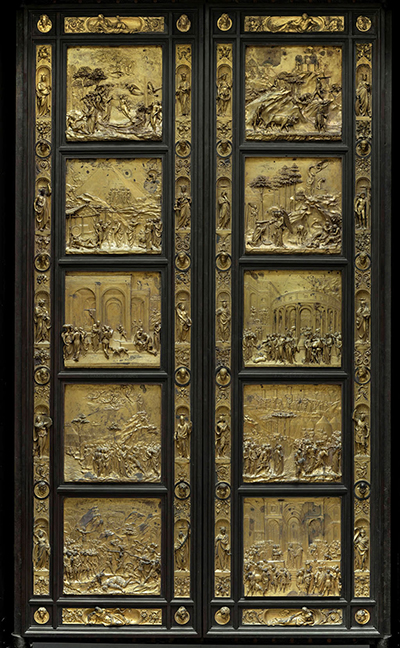
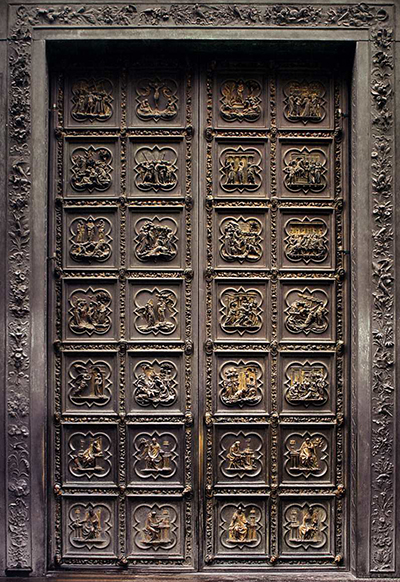
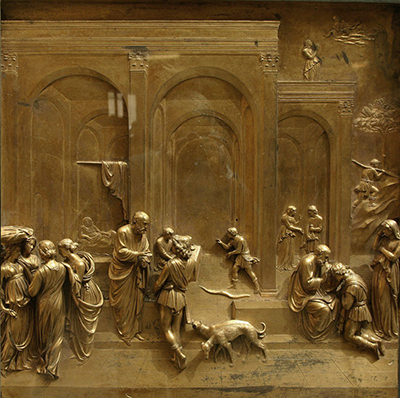
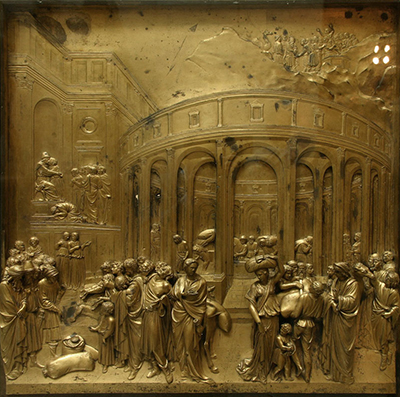
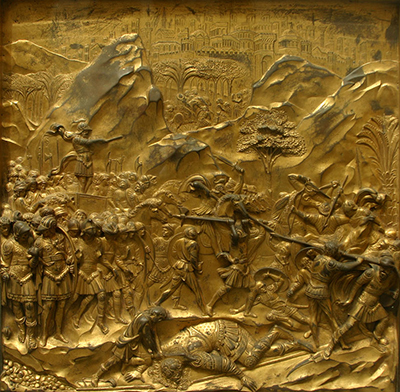
The North Doors contain twenty-eight bronze reliefs within a complex framework of heads, foliage and architectural ornament. Their production extended from the first years of the fifteenth century until 1424. The Gates of Paradise followed from 1425 to 1452, replacing the earlier door's small quatrefoils with ten large narrative fields and an equally ambitious surrounding frame.[4]
Both projects depended on repeated stages. Designs had to be converted into models; wax and moulds prepared; metal cast; surfaces corrected and chased; separate pieces fitted; and selected areas gilded. Ghiberti directed this process and claimed the finished works as his own, but authorship at this scale included planning, supervision and quality control as well as personal modelling.
Named workers on the North Doors
The Italian national catalogue record for the North Doors cites payments made between 1404 and 1407 to a substantial group of assistants. The names include Bandino di Stefano, Giuliano di Ser Andrea, Giovanni di Francesco, Bernardo di Piero Ciuffagni, Michele di Nicolai, Jacopo d'Antonio da Bologna, Domenico di Giovanni and others. A young Donatello also appears in this documentary orbit.[1]
A recorded payment establishes participation, but it does not automatically identify a particular figure or relief as that assistant's independent design. Workshop labour could include modelling secondary elements, preparing moulds, finishing casts or carrying out routine tasks that leave no recognizable individual style. The documents are most valuable when they show the breadth and organization of production without being forced into a modern division of artistic credit.
Paolo Uccello is traditionally associated with Ghiberti's workshop as an apprentice. The national catalogue presents this connection more cautiously than its list of recorded payments. That difference matters: documented employment, later report and scholarly reconstruction are not interchangeable categories.
Michelozzo and the changing workshop
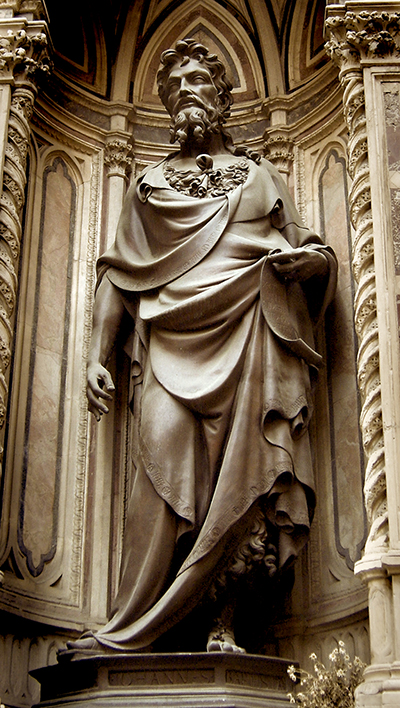
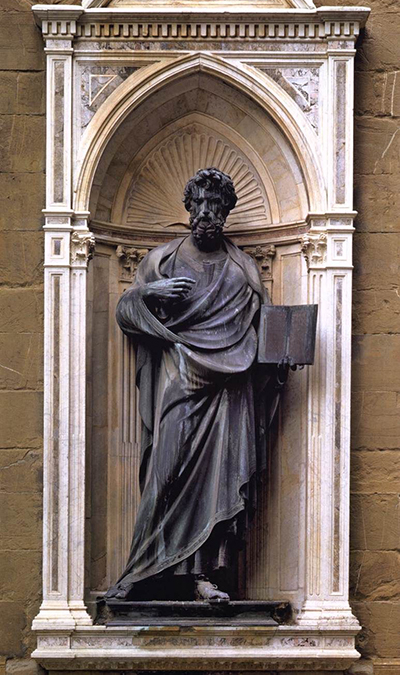
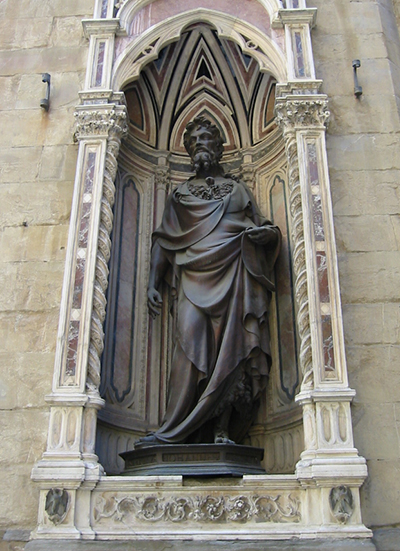
Michelozzo belongs to a later phase of Ghiberti's career. He is connected with work around 1420 and with the St Matthew ensemble at Orsanmichele, although responsibilities for statue and tabernacle need to be kept distinct. The Gates documentation also places Michelozzo within the extended process of cleaning and finishing the cast panels and frame components.
The official Gates catalogue describes Ghiberti, one of his sons and Michelozzo working on the cast stories and decorative pieces. Its attribution history also includes Benozzo Gozzoli and the goldsmith Bernardo Cennini. These records reveal a workshop that was not static. Personnel and responsibilities changed across almost three decades, while Ghiberti and members of his family supplied continuity.[2][3]
Can individual hands be identified?
Art historians have often tried to recognize collaborators in particular panels. Such proposals can be useful when supported by documents, technical evidence and careful comparison, but they remain different from a signed or fully documented attribution. A figure that resembles Benozzo Gozzoli's painted work does not by itself prove that he designed it; a payment to an assistant does not specify the part that survives.
The safest account therefore moves through levels of confidence. Ghiberti's authorship and direction are secure. Some assistants are documented in the workshop. Other connections are supported by catalogue attribution or later scholarship. The precise distribution of modelling and finishing within many individual components remains uncertain.
Donatello, Uccello and artistic exchange
The workshop placed younger artists close to an unusually demanding combination of drawing, relief, casting and surface finish. Donatello's documented presence is significant, but his mature sculpture should not be described simply as an outgrowth of Ghiberti's manner. The two artists developed sharply different approaches while working within the same Florentine world of guild patronage, ancient sculpture and public bronze.
Uccello's relationship is similarly better understood as exposure than as a simple chain of influence. The Gates made spatial construction, repeated figures and continuous narrative into practical workshop problems. Those concerns also mattered deeply to painters, but shared interests do not prove that every later experiment came directly from Ghiberti.
Influence and reception
Ghiberti's influence operated through several routes. Assistants carried workshop experience into other projects. The completed doors offered later artists a permanent demonstration of shallow relief, pictorial space and densely coordinated narrative. Casts, engravings and photographs subsequently carried their designs beyond Florence.
Reception must remain separate from direct workshop influence. Vasari's praise and the tradition that Michelangelo called the eastern doors worthy of Paradise show the Gates' later status. They do not document Michelangelo as Ghiberti's pupil, nor do they explain the fifteenth-century production process.
Ghiberti's workshop matters precisely because it resists a choice between solitary genius and anonymous manufacture. The surviving evidence shows sustained artistic direction supported by many forms of skilled labour. Recognizing that structure makes the doors more—not less—remarkable: their visual coherence was achieved across decades, materials and changing groups of workers.
Discussion
Ghiberti rewards slow looking: relief, gilding, narrative structure, workshop practice and conservation evidence can all change how a work is read.
Join the Conversation
Have an observation about Workshop Influence, a source to add, or a comparison that sharpens the reading? Share it below.
References
- Italian national catalogue, North Doors (in Italian)
- Italian national catalogue, Gates of Paradise (in Italian)
- Opera del Duomo, Gates of Paradise
- Metropolitan Museum of Art, The Gates of Paradise