 by Tom Gurney
Tom Gurney BSc (Hons) is an art history expert with over 20 years experience
Published on July 10, 2026 / Updated on July 28, 2026
Email: tomgurney1@gmail.com / Phone: +44 7429 011000
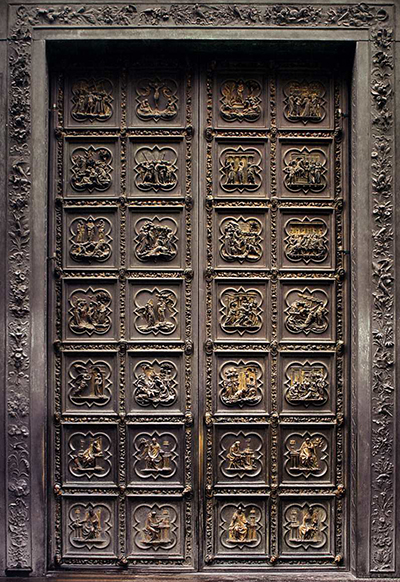
The Florence Baptistery's three monumental bronze doorways were produced in separate campaigns over more than a century. Andrea Pisano made the earliest surviving doors in the fourteenth century. Lorenzo Ghiberti created the other two sets: the twenty-eight-panel doors now associated with the north portal and the ten-panel Gates of Paradise associated with the east. Their present arrangement is the result of historical movement, and the originals are now conserved in the Museo dell'Opera del Duomo while replicas stand outside. [1]
Contents
- The three campaigns at a glance
- Why the doors moved
- Format and narrative
- Bronze and gold
- Originals and replicas today
- What the three doors reveal
The three campaigns at a glance
Andrea Pisano's doors, 1329–1336
Andrea Pisano's doors established the repeated format later inherited by Ghiberti: twenty-eight reliefs set within quatrefoils and surrounded by ornamental framing. Their principal cycle concerns St John the Baptist, patron saint of Florence and dedicatee of the Baptistery. Originally installed on the east, they later moved to the south portal.
Ghiberti's first doors, 1403–1424
Commissioned after the 1401 competition, Ghiberti's first doors use twenty-eight quatrefoils. Twenty narrate the life of Christ, while eight represent the Evangelists and Doctors of the Church. Installed first on the east, they moved to the north when Ghiberti's later doors were completed in 1452. [2]
Gates of Paradise, 1425–1452
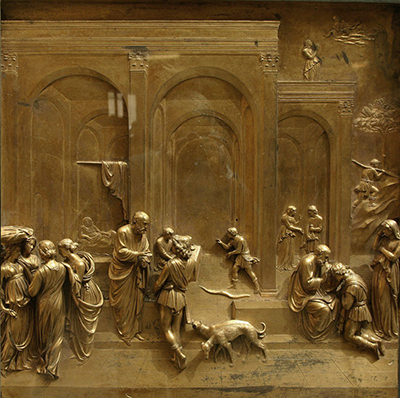
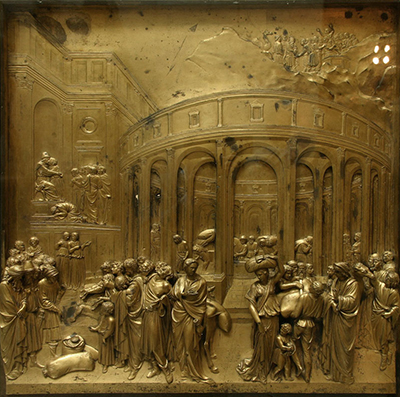
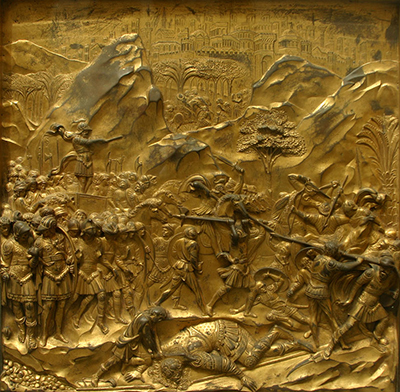
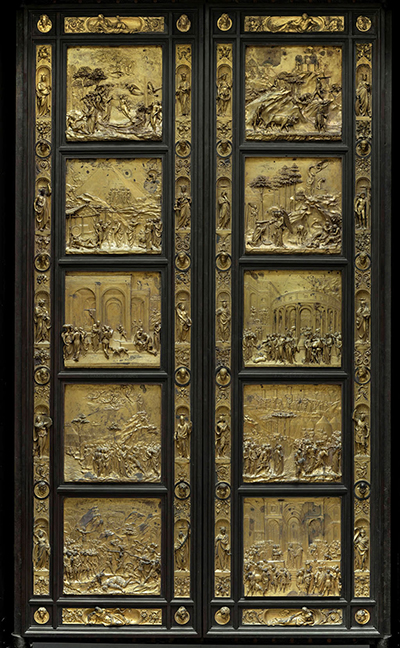
Ghiberti's second doors replace the repeated quatrefoil with ten large rectangular panels illustrating Old Testament narratives. Their scale permits multiple episodes to unfold within continuous landscapes and architectural settings. They were installed at the eastern entrance facing the cathedral. [3]
Why the doors moved
The portal names can obscure the chronology. Ghiberti's “North Doors” were not originally made for the north side. They occupied the prestigious eastern entrance after completion in 1424. When the Gates of Paradise were installed there in 1452, the earlier doors moved north. Andrea Pisano's doors had already moved from east to south.
These changes created a visual hierarchy. The newest and most ambitious commission occupied the entrance facing Florence Cathedral. The older doors remained essential parts of the Baptistery but were reassigned as the programme expanded.
Format and narrative
Andrea Pisano and Ghiberti's first doors share the twenty-eight-panel quatrefoil system. The repeated frames make the doorway read as a patterned grid while separating individual scenes. Ghiberti's later Gates reorganize the surface into ten broad narrative fields.
The difference affects storytelling. A quatrefoil generally concentrates attention on a single episode and a limited group of figures. A Gates panel can combine events separated in time, using paths, buildings, relief depth and changes of scale to connect them. The later system offers greater spatial freedom, although it also required careful control to prevent complex narratives from becoming confused.
Bronze and gold
All three campaigns depend on casting, chasing and extensive post-casting work, but their surfaces should not be described as identical. Restoration of Ghiberti's first doors revealed selective mercury-amalgam gilding on reliefs against dark bronze. The Gates of Paradise use gold more extensively across their narrative panels and frame.
The modern conservation histories also differ. The Gates underwent decades of investigation and treatment after damage and long concern over corrosion beneath the gold. The North Doors were treated in 2013–2015, revealing important evidence of their original gilding. Andrea Pisano's doors underwent their own later campaign. Similar techniques, including laser cleaning, may appear across projects, but conservators adapted treatment to each object's materials and condition.
Originals and replicas today
Visitors to the Baptistery encounter replicas on the exterior. The original doors are displayed in the Museo dell'Opera del Duomo's Sala del Paradiso, where the three campaigns can be studied together under controlled conditions. This arrangement protects vulnerable historic bronze and gilding while preserving the exterior's architectural appearance.
The museum setting changes the encounter. Outdoors, the doors belong to portals, ritual movement and the relationship between Baptistery and cathedral. Indoors, viewers can compare panels and surfaces closely. Understanding both settings is essential: the copies preserve location, while the originals preserve material history.
What the three doors reveal
Taken together, the doors show continuity as well as change. Ghiberti did not begin from nothing in 1403; he responded to Andrea Pisano's structure, material and civic importance. His first doors demonstrate sustained invention within that inherited system. The Gates of Paradise then transform the format without abandoning the hard-won knowledge of bronze production and narrative relief accumulated during the earlier commission.
The ensemble is therefore more useful than a simple progression from medieval to Renaissance style. It records how Florentine patrons, workshops and sculptors repeatedly rethought a single building across generations.
Discussion
Ghiberti rewards slow looking: relief, gilding, narrative structure, workshop practice and conservation evidence can all change how a work is read.
Join the Conversation
Have an observation about Baptistery Doors, a source to add, or a comparison that sharpens the reading? Share it below.
References
- Opera di Santa Maria del Fiore, Baptistery.
- Opera di Santa Maria del Fiore, North Door.
- Opera di Santa Maria del Fiore, Gates of Paradise.