


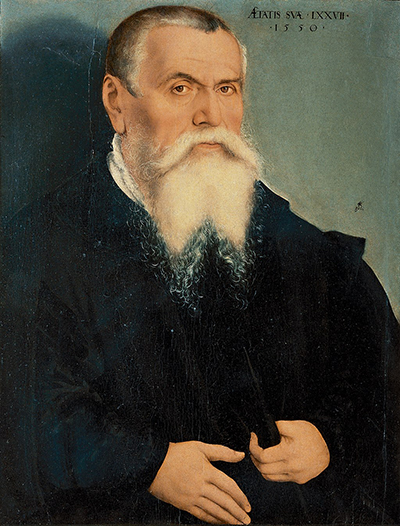
 by Tom Gurney
Tom Gurney BSc (Hons) is an art history expert with over 20 years experience
Published on June 19, 2020 / Updated on November 5, 2026
Email: tomgurney1@gmail.com / Phone: +44 7429 011000
Lucas Cranach’s Engravings
A woman rests with a child among deer, trees and sharply fractured rocks. Farther back, a small naked figure crawls through the landscape. In Lucas Cranach the Elder’s The Penance of St. John Chrysostom, dated 1509, the saint named in the title takes a moment to find. The intricate world around him commands our attention first. This engraving offers a particularly rewarding introduction to Cranach’s work on metal: a picture in which fine lines can describe a blade of grass, soften a face and make a forest seem almost inexhaustible. [1]
Engraving occupies a small, distinct place within Cranach’s printmaking. [10] His engraved portraits and religious subjects deserve to be looked at together, while preserving the difference between their metal plates and the woodblocks used for his woodcuts. Moving between the woodland of the Penance, the richly clothed Frederick the Wise and the young Martin Luther, we encounter several different purposes for a printed image: telling a story, presenting a ruler and bringing a religious figure’s likeness close to the viewer. [1] [2] [3]
At a Glance
Contents
How the engraved line works
An engraving begins with a polished metal plate. The artist pushes a burin, a sharp steel tool, through the surface to cut grooves. Ink is worked over the plate and the excess wiped away, leaving ink in the recessed marks. Under pressure, dampened paper takes that ink and receives the design in reverse. The plate’s outer edge can also leave an indentation in the paper, known as the plate mark. This is an intaglio process: its printing marks lie below the surface. [4]
The burin demands controlled pressure. A change in pressure or tool size changes the width of the cut, and therefore the line that appears on paper. Lines placed close together produce darker areas; crossing one set over another deepens the shade. Dots and short dashes extend the range. A face and a dark sleeve can consequently emerge from the same black ink, with differences in light and texture created through the organisation of marks. [4]
Wendy Thompson’s history of engraving for the Metropolitan Museum of Art places the medium within a tradition shaped by Martin Schongauer and Albrecht Dürer. Her account explains how varied strokes could produce form, surface and shadow together. That combination is useful to keep in mind when looking at Cranach. A patch of fur asks for a different rhythm from a cheek or a ribbon, even though each belongs to the same little field of engraved metal. [5]
Explore selected engravings
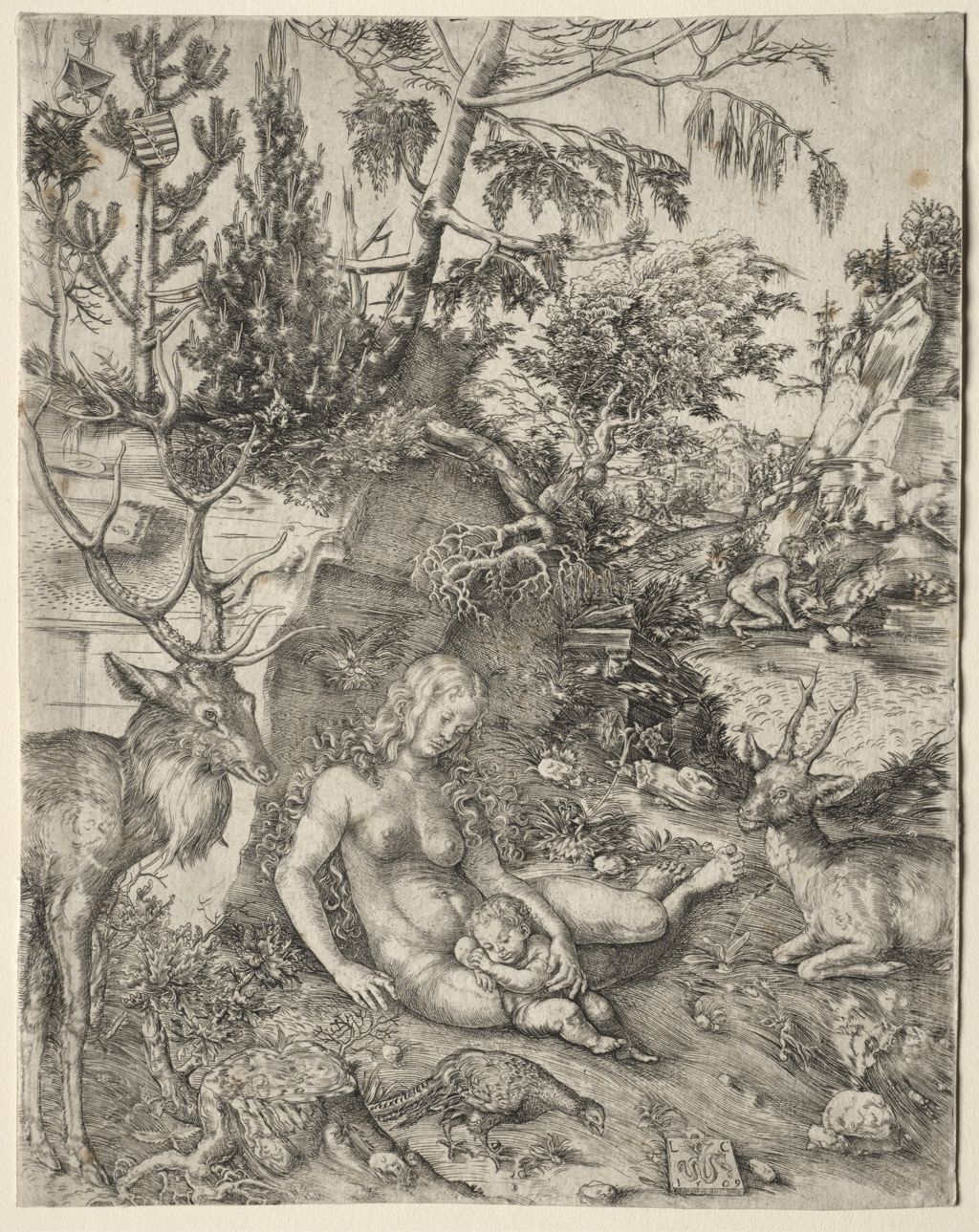
The Penance of St. John Chrysostom
The Penance of St. John Chrysostom, 1509. 1928.770. Cleveland Museum of Art, CC0
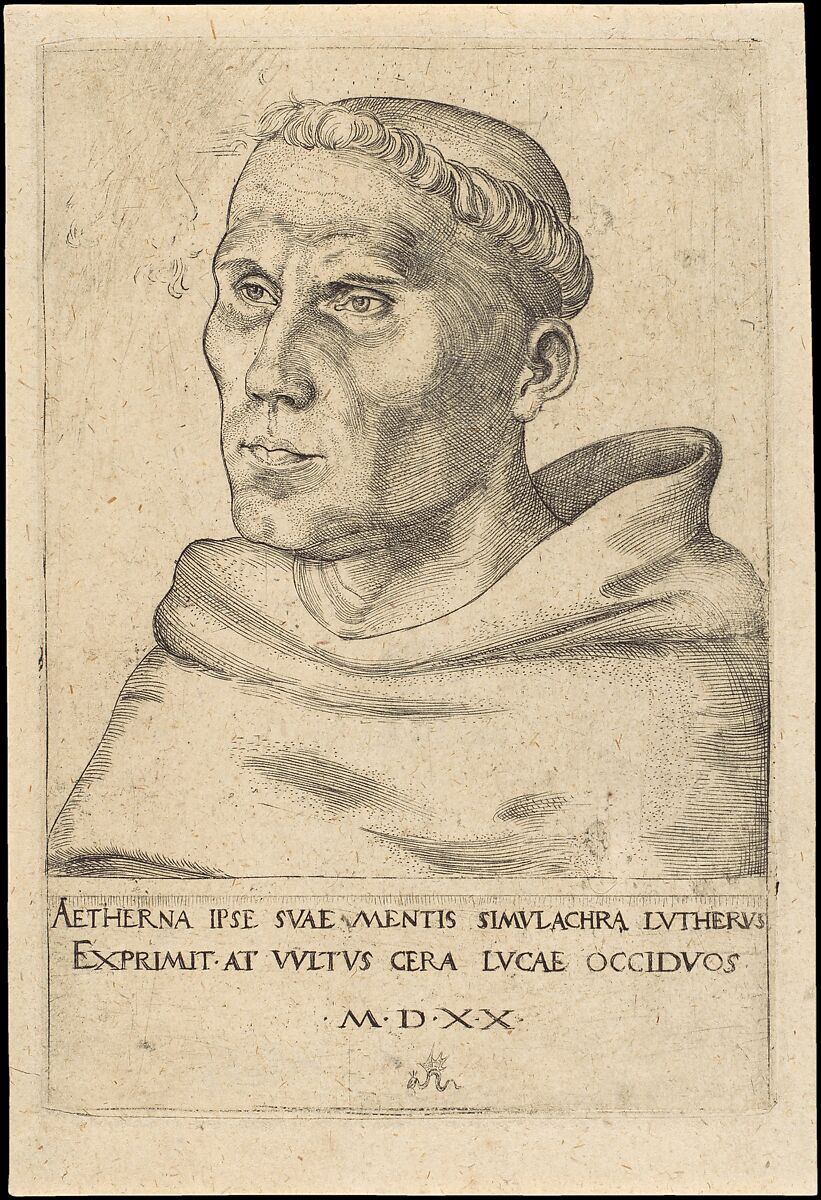
Martin Luther as an Augustinian Monk
Martin Luther as an Augustinian Monk, 1520. 20.64.21. The Metropolitan Museum of Art, public domain
Finding the saint in the forest
Cleveland’s impression of The Penance of St. John Chrysostom measures 25.4 by 20.2 centimetres. Seen at that intimate scale, its accumulation of detail becomes more remarkable. The mother and child occupy the lower centre, sheltered by the dark rock behind them. The child leans into the woman’s arm, and the bright, gently modelled flesh gives the pair a quiet prominence against the busier landscape. [1]
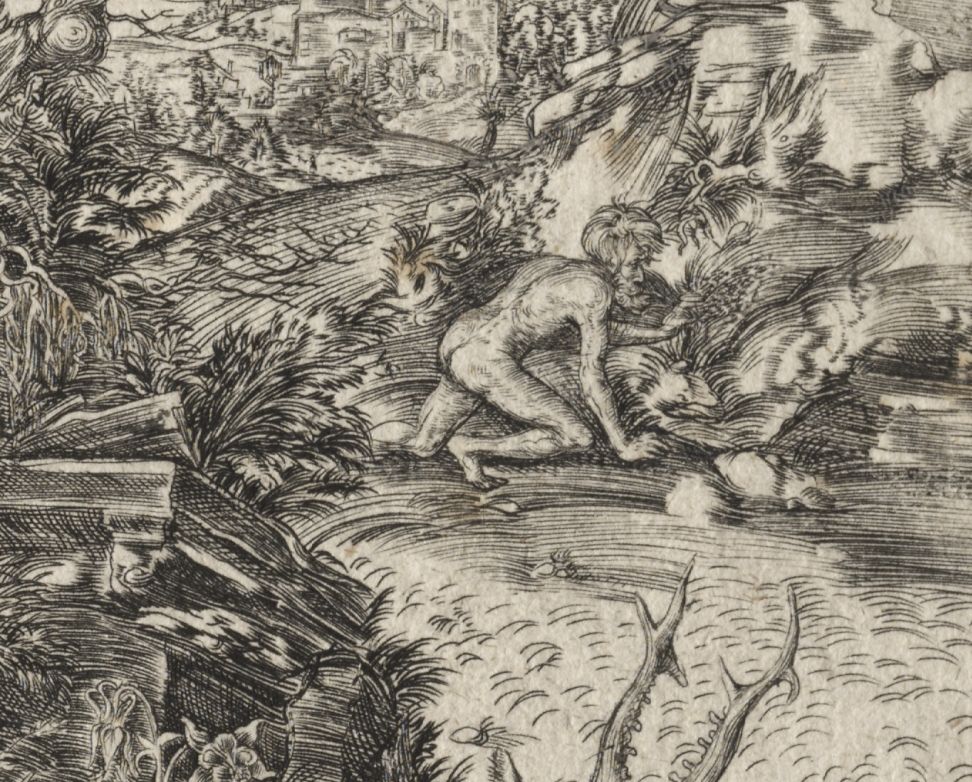
The story belongs to a legend about Chrysostom, rather than a reliable account of the historical saint’s life. Museum Boijmans Van Beuningen explains that a woman sheltered in the hermit’s cave, that he succumbed to temptation and subsequently tried to kill her. His penance was to live like an animal, moving on all fours. Cranach places that crawling figure in the right background, away from the woman who survives at the centre of the picture. [6]
This separation makes the viewer work backwards through the story. We first meet a mother holding her child; only later do we notice the man whose wrongdoing explains the title. His small scale makes him seem absorbed into the wilderness. The scene’s stillness is therefore uneasy. The woman’s gentle contact with the infant and the watchful animals coexist with a narrative of harm and repentance. [1] [6]
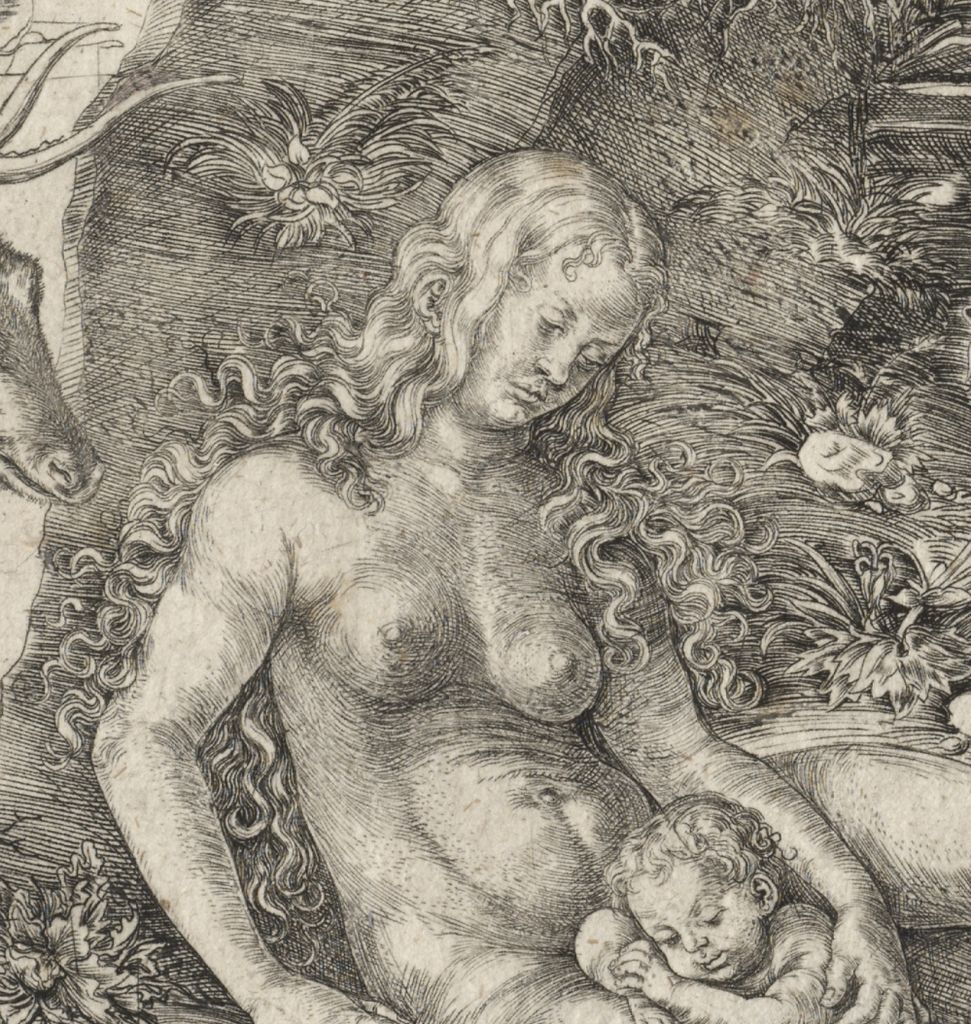
Look at the forest before trying to assign a meaning to every creature. The stag’s branching antlers answer the branching trees overhead. Tufts of leaves break into tiny, repeated strokes, while the rock behind the woman gathers much denser hatching. Her long curls create another kind of flowing pattern. Cranach differentiates these surfaces without colour: the print remains legible because its marks change direction, spacing and character as they move from one material to another. [1]
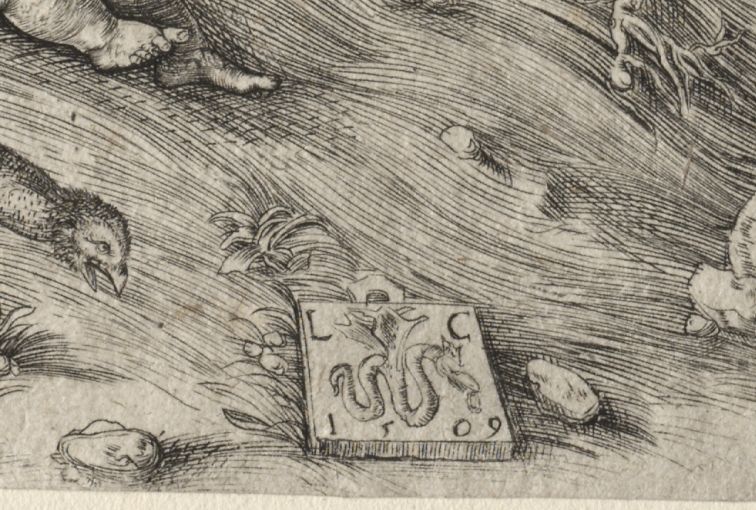
There are quieter discoveries near the edges. A bird pecks in the foreground, and a tablet bearing the date and Cranach’s identifying marks sits close to the lower boundary. Above, two shields hang from branches. The Louvre’s record of another impression specifically notes these shields and the signed, dated tablet. These small, deliberately placed details frame a landscape that can initially seem to have grown without restraint. [7]
Annotated Details from The Penance of St. John Chrysostom
Find the small crawling saint, compare the foreground figure with the shaded rock, and finish with the dated tablet near the lower edge.
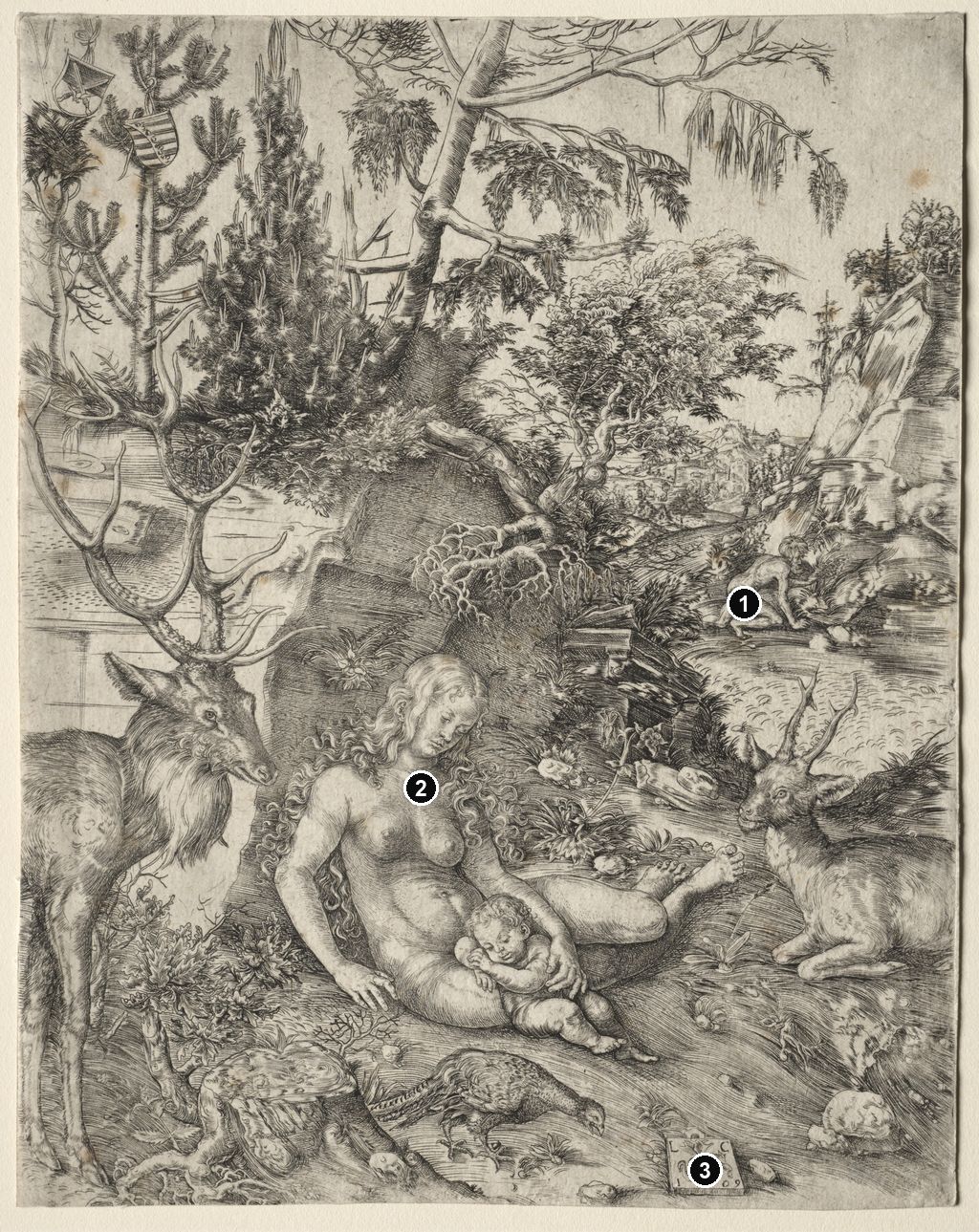
Details from THE PENANCE OF ST. JOHN CHRYSOSTOM
Cleveland Museum of Art, Gift of Leonard C. Hanna Jr., 1928.770. CC0 Open Access image. Overview annotated and details cropped and resized from the unchanged museum master.
Finding the distant saint
The small figure crawls across the middle distance, among rock and low vegetation. Discovering him changes the relationship between the foreground and the subject named in the title. [1][6]
Pale skin against shaded rock
The face and body remain relatively pale while close lines darken the rock behind them. Curving strands of hair create another texture between the two surfaces.
Frederick the Wise: likeness and devotion
Frederick’s presence connects the engravings with the Saxon court. Cleveland curator Jane Glaubinger describes how the elector encouraged Cranach’s printmaking and how printed images helped advertise his patronage. He also granted the artist the winged-serpent coat of arms in 1508. The emblem that appears within the prints thus has a history linking Cranach’s professional identity with princely support. [10]
Cranach’s engraving Frederick the Wise of Saxony, dated 1509 by the Met, concentrates the viewer’s attention differently. The elector stands behind a ledge, one hand resting over it, with a fur collar spreading across his shoulders. The arch around him contains the figure without crowding the face. Shields occupy the upper corners, and a little tablet below carries the date and the winged serpent. [2]
The textures offer a compact demonstration of Cranach’s engraved vocabulary. Fur is described with short, irregular strokes; the sleeves have large, curling folds; the chest is covered by a precise ornamental pattern. The sitter’s eyes and mouth remain comparatively restrained. These changes in handling make the richly dressed body substantial while keeping the face available for scrutiny. Looking slowly, we shift between the public signs of rank and the particular person wearing them. [2]
Another engraving presents Frederick inside a religious encounter. The Met dates Frederick the Wise of Saxony Adoring St Bartholomew to about 1508–9. Frederick appears in the lower right, holding an open book and looking upward. Above him the saint occupies a radiant space, surrounded by angels and rolling clouds. A suspended skin at the left makes the image’s devotional subject unsettlingly physical. [8]
Here the lines pull in many directions. Clouds curl around the figures, wings spread into the narrow gaps, and the saint’s halo forms a concentrated burst of straight rays. Frederick’s face is set within this movement but remains clearly distinguishable. The engraving shows how a portrait could participate in a larger devotional image. Recognition of an individual and the visual presentation of religious allegiance could share a single sheet. [8]
Cardinal Albrecht in black and white
The Met’s Cardinal Albrecht of Brandenburg, dated 1520, is a smaller sheet, measuring 16.9 by 11.5 centimetres. The cardinal faces slightly to the viewer’s right, wearing a broad cap and a buttoned robe. A coat of arms occupies the upper left, while closely packed lettering fills the upper right. An inscribed band beneath the portrait establishes another firm horizontal boundary. [9]
Within this orderly framework, Cranach gives the face a softer range of tones. The cheeks and chin are rounded through fine marks and small gradations, while the eyes hold their sharper outlines. Along the cap, repeated lines follow the curving surface. Behind the shoulders a dense field of almost horizontal strokes makes the paler face stand forward. The robe’s buttons introduce a measured sequence down the chest. [9]
The composition rewards comparison with Frederick’s portrait. Frederick’s fur and elaborate sleeves create a lavish surface; Albrecht’s head sits among heraldry, lettering and quieter expanses of cloth. Each image gives the sitter a recognisable presence within an arrangement of identifying signs. Engraving’s fine line can serve both tasks, rendering small letters and emblems with precision while allowing a face to retain softness and variation. [2] [9]
Luther’s face and the life of an image
In Martin Luther as an Augustinian Monk, also dated 1520, the surrounding apparatus is much simpler. Luther’s tonsured head and heavy robe occupy most of the image. His eyes look to the left, and the wide collar folds around his neck. The open background makes the engraved contours particularly clear. Small curved lines describe the cheeks and chin; much broader sweeps explain the robe’s weight. [3]
The Met connects this portrait with the year in which Luther published pamphlets challenging indulgences and papal supremacy, whose printing Cranach supervised. The image therefore belongs to a moment when Luther’s writings and appearance were both reaching an audience. Its Latin inscription, as the museum explains, sets the enduring products of his mind against the mortality of his face, the artist and the paper itself. Beneath it sit the Roman date and Cranach’s serpent emblem. [3]
At the Met’s recorded sheet size of 15.8 by 10.7 centimetres, this is an encounter with a face on a small piece of paper. The scale encourages concentrated looking. A slight change around an eye or the corner of a mouth becomes consequential when the image offers so few distractions. The closely worked surface also gives the viewer something beyond a silhouette: Luther’s face has hollows, planes and a sense of physical presence. [3]
Impressions, alterations and surviving paper
A print’s title and date identify only part of what we are seeing. The metal design and the individual sheet have related histories, and two impressions can preserve differences in printing or alterations to the plate. Luther’s portrait provides a specific example. The Met identifies its impression as the more common second state and explains that a puzzling bearded profile, visible in some early impressions at the upper left, was removed by burnishing. [3]
That removal changes how the background reads. It also gives “state” a practical meaning: the term can identify a stage in the plate’s development. An impression is the particular printed sheet taken from it. Variation in ink density needs to be considered alongside changes to the engraved design, because a darker appearance alone does not necessarily mean that additional lines were cut. The Met’s account of the Luther print discusses both inking and the disappearing profile. [3]
Measurements require similar care. For Frederick’s portrait, the Met records a sheet measuring 17.5 by 12.1 centimetres and a plate measuring 12.5 by 9 centimetres. The broad paper border visible around that impression belongs to the surviving object we encounter today. The separate measurements prevent us from imagining that the whole sheet was occupied by the engraved picture. [2]
The Penance survives in multiple collections, allowing another kind of comparison. Cleveland records equal image and sheet dimensions for its example; the Louvre describes its impression as having no margin. These are observations about particular surviving sheets. They do not establish how every impression originally looked or when each one was printed. A date engraved within a design must be read together with the documentation of the individual object. [1] [7]
Looking closely at Cranach’s engravings
Begin with the lightest area of one of these prints, then follow the marks into shadow. In the Penance, the woman’s body leads towards the darkness of the rock; in Albrecht’s portrait, the face stands against the linear background. Step back and those marks become tone. Move closer and the tone separates into decisions about direction, spacing and pressure. This movement between image and line is one of engraving’s particular pleasures. [1] [9]
Cranach’s engraved works also invite different kinds of attention. The Penance unfolds through discovery across a landscape. Frederick’s portraits connect an individual with dress, heraldry and devotion. Albrecht’s likeness draws face, insignia and inscription into a compact order, while Luther’s image gives greater space to the head and robe. Together, these sheets show how much variety Cranach could draw from a restricted palette of ink, paper and incised metal. [1] [2] [3] [8] [9]
Artworks directory
A selection of documented engravings and woodcuts. Entries identify particular impressions where the source does; repeated subjects do not imply different designs. A dash means that no date is supplied here. This selection does not enumerate Cranach’s paintings or his complete printed output.
| Name | Date | Medium |
|---|---|---|
| The Penance of St. John Chrysostom | 1509 | Engraving |
| Frederick the Wise of Saxony | 1509 | Engraving |
| Frederick the Wise of Saxony Adoring St Bartholomew | about 1508–9 | Engraving |
| Cardinal Albrecht of Brandenburg | 1520 | Engraving |
| Martin Luther as an Augustinian Monk | 1520 | Engraving |
| Adam and Eve in Paradise | 1509 | Woodcut |
| The Passion: Crucifixion | 1509 | Woodcut |
| Saint Christopher | about 1509 | Woodcut |
| The Penance of Saint John Chrysostom (Boijmans impression) | 1509 | Engraving |
| The Penance of Saint John Chrysostom (Louvre impression) | 1509 | Engraving |
| Adam and Eve in Paradise (Met impression) | 1509 | Woodcut |
| Adam and Eve (Heidelberg impression) | after 1509 | Woodcut |
| The Third Tournament | 1509 | Woodcut |
| The Tournament with Lances | 1509 | Woodcut |
| The Resurrection, from The Passion | 1509 | Woodcut |
| Christ before Herod, from The Passion | 1509 | Woodcut |
| Law and Grace (design attributed to Lucas Cranach the Elder) | about 1529 | Woodcut |
| Matthias, from The Martyrdom of the Twelve Apostles | — | Woodcut |
Frequently Asked Questions
Engraving prints ink from grooves cut into a metal plate. [4]
A state records a stage in the plate’s development. The Met’s Luther impression follows the removal of a small bearded profile by burnishing. [3]
Discussion
Follow the marks from light into shade, or compare how a face appears among clothing, symbols and inscriptions.
Reader Insights
Where do individual lines become a continuous area of tone?
How does the surrounding landscape change your reading of the Penance?
Which portrait gives the strongest sense of a particular person?
Join the Conversation
Share a detail, comparison or question about Lucas Cranach’s Engravings below.
References
- Cleveland Museum of Art, The Penance of St. John Chrysostom, Lucas Cranach, 1509, engraving, accession 1928.770, Gift of Leonard C. Hanna Jr. English collection record and public-domain image; image and sheet 25.4 × 20.2 cm. View source.
- The Metropolitan Museum of Art, Frederick the Wise of Saxony, Lucas Cranach the Elder, 1509, engraving, accession 30.12.5, Harris Brisbane Dick Fund, 1930. English collection record and public-domain image; sheet 17.5 × 12.1 cm, plate 12.5 × 9 cm. View source.
- The Metropolitan Museum of Art, Martin Luther as an Augustinian Monk, Lucas Cranach the Elder, 1520, engraving, accession 20.64.21, Gift of Felix M. Warburg, 1920. English curatorial commentary, collection record and public-domain image; sheet 15.8 × 10.7 cm, plate 14.3 × 9.7 cm. View source.
- The Metropolitan Museum of Art, “Engraving,” Materials and Techniques, 21 December 2018. English illustrated technical account of cutting, inking, wiping, printing, hatching and plate marks. View source.
- Wendy Thompson, “The Printed Image in the West: Engraving,” Heilbrunn Timeline of Art History, The Metropolitan Museum of Art, 1 October 2003. English scholarly essay on the medium’s history and systems of line, form and tone. View source.
- Museum Boijmans Van Beuningen, The Penance of Saint John Chrysostom, Lucas Cranach (I), 1509, engraving, accession DN 1149/100 (PK), Gift of Dr A. J. Domela Nieuwenhuis, 1923. English collection record and commentary on the legend and composition. View source.
- Musée du Louvre, Département des Arts graphiques, Collection Edmond de Rothschild, La pénitence de saint Jean Chrisostome (ou Chrysostome), Lucas Cranach the Elder, 1509, inventory 801 LR/Recto. French collection record; signed tablet, shields and marginless impression. View source.
- The Metropolitan Museum of Art, Frederick the Wise of Saxony Adoring St Bartholomew, Lucas Cranach the Elder, about 1508–9, engraving, accession 19.27.1, Gift of Mortimer L. Schiff, 1919. English collection record and public-domain image; sheet 18.4 × 15 cm. View source.
- The Metropolitan Museum of Art, Cardinal Albrecht of Brandenburg, Lucas Cranach the Elder, 1520, engraving, accession 28.97.76, Harris Brisbane Dick Fund, 1928. English collection record and public-domain image; sheet 16.9 × 11.5 cm. View source.
- Jane Glaubinger, Curator of Prints, section on Lucas Cranach in “Acquisition Highlights 2015,” Cleveland Art, March/April 2016, published online 23 February 2016, Cleveland Museum of Art. English curatorial account of Frederick’s sponsorship, the serpent emblem and the differing scale of Cranach’s woodcut and engraved production. View source.


