


 by Tom Gurney
Tom Gurney BSc (Hons) is an art history expert with over 20 years experience
Published on June 19, 2020 / Updated on November 5, 2026
Email: tomgurney1@gmail.com / Phone: +44 7429 011000
Lucas Cranach’s Woodcuts
A forest full of deer, a crush of armoured horsemen, a saint struggling through water: Lucas Cranach the Elder found very different rhythms within the woodcut. Some sheets invite us to wander through tiny details. Others organise a crowded scene around a single, urgent action. His prints could celebrate the Saxon court, accompany religious reading or give visible shape to Reformation teaching. The medium was flexible enough to serve all these purposes, and sufficiently demanding to make their differences matter. [3] [6] [8] [12] [14]
Woodcuts also bring us close to the practical intelligence behind Cranach’s art. A printed line began as a ridge of wood that had to survive cutting and printing. Colour could come from another block; words could appear beside the image. Their physical construction helps make their stories readable. [1] [2]
At a Glance
Contents
How the image came out of the block
Woodcut is a relief process. The cutter removes the areas intended to remain white, leaving the lines and shapes that will take ink standing above the recessed surface. Paper pressed against that surface receives the image in reverse. In an engraving, by contrast, the lines are cut into a metal plate and ink is held in those incisions. Both can produce extraordinarily intricate pictures, but their marks begin in different places: on the raised surface in one case, below the surface in the other. [1] [15]
That distinction helps explain the achievement of Cranach’s busier compositions. Every small white interval between black lines had to be made possible in the block. A pattern of fur, feathers or overlapping lances was therefore a problem of construction as well as drawing. The Met’s account of woodcut describes the preparation and transfer of a design, followed by cutting, inking and printing; it also notes that professional block cutters commonly undertook the carving. An attribution to Cranach should not automatically become a claim that his own hand performed every operation. [1]
The relationship with books was especially useful. Woodblocks and movable type could be printed together because both presented raised surfaces to the paper. Oxford’s History of Science Museum explains why this made woodcut economical for illustrated books and broadsheets. An image could enter a reader’s experience alongside a title, verse or argument, with the arrangement of the page helping to direct its meaning. [2]
Explore selected woodcuts
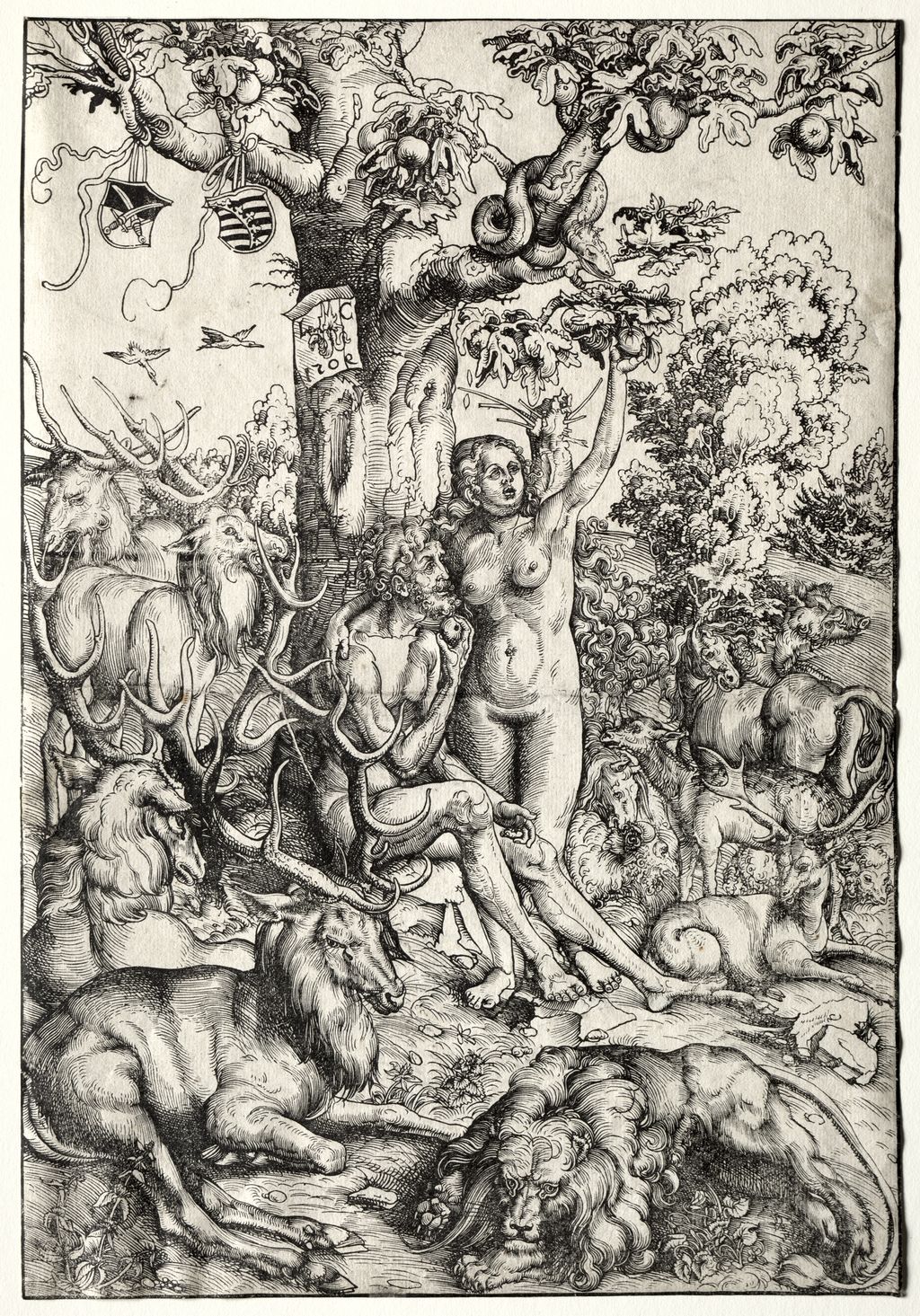
Adam and Eve in Paradise
Adam and Eve in Paradise, 1509. 1925.115. Cleveland Museum of Art, Gift of Ralph King; CC0
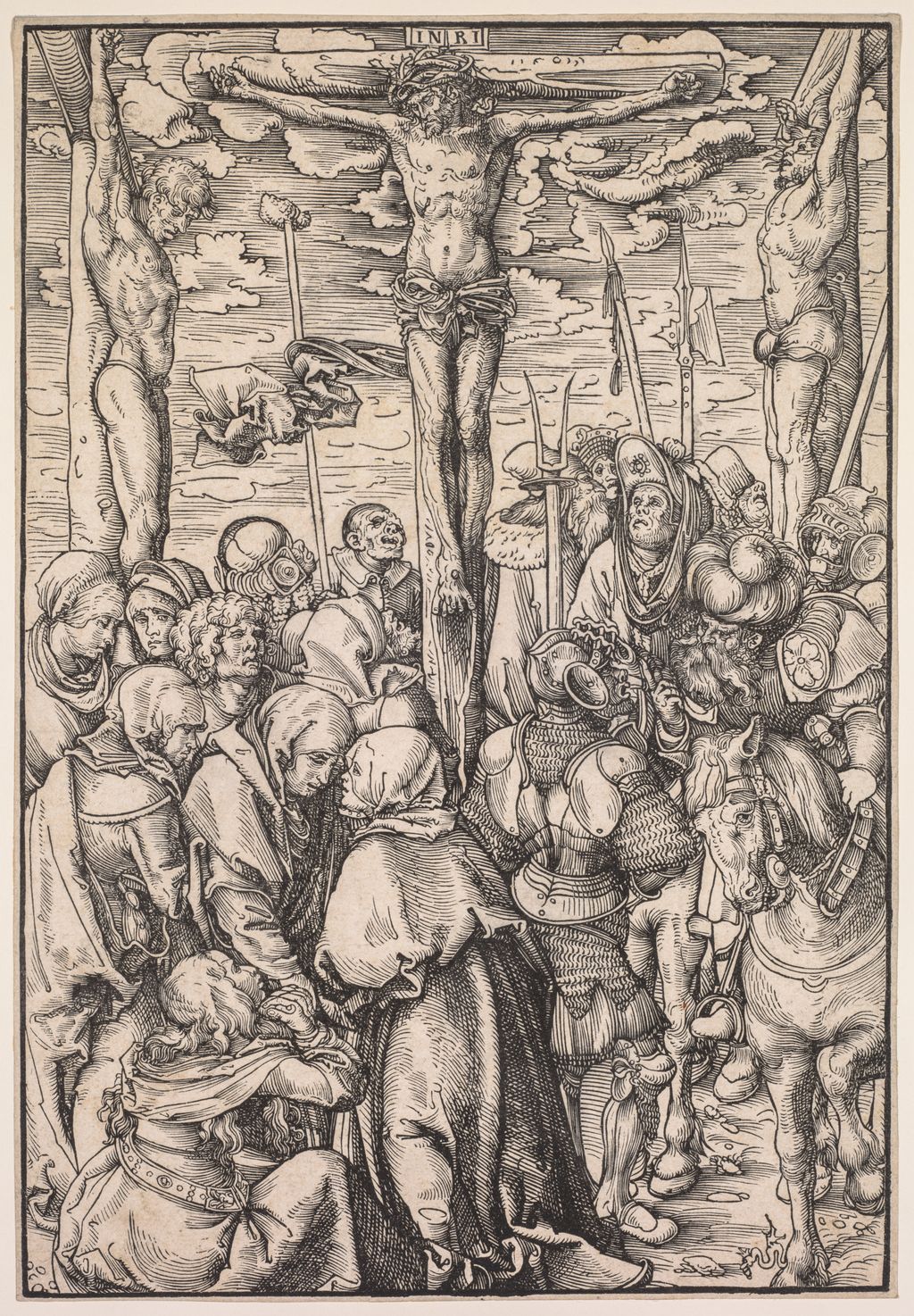
The Passion: Crucifixion
The Passion: Crucifixion, 1509. 1967.26. Cleveland Museum of Art, Delia E. Holden Fund; CC0
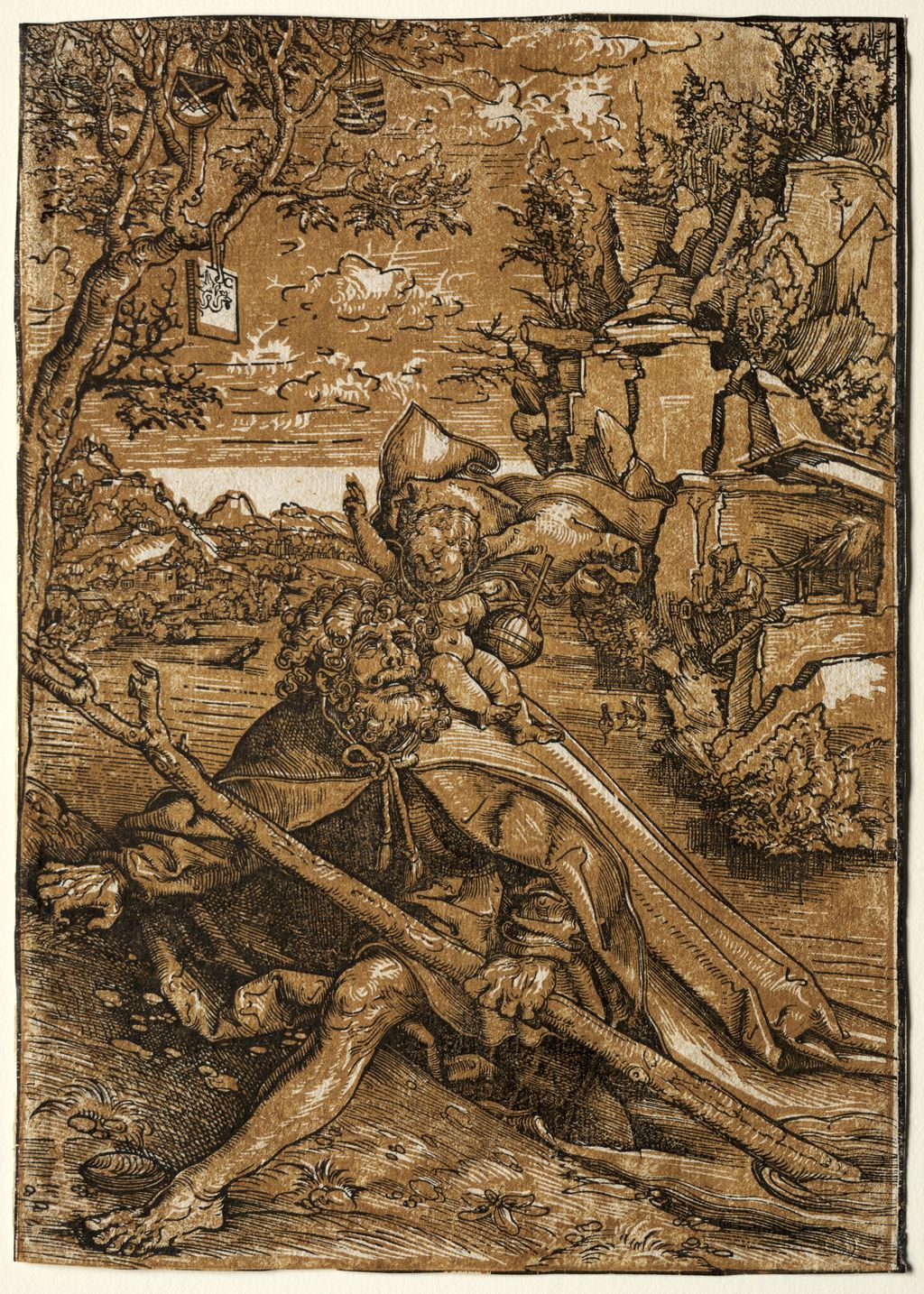
Saint Christopher
Saint Christopher, about 1509. 1941.40. Cleveland Museum of Art, Gift of Mrs. Ralph King; CC0
Eden under the sign of Saxony
In Adam and Eve in Paradise, dated 1509, Cranach fills the landscape around the first couple with animals. Adam sits holding fruit while Eve reaches into the tree. Deer, horses and other creatures share their space, making Eden feel richly inhabited. The Cleveland Museum of Art identifies the shields hanging above them as those of Cranach’s patron, Frederick, Elector of Saxony. Their presence draws a contemporary court into the biblical setting. [3]
Cleveland offers a particularly helpful caution about the animals. Although some have associations with human temperaments, the abundance of stags also suggests a hunting ground. Frederick was an enthusiastic hunter, and the museum proposes that such a landscape might have seemed a paradise to him. This interpretation gives the animals a connection with the patron’s world without requiring every creature to stand for a fixed moral quality. The pleasure of recognising different bodies, antlers and poses remains part of the picture’s appeal. [3]
The print survives in distinct museum impressions. The Met’s example, accession 17.37.66, is catalogued as a woodcut of 1509, with a sheet measuring 33.9 by 24.3 centimetres. Cleveland’s sheet is recorded separately at 33.5 by 23 centimetres. These measurements belong to individual objects; they should travel with those objects when the print is reproduced or discussed. [3] [4]
An especially revealing comparison comes from Heidelberg. The Cranach Digital Archive connects its impression, DE_KMH_S9828, with the work record LC_HVI-10_1, but dates the Heidelberg sheet after 1509 and assigns it to edition b of the only state. The date inscribed in a block and the date at which a particular sheet was printed can therefore differ. A familiar composition may preserve more than one moment in its history. [5]
Annotated Details from Adam and Eve in Paradise
Look from the shields in the tree to the reaching hand and the animals below. The three details follow different uses of the printed line.
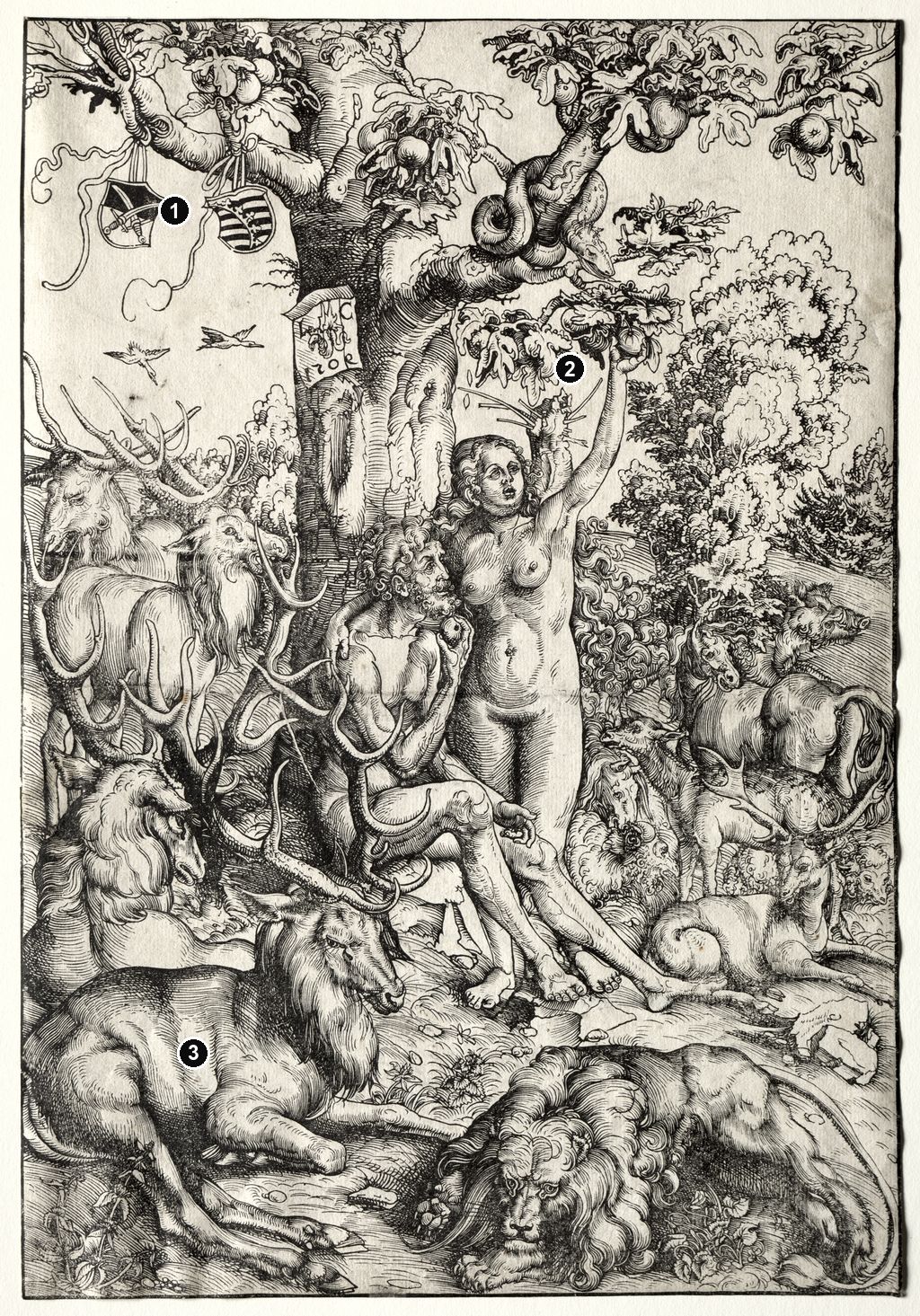
Details from ADAM AND EVE IN PARADISE
Details from Cleveland’s impression, 1925.115. Cleveland Museum of Art, Gift of Ralph King, CC0.
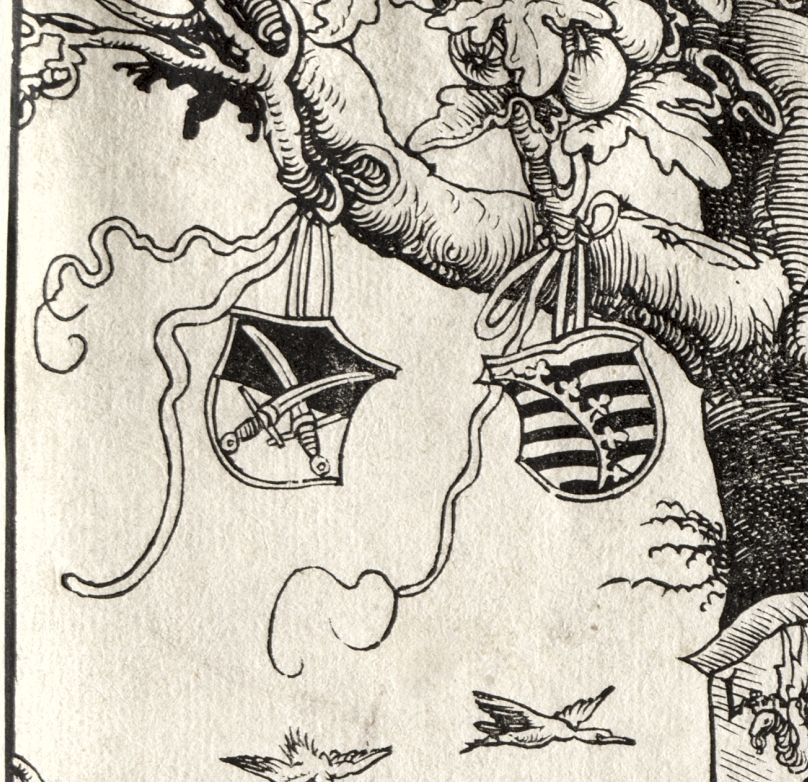
Shields among the branches
Two shields hang above the figures. Their clear outlines interrupt the organic forms of the trunk and leaves; Cleveland connects them with Cranach’s patron, Frederick of Saxony. [3]
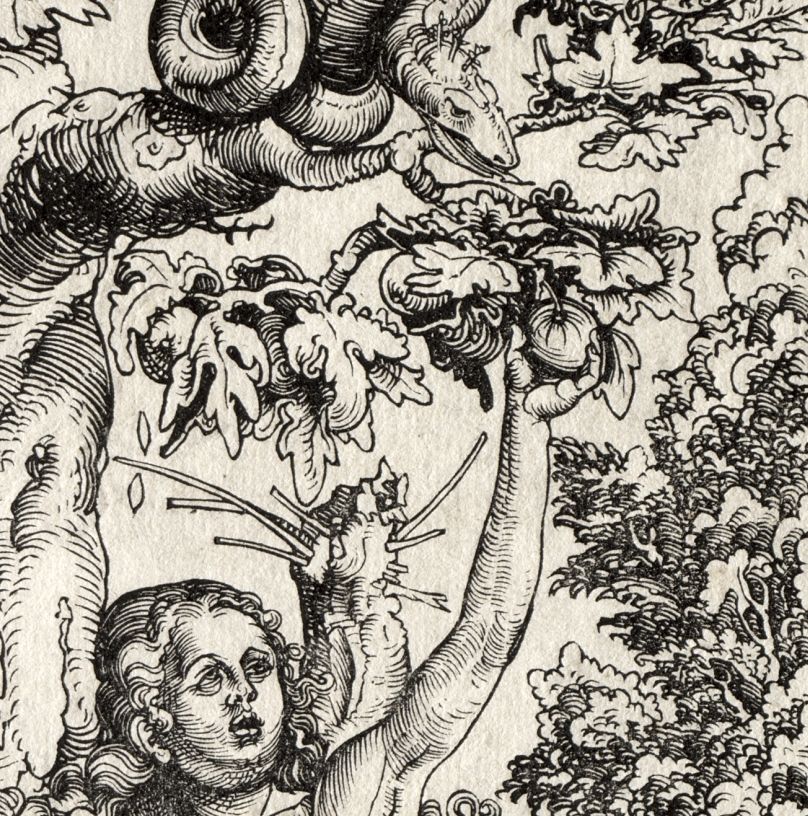
Eve reaches into the tree
Follow the raised hand towards the fruit. Pale intervals separate fingers, leaves and branches, making the action readable within a dense pattern of ink-bearing lines. [1]
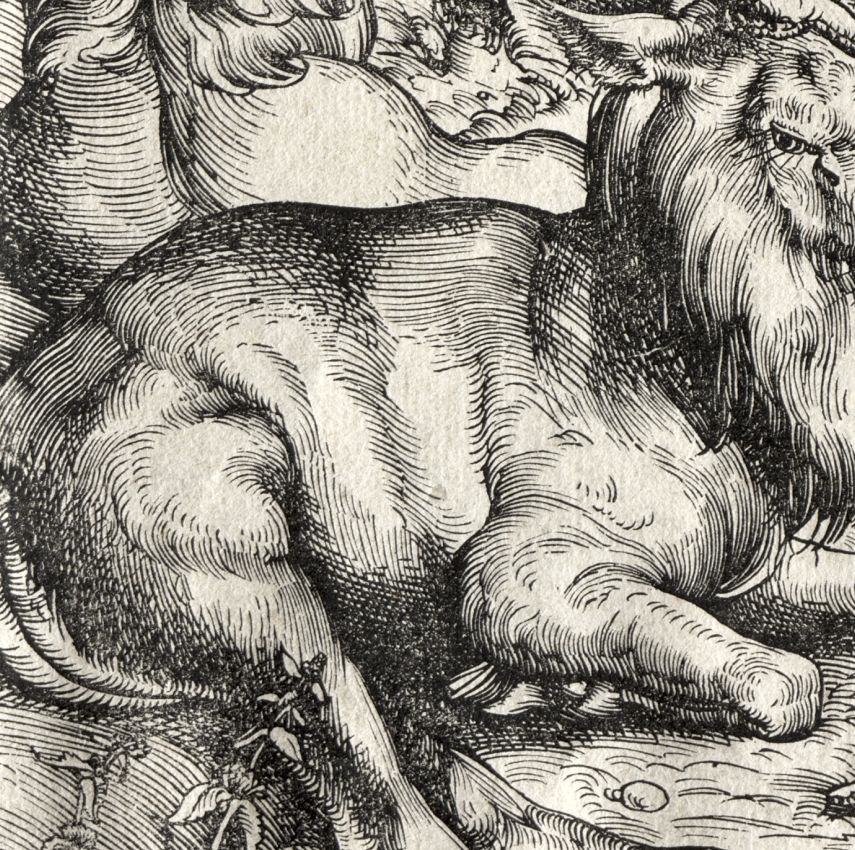
Fur, skin and curved lines
Curving strokes follow the animal’s flank, while shorter marks darken the hollows. Compare this textured coat with the smoother appearance of the human bodies.
The court in motion
The tournament prints replace Eden’s variety with the bustle of a public spectacle. The Third Tournament, dated 1509, shows mounted contestants crowded beneath intersecting lances. The Nelson-Atkins Museum of Art relates it to a series of three woodcuts depicting festive jousts held in Wittenberg in 1508. Frederick’s court supplied an occasion whose visual excitement Cranach could turn into a lasting image. [6]
Follow the diagonals and the apparent confusion begins to organise itself. The lances connect riders across the field, while spectators and buildings establish another level of activity behind them. The Nelson-Atkins label draws attention to a mounted band at the upper left, observers at windows and a grandstand at the right. Plumes and decorated horse trappings reward a slower second look. The gathering is an audience watching an event, and we become another audience watching them. [6]
Cleveland’s Tournament with Lances explains the action as a mêlée, a group encounter between teams, rather than a single pair of opponents meeting across a barrier. Its account helps make sense of the density: the confusion belongs to the subject itself. The sheet’s broad horizontal format accommodates a collective event, quite unlike the upright enclosure of Adam and Eve beneath their tree. [7]
These courtly subjects also gave printmaking a public role in Frederick’s patronage. In her discussion of Cranach for Cleveland’s acquisition highlights, curator Jane Glaubinger describes the prints as advertising the vitality and magnificence of his court. The patron’s heraldry makes that relationship visible, while the winged serpent granted to Cranach in 1508 became the artist’s own identifying emblem. [8]
Religious stories in sequence
The same year, 1509, saw Cranach’s Passion woodcuts. Their subjects place viewers among the people surrounding Christ, from encounters with his judges to the Crucifixion and Resurrection. Individual sheets can be absorbed as complete images, yet their membership of a sequence encourages us to carry an action or emotion forward from one scene to another. [8] [9] [10] [11]
Cleveland’s Crucifixion gathers mourners to the left and armed figures and horsemen to the right beneath the crosses. Dense hatching darkens the scene, while the sky has an agitated pattern of clouds. The composition allows public violence and private grief to occupy the same narrow field. Its contrasting groups give the viewer several ways into the event: through the elevated figure of Christ, through those who mourn him, or through the surrounding crowd. [9]
The Resurrection in Birmingham Museum of Art supplies a securely documented companion from the series, also dated 1509. Its sheet is only 24.9 by 17 centimetres. That modest scale matters when imagining the original encounter: these are pictures whose details invite close attention at reading distance. Birmingham also records the winged-snake emblem in the image, an identifying sign that links the religious sheet with Cranach’s wider production. [10]
The Albertina’s Christ before Herod makes the connection between print and page especially tangible. Its record identifies woodcut together with letterpress and describes a version with a surrounding border. The sheet measures 36.6 by 25.7 centimetres, considerably larger than the recorded image area of 24.5 by 17 centimetres. An inscription below the scene adds another layer of reading. The image was capable of appearing within an expanded printed setting, where border and text changed the viewer’s approach. [11]
Religious narrative extended beyond the Passion. The Met holds Matthias from the Martyrdom of the Twelve Apostles, a woodcut on a sheet measuring 16.2 by 12.6 centimetres. Its place in a named series is a reminder that Cranach’s religious prints also offered connected encounters with individual saints. The museum’s record does not supply a date, so the print’s identity and medium are firmer guides here than an assumed chronology. [16]
Printing light and colour
Cranach’s Saint Christopher brings a different material pleasure. In Cleveland’s chiaroscuro impression, catalogued around 1509, black lines work with a brown tone. Christopher wades through water carrying the Christ Child, with the weight of the child answered by the saint’s muscular body and supporting staff. The pale accents participate in the image’s modelling, helping forms emerge from the surrounding tone. [12]
The colour was printed from a tone block, while the black design came from a line block. Areas left unprinted allowed the paper itself to supply highlights. This is a distinct procedure from adding colour by hand to an already printed sheet. Wendy Thompson’s account for the Met explains the attraction of such prints through their relationship with drawings on coloured paper: a middle tone could be enriched with dark marks and bright accents. [12] [13]
Even the date invites close attention. Although Saint Christopher bears 1506, Cleveland places its making later, probably after 1508. The museum connects that judgement with Cranach’s acquisition of the winged-serpent arms and with his encounter with developments in colour printing. It interprets the early inscribed date as part of a claim to priority. This is an institutional interpretation of the evidence, not a reason to treat every inscribed year as unreliable. [12]
The technical experiment changes how we look. In a black-and-white sheet, a dense accumulation of marks can carry much of the work of shading. A tone block introduces a continuous field against which white and black take on more sharply defined roles. The resulting image belongs to the history of colour printing, while retaining the particular energy of the carved line. [13]
Giving doctrine a visible structure
Law and Grace, associated with Cranach’s circle around 1529–30, shows woodcut serving religious explanation. The Cranach Digital Archive places its undated design near the 1529 painting in Gotha. Its central concern is justification through faith and divine grace: John the Baptist guides the believer towards Christ, and the accompanying printed words help articulate the argument. [14]
Here the viewer is asked to compare conditions of human existence, moving between the demands of the Law and the promise of salvation. The picture gives a complex theological discussion a spatial arrangement. Text and image work together, making the page an instrument for returning to the teaching as well as seeing it once. [14]
The attribution history calls for care. The archive gives Lucas Cranach the Elder as designer under its current assessment, while also recording older attributions to Lucas Cranach the Younger and Hans Cranach. That record of disagreement is useful. The print belongs within the study of Cranach’s woodcuts, but its authorship should retain the qualifications preserved by specialist cataloguing. [14]
Reading the surviving sheet
A woodcut’s history continues beyond its design. The Heidelberg Adam and Eve shows why the terms matter: the archive distinguishes the state of the block from an edition of impressions taken from it. Its after-1509 dating does not turn the image into a different subject or erase the year carved into the design. It identifies another stage in the life of the printed work. [5]
For a first encounter with Cranach’s woodcuts, try comparing the tournament’s crossing lances with the darkened groups below the Crucifixion and the pale highlights of Saint Christopher. Each directs the eye differently. Following those changes makes the material itself part of the pleasure of looking: a carved surface could give shape to a clamorous public gathering, a scene of grief or a body moving through light. [6] [9] [12]
Artworks directory
A selection of documented engravings and woodcuts. Entries identify particular impressions where the source does; repeated subjects do not imply different designs. A dash means that no date is supplied here. This selection does not enumerate Cranach’s paintings or his complete printed output.
| Name | Date | Medium |
|---|---|---|
| The Penance of St. John Chrysostom | 1509 | Engraving |
| Frederick the Wise of Saxony | 1509 | Engraving |
| Frederick the Wise of Saxony Adoring St Bartholomew | about 1508–9 | Engraving |
| Cardinal Albrecht of Brandenburg | 1520 | Engraving |
| Martin Luther as an Augustinian Monk | 1520 | Engraving |
| Adam and Eve in Paradise | 1509 | Woodcut |
| The Passion: Crucifixion | 1509 | Woodcut |
| Saint Christopher | about 1509 | Woodcut |
| The Penance of Saint John Chrysostom (Boijmans impression) | 1509 | Engraving |
| The Penance of Saint John Chrysostom (Louvre impression) | 1509 | Engraving |
| Adam and Eve in Paradise (Met impression) | 1509 | Woodcut |
| Adam and Eve (Heidelberg impression) | after 1509 | Woodcut |
| The Third Tournament | 1509 | Woodcut |
| The Tournament with Lances | 1509 | Woodcut |
| The Resurrection, from The Passion | 1509 | Woodcut |
| Christ before Herod, from The Passion | 1509 | Woodcut |
| Law and Grace (design attributed to Lucas Cranach the Elder) | about 1529 | Woodcut |
| Matthias, from The Martyrdom of the Twelve Apostles | — | Woodcut |
Frequently Asked Questions
Ink is applied to the raised parts of the block and transferred to paper under pressure. [1]
The attribution identifies the artist’s design; professional cutters could carry out the carving. [1]
Discussion
Compare the direction of the marks and the way each scene draws your attention.
Reader Insights
Which details first draw you into the woodland scene?
How does the Crucifixion organise its crowded figures?
What changes when a print uses pale highlights as well as dark lines?
Join the Conversation
Share a detail, comparison or question about Lucas Cranach’s Woodcuts below.
References
- The Metropolitan Museum of Art, “Woodcut,” Materials and Techniques, 21 December 2018. English. Explanation of block preparation, design transfer, professional cutting and relief printing. View source.Splash image: Adam and Eve in Paradise, 1509. 1925.115. Cleveland Museum of Art, Gift of Ralph King; CC0
- History of Science Museum, University of Oxford, “Woodcut,” undated. English. History and technique, including printing woodblocks alongside type. View source.
- Cleveland Museum of Art, “Adam and Eve in Paradise,” 1509, accession 1925.115, Gift of Ralph King. English. Object record and interpretation of animals and Saxon heraldry. View source.
- The Metropolitan Museum of Art, “Adam and Eve in Paradise,” 1509, accession 17.37.66, Gift of Henry Walters, 1917. English. Object record, medium and impression-specific dimensions. View source.
- Cranach Digital Archive, “Adam and Eve,” work LC_HVI-10_1 and Heidelberg impression DE_KMH_S9828, Kurpfälzisches Museum Heidelberg; data credited to Armin Kunz/cda, 2026. English. Work date, only state, edition b and after-1509 impression dating. ; View source 1. View source 2.
- Nelson-Atkins Museum of Art, “The Third Tournament,” 1509, accession 33-1622, Purchase: William Rockhill Nelson Trust. English. Object record and gallery label on the 1508 Wittenberg tournaments. View source.
- Cleveland Museum of Art, “The Tournament with lances,” 1509, accession 1927.204, Dudley P. Allen Fund. English. Object record and explanation of the group mêlée. View source.
- Jane Glaubinger, Cranach discussion in “Acquisition Highlights 2015,” Cleveland Art, March/April 2016, online 23 February 2016. English. Court patronage, winged-serpent emblem and Passion woodcuts. View source.
- Cleveland Museum of Art, “The Passion: Crucifixion,” 1509, accession 1967.26, Delia E. Holden Fund, Hollstein 20. English. Object record and image description. View source.
- Birmingham Museum of Art, “The Resurrection, from the series ‘The Passion’,” 1509, accession AFI.212.2013, Collection of the Art Fund, Inc.; Gift of Roy Curtis Green in memory of Miriam Walker Green and Dr. R. C. Green. English. Object record, dimensions and emblem. View source.
- Albertina, Vienna, “Christus vor Herodes (Passion Christi, 5),” 1509, accession DG1929/146, online record last edited 24 May 2023. German object title, medium, inscription and edition fields within an English interface. View source.
- Cleveland Museum of Art, “Saint Christopher,” c. 1509, accession 1941.40, Gift of Mrs. Ralph King, Hollstein 79. English. Chiaroscuro technique and the museum’s interpretation of the inscribed date. View source.
- Wendy Thompson, “The Printed Image in the West: Woodcut,” Heilbrunn Timeline of Art History, The Metropolitan Museum of Art, October 2003. English. Chiaroscuro woodcuts and their relationship with drawings on coloured paper. View source.
- Cranach Digital Archive, “Law and Grace,” LC_HVI-124_14; interpretation and dating credited to Armin Kunz, 2023. English. About 1529; attribution history, theological programme and printed text. View source.
- Wendy Thompson, “The Printed Image in the West: Engraving,” Heilbrunn Timeline of Art History, The Metropolitan Museum of Art, October 2003. English. Intaglio technique and the ink-bearing incised line. View source.
- The Metropolitan Museum of Art, “Matthias from the Martyrdom of the Twelve Apostles,” undated in the online record, accession 25.22.1, Harris Brisbane Dick Fund, 1925. English. Medium, series identity and dimensions. View source.


