by Tom Gurney
Tom Gurney BSc (Hons) is an art history expert with over 20 years experience
Published on August 12, 2026 / Updated on August 12, 2026
Email: tomgurney1@gmail.com / Phone: +447429011000
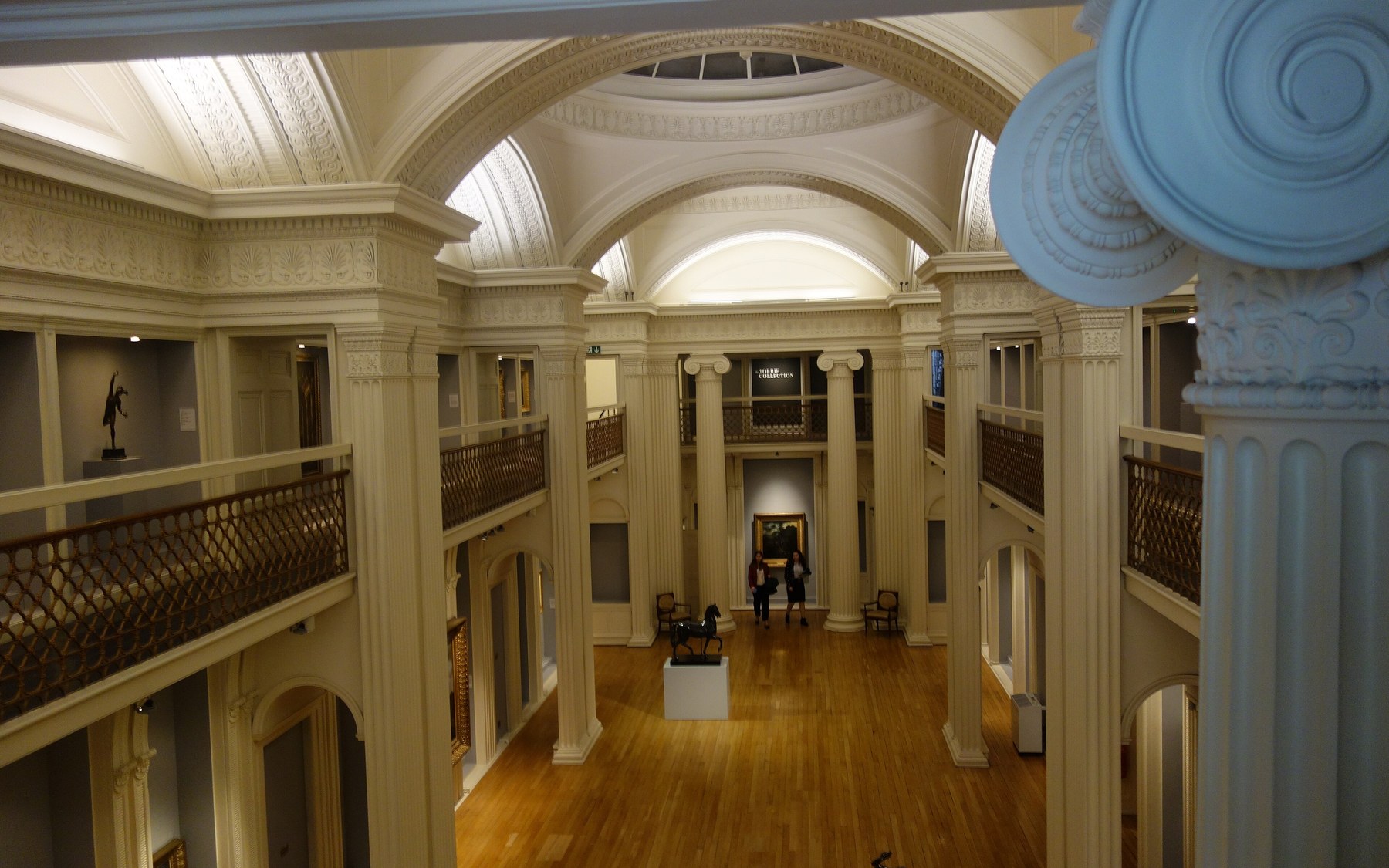
Interior of Talbot Rice Gallery by Vysotsky; CC BY-SA 4.0 via Wikimedia Commons. Cropped for TheHistoryOfArt.org. · Image source
What Talbot Rice Gallery is
Talbot Rice Gallery is the public art gallery of the University of Edinburgh. It is not best understood as a museum with a permanent collection route. Its identity comes from a changing programme of contemporary exhibitions and commissions, shaped by the possibilities of a research university and presented in two markedly different spaces inside Old College. That combination gives the gallery a distinctive role in Edinburgh: it can invite artists to work with academic research, archives and collections while remaining a free public venue in the centre of the city.
The gallery opened in 1975 and has developed a reputation for presenting Scottish and international artists, often through projects made specifically for its architecture or intellectual setting. The official University description calls it a centre for art and ideas. That is a useful phrase if it is taken seriously. The exhibitions are not simply illustrations of university research, and the gallery is not a shop window for academic departments. Its strongest projects allow artists, curators, researchers, students and public audiences to test different ways of making and interpreting knowledge.
For visitors, this means that a trip is led by the current programme rather than by a checklist of famous objects. One season may centre on a large installation; another may bring historic material from University collections into dialogue with contemporary work; a group exhibition may be organised around borders, debt, children’s rights or another public question. It is worth checking what is on before travelling, but the setting and institutional model remain interesting even when the names are unfamiliar.
Old College and two contrasting gallery spaces
Talbot Rice occupies part of the University of Edinburgh’s Old College on South Bridge. The building was designed by Robert Adam in 1789 and completed by William Henry Playfair in 1887, so its present form belongs to more than one architectural moment. The gallery’s historic Georgian Gallery retains ornate features and a high, ceremonial character. Beside it, a contemporary white-cube space offers a plainer environment for installation, film, sculpture and other recent practice.
The contrast is not merely decorative. Contemporary art behaves differently in each room. In the white cube, walls and lighting can be treated as adjustable components of an exhibition. In the Georgian Gallery, the architecture is always present: ceiling, proportions, mouldings and the memory of earlier uses become part of the encounter. Artists may work with that resistance rather than pretend the room is neutral. Moving between the two spaces can therefore feel like moving between different arguments about what a gallery should be.
The Georgian Gallery was formerly part of the University’s Natural History Museum. Talbot Rice notes that Charles Darwin studied there while enrolled as a medical student in Edinburgh in the 1820s. That fact should not turn the gallery into a Darwin attraction, but it does sharpen the building’s history. A room now used for contemporary art once organised specimens and natural knowledge. Recent student research into Old College has also drawn attention to people and histories that traditional institutional narratives left at the margins, including the Guyanan-born taxidermist John Edmonstone and the Edinburgh Seven. The space is therefore both elegant and intellectually uneven: a place where collecting, classification, education and access have changed over time.
Old College also affects the practical visit. Talbot Rice is reached through a historic university building rather than a purpose-built street-front museum. The official visit page gives the current entrance route, access resources and any temporary restrictions. Visitors who use wheelchairs or have mobility requirements should read that page before setting out, because the nineteenth-century levels and live building work can materially affect entry.
David Talbot Rice and the 1975 opening
The gallery is named for David Talbot Rice, who lived from 1903 to 1972 and held the University’s Watson Gordon Chair of Fine Art from 1934 until his death. His scholarship helped transform the study of Byzantine and Islamic art, fields that did not sit comfortably within the narrower Western-European narratives once common in British art history. The University opened the gallery in his honour in 1975, under his successor Giles Henry Robertson.
The name is relevant to more than institutional memory. Talbot Rice believed in the serious study of objects, cultures and histories that had often been treated as peripheral. The present gallery is a contemporary institution rather than a memorial display of his scholarship, but its outward-looking programme and its use of a university’s intellectual resources make the dedication intelligible. The gallery can place different kinds of knowledge in public view, then allow artists to question how that knowledge was produced.
Since 1975, Talbot Rice has worked across contemporary exhibitions, commissions, publications and events. The programme is selective rather than continuous: installation periods can close the galleries between exhibitions, and the number and shape of projects vary. That rhythm is another reason not to describe it like a conventional collection museum. Its history is best read through the exhibitions it has enabled and through the relationships between those exhibitions, the University and Edinburgh’s audiences.
A university gallery as a research partner
Talbot Rice states that solo exhibitions give international artists access to University research and collections, while conceptual group exhibitions foreground political and social questions. The distinction matters. In a solo project, a specific artist may spend time with an archive, a scientific field, a building history or a scholar whose work opens a new direction. In a group exhibition, the gallery can assemble several practices around a contested subject without pretending that art delivers one settled answer.
This research-led model is most convincing when exchange changes the artwork or the exhibition, not when academic language is added afterwards. A commission may require new technical knowledge, recover overlooked material or confront the history of the institution itself. A tour led by an academic can place the work beside another field of thought, but the artist’s form, material and ambiguity remain central. The gallery becomes a meeting point rather than a lecture room.
University collections are part of this ecology, but they should not be confused with a permanent Talbot Rice collection. In 2016, for example, The Torrie Collection brought the University’s founding art collection together in the Georgian Gallery for the first time in more than a decade. The bequest of Sir James Erskine of Torrie includes important Dutch paintings and Renaissance sculpture. Showing it at Talbot Rice made the University’s historic holdings publicly visible and activated the Georgian space, yet it remained a particular exhibition rather than the gallery’s everyday permanent route.
This capacity to move between historic holdings and new commissions gives Talbot Rice unusual range. It can ask how a university acquired and classified objects, how knowledge changes when it is displayed, and how artists can work critically within an institution without becoming its public-relations voice. Visitors do not need specialist knowledge to benefit from that approach, but reading the exhibition guide or joining a tour can make the research relationships clearer.
Programme examples that explain the gallery
A few projects show the range better than a long list of names. John Akomfrah’s Vertigo Sea was presented in 2017 as his first solo exhibition in Scotland. Its multi-screen film brings histories of whaling, migration, environmental damage and the sea into a visually immersive form. In Talbot Rice’s programme it demonstrated how moving-image work can connect historical evidence, political urgency and sensorial experience without collapsing them into a single lesson.
Lucy Skaer’s The Green Man in 2018 used the Georgian Gallery as more than a container. Skaer’s work often reorders images, objects and materials so that their histories become unstable. In a former natural-history museum, that attention to classification and transformation acquired an additional charge. The architecture could be read alongside the works rather than edited out of the encounter.
In 2024, El Anatsui’s Scottish Mission Book Depot Keta extended beyond the galleries to the Old College facade. Talbot Rice described it as the most significant exploration of Anatsui’s practice yet staged in the United Kingdom, spanning five decades and opening with a monumental new work made for the gallery. The title recalled the Scottish mission book depot in Keta, Ghana, where Anatsui obtained school materials as a child. The project connected personal memory, reused industrial materials, Ghana and Scotland, and the colonial histories carried by missionary and educational networks. The building itself became part of the exhibition’s public address.
Other programmes have taken different forms. Group exhibitions such as At the Gates brought feminist and political practices together; Borderlines addressed borders during the Brexit period; and projects involving artists such as Qiu Zhijie, Emeka Ogboh, Céline Condorelli, Alice Neel, Jesse Jones and Wael Shawky show the programme’s international reach. The point is not that every exhibition follows one curatorial formula. It is that Talbot Rice repeatedly uses its scale, spaces and university context to support work that needs more than a neutral sequence of rooms.
The gallery’s projects have also travelled or developed through international partnerships, with the institution citing presentations and collaborations in cities including Adelaide, Bilbao, Dublin, Melbourne, Rennes and Singapore. That reach is significant for a gallery of this physical scale. It suggests that Talbot Rice’s influence depends less on a large permanent collection than on commissioning, curatorial research and relationships that continue beyond Edinburgh.
Students, schools and community engagement
Talbot Rice is part of Edinburgh College of Art, and students are not treated only as an audience arriving after the programme has been decided. The gallery offers introductions, workshops, presentations and encounters with a working contemporary-art institution. Its Trading Zone exhibitions have looked across practices and art forms within Edinburgh College of Art, giving student work a curatorial context rather than reducing the relationship to occasional volunteering.
For students elsewhere in the University, exhibitions can become a springboard for discussion, making and wellbeing. The official programme describes after-hours creative sessions, tours and activities intended for both experienced makers and beginners. This matters because a university gallery can otherwise feel as though it belongs only to art students or researchers. The more useful model allows people from different disciplines to enter through curiosity rather than prior expertise.
The schools programme offers free introductions, tours and workshops for nursery, primary and secondary groups, linked to the current exhibitions and Scotland’s Curriculum for Excellence. Recent projects have used artists’ work to discuss children’s rights, environmental justice, protest, storytelling and imagination. The value lies in responding to the actual exhibition rather than delivering a generic craft activity unrelated to the art around it.
Community work extends to charities, local groups and longer partnerships. Talbot Rice describes projects with schools, families, community organisations and local prisons, supported by tours, creative workshops and collaborative activity. Its public programme includes artist talks, panel discussions, curator and academic tours, performances, family sessions, British Sign Language tours and sensory-friendly or quiet periods. Not every format accompanies every exhibition, so visitors should consult the current programme, but the breadth indicates that interpretation is treated as part of the gallery’s work rather than an optional add-on.
How to approach a visit
Start by checking whether the gallery is open between installations and what kind of exhibition is occupying each space. Because admission is normally free, it can fit into a wider Old Town day, but it deserves more than a rushed architectural look. Read the introductory panel, notice which parts of the building the artist has chosen to use, and give moving-image or sound work enough time to establish its rhythm.
If both the white-cube and Georgian spaces are open, compare them. Ask what the historic room contributes that a neutral gallery could not, and whether the contemporary space allows a different kind of concentration. Where University research or collections inform the project, look for the point at which evidence becomes artistic material. The best question is not simply “what is the research?” but “what has the artist done with it?”
Talbot Rice sits in Old College on South Bridge, within walking distance of Edinburgh Waverley station and the Royal Mile. That makes it easy to combine with the Old College quadrangle or one other nearby cultural stop. Avoid building a tight schedule around it without checking exhibition dates, however, because the gallery closes for installation and its hours can change during festival periods.
Access and visitor information
The official visit page should be the final authority for opening times, admission, access and temporary building conditions. As checked on 12 August 2026, the gallery reported that its main lift was out of service during replacement work and asked wheelchair users to arrange access in advance, with some dates affected by wider Old College construction. That is a material caveat, not a minor footnote. Anyone who needs step-free access should contact the gallery and read the latest notice before travelling.
Talbot Rice also provides a visual storyboard, sensory map, large-print exhibition guides and a British Sign Language welcome video. Portable seating and a wheelchair may be available on request, assistance animals are welcome, and current arrangements for alarms, toilets, bags and entry are explained online. These details can change, particularly while building work is active, so this guide deliberately avoids turning them into permanent promises.
For everyone else, the same principle applies: use this page to understand why the gallery matters, then use Talbot Rice’s own site to plan the day. Its enduring interest lies in the conjunction of contemporary art, university research and a building with a long history of collecting and classification. The current exhibition determines what you will see; the gallery’s spaces and institutional model determine the questions that encounter can raise.
Sources and further reading
Use these official museum pages, object records and exhibition sources to check details and keep exploring.
- About
Institution identity and programme model - Support us / Our Heritage and Vision
Heritage, architecture and impact - Visit us
Visitor and access source - Learn and engage
Learning and participation source - Exhibitions
Programme archive - El Anatsui / Scottish Mission Book Depot Keta
Commissioning and building-scale programme example - The Torrie Collection
University collection relationship - Talbot Rice Gallery
University venue record