


 by Tom Gurney
Tom Gurney BSc (Hons) is an art history expert with over 20 years experience
Published on June 19, 2020 / Updated on September 27, 2026
Email: tomgurney1@gmail.com / Phone: +44 7429 011000
Architecture of the Plain: colour across a constructed surface
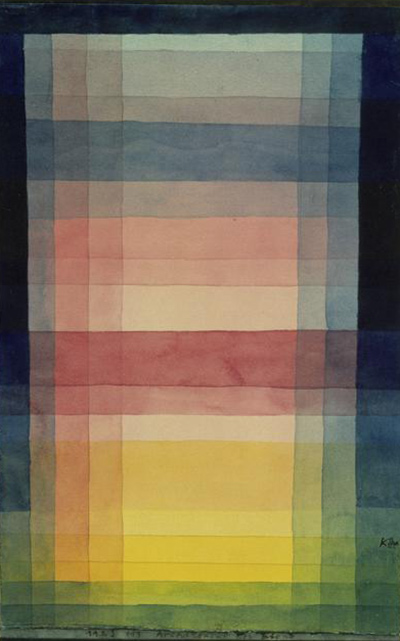
Paul Klee's Architecture of the Plain is Architektur der Ebene, 1923, 113. It belongs to the Museum Berggruen in Berlin, within the Staatliche Museen zu Berlin, under inventory number NG MB 122/2000. The museum records watercolour and pencil on paper mounted on cardboard, with watercolour and pen on strips at the top and bottom and a second worked strip below. The sheet is about 28 by 18 cm, with slight variations in its irregular measurements. It is a small, carefully bordered work on paper, even though its colour fields can give an impression of openness.[1][2]
The familiar English title can sound like a landscape seen from a distance. The picture instead presents a vertical network of transparent colour bands. Blues and muted reds cross a pale centre; yellow grows stronger toward the bottom. The left and right edges are darker and more compressed. Rectangles appear, but they do not lock into an exact architectural plan. Looking at it as “architecture” means attending to how Klee constructs a surface from line, overlap and interval, rather than looking for a particular building or a literal plain.[1]
A grid drawn without a ruler
The Berlin catalogue describes Klee drawing faint, slightly wavering pencil lines without a ruler. Horizontal and vertical parallels form an imprecise, overlapping grid. Some edges are difficult to locate because a translucent wash crosses them; others appear as stronger bars. That deliberate irregularity keeps the work from resembling an engineering diagram. It also lets a line be experienced as a movement across the sheet rather than merely as a boundary around a coloured box.[1]
The transparent colour changes are as important as the grid. The museum's German object essay by Roland März describes shifts from ultramarine to lighter blue, from burgundy toward pink and violet, and from light yellow toward ochre. Where washes overlap, they create intermediate tones that cannot be understood by naming each rectangle separately. The bright area is concentrated toward the bottom, where yellow seems to rise from green. The position of that light reverses a simple expectation that the upper part of a vertical composition must be the most open or luminous.[1]
The title's Ebene may suggest a plain, but it can also direct attention to the plane of the image. The museum's account emphasizes a two-dimensional ordering of transparent colour, not a depicted site. A viewer may sense a horizon in the broad horizontal transitions, or a doorway in the pale central passage. Those are possible readings of the shapes, not documented locations. The work is more precise when described as an experiment in how a surface can feel spacious while remaining visibly made of paper, pencil and wash.[1]
The worked border is part of the object
The Berlin object record specifies upper and lower strips with watercolour and pen, plus a second lower strip. This is easy to lose in a cropped reproduction. Those additions are part of the documented technique and make the image's limits more active: the vertical colour architecture is held between worked edges, not simply cut off at the edge of a rectangular photograph. The gallery's dimensions also give paired heights and widths because the object is not a perfectly uniform rectangle. Treating “28 × 18 cm” as a useful approximation is more honest than pretending the sheet has one exact width.[1]
A 2022–23 Tokyo exhibition checklist, issued by the National Museum of Western Art with Museum Berggruen, independently identifies the work as watercolour and graphite on paper mounted on cardboard. Its bilingual Japanese and English entry calls out the two border strips and the second lower strip. “Graphite” is the checklist's English wording for the pencil recorded in Berlin; the sources describe the same object and do not turn it into an oil painting. The Japanese title 平面の建築 puts “plane” in the foreground, a useful reminder that translations can stress different aspects of Ebene.[1][3]
A small reproduction provides the outline of the composition but cannot reliably show the faint pencil or layered edge construction needed for technical conclusions. The object description and exhibition checklist provide the evidence for those material details. In particular, a smooth digital colour block should not be mistaken for the physical wash, support and mount.[1][3]
Klee at the Bauhaus
Klee made the work while teaching at the Bauhaus in Weimar. The Bauhaus-Archiv explains that his teaching in form and colour supplemented the workshops, and that formal architecture training at the school began only in 1927. Thus the 1923 title should not be made into evidence that this watercolour was a student's building plan or an illustration for a particular architecture course. Its relationship to Bauhaus teaching is more securely found in its attention to line, field, colour and their interactions.[4]
The Zentrum Paul Klee describes a substantial body of surviving lecture notes from Klee's Bauhaus years, as well as his smaller Beiträge zur bildnerischen Formlehre. Those records show that the artist thought systematically about pictorial formation. They do not show that this particular watercolour was made as a classroom demonstration. The Berlin museum's object essay is more specific about what can actually be seen: a grid gently displaced by freehand line and transparent washes.[1][5]
The 2008 Berlin exhibition checklist places Architektur der Ebene in a Bauhaus section and supplies Klee's annual number 1923, 113. It records the work's medium and its Museum Berggruen ownership. That early museum checklist and the current object page agree on the key identity; the more recent Berlin record supplies fuller details of the border and provenance.[1][2]
Klee also made a distinct oil painting titled Architektur in 1923. Its stacked opaque blocks, larger size and Neue Nationalgalerie inventory separate it from this translucent sheet. The two can be compared for their different ways of making a visual structure, without treating either as a preparatory version of the other.[1][6]
From the artist to Museum Berggruen
The current Berlin provenance begins with the work in Klee's possession until 1940. It then passes through Lily Klee, the Klee-Gesellschaft, Felix Klee and his estate, a Swiss private owner, and Heinz Berggruen. Berlin records the museum's 2000 acquisition from Berggruen with public support. The listed dates are ranges in the owner record, not a claim that every intermediate transaction or location has been independently reconstructed here.[1]
Roland März's Berlin interpretation compares the loose colour bands with later American colour-field painting. That is a retrospective visual analogy, not a claim of direct influence on Morris Louis, Mark Rothko or Barnett Newman. It is helpful because it calls attention to the washes as fields rather than pieces of an imaginary wall. Equally, the “architecture” of the title remains unlike a building that could be drawn to scale: the unequal line, layered colour and glowing lower band make a spatial experience from the surface itself.[1]
Architecture of the Plain rewards slow looking at a small work. The geometry supplies a framework; the pencil's slight movement and the transparent wash continually loosen it. The paper's worked borders make clear that the frame is constructed too. Klee's architecture is therefore something the eye builds while crossing the image, without needing to settle on a literal plain.[1][3]
Related artworks
Explore eight other Klee works from the researched artwork cluster.
Sinbad the Sailor
1923
Actor's Mask
1924
Red Balloon
1922
Senecio
1922
Twittering Machine
1922
Ancient Harmony
1925
Crystal Gradation
1921
Fish Magic
1925
References
- Staatliche Museen zu Berlin, Museum Berggruen, Architektur der Ebene, German owner record and Roland März's object essay, updated 2026: title, date, inventory, materials, border strips, variable dimensions, provenance and interpretation. The page labels its photograph Public Domain Mark 1.0, View source.
- Staatliche Museen zu Berlin, Das Universum Klee, 2008–09 work list, German and English, p. 7 of PDF: Architektur der Ebene, 1923, 113, watercolour and pencil on paper mounted on cardboard, Museum Berggruen, View source.
- National Museum of Western Art, Tokyo, 2022–23 Berggruen exhibition checklist, Japanese and English, entry 65, PDF p. 4: 平面の建築 / Architecture of the Plain, material and border-strip detail, View source.
- Bauhaus-Archiv, “Unterricht”, German: institutional account of preliminary teaching, Klee's form and colour instruction, and the 1927 start of regular architectural training, View source.
- Zentrum Paul Klee, “Archiv & Forschung”, German: scope of surviving Klee teaching notes and Beiträge zur bildnerischen Formlehre, View source.
- Staatliche Museen zu Berlin, Neue Nationalgalerie, Architektur, German owner record: title, 1923 date, oil medium, 58 × 39 cm dimensions, Neue Nationalgalerie inventory NG 7/69 and composition of the separate work, View source.