


 by Tom Gurney
Tom Gurney BSc (Hons) is an art history expert with over 20 years experience
Published on June 19, 2020 / Updated on September 27, 2026
Email: tomgurney1@gmail.com / Phone: +44 7429 011000
Flower Stand with Watering Can and Bucket: Klee’s 1910 colour experiment
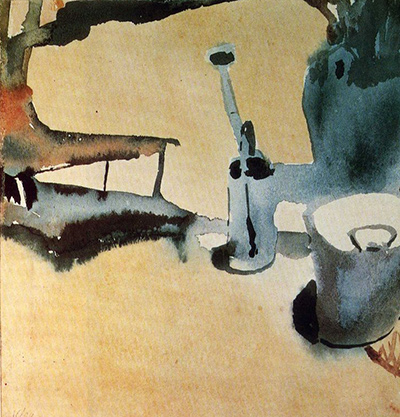
Paul Klee made Blumensteg, Gießkanne und Eimer—usually translated Flower Stand with Watering Can and Bucket—in 1910. The Städtische Galerie im Lenbachhaus, Munich, records it as 1910, 47 (B), a watercolour on paper mounted on cardboard, measuring 13.9 × 13.4 cm. Its museum inventory number is G 13116. The small format is central to the work: an ordinary group of garden objects becomes a close study of how a few areas of colour can establish light, shadow and shape.[1]
The English title is slightly more functional than the German Blumensteg, a stand or narrow support for flowers. At the left, a dark horizontal structure and its thin supports suggest a raised stand. The watering can stands near the middle, its neck rising into the light field. At the right, the bucket is defined by a dark outer form around a pale opening. A mass of blue-green at the upper right could be foliage or shade; the image does not require it to be named more exactly. Much of the foreground and background is a warm, open yellow. The work presents the tools of tending a garden, with hardly any flowers explicitly described in the reproduction.[1]
A garden still life made of colour
The objects are recognizable, but Klee does not enclose each of them with a firm descriptive outline. The stand is largely a set of horizontal dark and red-brown bands. Its apparent legs are slight, almost incidental marks. The watering can is a pale blue-grey vertical shape with dark accents at its centre and base. The bucket's light interior cuts into a much darker body. Each object is established by the relation of adjoining colour and value. There is enough information to identify a stand, can and bucket without requiring a complete drawn contour for any of them.[1][2]
The yellow ground is more than a neutral surface under the objects. It carries the impression of light through the centre and lower half of the picture and intensifies the darker blues, greens and browns around it. Those cooler, heavier passages can be read as shadow, but they also operate as independent colour shapes. A dark patch at the bucket's lower left anchors it; another runs beneath the stand. The objects seem set into one field rather than placed against a conventionally modelled backdrop. The small reddish marks near the lower right prevent the otherwise open yellow area from becoming empty.[1]
The Lenbachhaus describes this sheet as one of Klee's small watercolours from 1910 in which he explored colour with less dependence on line or traditional light-and-dark modelling. Its text notes both the fluid application of pigment and the considered distribution of lighter and darker values. This combination explains why the painting can appear spontaneous without being accidental. Diffuse watercolour edges alone are no evidence of a loss of control; the museum sees an experiment in the deliberate placement of colour and tone.[1]
The museum connects the watercolour with a diary description of working wet into wet on moistened paper in Bern. That is valuable evidence for Klee's practice at the time, though the public object record does not give a step-by-step conservation analysis of this individual sheet. In the reproduction, diffuse transitions around some dark passages are visible alongside more decisive edges. The balance of soft and firm marks is more useful to describe than an imagined sequence of every brushstroke.[1]
Klee's “light form” experiment
Art historian Charles W. Haxthausen reproduces Blumensteg, Gießkanne u. Eimer as figure 13 in his study of Klee's changing styles. He places the sheet among experiments of summer 1910 in which Klee tried to make colour carry a motif independently of line. Haxthausen reports Klee's term Lichtform—“light form”—for this approach. By blurring the details of what he saw, Klee sought an extract of nature's colour relationships rather than a detailed inventory of objects. The scholar treats the work as a specific example of that procedure, not merely as a general stage on the way to later abstraction.[2]
The stand, can and bucket show what that shift accomplishes. A conventional still life might use contour, perspective and shading to fix the objects in space. Here, the pale yellow span, dark horizontal stand and cool container forms do much of the descriptive work. The eye supplies the remaining connections. For example, the stand can be read as an object partly because the dark bands interrupt the yellow at a plausible height; no complete outline of its surface is needed. The bucket is legible through a bright opening set against a blue-grey side. These are direct visual observations consistent with Haxthausen's account of colour acting as a form-making element.[1][2]
Haxthausen describes Klee's 1909–10 work as a series of separate inquiries into line, tone and colour. He argues that Klee explored each pictorial element on its own, sometimes making it the main vehicle of representation. He then traces a longer effort to combine them without making one simply serve another. That account helps avoid treating Flower Stand as a crude sketch awaiting the artist's “mastery” of colour. It is a carefully posed problem within a wider set of contemporary experiments.[2]
Cézanne, the earlier work and the date
The Lenbachhaus's interpretation relates the quiet economy of this watercolour to Paul Cézanne's use of colour areas in place of solid-looking objects. The museum quotes Klee's enthusiastic response to a Cézanne exhibition he saw in Munich in spring 1909. It also points back to Klee's preceding studies in monochrome watercolour, where he had examined the distribution of light and dark. These are grounded connections within the museum's reading of the painting. They do not show that Klee copied a particular Cézanne canvas or that its palette came directly from a nineteenth-century Impressionist picture.[1]
The 1910 date is important. Klee's much-cited journey to Tunisia took place in 1914, four years later. The Lenbachhaus explicitly places this watercolour among his colour experiments before that trip. The older idea that Klee had not yet learned to handle colour until after Tunisia obscures what the small 1910 sheet is already doing. A yellow field, a few blue-green shadows and restrained warm accents make the garden equipment visible through differences in colour and weight.[1][2]
Klee's later work used other combinations of line, tone, colour and material. Haxthausen emphasizes that the artist worked in multiple styles, even within one year. A later collage or sharply drawn painting therefore should not be presented as the inevitable improvement on this watercolour. Blumensteg is more revealing when viewed on its own terms: an ordinary garden motif pared down to a compact experiment in light and colour.[2]
The object and its record
The Lenbachhaus identifies an ink “Klee” at the lower left and “1910 47” on the mount at the lower right. It records acquisition by purchase in 1963 and lists the work as not currently on display. Those details strengthen the identity beyond a title attached to a reproduction. Its owner record gives the width as 13.4 cm; Haxthausen's figure caption prints 13.3 cm. The current owner measure is the stronger figure, while the small published discrepancy remains part of the research record.[1][2]
The museum included the sheet in its 2007 exhibition about gardens. That exhibition placed garden imagery across periods and artists, but its general discussion of garden symbolism is not an object-specific meaning for this Klee watercolour. The title and image show implements of cultivation; no documented source establishes a particular flower species, location, person or symbolic episode for it. The strongest available interpretation remains the museum's and Haxthausen's close account of the visual experiment.[1][2][3]
The visible relationships of colour, value and shape provide a way into this small sheet. The broad yellow passages evoke light without describing a sun or sky; the cooler forms identify ordinary objects without outlining them fully. Klee's method makes a garden still life a study in perception—how little information an image needs before stand, can and bucket become legible.[1][2]
Related artworks
Explore eight other Klee works from the researched artwork cluster.
Hammamet with Mosque
1914
Flower Myth
1918
Angelus Novus
1920
Crystal Gradation
1921
Red Balloon
1922
References
- Städtische Galerie im Lenbachhaus, Blumensteg, Gießkanne und Eimer (German owner object record): title, 1910, 47 (B), medium, 13.9 × 13.4 cm dimensions, inventory G 13116, inscriptions, 1963 acquisition and the interpretation by Helmut Friedel and Annegret Hoberg, Der Blaue Reiter im Lenbachhaus München (2007). The museum image has CC BY-NC-SA 4.0 terms, View source.
- Charles W. Haxthausen, “Paul Klee, Wilhelm Hausenstein, and ‘the Problem of Style’”, kritische berichte 42, no. 1 (2014), pp. 47–67, especially pp. 50–52 and fig. 13: specialist analysis of Klee's 1909–10 isolation of line, tone and colour, his Lichtform method, and this watercolour as an example. The figure caption prints 13.9 × 13.3 cm, View source.
- Lenbachhaus, “Gärten – Ordnung, Inspiration, Glück” (German exhibition record, 2007): lists this exact 1910 work among the exhibited objects. The exhibition's general garden discussion is not treated as a specific interpretation of the sheet, View source.