 by Tom Gurney
Tom Gurney BSc (Hons) is an art history expert with over 20 years experience
Published on June 19, 2020 / Updated on September 27, 2026
Email: tomgurney1@gmail.com / Phone: +44 7429 011000
Lemon Harvest: Klee’s late image of work and fruit
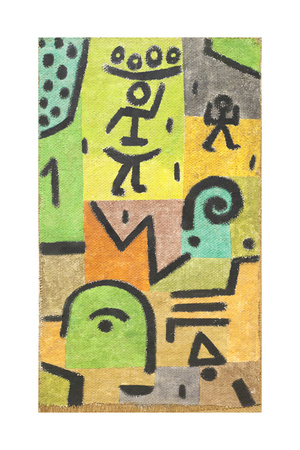
Paul Klee made Citronen-Ernte (Lemon Harvest) in 1937. A multilingual index identifies it as 1937,219 and translates the title into French as Récolte de Citrons. A German publisher's illustrated cover caption independently gives the same title and annual number. These sources establish a much firmer identity than the inherited page, which offered only a general description of “colourful squares” and promotional praise.[1][2]
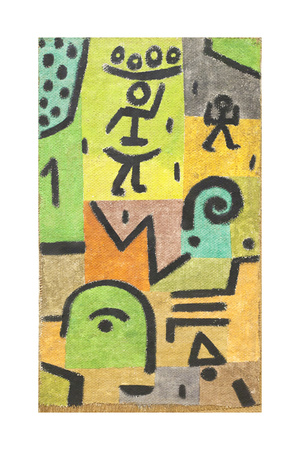
The picture sets thick black signs and a few humanlike figures against green, yellow, orange, grey and muted rose fields. Its central upright figure seems to balance a curved horizontal form topped by dark oval marks. The title invites us to read those marks as lemons being gathered or carried, though the modest reproduction does not let us identify each form with certainty. Smaller shapes to the right and lower down complicate any simple story of one worker in one orchard. Klee gives enough cues for harvest to enter the scene, then lets marks and colours take over.[1][3]
A scene made from signs
The composition is vertical and compact. At the top left, dark dots gather beside a broad curved line; nearby, a standing figure is reduced to an oval head, a short body, branching arms and angular legs. A smaller dark figure occupies the upper right. In the lower half, a large green arch and a slanted black path of marks answer these bodies without forming a conventional ground plane. The yellow and green areas can suggest sunlit vegetation, yet they also work as independent colour fields.[1][3]
The curved form above the main figure is particularly ambiguous. It can be seen as a tray, a bough or a graphic bar holding fruit. Its exact function is less important than the relation it creates between the figure and the dark ovals. Klee compresses person, action and object into a few memorable signs. The result is not a naturalistic record of workers picking fruit. It asks the viewer to assemble the harvest from a title and a small group of visual prompts.[1][3]
The black line has several jobs. It gives the main figure a body, edges the coloured areas and leaves isolated dots that might become fruit, stones or marks of movement. The painting would be hard to read without those lines, but they do not fully describe anatomy or landscape. Colour carries much of the remaining structure: a luminous green zone behind the central body, warmer orange and yellow below, and cooler grey near the upper right. The restricted forms make the shifts between those zones more conspicuous.[3]
Watercolour on a prepared textile
Object captions describe the work as watercolour on a primed jute support, measuring 70 × 46 cm. A German publisher's caption gives the concise formula Aquarell auf Grundierung auf Jute and names the Collection Fondation Pierre Gianadda, Martigny. A commercial listing sourced from an art-image supplier offers a more elaborate support description: watercolour on a ground on jute, laid over a second piece of white-primed jute and stretched. That construction is plausible but has not been checked against the holding collection's own record, so the simpler published description is safest for this article.[2][4]
“Watercolour” here should not make readers imagine a small sheet of white paper. The prepared textile and substantial dimensions distinguish this work from many of Klee's portable works on paper. A priming layer also means the colour is mediated by a prepared surface rather than simply soaked into raw jute. The small website image cannot reveal all its texture or the exact order of ground and paint. The difference between the material object and its online reproduction is a reason to be precise about what the captions actually establish.[2][4]
Bridgeman Images also describes the 1937 work as “watercolour on jute,” corroborating the broad medium.[5]
Why lemons appear in a 1937 Klee picture
Klee had lived in Bern again since leaving Germany at the end of 1933. The Zentrum Paul Klee records serious illness from 1935, difficulty working in 1936, and the renewed activity of 1937. That chronology gives the picture a place in his later practice without turning its playful forms into a simple symptom of illness. The harvest scene should be read first as an artwork, not as an illustration of a medical biography.[6]
His earlier travels also matter. A Zentrum Paul Klee exhibition guide documents repeated journeys to Italy during the Bauhaus period, including Sicily, and explains that Mediterranean flora and landscape left lasting impressions. In a review of the exhibition Paul Klee and Italy, Roderick Conway Morris specifically names Citronen-Ernte among late pictures that the exhibition related to Italian experience. This is an interpretive connection made by the exhibition and reviewer; it does not prove that the 1937 work portrays a particular Italian orchard or that Klee painted it during a trip.[7][8]
The citrus title therefore carries an evocative southern setting while the image remains stubbornly unlike a conventional landscape. Yellow-green and orange fields support the idea of fruit and warmth; the signs of labour keep the “harvest” active. The painting can suggest a remembered place without naming one. It turns an agricultural subject into a language of bodies, arcs, dots and colour divisions.[1][3][7]
A late work without a fixed story
It would be easy to identify every oval as a lemon and every zigzag as a worker's arm. The visible evidence is less exact. Klee simplifies and rearranges the scene so that the title supplies part of its legibility. The central figure can be recognised quickly; the more one follows the peripheral marks, the less certain the narrative becomes. That open reading is a feature of the picture, not a failure to finish an illustration.[1][3]
The old page called the work “primitive” and suggested that viewers would chiefly want it as a poster. Neither claim helps explain the painting. It is more useful to ask how a jute-supported watercolour of 1937 turns a named harvest into a system of signs. The date, original title and reported material give us concrete anchors; the exact place, action and meaning of many individual marks remain questions for looking.[1][2][4]
The Fondation Pierre Gianadda holding and measurements are supported by published captions, but the collection's present object record and Klee's printed catalogue raisonné have not been read directly here. Those sources could refine the support construction, provenance and title transcription. Until then, this article keeps interpretive claims distinct from observed forms and captioned facts.[2][4]
Related artworks
Explore eight other Klee works from the researched artwork cluster.
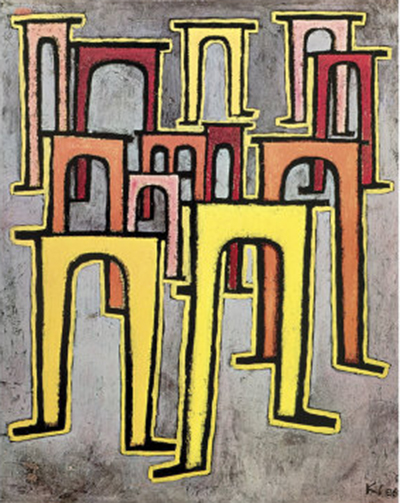
Viaducts Break Ranks
1937
Insula Dulcamara
1938
New Harmony
1936
Death and Fire
1940
Fire Full Moon
1933
Struck from the List
1933
Ad Parnassum
1932
References
- PaulKlee.fr, multilingual 1937 work index (German, French, English), entry 1937,219: Citronen-Ernte / Récolte de Citrons / Lemon Harvest. This is a secondary crosswalk, not the printed catalogue raisonné, View source.
- Schattauer/Cotta publisher preview, cover-art credit for Die biographische Anamnese unter tiefenpsychologischem Aspekt (German): explicitly identifies Citronen-Ernte, 1937,219, watercolour on primed jute, 70 × 46 cm, Collection Fondation Pierre Gianadda, Martigny. A second 2011 publisher preview gives the same caption.
- TheHistoryOfArt.org, existing Lemon Harvest image: visual reference for the close reading; image-origin and high-resolution reuse terms are not established by this inherited file, View source.
- Bildergipfel/akg-images listing for Citronen-Ernte (German): commercial image caption describing the more elaborate prepared and layered jute support and 70 × 46 cm; collection support wording awaits direct owner verification, View source.
- Bridgeman Images, Harvest of lemons (Zitronen Ernte) (English): licensed photograph listing, 1937, watercolour on jute. Its image terms do not govern the pre-existing site file, View source.
- Zentrum Paul Klee, artist biography (English): institutional chronology for Bern, illness and later practice, View source.
- Zentrum Paul Klee, Mapping Klee exhibition guide (English): institutional account of Italian travels, Sicily and the continuing effect of Mediterranean flora and landscape, View source.
- Roderick Conway Morris, “Paul Klee's Colorful Trail in Italy” (English): review of the Rome exhibition, naming Citronen-Ernte among later Italian-inflected works; an interpretive review, not a provenance or location record, View source.