


 by Tom Gurney
Tom Gurney BSc (Hons) is an art history expert with over 20 years experience
Published on June 19, 2020 / Updated on September 27, 2026
Email: tomgurney1@gmail.com / Phone: +44 7429 011000
Explore the details of Likeness in the Bower
Select a numbered area to examine its detail at high resolution.
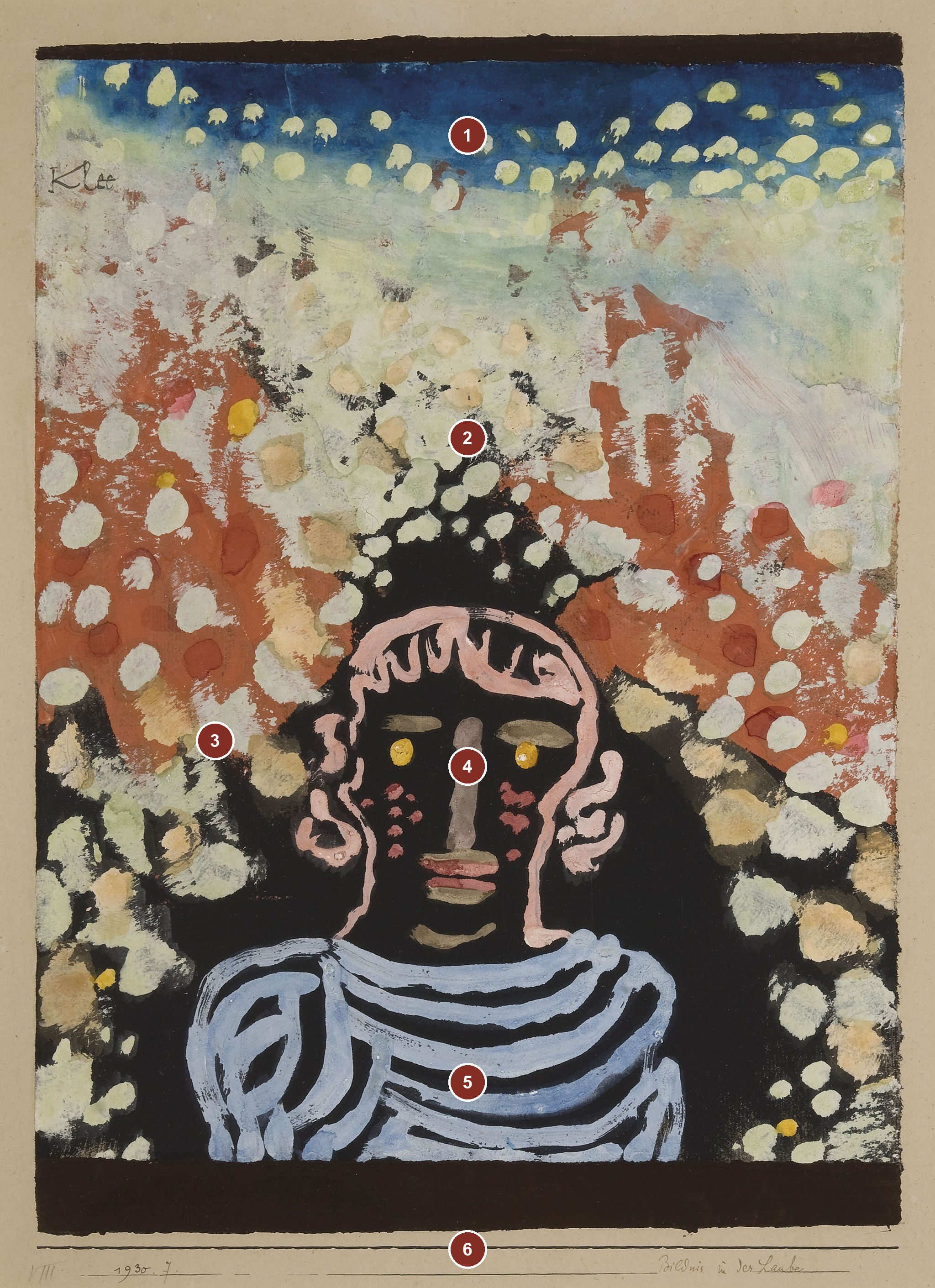
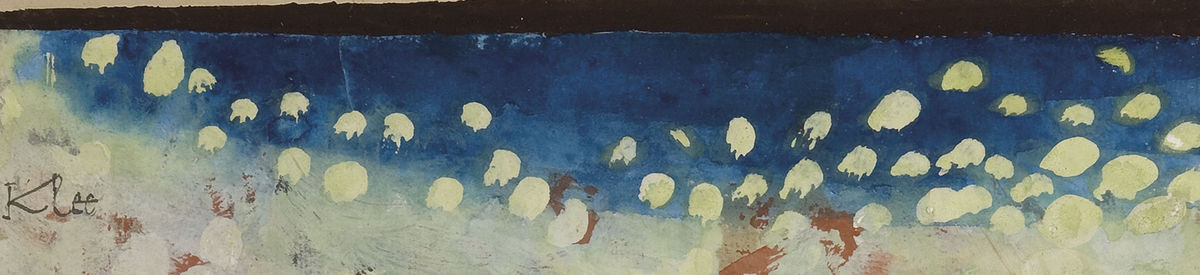
Pale spots against the deep blue upper band
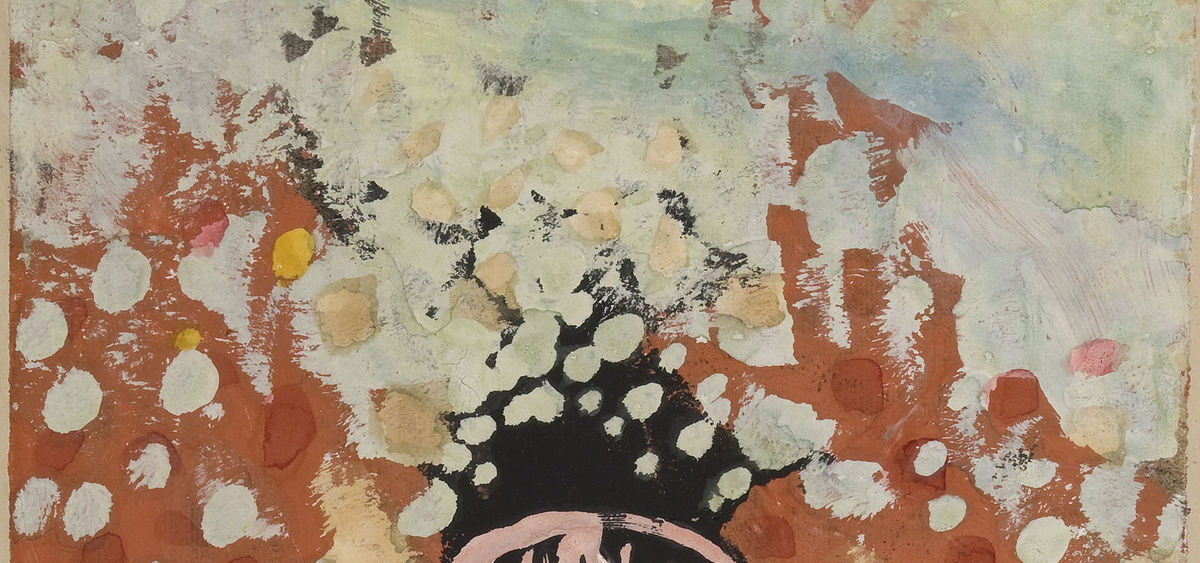
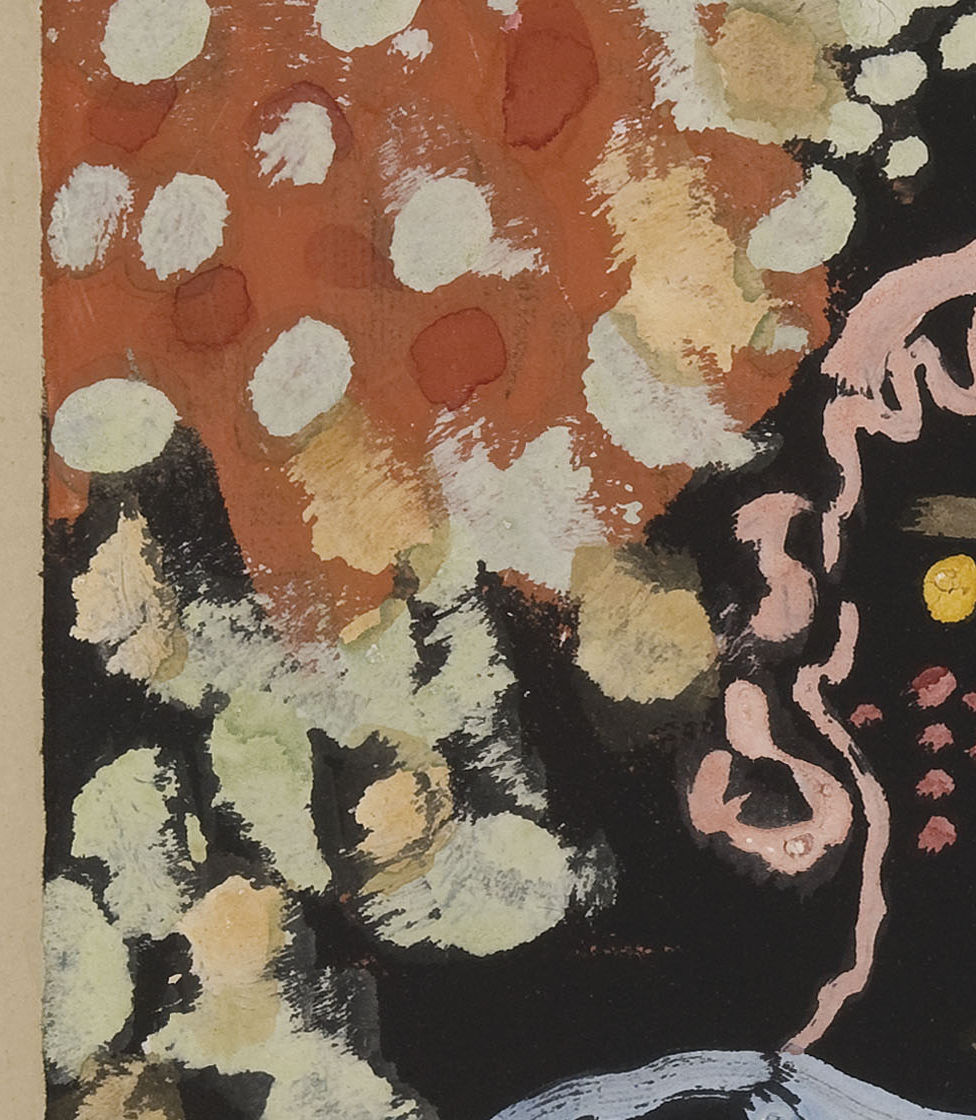
Red and cream marks around the head
Left-hand blossoms and dark frame around the face
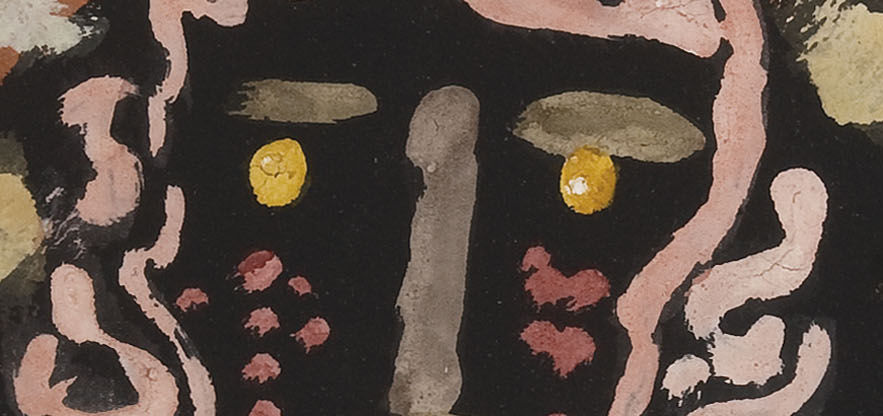
Yellow eyes, grey nose and red cheek marks
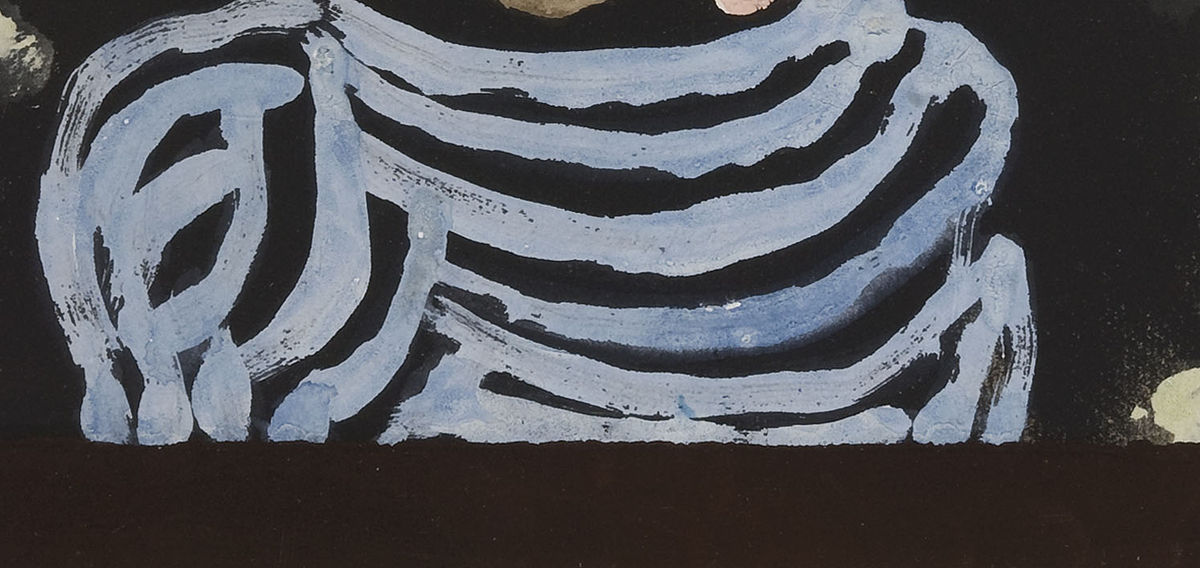
Pale blue lines of the garment
Klee’s date, number and title on the mount

Likeness in the Bower: Klee’s portrait within colour
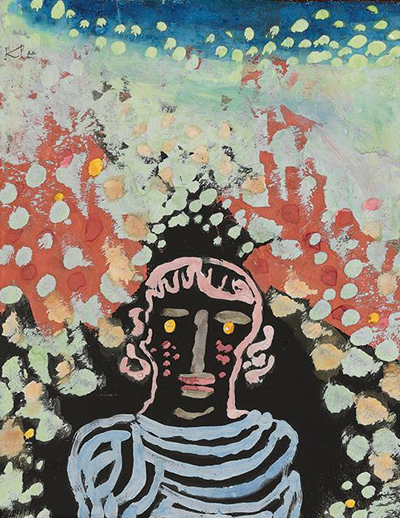
Paul Klee titled this work Bildnis in der Laube—usually translated as Portrait in the Arbour or Likeness in the Bower. It was made in 1930 and carries the artist's inscription “VIII 1930. 7. Bildnis in der Laube” on its mount. A multilingual work index places it at 1930,7. Christie's cites the Paul Klee Foundation's printed Catalogue raisonné, volume 5, page 414, number 5123, though that printed entry has not been directly examined for this page.[1][2]
The subject looks out from a dense collar of pale blue lines and a dark mass of hair or foliage. Two yellow eyes, a long grey nose and small red mouth give the face a direct presence. Above it, red, cream and turquoise marks climb toward a deep blue band flecked with pale spots. The German Laube suggests a shaded garden shelter or arbour, but Klee does not draw a literal trellis. The sitter and setting become entangled in colour and pattern.[1][3]
A portrait that keeps its face
Despite the surrounding abstraction, the face is remarkably legible. Its eyes are placed evenly and its nose drops between them like a vertical support. Pale pink lines define forehead and ears, while red touches on both cheeks animate the dark facial field. The mouth consists of a few short horizontal strokes. Klee pares these features back, yet the gaze remains strong enough to hold the picture together.[3]
The lower pale-blue passages can be read as a striped garment, scarf or neckline. They loop around the shoulders and bring the body's shape forward from the dark background. The upper half then seems to release the sitter into a cloud of dabs and coloured flecks. The picture does not require us to choose between a portrait and a garden scene: the title joins them, while the image lets one merge into the other.[1][3]
The old page described the ground as black canvas. The auction records instead identify a work on paper mounted on board. What appears to be a dark background belongs to a layered painted surface, not evidence that the work is oil or gouache on canvas. The distinction matters because the fine pale marks of the face and garment are easier to understand as painted interventions on a prepared sheet than as a general claim about “lighting up” a canvas.[1][4]
Colour organizes the portrait in bands without making it static. At the top, dark blue holds small pale green and yellow marks; below it, a light mottled area spreads across the upper face. Dense black near the head and shoulders anchors the centre. The salmon-red surround punctuates that darkness, while the pale blue of the lower garment returns the eye to the figure. The colour fields suggest filtered light, but they do not prove a particular time of day or a specific flower or leaf species.[3]
What the auction records say about materials
Christie's 2010 catalogue describes gouache on paper laid down by the artist on board, with an image measuring 33.3 × 24.1 cm and the artist's mount 57.5 × 46.4 cm. A later German Karl & Faber auction description gives watercolour and gouache over a paste ground on paper, on cardboard, and measures the image at about 33.5 × 24 cm. Those accounts agree on a mounted work on paper and nearly agree on dimensions. The German description supplies further material layers that Christie's short line omits; it should be checked against the printed catalogue raisonné or conservation documentation before being treated as definitive.[1][4]
The mount is part of the object's evidence. Christie's records the signature at upper left and the title, date and two numbers on the mount. That marginal writing identifies the work independently of later English translations. It also explains why cropping the picture down to just the coloured image can lose information about how Klee presented and catalogued it.[1]
The title itself leaves the sitter unnamed. Bildnis is a portrait or likeness, not a proper name. The work cannot securely be called a portrait of a known friend or family member without an identifying source. The inherited page's description of a dress and curls may be a plausible visual impression, but it does not establish the sitter's identity, gender or clothing with certainty. This article describes the visible features and leaves those questions open.[1][3]
Exhibitions and ownership
Christie's provenance begins with Alfred Flechtheim in Düsseldorf, listed until 1931, then Daniel-Henry Kahnweiler in Paris and The Mayor Gallery in London by 1935. The work was shown at the Flechtheim-linked Düsseldorf exhibition in June–July 1931, then at The Mayor Gallery in June 1935. Those early appearances are significant: the painting did not remain a hidden studio experiment but entered the international gallery network shortly after it was made.[1]
Later exhibition records place it in London at Marlborough Fine Art's Painters of the Bauhaus show in 1962 and a Klee show in 1966, then at a Saidenberg Gallery retrospective in New York in 1969. The provenance printed by Christie's passes through those dealers, Galerie Athénée AG in Triesenberg, and Marlborough Fine Art in New York in 1989. The listing is an auction-house account of the chain; it should not be stretched into a claim that every intervening transfer date or beneficial owner is known.[1]
The work was stolen from Marlborough's New York gallery in 1989 and recovered more than twenty years later. Christie's records the theft and recovery with assistance from the Art Loss Register. Contemporary reporting describes a Montreal dealer receiving the picture from someone offering it for sale, recognising a problem with its status and contacting US authorities. The news account calls it an “oil painting” and uses the English title Portrait in the Garden; those material and title shortcuts conflict with Christie's object description. For the object's medium, the auction catalogue is the stronger source.[1][5]
This history is notable, but it is not the painting's subject. The theft occurred long after Klee made the work and does not explain the pale dabs or the sitter's gaze. It belongs in a separate provenance account, where dates and agencies can be checked, rather than replacing close attention to the 1930 picture.[1][5]
The painted shelter
The Laube of the title can be approached as a structure made by colour rather than architecture. The curved dark line around the head and the red-and-cream flecks above it create a canopy-like zone; the blues at the top set a limit above that zone. Yet there are no clear posts, lattice or garden furniture. Klee makes a place for a portrait through overlapping marks. The sitter appears both before that place and partly absorbed into it.[1][3]
The work's visual tension lies in that balance. The face is frontal and readily grasped, while the surrounding colours refuse to settle into a single literal garden description. The title offers a setting; the painting keeps it provisional. Its 1930 date and documented material construction give a factual frame, and its exhibition and recovery record give a later history. Neither can replace the direct encounter with a face holding steady inside an unsettled field of colour.[1][3][4]
Related artworks
Explore eight other Klee works from the researched artwork cluster.
Ad Marginem
1930
Error on Green
1930
Fire in the Evening
1929
Highway and Byways
1929
Ad Parnassum
1932
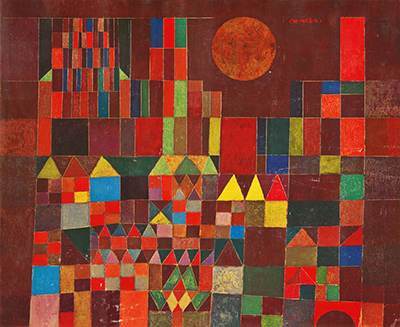
Castle and Sun
1928
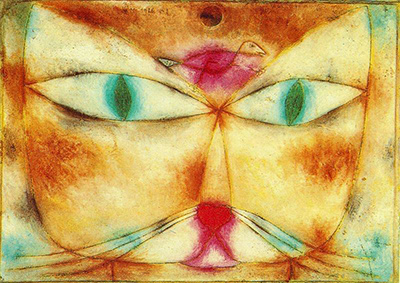
Cat and Bird
1928
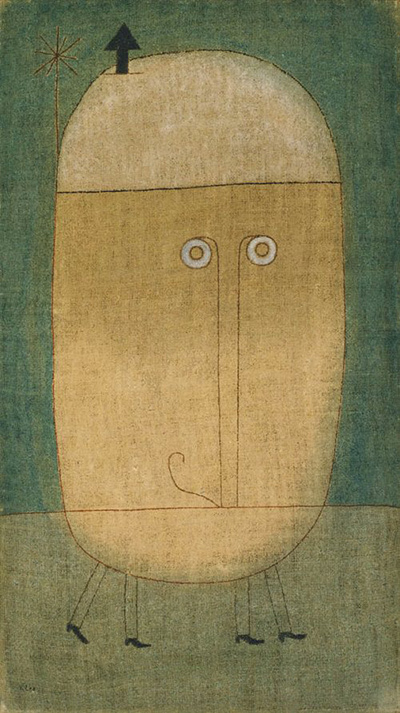
Mask of Fear
1932
References
- Christie's, Bildnis in der Laube, 5 May 2010, lot 229 (English): original inscription, medium, image and mount dimensions, provenance, exhibitions and citation to Paul Klee, Catalogue raisonné (2001), vol. 5, p. 414, no. 5123. The printed catalogue itself was not directly read here, View source.
- PaulKlee.fr, multilingual 1930 work index (German, English and French), entry 1930,7: title and number crosswalk; secondary index, View source.
- Wikimedia Commons, Bildnis in der Laube: 2,323 × 3,200-pixel, 300dpi public-domain reproduction sourced to the Christie's record; visual reference for close reading and for the local splash and detail assets. Its source and exact-file identity are recorded in the image ledger, View source.
- Karl & Faber, auction catalogue, lot 558 (German): watercolour and gouache over paste ground on paper, mounted on card; approximate image and mount dimensions. This is a later auction description, not a conservation report, View source.
- DNAinfo, “Paul Klee Painting, Stolen from Manhattan 21 Years Ago, Returned to the U.S.” (English, 24 March 2010): contemporary report of the Montreal dealer and US recovery. Its “oil painting” wording conflicts with the object catalogues and is not adopted here, View source.
