


 by Tom Gurney
Tom Gurney BSc (Hons) is an art history expert with over 20 years experience
Published on June 19, 2020 / Updated on September 27, 2026
Email: tomgurney1@gmail.com / Phone: +44 7429 011000
Sunset: Paul Klee’s dotted picture of simultaneous space
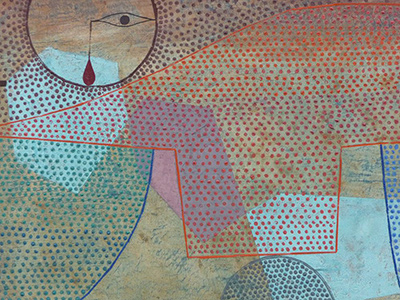
Paul Klee's Sunset (Sonnenuntergang) of 1930 is an oil painting on canvas, 46.1 × 70.5 cm, in the Art Institute of Chicago. The museum received it from Mary and Leigh Block in 1981 and records it as accession 1981.13. A pale, blue-white field, veils of red and a repeated screen of dots make the picture appear to vibrate. It contains a schematic face in the upper left and, in the complete work, a small red sun and downward arrow near the lower right. The local reproduction above is a close crop that leaves out that lower pair; the museum's object page shows the full composition.[1]
This is a separate work from Klee's With the Setting Sun (mit der sinkenden Sonne) of 1919. The earlier watercolour is a much smaller work in a Swiss private collection, deposited at the Zentrum Paul Klee in Bern. The two pictures share an evening subject, but differ in date, technique, support, scale and imagery. The Chicago painting's all-over dots and face should not be confused with the earlier work's large red disc and small house.[1][4]
Reading the complete image
A low, red-outlined form crosses much of the centre of Sunset. Its upper edge rises into a rounded dome before falling to either side, while its lower edge steps down into a broad rectangular extension. Circular forms press in from the lower left, lower middle and right. Each appears partly behind or partly in front of another coloured zone. The shapes are clear enough to follow, but difficult to assign to a single landscape seen from one position.[1]
Small dots cover large portions of the surface. Their density and colour change: blue-green at left, red through the broad middle, violet and blue at right, and darker tones toward the upper edge. The dots do not erase the underlying blocks; instead, they let several layers stay perceptible at once. A viewer may first attend to the marks as a surface pattern, then look through them to the pale ground and floating forms beneath.[1][2]
The schematic face sits in a partial circle at the upper left. Its eye, angular outline and descending red tear-like shape are spare signs rather than a portrait. Near the lower right of the full painting, the little red sun and arrow anchor the title more directly. Their scale is striking: the named sun is small beside the vast field of colour and dots. The work makes sunset a condition spread across the whole picture, not merely a single disc on a horizon.[1]
The older article suggested the face looks Egyptian and linked it to Klee's 1928–29 journey to Egypt. That is a possible visual association, but no consulted owner or specialist source connects this particular face to a specific Egyptian model. The page therefore describes what can be seen without asserting that source of inspiration. It also avoids treating the different dots as a literal musical notation.[1][2]
Dots are not simply Pointillism
The museum describes Sunset as an image whose linear structures, tones and shapes work in rhythm. Richard Verdi, in his 1968 study published by the Art Institute of Chicago, gives a more exact account. He says Klee placed the dots on a foreground plane through which a background of floating coloured shapes remains visible. He cautions against equating the method with Neo-Impressionist Pointillism: the similarity lies in using small marks, while Klee's purpose here is not the optical mixing of colour into one unified tone.[1][2]
That distinction helps explain the painting's unusual depth. The dots do not make a conventional recession to a distant skyline. The planes seem to coexist and change independently. Looking from the upper left face across the central red shape and down to the sun, the eye alternates between surface and depth, large form and small repeated unit. Verdi calls attention to the autonomy of these pictorial “voices”; the museum's current account similarly describes stillness and movement, shallowness and depth held in balance.[1][2]
The image is not purely abstract: face, eye, sun and arrow remain recognisable. Yet none fixes a stable natural scene. A face can coexist with a landscape-like spread of colour; a low red disc can appear at the edge without making a standard sunset view. The picture operates through these simultaneous possibilities rather than resolving them into a single story.[1]
Music and polyphony
Klee's musical training matters here because he repeatedly asked how relations between independent parts might work in painting. The Art Institute's record connects Sunset to his idea of pictorial polyphony, where visual elements act together at one time. The Zentrum Paul Klee reproduces a 1917 diary passage in which he argued that painting could present several events simultaneously in space. Its digital music guide likewise explains that he tried to translate musical principles into visual art. These sources support the analogy, but not a claim that each dot stands for a note or that the picture corresponds to a particular composition.[1][3]
Verdi compares Sunset with Klee's Polyphony of 1932. In the earlier picture, he says, the separate layers can still be distinguished: a dotted screen in front, coloured shapes behind. In the later work, dots and blocks interweave more completely, making it harder to isolate an individual “voice”. That comparison gives Sunset a place in an evolving investigation of simultaneous images, without calling it an early version of one identical technique.[2]
Music can also clarify how a viewer looks. A melody unfolds over time, but the picture's forms are already present together. One can choose an order of attention: follow the dots, trace the red outline, pause at the eye, or return to the small sun. Each route changes what feels dominant. This is an interpretation of viewing, anchored in Klee's and Verdi's accounts of simultaneous pictorial experience, rather than a reconstruction of a score.[2][3]
The work's path to Chicago
The Art Institute's researched provenance is unusually specific. The painting stayed with Klee in Dessau and later Bern. Between December 1934 and April 1935 he gave it to the critic Will Grohmann. A Berlin or Dresden context can therefore be discussed through an actual relationship, rather than a vague claim that the work became “sought after”. It later passed through Marlborough Fine Art, London, which sold it to Mary and Leigh Block in 1964; the Blocks gave it to the Chicago museum in 1981.[1]
The owner lists a 1935 Kunsthalle Bern exhibition, subsequent German and British presentations, a 2006–07 Klee and America tour, and a 2024 New York exhibition. Those are documented appearances, not evidence of continuous display in Chicago. Its publication history also records the German title Sonnenuntergang and the French Coucher de soleil. The Art Institute cites the Paul Klee catalogue raisonné, volume 5, entry 5327, but that printed entry has not been read directly for this page; the museum's object record is the source for the citation.[1]
The composition resists reducing “sunset” to a sentimental landscape. A sun and arrow are present, but small; the larger event is a change in how colour, line and dots are perceived together. The eyes on the upper face and the viewer's own searching gaze become part of that experience. When the foreground screen and the shapes beneath seem to trade places, the static canvas can feel as if it is still changing.[1][2]
Related artworks
Explore eight other Klee works from the researched artwork cluster.
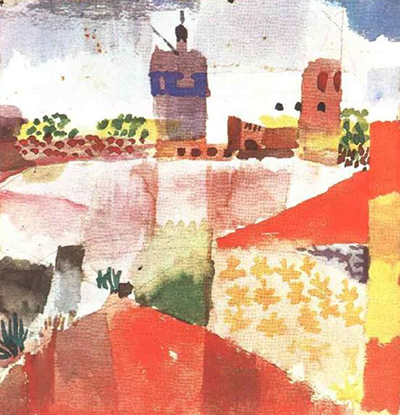
Hammamet with Mosque
1914
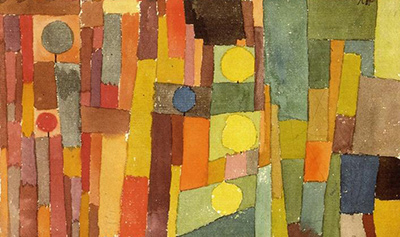
Flower Myth
1918
Angelus Novus
1920
Crystal Gradation
1921
Red Balloon
1922
References
- Art Institute of Chicago, “Sunset,” object record and its public collection API entry: medium, dimensions, full image, interpretation, provenance, exhibitions and publication history.
- Richard Verdi, “Musical Influences on the Art of Paul Klee,” Art Institute of Chicago Museum Studies 3, 1968, pp. 98–100: direct discussion of Sunset, foreground dots, independent planes and comparison with Polyphony, View source.
- Zentrum Paul Klee, Klee & Kandinsky exhibition chronology, 2015, German text: Klee's 1917 diary no. 1081 on simultaneous pictorial voices; and Zentrum Paul Klee, “Klee Musical” digital guide, on music and visual art.
- Zentrum Paul Klee, Kosmos Klee: Press Images, no. 03: identifies the different 1919 watercolour mit der sinkenden Sonne by date, medium, dimensions and collection status, View source.