


 by Tom Gurney
Tom Gurney BSc (Hons) is an art history expert with over 20 years experience
Published on June 19, 2020 / Updated on September 27, 2026
Email: tomgurney1@gmail.com / Phone: +44 7429 011000
A Woman for Gods: a figure across the frame
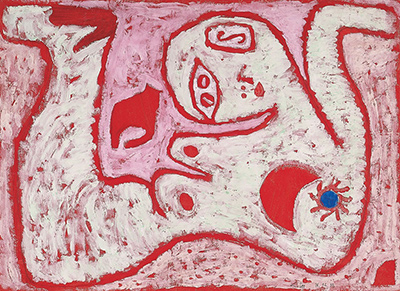
Paul Klee's A Woman for Gods is his ein Weib für Götter, a large work on paper from late 1938. The Fondation Beyeler records it as 1938, 452 (A 12), made with coloured paste and watercolour on wrapping paper mounted on cardboard, measuring 44.3 × 60.5 cm. Klee signed and dated it in black at the lower right: “Klee 18.12.38.” The work is now inventory 03.3 in the Beyeler collection. These details anchor a picture that resists an easy description as either a reclining nude or a wholly abstract arrangement.[1]
The pale figure stretches, curls and seems to press against the edges of a broad red and pink field. A head near the top centre carries open, displaced features. A long limb bends towards the upper right; another part rises at the left. Near the lower right, a blue centre with red rays or strokes interrupts the body's pale surface. Thick red contours gather the parts into a single presence without making them behave like a conventional anatomical portrait. Klee makes the figure occupy nearly the whole available space, so the body's boundaries and the picture's boundaries become closely involved.[1][2]
A body held by the picture
The composition changes as the eye moves through it. The rounded head and a curving form below may be read as a neck and torso, yet the position of the limbs refuses the mechanics of an ordinary reclining pose. Pink and chalky white passages seem to push against the dominant red. Klee's dark outlines define features, while his broader red contour binds the pale figure to its surrounding field. There is no room for a stable floor, bed or landscape. The image's tension comes from a body that appears at once expansive and constrained.[1][3]
Art historian Max Huggler's 1969 reading, relayed by Klee specialist Osamu Okuda, stresses the way the feet brace at the upper corners while the extended body seems to float. Huggler also saw a solar wheel and a mouth-like form within the body, interpreting them as signs of a cosmic content. That is one historically important reading of the marks, not a key supplied by Klee to fix every symbol. The blue-centred shape can indeed draw the eye as a radiant sign; identifying its exact mythic function requires more than visual resemblance.[2]
The title contributes another opening. Ein Weib für Götter might suggest a woman destined for gods, offered to them, or belonging in their sphere. Its short phrase does not state which gods, what happens to the woman, or whether Klee intended reverence, irony or both. The established English title A Woman for Gods retains that awkward openness. An early American exhibition instead called it Bride of the Gods. That 1944 translation adds a specific relationship that Klee's German does not explicitly name, making it an instructive part of the work's reception rather than a substitute for the original title.[1][2]
Paste colour on wrapping paper
The owning museum's material description is specific: coloured paste and watercolour on wrapping paper on cardboard. The support was not an oil canvas, as “painting” might suggest to a casual reader. A broad paper sheet gives Klee room to join emphatic colour areas to smaller drawn and painted signs; mounting it on cardboard gives the finished work a more rigid backing. The Zentrum Paul Klee describes paste-bound colour as an established part of his practice, especially in combination with other media in his later years. That general technical history helps explain the recorded materials but does not establish the exact order in which this particular red, pink, white and blue surface was made.[1][4]
At 60.5 cm wide, the work is substantial for a Klee work on paper. Its horizontal orientation matters. The pale body does not simply sit within a central rectangle; forms push into corners and bend along the margins. The lower curve holds the image together, while the raised parts make the figure seem to strain upward. The roughness of the colour is part of what the reproduction communicates. The body is assembled through patches and contours, not polished modelling intended to imitate skin.[1][2]
Klee's date, 18 December 1938, gives a precise final-day inscription rather than a general placement in his late period. It does not prove that every mark was completed on that date, but it is unusually close evidence for when he considered the work ready to sign. The annual designation 1938, 452 (A 12) belongs to Klee's production record. The Fondation Beyeler separately cites the printed Paul Klee. Catalogue raisonné, volume 7, as no. 7654, illustrated on page 504. These numbers serve different cataloguing purposes and should not be collapsed into one.[1]
Late Klee and different interpretations
Klee made the picture after leaving Nazi Germany for Bern and during the late work shaped by illness and political upheaval. Both contexts have influenced its interpretation. The figure's strained pose can support thoughts about fragility, exposure or violence, but it does not identify a named event. The original page called the picture a work “after the war,” although it was signed in December 1938, before the Second World War began. It also said that the woman was resting and that Klee's purpose was to celebrate particular bodily features. The documentary sources do not establish either intention.[1][5]
One scholarly reading, in a study of dolls and puppets in Klee's late art, connects A Woman for Gods with nearby 1938 figures whose bodies appear displaced or broken. Its author proposes that the distorted woman may be understood as a victim of the era's violence and reads the title as a possible irony directed at Nazi mythology. This is a forceful interpretation, not an identified bombing victim or a statement by Klee. The study's claim that the body has been killed by bombs goes further than the object record or the image can verify. The reading is useful because it asks us to notice the figure's strain within its historical moment; it should be presented alongside other possibilities rather than as the picture's settled subject.[5]
Huggler's cosmic interpretation begins elsewhere: the body's braced, floating posture and the wheel-like mark can suggest a relation between human form and a larger order. Okuda's account of Huggler preserves that response in the work's reception history. Neither the political nor cosmic reading eliminates the other's visual evidence. Both attend to a body that fills and unsettles its frame. Klee's title keeps the relation between woman and “gods” open enough that viewers have continued to disagree about whether the encounter is exalted, threatening, theatrical or deliberately unresolved.[2][5]
From Klee to Clifford Odets
The Beyeler provenance gives the work a notably rich transatlantic history. It remained with Klee until 1940, with Lily Klee thereafter. The record also notes commissions with Galerie Simon in Paris and Nierendorf Gallery in New York around 1939–46. The distinction matters: being held on consignment by a gallery is not the same as a simple change of ownership. By 1946, the picture belonged to playwright and screenwriter Clifford Odets in Los Angeles, who retained it to at least 1952. Later it passed through Curt Valentin and Los Angeles galleries, auctions and private collections before entering the Beyeler Foundation in 2003.[1]
Okuda researched Odets's Klee collection using correspondence, gallery lists and exhibition records. He identifies ein Weib für Götter among Odets's works and explains that the picture first appeared publicly in a 1944 Philadelphia Art Alliance exhibition as Bride of the Gods, lent by Nierendorf Gallery. A list of works sent to Odets in June 1946 used the same English title. Okuda judges it likely that Odets obtained the picture through Curt Valentin rather than buying it directly from Nierendorf, but he presents the route as an inference. That careful distinction keeps the documented 1944 loan and 1946 collection connection separate from a conjecture about the exact sale.[1][2]
Okuda also compares the figure with Odets's own 1947 watercolour Crime of Passion. He sees a possible visual borrowing of the contorted form, transformed into an ordinary human drama. The comparison tells us about the artwork's reception in Odets's hands; it does not show that Klee anticipated the later play or picture. A viewer can follow the shape's afterlife without turning similarity into proof of direct influence.[2]
The owner's record follows the work through a 1959 Parke-Bernet sale, a 1972 Sotheby's sale, a 1973 Finarte sale and a 1994 Sotheby's offering that went unsold. It lists the Saidenberg Gallery, James Wise and Giuseppe Nahmad among later holders, then Paris and Basel galleries from 2000, before the Beyeler Foundation acquired it in 2003. This path crosses several markets and cities. The evidence documents circulation, though it does not explain each owner's motives.[1]
Exhibition and afterlife
The 1944 Philadelphia showing preceded a 1945 Nierendorf exhibition and a 1953 New York exhibition associated with Curt Valentin. The picture later appeared in Beyeler exhibitions on late Klee and on Eros, and in Zentrum Paul Klee exhibitions that brought Klee into dialogue with Picasso, the uncanny and Surrealism. Those different curatorial settings help explain why the figure has attracted mythic, bodily and political readings. A list of past exhibitions is not evidence that the work is currently on view.[1]
The picture's documented facts are unusually firm: title, date, materials, dimensions, collection and a detailed path through galleries and owners. Its figure remains less fixed. Red surrounds and outlines a pale body whose parts push towards the edges, while a small bright sign interrupts the surface. That combination lets the image appear vulnerable and monumental at once. Reading it closely means keeping those visual tensions in view while leaving the gods in the title unnamed.[1][2][5]
Related artworks
Explore eight other Klee works from the researched artwork cluster.
Insula Dulcamara
1938
Viaducts Break Ranks
1937
Death and Fire
1940
New Harmony
1936
Fire Full Moon
1933
Struck from the List
1933
Ad Parnassum
1932
References
- Fondation Beyeler, ein Weib für Götter collection record, German: object identity, inscription, medium, measurements, provenance, exhibitions and printed catalogue bibliography, View source.
- Osamu Okuda, “Klee Goes to Hollywood: Clifford Odets and His Favorite Artists,” Zwitscher-Maschine, 2017, English; specialist provenance study using archival correspondence and exhibition catalogues, with Max Huggler's later interpretation and a comparison with Odets's Crime of Passion, View source.
- Google Arts & Culture, A Woman For Gods, collection-supplied English object label and image; confirms title, original title, medium and dimensions. Visual observations are readings of the reproduced work, View source.
- Zentrum Paul Klee, exhibition material on Klee's painting techniques, German: general account of paste-bound colour in Klee's practice, not a conservation report on this work, View source.
- Russell Stephens, “Paul Klee: Protected Children, Broken Puppets and the Problematization of Modernism,” in Dolls and Puppets as Artistic and Cultural Phenomena, pp. 34–54, especially pp. 48–49: a political reading of the displaced figure, treated here as an interpretation rather than verified iconography, View source.