by Tom Gurney
Tom Gurney BSc (Hons) is an art history expert with over 20 years experience
Published on June 19, 2020 / Updated on October 15, 2026
Email: tomgurney1@gmail.com / Phone: +44 7429 011000
Caricature of the Laocoön Group: a woodcut after Titian: Introduction
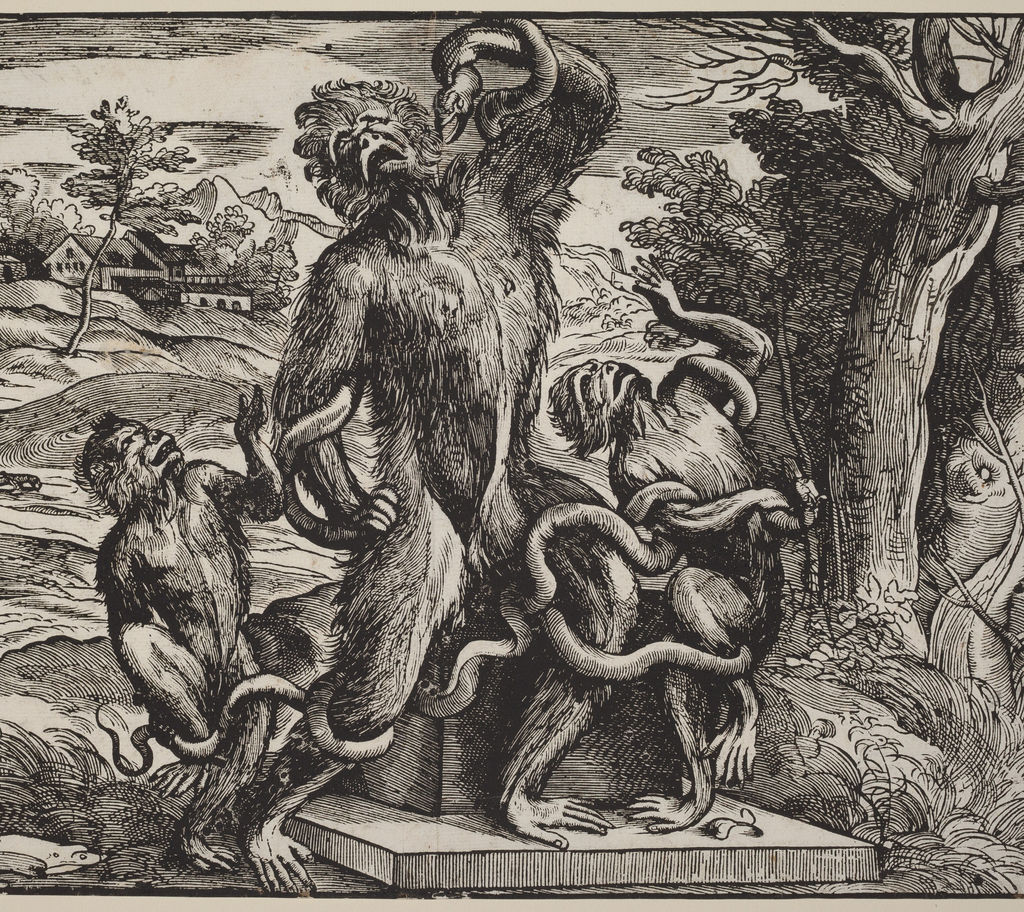
Three apes struggle with serpents on a low plinth. An ape at the centre throws its head back, while a smaller figure at either side is pulled into the same knot of bodies and coils. The arrangement is instantly strange once its model is recognized: the celebrated ancient marble Laocoön and His Sons. The print replaces the human priest and his children with apes. This Caricature of the Laocoon Group is a woodcut, not a painting by Titian. The impression at the National Gallery of Art, Washington, is catalogued as attributed to Niccolò Boldrini after Titian, dated about 1540–45.[1][2]
That wording assigns different tasks, and leaves each qualified. A design associated with Titian was translated into a carved woodblock traditionally attributed to Boldrini; ink from that block produced the print. The NGA's physical sheet, 1972.49.4, measures 26.5 × 40.1 cm and is printed on white laid paper. Calling it simply “Titian's caricature” can be useful shorthand, but it hides the printmaker and risks treating an attributed design as a signed drawing or an autograph canvas.[1]
At a Glance
- WorkCaricature of the Laocoon Group
- Research recordNational Gallery of Art
Annotated details from Caricature of the Laocoon Group
Select a numbered area to find its detail below. Open a detail image to view it larger.
Details from CARICATURE OF THE LAOCOON GROUP
Laocoon Monkeys and Serpents
Laocoon Village and Landscape
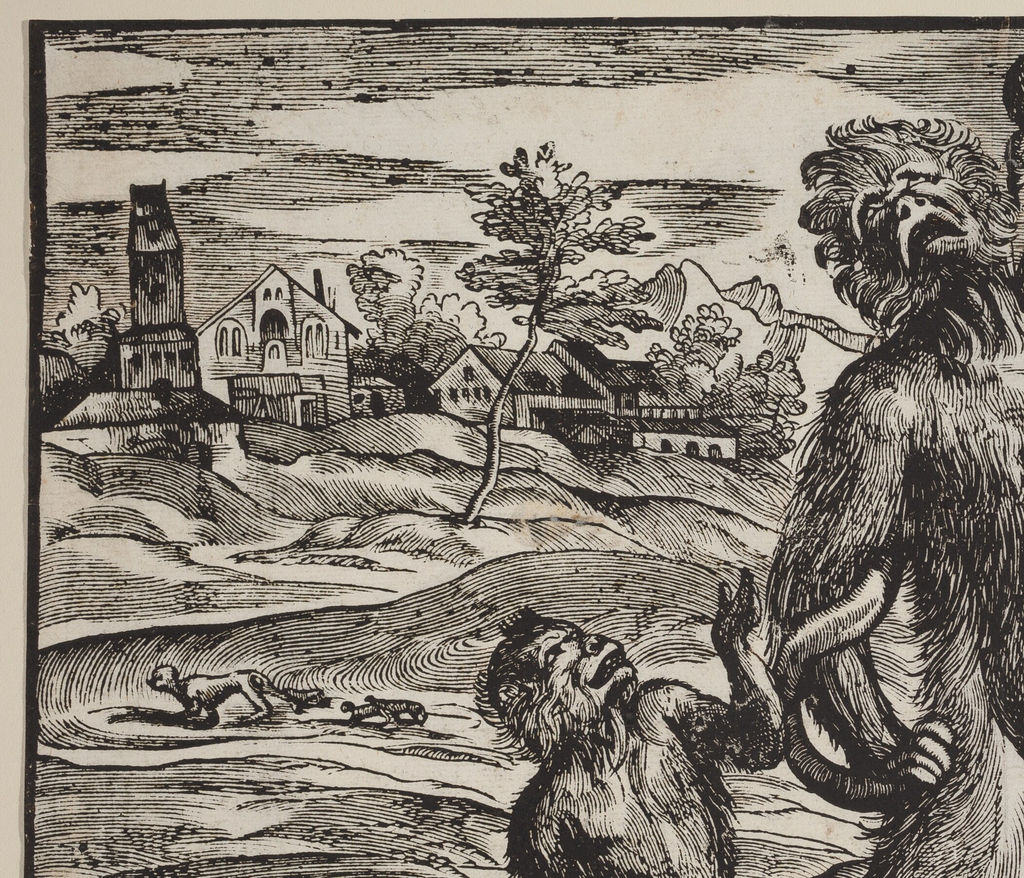
Image: National Gallery of Art, Washington. Open Access, public domain. Cropped and resized. Public domain. Image source · Reuse licence
Contents
- From Roman marble to Venetian woodcut
- Who made the image?
- What is the joke aimed at?
- This impression's later history
From Roman marble to Venetian woodcut
The Vatican Museums date the discovery of the ancient Laocoön group to 1506 on Rome's Esquiline Hill. Pope Julius II acquired it and displayed it in the papal Statues Courtyard. In the story behind the sculpture, the Trojan priest Laocoön warned against admitting the wooden horse left by the Greeks; serpents attacked him and his two sons. The marble's intertwined bodies and desperate gestures became a conspicuous model for Renaissance artists who wanted to study expressive movement and human anatomy.[2]
The woodcut borrows the marble's three-figure struggle while altering nearly everything about its dignity. The central ape stands high, its mouth open and one arm caught in a coil. The two others occupy lower positions, their bodies twisted by snakes. The rectangular base still recalls a sculptural pedestal. Yet the group has been set in a wide landscape: a village and low hills lie to the left, and a heavily worked tree rises at the right. The ancient work is being copied, displaced and made comic at the same time. It is not merely a scene of wild animals; it is a picture that expects viewers to recognize another famous picture in sculptural form.[1][2]
Black lines gather into dense shadows around the torsos, snakes and tree. White gaps keep fur, scales, sky and ground distinct. In a woodcut, the artist cuts away the parts of a block that should not receive ink; the raised surfaces print the dark lines. The process gives the caricature a graphic rhythm of repeated hatching and exposed paper. That look belongs to the block and its printing, not to a paintbrush on canvas. The National Gallery's sheet is one surviving impression from the design, and its paper dimensions describe this particular impression rather than the size of every surviving copy.[1][3]
Who made the image?
The NGA attributes the block cutting to Niccolò Boldrini and places Titian behind the design. The Metropolitan Museum of Art catalogues another impression with two especially careful labels: “Attributed to Nicolò Boldrini” and “? After Titian.” The question mark makes the design connection explicitly tentative. The Met notes that Boldrini's firmest documented tie to Titian is a different, signed chiaroscuro woodcut of Venus and Cupid dated 1566. It records scholarly challenges to Boldrini's authorship of a broader group of Titian-related woodcuts, with Giovanni Britto proposed for some, but also says those challenges did not specifically examine this caricature.[1][3]
This does not prove that Britto cut the Laocoön block. Nor does the later signed Venus and Cupid prove Boldrini's hand in every earlier woodcut attributed to him. The safest account follows the collection records: a sixteenth-century woodcut conventionally linked to a Titian design, with Boldrini as an attributed cutter. That retains the collaboration implied by the image while allowing the uncertainty in both names to remain visible.[1][3]
Several museums hold impressions. The Met's example is 22.73.3-125, with a larger paper sheet than the Washington copy. The Rijksmuseum holds another, RP-P-OB-30.980, and catalogues its own dimensions separately. These are not three unrelated compositions. They are physical prints of the caricature, whose sheets, histories and catalogue descriptions differ. The Fitzwilliam Museum's impression even has a later graphite note on its mount suggesting an “epigram” against a copy by Baccio Bandinelli. Since that note is on the mount rather than part of the printed block, it should not be treated as Titian's original caption or proof of his intention.[3][4][5]
What is the joke aimed at?
At a basic level, the parody works by reducing idealized human bodies to apes while preserving the prestigious marble's dramatic shape. A viewer who has seen or heard of the Laocoön can recognize the model and the deliberate mismatch. But identifying a more precise target has produced competing interpretations. The Spencer Museum of Art, which owns another impression, describes a proposal that the print engaged a Renaissance dispute over anatomy. Ancient medical authority, especially Galen, was often read through observations drawn from animal bodies; Andreas Vesalius advocated direct human dissection and corrected inherited anatomical claims. Under this interpretation, apes placed in an admired model of human form make a pointed joke about treating animal anatomy as human anatomy.[6]
The Spencer material also uses cautious wording: the print may explore that controversy. The image contains no printed statement naming Galen, Vesalius or a physician as its target. Another viewer could understand the joke chiefly as a challenge to the high status of the ancient statue, or as play with the very act of imitation. The anatomy reading is compelling enough to explain, but it should not be turned into a documented commission or the only possible meaning. The Fitzwilliam mount's Bandinelli theory belongs in the history of later interpretation for the same reason: its presence tells us what one later annotator thought, not what the original makers wrote.[5][6]
The print's landscape also complicates a simple one-line reading. The animals are not photographed in a gallery or left floating against blank paper. A village, open ground and tree make a new world for the old sculptural pose. The stone base remains beneath them, however, preserving the act of artistic imitation inside that world. The joke depends on both moves: viewers see apes struggling with snakes, then realize that they have been made to “perform” a revered work of ancient sculpture.[1][2]
This impression's later history
The National Gallery records the Washington impression with the London dealer P. & D. Colnaghi, who sold it to the museum in 1972. That is a documented modern step in the object's history; the NGA's short provenance does not establish its complete path through earlier centuries. The sheet is currently listed as not on view. Its public-domain museum image, together with enlarged details, allows close study of the cut line, the plinth and the small landscape without confusing this impression's history with those held in New York, Amsterdam or Cambridge.[1]
On the site's Titian prints guide, this caricature shows why printmaking cannot be folded into a single painter's hand. Its power lies in the transformation of a famous ancient sculpture, the labour of cutting and printing, and the different meanings later scholars have proposed. The pleasure of recognizing the Laocoön and the uncertainty of the joke's precise target can coexist.[1][2][3][6]
Researched Titian and related works
Frequently Asked Questions
No. It is a sixteenth-century woodcut. The NGA attributes the block to Boldrini after a design associated with Titian; the Met makes the latter connection more tentative.[1][3]
They replace Laocoön and his two sons in a parody of the ancient sculpture. Scholars have proposed several targets, including inherited ideas about anatomy, but no printed explanation fixes one exclusive meaning.[2][6]
The Vatican Museums date its discovery in Rome to 1506.[2]
In the National Gallery of Art, accession 1972.49.4. The NGA currently lists it as not on view.[1]
Discussion
What do you notice when you look closely at Caricature of the Laocoön Group: a woodcut after Titian?
Share a specific observation or a source that adds context.
Reader Insights
Which detail changes your reading?
How does its original setting affect what we see?
Which part of the evidence remains uncertain?
Join the Conversation
Add your observation below.
References
- National Gallery of Art, “Caricature of the Laocoon Group,” accession 1972.49.4, object and provenance record. View source.
- Vatican Museums, “Laocoön,” account of the ancient group and its discovery. View source.
- The Metropolitan Museum of Art, “Caricature of the Laocoön sculptural group,” impression 22.73.3-125, attribution and collection notes. View source.
- Rijksmuseum, “Karikatuur op de Laocoöngroep,” impression RP-P-OB-30.980. View source.
- Fitzwilliam Museum, “Caricature of the Laocöon Group,” impression P.1818-1991 and mount inscriptions. View source.
- Spencer Museum of Art, “Caricature of the Laocoön represented as a Monkey in a Landscape,” impression 1960.0074 and interpretive labels. View source.