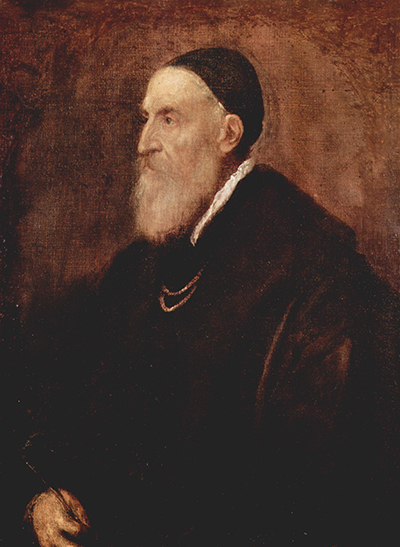
 by Tom Gurney
Tom Gurney BSc (Hons) is an art history expert with over 20 years experience
Published on June 19, 2020 / Updated on October 15, 2026
Email: tomgurney1@gmail.com / Phone: +44 7429 011000
Titian's words: letters, translations and misattributed sayings: Introduction
What did Titian actually say about his paintings? The most useful answers come from dated correspondence, not from collections of attractive one-line quotations. Letters to Philip II and Charles V connect particular words to particular works, recipients and practical decisions. They mention pictures being prepared, altered and sent; they also show an artist managing court relationships. A sentence detached from that setting can sound like a timeless theory of painting when it was part of a request, explanation or promise.[1][2][3]
This guide follows documented occasions rather than assembling a list of doubtful aphorisms. Some original passages survive in Italian, while museums provide translations or paraphrases. A translated phrase is useful if its source is named. An ambassador's description of Titian is evidence about him, but it is not a quotation by him. A patron's instruction has yet another voice. These distinctions let the documents illuminate the paintings without pretending that every memorable formulation came from the painter's mouth.[1][2][4]
At a Glance
- SubjectTitian Quotes
- ScopeVenetian Renaissance art
- Source approachCollection records and primary documents
Contents
- Where to begin: a dated document
- The 1554 pair: Danaë and Venus and Adonis
- 1559: “finished” and still being refined
- A continuing exchange in the 1560s
- Court letters as work, not private diary entries
- Voices around Mater Dolorosa
- Published dialogue is not Titian's stenographic speech
- How to check a popular “Titian quote”
Where to begin: a dated document
When a quotation is attributed to Titian, look first for a date, recipient and original source. The Museo del Prado identifies a Venice letter of 23 March 1553 to the future Philip II that refers to arranging the poesie. It is an early documentary sign of the mythological project later realised as six major paintings for Philip. The letter also announced a portrait. Its importance lies in the conjunction of a named correspondent, a work being sent and a group of pictures under preparation. It cannot establish, unaided, every subject eventually selected or the location in which Philip intended to hang them.[1]
The Italian phrase about putting the poesie in order is short, but even a short phrase has a setting. Titian was writing to a powerful patron, reporting work in progress and sustaining the relationship on which future commissions depended. The Prado concludes that the project was already known to both men and probably grew from their earlier meeting. That is the museum's historical inference from the evidence, not a separate sentence in which Titian laid out a complete programme. The poesie guide tracks the resulting canvases; here the letter matters because it shows how a project can be visible in correspondence before its final form is known.[1]
A useful citation for this letter would identify its date, addressee, place and the edition or museum discussion used for the text. Merely writing “Titian said that his paintings were poems” blurs a descriptive term, a documented line and modern interpretation. It also suggests that a brief court letter was an independent manifesto. The surviving words are stronger evidence when their ordinary documentary purpose remains visible.[1]
The 1554 pair: Danaë and Venus and Adonis
The Prado connects Titian's 1554 Venus and Adonis with the Wellington Collection Danaë. Venus is seen principally from behind, while Danaë gives another view of the female body. The museum explains that the pair allowed Titian to demonstrate painting's ability to offer different viewpoints, an ambition relevant to contemporary comparison between painting and sculpture. The point belongs to two specific works made for Philip, not to every nude or every painting Titian produced.[1]
This is a case in which a popular retelling can distort a documented argument. Titian's letter accompanying Venus and Adonis is often reduced to the idea that he was simply showing the reverse side of a woman. That leaves out the relationship between the two paintings, their royal recipient and the claim about what painted invention could achieve. It can also imply that the Prado Venus and Adonis was Titian's first treatment of the subject. The museum says he had explored it earlier and that technical examination of the Prado painting reveals a connection to a version in Moscow. A letter about the new royal picture must therefore be read with its particular version in mind.[1]
The Prado's Spanish account offers an interpretation of the correspondence and the visual pair. An English author can paraphrase that account accurately without presenting a new English sentence as Titian's exact wording. If literal quotation is needed, name the translation or edition that supplies it. A museum's prose about a letter is not automatically a published transcription of the whole letter. That basic distinction prevents a curator's explanatory words from being copied into Titian's voice.[1]
1559: “finished” and still being refined
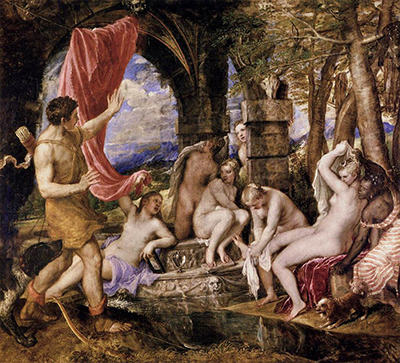
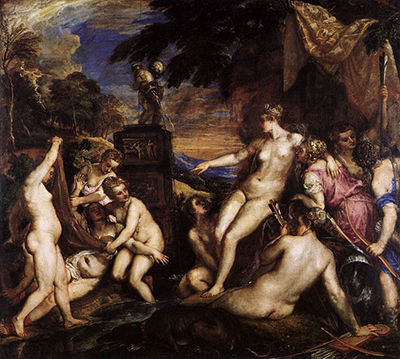
The National Gallery's research on Diana and Actaeon traces a sequence of letters concerning that painting and Diana and Callisto. On 19 June 1559, Titian told Philip the two poesie were finished and awaited instructions for shipping. On 22 September, he wrote that their dispatch was near. In the later letter he said he had worked on them for more than three years and stressed the effort he had spent refining them. These are dated statements tied to a specific pair of large canvases, not general declarations that every Titian work took the same length of time.[2]
An August letter from the Spanish ambassador in Venice complicates the plain reading of “finished.” According to the National Gallery, the ambassador reported that Titian was still resolving small things in the pictures that others might not notice. This sentence is the ambassador's report, not a line by Titian. It helps explain how a painter could announce completion in June and continue working before dispatch. The apparent contradiction need not be smoothed away. “Finished” could mark readiness in a diplomatic exchange while further adjustment remained possible. The Gallery also notes visible revisions in the painted surface, evidence that can be considered beside the correspondence.[2]
The September letter's rhetoric matters too. Writing to a king, Titian emphasised his diligence and the desire to make work worthy of the recipient. The National Gallery prints an English translation of a passage about never being satisfied with his efforts and continuing to improve them. It is strong evidence for what he chose to tell Philip in this particular exchange. It should not be treated as a transparent window onto every private doubt, nor converted into an unsupported slogan such as “Titian never finished a painting.” The letter's practical purpose was to explain delay and impending delivery while honouring the patron.[2]
The two Diana canvases are a useful test of how documentary and visual evidence work together. A letter can date a claimed stage in production; an ambassador can describe continuing work; technical and close visual study can identify changes in the object. None of these sources alone says everything. The strongest account keeps the sequence intact: declared finished in June, still subject to small adjustments in August, and close to shipment in September.[2]
A continuing exchange in the 1560s
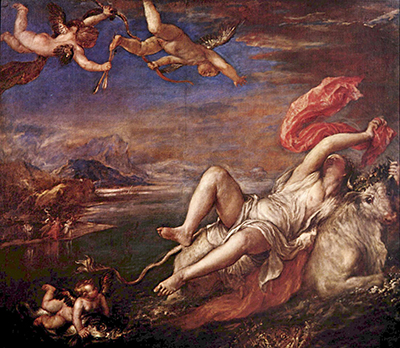
The correspondence did not stop with the Diana pair. The National Gallery's catalogue of The Death of Actaeon notes letters in which Titian reported progress on The Rape of Europa and an Agony in the Garden, announcing their completion on 26 April 1562. A later diplomatic letter of 1568 listed mythological subjects that Titian could supply. The first is evidence of an artist reporting on work; the second is a third party's account of possibilities. A subject in the latter list should not automatically be counted as a finished, delivered canvas.[5]
This difference helps with a recurrent confusion about the poesie. The six original paintings sent to Philip and the related Death of Actaeon do not have identical delivery histories. Letters can show intention, readiness or an offer without proving that a picture arrived or that a work now in a museum is the very version described. To move from a documentary phrase to an object identification, researchers compare dates, dimensions, provenance, surviving variants and the works themselves. Quoting a line accurately is only the start of interpretation.[1][5]
The National Gallery also notes that Titian's letters envisaged the poesie displayed together in one room, while Philip's changing residences make a fixed initial destination unlikely. Here again the evidence has two layers: what the letters indicate about Titian's imagined ensemble, and the museum's inference about the king's practical arrangements. A concise quotation about one room cannot by itself tell us where the group actually hung at a particular date.[6]
Court letters as work, not private diary entries
The public language of court correspondence could be elaborate and deferential. The National Gallery describes Titian's letters to Philip as combining respectful address with requests that could seem bold. That mixture suits an artist who depended on court favour while also offering rare and valued work. A letter's compliments may be sincere, strategic or both. Its recipient, occasion and requested action need to be understood before an expression of devotion is cited as a freestanding portrait of personality.[7]
Other letters illuminate how paintings moved. The Staatliche Museen zu Berlin's entry for Venus with an Organist notes a December 1545 letter from Titian to Charles V expressing a wish to deliver a Venus personally. It also records a September 1548 letter to Antoine Perrenot de Granvelle referring to a Venus commissioned by the emperor, brought to Augsburg and apparently being sent onward. These mentions reveal negotiation and transport across court locations. They do not permit every surviving Venus with an Organist to be identified with the picture in a letter. The Berlin account itself discusses multiple versions and later developments of the subject.[3]
The contrast between “a Venus mentioned in a letter” and “this Venus now in a collection” is fundamental. Artists repeated successful compositions; assistants might participate; pictures could change hands. A dated letter can establish that some work existed or was planned, but the exact link to a present object demands additional evidence. The same caution applies to religious paintings and portraits. An archive reference is not an automatic inventory number.[3]
Voices around Mater Dolorosa
The Prado's account of Mater Dolorosa with Open Hands brings several documentary voices into one picture's history. A 30 June 1553 letter from the Spanish ambassador in Venice reports Titian awaiting the emperor's instructions for a Virgin panel related to an Ecce Homo. Charles V later requested a second Mater Dolorosa painted on stone and supplied a model. These are evidence for a patron's wishes and for the practical work of finding a suitable support. They are not quotations in which Titian expressed a general rule about painting on stone.[4]
The Prado also refers to a 1561 letter in which Titian explained to Philip II the meaning of tears on a Magdalene he had sent. That is a different painting and a different occasion. It can illuminate how the artist described devotional effect to a patron, but it should not be folded into the earlier ambassador's report as though the three documents were one exchange. The Prado's discussion makes the wider point that Charles's choices of support and model mattered to these works. A quotation page should leave space for what patrons specified, not cast every visual feature as the painter's unsolicited theory.[4]
This example shows why even carefully translated letters need a documentary map. Who wrote? To whom? About which object? Was the claim made before or after the work was completed? Where does the present painting sit among variants? Answering those questions may take more words than reproducing one elegant sentence, but it gives the sentence a reliable meaning.[4]
Published dialogue is not Titian's stenographic speech
Contemporary Venetian art writing is valuable, but its genres differ. Lodovico Dolce's L'Aretino, or Dialogo della pittura, is an authored dialogue in which speakers discuss painting. It can show ideas debated in Titian's cultural circle, yet a speech assigned to a dialogue character is not a verbatim interview with Titian. Likewise, Pietro Aretino's writing about his painter friend reflects Aretino's voice, interests and rhetorical skill. A reader should not convert praise by a contemporary into a first-person pronouncement by the painter.[8]
Later editions could bring dialogue and letters into the same volume, encouraging accidental conflation. A citation should therefore specify whether its text comes from Titian's own signed or attributed letter, another correspondent's letter, a dialogue by Dolce, or a later editor's account. If the original language is not available to the writer, cite a reliable institutional translation and avoid reconstructing exact wording from a summary. The distinction matters even when the underlying idea seems consistent with Titian's paintings.[8]
For a fuller documentary corpus, the Fondazione Centro Studi Tiziano e Cadore describes Lionello Puppi's Tiziano: L'Epistolario as an edition of correspondence to and from Titian spanning 1513–1576. That title is a route to checking individual letters and editorial apparatus. It is not itself evidence that every aphorism on a quotation website appears in the archive. An exact letter quotation should identify the edition and page, or a museum's clearly labelled translation, so that another reader can find the passage.[9]
How to check a popular “Titian quote”
First search for the earliest traceable source. A phrase that appears only in modern quotation compilations has a weak claim, however fitting it sounds. Next ask whether the supposed original is a letter by Titian, a report about him, an authored dialogue or a later interpretation. Then check date, recipient, work named and the surrounding request or argument. A ten-word excerpt can reverse the emphasis of a paragraph if it hides a condition or compliment to the patron.[1][2][8]
Check the language and translation too. Italian syntax and courtly forms do not always produce one inevitable English version. If an English museum paraphrases the gist of a document, quote the museum as a modern source or paraphrase its explanation; do not put new quotation marks around words it has not presented as Titian's. If an attractive saying has no verifiable original, leave it unattributed. The paintings and dated correspondence offer more than enough material without an invented motto.[1][2][9]
Finally ask what the passage can prove. The 1553 letter documents a project under way; it cannot give the final list of six pictures by itself. The 1559 letters document claims of completion, revision and dispatch; they are not a diary of each brushstroke. The 1545 and 1548 Venus letters document court dealings but do not automatically identify one surviving version. The most revealing “Titian quotes” are precise, situated statements that can be tested against the works and other records.[1][2][3]
Researched Titian and related works
Frequently Asked Questions
No single sentence does that work. The dated letters are more dependable when read with their addressee and paintings. The 1554 Danaë and Venus and Adonis discussion, for example, concerns a particular royal pair, not a universal formula.[1]
The National Gallery translates a 22 September 1559 letter to Philip in which he emphasised sustained effort and improvement of the two Diana pictures. Cite that letter and translation rather than turning its courtly explanation of a specific delay into a general aphorism.[2]
No. It can be quoted or paraphrased as the ambassador's report. The August 1559 report about small adjustments to the Diana pictures is valuable precisely because it is a separate observer's account beside Titian's own letters.[2]
Start with the museum or scholarly edition that prints or translates the dated passage. Record its date, recipient and page or stable link. The Prado and National Gallery sources here identify several letters; Puppi's edited correspondence is a route to the fuller texts and editorial context.[1][2][9]
Discussion
What do you notice when you look closely at Titian's words: letters, translations and misattributed sayings?
Share a specific observation or a source that adds context.
Reader Insights
Which detail changes your reading?
How does its original setting affect what we see?
Which part of the evidence remains uncertain?
Join the Conversation
Add your observation below.
References
- Museo Nacional del Prado, “Venus y Adonis,” collection essay and discussion of letters and the poesie (Spanish). View source.
- National Gallery, London, “Titian's Diana and Actaeon,” research paper, “Date and working practice.” View source.
- Staatliche Museen zu Berlin, “Venus mit dem Orgelspieler,” collection essay and correspondence chronology. View source.
- Museo Nacional del Prado, “La Dolorosa con las manos abiertas,” collection essay (Spanish). View source.
- National Gallery, London, catalogue entry for “The Death of Actaeon.” View source.
- National Gallery, London, “Titian: Love, Desire, Death,” exhibition account of the poesie and correspondence. View source.
- National Gallery, London, “Titian: Europe's most wanted,” discussion of his letters to Philip. View source.
- Lodovico Dolce, L'Aretino ovvero Dialogo della pittura, digitised historical edition. View source.
- Fondazione Centro Studi Tiziano e Cadore, description of Lionello Puppi's Tiziano: L'Epistolario. View source.