by Tom Gurney
Tom Gurney BSc (Hons) is an art history expert with over 20 years experience
Published on June 19, 2020 / Updated on October 15, 2026
Email: tomgurney1@gmail.com / Phone: +44 7429 011000
Titian’s Study of Legs for the Martyrdom of Saint Lawrence: Introduction
Two muscular legs dominate a tall sheet of blue paper. One bends, the other extends towards a lightly sketched foot; above them, traces of a torso and arms are much fainter. This is not an anonymous exercise detached from a painting. The sheet in the Uffizi’s drawings collection, inventory 12907 F, is associated with the executioner at the lower right of Titian’s Venetian Martyrdom of Saint Lawrence. Lionello Puppi identifies the figure beside the gridiron on which the saint is martyred, and a National Gallery technical study calls the sheet a rare surviving drawing from Titian’s later career securely related to a known composition.[1][2]
Its short website title, Study of Legs, is accurate but incomplete. The drawing is a working answer to a particular problem: how to give the executioner weight and balance within a dark, crowded altarpiece. It also has a second life on the back, where another leg study has been linked to Titian’s Sisyphus in Madrid.[2] Keeping recto and verso distinct is essential. The legs seen on this page concern the Venetian martyrdom; the other side should not be silently folded into the same commission.
At a Glance
- WorkStudy of Legs
- Research recordgazzettadalba.it
Annotated details from Study of Legs
Select a numbered area to find its detail below. Open a detail image to view it larger.
Details from STUDY OF LEGS
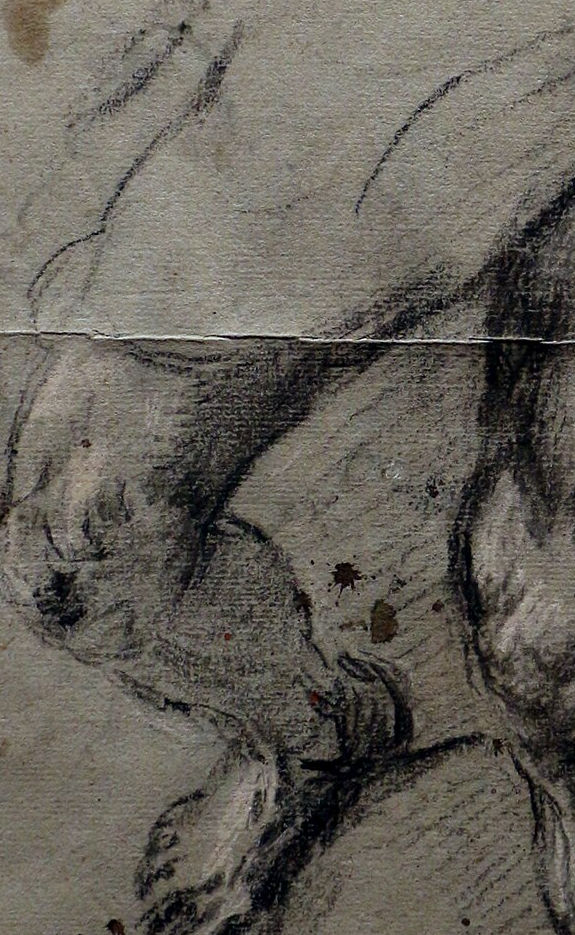
Study of Legs for the Martyrdom of Saint Lawrence Bent Leg
Study of Legs for the Martyrdom of Saint Lawrence Extended Leg and Foot
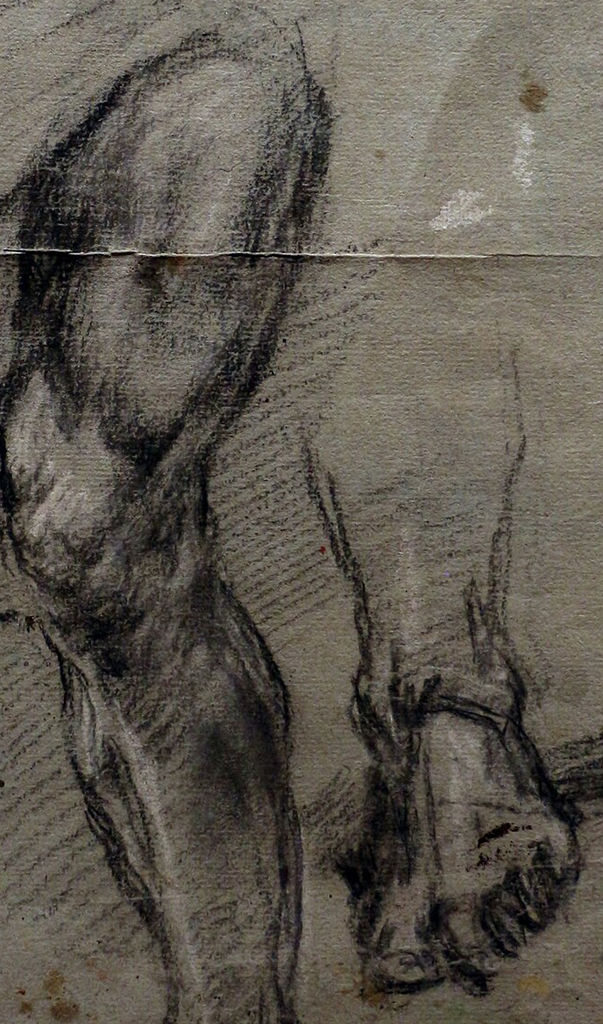
Photo: Francesco Bini (Sailko), CC BY-SA 4.0. Cropped and resized. Image source · Reuse licence
Contents
- The exact sheet and the Venetian picture
- Looking closely at the marks
- A long and difficult commission
- A rare connection between drawing and painting
- What is on the back?
- Which Martyrdom of Saint Lawrence?
- Why the whole sheet matters
The exact sheet and the Venetian picture
The Uffizi holds the drawing in the Gabinetto dei Disegni e delle Stampe as 12907 F. The National Gallery reproduces it as a study on blue paper measuring about 40.9 × 25.2 cm; its caption describes the dark drawing medium as black chalk or charcoal.[2] Such caution is appropriate. A photograph can show grey and black marks, pale accents and the paper’s colour, but it cannot by itself resolve a material identification. Different catalogues may name chalk, charcoal and white heightening more decisively; the National Gallery’s published uncertainty should remain visible rather than being flattened into a single unqualified recipe.
Puppi links the sheet to the figure standing on the right of the gridiron in the Martyrdom made for the Massolo family altar at Santa Maria dei Crociferi in Venice.[1] The painting now hangs in the Jesuit church of Santa Maria Assunta. The National Gallery gives the altarpiece as an oil canvas, about 493 × 277 cm, later transferred to another canvas.[2] The drawing is therefore not a small version of the whole composition. It concentrates on the supporting limbs of one participant in a much larger scene.
This distinction helps a reader locate the study in the finished image. Saint Lawrence lies upon the gridiron; the torturer or executioner stands at the lower right, working around it.[1][2] He is part of the human machinery of the martyrdom, not Lawrence himself. The drawing tests how his lower body bears that action. A caption that merely says “male legs” would lose this precise identification; a caption that calls the sheet a complete design for the altarpiece would claim too much.
Looking closely at the marks
The sheet gives more attention to the thighs and knees than to the feet. One leg seems flexed to carry weight, while the other reaches away to establish a wider stance. The knees, calves and changes of direction are built with broad, searching marks rather than enclosed, polished outlines. A light fold crosses the photographed paper. Above the legs, the upper body is only faintly mapped. The relative finish matters: the figure’s balance is being tested where the painter needed a solution, while other parts appear already assumed or left for later.[2][3]
The National Gallery proposes two possible explanations for that faint upper body. Titian may have carried its position across from a previous drawing; alternatively, he may already have established torso and arms in the painting and returned to the sheet to work out the legs’ musculature more carefully.[2] The source does not choose decisively between those sequences. Both would make this a study made in dialogue with a developing composition, but neither tells us a precise day or year.
The same study observes that the medium is handled broadly, supplying enough information to guide the painted legs without fixing every edge. The toes and feet are only roughly indicated; in the finished scene they recede into semi-darkness.[2] This is a functional choice in a preparatory drawing, not necessarily evidence that Titian abandoned the feet. The page asks where the legs will stand and how they turn. The painting must then make that stance work under its lighting and among neighbouring figures.
The finished torturer’s left thigh has suffered substantial losses and later reconstruction, according to the National Gallery’s notes.[5] That condition places a limit on one-to-one comparisons. A difference between drawing and the painting as seen today might reflect Titian’s revision, the needs of paint and light, or damage and later treatment. The sheet preserves a stage of thought that the present painting cannot always show with equal clarity.
A long and difficult commission
The drawing’s date is best understood through the commission, not a confident year assigned from its appearance. Puppi cites Lorenzo Massolo’s will of 18 November 1548, which already required the family altarpiece to be finished. He proposes that Titian may have received the work in 1547, before travelling to Augsburg, and that it was at least set out by the autumn of the following year.[1] The National Gallery similarly distinguishes a probable commission in 1547 from the still uncertain beginning of painting.[2]
The project extended across much of the 1550s. Lorenzo died in January 1557. A will drawn up by his widow, Elisabetta Querini, in March 1557 still urged completion if the altar and picture remained unfinished. Puppi judges that the work was probably ready not long afterwards, and cites an October 1564 letter referring to a Saint Lawrence picture Titian had made years earlier.[1] This creates a documentary frame for the altarpiece, but not a firm date for this particular sheet. It may have been made at more than one plausible point during the work.
Puppi also notes a nuance in patronage. The altar belonged to the Massolo family and Lorenzo’s name matched the saint’s, yet the role of Elisabetta Querini may have been especially important in bringing the commission to Titian and urging its completion.[1] The sheet does not settle who first approached the painter. It does, however, give concrete evidence of attention lavished on a figure far from the central martyr: even a torturer’s legs had to be solved for the scene to convince.
A rare connection between drawing and painting
Few surviving Titian sheets from the second half of his career can be linked confidently to a named painting. The National Gallery’s technical bulletin presents 12907 F as a rare exception.[2] That rarity should not be turned into the myth that Titian did not draw. It is a statement about survival and identification. A preparatory sheet might be discarded, separated from its commission or never recorded; others may remain unattributed. This one remains readable because its leg studies connect to a particular figure.
The same technical study distinguishes a drawing on paper from underdrawing inside a painted work. It reports brush-drawn planning lines beneath Titian’s later paintings and explains that infrared examination does not always recover every initial mark, especially where paint layers are thick or pigments complicate imaging.[2] The Uffizi page is a separate object that could be moved, handled and reused. Underdrawing is a phase embedded in the canvas. Both matter to reconstructing practice, but neither is a substitute for the other.
The bulletin’s examples of internal drawing include changes in figure placement and drapery in other Titian paintings.[2] In that light, 12907 F is valuable because it shows one of the artist’s decisions before or during execution in a form we can inspect directly. The light upper body and worked legs suggest selective attention: drawing need not mean a fully settled cartoon transferred wholesale to canvas. It can be a way to return to a stubborn part of an evolving figure.
What is on the back?
The sheet’s reverse complicates any account that treats it as a single-purpose object. The National Gallery describes another study of a leg on the verso, associated with the figure of Sisyphus in the Museo Nacional del Prado, Madrid. It also notes further sketches on that side, not all by Titian.[2] A statement that the “verso is by Titian” would therefore erase the source’s attribution distinctions. The securely discussed recto and the mixed marks on the reverse need separate labels.
The Prado Sisyphus connection does not mean that the Venetian executioner and Sisyphus were conceived for one painting. Paper could carry trials for different subjects, and the sheet’s two faces could enter a later history of reuse. The evidence checked here does not establish the order in which every mark was made. It does show why the work is more informative than a cropped image of two legs: the whole sheet gives space for faint upper-body work, and its reverse opens a second, qualified connection to Titian’s paintings.[2]
That caution matters for chronology as well. The known documentary span of the Martyrdom provides a frame for the recto, while the verso may involve a separate project and additional hands. It would be unsound to derive a single exact date for the complete sheet from either side alone. Inventory 12907 F identifies the physical paper; recto and verso identify different sets of marks.[1][2]
Which Martyrdom of Saint Lawrence?
Titian made a later version of the Martyrdom for Philip II and the Escorial. The Uffizi leg sheet is linked by Puppi and the National Gallery to the Venetian Massolo altarpiece, now at the Gesuiti, not automatically to every version of the subject.[1][2] Shared iconography is a reason to compare the paintings; it is not permission to relocate the drawing’s exact figure without evidence.
There are also similarly titled studies by other Venetian painters. A Rotterdam sheet for a different Martyrdom of Saint Lawrence concerns Jacopo Tintoretto’s later altarpiece, not Titian’s Uffizi 12907 F.[4] A researcher using image search could easily merge them on title alone. Artist, inventory, location and related painting are the identifiers that prevent that mistake.
Why the whole sheet matters
The inherited close crop makes the anatomy prominent but reduces the paper to a frame around it. A fuller photograph shows the top of the sheet, pale surrounding marks, fold and collection stamp.[3] These details help a viewer see the study as a working object rather than an extracted illustration. They also show the modest scale of the marks relative to the very large painted altarpiece. One figure’s legs, rehearsed on a single page, would eventually support a narrative measured in metres.[2][3]
The drawings guide places this sheet among the rare links between Titian’s graphic and painted work. The sound conclusion is both precise and restrained: Uffizi 12907 F records studies for the torturer at the lower right of the Venetian Martyrdom of Saint Lawrence; it retains faint evidence of a wider figure; its reverse includes a separate study related to Sisyphus and marks of mixed attribution. The exact instant when Titian used the page, and the full sequence connecting paper to canvas, remain open.[1][2]
Researched Titian and related works
Frequently Asked Questions
They belong to the executioner or torturer at the lower right of the gridiron in the Venetian Martyrdom of Saint Lawrence, according to Puppi and the National Gallery.[1][2]
No. The sheet is linked to the Massolo altarpiece made for Santa Maria dei Crociferi in Venice, now at the Gesuiti. Titian’s Escorial version is a separate painting.[1][2]
The National Gallery calls the dark medium black chalk or charcoal on blue paper. The photograph alone does not settle a more exact material list.[2][3]
The recto has faint marks for torso and arms above them. Its verso also carries another leg study associated with Prado Sisyphus, together with sketches not all attributed to Titian.[2]
Discussion
What do you notice when you look closely at Titian’s Study of Legs for the Martyrdom of Saint Lawrence?
Share a specific observation or a source that adds context.
Reader Insights
Which detail changes your reading?
How does its original setting affect what we see?
Which part of the evidence remains uncertain?
Join the Conversation
Add your observation below.
References
- Lionello Puppi, “Il Martirio di San Lorenzo / The Martyrdom of Saint Lawrence,” bilingual scholarly essay and commission documents, 2012. View source.
- Jill Dunkerton and Marika Spring et al., “Titian after 1540: Technique and Style in his Later Works,” National Gallery Technical Bulletin 36 (2015), pp. 12–13 and notes. View source.
- Francesco Bini (Sailko), independent photograph of Uffizi sheet 12907 F, CC BY-SA 4.0, Wikimedia Commons. View source.
- Museum Boijmans Van Beuningen, “Study of a Male Nude Holding a Pole,” Jacopo Tintoretto, a distinct drawing for another Martyrdom of Saint Lawrence. View source.
- National Gallery, London, notes and bibliography to Technical Bulletin 36, note 22 on the painted executioner’s damaged and reconstructed thigh. View source.